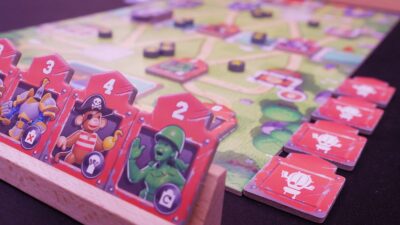
Remember Fantastic Factories? I reviewed it earlier this year and liked it for its streamlined, dice-driven, tableau-building gameplay. But I also wanted more oomph and replayability. And that's exactly what Creature Caravan promised: a deeper, wider, more engaging design that seemingly took the core of Fantastic Factories to the next level.
On paper, Creature Caravan has everything I asked for; on the table, it's more than I bargained for, and the overall experience is less than the sum of its parts. It has a kitchen sink feel—overpacked and spilling over the edges into an intriguing but messy venture. It doesn't help that its engine-building is fraught with a lack of real agency.
This review is based on my own personal copy of Creature Caravan, which I bought new from Gamers Guild AZ. Not a free review copy.
Table of Contents
View more
What It Is
Creature Caravan is a dice-engine tableau builder, where you build up a caravan of traveler cards in your tableau and activate their abilities using the dice you roll every round. The goal is to get your caravan safely to the haven of Eastrey, all while fighting off and surviving against the Ember Zombies that roam the lands. Doing so won't be easy due to limited resources and time.
Everything revolves around your own personal tableau of cards (which starts at 0 cards and maxes out at 12) and your five dice. Turns are played simultaneously, and during a turn you'll roll all five dice and place those dice on various spots to trigger actions. You have your own personal player board with some basic dice actions, but most traveler cards also have a die action, so adding cards to your tableau expands what you can do.
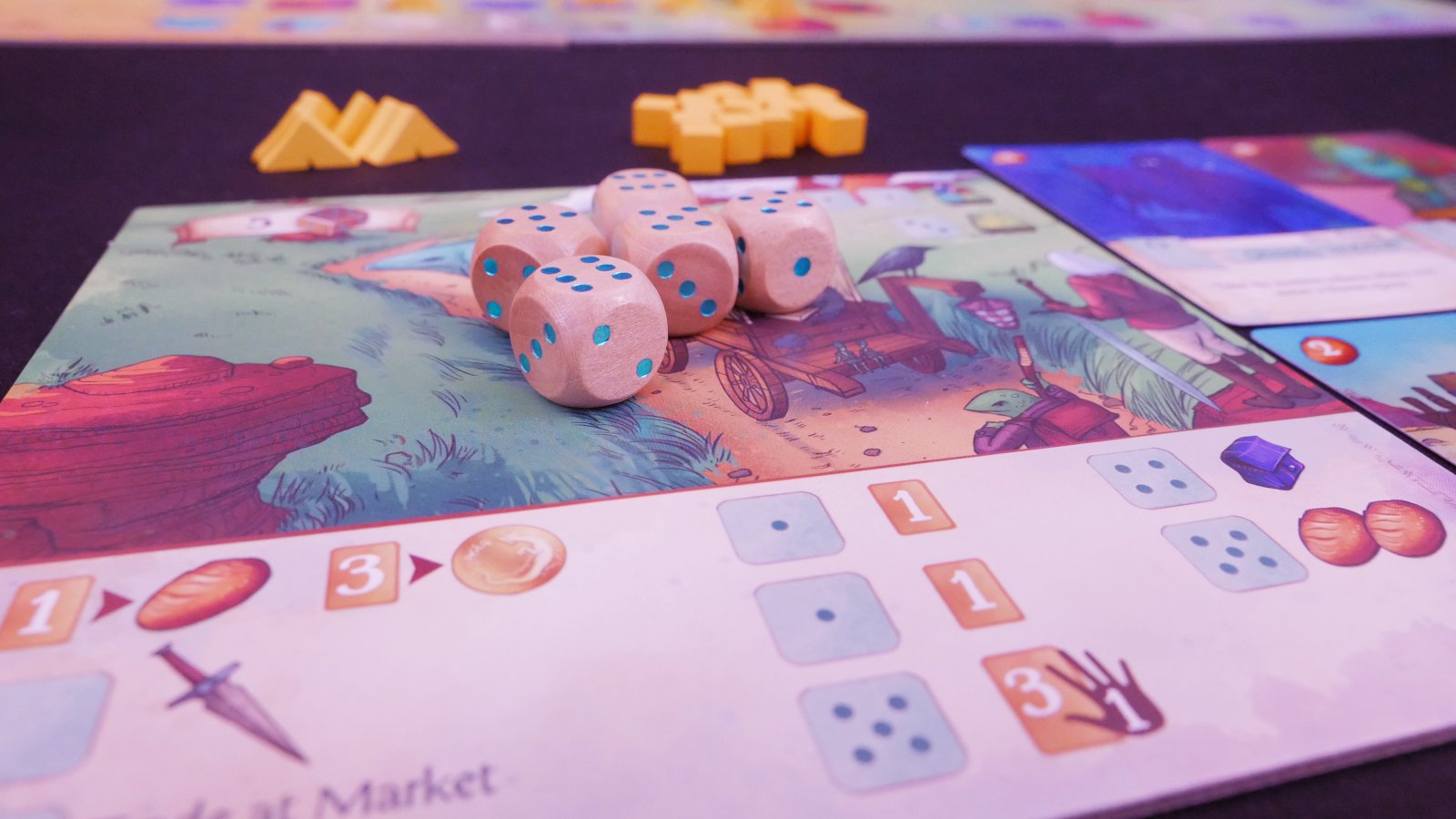
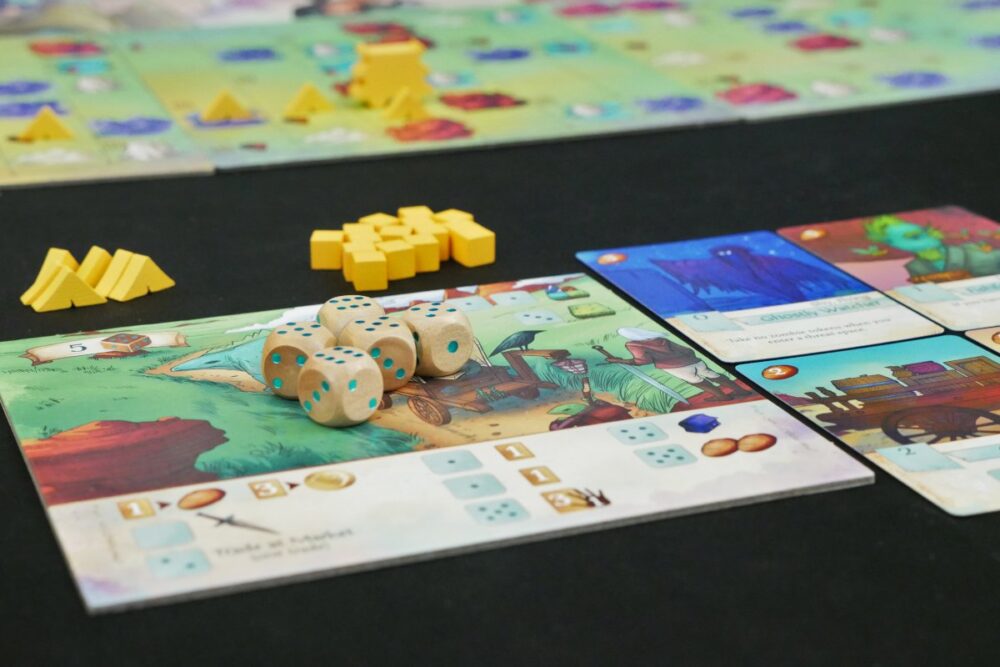
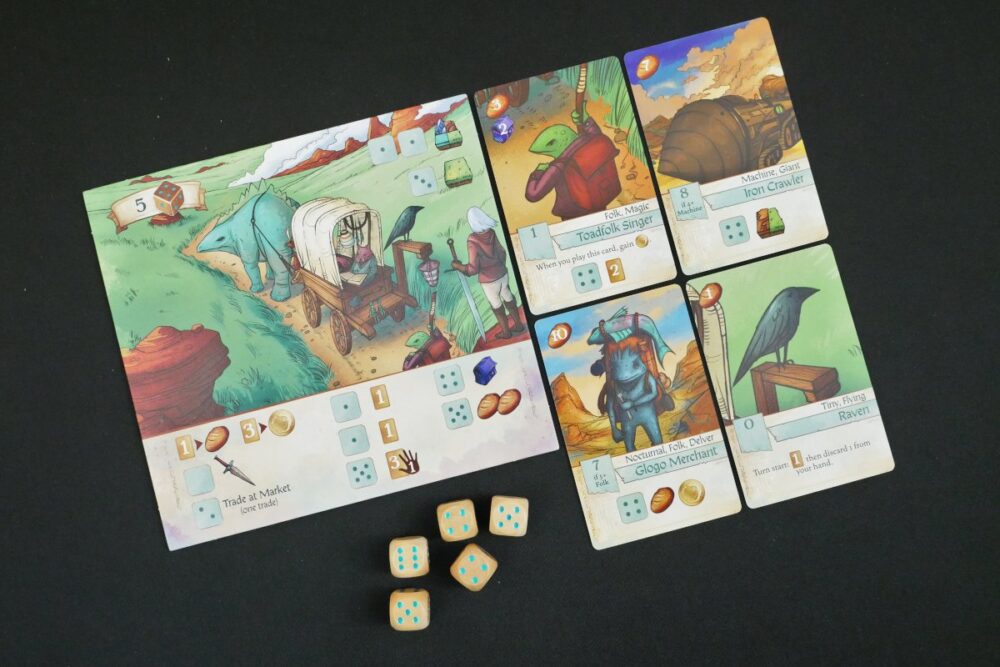
Here's what each player's own tableau looks like: player board, cards, dice.
But adding travelers to your caravan isn't easy. You'll need to pay the requisite resources to play a traveler from your hand, and resources include Food, Coins, and Bags (representing supplies and valuables) acquired via dice actions and traded via the markets. So the gameplay loop looks like this: roll dice → activate actions → gain resources → grow caravan while trekking across the map and fighting/avoiding Ember Zombies.
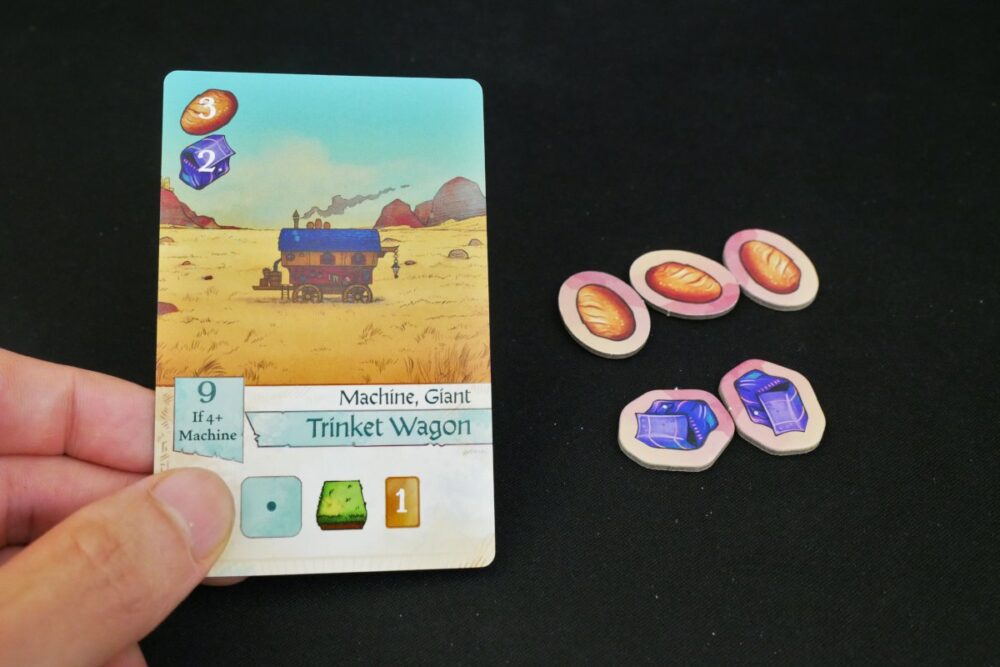
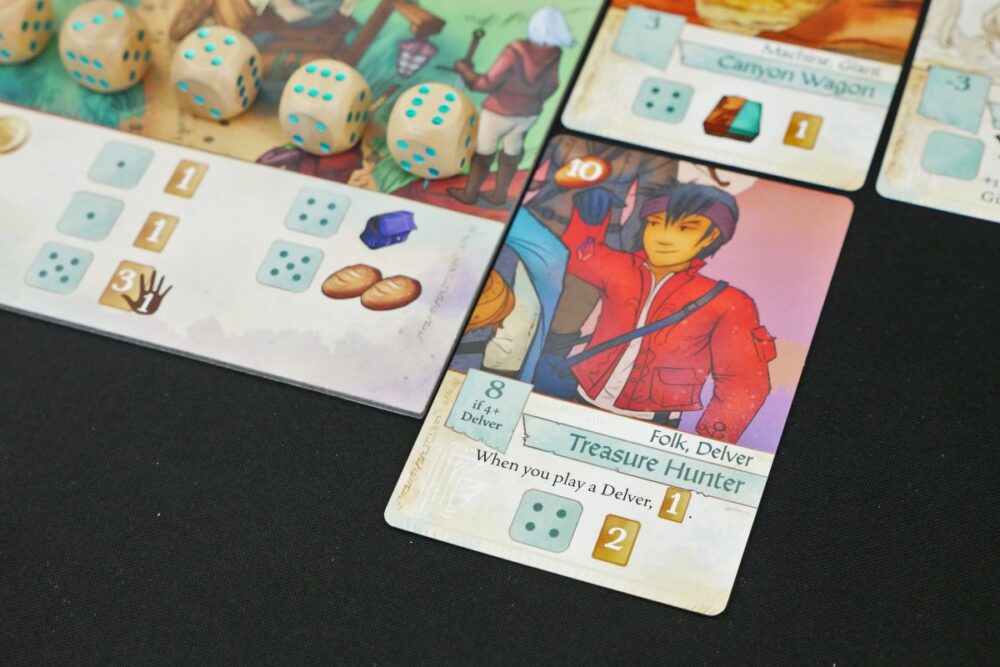
To play a card from hand to tableau, you'll need to pay its resource cost.
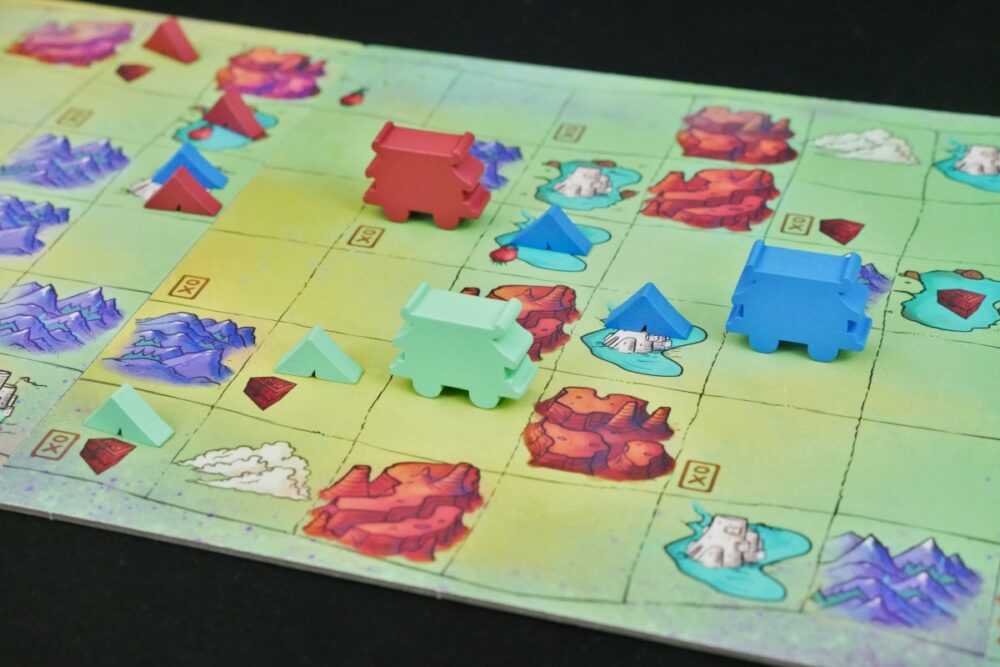
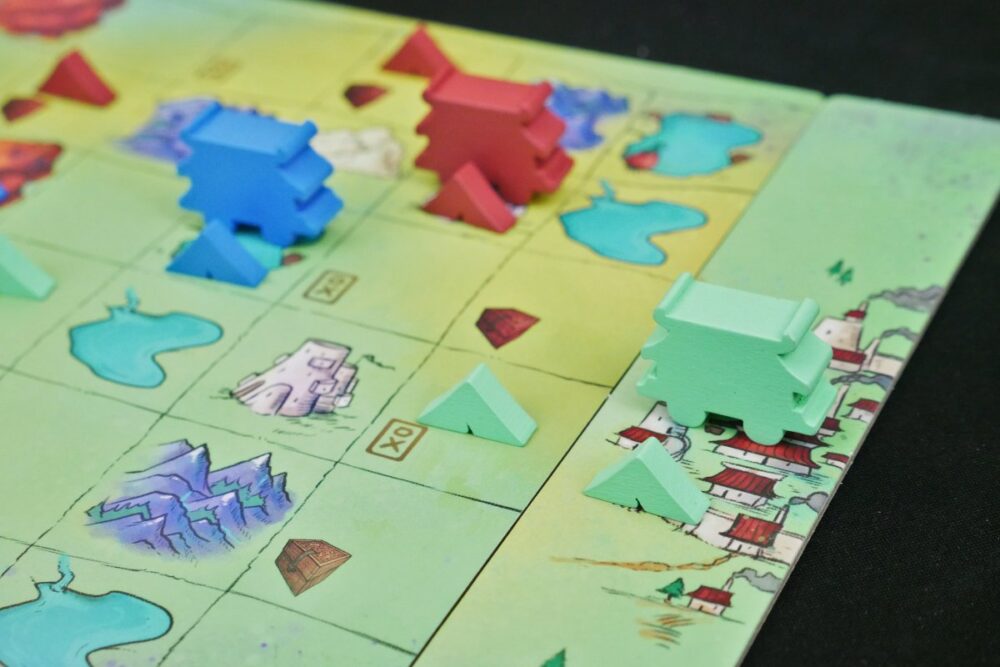
At the end of every turn, you'll "camp" by placing a tent token on whichever map space you're on. If you're camped on a special location, you'll trigger a special action (like drawing more cards or finding some fruit). Apart from that, these camps track your progress towards Eastrey, and they also act as a timer—once everyone places their final camp, the game is over.
Each player treks across the map with their Caravan token. Every day, you put up a Tent marker on whichever spot you're on, leaving a trail as you make your way across.
Whoever has the most points—tallied up from their travelers, how far they traveled, whether they reached Eastrey, how much market trading they did, how many Ember Zombies they killed, and how much treasure they collected—wins Creature Caravan.
How It Feels to Play
The Decision Space Is Vast and Free
Dice worker placement games can fall apart when they're too restrictive. You roll your dice but can't place them anywhere? Or you can technically place them, but the actions are effectively worthless? Too much of that robs you of your agency, leaving you up to the mercy of the dice. But Creature Caravan gets around that in two major ways.
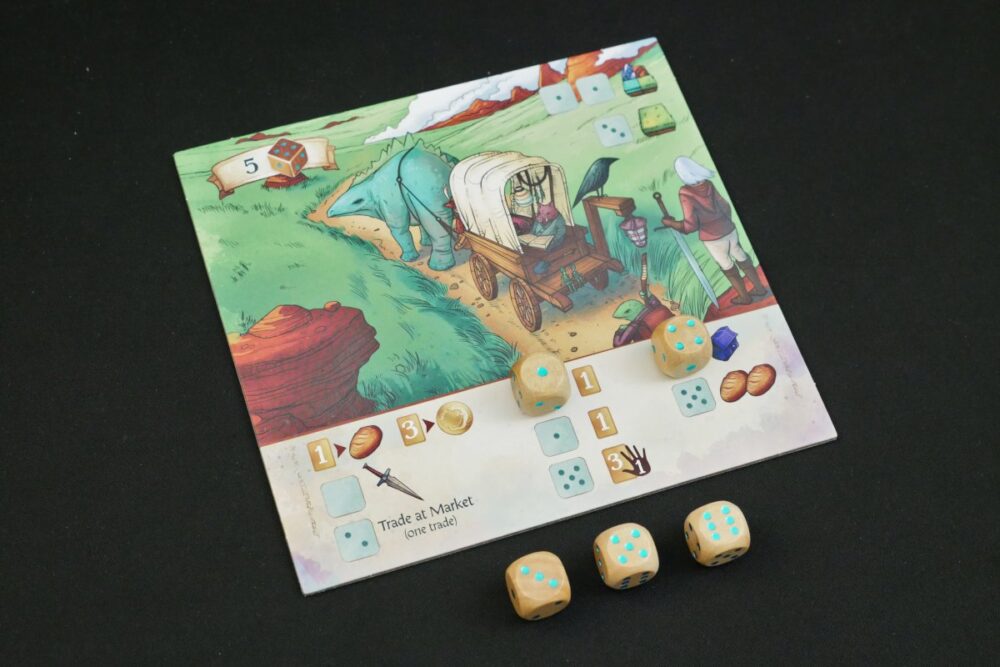
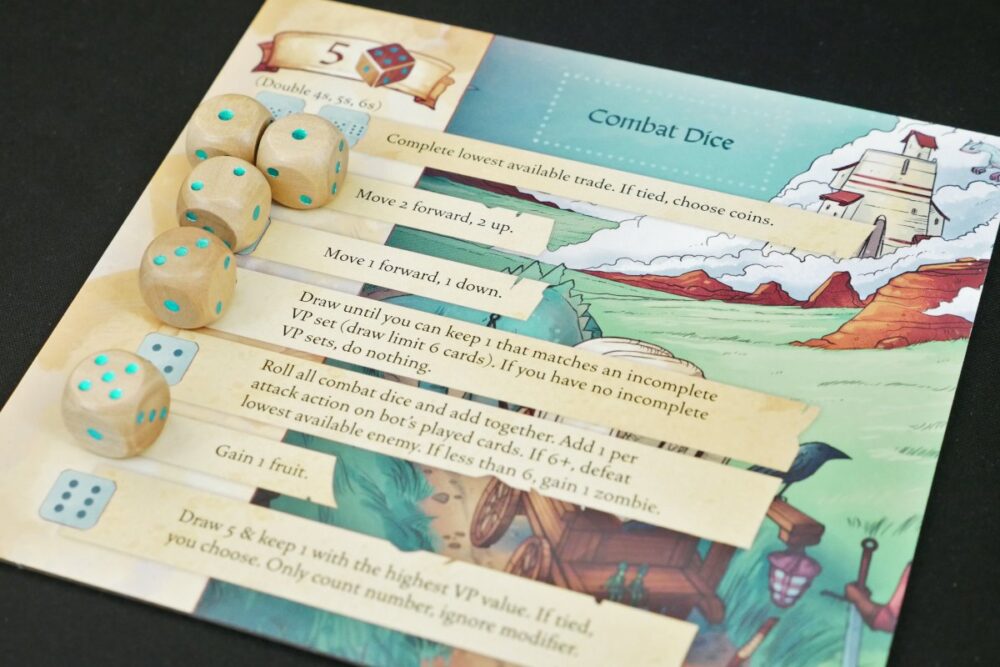
The first is that your personal player board has 9 basic dice actions, which already starts you off with plenty of options. Even if it takes several turns to build up your caravan engine, you always have valuable actions you can take—and that means you never feel like a turn was wasted. Those basic actions are varied, too, so you're always able to adapt your dice rolls and figure out a good allocation that keeps you chugging along. That basic action variety starts you off with a wide decision space, and you never feel cornered.
The player board doubles as a helpful reference for the basic actions you can do.
The second is that Creature Caravan has a lenient dice placement rule: if an action requires a certain die value, you can place any die that's equal to or greater than that value to take that action. For example, the basic "Earn 1 Bag" action requires a 4 die, but you could also trigger it with a 5 or 6 die. This opens up the game and creates a lot of freedom—you won't be locked out of a 3-die action just because you rolled a bunch of 5s and 6s. This freedom widens the decision space further, with most actions almost always available to take.
That lenience goes even further with the Fruits, which you can acquire by camping on specific spots along the way to Eastrey. When you get a Fruit, you can place it on any traveler card in your caravan to turn the die requirement of that traveler's action to 1; in other words, any die can be used to trigger a traveler's action if they have a Fruit. Suddenly, even powerful abilities are made cheap—like the Dino Wagon, which normally requires a 6-die to move across any terrain, but with a Fruit can move every turn on demand.
Luck Gets In the Way of Your Engine
Creature Caravan may be a dice worker placement game, but more than that it's a tableau builder. Everything revolves around those 134 unique traveler cards that power your engine and dictate what you can do. The efficacy or impotence of your engine will come down to which cards you're able to draw, which of those you're able to add to your caravan, and which of those you're able to keep triggering with your limited dice actions every turn. But it's that first crucial step—drawing the cards you need—that really hampers you.
Suppose you hire the Treasure Hunter to your caravan, who scores 8 points if you have 4+ travelers with the "Delver" keyword. Even if you get him early (not likely since he costs 10 Food to hire), you still have at most 11 turns to find and hire those 4+ Delvers, let alone other travelers that mesh well with whatever engine you're building. Similarly, if you stumble across the Allied Travelers card, you can "ignore negative points on cards." That instantly bumps up the value of cards like Rat Swarm, which is -5 points unless you have 4+ Nocturnal. If you happen to draw both of those cards, you get to benefit from that pairing... but only if you have enough turns and resources to make it happen.
My point is, the highly random nature of the card deck means you can't always build the engine you want. You have no idea what you'll draw, you have to make constant pivots, and by the end you're left with a disjointed group that's nothing like what you planned. Every card is multi-use, so you have multiple reasons to want a card, but that also means multiple reasons to not want it. Your engine is hobbled together with parts you're mostly ambivalent about, and despite how generous the game is with its deck churn, the parts you actually want may never show up—or if they do, they show up too late.
134 Unique Cards Leads to Mental Overload
Creature Caravan is a mental drain. It's not that the game itself is overly complex in its rules. In fact, it's built on a strong mesh of mechanisms that are mostly simple on their own. But with it being a tableau builder that leans heavily on card text and actions, and with the entire engine centered on your card choices and how well you use them, there's a lot to think about.
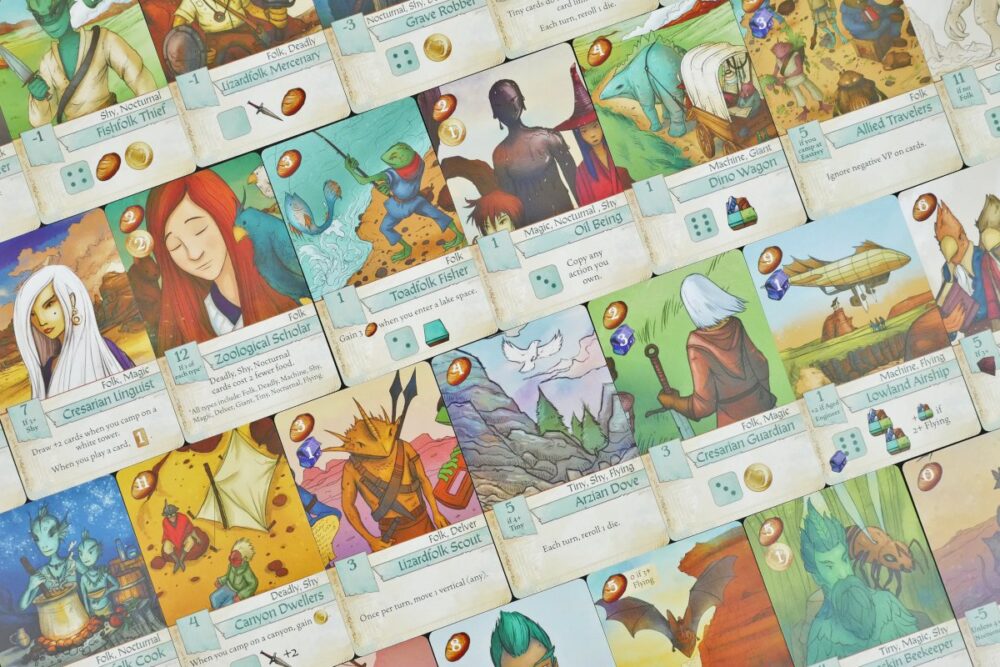
All 134 traveler cards in Creature Caravan are unique, and nearly every element of a card can change: costs, keywords, die actions, point values. Some of the cards even have conditional scoring rules (like Crystal Furnace Robot's "1 + 4 if any Toadfolk"), with each one hanging another extra rule to the back of your mind. That's a lot of reading, processing, and remembering to do as your caravan grows from 0 to 12 traveler cards.
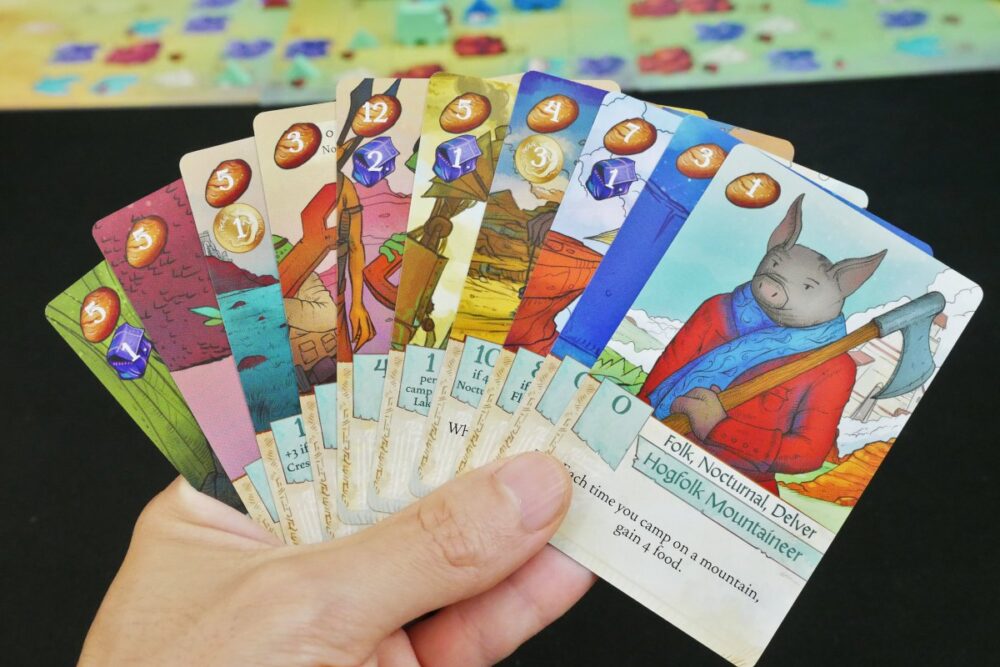
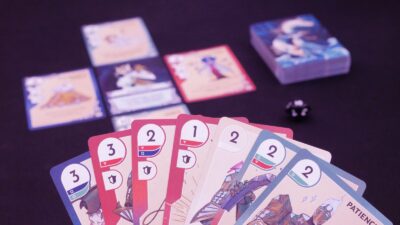
You start with 8 cards in hand, and that's already a lot to process. Over the course of the game, you'll likely draw, play, and discard dozens more.
As your tableau grows, the combinatorial nature of possibilities can start to weigh on you as you consider all the different rules and abilities. Your hand of cards blows up with more travelers you can ever hope to play, and you have to constantly evaluate them as either trash or potential keeps, and you're constantly juggling your few resources to see which of the potentials should actually be played next.
It's a lot to hold in your head, and I always find myself zoning out around the 45-minute mark because my brain gets tired. The challenge isn't the same as solving a complex puzzle or optimizing limited resources; it's more like trying to manage a rolodex of people and keeping all their details in mind, all while the rolodex itself keeps growing and morphing.
Market/Zombie Boards Add Complexity, Not Tension
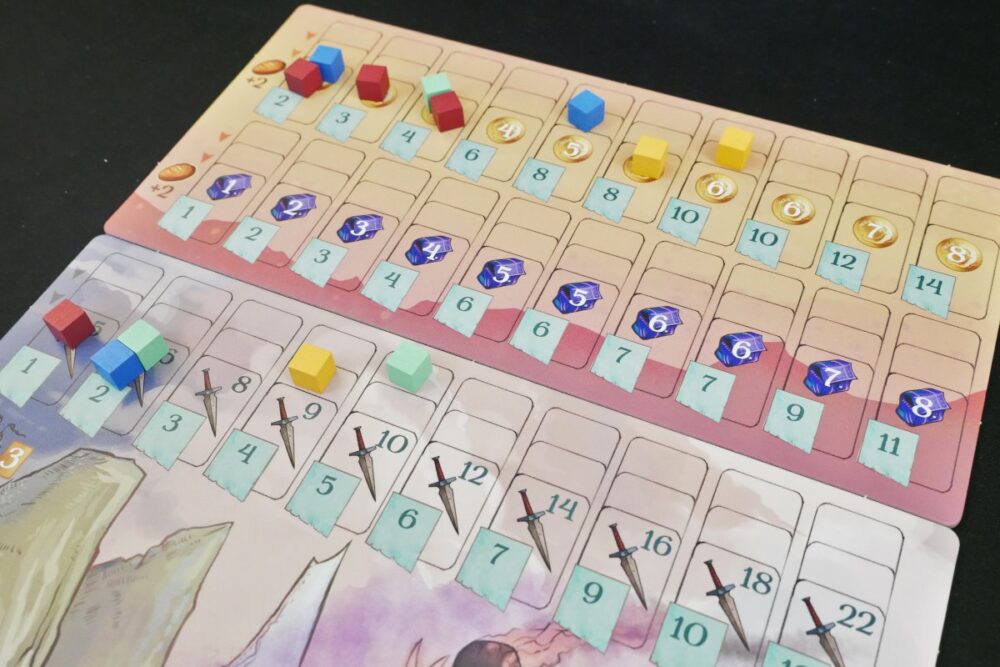
When you first encounter Creature Caravan, one thing immediately stands out: the unusual design of the market and Ember Zombie boards. On the former, you can initiate a trade (Coins for Food or Bags for Food); on the latter, you can attack Ember Zombies that are chasing you; they all have 10 different columns representing different trade amounts and Ember Zombies to attack. Each column offers points, and each column is first-come-first-served.
Mechanically, these boards act like shared public goals with a twist: the first player to activate a column starts a 1-round timer for that column. Everyone else has 1 round to also complete that column, else it gets locked out and no longer available for the rest of the game. But thematically, these boards make zero sense. I'm struggling to explain them even as I write this because the disconnect between theme and mechanism is so great.
It's one thing to trade 5 Coins for 7 Food and earn 8 points doing so... but why would that specific trade remain open to others for just 1 more round, while another trade like 3 Coins for 5 Food and 4 points still sits open? What kind of merchant says, "Now that John has traded me 7 Coins for 9 Food, I'll make the same trade with anyone else... but only for the next hour! When that hour is up, I'm closing my doors permanently."
It's one of the most unintuitive mechanisms I've seen in a board game. And I get what it's going for: a kind of race-like indirect competition that's meant to put pressure on you as opportunities disappear. But I don't feel any tension from the market or Ember Zombie boards, mainly because 1 round isn't long enough to prep myself and jump on those disappearing opportunities. When John makes that 7-Coins-for-9-Food trade and I'm sitting on a single Coin, I know there's no way I'm getting another 6 Coins in a round. I just shrug and move on with one of the many other scoring paths in the game.
It's Point Salad (Not in a Good Way)
Creature Caravan is a tableau-building game, a dice worker placement game, an engine-building game... but most of all, it's a point salad game. That means points are earned in lots of different, unrelated ways, and nearly every action grants some amount of points. Here, you'll get points: by playing travelers to your caravan, by composing your caravan in a way that meets the keyword conditionals of travelers, by trekking across the land to Eastrey, by making market trades, and by defeating zombies.
But point salad is tricky to pull off. In order for it to work, all of those point-scoring avenues need to feed into a single, overarching goal. In the case of The Castles of Burgundy, that's building out a well-designed duchy; in the literal Point Salad, it's collecting the best assortment of vegetables. But Creature Caravan doesn't know what it wants to be. Every one of its elements pulls you in a different direction, and it's unclear which direction is the main one.
It's all about reaching Eastrey! Or is it?
Thematically, you're on a journey to Eastrey. Mechanically, everything in the game seems to distract you from that main goal. You can move a quarter of the way to Eastrey, lag behind everyone else, and still win because you spent all your time trading resources and deck-churning for travelers. Meanwhile, I might make it all the way to Eastrey and lose with half your points because I didn't do enough secondary stuff along the way.
Getting to Eastrey should be a moment of triumph, the core goal of the game, but it's anticlimactic and not even worth many points. It exposes the game's core weakness, which is that it offers too many pathways with very little direction and cohesion. It's aimless point salad, a hodgepodge of mechanisms and goals that spread you thin and dilute the experience instead of building into something central and greater.
Player Count and Scaling
The best thing about Creature Caravan is its simultaneous play. With so much going on in your hand, in your tableau, and in the dice you roll, it's nice to sit quietly with yourself and figure out all your moves at your own pace without the usual turn pressure. As such, Creature Caravan scales well mechanically and maintains a stable 90-minute playtime at all counts.
But simultaneous play is also Creature Caravan's greatest flaw due to its total lack of player interaction. You'll silently spend 5–10 minutes working out your turn, look up, ask "Is everyone done?", then do it all again. Virtually zero table talk and no reason to look at what others are doing. At most, 90 minutes pass and you lean over to see what everyone else managed to accomplish as you compare scores. Nothing they did impacted you at all.
Creature Caravan is as multiplayer solitaire as they come, and here it's to the game's detriment. For a game as meaty and lengthy as this one, I'm not content to sit in silence and ignore everyone else at the table. I want their presence to meaningfully impact my own experience. Multiplayer solitaire is fine for a 15–30 minute game, especially one that generates laughter or encourages social interaction if not mechanical interaction.
If I'm sinking 90 minutes into a game, I don't want to squander that time being in my own head. So despite the game scaling well enough, I'd only play this solo—or with a partner who's content to sit quietly in your company.
Solo Mode
Given how multiplayer solitaire the game is, I don't think Creature Caravan really needs a solo mode. But it has one, and it tries to replicate the only bit of player interaction there is: activity on the market and Ember Zombie boards. And while that bit of interaction is welcome in theory, the automa is clunky and convoluted enough that I'd rather play without it.
Using the solo mode board, you roll five dice and assign them to various actions ranked in priority order. Those actions include moving the automa's marker across the land, claiming trades and attacking Ember Zombies, collecting cards for its own tableau, and more. By the end of the game, the automa scores according to everything it managed to "accomplish."
The solo mode board with actions determined by random dice roll.
It's a clever system that tries to emulate the presence of another player, but it's fiddly with all the micromanagement of pieces, and it's mentally taxing as you have to process the automa's tableau (which operates by a different set of rules than a true player's tableau). It's also extremely luck-driven, as it's entirely determined by what dice are rolled and which cards are drawn. There's no rhyme or reason as to whether it beats you or not—you have no way to block or influence its "decisions," so it feels like a crapshoot.
It's not an optimization puzzle that you can solve or overcome, as is the case for most solo modes. It's a mini-game that occurs on the side, apart from your own gameplay, and it's just there to randomly generate a target score to beat. I'd much prefer a beat-this-score chart. The end result is the same and at least you don't have a bot hogging space on the table.
Replayability
If you can get past its flaws, Creature Caravan offers a lot of wilderness to explore with its massive deck of unique traveler cards. No two games will ever be alike because you'll only see like a quarter of the deck per game, so you may not even draw the same cards from game to game, let alone hire the same ones to your caravan—and definitely not the same 12 cards. Yes, luck gets in the way of cobbling together your engine, but you've never built that specific engine before and will never build that one again.
And while I previously argued that Creature Caravan's engine building feels futile and aimless, I must concede that running whatever engine I've built does keep me engaged. Because no two engines are the same, no two decision-making processes are the same. Every engine represents a different strategy, and even if your engine sucks, figuring out how to get the best results out of it on every turn is challenging. It goes back to the decision space and freedom offered by the dice actions—you can almost always make the dice work.
If you like what Creature Caravan offers, its decision space is freshly shaped with every game, and it'll provide enough variety to keep coming back indefinitely. But if you're like me and need more than mere variety—if you need real control over your engine and real cohesion in mechanisms—you won't find a game worth returning to. For me, Creature Caravan is engaging enough in the moment, but wears itself out fast and doesn't entice me back.
Components and Setup
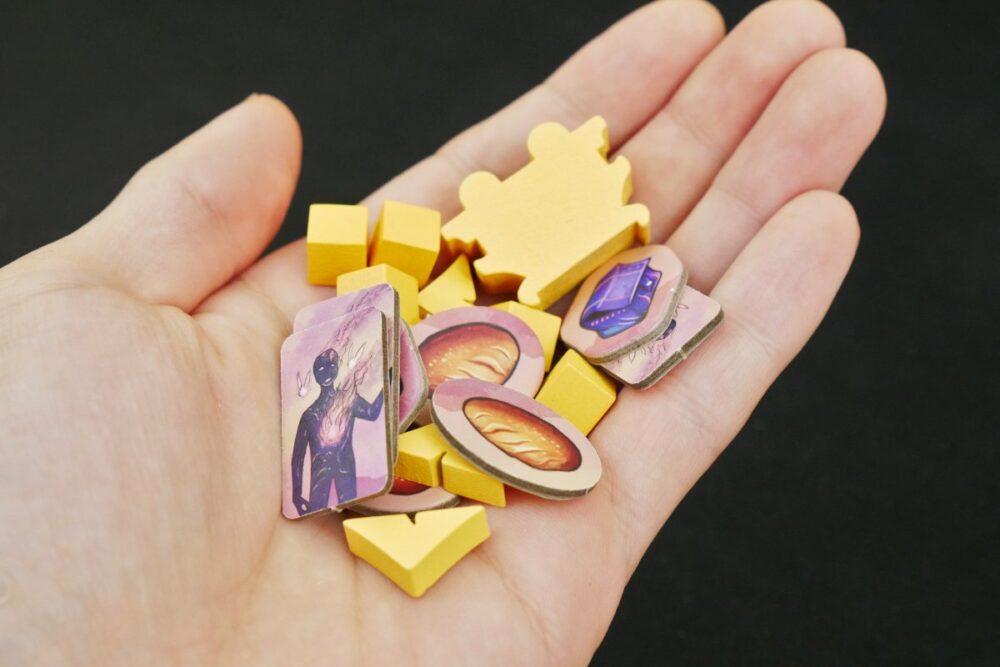
The quality of Creature Caravan's production is fantastic. The boards are thick cardboard, the dice and player tokens are wooden, and the various resources are cardboard chits, but it's the artwork that stands out. Though cartoony, it's vibrant and inoffensive, certainly not kiddish or off-putting. Every card is individually illustrated, the graphic design is intuitive, and the iconography is clear and informative. Mechanically, it's a breeze.
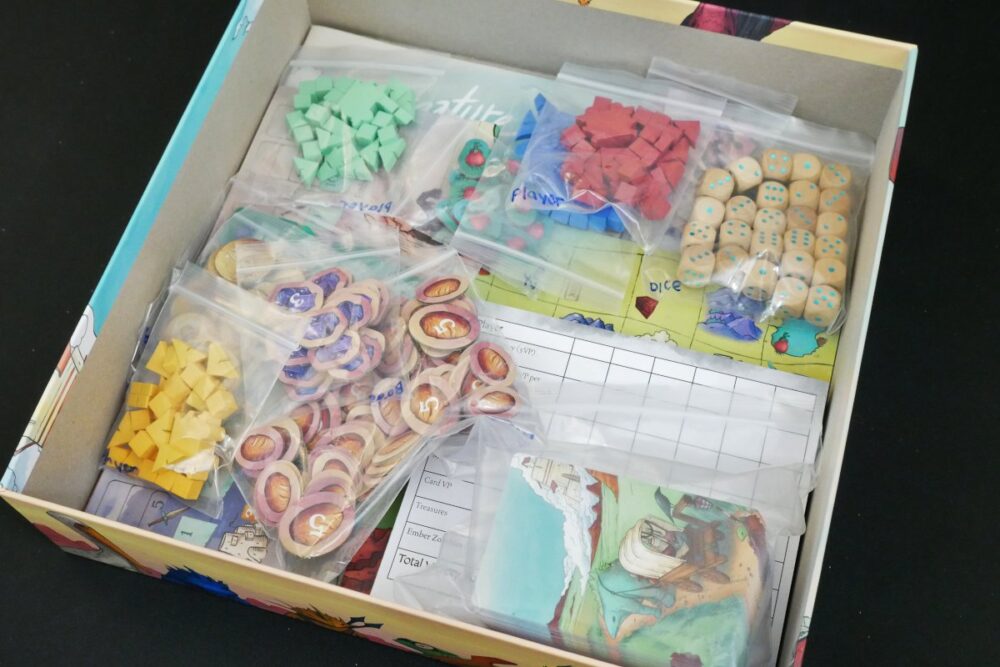
But with every year I spend in this hobby, the more averse I become to games with lots of tokens and components. A fast setup is important to me—it makes a game a lot easier to pull off the shelf—and Creature Caravan is slow at 10 minutes, and that's with everything bagged and organized well. You'll set up all the boards and the various supply piles, shuffle the traveler deck, distribute player tokens/cubes/tents/dice to everyone, and deal out starting hands. At 10 minutes, it's just on the edge of acceptable for a 90-minute game.
And it's also a table hog, which is a double whammy for me. On a standard 3-by-3-foot surface like I have, the boards and supply piles take up more than half the space. Throw in each player's tableau—which includes a player board, token piles, up to 12 traveler cards, and a discard pile—and the space requirements quickly blow up. A 3-by-3-foot table is barely enough to fit solo (yourself + automa) and 2p (yourself + partner). It won't fit 3p or 4p at all.
The Bottom Line
Creature Caravan has some great ideas, particularly in its dice action design, but it's overwrought and aimless. Its deck of 134 unique cards is a double-edged sword, offering endless variability but also lots of mental load and lack of agency in the card draw.
If you just like churning through dice placements and don't care if luck derails your engine, there's a game here; if you want a streamlined game with a cohesive design, this one will disappoint. I suspect I won't keep Creature Caravan in my collection because I feel like I spend more energy managing the game than playing it. The juice isn't worth the squeeze.