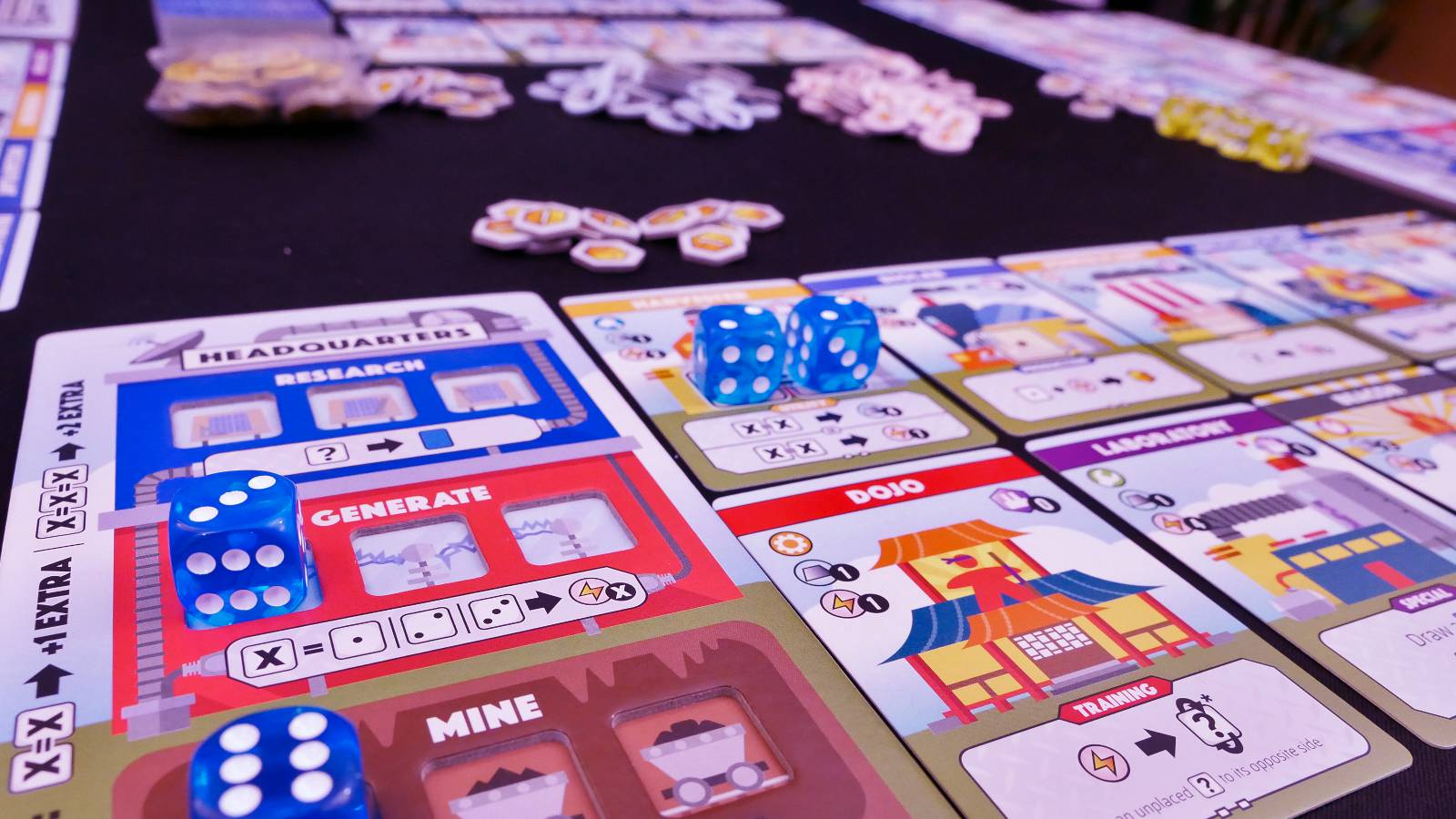
It's round five and you're sitting on a stockpile of Energy and Metal. You hold your breath, you roll your dice. How those numbers land will determine whether you get to turn those resources into Goods or you collect even more Energy and Metal beyond what you can physically hold—and when that happens, you know you can't blame anyone but yourself.
Fantastic Factories is dice-driven, but it's not about the dice. It's about the engine you build and how quickly it can churn out Goods while handling whatever dice you may end up rolling.
This review is based on my own personal copy of Fantastic Factories, which I bought new from Barnes & Noble. Not a free review copy.
Table of Contents
View more
Overview
At its core, Fantastic Factories is a resource-conversion engine-building race game. You'll be managing a tableau of cards ("Buildings") with various resource conversion actions, with some of those actions requiring specific dice values ("Workers"). Whoever drafts the most synergistic tableau that's able to crank out points ("Goods") faster than everyone else, while being most clever about their dice placements, will win.
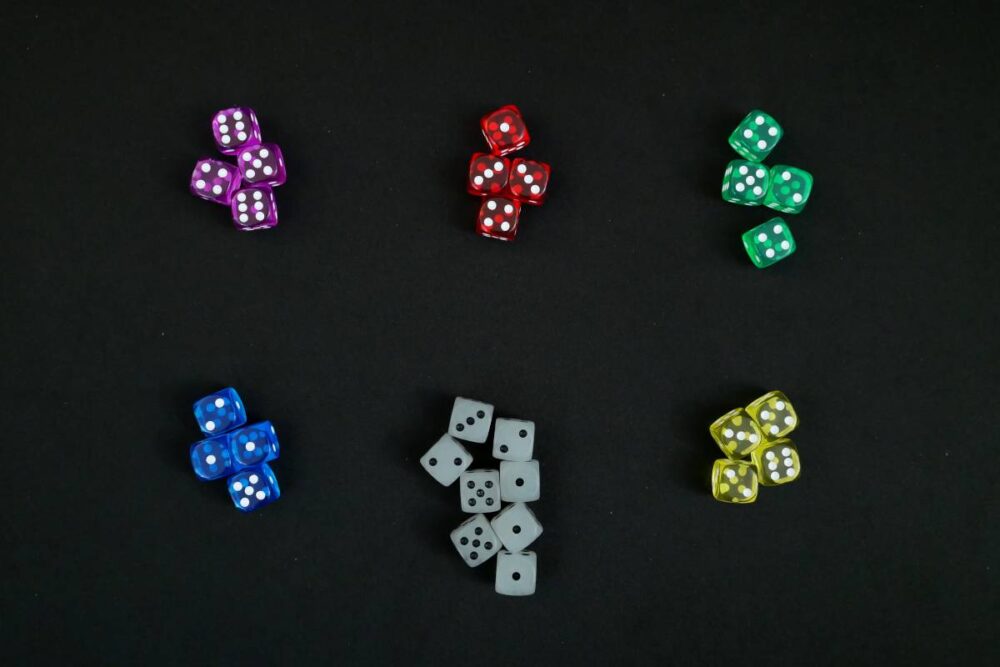
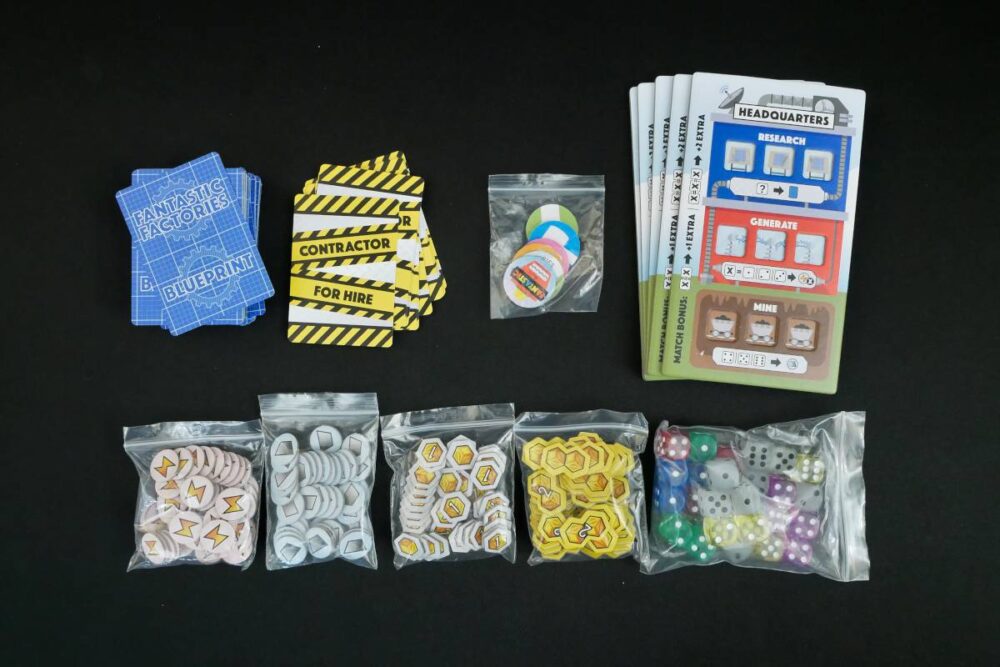
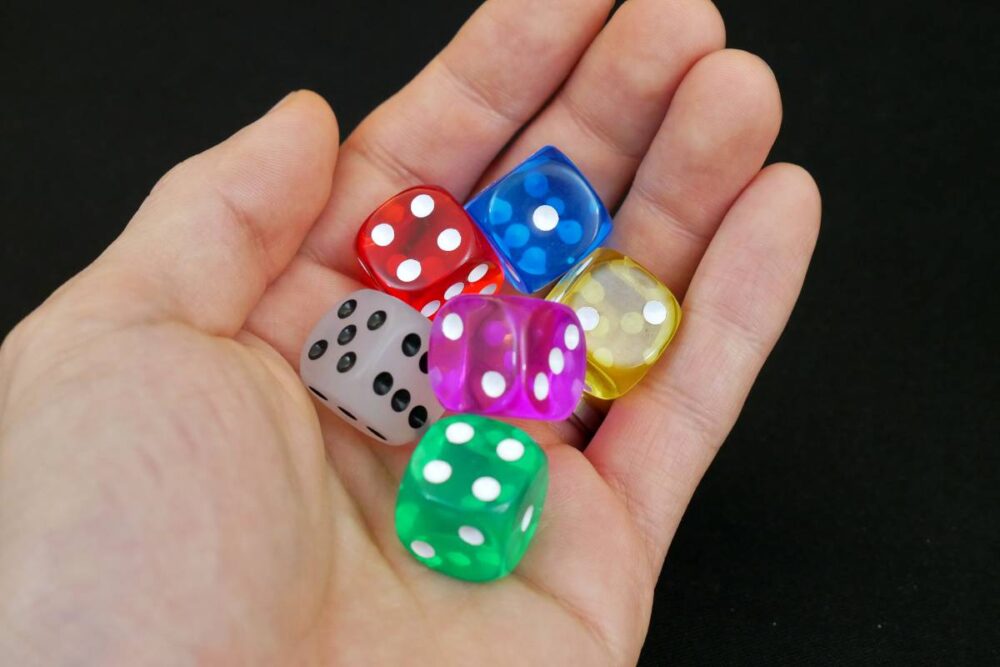
The five sets of player dice, plus neutral gray dice.
Fantastic Factories revolves around dice worker placement. Every player starts with a set of 4 dice in their own color. These dice represent the Workers in your factories, and you'll need dice of varying values to accomplish the various actions in your factories.
You'll roll all your dice at the start of every round (plus any extra dice you may earn through certain bonuses), which gives you the particular values you have to work with for the round. Most actions will require one or more dice of certain values if you want to perform them.
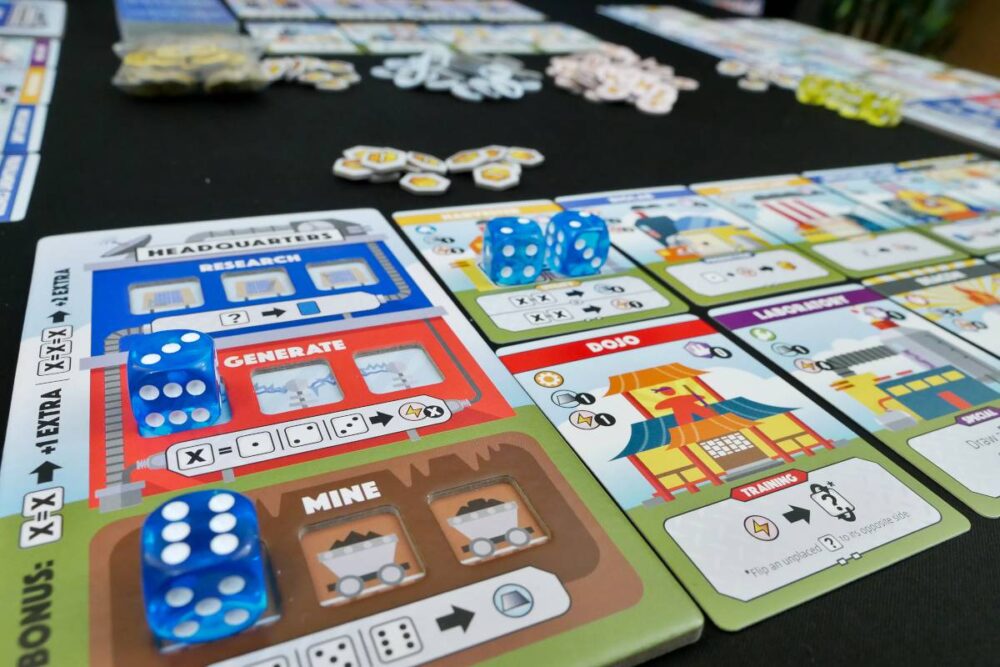
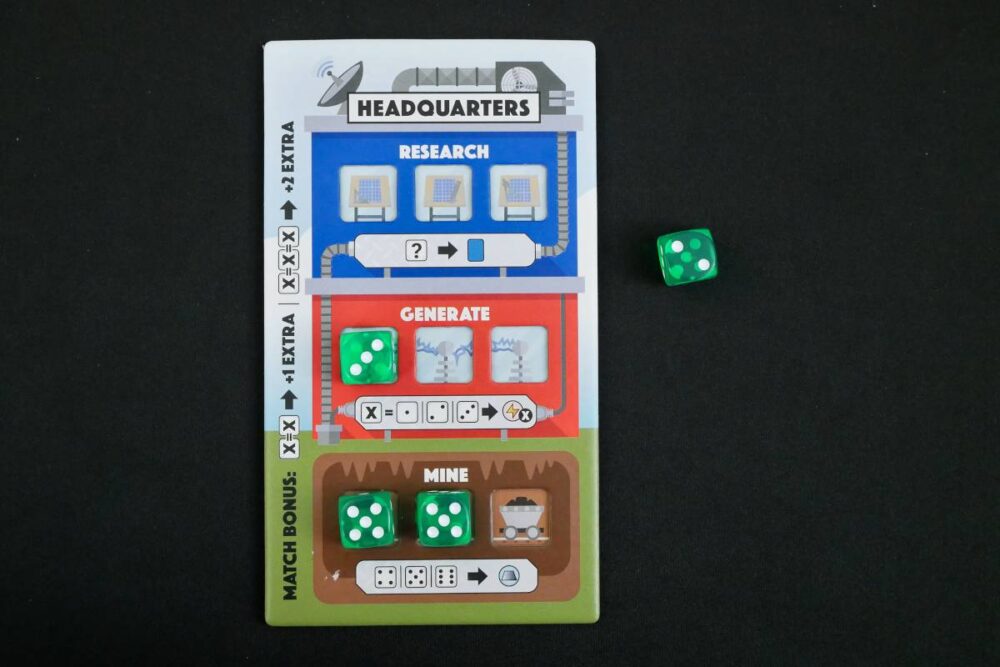
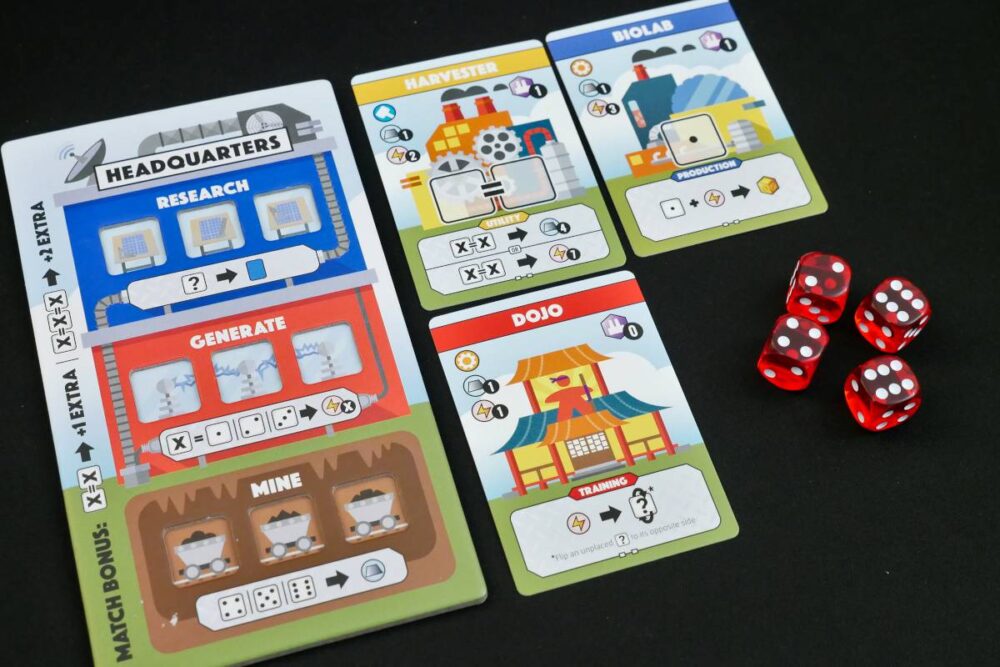
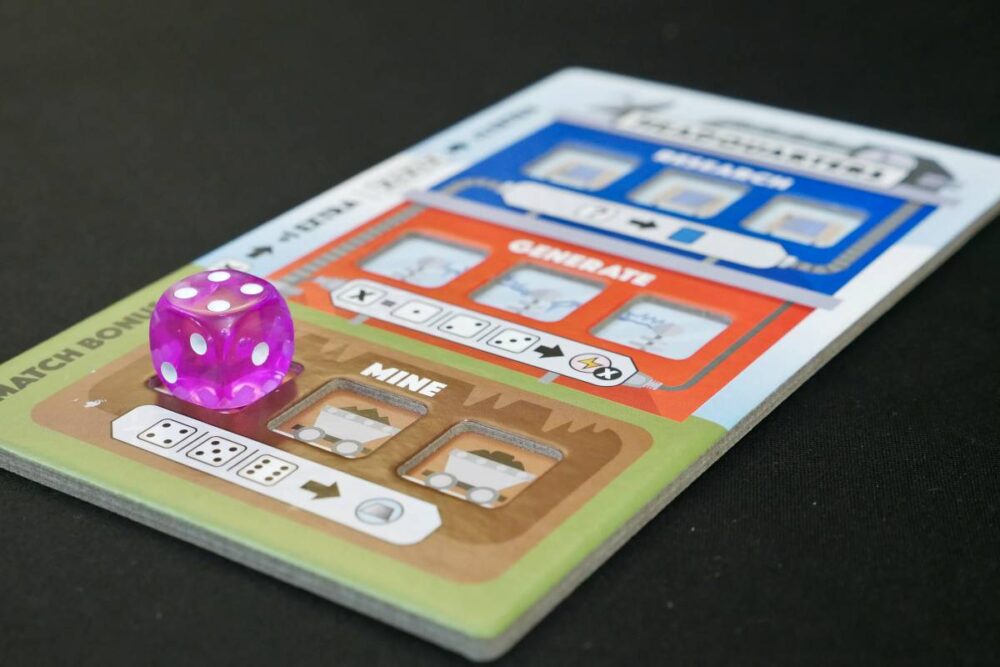
Everyone also starts with their own Headquarters Board. The Headquarters Board gives you three basic actions that are always available:
Research: Place any value die to draw a Blueprint card. (More on this below.) The value of the die doesn't matter. You can do this action up to three times per round.
Generate: Place any 1, 2, or 3-value die to gain Energy tokens equal to the die value. You can do this action up to three times per round.
Mine: Place any 4, 5, or 6-value die to gain 1 Metal token. The value of the die doesn't matter. You can do this action up to three times per round.
Whenever you take one of these basic actions, if the value of the die you're placing matches any previously placed die for that action, then you gain an extra Blueprint card, Energy token, or Metal token for every matching die.
Okay, so what are Blueprint cards? A Blueprint card gives you another special action you can do, but you have to "build" it before you can use. Once built, it's in your personal tableau—and in addition to the basic Research, Generate, and Mine actions, you can now do these Building actions. Everyone starts with a hand of 4 random Blueprints.
But Building actions differ from basic actions in some ways:
Every Building action is a "recipe," which means it has inputs and outputs. If you can pay everything to the left of the arrow, you gain everything to the right of the arrow.
Some Buildings require a die (like the basic actions) and may provide weaker or stronger benefits depending on the placed die value, but other Buildings don't need a die at all. As long as you fulfill the inputs, you can activate them and gain the outputs.
Each Building can only be activated once per round.
To build a Blueprint, you'll have to pay its cost: Energy tokens, Metal tokens, and another Blueprint card from your hand with a matching Tool symbol. You can't build multiple copies of the same Building (unless it says you can).
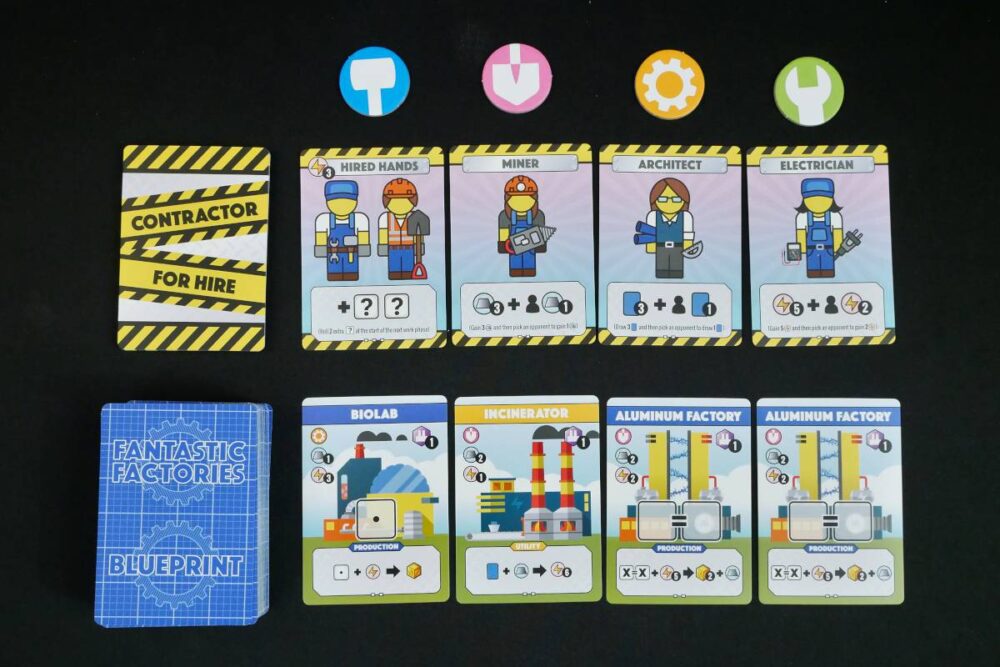
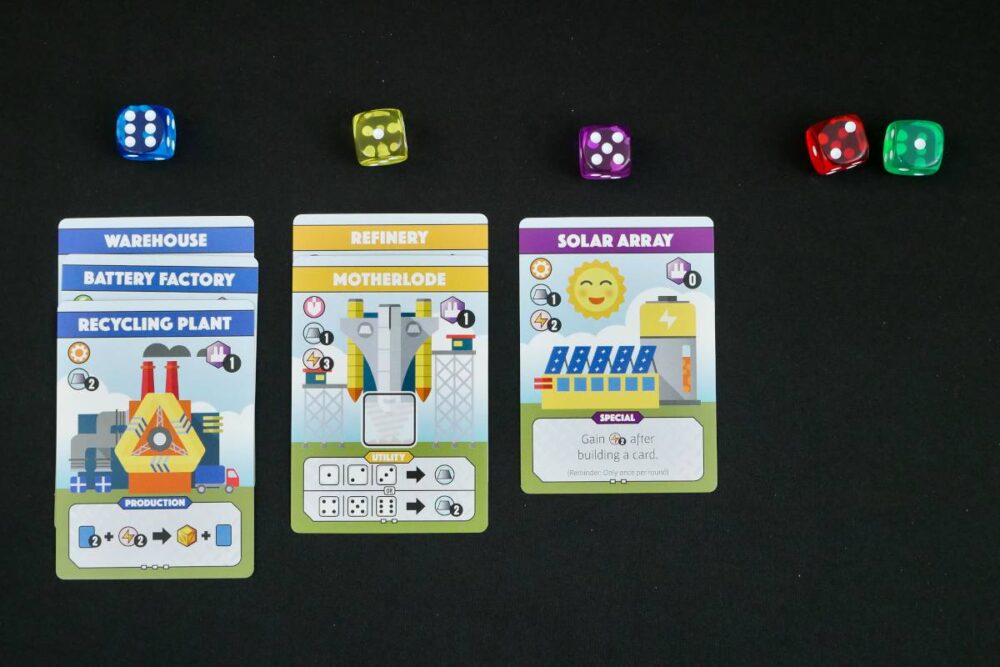
This is the market. The Contractors are on top, the Blueprints on bottom.
Every round of Fantastic Factories is split into two phases: the Market Phase and the Work Phase. The Market Phase goes in player turn order and each player chooses one of two options:
Draft a Blueprint card. Take 1 Blueprint card from the central market and put it in your hand for free. Then, refill the vacant market spot with the top card of the Blueprint deck.
Activate a Contractor. Pay the cost of 1 Contractor in the central market to activate its special ability, then discard it. The cost of a Contractor is to discard a Blueprint from your hand that has the same Tool icon as what's above the Contractor. (Some Contractors may also cost Energy or Metal, too.) Then, refill the vacant market spot with the top card of the Contractor deck.
Before you take your Market Phase action, you can optionally pay 1 Energy or 1 Metal to clear all Blueprints or all Contractors (but not both) from the market, then refill them from their respective decks.
After everyone has taken a turn in the Market Phase, it's now the Work Phase. The Work Phase is simultaneous. At the same time, all players roll their dice and take their actions in any order: build Blueprints, place Workers, and activate Building abilities.
When all players have run out of potential actions, the round ends and the next one begins (with a Market Phase).
The game end is triggered when one of two conditions is met: either someone has produced 12 or more Goods, or someone has built their 10th Blueprint. At that point, the current round is played out and then one final round is played. Then the game is over.
Players sum the number of Goods they've produced plus the Prestige values of all their Buildings to get their scores. Whoever has the highest wins!
Setup and Table Footprint
Fantastic Factories is relatively quick to set up, and a lot of it is helped along by the nice box insert (see "Production Quality" section):
Shuffle the Blueprint and Contract decks.
Give each player a Headquarters Board, a player aid card, the 4 dice in their player color, and 1 Metal and 2 Energy tokens.
Give each player 4 random Blueprint cards.
Set up the central market: 4 Blueprint cards plus the Blueprint deck, and 4 Contract cards plus the Contractor deck. Plus the Tool icons, one above each Contractor card in the market.
Set aside the Metal, Energy, and Goods tokens as a supply.
And you're ready to play! It only takes a few minutes and the whole process is pretty intuitive and self-explanatory.
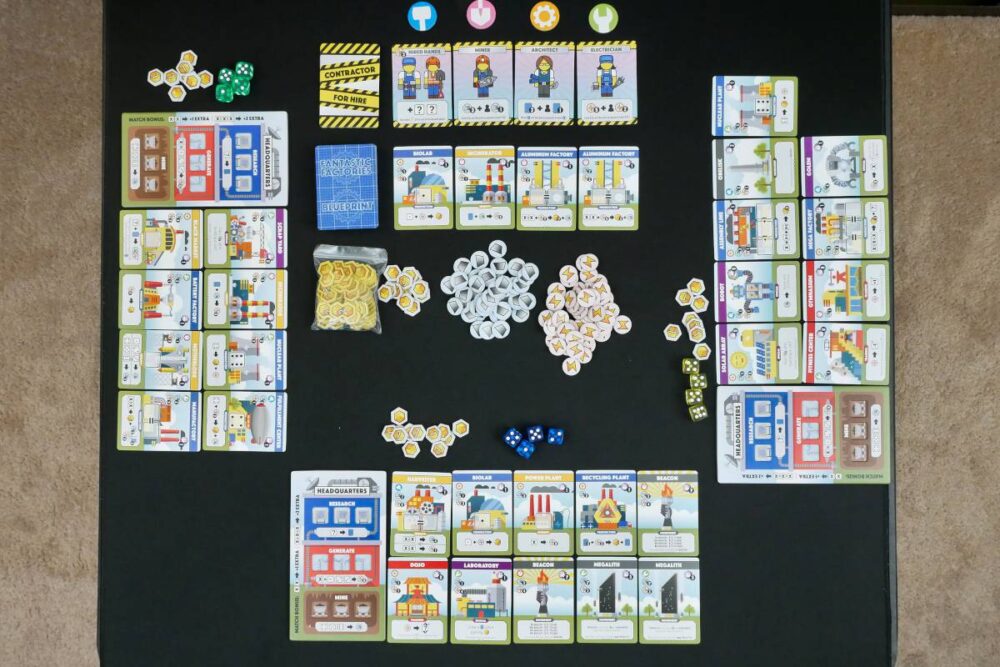
A full 3-by-3-foot table is needed for this 3-player game.
Fantastic Factories needs a good amount of table space. That's expected for any game that has personal player tableaus, though, and the nice thing is that the player tableaus aren't too big here.
You have your Headquarters Board, your dice, and your resource tokens. Beyond that, you gradually build a 10-card tableau (2 rows of 5 cards) as you build your Blueprints. Multiply that for every player, plus the central market, and you have a game that's neither compact nor a table hog.
Learning Curve
Fantastic Factories is a gamer's game, but it's on the simpler side. I'd call it a family-plus game—probably too complex for first-timers and non-gamers, but perfectly fine for someone who has experience with games like Catan, Ticket to Ride, and Carcassonne. It's simpler than Wingspan.
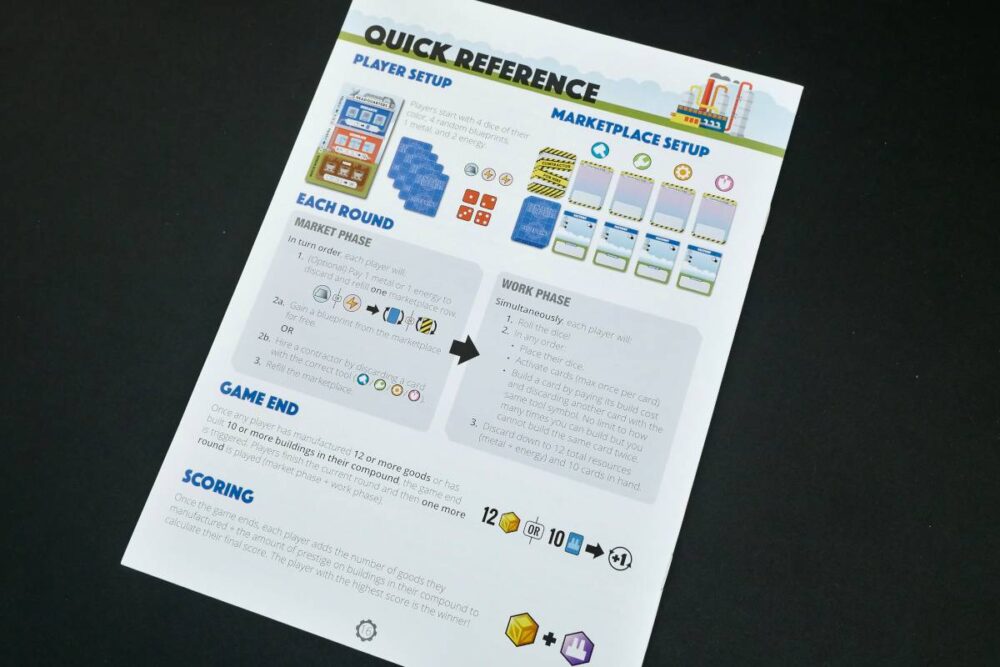
The back of the rulebook has a Quick Reference, which makes it easy to get up to speed even after it's been collecting dust on your shelf for years.
The general flow and turn structure of Fantastic Factories is actually quite straightforward. You draft cards in the Market Phase, then place dice in the Work Phase to trigger actions. But there are a few points of friction that could trip up less-experienced players:
Different Blueprint cards have unique actions. Your first time through can be confusing as you try to interpret the iconography and figure out which actions are worth getting.
To build a Blueprint, you have to discard other Blueprints from your hand. It's a great mechanism that makes for interesting choices, but wrapping your head around it for the first time can be weird.
Two different market types. Blueprints are for drafting into your hand while Contractors are for one-time-use actions.
But these are just "first game woes" and fortunately the game comes with player aid cards that newbies can reference. It only takes a few rounds to get over the learning hump, and from then on Fantastic Factories is pretty much smooth sailing with low mental overhead.
Game Experience
Decision Space
Fantastic Factories isn't a light game, but it isn't too complex either. It's on the lighter side of "medium-weight strategy" with most of its weight coming from its engine-building decisions.
Your Buildings are the crux of your engine. Being able to analyze the Blueprint market and draft cards that work well together? That's one of the core skills you need to excel in Fantastic Factories. After that, it's about managing your resources to actually build those Blueprints and activating your Buildings in the right order to take advantage of their synergies.
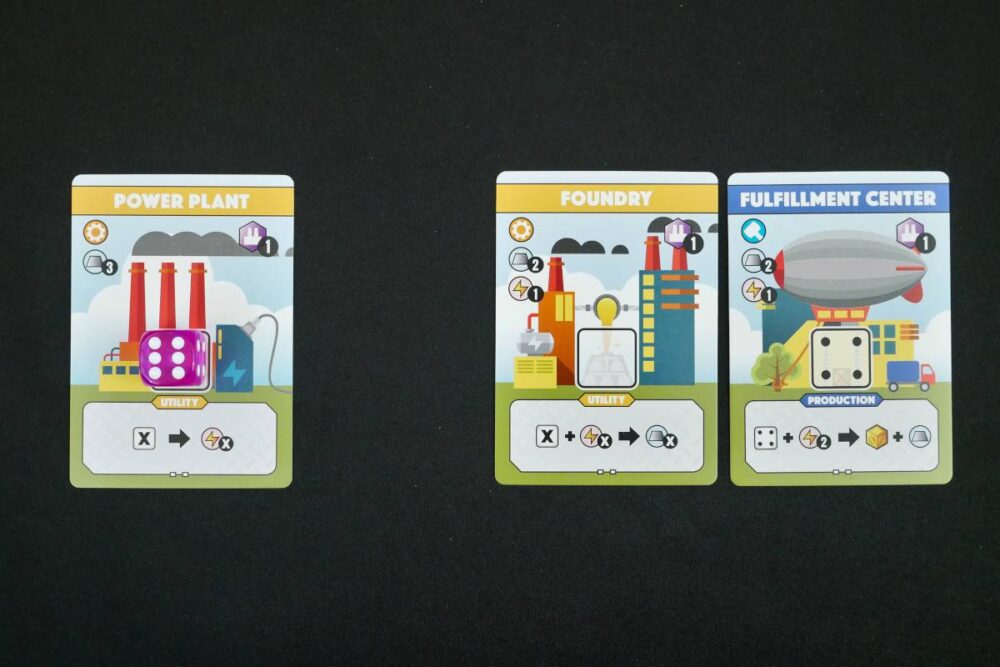
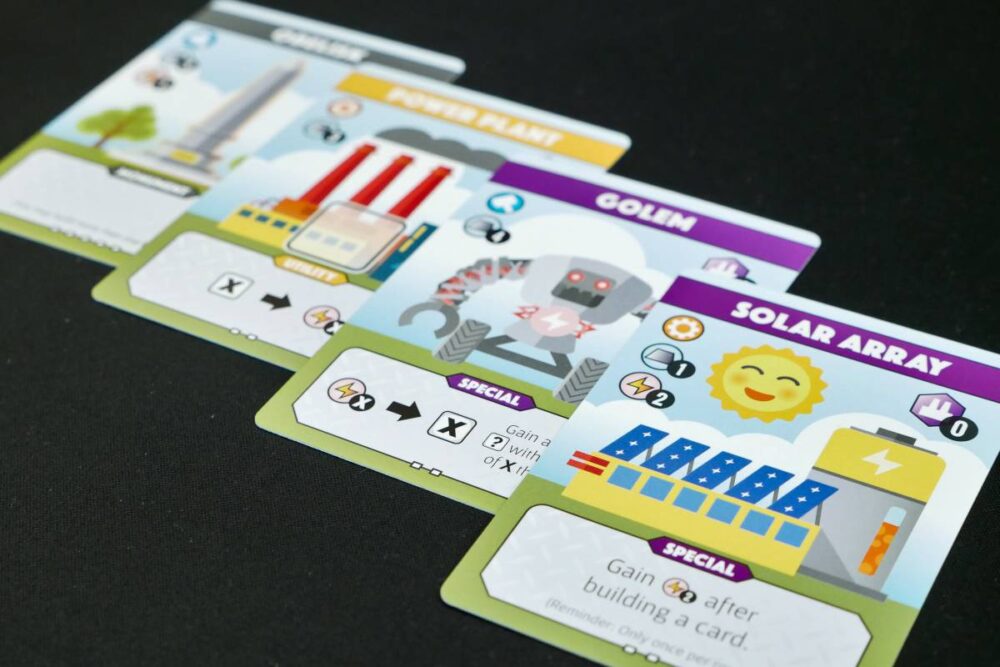
Let's say you build a Power Plant: You can place any die on it and gain Energy equal to the die value. That's a great card with lots of potential! Maybe you combine it with the Foundry to turn Energy into Metal, or with the Fulfillment Center to produce Goods and Metal. But Energy can also be used to alter your rolls via the Dojo, Gymnasium, etc., so maybe you build a Power Plant as part of your dice mitigation strategy.
I can use the Power Plant to generate Energy, then use that Energy (if I have the right dice) to create Metal with the Foundry or Goods + Metal with the Fulfillment Center.
But there are other strategies, too. The Recycling Plant lets you discard 2 unwanted Blueprints into 1 free Blueprint draw, helping you find great Blueprints while producing Goods as a byproduct. Or the Trash Compactor, which straight-up turns 2 Blueprints into 2 Goods (but requires a pair of doubles to activate). Or the Golem, which turns Energy into an extra die, giving you more actions per turn.
And those actions per turn can be crucial for efficiency.Fantastic Factories isn't just about building the right Blueprints; it's about rolling your dice and choosing the best chain of actions you can. Just because you have a synergistic set of Buildings doesn't mean you'll be able to use them exactly as you need every time—sometimes you get a crappy roll and can't do what you want.
In that sense, Fantastic Factories is both strategic and tactical. You have to set yourself up for success with smart Building choices that work well together, but you also have to roll with the punches and think on your feet. Maybe this turn you forego Goods production and instead stock up on Energy in preparation for next turn.
Fantastic Factories has two other aspects that are less important but still feed into the overall decision space of your turn.
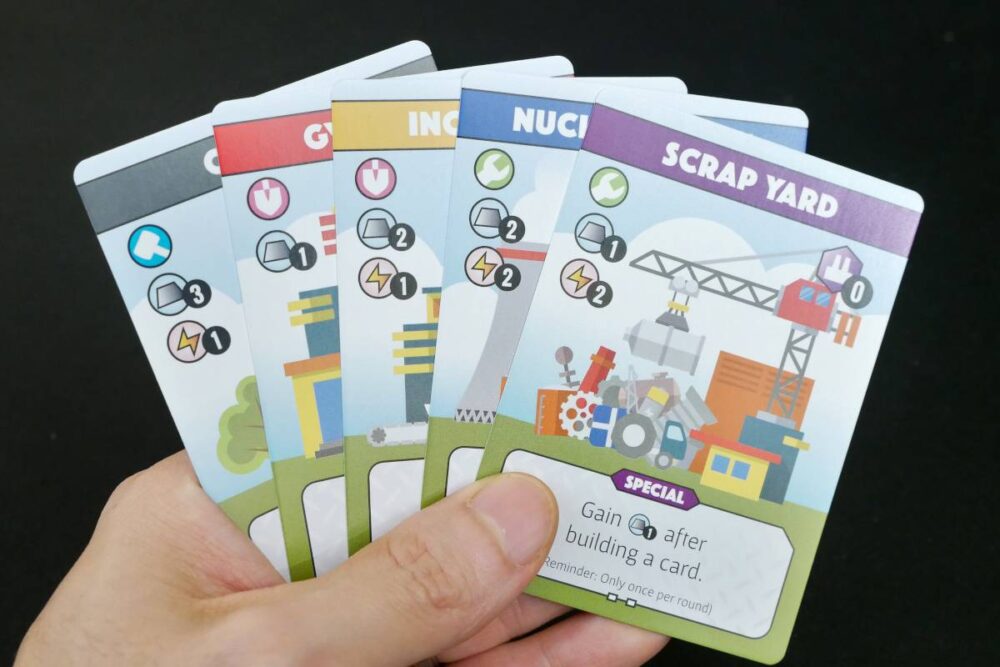
First, you have to spend Blueprints to build Blueprints. It gives you reason to comb through the deck and draft cards that don't play into your strategy. It also puts pressure on you when you have a whole hand of cards you like and can't pick which one to sacrifice. And it can rear its head when three rounds later you wish you hadn't tossed that Scrap Yard after all.
This Scrap Yard has a Wrench icon. If I want to build it, I need to discard another Blueprint from my hand with a Wrench icon—in this case, that Nuclear Plant.
Second, you can employ the help of Contractors. They aren't too helpful in the earlier rounds when you're still setting the foundations of your engine and in need of Blueprints, but they're great when you lack clear direction on what to do next. Don't need any of the available Blueprints this round? Toss a card, activate the Specialist, and crank your engine to max with the extra die you get for the round.
Fantastic Factories isn't a brain burner nor is it prone to analysis paralysis. You only have so many options with any given dice roll—each die can only fit into two or three cards, if that. You analyze what you're able to do, then execute. It's smooth, yet you never feel like you're on autopilot.
Luck Factor
Fantastic Factories starts you off with some mitigation for bad dice rolls, namely the Headquarters Board, which generously provides outs so you're never stuck with a truly bad roll. You always have something to do.
But Fantastic Factories is also a game about developing your own mitigation via Blueprints. Almost every Blueprint is an opportunity for a die to find its home, and you want to build as many homes as you can for the different die values, else one might find itself left out. With smart Building selection, you can flourish no matter what you roll.
What about the market? There's luck there, too. With only 4 Blueprints available to draft from at a time, you may not be able to build the exact engine you want—you have to cobble together something functional from what's out there (unless you regularly sacrifice resources to wipe the market and hope something good comes out). It's an important part of the engine-building puzzle, but it sucks when you don't like any of the options.
The entire game is about probability management and building an engine that can keep chugging along even when your dice stumble. With that much mitigation, Fantastic Factories never feels unfair. If you're ever stuck with without a good move, it's because you trapped yourself.
Fun Factor
Fantastic Factories is quiet but not boring. You won't hear much more than the clacking of dice rolled, then silence as everyone—including you—scans their tableaus, looking for where to fit their dice. You're working on your own puzzle, they're working on theirs, and it's captivating enough.
Because when every single die you rolled fits into the exact Buildings you need, in the exact order you need them, to churn your heaping pile of Energy and Metal into 5 Goods and leapfrog ahead of everyone? Nobody looks up from their own tableaus, but you've got a grin on your face.
Pacing
It's easy to lose track of time playing Fantastic Factories. Not that it takes long to play—you'll wrap up within an hour every time—but it's the snappy pace that keeps your mind from wandering. You roll, you work through dice placements, you draft a card, and you're right back to rolling again.
Every round compounds on the last one, so your tableau is growing and your options are widening. It all snowballs into a big race as everyone cranks out more and more Goods every round. It's incremental, but it accelerates. And once someone pushes out that 12th Good or 10th Building, you only have one more chance to come out ahead. That's it.
Player Interaction
There's no player interaction in Fantastic Factories, at least not in the usual sense. You aren't tearing down anyone else's engine. You aren't blocking their progress. But you are drafting from the same market and racing to build a better, faster engine than them—and that puzzle is the game. There's enough tension to make up for any lack of direct interaction.
One warning, though: with simultaneous play comes the potential for cheating. When everyone's head down in their own puzzle, no one can referee the rules. Oh, James produced 4 Goods this round? You have no way to know if that's legit. You have to trust that everyone knows the rules and isn't breaking them, even unintentionally. That also puts more pressure on getting the teach right.
Player Counts
Simultaneous turns is great for player scaling. It cuts away the downtime—you aren't twiddling your thumbs while Jerry hems and haws between Motherloding his 3-die for Metal or sticking it in his Headquarters for Energy. No matter how many Jerrys you have at the table, you aren't held down. You can freely work your own puzzle at your own pace.
But player scaling does affect one aspect: the market churn. With more players, more cards are drafted every turn. More wipes happen. More Contractors are hired before you're able to speak with them. That means a more dynamic market, but it also means you can't plan ahead as much in the Market Phase. If that bothers you, shrink your player count.
Replayability
I really enjoyed my first few plays of Fantastic Factories. In fact, I distinctly remember thinking: "This game is better than Wingspan! It's faster and more thrilling and just as satisfying with its engine-building. Destined to be a staple in my collection. Yup, for sure." But that feeling faded in five plays.
Now, don't get me wrong. Fantastic Factories is fun (see "Fun Factor" section) and I would happily play it if someone suggested it. It's still engaging after half a dozen plays and there's nothing wrong with it. But this is one of those cases where the game needs variety to stay fresh.
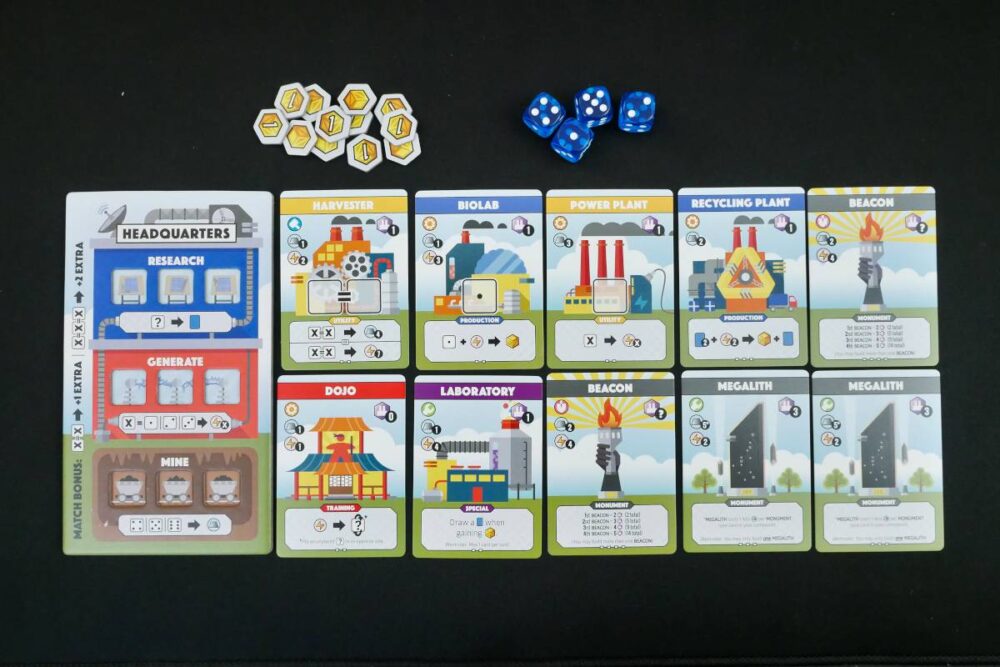
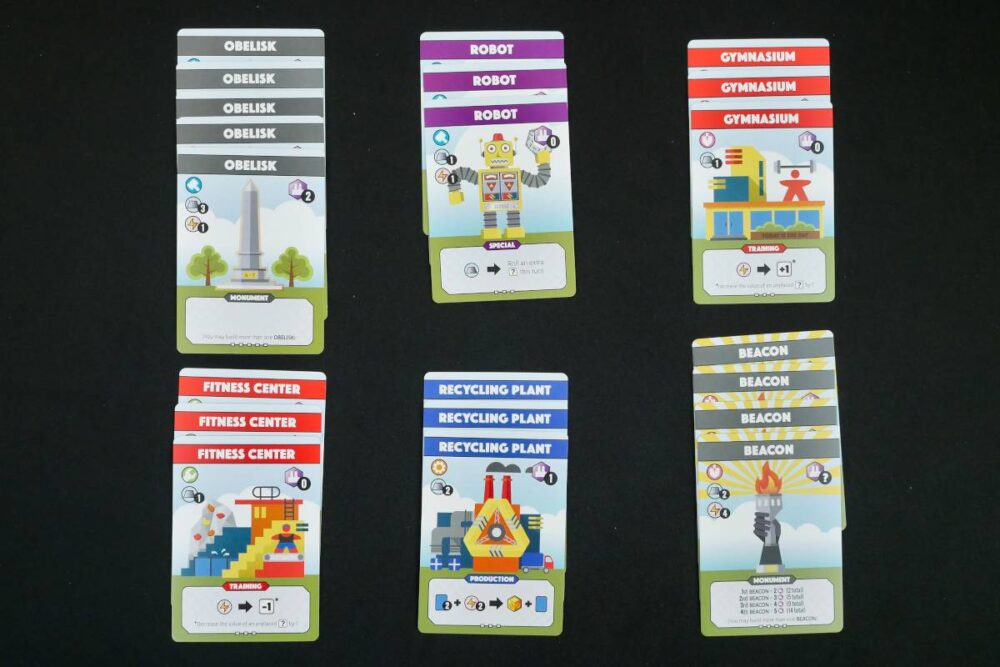
These Blueprint cards have the most duplicates in the deck. Most other Blueprints have 2 or 3 copies each. The result? Constant déjà vu.
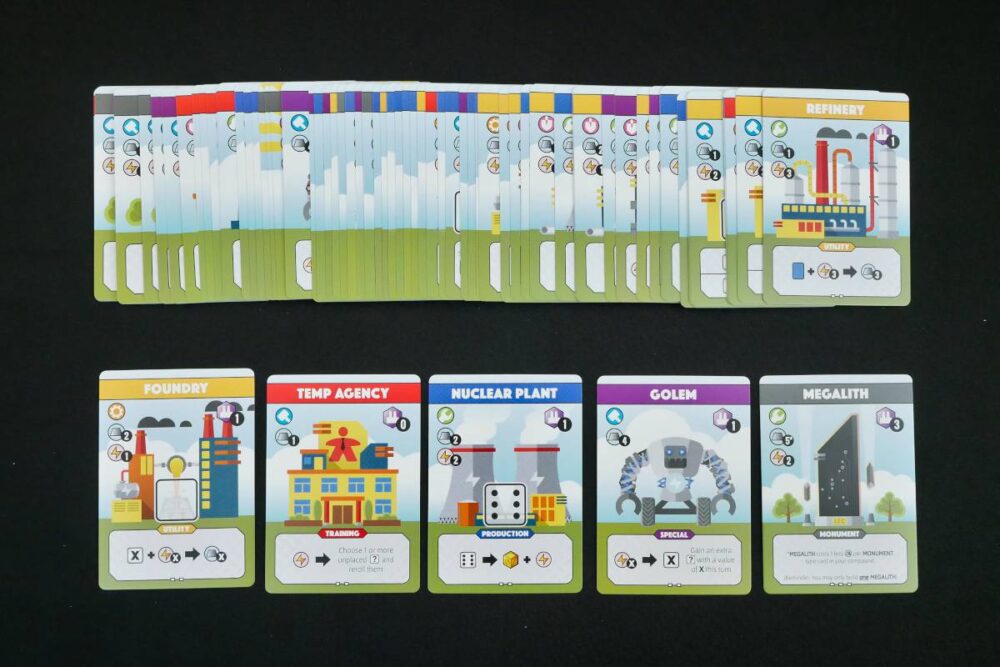
The Blueprint deck consists of 74 cards, which seems like a good chunk at first glance... but the more you play, the more you realize there are quite a few duplicates and boring cards that don't do anything (e.g., Obelisks). And you go through most of the deck every game. The result? It loses freshness, fast.
For more variety, you'll need to pick up the Manufactions expansion with its extra Blueprint cards and other goodies—and you need that variety here. Your engine is the combination of your different Buildings. The more unique Buildings, the more you can mix and match into fun combos. But when you see the same Buildings again and again, it starts to feel "samey" fast.
It's that kind of game that's surprisingly fun whenever I revisit it. I always find myself thinking, "Hey, maybe we should play this more often." But months later when I spot it on my shelf, I don't feel compelled to pull it out. It doesn't excite me like it did at first.
Solo Mode
In the solo mode, Fantastic Factories throws you against an automa called "The Machine." Your half of the game is unchanged, except here you're playing with all the white dice (instead of one set of a color). The Machine has its own system: one of each die color, each color its own action. You take your turn as normal, then roll The Machine's dice to see what it does—and you hold your breath.
Because The Machine has its own tableau that operates by its own rules. Its Buildings are organized by color, corresponding to the dice colors. If the blue die value is equal to or lower than its number of blue Buildings, it produces a Good. Same for the red, purple, and yellow dice. Roll a bunch of fives and sixes and you can breathe easy for a round; roll a bunch of ones and that lead you built over three rounds evaporates.
Here's an example turn for The Machine. The Yellow 1 is less than its 2 Yellow Buildings, so it produces a Good. The Blue 6 and Purple 5 are too high, so they don't produce any Goods.
And then you have The Machine's green die, which takes Blueprints from the market or topdecks the Blueprint deck while wiping the Blueprints or Contractors in the market, all depending on what it rolls. The Machine always gains a new Blueprint every round, which means it's always powering up its colored dice—every round it's more likely to produce Goods.
The solo automa is really easy to run: chuck dice and compare against the tableau. Yet it captures the game's racing escalation and puts pressure on your own engine to outrun it. The Machine actually makes replayability better.
Production Quality
I'm torn on production. It's clear a lot of thought was put into it, but it has one glaring issue that I have a hard time with. But don't worry—that thing is totally subjective. On the whole, Fantastic Factories is objectively well-made.
My biggest issue is the artwork.Fantastic Factories employs a flat, retro, cartoony style that's reminiscent of old-school Flash games from the 2000s. It's such a misstep, if you ask me. It makes the game feel cheap and amateurish, with a vibe that's silly (good) but unrefined (bad). I hate that it feels like I'm playing a prototype every time it comes out.
But the graphic design and iconography are good, at least. The information on cards is laid out well and it's easy to interpret. The icons are all clear and intuitive to understand, and pretty much all the Blueprint actions are self-explanatory. (If any ever trip you up, you can refer to the handy Appendix in the rulebook that explains every card. Nice.)
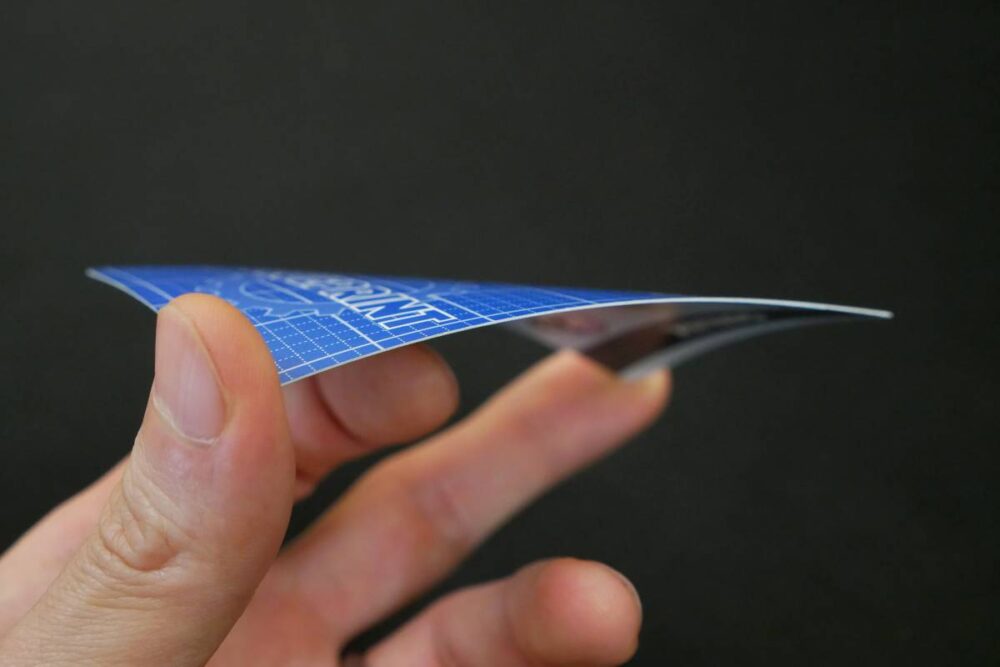
The card quality is good. They're surprisingly thick so I'm not worried about durability, yet they're easy enough to shuffle. I've had the game for over 2 years (as of this writing) and I haven't seen any warping or other issues with the card stock. Apart from the artwork, they feel good to handle and give me the feeling that they're medium-to-high quality. The only thing missing is a linen finish, which would bump them into premium space.
The Headquarters Boards are excellent. These dual-layered boards lend a premium quality to the game with its recessed spots for placing your dice. It's just satisfying when a die fits neatly into an action spot—and these are basic actions, so you'll be doing them a lot. (If only the cards were also dual-layered! But I know how impractical that'd be, lol.)
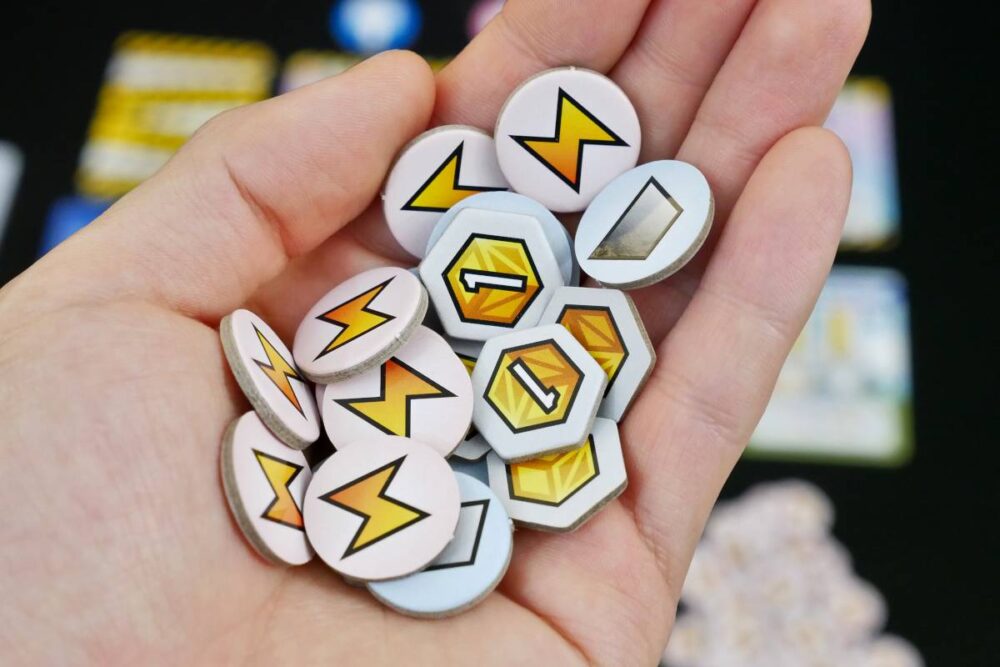
The cardboard tokens are pretty good. I've seen thicker, but I've also seen thinner. These tokens fall somewhere in the "nice to handle" range—easy to pick up, not so big that they take up too much space. With how often you're gaining and spending these resources, it's good that they feel good. And while I ragged on the card artwork above, I will admit that these tokens for Metal, Energy, and Goods look great and are easy to tell apart.
The dice are fine. They're smaller than I'd like... but that's fine in a dice placement game, I guess. Their colors are easy enough to tell apart and the pips are easy enough to read despite their translucency. I would've preferred that they weren't translucent, but that's personal taste. The dice have a bit of heft to them, so they feel nice to roll. Overall, not bad.
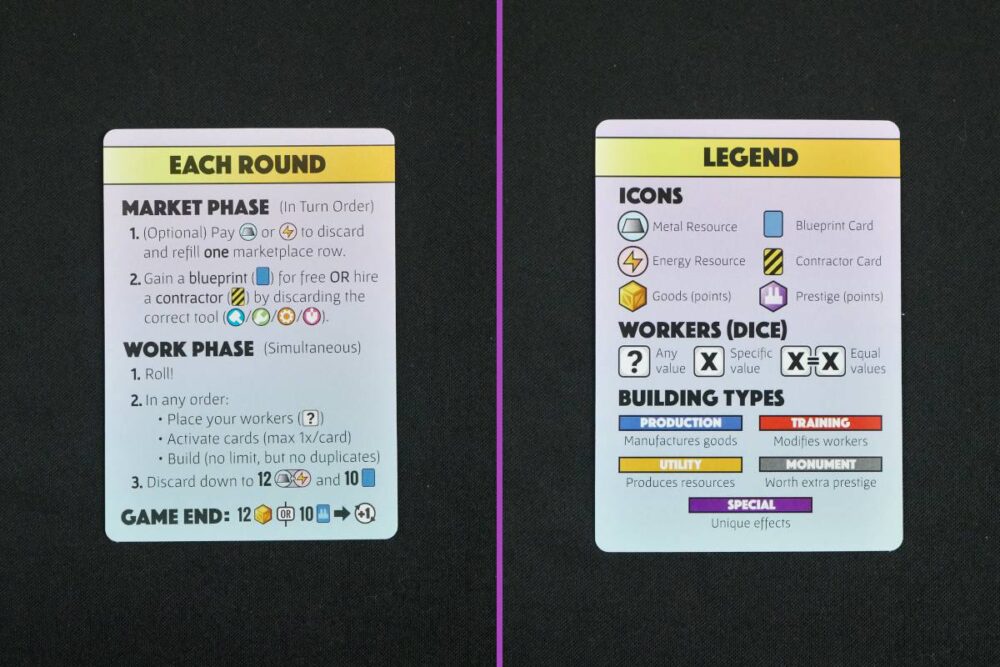
The player aid cards aren't perfect, but I don't care. Player aids are always appreciated, even if they could be better. In this case, you get turn structure explained on one side (great!) and an icon legend on the other side (also great!), with enough cards that each player can get their own. Sure, it's a small thing... but it helps first-timers (see "Learning Curve" section).
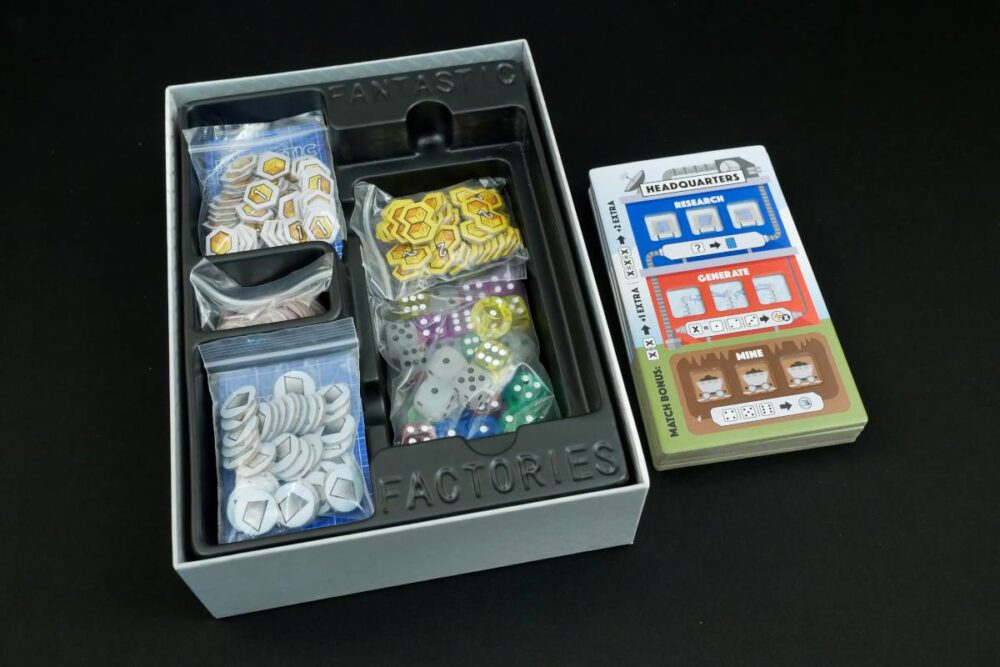
The box size is good, the insert is great. There's pretty much zero wasted space within the box (and you know how much I love that!), plus you get neat compartments for everything. It facilitates fast setup and cleanup, and it's downright satisfying (although the main compartment can be a little tight if you aren't careful about how you put things in). Overall, it's a smaller medium-sized box that fits easily on any shelf.
The Bottom Line
If you're looking for a pure engine-builder that packs a solid race into a consistent 1 hour, that works at all player counts thanks to simultaneous play, with enough luck for surprises and enough mitigation to fight bad luck, Fantastic Factories is a solid choice. It's especially good solo. But don't get it if you're expecting a deeply strategic experience or endless replayability.