Chronicles of Crime does two things that intrigue me: first, it lets you conduct your own open-ended investigation as a true detective would, and second, it incorporates an app that streamlines the gameplay. It promises a deeper, more immersive deduction experience than what you normally get in a genre full of abstract puzzles that only serve to stimulate intellectually.
By the first game, I was sold. By the second and third game, I started seeing the cracks. Chronicles of Crime makes you feel like both a genius and an idiot, trusting you to navigate its web of hidden information and abandoning you when you can't see where to go next. There's a realness to it that cuts both ways.
This review is based on my own personal copy of Chronicles of Crime, which I bought used from BGG's GeekMarket. Not a free review copy.
Table of Contents
View more
What It Is
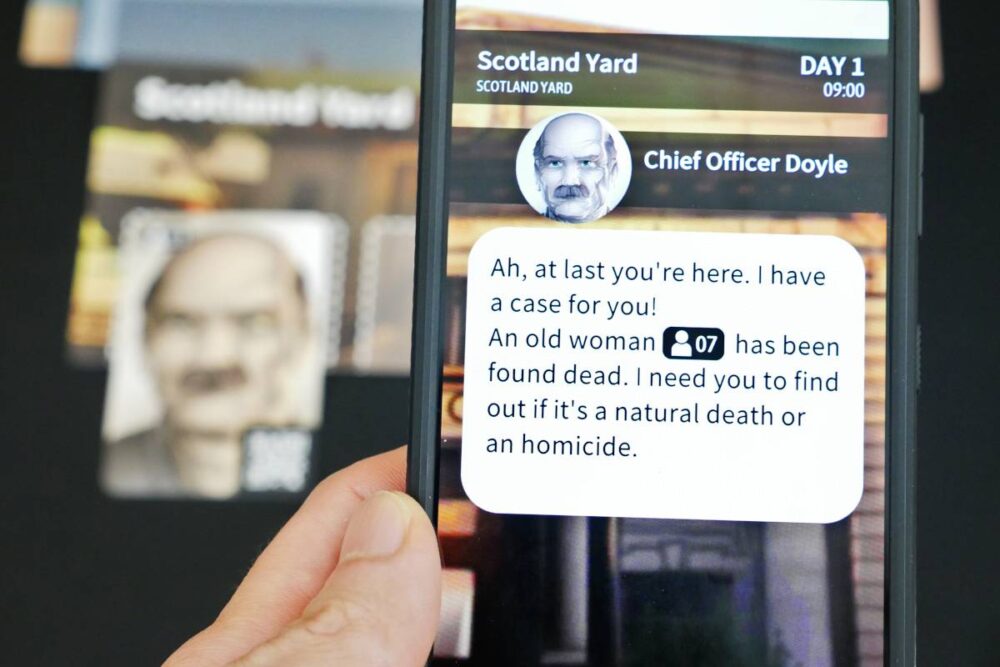
Chronicles of Crime is an app-driven murder mystery game and you're the detective. You have to go out, visit locations, chat with witnesses and persons of interest, examine 3D crime scenes, gather and analyze evidence, and use logical deduction to figure out what's going on and who to arrest. You do all this using the Chronicles of Crime app on your phone, scanning QR codes on cards that represent all the interactables in the game.
It's cooperative with open information, but there's no traditional turn-by-turn structure here. You work together and freely discuss the details of the case, but anyone can be the actual person interfacing with the game itself—just take the phone, scan something, and get a response.
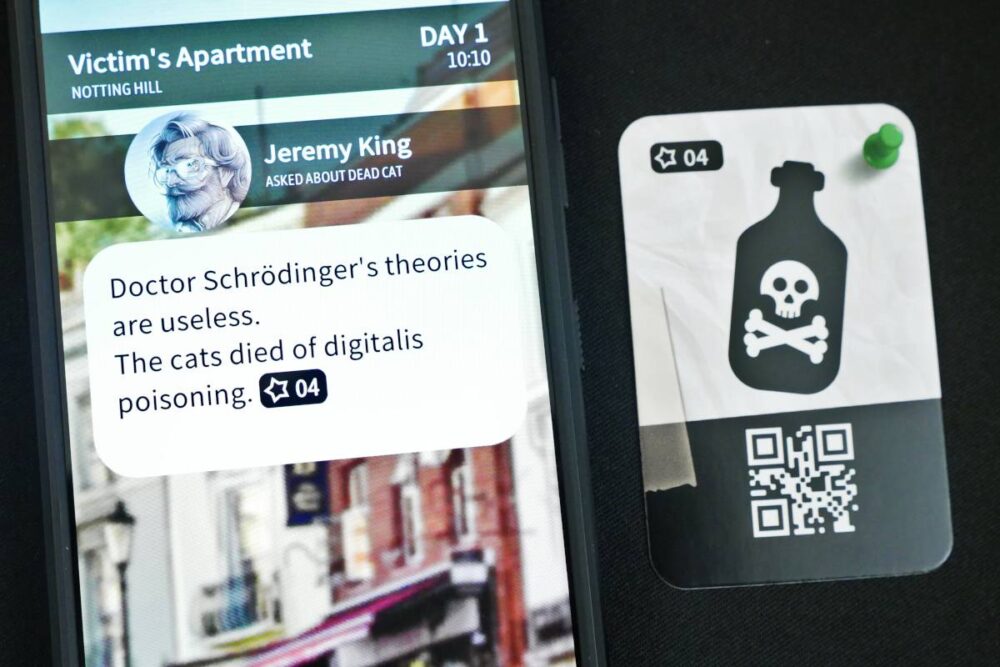
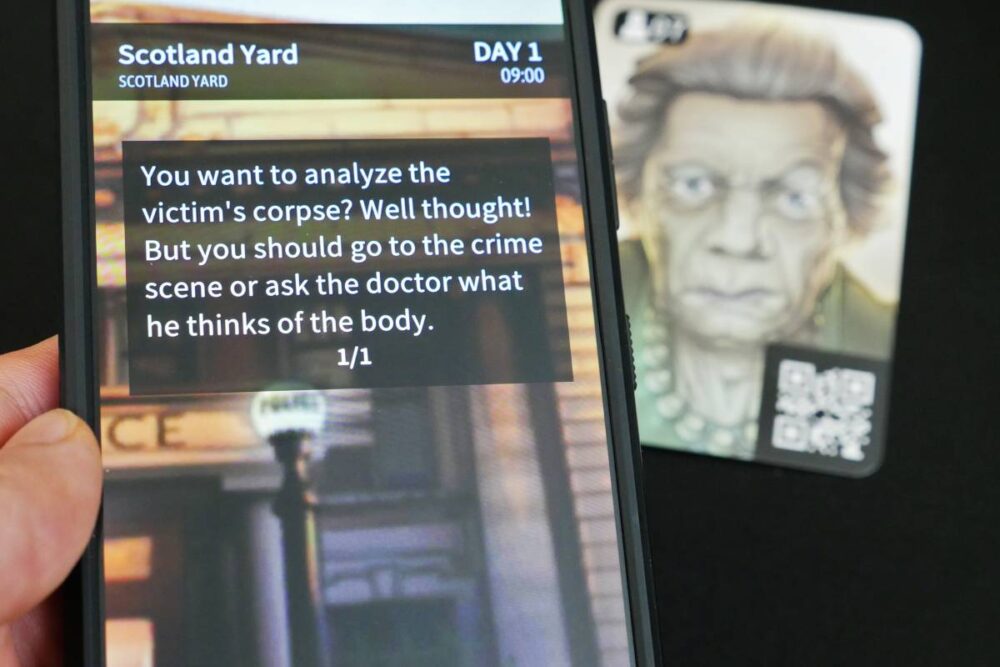
The app can be used to scan any game element with a QR code: people, locations, clues, evidence. Just bring your phone up and long-touch the screen.After scanning, the app will respond. If you mess up and scan something incorrectly, it'll give you a hint as to how you might be able to do it the right way.
But there's also time pressure. Every action costs 5 minutes of in-game time, except for changing locations which costs 20 minutes. It's all about action efficiency and solving the case in time. Meanwhile, cases may dynamically evolve in the background as time passes (e.g., characters get killed, people move locations, evidence disappears). If you meander with wasteful turns, you may miss your window to interrogate a key witness.
When you think you've solved the case, you speak to the police chief and answer various questions like who did it, what was their motive, who else was involved, how did they die, etc. If you're mostly correct, you get a score—otherwise, it sends you back out to keep digging some more.
How It Feels to Play
Sprawling Decision Space
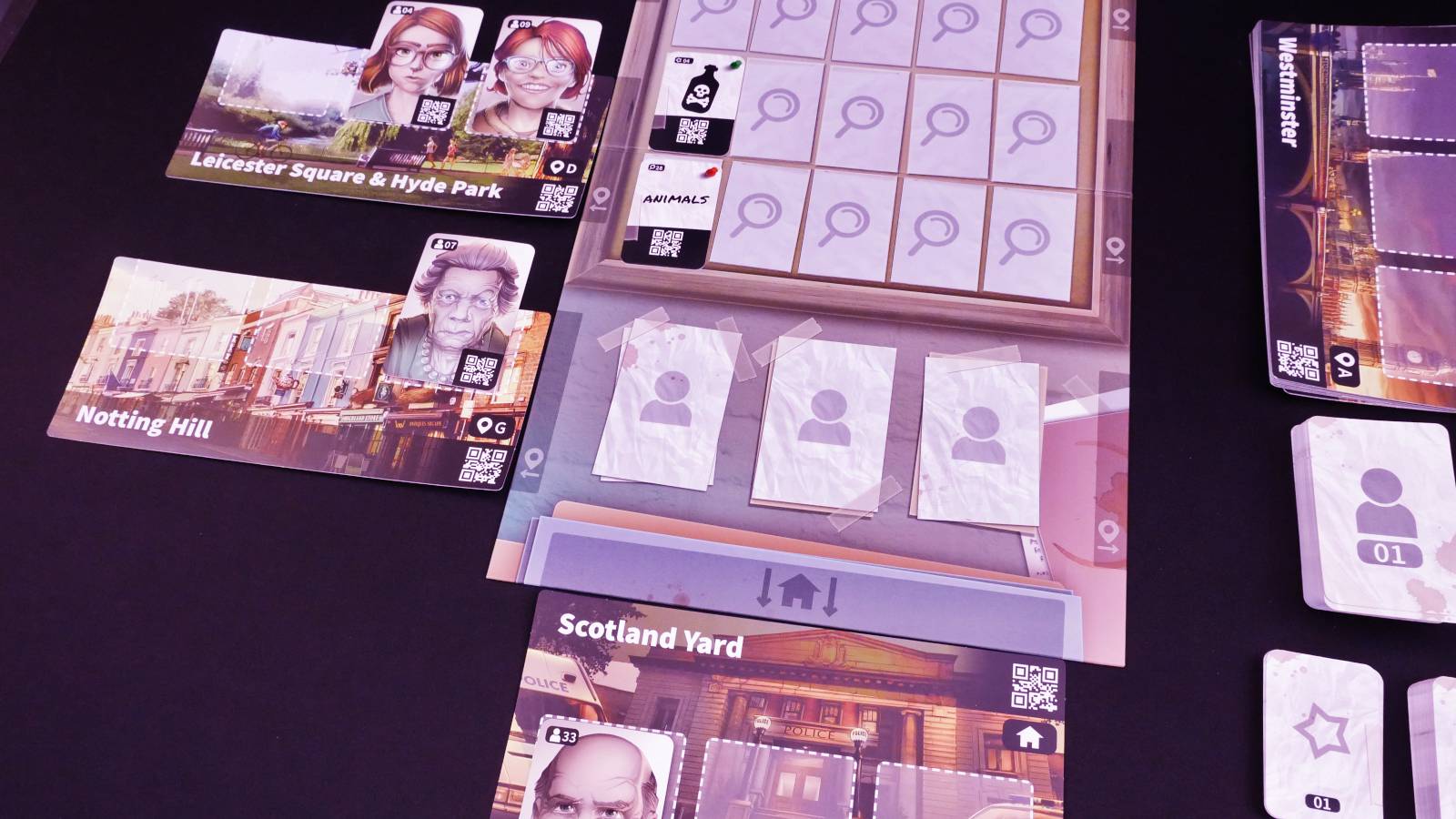
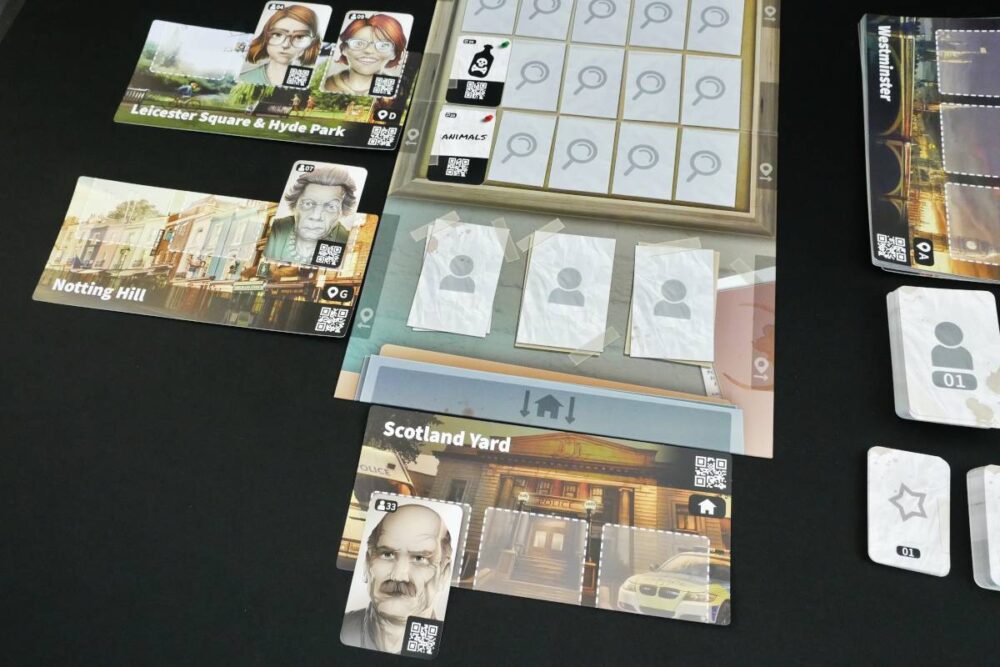
In Chronicles of Crime, you'll stare at an Evidence Board with a dozen or more items, up to 8 different locations with up to 3 characters at each location, and you'll need to mentally process what you know about each item, location, and character to bridge the gaps between them. Those mental bridges uncover more stuff for your Evidence Board, and the number of potential connections grows exponentially—it's a lot to take in.
This is 5 minutes into the tutorial case. In real cases, you might end up with 6 or 7 locations, dozens of characters, and even more clues and evidence.
What this means is, you can't just brute force your way to victory. You have a time limit (actually more like an action limit since the game isn't played in real time), and that forces you to think. You want to avoid wasteful actions that return zero new information, so you have to deduce who, what, and where will give you the clues/leads you need to keep progressing. That bloody bullet is standard-issue British Army ammunition? Maybe it makes sense to ask the soldier back at the local bar about it, and maybe you don't waste time asking the florist. What's she going to know about it, anyway?
It's a complex web of information that only grows with each successive deduction. It's meatier than those singular 15-minute puzzles that you normally encounter in deduction board games like Turing Machine and A Carnivore Did It.
Satisfying Case Progression
Every case in Chronicles of Crime starts small. The Police Chief calls you to Headquarters with the situation, then sends you off to your first lead—a dead body in the park, a victim whose office was ransacked, a prominent businessman who got a death threat. The more you poke and probe and pull, the more it unravels to reveal the larger narrative.
The game's use of icons and numbers to indicate which card gets added to your case? Brilliantly intuitive, easy to manage, and not overwhelming.
Chronicles of Crime structures its cases with a satisfying logic. There's real momentum as you discover evidence, learn character motives, spot clues that contradict character statements, find out that two previously unrelated characters are actually in cahoots. The stories aren't going to win any writing awards, but they're competently told and compelling enough to hold your attention, and they have just enough narrative sinew to hold together without falling apart. You reach the end, look back, and it mostly makes sense.
And it feels good when you get there. Elements click together, pieces fall into place, and the sum of each story is greater than its disparate parts.
The Difficulty Conundrum
Chronicles of Crime puts the onus of solving the case on you. It doesn't hold your hand, and it rarely nudges you in the right direction—you have to forge your own ideas. When you suddenly remember that So-and-so is an alcoholic, so maybe you should show him the bottle you found at the crime scene, which breaks him and gets him spilling his secrets? That victory is all on you.
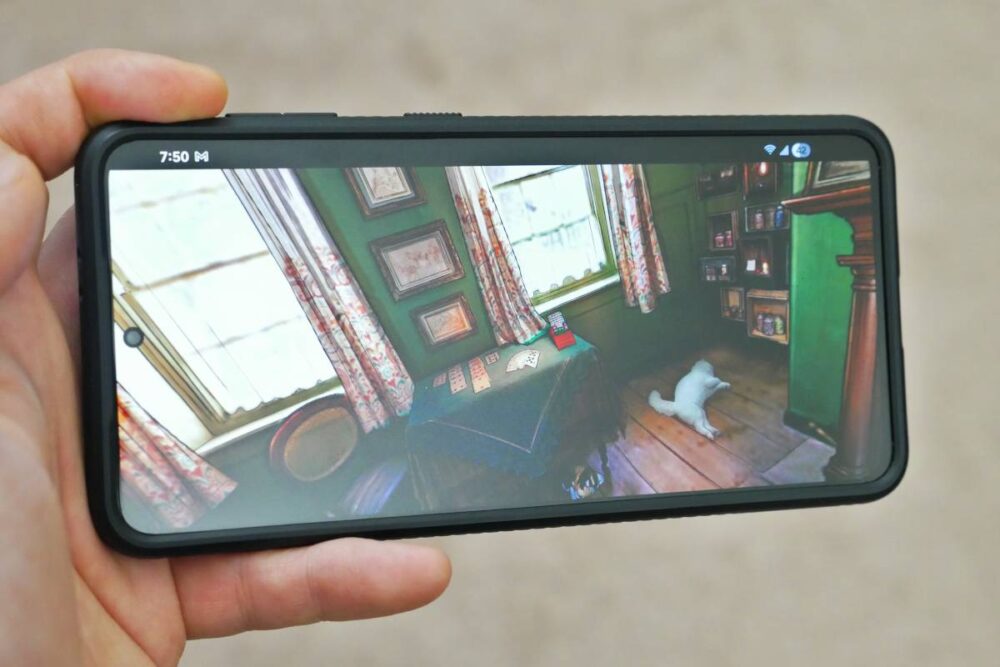
When you inspect a crime scene, you have limited time to look around and spot as many clues as you can. It's one of the most fun parts of the game.But if you overlook certain clues, you might miss your only chance to catch a lead—and without vital clues, you may find yourself at a dead end.
But when you're stuck, you're stuck. Chronicles of Crime leaves you to figure things out on your own with no hint system. You'll get periodic warnings that the clock is ticking and you better dredge up an answer soon, which really squeezes you psychologically, but no help. If you overlook something, or forget something, or just never connect two things for whatever reason, you'll pore over every card on your Evidence Board again and again for 20 minutes before finally giving up. What's worse, some of the cases don't offer hard evidence for every step, forcing you to rely on inferences and logical leaps.
Chronicles of Crime is difficult and unforgiving, and the latter is a big strike against it. A murder mystery deduction game should allow for success based on hunches, but should never rely on hunches for success.
The App's Shortcomings
Chronicles of Crime is a clever example of app-driven gameplay done well. Scanning QR codes is a non-fiddly way to interact with a game that has lots of interactables, and running it on an app allows the software to handle admin duties like clock time, story tracking, and dynamic background events. It's easy and immersive, even if the novelty wears off fast. When you're scanning 100–200 times per case, it's hard not to feel it getting repetitive.
There's an always-accessible "History" where you can page through every single screen you've seen throughout the case. But thumbing through hundreds of pages without a quick search feature can be a huge pain.
My problem with Chronicles of Crime's app is a lack of quality-of-life features. It gives you a paginated history of all actions and dialogs for the current case, but it isn't searchable. Thumbing through 200+ pages to find and revisit a specific character's response from an hour ago? A waste of time. The app lacks a notes page for jotting stuff down. I wish it had a recap feature that tells me everything I've learned so far. Without these things, memory plays a much bigger role than I'd like. It sucks when you forget or overlook one small thing someone mentioned in passing, which could've blown open the case for you.
The lack of a hints system is a huge miss, too. When you run into those dead ends—and you will run into them—you end up wasting so much time retreading ground and searching for that one missing lead you need.
Player Count and Scaling
Chronicles of Crime's gameplay doesn't meaningfully change with player count, but the experience does. With more players, you have more discussion, speculation, and suggestions—more brains to dig your way out of dead ends and discover new leads. There's also shared joy in the narrative as motives are revealed, plot twists unfold, and answers are revealed. You get to enjoy all of that together. It's a welcome step up from the linear, everyone-solve-your-own-riddle affair of an escape room.
But extra heads are a double-edged sword. More players means more opportunity for friction and arguments, for quarterbackers and alpha gamers to take over, for meeker players to slink back and take a more passive role and miss out on the full experience. You don't get to handle the app as often, and it can feel like you're just along for the ride.
That's why I like Chronicles of Crime best at 2 players. You have a partner to bounce ideas off of and you're fully engaged and invested throughout the whole case, without that feeling of too many cooks in the kitchen. It's also good solo, though the difficulty spikes because you have no second brain to catch all the details you'll inevitably miss.
Replayability
I wish Chronicles of Crime was replayable.
Sure, you can technically play any case as many times as you want, but it's the same exact case every time. I've replayed two of the cases because I lost and wanted to get them right, but that's not the same as "replayable." You have a growing meta advantage with subsequent plays, knowing what you know from past plays. With 5 one-and-done cases in the box—each one lasting about 60–90 minutes—there isn't too much to explore.
Excluding the tutorial case, Chronicles of Crime comes with five cases: a three-part story called "The Power Behind" with a long arc and recurring characters, and two one-shots called "Curse of the Pharaohs" and "Every Rose Has Its Thorns."
However, Lucky Duck released a Scenario Editor that anyone can use to create and share their own custom-made cases. The BGG community has created more than a dozen of them that you can download and play for free, and some of them are as good as (or even better than) the official cases. This alone doubles the value of the game.
If you're okay with getting just a handful of memorable one-time experiences, Chronicles of Crime is worth looking into. If you're looking for a game that'll hit the table over and over again, this isn't it.
Components and Setup
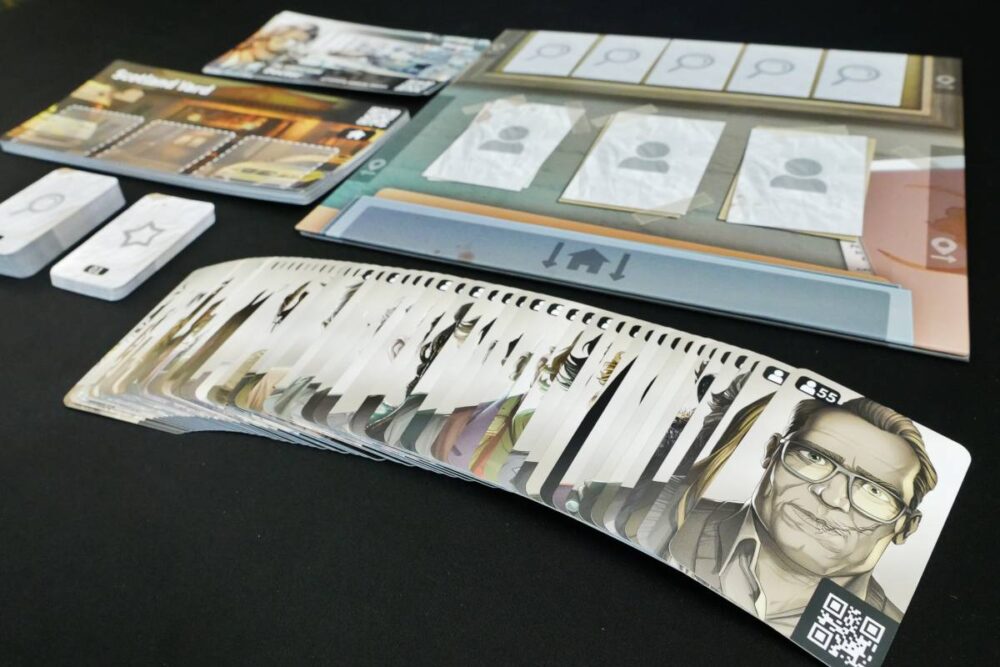
Chronicles of Crime sets up within minutes. The game box insert plays a big role in its quick setup, and all of the game logic happens in the app, which keeps the component count low. And while the game could've been 100% digital, I like the physicality of the cards and board. The Evidence Board establishes true detective atmosphere, and the various location boards and cards keep the case organized and readable. It's immersive and feels lived-in, even if you're just scanning QR codes all day.
But the production isn't perfect. Cleanup is significantly worse than setup, as you have to sort all the case cards back into their respective decks. (If you don't, you just postpone that effort to your next play.) And while I see the value in the character and item cards being "modular" and "reusable," cases end up blending together. When the old man and redhead woman from a previous case return in a later case as new characters, their identities bleed together and add unnecessary mental load. Also, the location and forensic boards are thin and prone to minor warpage over time. (You can see it in my photos.)
As for table footprint, it's manageable. I'm able to fit it all on a 3-by-3-foot playing table, though it can get cramped on bigger cases.
The Bottom Line
If you hate the idea of scanning dozens of QR codes and reading lots of short blurbs on your phone, skip it. But if you want a murder mystery with broad freedom to investigate off-rails, one that challenges you and trusts you to solve things without hints, then get it. At $40 MSRP, though, it's a tough sell. Get it on sale or used—and you can always sell it afterwards to recoup costs.