Once again, I fell for the hype... but this is one of the rare times when a game actually exceeded my expectations, and I say that as someone who came into this game expecting a lot (due to all the hype).
Without further ado, here's everything you need to know about Cozy Stickerville, how it plays, why it's such a refreshingly fun game unlike any other, and whether it's worth adding to your own collection.
MINOR SPOILER ALERT: In order to explain how the game works and why certain parts are good or bad, I need to show components and examples. Some of the photos will "give away" what's in the box, but I don't think it'll ruin your own experience with the game should you decide to get it.
This review is based on my own personal copy of Cozy Stickerville, which I bought new from Gamers Guild AZ. Not a free review copy.
Table of Contents
View more
Overview
Cozy Stickerville tells you everything you need to know right from its name. It's one of the most chill cooperative experiences I've ever had with a board game, where you're basically just putting stickers on a map and building out your village together. In between all that, you're treated to various stories and events in choose-your-own-adventure style. If you've ever played Animal Crossing, then you know what to expect here.
But there's enough structure to Cozy Stickerville that it really can be called a "game," even if it feels more like an activity. It's technically a "legacy game," meaning you make permanent changes to it (via stickers) and only play a finite number of times before it's completed. By game's end, you have a full village of stickers and stories that may or may not have resolved.
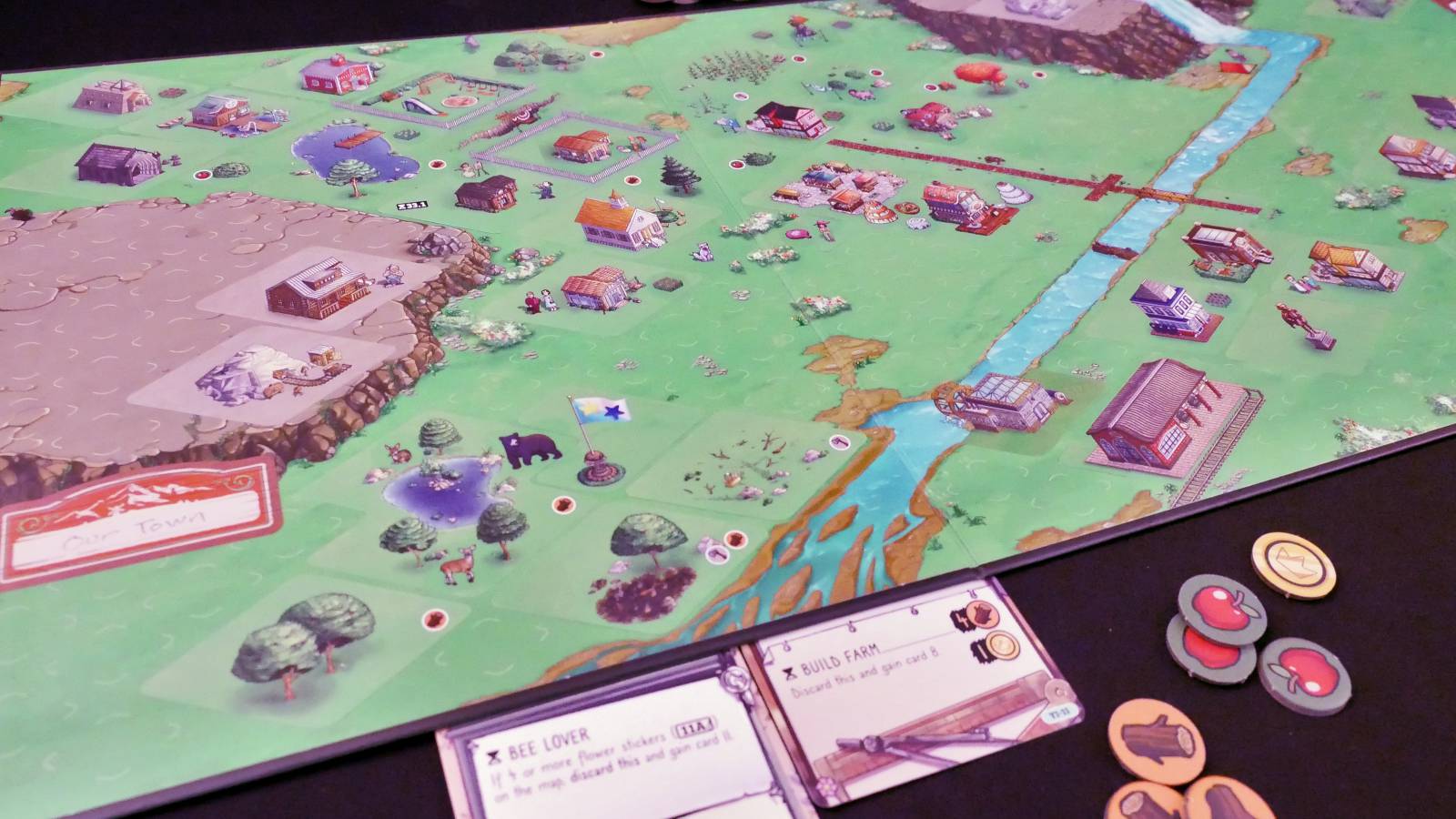
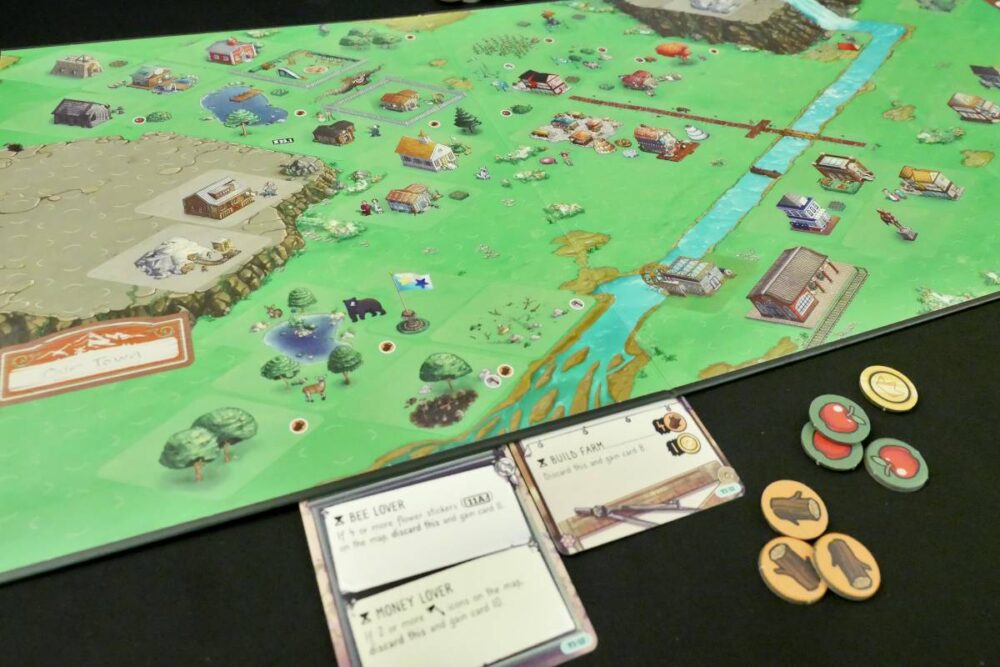
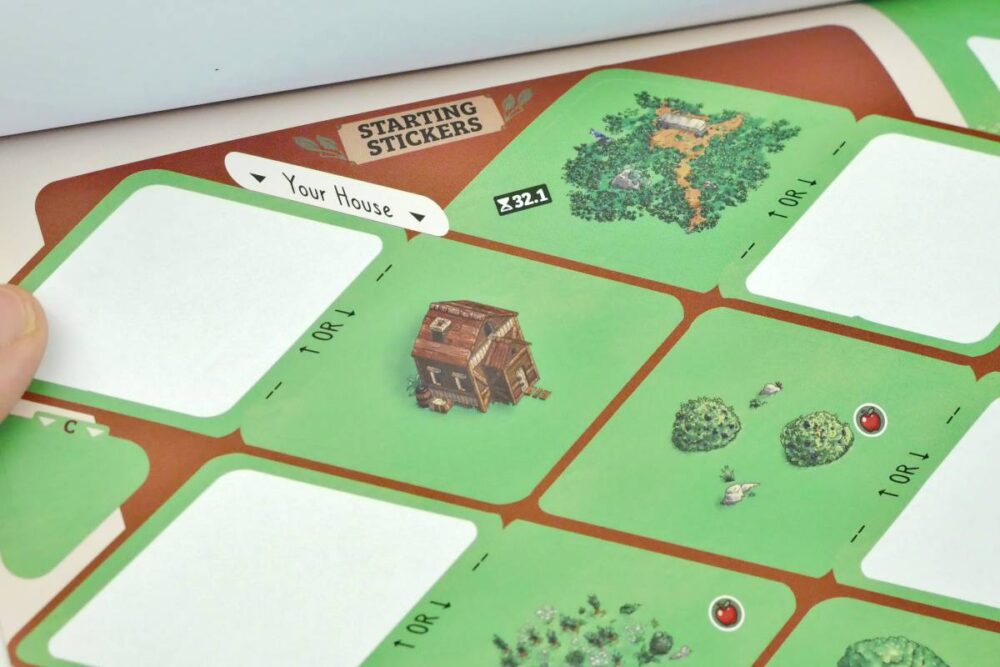
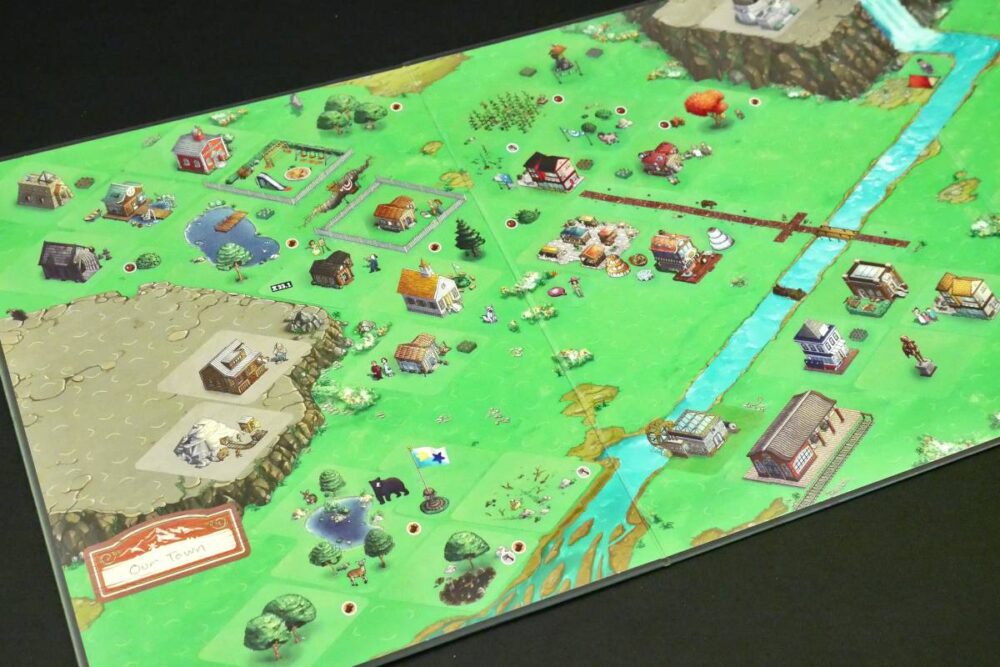
The stickers are the main draw of Cozy Stickerville. The game comes with a nifty Sticker Book loaded with 800+ stickers, ranging from buildings to trees to villagers to weird occurrences that may or may not show up. Stickers are always placed on the Map Board according to placement rules:
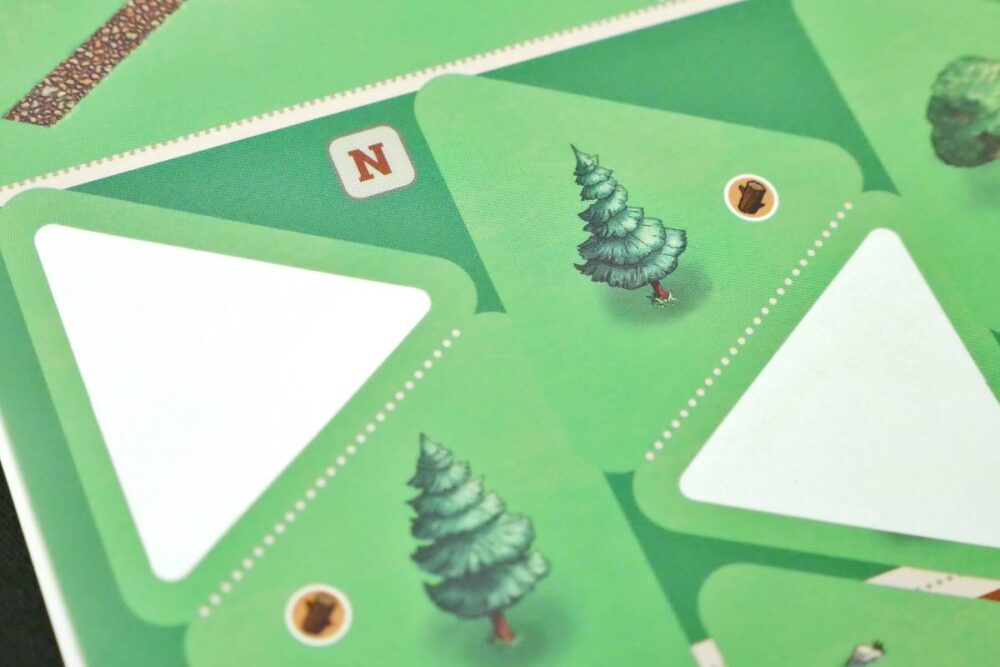
Stickers must align with the Map's grid.
When a sticker is placed on the Map, its background must match the Map's terrain where it's placed.
Stickers cannot overlap. The only exceptions are clear stickers, which are allowed to be placed on existing stickers.
Over the course of the game, you'll be adding new stickers, covering up existing stickers, and sometimes even removing stickers. Almost every sticker serves a gameplay purpose; very few are "cosmetic only."
Cozy Stickerville takes place over 10 Years, with each Year being one gaming session. When a Year ends, you can either pack it up (while saving your progress) or continue on with the next Year. If you do pack it up, you can resume from where you left off very easily. After Year 10, the game ends and you see how well you did—but there's no true "win" or "loss" condition. You simply end with a complete village that you can admire.
You can play Cozy Stickerville two times. The first playthrough happens on one side of the Map Board. After that, you can start over from Year 1 through Year 10 on the other side. However, some of the choices you made in your first playthrough won't be available the second time through, so that second playthrough is guaranteed to be different!
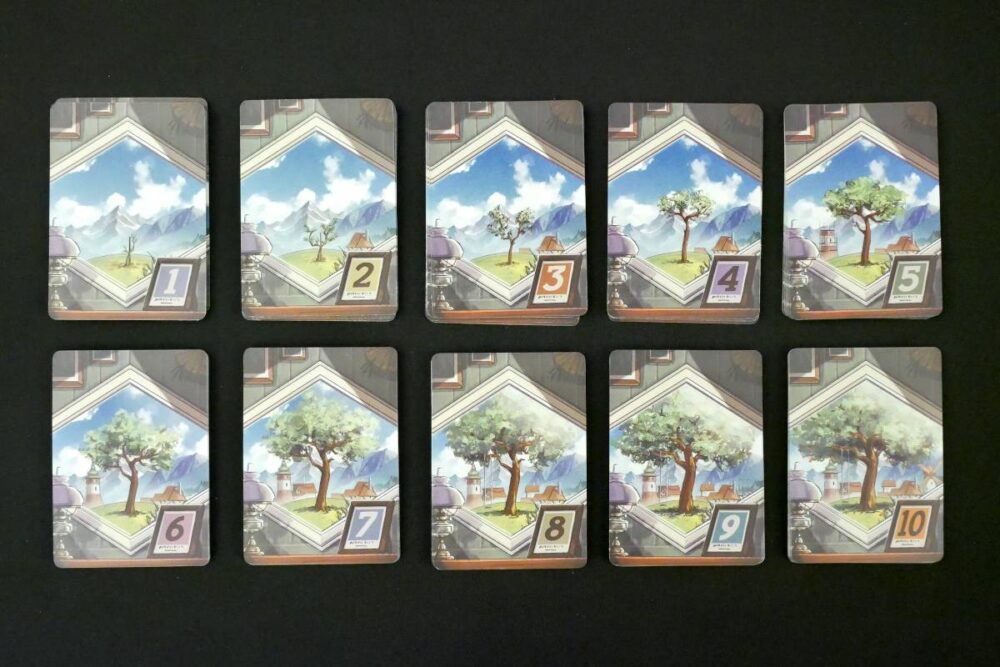
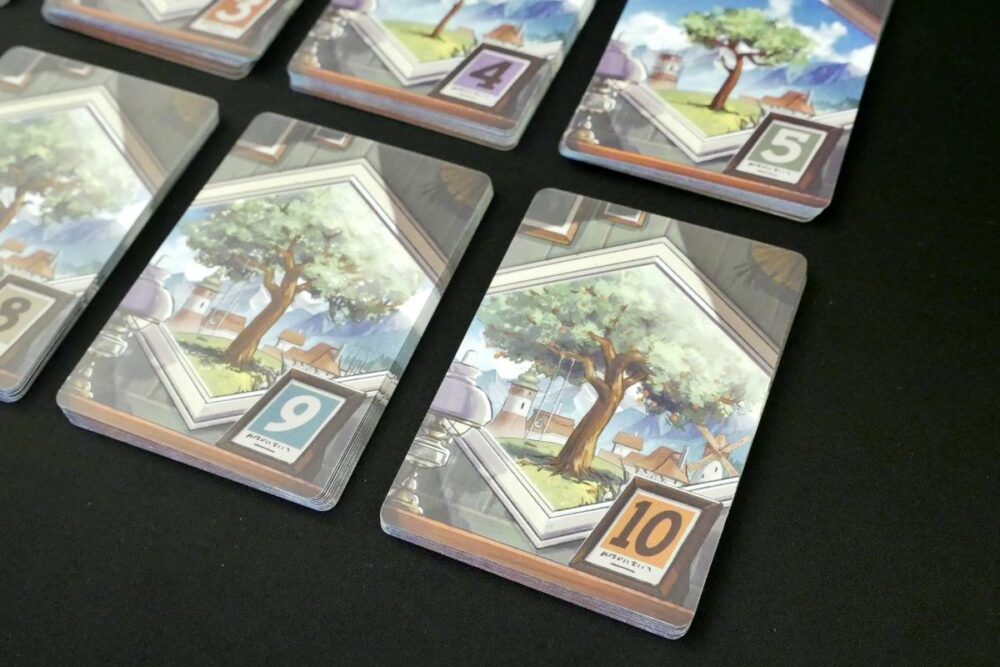
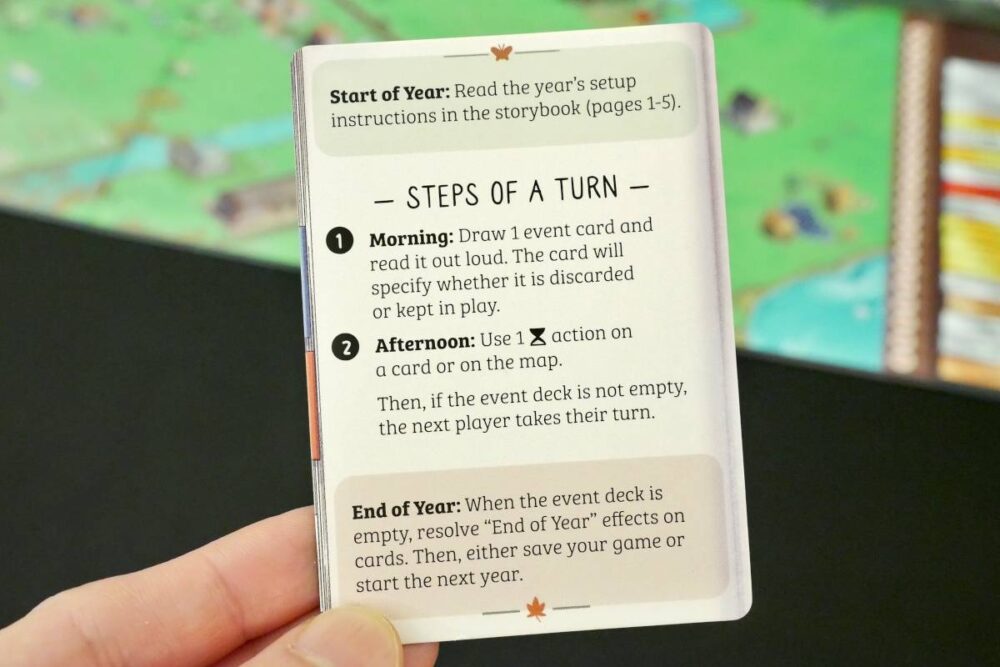
Cozy Stickerville comes with a 120-card deck of Event cards, which is split into 12 cards per Year. That means there are 12 cards for Year 1, 12 cards for Year 2, and so on. When you sit down to play a certain Year, you shuffle up the respective Year cards into a draw deck. When this draw deck runs out, the Year ends and that's when you either pack up or keep going.
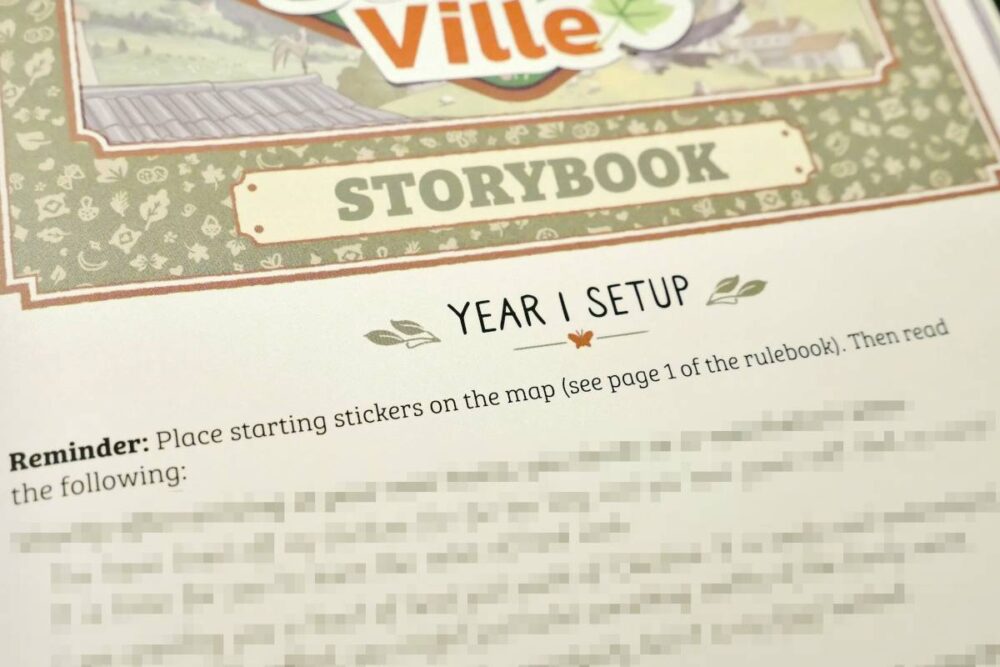
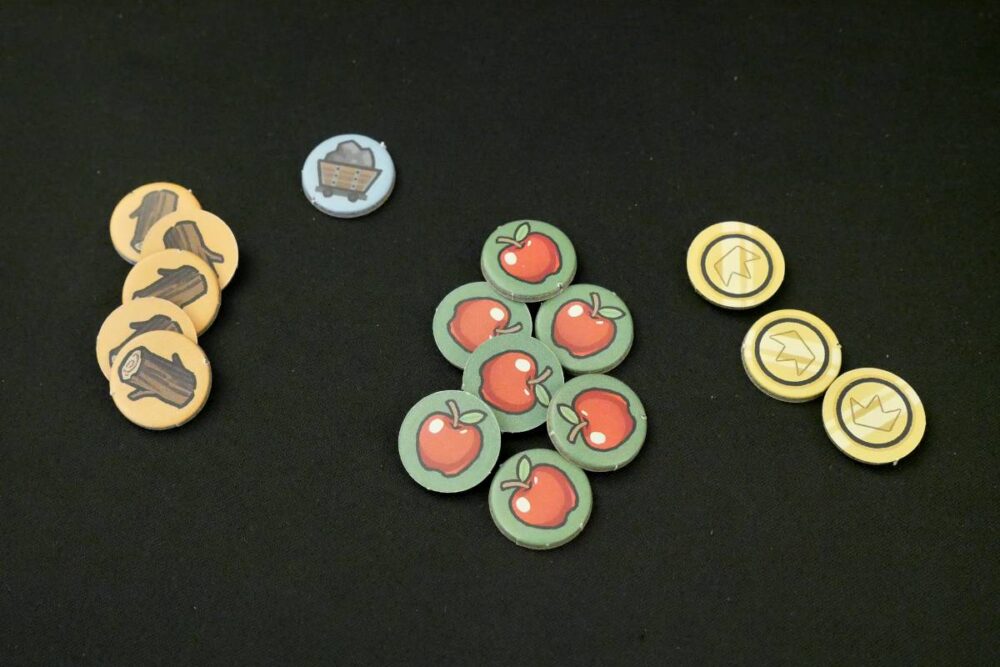
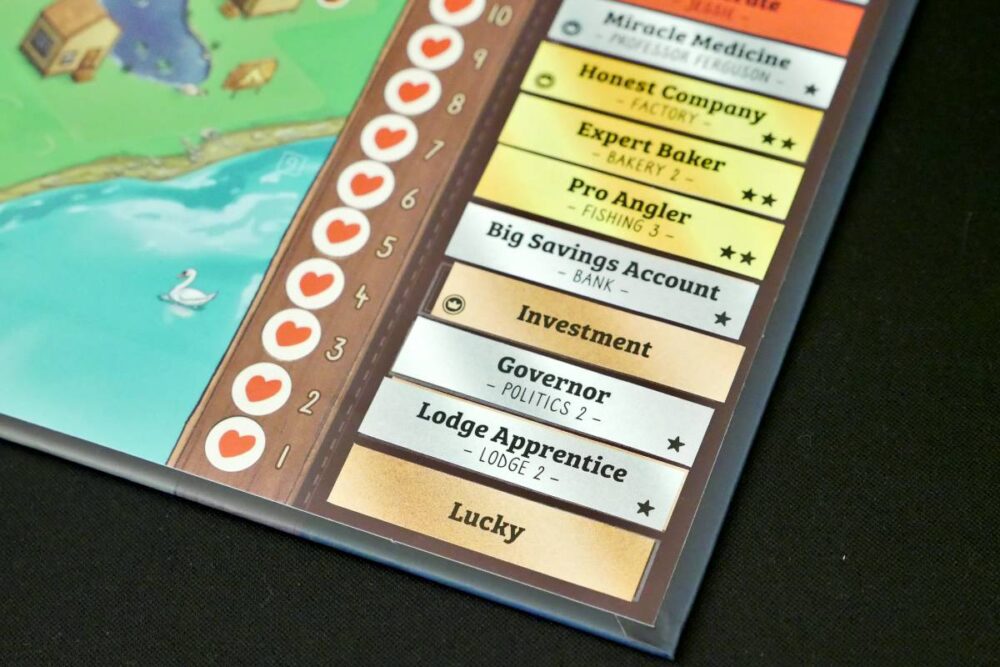
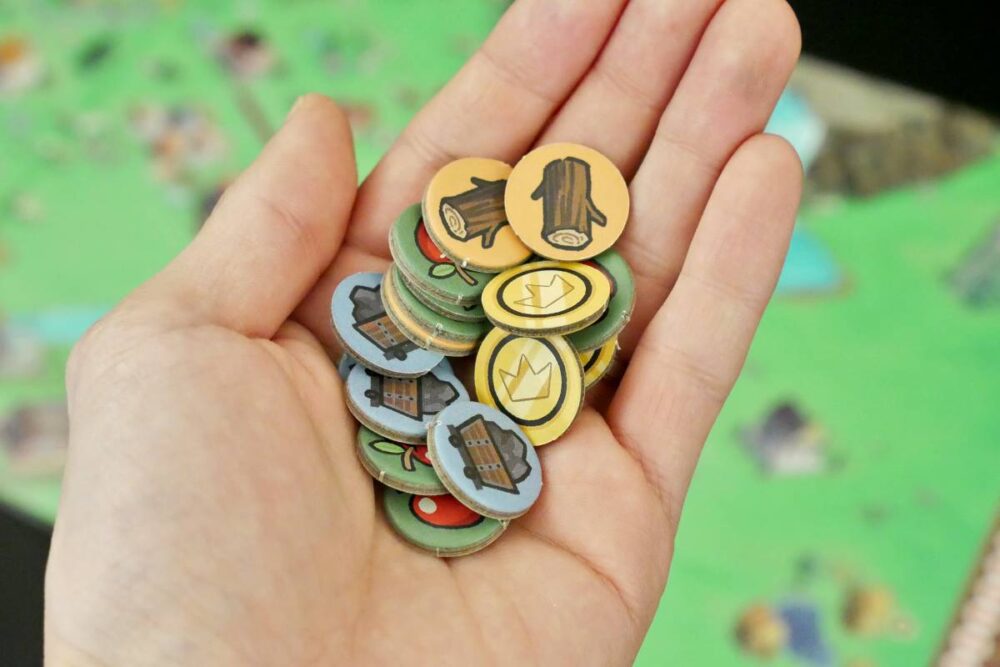
The start of a Year is simple: you read the "Year Setup" in the Story Book and do what it tells you. For the most part, that just means taking income: you earn Food, Wood, and Gold based on the status of your village. Log icons on your map stickers? That's 1 Wood each. Apple icons on your map? 1 Food each. And for every Crown icon in your milestones, 1 Gold.
Sometimes a Year might have a special event that's explained in the Year Setup, but I'll leave you to discover those on your own.
A turn in Cozy Stickerville is straightforward: you draw a card from the Event deck, do what it says, then perform an Action.
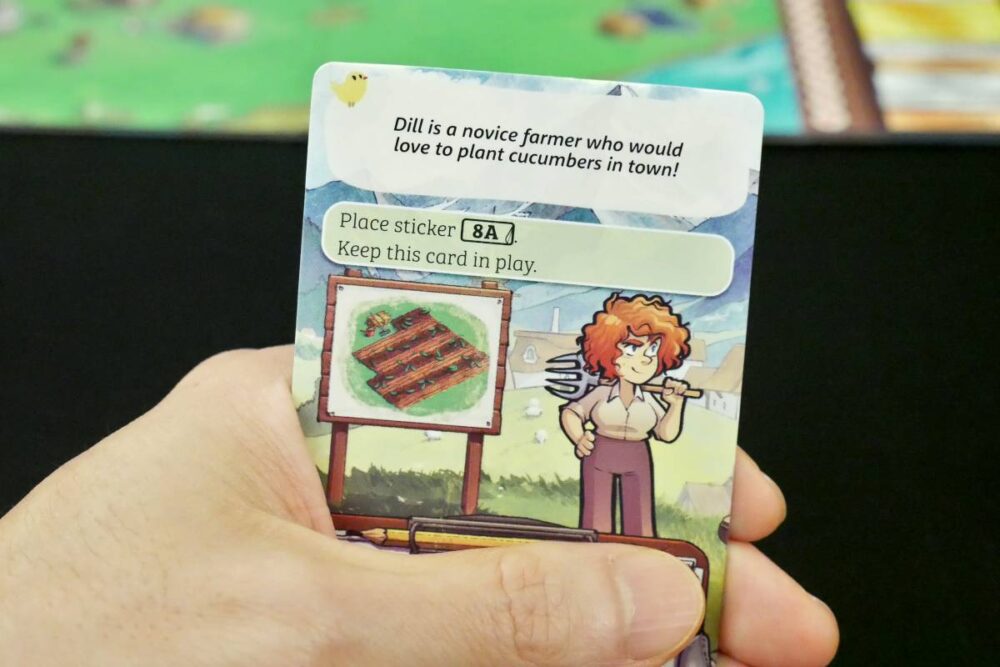
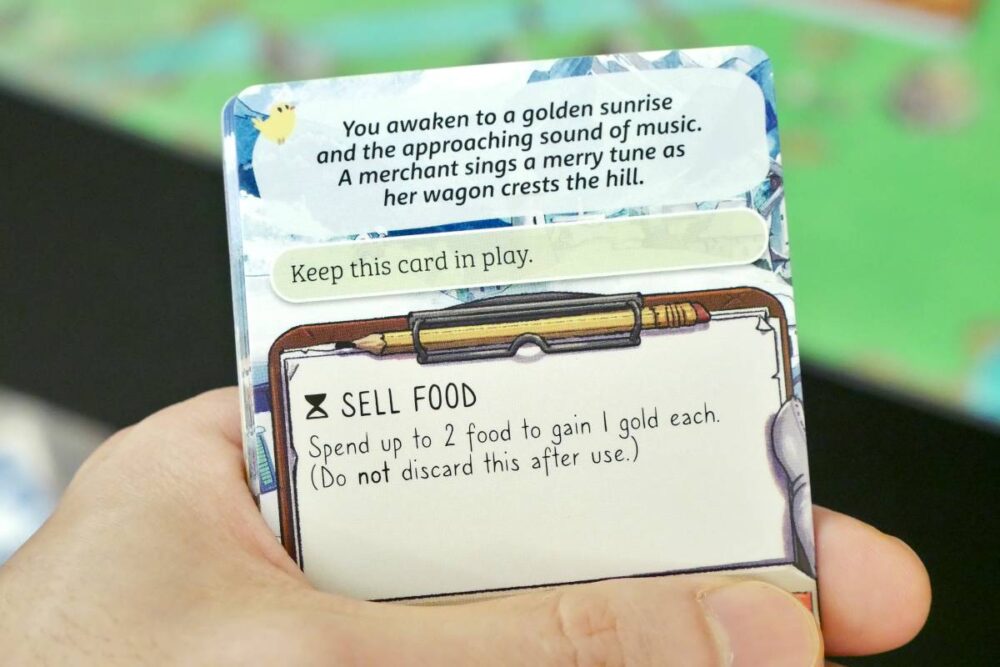
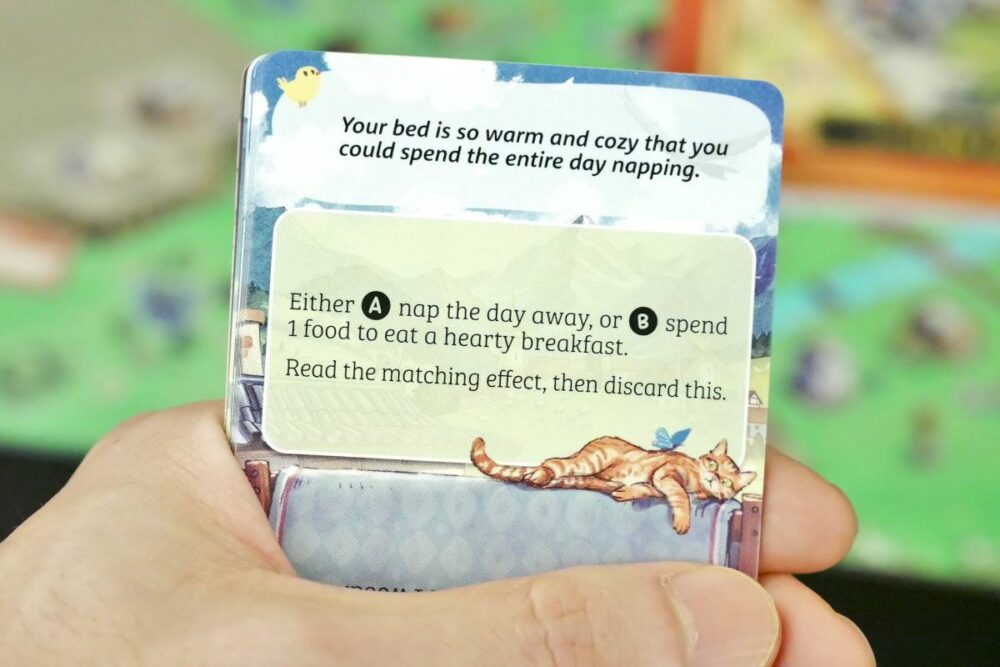
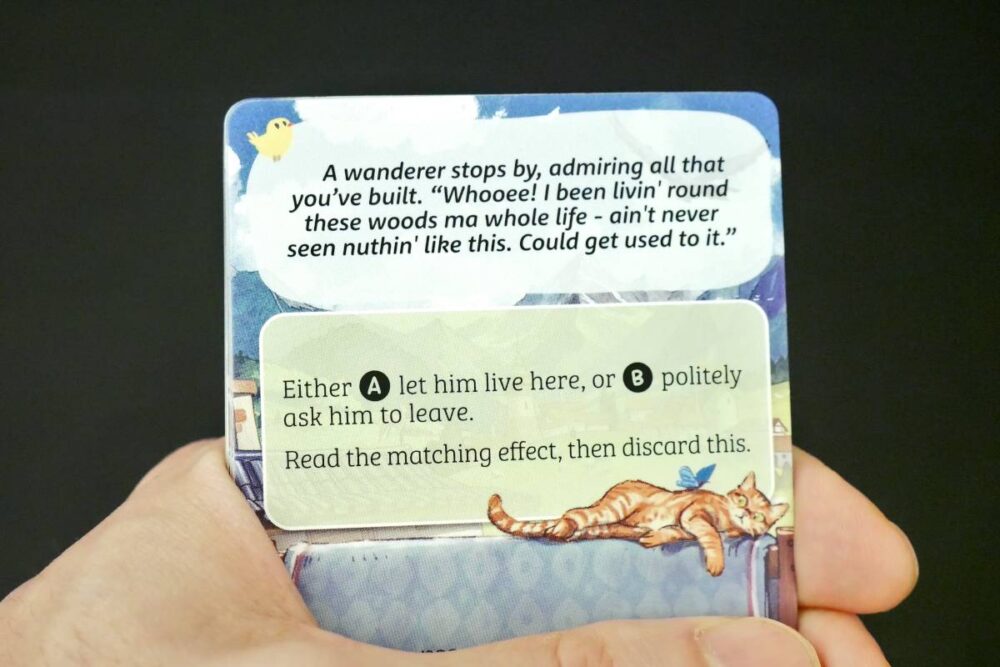
An Event card is what it sounds like: a bit of flavor text describing some kind of event that happens in your village, sometimes with a direct outcome (e.g., you lose 1 Gold because it was stolen in the night). Other times you're given a decision to make (e.g., either help your neighbor or ignore them). And other times the Event card gets added to your tableau as an Action.
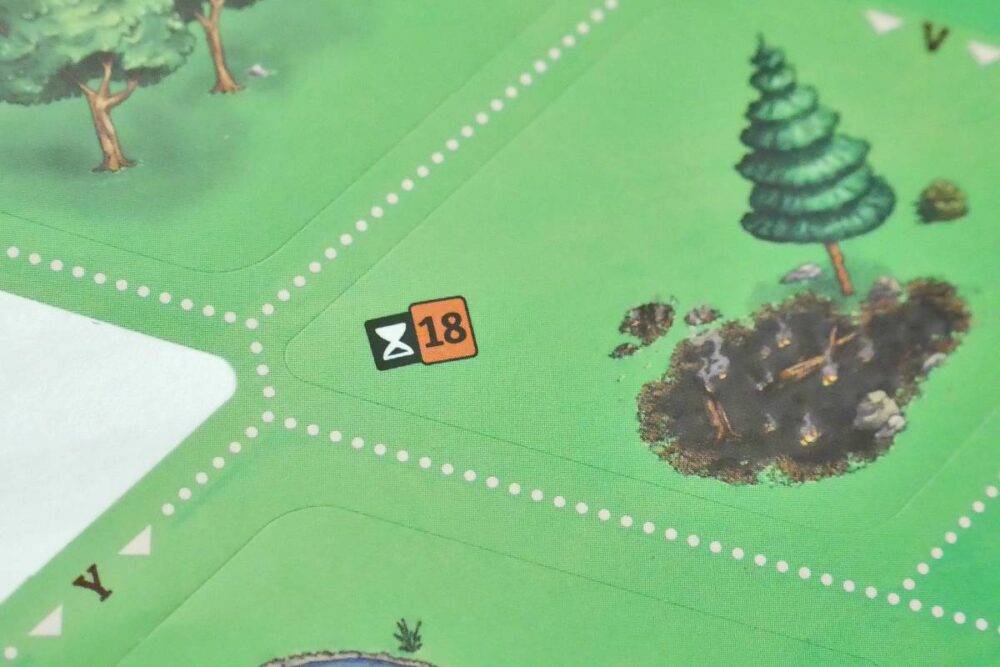
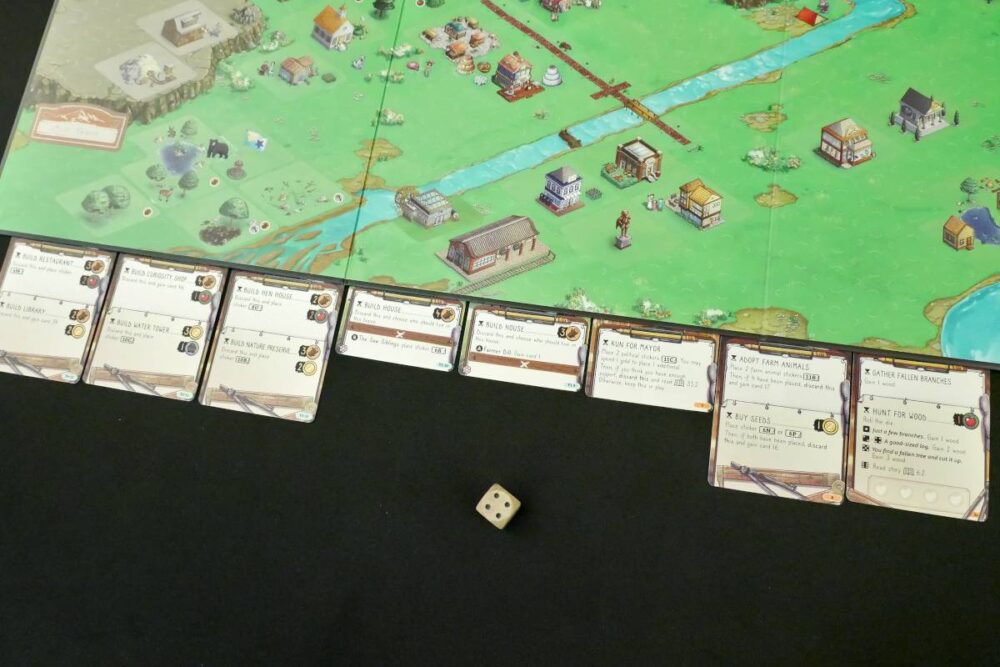
Once you've resolved the Event for your turn, you get to perform an Action. All Actions are marked by an hourglass icon. You'll find these on the stickers on your map as well as the Action cards in your tableau.
In Cozy Stickerville, Actions come in three varieties:
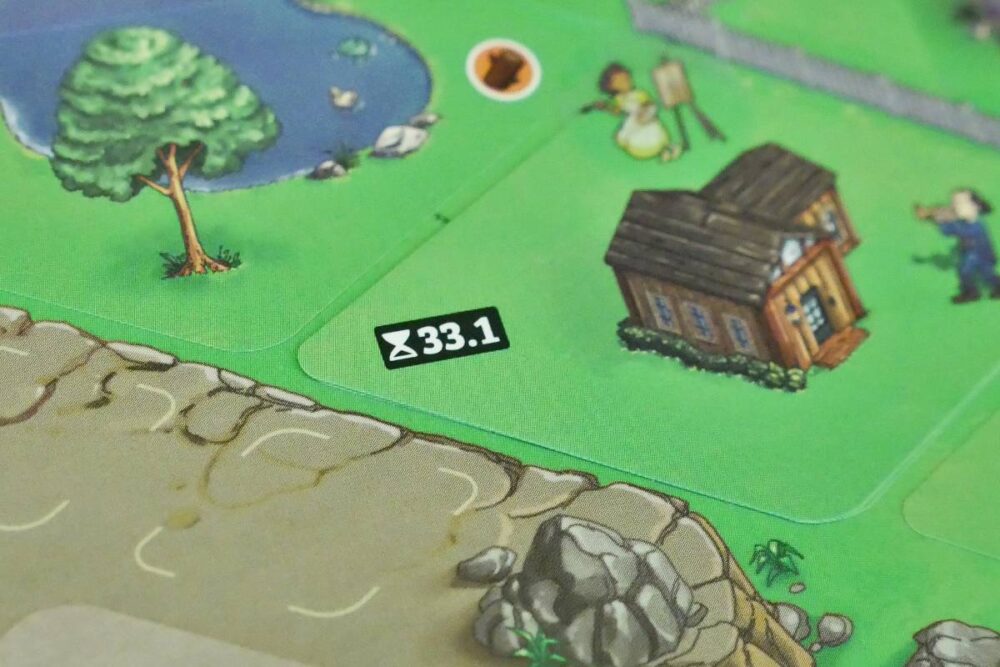
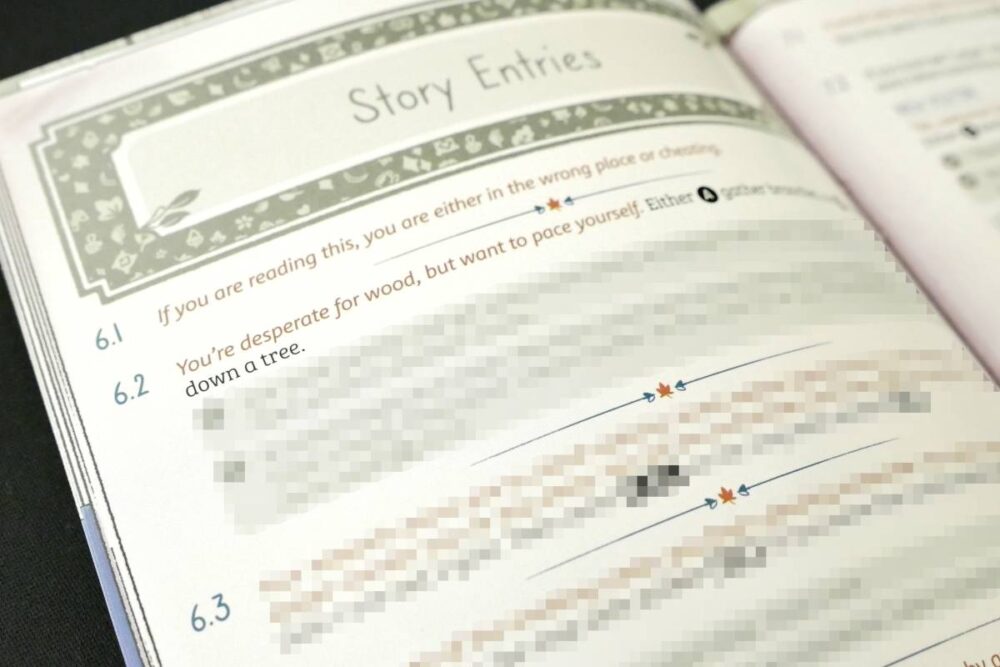
Read Story. If the hourglass icon has a decimal number next to it, you'll read that story entry in the Story Book. The number before the dot tells you which page, while the number after the dot tells you which specific entry on that page. Every story entry is like a small event with its own direct outcome or decisions to make.
Draw Card.Cozy Stickerville has a special deck of Catalog cards, which you'll uncover by performing various Actions throughout the game. A Catalog card usually represents a lore element, whether that's a new villager identity, a story-related Event, or a special Action that you've discovered and/or unlocked. Drawing from the Catalog deck is usually a big deal and therefore quite exciting.
Card Ability. Whenever an Action card is added to your tableau, you gain the ability to "do that Action" on a future turn. The card itself tells you what the Action does, so all you have to do is pay the resource cost (if any) and then follow the instructions. Some cards can be used multiple times, while others are one-time use. Some cards offer different Actions but you can only choose one of them.
There's a little more to the game than I've described, but I'll leave you to explore and discover those things. Cozy Stickerville ends once you've completed Year 10, at which point you'll assess your village and get 1 of 5 different endings. (You can't "win" or "lose.") You'll also get to play through a second time on the reverse side of the Map Board.
The Save System
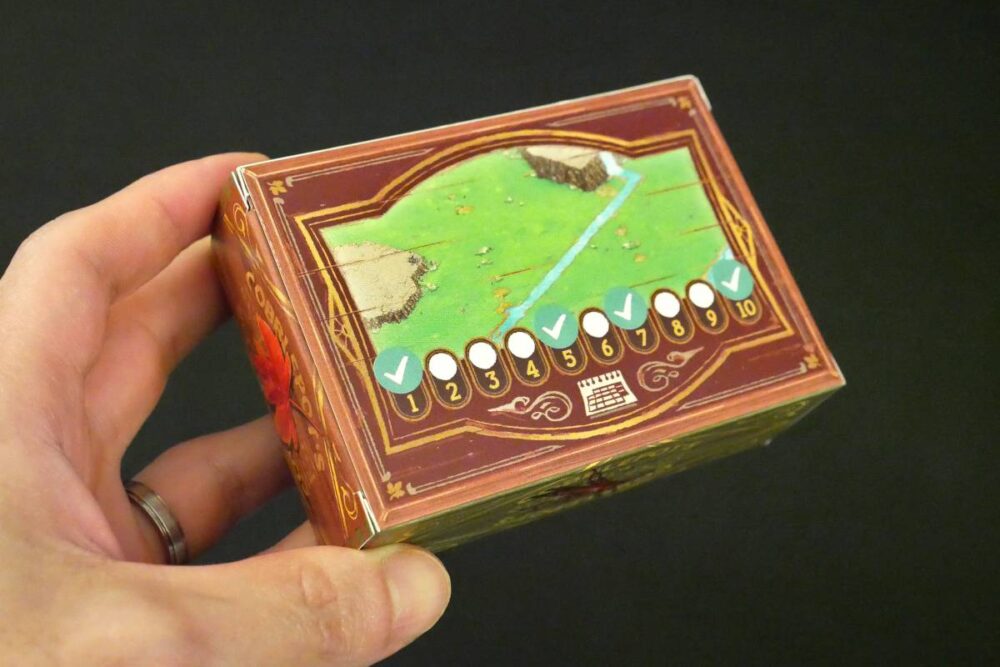
Cozy Stickerville has an ultra-simple save system that makes it easy to pack up your progress and resume at a later time without losing anything. All you gotta do? Shove everything into the Save Box!
That means all the cards currently in your tableau, plus all the unspent resource tokens in your possession. Close the box and mark it with a Progress sticker indicating the latest Year you completed.
When you resume, just open the box, dump its contents, and organize the cards in your tableau. You're ready to go!
Setup and Table Footprint
I love so many aspects of Cozy Stickerville, including how quick and painless it is to set up and start playing. A lot of that is thanks to the ultra-simple save system, which facilitates an easy pack-up and resume. I appreciate the stress-free approach to stopping and starting.
With Cozy Stickerville, I can pull out the box and be ready to play in about 3 minutes. I just have to unload the Save Box, take out the Year cards for the next Year, and shuffle them up. I also dump the resource tokens off to the side somewhere and take out the Catalog deck. That's really it!
I also appreciate how compact it feels on the table.Cozy Stickerville is thoughtfully designed, maximizing how much it offers while minimizing how much space it needs. A small table is all you need.
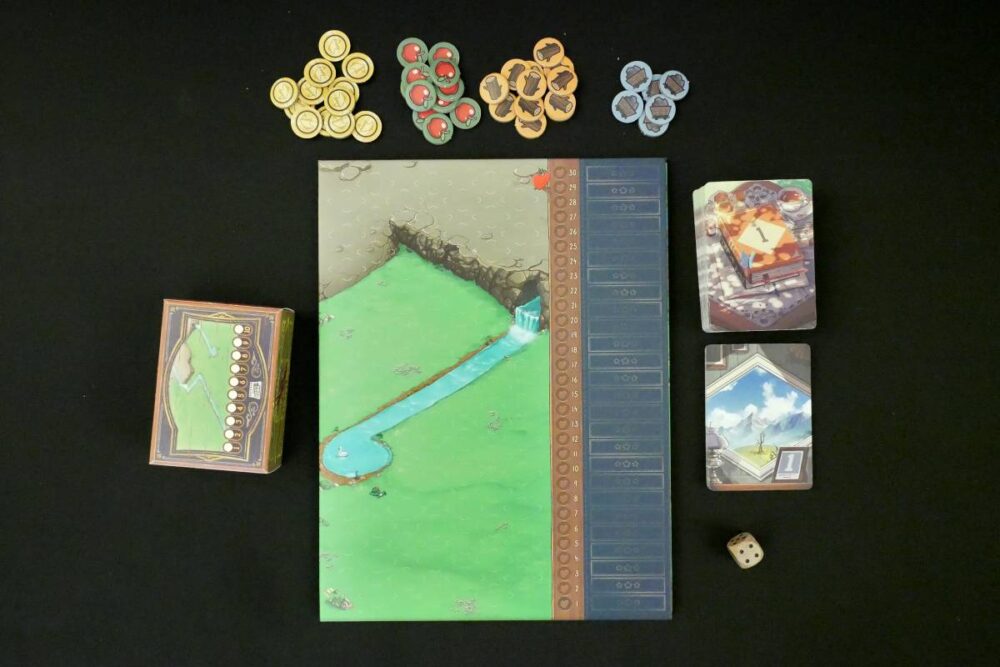
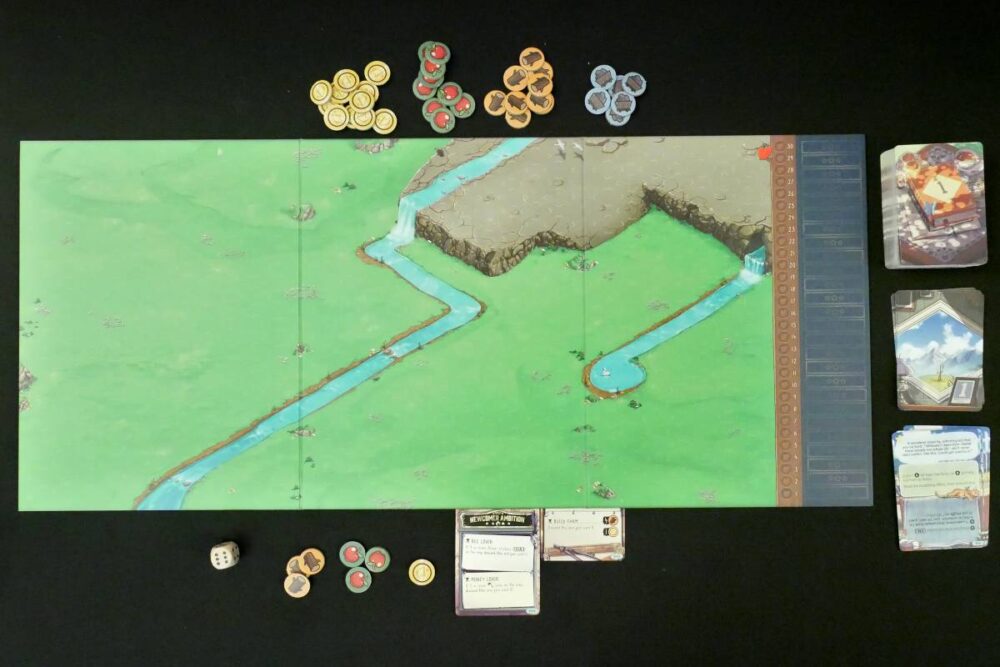
The Map Board is the biggest element, of course. Next to that, you just need a small area for the token supply, the Catalog deck, the Year deck, and a discard pile. As for your tableau, your cards slide under the Map Board's edge, taking up not much space at all. And that's it, really.
You may also need room for the Sticker Book and Story Book, but if you're really tight on surface space, you could play with these in your lap.
Learning Curve
Cozy Stickerville is a true made-for-everyone experience. Not only is it super straightforward to set up, it's extremely simple to play: just draw a card, do what it says, then choose an Action and do what it says.
In many ways, Cozy Stickerville is an on-rails activity. If you've ever read a choose-your-own-adventure book, then you know exactly what to expect here. The game effectively plays itself—all you have to do is choose which paths you want to take when presented with multiple options.
That simplicity means anyone can play Cozy Stickerville. Yes, seriously! Even your grandma or grandpa who's never played a board game or card game in their entire life can enjoy this one, although you might want to be there to guide them and answer any questions they might have. (The one caveat is that it's language-heavy. No surprise given it's so story-driven.)
Cozy Stickerville's rulebook is perfection. It takes you through the flow of the game and explains everything fully and succinctly. It's structured with smart sections and headings so rules are easy to reference. The Story Book is also ingeniously designed, with zero ambiguities. Cozy Stickerville is excellently produced and easy to play. It's for the whole family.
Game Experience
Decision Space
What really surprises me about Cozy Stickerville is that it's "just" a choose-your-own-adventure game with a bunch of linear stories, but isn't a brainless experience. In fact, the decisions can be pretty tough at times!
Every turn starts with a decision. You draw one of the 12 Event cards for the current Year, and every Event card presents some sort of occurrence or happening. Maybe new villagers want to join you, or something's been eating your food at night, or you're hungry and craving a bigger breakfast. You then make a decision: Which of two villagers do you want joining your village? Do you investigate the missing food? Will you eat a bigger breakfast (i.e., spend valuable Food tokens) to gain an extra Action this turn?
Lots of Event cards are simple and small, but they're mixed in with bigger decisions with bigger stakes. Some have permanent consequences, so you're never quite sure what the right decision is, especially when there are potential risks involved. The fact that every Event card presents an active decision is what makes them so much more interesting than "here's what happens, now do this"-style passive Events seen in other games—and making these decisions keeps you engaged and invested every single turn.
Another thing I like about the Event card choices is that there usually isn't a "right" decision. Some are riskier than others and can have negative consequences, but you can glean that from how the scenario is described and decide accordingly. And even when you get a "bad" outcome, it never feels unfair. The Event cards are full of unexpected twists (so you're kept on your toes), but they make sense (so you don't feel frustrated).
Of course, Cozy Stickerville is more than just Event card decisions. That's only the first half of your turn. The second half of your turn involves taking an Action, and this part is way juicier with more player agency.
You always have an abundance of Actions available. Maybe not in Year 1 when you're still settling into your new village, but certainly in Year 2 and beyond. As you make your Event card decisions, you'll gain new stickers on your map and new cards for your tableau. Those map stickers often provide new Action spots (that you'll use to interact with those points of interest), and those new cards also provide new Actions to perform.
What this means is, your pool of potential Actions is constantly expanding. You're never starved for choice. In fact, Cozy Stickerville is so generous with its offerings that you might even feel overwhelmed at times. I remember at one point during Year 6 or Year 7, I had so many cards in my tableau and kept being pulled towards newer plots before finishing older storylines.
This is all part of the design. You simply can't do everything in Cozy Stickerville because you don't have enough Actions per Year for all the Actions on your map and in your tableau—and that just makes your decisions that much more important. If you can't do everything, then you have to be intentional about what you do do.
And I haven't even talked about the resources yet!
In Cozy Stickerville, you begin every Year with income. The trees on your map give you Wood. The bushes give you Food. Your milestones give you Gold. (Nothing gives you Ore, though! That's for you to figure out.) You take an income at the start, then you spend those resources on various Actions and Event decisions and Story options throughout the Year (like spending Wood and Gold to build houses for new villagers or spending Food to advance one of your storylines with a neighbor).
The tough part is making your resources last an entire Year. You feel so rich after taking income, but it's extremely easy to burn through it all within just a few turns if you aren't careful. And while there are ways to earn extra resources mid-Year (like going fishing at the pond to gain Food), you have to spend a precious Action to do so—and if you think about it, your finite number of Actions per Year is your most valuable resource of all.
So, how are you going to divvy up your Food, Wood, Gold, and Ore for the Year? That's the true source of decision angst in Cozy Stickerville. It's about determining which Actions you want to pursue (and neglect), carving out a path for a given Year, then effectively allocating your resources to those Actions (and figuring out how to earn more resources along the way).
Who says there can't be interesting decisions in a choose-your-own-adventure format? Cozy Stickerville absolutely nails it. The whole game is one interesting decision after another, punctuated with unexpected twists and surprising developments that prevent the game from ever feeling too repetitive or stale. (And don't worry about analysis paralysis! There's a wealth of choices, but they're simple and don't require heavy thinking.)
Luck Factor
There are two main elements of luck in Cozy Stickerville. And you know what? In retrospect as I write this review, I have to admit that the game can be pretty random at times—or, if not random, at least unpredictable. If you can't handle uncertainty or things not going your way for reasons beyond your control, then you may not have a good time.
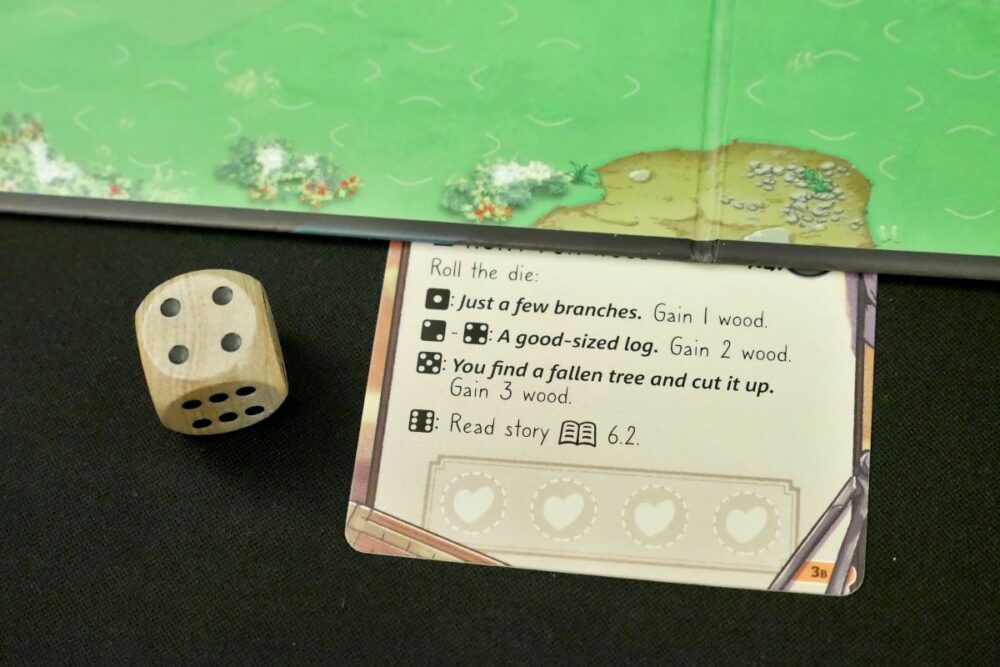
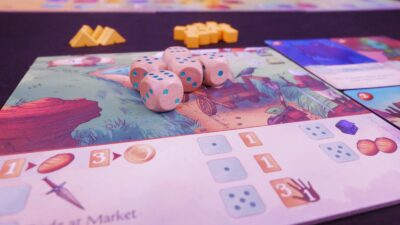
The first luck element? The Decision Die. Some Actions and story entries—not too many, but enough that it matters—will have you roll a die to determine the outcome. In one instance, rolling a 1 or 2 could be bad while rolling a 3, 4, 5, or 6 could be good. Or maybe it's all bad except for rolling a 6, which happens to be special. Most of the time your one roll is final, although there are a few that let you fudge your results a bit.
But I have to say... it sucks when a plot or Action is messed up by a bad die roll. You might lose a turn because you have to come back and try again later, or you might be locked out of an entire story path. I thought modern board gaming had evolved past roll-and-see-what-happens gameplay, but apparently not. It's a minor issue... but it sucks when it happens.
The second luck element? Blind outcomes. The die rolling wouldn't be so bad if you knew what you're aiming for and could hedge your bets accordingly, but you can't. You don't know what the outcomes are until after you've made your choice, and by then it's too late. Sure, you could argue that blind outcomes are there for mystery and surprise... but that doesn't mean it isn't frustrating as a gameplay mechanism.
Blind outcomes also apply to non-random decisions. For example, a strange person walks up to you and says something cryptic, then you must respond in one of three ways. Which answer is best? Beats me! There's no way to know how any decision will play out. You can sometimes deduce an outcome based on how you think it'd might go in real life, but the game also throws curveballs when you least expect it... so you can never quite know.
To be fair, blind outcomes are what choose-your-own-adventure stories are all about, so I'm not counting this as a knock against Cozy Stickerville. I'm just mentioning it so you're aware before you buy it.
Fun Factor
I haven't had this much fun in a while. Cozy Stickerville is true to its name, evoking a real sense of warm coziness as you journey your way through from empty village to bustling town. The gameplay is light, but the decisions are meaningful. There's drama and conflict as you progress through the different storylines, and you have limited resources so you simply can't do everything you want to do. It's chill, but it's also engaging.
I just find the whole experience so satisfying. The peeling of the stickers, the gradual evolution of the village, the shrinking of my tableau as I complete different Actions and story beats. On top of that, Cozy Stickerville is fun because you get to see how your very own village unfolds according to your own decisions—and as you make choice after choice, events build on each other and snowball in ways that are unique to your village. Then, when you're done, you can share your village online and see how others did.
If you play with a partner, there's another layer of fun as you discuss the various story beats and deliberate over what Actions to do, which villagers you want to invite or shun, whether to neglect or pursue that innocuous discovery you made last Year... and then sharing in the excitement of the plot twists you encounter. I got caught up in it and loved every moment.
Pacing
What surprises me most about Cozy Stickerville is its impeccable pacing. We've seen this sort of thing a million times in video games, mobile games, other board games... but it takes real design skill to nail the progression so well. It can't be so slow that it drags and you start to lose interest, nor can it be so fast that it's either overwhelming and/or unsatisfying. But it's perfect here. You start with nothing and grow at just the right speed.
In fact, Cozy Stickerville hits me with "just one more turn" syndrome. I don't usually get this in board games—more in video games—but Cozy Stickerville manages to do it. When a Year ends, I can't help but feel that itch inside. I'm compelled to bust out the next Year deck and keep going. And the game makes it so easy to do so. The design is so clean, you can't help but think "Might as well keep going!" And keep going I did.
What I'm trying to say is that Cozy Stickerville's turns are so simple, so quick, and so fun that you're swept along for the ride with almost zero friction. You face an Event card, make an Action, and you're done. Turn after turn, you make real progress and snowball upwards. You're constantly gaining new Actions, new stories that beg to be explored, new goals that pull you in new directions—and you can't do it all. You merely do what you can.
There's very little downtime and the sessions fly by. You blink and suddenly 30 minutes have passed, the Year is over, your village has grown, and you're still in the middle of all these stories... Can't stop now!
Player Interaction
In one sense, there's no player interaction in Cozy Stickerville because you aren't actually playing as separate players. Rather, you have one village and you're just taking turns making decisions.
But when it comes to the decision making, there can be as much player interaction as you want. Want each player to make their choices in isolation with no input from anyone? You can. Want to discuss every single choice and make sure everyone is on board with the answer? You can!
Because of that, there could be some quarterbacking. If you have a particularly bossy or picky player in your group, they might strong-arm you on your turn and force certain choices. But given how low-stakes and exploratory this game is, I don't see that being a huge issue.
Player Counts
As someone who played it from start to finish with his wife, let me tell you: Cozy Stickerville is best played at 2 players. You alternate taking turns—so that's 6 turns each per Year—and you have someone to share this magical journey with. You can debate and discuss whether those newcomers should join your village or whether those neighbors deserve your help. It sprinkles a little something extra on top that brings out the game's fullness.
You could play it solo, but I don't think it'd hit quite the same. Would I play it solo? Absolutely. The gameplay and story are no different regardless of how many players are involved. But it may fall a little flatter when alone.
Meanwhile, I don't think I'd want to play this with 3+ players. I don't want to wait that long between turns and I don't want every major decision to be conducted via committee vote. To be fair, I haven't actually played it at 3+, but I can imagine what it'd be like... and I think it'd detract from it.
Fiddliness
Cozy Stickerville isn't fiddly at all (with one caveat). Story-driven adventure games are often overloaded with components—cards, tokens, dice, etc.—to maximize gameplay, but as a result suffer from excessive administration and too many moving parts. Not so here. The tokens and cards are few and easy to manage; it never feels overwhelming or too much.
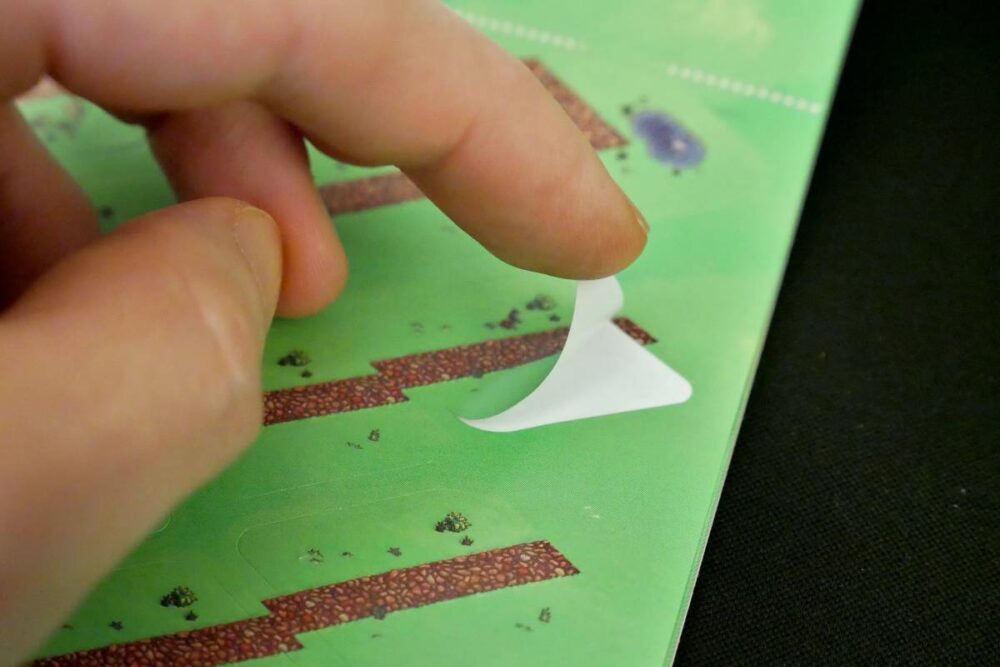
The only bit that could feel fiddly? Peeling stickers from the Sticker Book and placing them on the Map Board. This could be a problem if you have trouble with manual dexterity—some stickers are small and precise, and you'll be peeling and sticking all the time.
I LOVE all the peeling and sticking, but I also admit that the whole process is therapeutic to me. If you have physical limitations, or simply don't like peeling and sticking, then Cozy Stickerville may indeed be too fiddly for you.
Replayability
Cozy Stickerville is a legacy game, which means it's a one-time experience. You make permanent and irreversible changes with your decisions, and there's a finite number of times you can play. You'll eventually reach the end and won't be able to play any further.
But there's plenty to explore in Cozy Stickerville, even if it eventually runs out. The full playthrough is 10 Years, and each Year takes about 30 to 45 minutes. After that, you unlock a second playthrough of another 10 Years. That's 20 total gaming sessions, or about 10 hours of entertainment. (Be honest: how many games on your shelf have you played at least 20 times?!)
In that sense, Cozy Stickerville has some replayability—and in my eyes, it's high-quality replayability. Every Year is addictive and satisfying, to the point where I've had to force breaks so I didn't burn through it all too quickly. I wanted to savor it as much as possible. It's been a long time since a game made me feel like this, and that alone is worth the price of admission.
Not to mention the genius of the second playthrough. All of the major decisions you made through the first playthrough are locked during your second time through, so you get to experience a whole new side of the game (most of the stories you skipped before).
All in all, Cozy Stickerville packs a ton of substance into 20 total plays. It's extremely compelling and rewarding from Year to Year, and it pulls you right along from start to finish. Don't let its finite lifespan turn you away. I paid a full $33 for it and I have no regrets—it was worth every penny.
Production Quality
Cozy Stickerville is a marvel. Unexpected Games walked an incredibly fine line here, giving us a premium sticker experience while exercising restraint where necessary to keep the price (relatively) down. The game is thoughtfully made and effective, without being wasteful. I'm impressed by it every time I look back at my board and appreciate my village.
The card designs and sticker artwork are excellent. The aesthetic is warm and playful and inviting, while the graphic design and font choices are clean and structured yet full of personality. It gives big Stardew Valley vibes, even more so than Stardew Valley: The Board Game! Okay, maybe not... but there's absolutely no question that this game is ultra cozy. The village just feels pleasantly alive from the very first sticker.
I also want to give kudos to those tiny little identifiers on the bottom-right corners of each card. They're cleverly labeled and colored so you can instantly tell which Year and/or Catalog deck they come from, making it very easy to separate it all out and reset for your second playthrough.
The stickers use high-quality adhesive. There will be times when you need to unstick stuff from the Map Board, whether due to accidental placements or story progressions. The adhesive in Cozy Stickerville is strong enough that nothing comes off prematurely, yet not so strong that things rip when you go to unstick something. Nor does it leave residue behind.
It's so good that it actually has me wondering why real-world stickers aren't like this. I've never used such high-quality stickers before.
The Sticker Book is smartly organized. Whenever you're told to add a new sticker to the Map Board, that sticker is identified by its page number followed by a letter. You'll always find the right sticker. It's impossible to mess up (as long as you're paying attention). Sure, it may not be a world-shattering innovation, but it does make the gameplay as smooth as possible.
My only wish is that Cozy Stickerville came with a pair of tweezers. Some of the stickers are thin and/or small, which can be hard to peel for thicker fingers. I know tweezers were left out for cost reasons, but still...
The Story Book is easy to read and intuitive to navigate. You'll be constantly picking up and putting down the Story Book throughout play, so it's vital that it never starts to feel cumbersome or repetitive. Fortunately, Cozy Stickerville nails it—the Story Book is small and manageable, easy to pick up, easy to flip through, easy to read. When you're told to read a certain story entry, you're given the page number and entry number. And given that most story entries are decisions you need to make, I like the low-contrast answer text that makes it hard to accidentally spoil yourself. I can't think of a single way the Story Book could be improved. It's a joy to interact with.
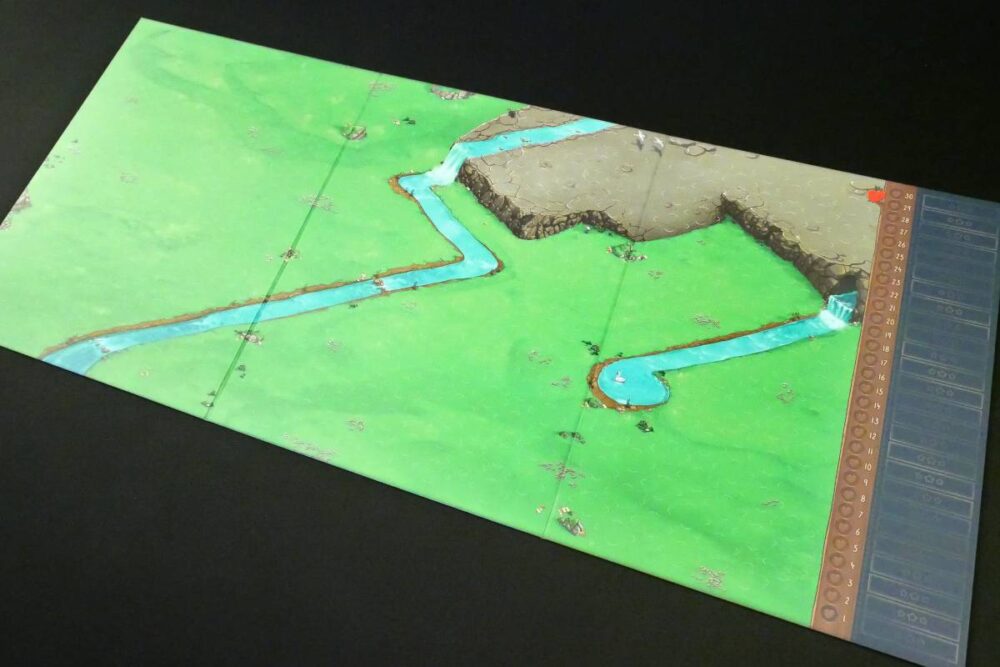
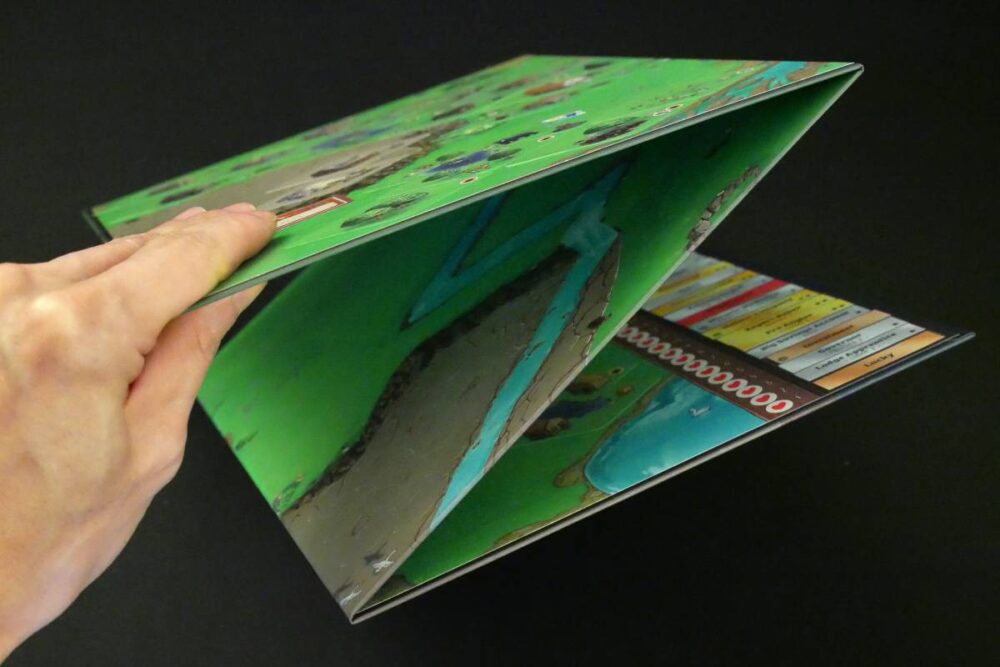
The Map Board is thick, looks great, and folds/unfolds easily. The moment you open the Map Board for the first time, you're hit with tons of open space and infinite possibilities. There's so much character just in the artwork and map layout, and you can't wait to see how it's going to evolve with all the sticker freedom afforded to you. The board itself is constructed well from robust chipboard, reminiscent of a good Monopoly board, especially in how well it folds. I like the tri-fold design, making it easy to pack and unpack, without being too big and allowing the box to stay reasonably small.
The cardboard resource tokens are great.Cozy Stickerville could've gone overboard with metal coins or wooden tokens for its resources, but I'm glad it didn't. The extra-thick cardboard used here is hefty enough that it doesn't feel cheap and remains easy to pick up and handle, while keeping the overall cost down—important for a game with finite plays, as the price is already somewhat high due to the hundreds of stickers. I love the icons and artwork on the tokens, too. Very readable and aesthetically fitting.
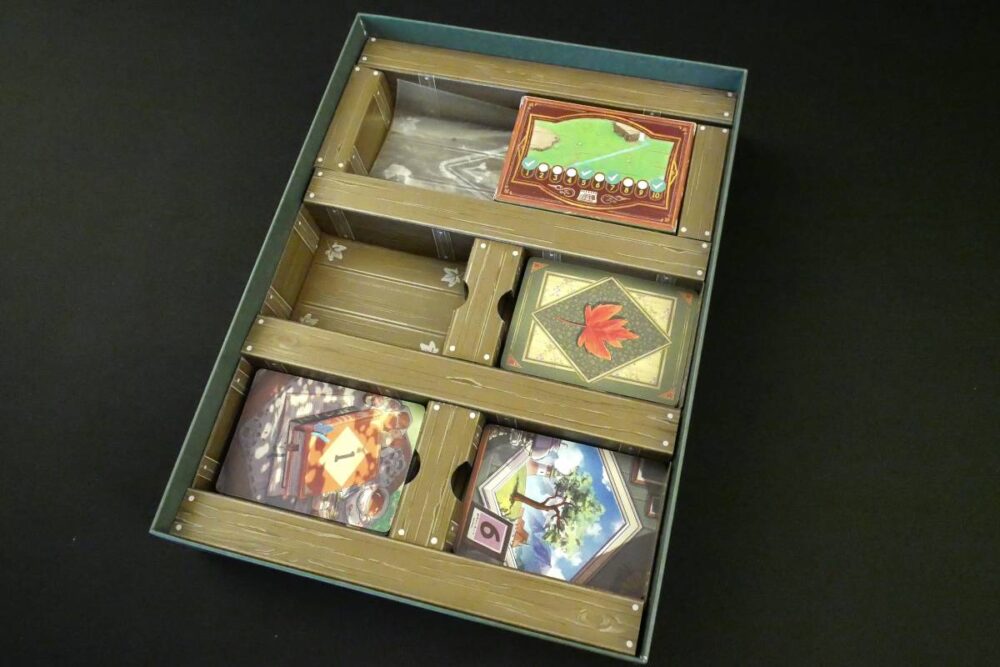
I love the game box size and insert. I didn't realize it until a few games in, but Cozy Stickerville's box is designed to look like a book! That's pretty cool given the whole story-driven framing of the game. I appreciate the size and shape—neither too big nor too small, sits comfortably on my shelf without any awkwardness. I also love the insert with its four wells for the different cards: two for unused cards and two for spent cards. Combined with the Save Box (more on the save system), it facilitates fast setup and cleanup. And this time, I'm actually glad they went with card stock instead of plastic! It reinforces the nature theme and keeps cost down even more.
The Bottom Line
Cozy Stickerville was a revelation for me. Between the lovely stickers, decisions with permanent impact, fun story beats, clean tableau management, and "just one more turn" addictiveness, it's one of a kind. I've never been keen on narrative/legacy games, but I loved this one—and it even got me itching to explore more games like it! I know the $40 retail price is hefty for a "sticker activity," but I got my money's worth from this one-time experience.