I feel like I'm the only one who sees Take Time for what it is: a gorgeous siren that lures you in with its incredible artwork only to devour you with lackluster gameplay. It might just be the worst limited-communication co-op I've played. Yes, even worse than The Mind, to which it's often compared.
Take Time wants you to feel clever, but doesn't give you the tools needed to make truly clever plays. It paints itself as a game of logical deduction, but it's hazy, chaotic, and lucky—a good thing if you struggle with co-op deduction and hate being the weak link every time, bad if you want an actual game.
This review is based on my own personal copy of Take Time, which I bought new from Game Nerdz. Not a free review copy.
Table of Contents
View more
What It Is
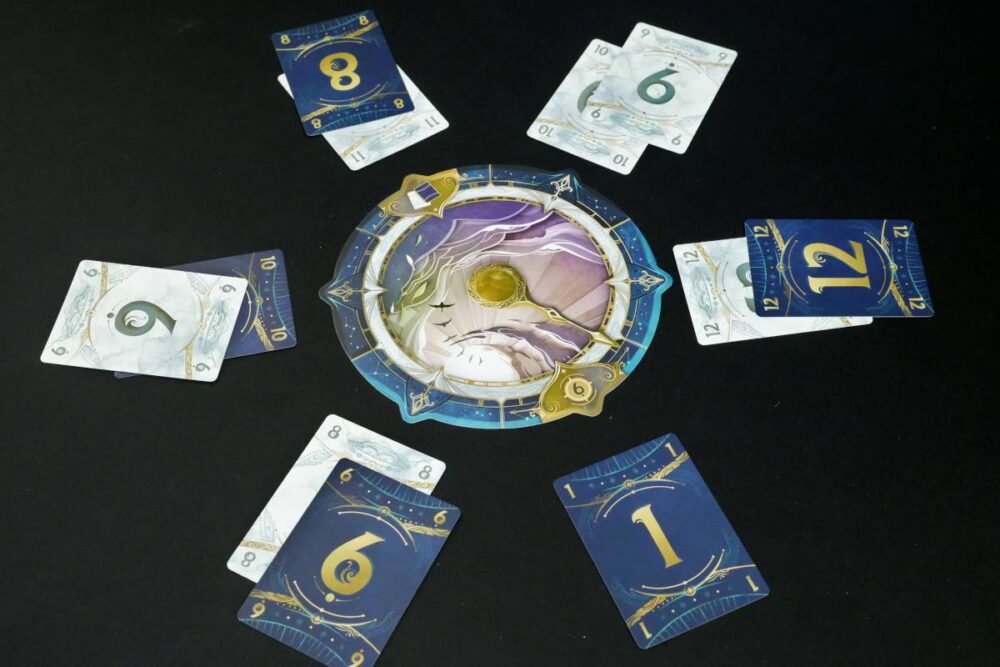
Take Time is a cooperative mind-melding card game for 2 to 4 players. The game consists of a 24-card deck (1–12 dark Solar cards and 1–12 light Lunar cards) and 40 "clocks," each its own scenario with special rules that mix up the gameplay. Every clock has six segments to play your cards into, and the goal is for each segment's value (the sum of all cards in that segment) to be greater than or equal to the one before it in clockwise direction. At the same time, the value of a segment can't exceed 24.
The catch? All cards are played face-down. The second catch? There's no talking once you pick up and look at your hand. Your turn is dead simple: play a card face-down to one of the segments. Turn by turn it goes until everyone has played all their cards. Then, it's time for the reveal. Segment by segment, the cards are flipped over and evaluated. If the segments around the clock are in ascending order, you win. Otherwise, you lose.
The one wrinkle is that you can optionally play a card face-up whenever you want, but the group is only allowed between 2–4 face-up cards (depending on player count). As for the clocks, they introduce new restrictions and obstacles as you progress, such as: only Lunar cards in this segment, no 6/7/8 cards in that segment, the first card of the game can't be played in this segment, etc.
How It Feels to Play
The Information Gap
In my 15th game of Take Time (each game is like 5 minutes), it finally clicked. I sat there, staring at my hand, trying to decide what to play in response to the face-down card my wife just played—but I didn't know what to play because I didn't know what she played. Yes, of course, that's the entire point of the game... but even in a game of hidden information and limited communication—or especially in a game like this—you need details on which to build your inferences and deductions. Even if I can't see what she played, I should be able to suss it out. But Take Time doesn't give you enough to do that.
What information can I glean from this card placement? It's a dark Solar card and it's not a 1, 2, or 3. Will I be able to narrow it down even further? Unlikely.
Everyone starts the game with a randomly dealt hand of cards, but only half the deck is used. The other half is set aside and you have no idea what's in there, which means you have no idea which cards are in play. So when my wife plays a card to a clock segment, it could be a White 1... or maybe not because none of the White 1s were dealt. Between the luck-of-the-draw starting hand and incomplete knowledge of what's in play, you're never reasoning from data. You're only guessing from vibes.
Maybe this information gap exists for replayability, ensuring that "no two games are alike" with only half the cards being used. Or maybe it's meant to inject randomness, lifting the pressure that comes from perfect knowledge of what's out there. It certainly softens the skill floor and lets you make your decisions on a whim—in fact, the game almost encourages it. But a deduction game that rewards smart insights and clever plays? Take Time is not it.
Fast Play With No Real Tension
Turns in Take Time are fast, and that's a big point in its favor. You only have 3 or 4 cards in hand at any given time, and you only have so many spots to place a card. You're paying attention on everyone else's turns, imagining what they could be putting down so you can adjust accordingly. Downtime is minimal. Turns zip by. The whole round is over in minutes. If you've read my other reviews, you know how much I value snappy turns.
But here, the fast play is to the game's detriment. You only make 3 or 4 plays and the clock is already over. There's no time for tension or anticipation to grow. Boom-boom-boom, okay—let's reveal! Limited communication games live or die by how taut the silence feels, by how much nail-biting you do as you hope no one makes a mistake. Between the near-fully-hidden information and the blink-and-it's-over pace, you get none of that.
So when you get to the end and flip all the cards to see if you succeeded, you hold your breath for a second... and that's it. Win or lose, it's gone in a flash.
Shallow Strategic Depth
Take Time tries to mitigate its aimless, unstructured design by splitting the game into two phases: the pre-game discussion phase, then the silent execution phase. That pre-game phase is there for strategizing, to give everyone some idea of a plan to work towards together. The discussion happens after all the cards are dealt, but before anyone looks at what they have. The color distribution (dark Solar cards and light Lunar cards) gives you the tiniest bit of information to hinge your strategic talk on.
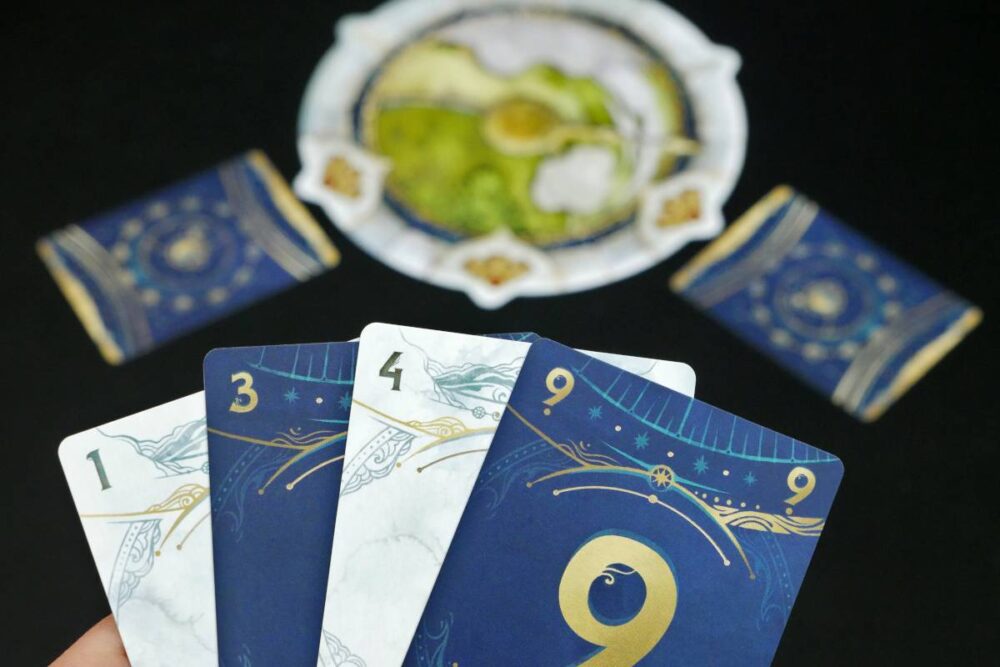
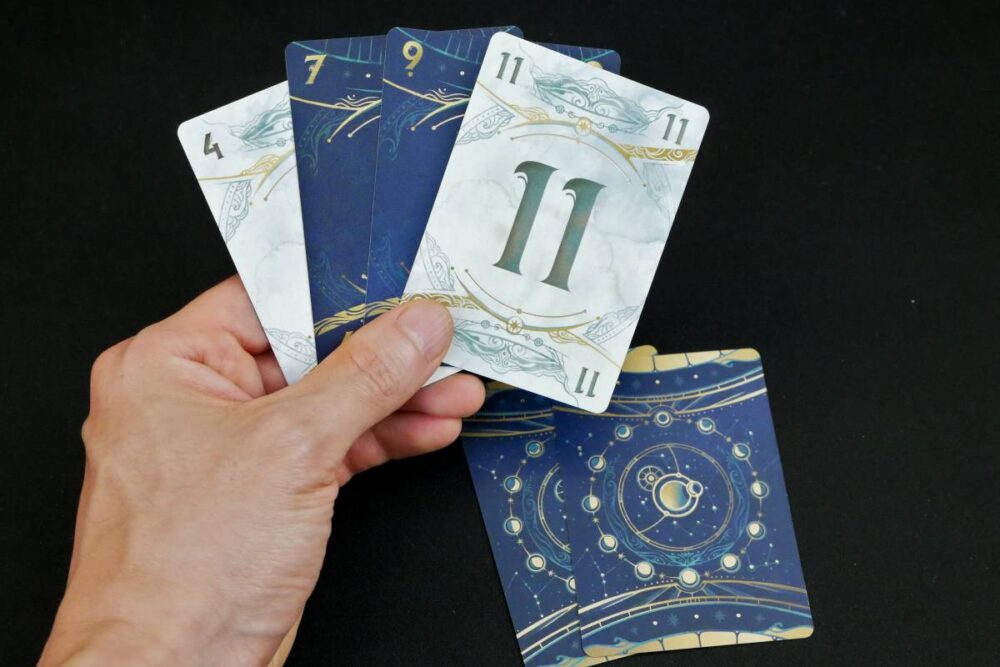
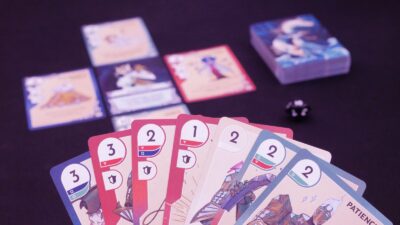
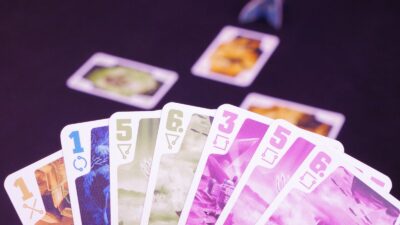
In this 3-player example, we know what color cards we've each been dealt. Now it's time to strategize before we actually pick up and play these cards.
But strategy-planning in this game is vague and futile. The rulebook offers examples of good strategic remarks, like "We want to aim for 14 for this segment" and "If I place my first card next to this segment, nobody else should place anything there because I'll manage it on my own." On paper? Great, you hatch a plan and do what you've agreed to. In practice? The strategic remarks often boil down to "if I do this, then..." and "if you have this, then..." And the nature of a conditional means it may not even come to pass.
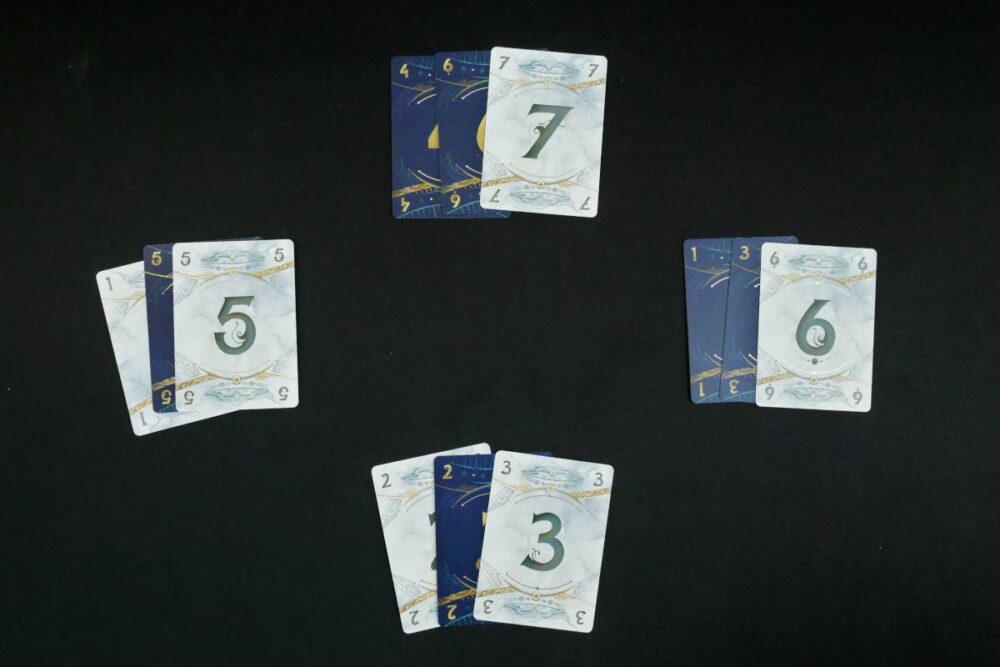
In this 4-player example, everyone happens to be dealt low-value cards. Some clocks are practically unwinnable if you end up in this position.
You can concoct as complex a strategy as you want, but if you aren't dealt the right cards, you can't do anything about it. If everyone is dealt low-value cards, you may be boned right from the get-go. I've even tried playing with a predetermined "meta" group strategy—we all play our cards from highest to lowest, no exceptions—and it still felt arbitrary.
The Power of Face-Up Cards
In Take Time, there's only one way to give explicit information to other players: you play a card face-up. A face-up card lets others better assess the face-down cards in that same color, and it also gives them a peek into what your own strategy might be given your hand. But the group as a whole can only play a few face-up cards, so you have to be smart about it—if you're going to burn one of your precious face-ups, you better make it count. It's a tough decision, and that's why it's my favorite part of the game.
It still doesn't make up for the huge information gap, and the game knows this. That's why when you inevitably fail a clock, Take Time graciously allows you one more face-up card on your next attempt. But that just makes me wonder: am I supposed to win on the first try without consolation face-ups, or am I intended to fail and succeed on repeats? All I know is, most clocks feel impossible without extra face-ups, yet I also feel like I cheated if I win with extra face-ups. The design robs the victory of its delight.
Player Count and Scaling
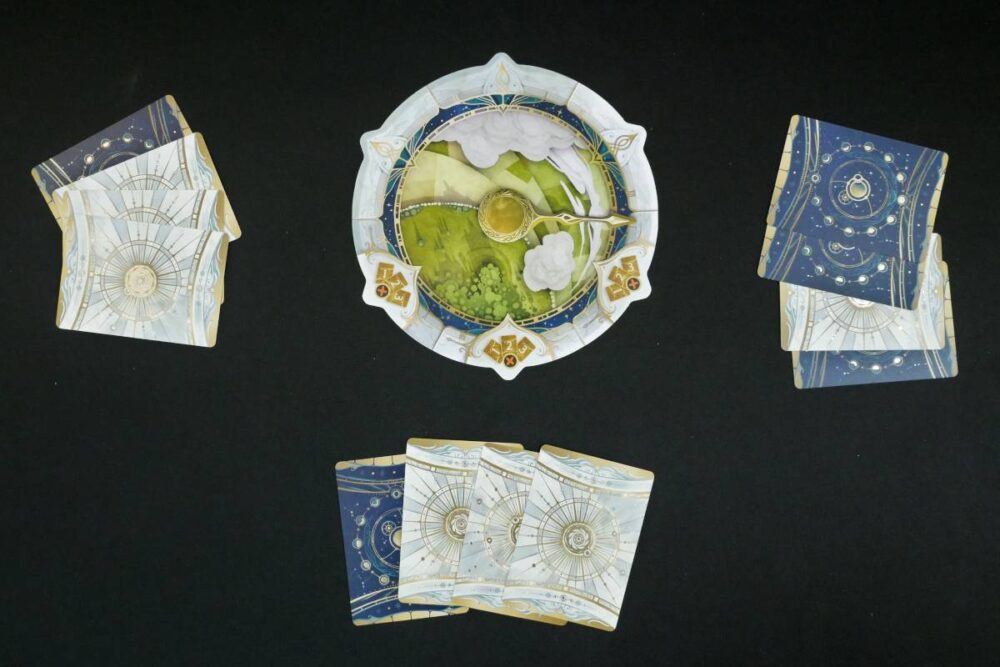
Take Time is different at every player count, with the 2-player game clearly the best. There's a special rule at this count: each player is first dealt 4 cards with 2 extra cards set aside, and after you've played your first two cards, you add those extra cards into your hand. You see a total of 6 cards, giving you more information and more to work with. The trade-off is fewer face-up cards—you can only play 2 face-ups between the two of you. The result is a more strategic, less chaotic experience that still lacks deductive weight.
In this 2-player example, I get to see my first hand of 4 cards. Once I've played two of them, I get to pick up those two extra cards. I'll play a total of 6 cards.
Bump it up to 3 players and you're each dealt 4 cards while getting 1 more allowed face-up card. You're more likely to get boned by luck, with a hand that leaves you no way to stick to whatever strategy you've devised.
Step up to 4 players and all the worst bits are amplified: only 3 cards each, more likely to draw a bad hand, more likely for one weak player to derail success even when everyone else plays well. At this count, it's a loosey-goosey game of vibes and intuition—strategy has been tossed out the window. The only saving grace here is that you start with 4 allowed face-ups, but that still depends on everyone being smart about when to use them.
I dislike all player counts.
Replayability
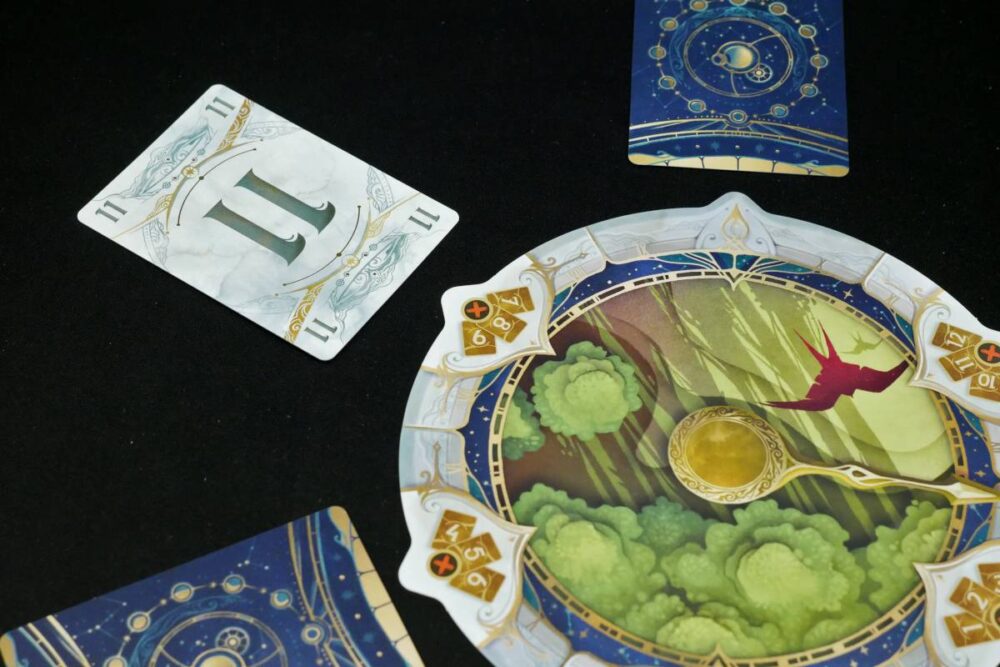
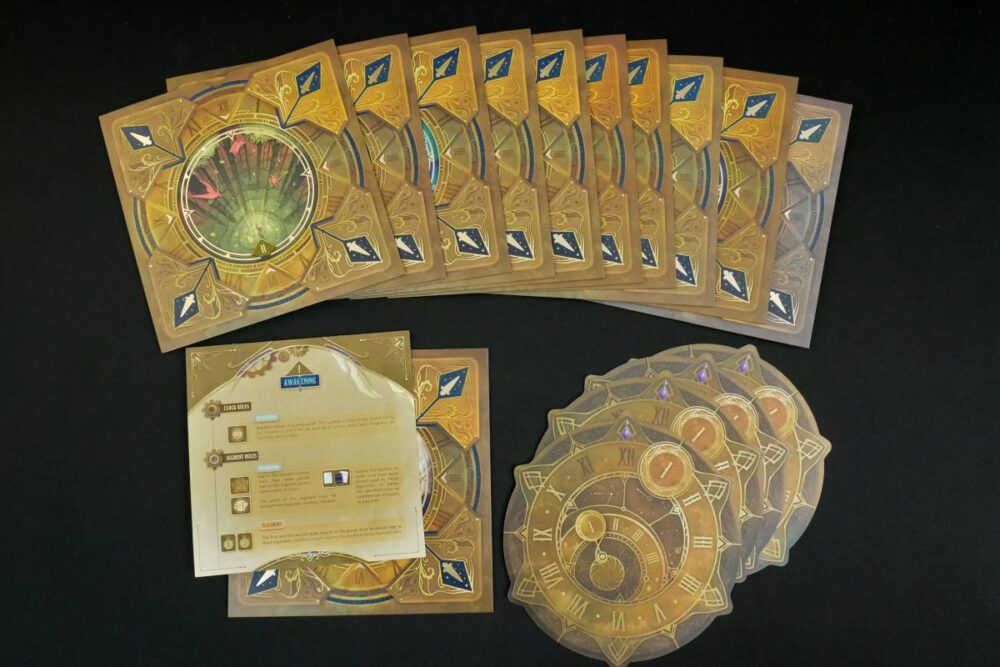
To its credit, Take Time's box is dense. You get 40 clocks, with each clock having its own small twists on gameplay. You can think of them as stages in a video game, divided into 10 worlds of 4 stages each. Each clock is infinitely replayable—you'll probably struggle through several hands per clock, and once you win, you can shuffle up and keep playing it again if you want.
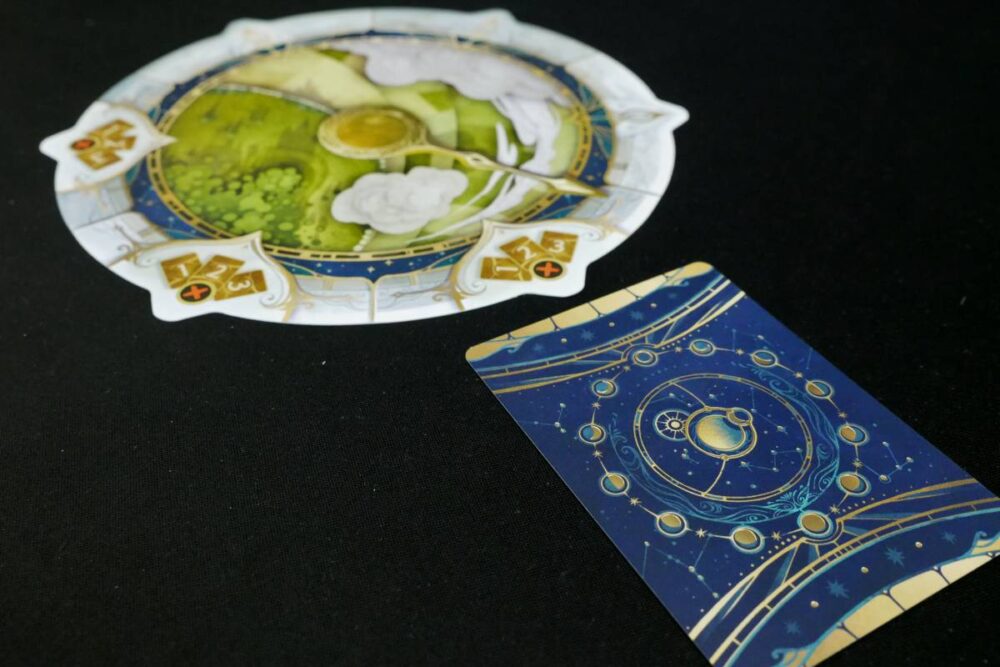
There are 10 clock sleeves and each sleeve contains 4 clocks. Every clock sleeve introduces gameplay twists, keeping it fresh as you progress.
This variety and replayability is the best thing about Take Time, which is a shame because the gameplay itself is so lackluster. If I enjoyed my time with it, I'd be thrilled at having 40 unique "game modes" that I could bounce between on demand, plus the satisfaction that would eventually come from 100%-ing all the stages. It'd be the type of game I'd introduce to various groups and try to see how far I get with each one.
But I don't enjoy my time with it. In fact, every session I found myself waiting for it to be over so I could spend my time on something better. No amount of variety or replayability can patch that over.
Components and Setup
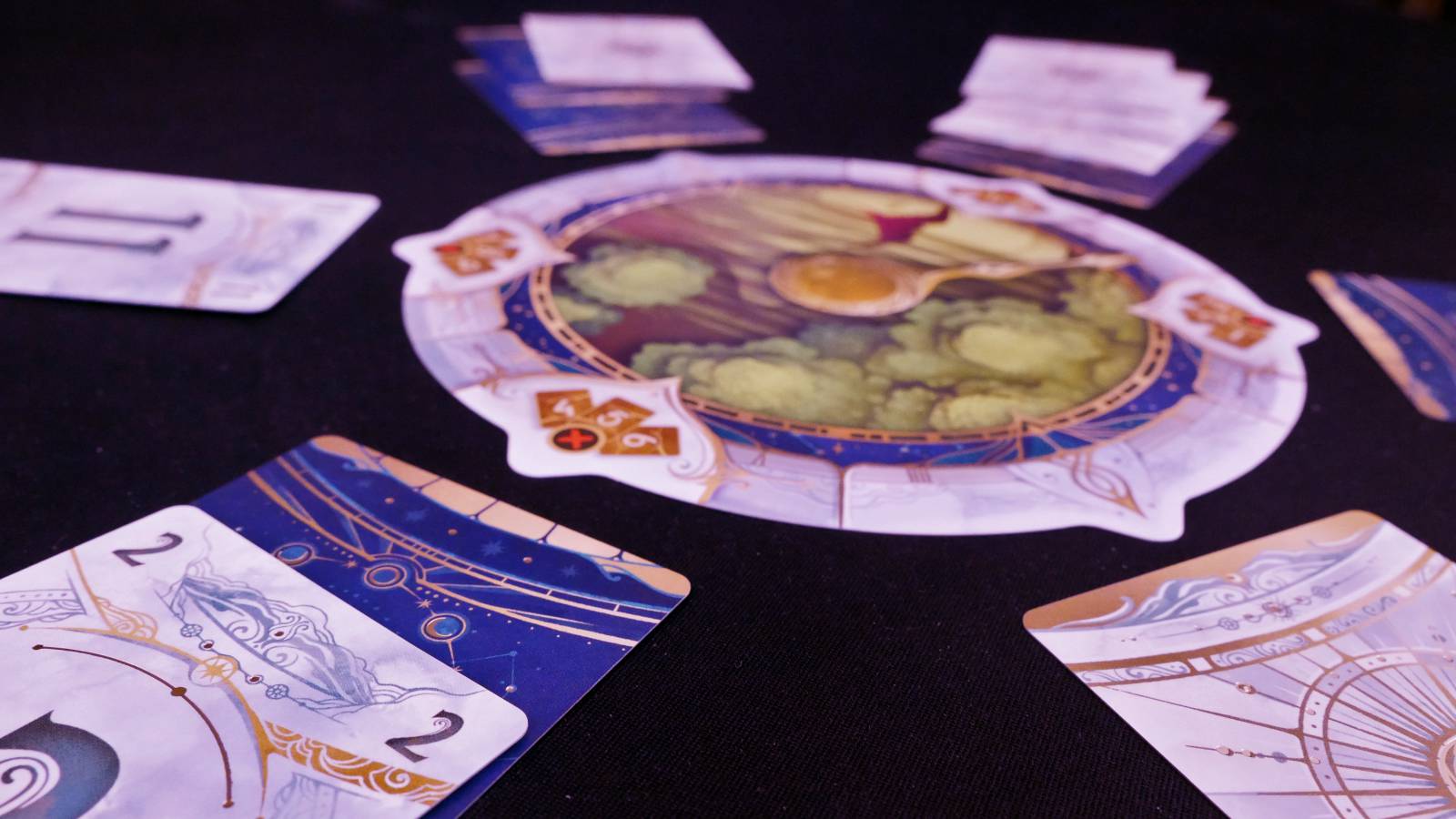
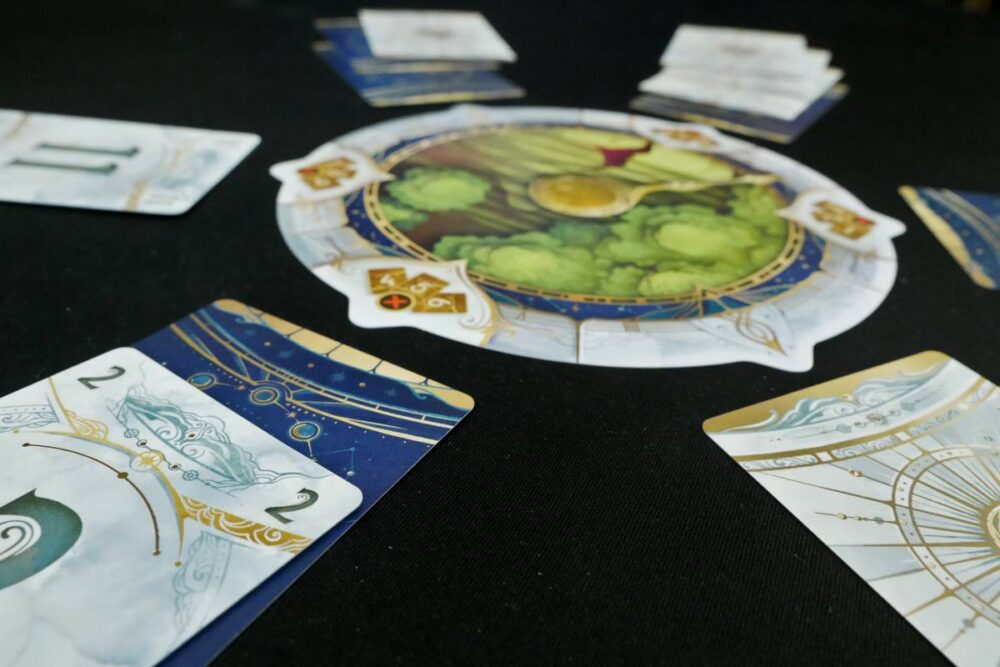
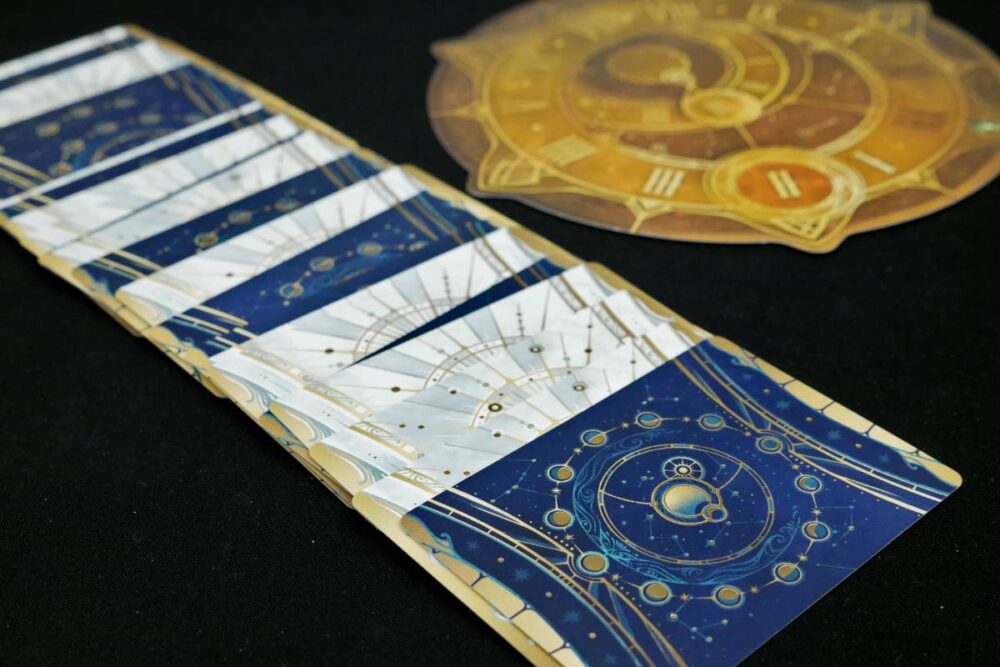
Maud Chalmel knocked it out of the park with Take Time's visual concept. The luxurious, gleaming-metal, clock-inspired designs floating through a nebulous expanse really bring out the "time and space" motif. More than that, it's striking. The artwork catches your eye and draws you in, especially the dark-and-light Solar/Lunar cards that ooze a premium feel. It's a bit distracting in some places—especially the clock backs, where I struggle to discern what chapter and clock each one is—but you can't deny that it's pretty.
The artwork and graphic design is gorgeous all around.
Take Time sets up fast and doesn't need much table space. Pick a sleeve, pull out the clocks, shuffle up and deal out the cards. You're playing within minutes, and the at-the-table experience is clean. The cards are perfectly weighted—neither too thin nor too thick—and they have a matte finish that keeps them easy to read in harsh light. The lack of a linen finish feels like a misstep, though, given how premium it feels otherwise.
The Bottom Line
Take Time is a 24-card activity masquerading as a game, dressed up in alluring art, promising to be so much more than what it is. It's what you pull out on a casual, low-stakes night when you want to feel like you're accomplishing a cooperative feat together, without the stress and pressure that comes with a true performance-driven cooperative game.
Don't get Take Time if you want a clever deduction game where skill trumps luck and success hinges on reasoning. If you're looking for more along the lines of The Crew and Bomb Busters, this isn't it. Take Time is like The Mind: all vibes. An illusion. A smokescreen. I'll be getting rid of it, even though it kills me to part with such a beautiful production.