Card games are notoriously difficult to get right. In a saturated market where all the original mechanisms and ideas have been taken, it's hard to walk the line that gives you a game that's simple yet interesting, tense yet accessible, fun yet hasn't been done better already. And for as hard as it is to stand out among card games, it's even harder for a card game to earn its seat as a genuinely compelling game among all board games.
From my very first play, I knew Push was a winner. It's everything a simple card game should be: strategic, lucky, explosive, consequential, uncomplicated, inexpensive. Push is deliberate in the experience it aims to deliver, and it's also clear about what kind of game it isn't. If you're expecting skill to trump luck every time, move on. This game isn't for you. But if you want to see what pure push-your-luck looks like at its best, Push needs to be on your radar.
This review is based on my own personal copy of Push, which I bought new from Barnes & Noble. Not a free review copy.
Table of Contents
View more
What It Is
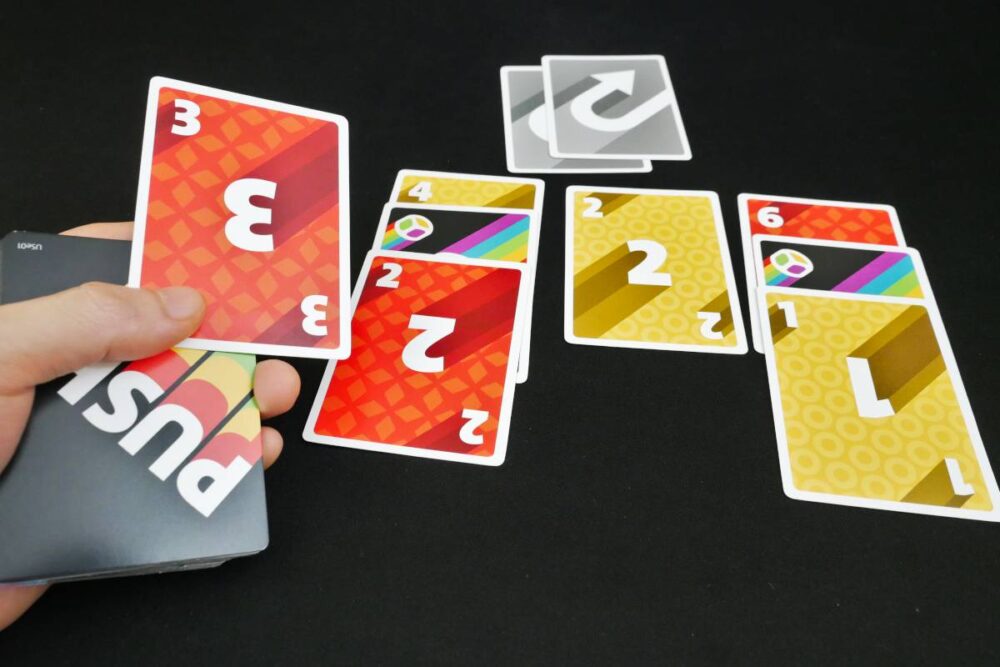
Push is a push-your-luck card game for 2 to 6 players where all you're doing is flipping cards from a central deck and placing them into one of three stacks. On your turn, you keep flipping and placing cards into stacks until either you decide to stop or you bust. Players take turns in this way until the deck runs out, then scores are tallied to find the winner.
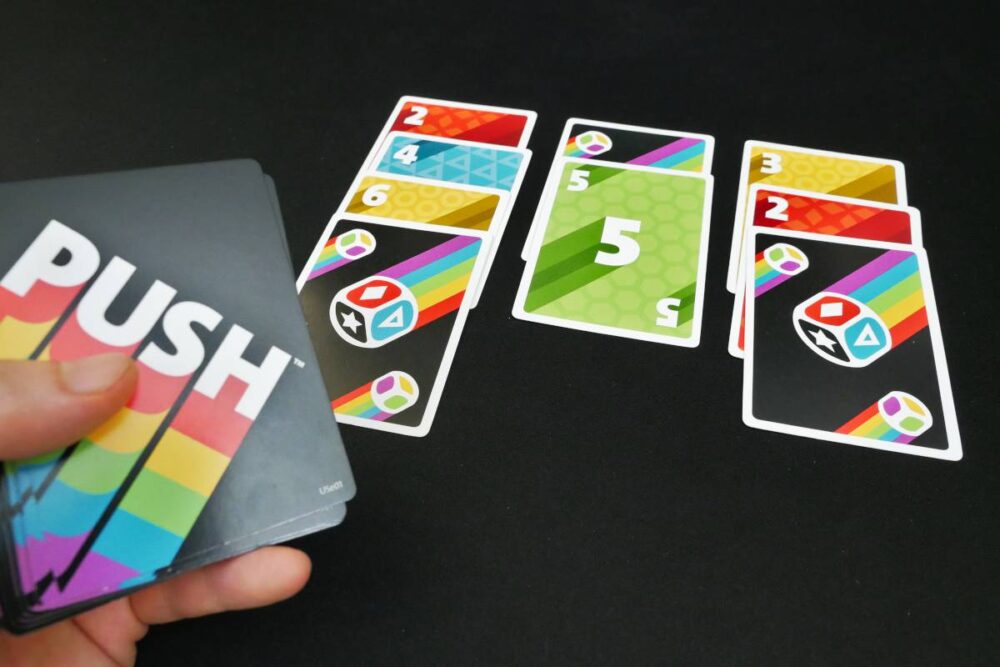
You draw a card and place it into a column. Simple as that.
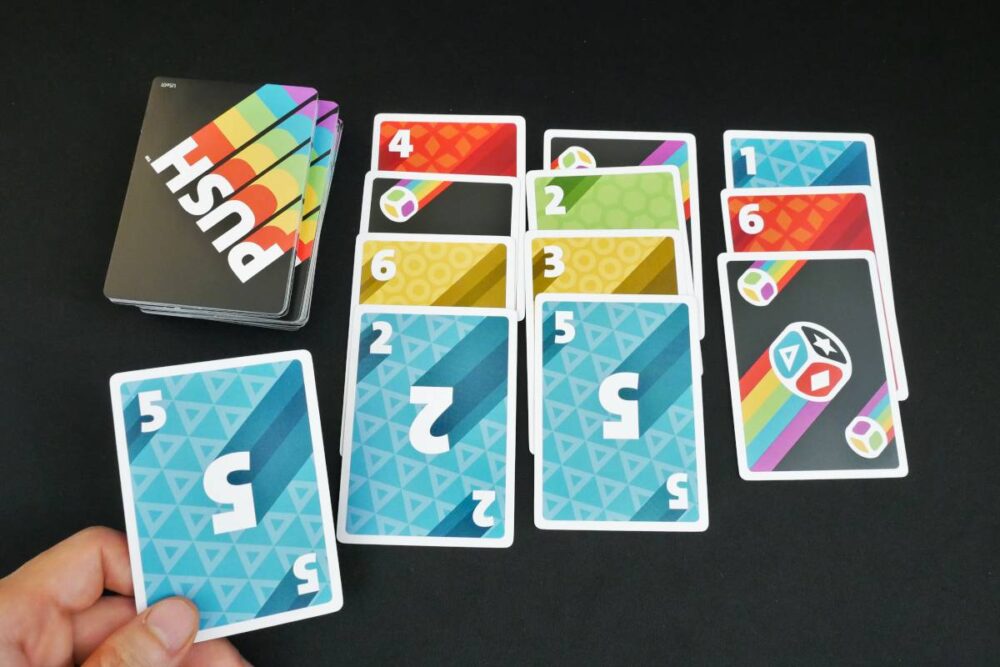
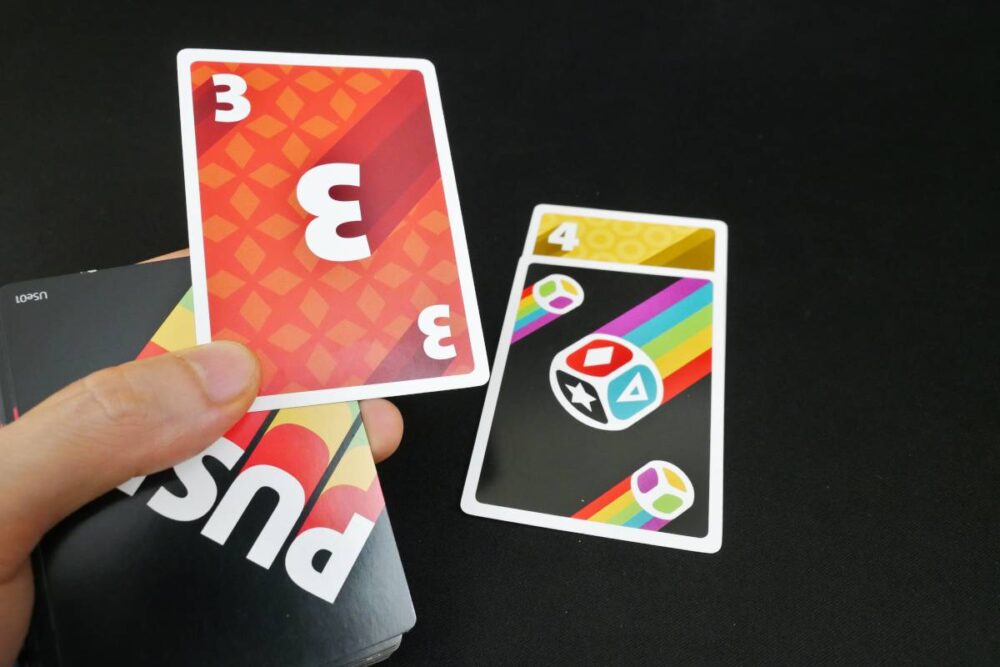
The 90-card deck consists of five colors: Red, Blue, Yellow, Green, Purple. Each color has cards numbered 1 through 6, with three copies of every color-number combo. When placing cards into stacks, you can't place into a stack that already contains a card of the same color or same number. If you draw a Green 5, you can't place into Stack 1 that has a Green 2 (same color) or Stack 2 that has a Yellow 5 (same number), so you must place into Stack 3. If you can't place the drawn card into any stack, you bust.
This Blue 5 can't go into any of the columns, so you bust!
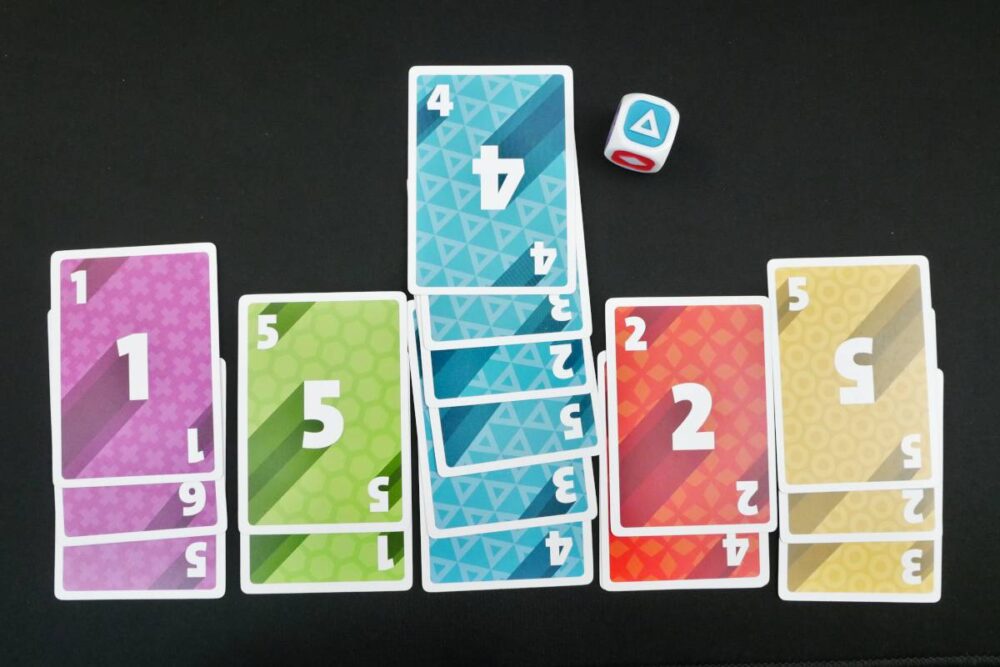
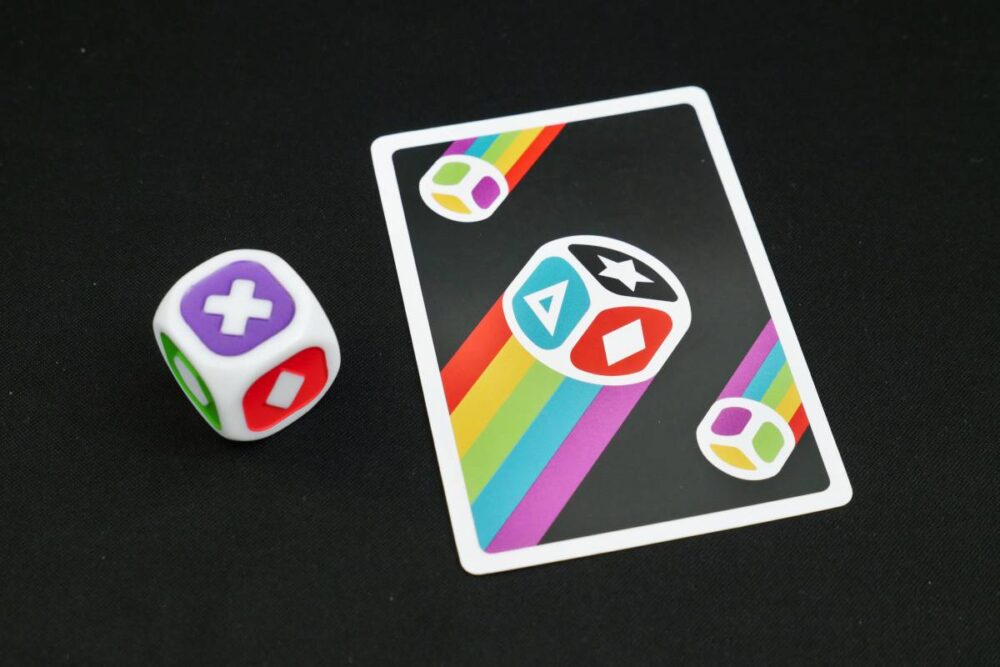
If you choose to stop before drawing a card, you're safe. You draft one of the three stacks you've made and collect those cards as points equal to the cards' number values. The players ahead of you draft the remaining stacks, earning points as well. If you draw and bust, you lose the opportunity to draft any of the stacks (the players ahead of you still get to draft), and you must roll the die. That six-sided die is your main threat, with one face corresponding to each of the card colors, as well as a "safe" side. If you roll a color, you lose all the cards you've collected in that color; if you roll the safe side, you lose nothing.
These are all my accumulated points—and I just happen to roll the one color that would kill the most points. Buckle up because that's how it goes!
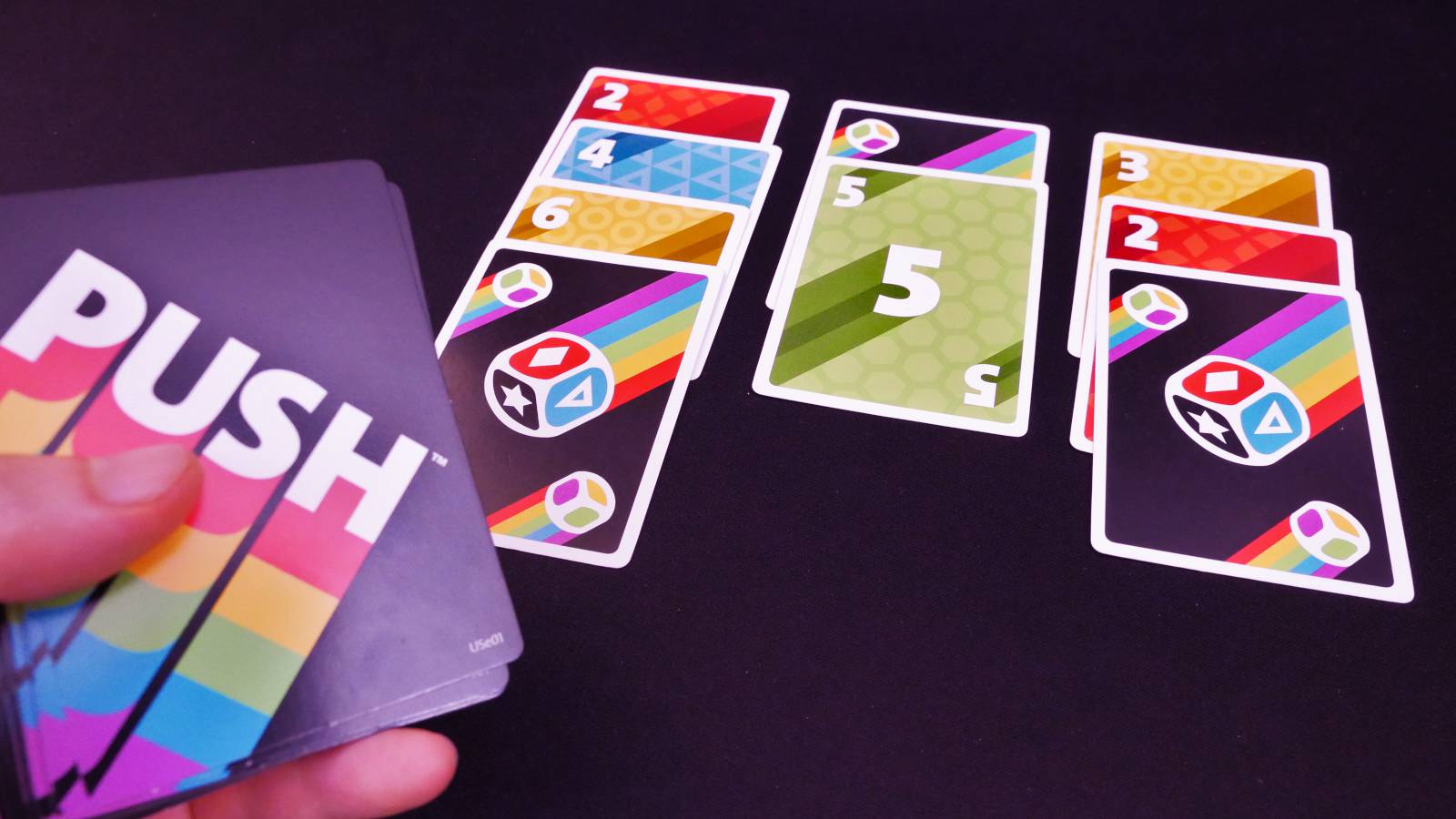
The deck also contains 18 black cards, which are also placed into stacks when drawn and also can't be doubled up within stacks. When drafting a stack with a black card, you must roll the die. You'll also find 12 reverse cards in the deck, which don't get placed into stacks; instead, they reverse the direction of drafting when the current player ends their turn. The two players ahead who were expecting to draft may get nothing, while those behind may get to draft again.
How It Feels to Play
Deceptive Decision Space
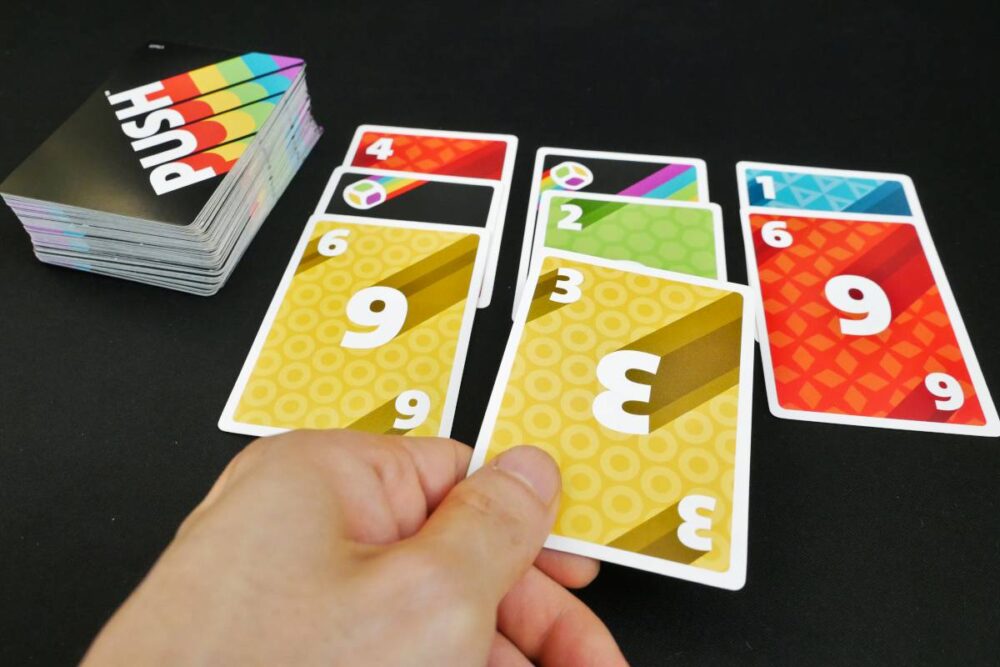
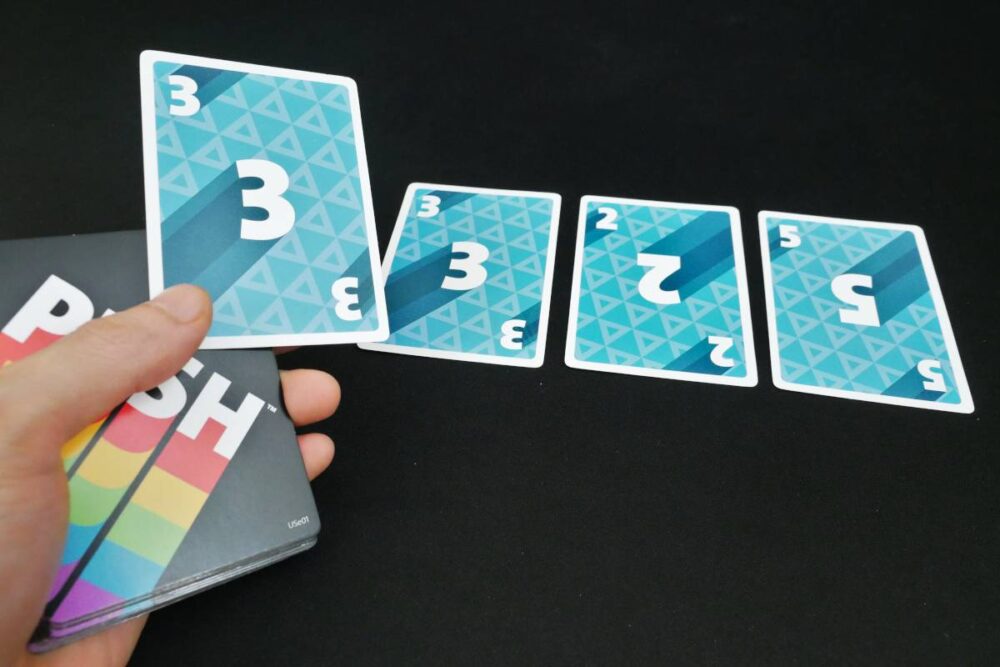
Simple doesn't always mean flat, and Push makes sure of that. It doesn't look like there's much going on at first—you have only one decision you're making over and over again: which stack am I going to put this card in? But your three stacks are constantly evolving with every card, and the makeup of your three stacks constrains future card placements. A Red 3 on your third draw may be perfectly innocent, but a Red 3 on your tenth draw would be disastrous if all your stacks have Reds. It's not just mindlessly putting cards "wherever they fit best," but about managing risk and not painting yourself into a corner.
Drawing a Red 3 as your third card: you have some leeway with it.Drawing a Red 3 as your tenth card: not a lot of freedom anymore, your past decisions dictate where you can go, and the risk is much higher.
Below that, you have the banking layer. On your turn, you can completely forego card drawing to instead "bank" some of your points. When banking, you flip over all your collected cards of a chosen color, permanently protecting them against the black die. It's another push-your-luck decision: either keep going and leave your growing pile of points vulnerable, or play it safe and give up the opportunity to collect more points. There's real strategic tension here, and you'll feel it the first time you lose 20+ points to a bad die roll because you didn't bank when you had the chance.
Quick Pace, Real Stakes
Every turn of Push is a fresh sprint. You start with a blank slate, you flip your first card, and it's already building. Each flip only takes a few seconds, and each flip escalates as you confine yourself to ever-tightening stacks. Eventually, you either stop and sigh in relief... or bust and bury your head in your hands. Everyone takes their stacks, then it's onto the next player. The pace is almost breathless, with a constant start-stop rhythm that circles around the table and never gives you time to look away and get distracted.
So much tension just from the threat of this die and these black cards.
Holding all of these small sprints together is the game's overall arc. Every sprint grows your collection of points while at the same time risking the very collection you're growing. Every sprint is more nail-biting than the last because the consequence of busting is ever greater. Every subsequent black card and die roll is that much more threatening, looming over you and your points.
It's not just empty flips and rolls. Push actually makes you care. When you've hoarded tons of points in every color and you're shaking that die in your hand, you actually start to sweat, hold your breath, and hope against all hope that it'll land on the one safe face that'll spare you the misery.
Luck Is Still Luck
Push is a true push-your-luck game and doesn't apologize for it. You have decisions to make and strategies to lean on, but that will only take you so far. You have to be okay with fate derailing your plans. The first four cards you draw on a turn could all be Blues, busting before you even have a chance to do anything real. And when you roll that die, your biggest pile could be wiped in a snap... or you could roll spares all game and never get hit.
Sometimes you draw the same color four times in a row. That's just bad luck.
You can't outrun the luck in Push—and that's not a bad thing. Those moments are what make it such a thrill to play. When you crash hard and slip out of first place, when you skate by on a die roll while everyone else gets slammed, when you're certain the next card couldn't possibly bust you but it does? It's unpredictable, punishing, downright unfair... and addictive.
The Table Energy
Push's best trick is how it draws out and amplifies the energy at the table. It doesn't matter whether you're the one who's risking it all or watching someone else play with fire—you want to see what happens. You're invested. You know the stakes and you know how quickly things can implode.
That investment is what makes the excitement so infectious. When Bob is hemming and hawing about whether to draw another card, you can't help but blurt out: "Do it! C'mon, you know you want to!" And when he does draw and inevitably busts, the table erupts in laughter. You're cheering on a trainwreck and loving every second of it, partly because you know your own trainwreck is waiting for you in just a few more turns.
And the excitement never lets up thanks to those reverse cards. They surprise you when you least expect it. They take away that good stack you wanted so much, or they saddle you with a terrible stack you can't avoid. You accept the bad stack, roll the die, and hope for the best. A safe roll? You let out a big sigh of relief. A bad roll? The table erupts again. Push is pure entertainment, minute by minute, not a moment wasted.
Player Count and Scaling
Push's sweet spot is 5 players. At this count, everyone is engaged on every turn: the active player is flipping while the two players ahead and two players behind are watching the stacks in case they must draft. But the real payoff is how this player count maximizes table energy. More players, more ribbing and groaning, more tension as points constantly shift up and down with every turn. And the downtime isn't bad—turns are fast and waiting four turns between your plays provides a good balance between actively pushing your luck and passively drafting on others' turns.
Push is almost as good at 4 players, with all the same benefits except scaled down a tad. At 3 players, it starts to lose its high-energy appeal, but still plays well as a fun time-killer. At this count, there's slightly less unpredictability since all players are always involved on every turn: the active player, plus the other two are guaranteed to draft.
Push is even fun at 2 players, but it becomes something of a slot machine—too random, not enough agency. While I've enjoyed it at this count with just my wife, I'd always prefer to play Push with at least a third seat.
Replayability
Push is just a deck of cards and a die. Apart from shuffling, nothing changes from play to play. And yet it's highly replayable. Why? Because it gives you the same dopamine hits as gambling does.
When it's your turn and you're staring down the deck, not sure if you should draw the next card or not—that constant thrill of anticipation keeps you hooked. Is it safe? Is it a bust? You don't know, but you have to know. The game offers just enough reward and just enough stakes to keep you under pressure, and that pressure is strangely addictive.
Staring down three columns that all have the same color (in this case, black) and knowing you could bust but still pulling the trigger anyway? Pure gambling fun!
Each game of Push only takes about 15 minutes to play, so when it's over, you're bound to hear someone say "Let's play again!" And all it takes is a quick shuffle and you're ready to go. It's not the kind of game I'd play all night long, but it's a fantastic way to kill an hour. It's a staple for my family and we keep coming back to it numerous times every year.
Components and Setup
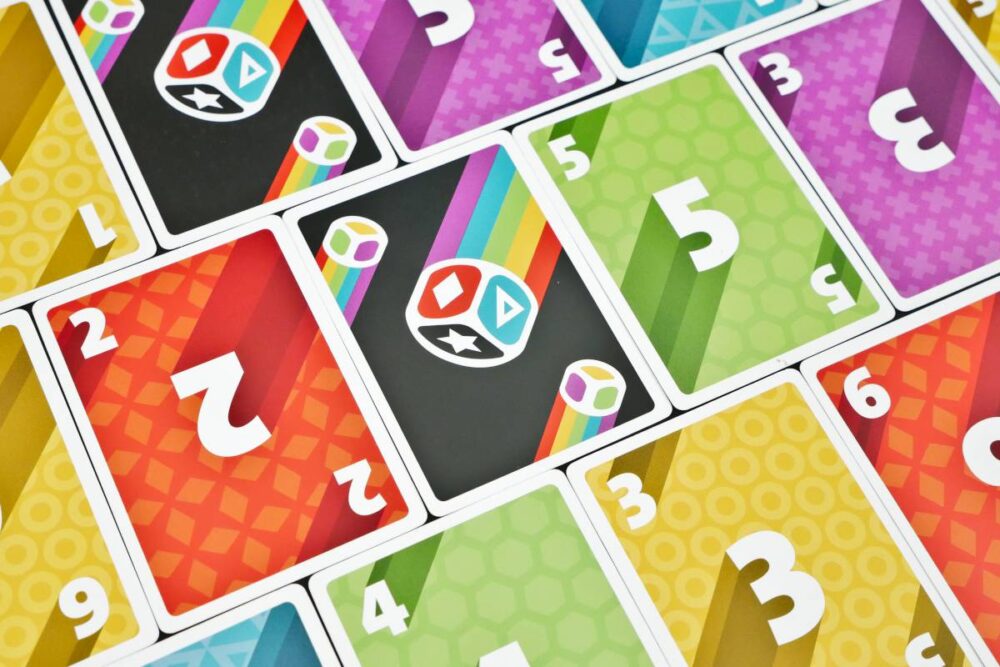
Push's production design is a double-edged sword. On the one hand, it's dead simple and quick to set up—just cards with flat colors and numbers. If you walked past a table playing it, you'd assume it was Uno. That makes it widely accessible, inoffensive, and non-threatening to non-gamers. But it also has no personality. Combine that with the generic name and you have a game that people will overlook without a second glance.
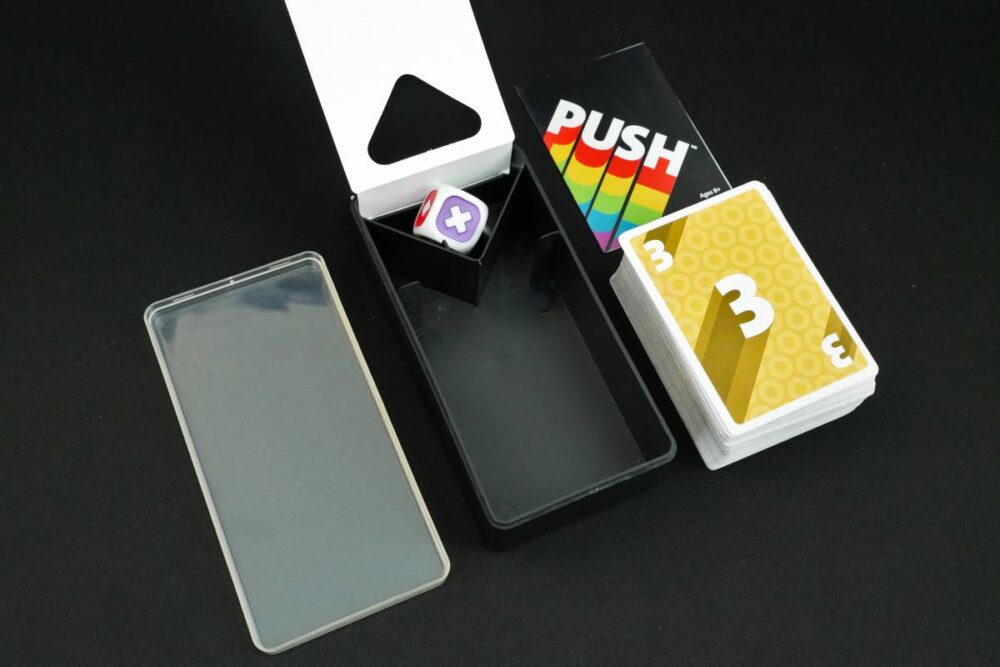
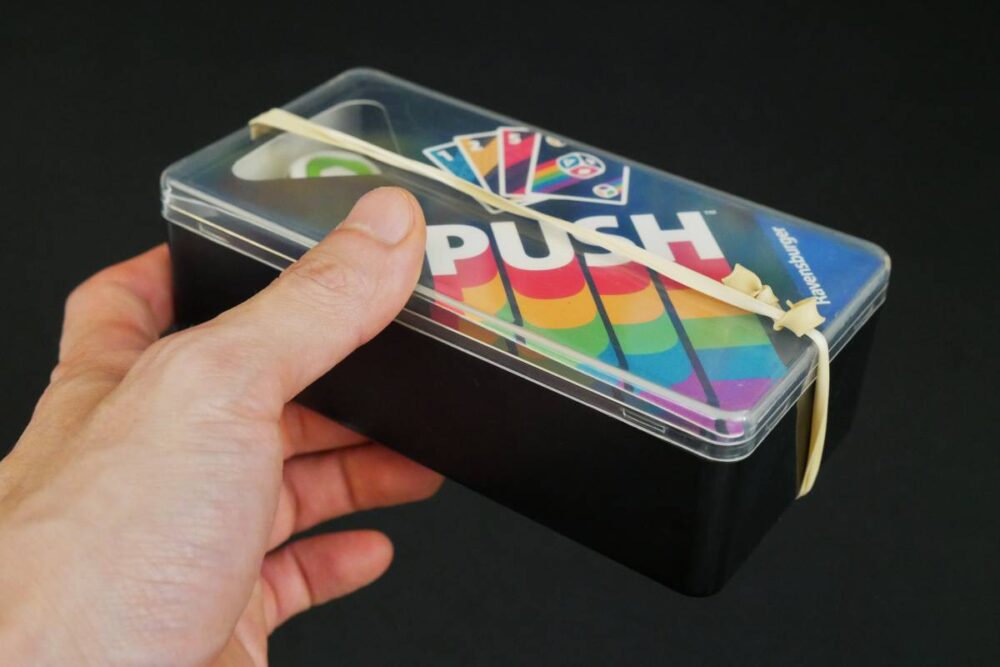
The component quality is disappointing, too. It comes in an unusually shaped plastic case with a lid that doesn't even stay on, and it's so cramped inside that you have no room for sleeved cards. The loose lid is a real problem—I use a rubber band to keep mine together. (To be fair, I believe later editions come in a cardboard box. If you can, get that one.) And sleeved cards are almost necessary for this game, given how flimsy the cards are. Marked cards will compromise the push-your-luck draws, so sleeve them as soon as you can.
The only good bits are the chunky die (fun to roll) and legible cards (clean graphic design and colorblind accommodations). Otherwise, it's a cheap game with a functional production. I hope it never goes out of print because I plan to play it into the ground and replace it once it's no longer playable.
The Bottom Line
Push is one of my all-time favorite filler games. I love playing it with family as well as strangers. I play it multiple times every year because it's so easy to pull out and enjoy. At $13 MSRP, it's insanely good value for how much I've gotten out of it. If you want a low-effort, high-energy, high-excitement card game for up to 5 players, I've yet to experience a better game.