If there's one thing that really irks me about a board game, it's when it's too fiddly—excessive components, tedious manipulation of said components, way too much manual upkeep for what the game delivers. That was my biggest fear going into The Guild of Merchant Explorers, which has a reputation online for it. I dreaded the thought of placing a bunch of cubes, removing all of them, and doing it all again multiple times. It's why the game sat on my wishlist for three years before I finally pulled the trigger on it.
What surprised me is that it's not as fiddly as its reputation would have you believe. I didn't mind handling all those cubes. But it has a different, more fatal flaw brewing underneath—one that didn't show itself until my third play.
This review is based on my own personal copy of The Guild of Merchant Explorers, which I bought used from BGG's GeekMarket. Not a free review copy.
Table of Contents
View more
What It Is
The Guild of Merchant Explorers is a route-building puzzle-strategy game with two twists: first, your routes are built on your own personal board (not a shared central board), and second, your routes are obliterated between each of the game's four eras. You build out, earn points, reset almost everything, rinse and repeat a total of four times, then see who earned the most points.
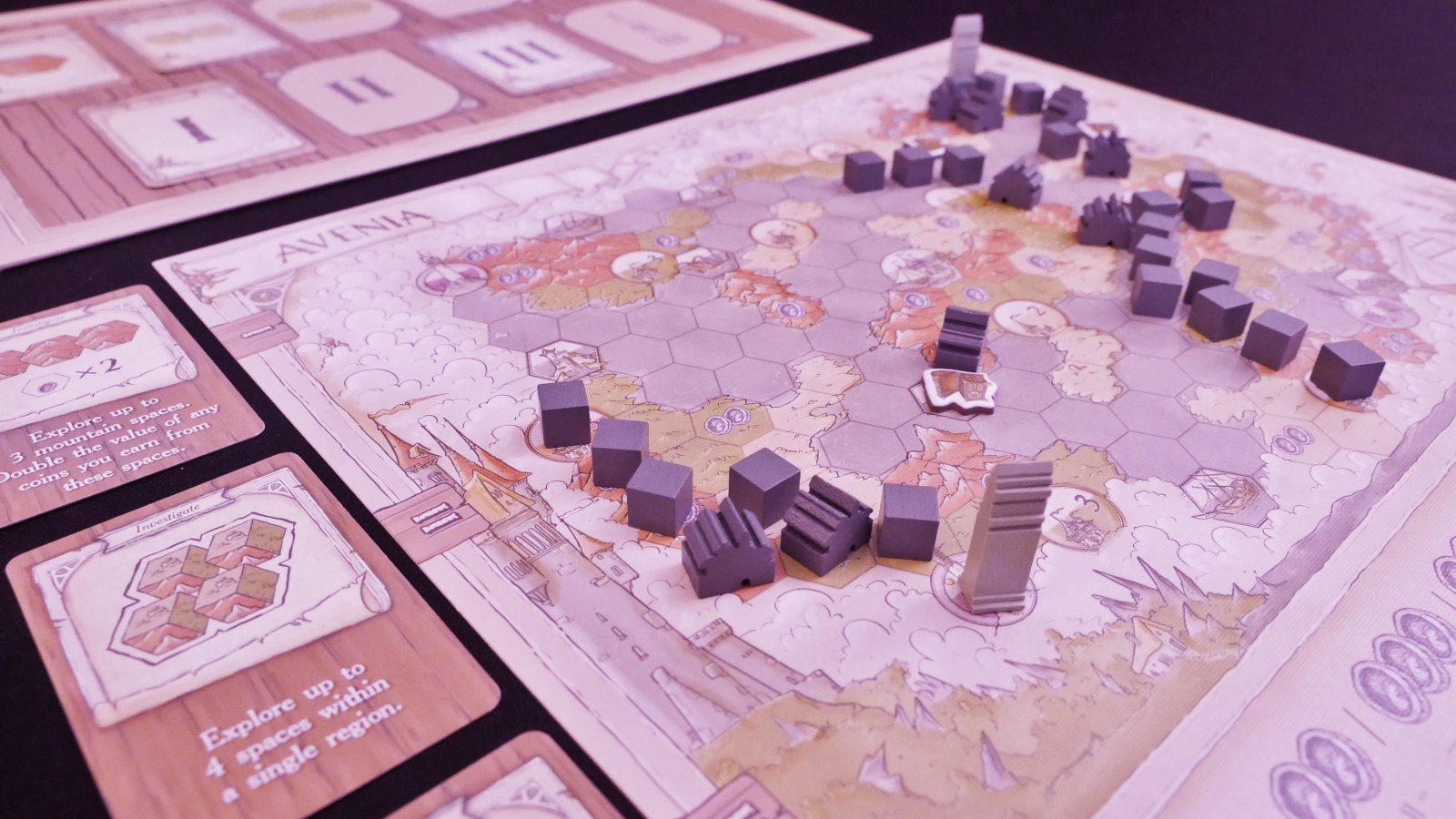
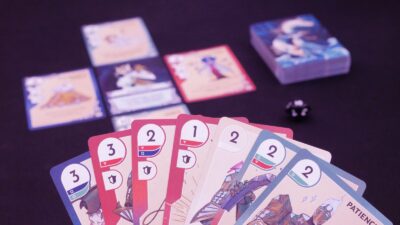
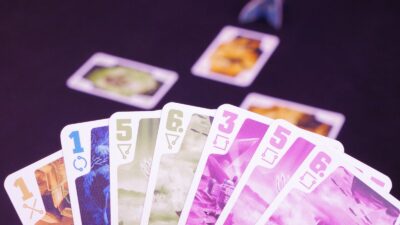
At the heart of this game is a bingo-style card-flipping action mechanism: a central deck of action cards, flipped one by one, that determine which hexes you're allowed to explore on a given turn. Everyone's bound by the same card and must make the same move on their boards, but where and how you explore on your own board is up to you. So if the action card says you can explore any 2 grass hexes, you get to choose which 2 grass hexes—provided they're adjacent to previously explored hexes in this era.
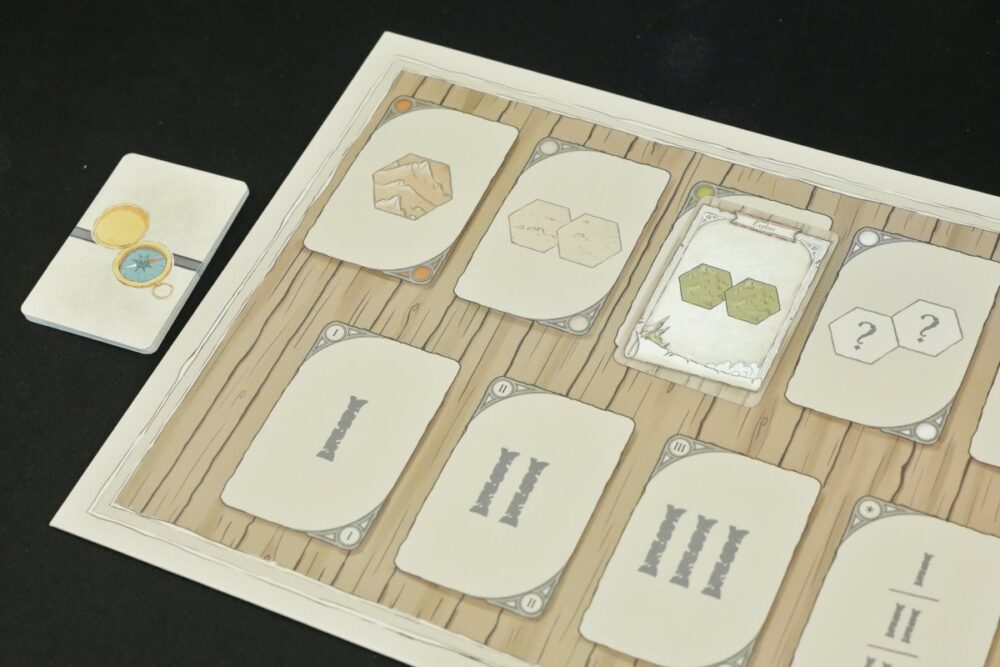
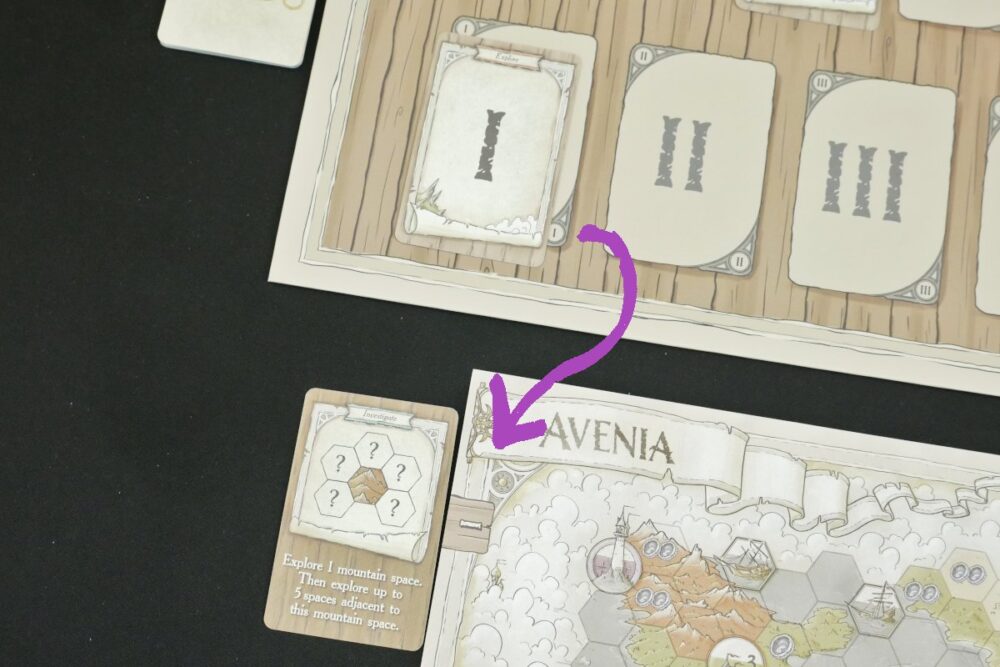
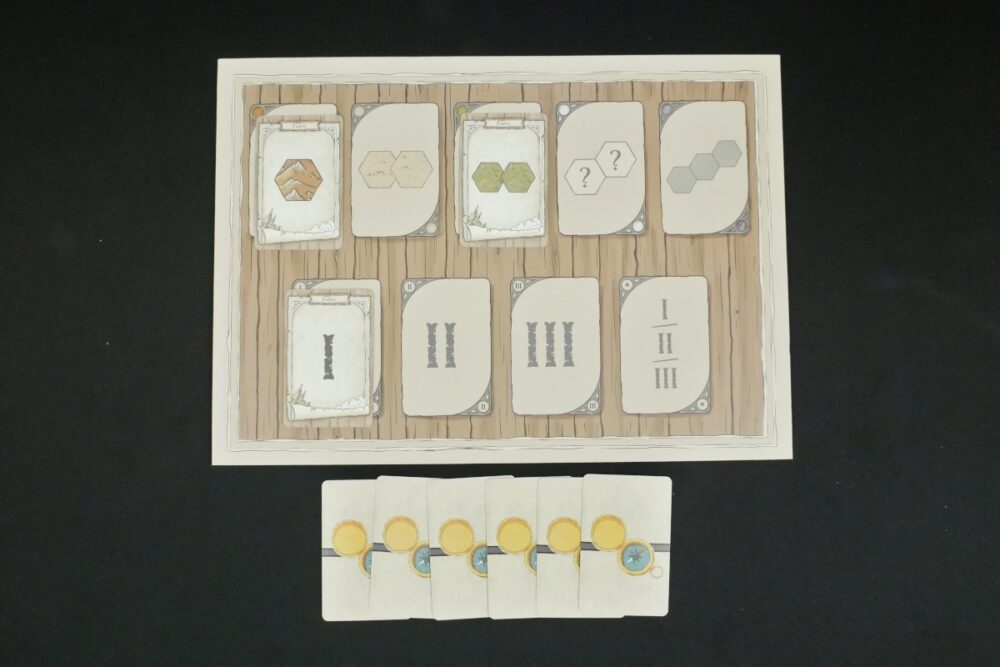
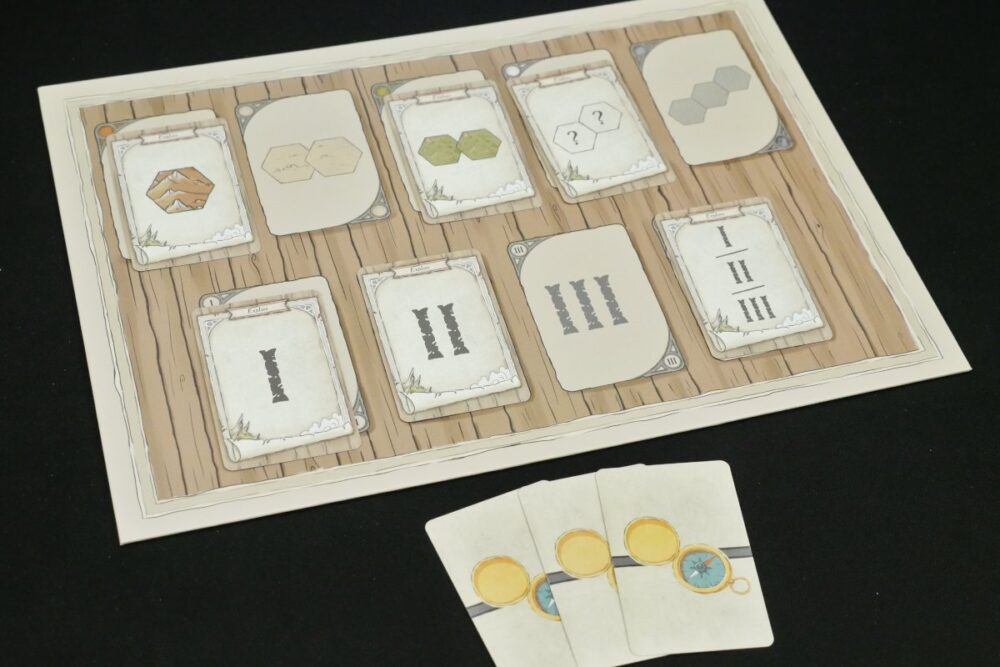
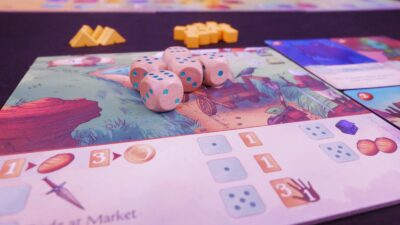
All the revealed actions for the era are tracked on this board, so you can see what has already come out and what's still yet to come.
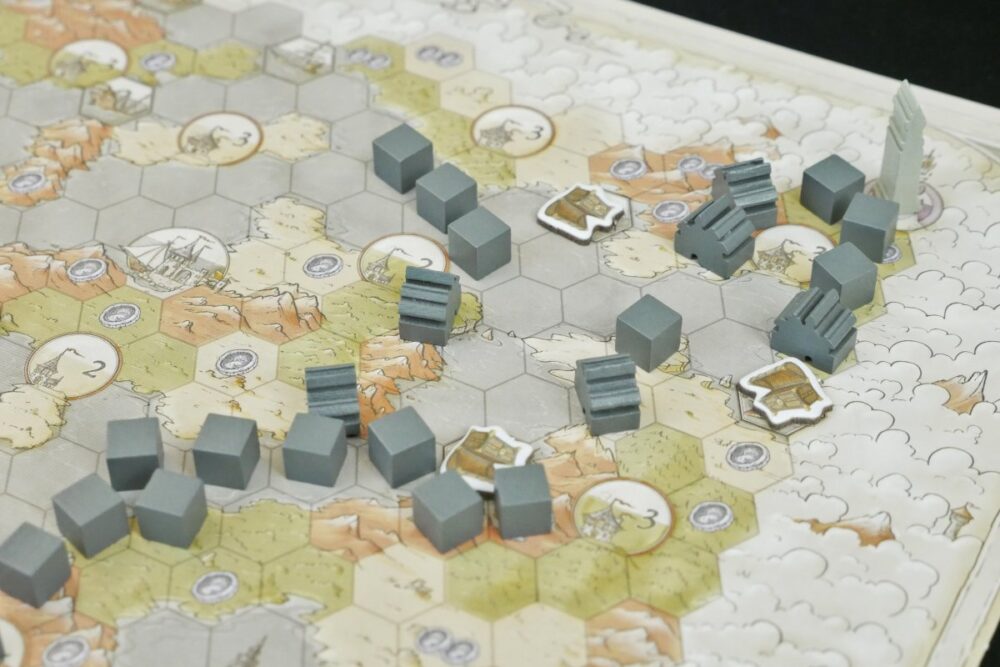
When you fully explore an entire "region" on your board (i.e., a cluster of same-terrain-type hexes), you get to place a village on one hex in that region. Villages are key because they persist across eras. Normally, when the action deck runs out and the current era ends, all the hexes you explored during this era are erased, which means you have to start the next era's explorations from the center of the map. But if you've built villages? You have additional spots on the board from which you can start your routes.
That grassy region is comprised of three hexes. Since all three were explored, I was able to build a village in one of the open grass hexes.
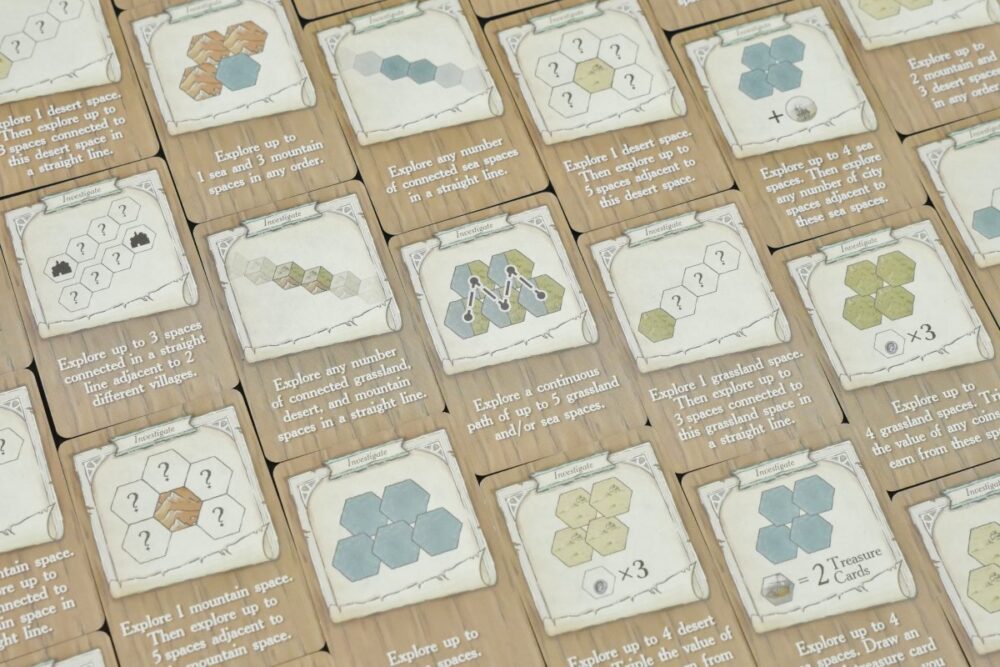
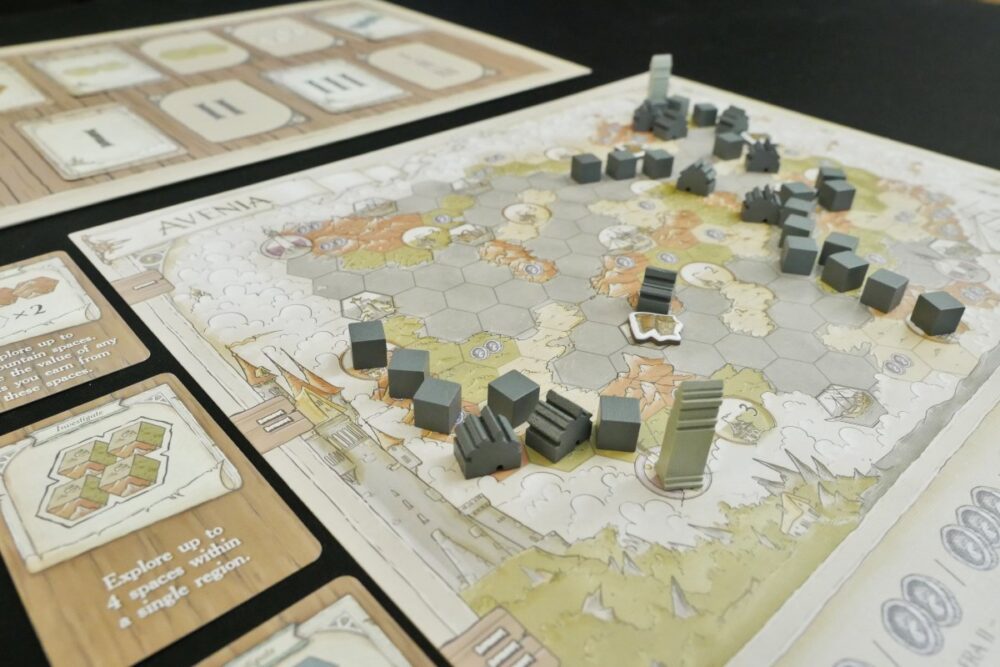
The other key feature in The Guild of Merchant Explorers is that players gain special "Investigate" cards, which are super-actions that only you have. These are triggered by the action deck, providing players with large power spikes that make it possible to explore more and more of the map in each subsequent era. So whereas the basic actions might only let you explore 2 desert hexes or 1 mountain hex, an Investigate action typically lets you explore anywhere from 4 to 6 hexes (along with some restrictions). And since every Investigate card is unique, players are forced into asymmetric strategies.
The first time the Era 1 Investigate action comes out, you draft an Investigate card that gets slotted next to your board. This will trigger again a few more times in later eras.
Points are scored by exploring hexes with coins, building villages, discovering tower hexes on the far corners of your board, and finding treasure via ruin hexes. Whoever amasses the most points over four eras is the winner.
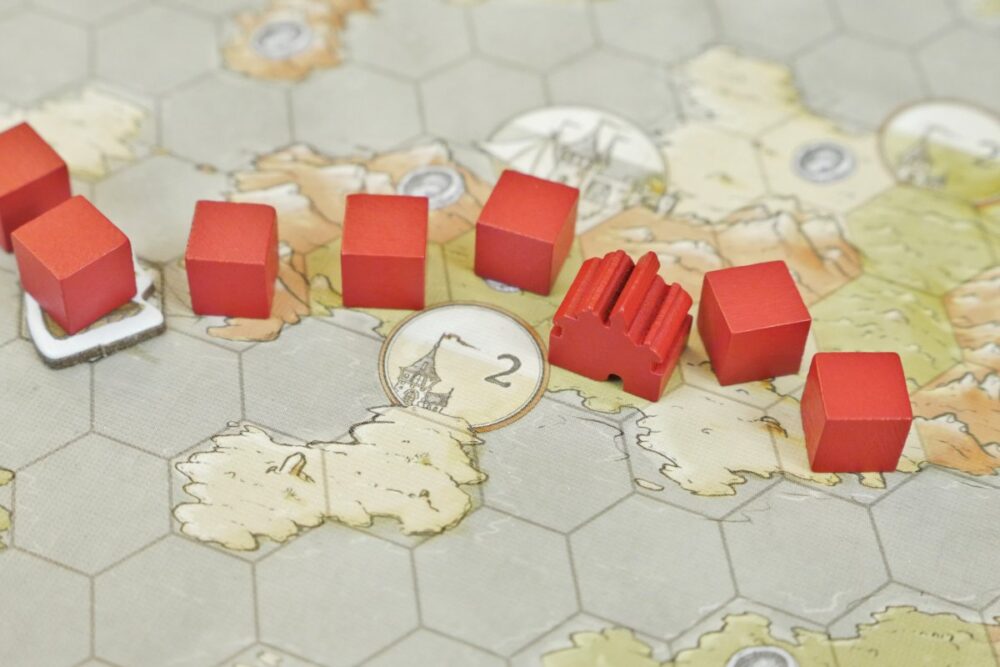
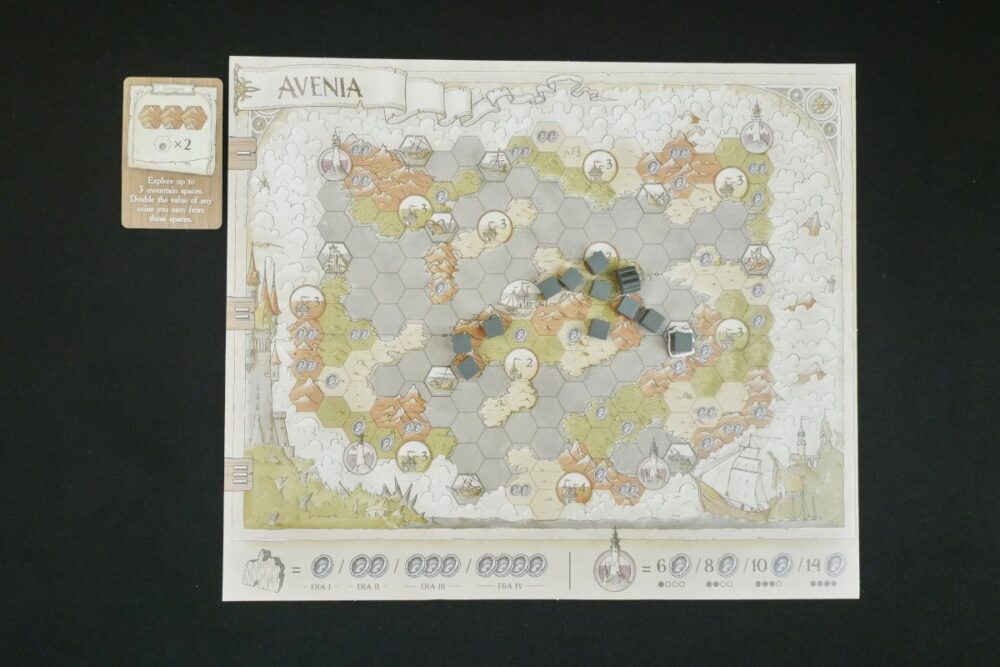
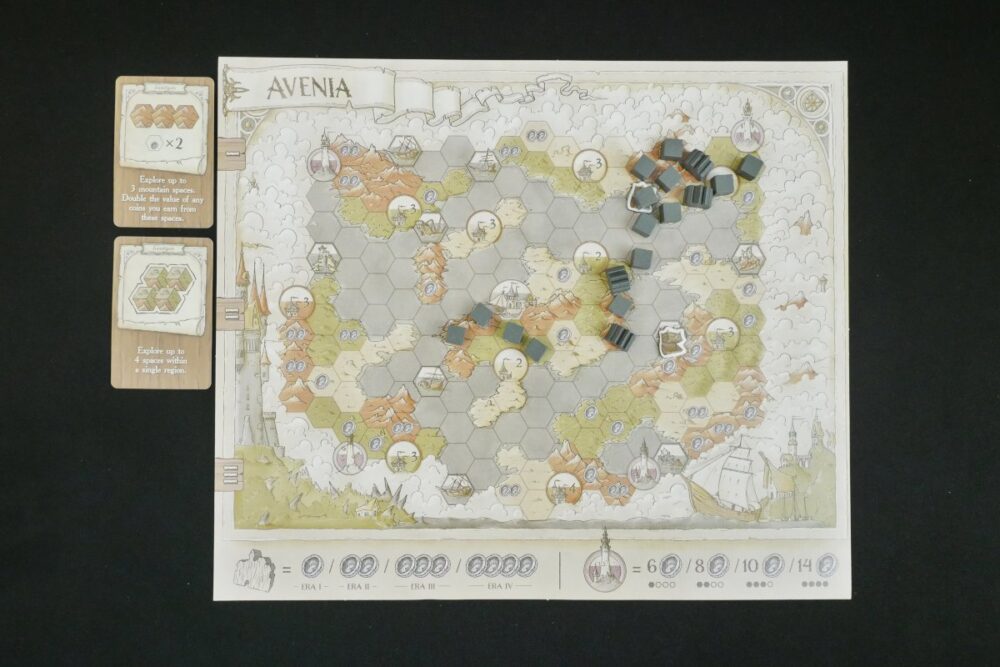
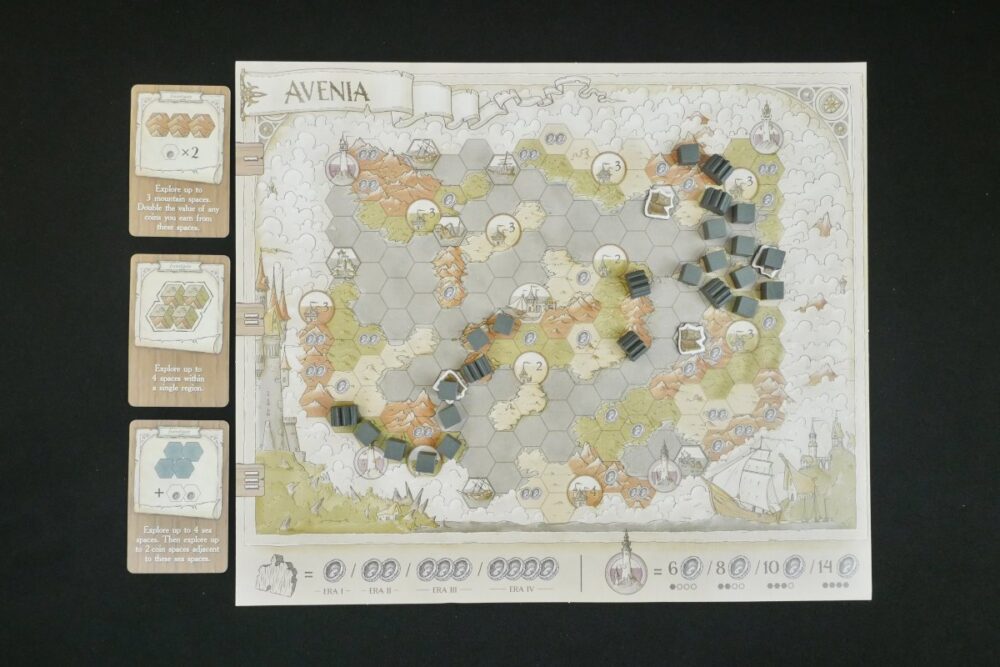
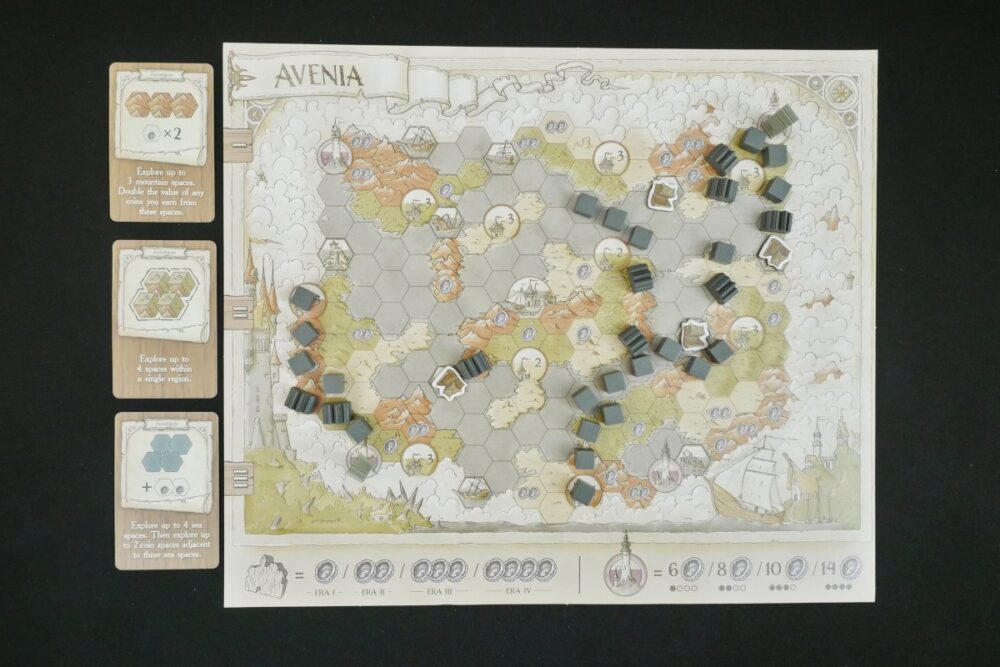
Here's a sample game and what my board looked like at the end of Era 1.The same game, except now the end of Era 2. Since the board was reset between eras, I was able to explore more of it by starting at the village I built in Era 1.My board at the end of Era 3. With the Investigate cards, I was able to explore more of the board in a single era.And finally, what my board looked like at the end of Era 4.
How It Feels to Play
The Action Deck Is Tactical, Not Strategic
The simplicity of the action deck—flip a card, it tells you where you can explore, you choose where to place your cubes—is also what makes The Guild of Merchant Explorers so tactical. You can't exactly plan ahead because that action deck is shuffled at the start of every era, so you don't know in what order they're coming out. If the desert action comes before the grass action, you might be able to explore that grass region over there—but if grass comes before desert, you won't be able to first cross that desert hex that lets you reach the grass hex. Now you have to waste your grass action... or shift to a backup plan.
You know which cards are coming, but not their order. That makes it hard to plan ahead.
Order matters, and that means you have to go with the flow and constantly re-evaluate your plans. So many times I've started an era with a certain goal in mind—"I'm going for the northeastern tower"—only to abandon that whole idea because the first action card took me in a totally different way. The Guild of Merchant Explorers is more about leaning into those unpredictable winds than it is about nailing down a plan and forcing it at all costs.
That means you have to take risks. Is there luck in the order of the action deck? You bet. If all the big Investigate cards come out first in an era, you may not be able to make full use of them—you might need the smaller basic actions to come out first so you can bridge some terrain gaps, allowing you to first reach key chokepoints on the map and set yourself up for those big moves afterwards. If the action deck dumps all your big moves early, you can end up wasting entire Investigate cards and losing out on a lot of impactful exploration.
The Investigate Cards Are Everything
In The Guild of Merchant Explorers, the basic actions are almost trivial—exploring only 2 grass hexes or 1 mountain hex feels inconsequential. But once you get your first Investigate card, it opens up and the fun begins.
Whereas the basic actions only let you explore 1 or 2 hexes on a turn, every Investigate card guarantees at least 4 to 6 hexes. That's why I like to call them "super-actions," and that's why they're so huge. A single Investigate action can fill out whole regions in a single turn, or suddenly complete goal cards and snatch those points away from opponents, or secure big progress towards a key tower or ruin on your map. A well-played Investigate can swing big in your favor, so there's a lot riding on it.
But it's not just the size of the Investigate cards that makes them so interesting—it's that every Investigate card is distinct, and you draft another one for yourself in every era. In other words, in Era 1 you have one Investigate card, in Era 2 you have two, and in Era 3 you get your third. This means you end up with a set of Investigate actions that are unique to you, allowing you to traverse the map in a way that no one else can. Everyone's forced to approach their routes through their own lenses, so by the end everyone has completely different routes despite playing the same exact order of action cards.
And that's why the drafting of Investigate cards is the biggest decision you'll make in The Guild of Merchant Explorers. When that first era's Investigate action comes, you draw two from the Investigate deck and keep one. You're now locked into that Investigate card for the rest of the game, and it'll show up again in all future eras. You have to plan your movements around that card, knowing that it'll keep coming out in every era. You then get another Investigate card in Era 2, then another in Era 3. Making sure they all work well together is a key skill for mitigating the luck of the action deck.
Public Goal Cards Give You Early Direction
When you first sit down to The Guild of Merchant Explorers, it feels like there's too much to consider—you start in the center of the map and you can go in any direction. But with the public goal cards, you have some guidance. Not only do they introduce tension as you race to score their first-come-first-earned points, but they also give you reasons to move around the map with intention. The start of every era in The Guild of Merchant Explorers would feel aimless and arbitrary if it weren't for these public goals.
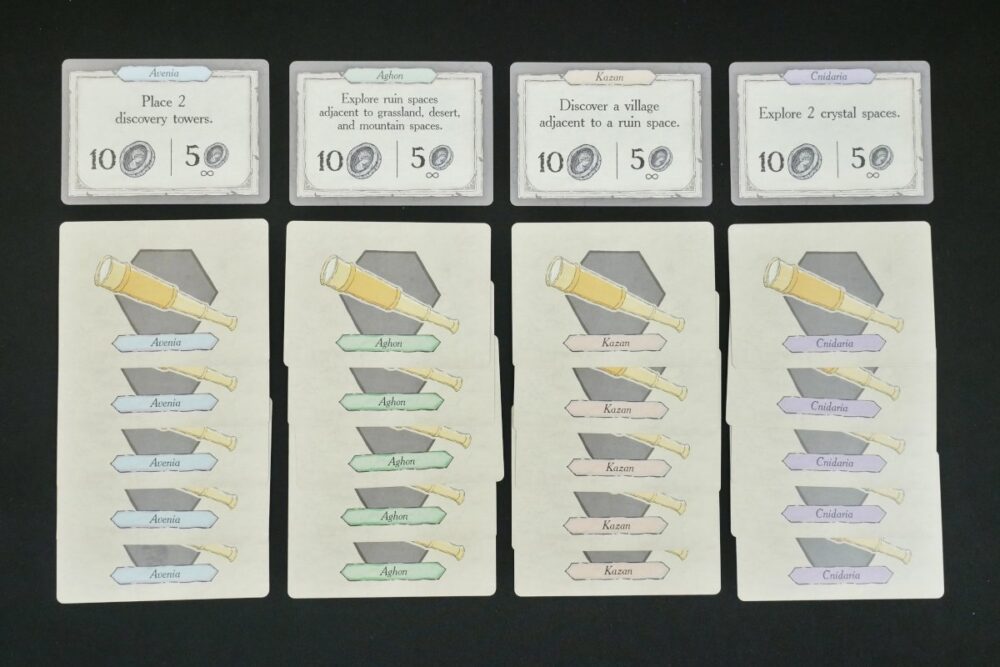
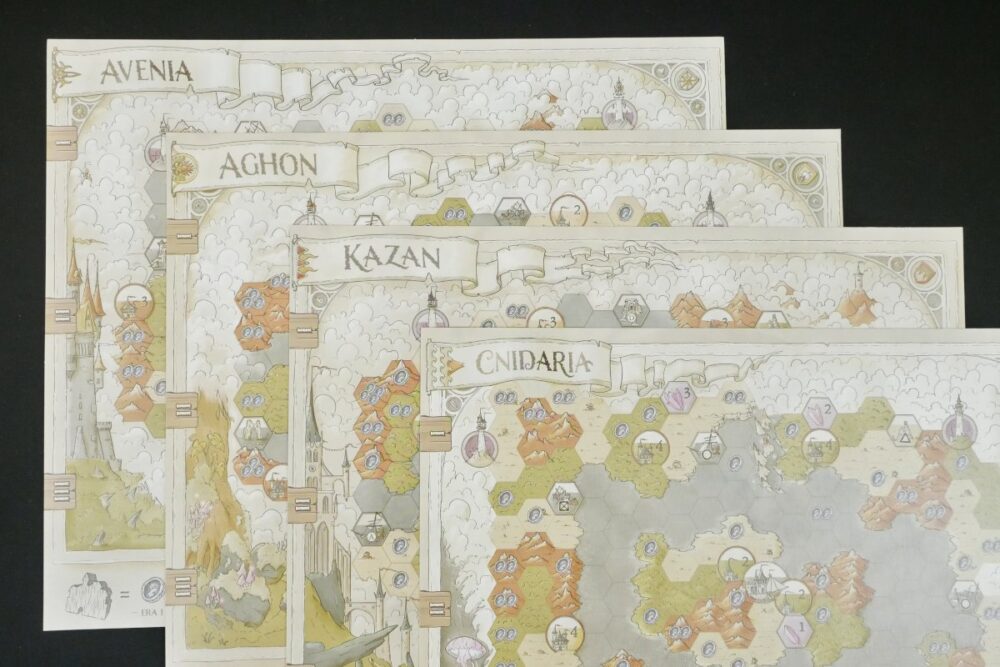
There are 4 maps and each map has its own set of 6 possible goal cards. In any given game, you only play with 3 randomly chosen goal cards.
With a goal like "Discover a village adjacent to a ruin space," you can immediately narrow things down: look for a nearby ruin space, one with a blank adjacent space where you could settle, in a region you think you could reach and complete. Now you have purpose and you can start exploring toward that ruin and that region. On the other hand, a goal like "Discover a village on a region of 5 spaces or larger" puts you through the same process of evaluation but might take you in the opposite way.
A puzzle-strategy game should make it clear what you're trying to solve, and the public goals do that. You always have something to work towards, and that gives the game immediate momentum from the get-go. The only time it flounders is when you're in Era 3 or Era 4 and you've already completed all three public goals, at which point you still have other ways to score points but it does feel like the game closes up and starts to stall.
Simultaneous Play Is Double-Edged
One of my favorite design choices in The Guild of Merchant Explorers is the simultaneous play of the bingo-style action deck. A card is drawn, then everyone works on their own board, quietly figuring out which hexes to explore, going through their own calculations to earn as many points as they can given their board state. Playing in parallel means the game keeps moving and you're always engaged, never yawning or twiddling your thumbs because there are three other players to endure between your turns.
Well, that's how it is about 80 percent of the time. The other 20 percent of time, analysis paralysis kicks in for someone as they crunch through all possible actions remaining in the action deck. They can't help but work through all potential combinations, formulating contingencies and wringing out every last point they can muster. Meanwhile, you just had a lightning-fast turn and now you're waiting several minutes for them to wrap up their strategizing.
When only a few cards remain in the action deck, you can sort of plan ahead—and crunching through all the permutations can stall things.
Yes, there's a lot of luck and unpredictability in the order of action cards, but the shape of an era quickly starts to change when you near the end of it. There's always a fixed number of action cards, so if you know which cards have already come out, then you know exactly which cards are still to come—and that means when the deck is down to two or three actions, you can crunch through all possible orders in which they might show up. That's when analysis paralysis often rears its head, breaking the pace. In a game that's entirely multiplayer solitaire, I don't want to be waiting around for someone else.
Player Count and Scaling
It doesn't matter how many players are at the table. The Guild of Merchant Explorers is pure multiplayer solitaire, with just a sprinkling of indirect player interaction with its public first-come-first-scored goals. Apart from racing for those goals, you're 100% focused on your own personal board, exploring your own routes, with zero influence or blocking from others.
They have no say in your decisions, and vice versa. You never have to look at their boards, and vice versa. And while the simultaneous turns are great for pacing, it adds to the feeling of isolation—the whole game is played in silence, save for the occasional under-your-breath muttering as you crunch through decisions. You flip the action card, place cubes on your board, then look up and wait for everyone else to finish. "Ready?" you ask. "Yup," they say. Flip again.
If you hate multiplayer solitaire, you have to know this before going into The Guild of Merchant Explorers: it does not get more solitaire than this. But if you just want to work on your own puzzle without regard for anyone else, then this game out-solitaires other multiplayer solitaire hits like Cascadia, Wingspan, and Sagrada because there's no hate drafting or denials.
Replayability
When you first unbox The Guild of Merchant Explorers, you find that there are 4 different maps and each one has its own layout and quirks. Between that and the bingo-style action deck and the randomized Investigate cards and public objective goals, you expect a lot of replayability. I know I did. Instead, what I found is that The Guild of Merchant Explorers is a good example of a common board game pitfall: variability is not replayability.
On my first play, on the Avenia map, I was enamored. Every decision felt fresh, the action constraints forced me to adapt, the snappy turns kept me engaged. After that, I moved on to Aghon—wow, the novel layout posed new challenges with new decisions, and the game retained its freshness. But when I moved on to Kazan, expecting more fresh gameplay with its new quirks and goals, I started to feel the weight of sameness: there aren't that many possible hexes to explore on a given turn, and the challenge doesn't evolve. Even Cnidaria and its unique Crystal hex type couldn't stave off the repetitive feeling.
I've played The Guild of Merchant Explorers a total of 8 times—twice on each map—and I'm done with it. Despite the variable layouts, the unpredictable action card flips, and the randomized goals, the overall arc and the turn-to-turn gameplay feel samey. Map differences are too minor to shake things up, and playing the same map again reveals how railroaded you actually were by the terrain on your first play.
In short, it stales fast. I'm confident there's nothing left for me to discover, and the only reason to play again would be to see if I can achieve better action efficiency. If you're like me and you don't care much about beating your own high score, then that leaves no incentive to come back.
Solo Mode
Solo is the best way to play The Guild of Merchant Explorers. Everything is effectively the same but with one change: instead of racing against others for the public goals, the game puts you up against a simple countdown mechanism. Now you're racing against the clock instead of other players, and you're trying to beat a score threshold (the rulebook gives Easy, Normal, and Hard targets).
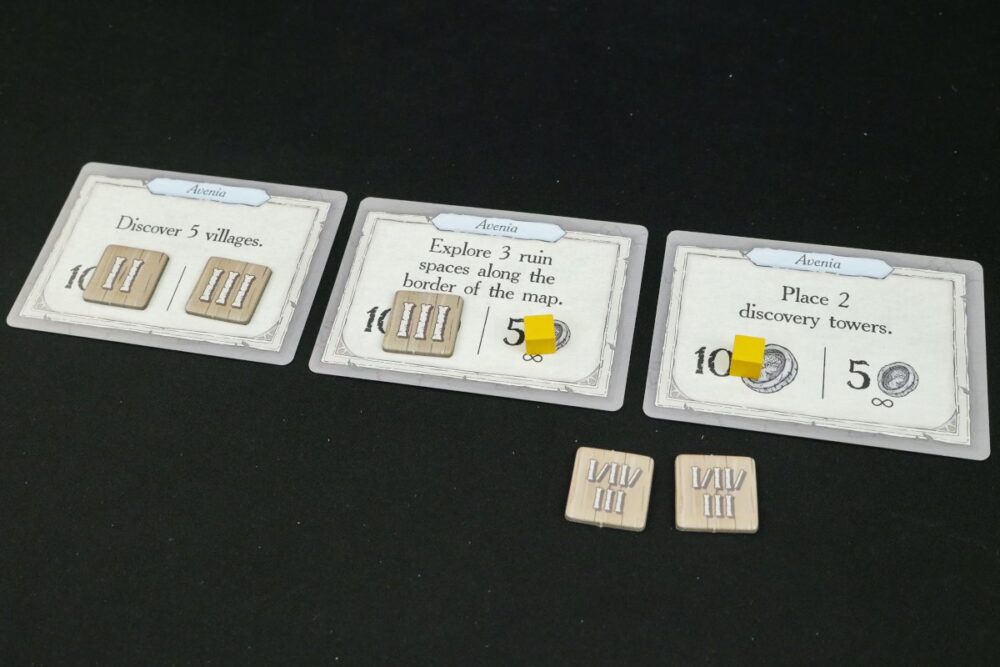
The Guild of Merchant Explorers provides solo tokens that correspond to the Investigate cards in the action deck. When those Investigate cards show up, you take the respective solo tokens and cover up the next goal card. It happens once during Era 2, then again in Era 3, and one last time in Era 4. If you don't clear those goals in time, you'll get blocked out.
In Solo Mode, if you don't clear the goals fast enough, these tokens will block you at the end of their respective eras.
One interesting twist is that the goals are covered up from left to right, so the left-most goal is under the most time pressure at the start. It forces you to prioritize goals in order and adapt your plans accordingly. That's not the case when playing against others, where all goals are up for grabs at all times and equally at risk of being snatched up. Meanwhile, you have to complete all 3 goals in order to win—not true when playing multiplayer.
Between that and the fact you don't have to wait for others to wrap up their turns, solo mode is the best way to play.
Components and Setup
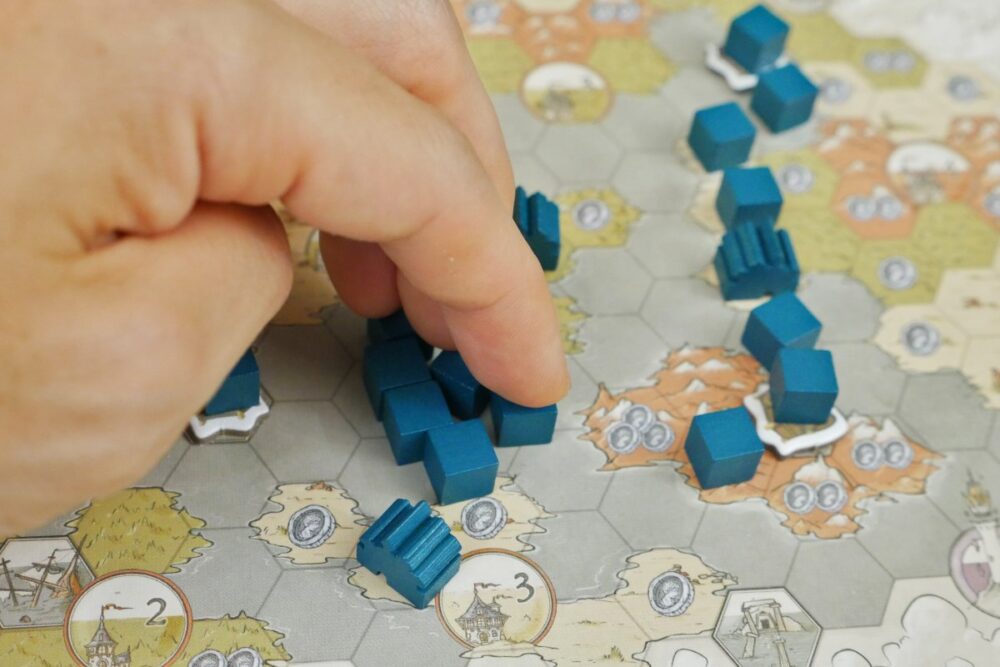
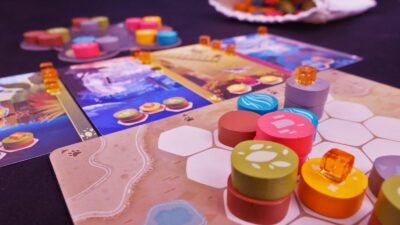
My biggest worry coming into The Guild of Merchant Explorers—and the reason why it sat in my wishlist for over three years before I finally bought it—was its reputation for fiddliness. Carefully placing dozens of cubes on a flat card stock board only to pick them all back up at the end of every era? Not my idea of fun, especially when a small bump or moment of clumsiness could send everything skittering and ruining your game.
Turns out, it's not as bad as I feared. The map doesn't fill up with that many cubes in a single era—not even in the final era—so there isn't much to clean up at era's end. Plus, the flatness of the board means you can just slide cubes out to the edges instead of picking them up one by one.
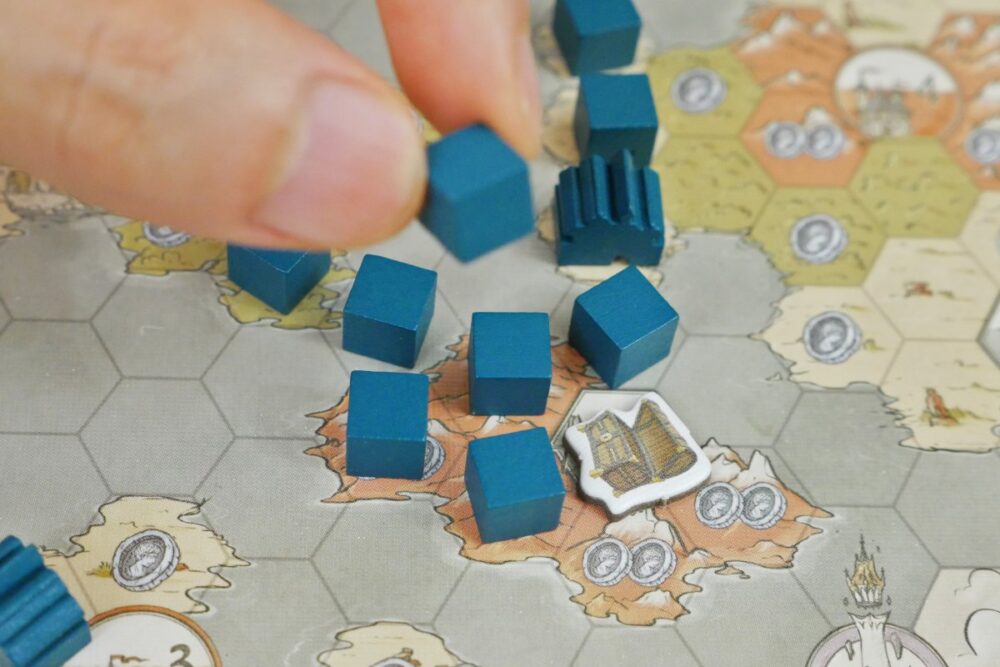
You might struggle with delicate placements if you have fat fingers or trembling hands (guilty), but even then it's not too bad. It's at its worst when you're exploring ruins and connecting cities, in which case you do have to pick up a cube, place a cardboard token beneath it, then put the cube back down. This is the only time where dexterity really matters, but it's infrequent enough that it's more of an inconvenience than a deal-breaker.
Otherwise, the production of The Guild of Merchant Explorers is acceptable—neither stunning nor disappointing. The beigeness of everything doesn't bother me as much as it does others online, and I like the quaint art style. The map is legible and the iconography is intuitive. The setup takes a few minutes, faster if you have all the components separated into individual baggies, and the table footprint is comfortable on a 3-by-3-foot table.
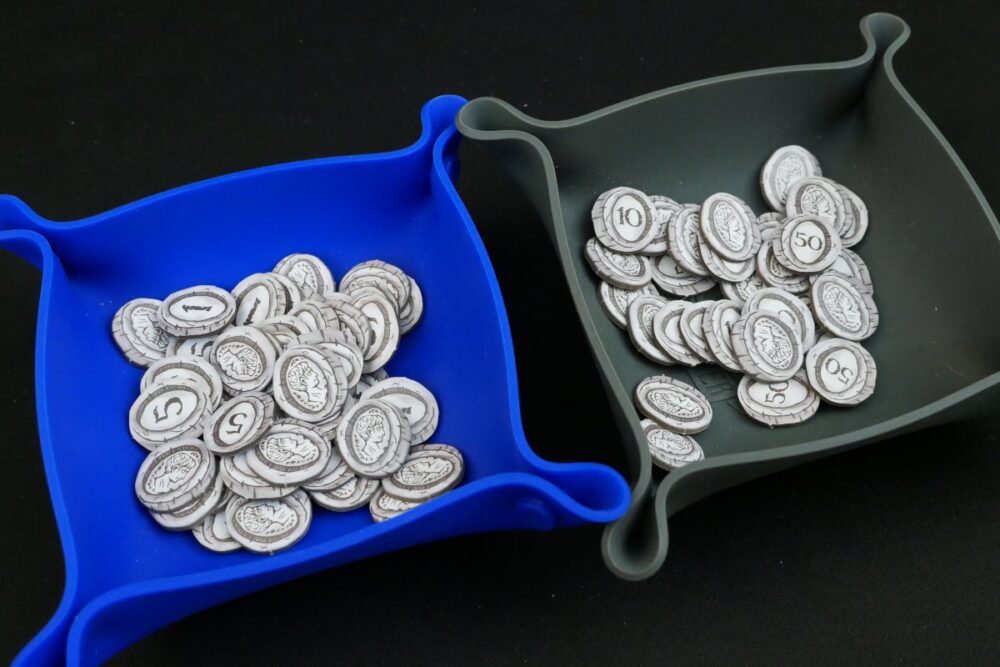
The one thing I don't like? The coins aren't double-sided, so it's hard to fish for the right denominations when they're all in a bowl or pile. The rules technically say coins are to be kept face-down (hidden), so I guess that's why they have blank backs, but it's an unnecessary rule. Given how multiplayer solitaire the game is, you're never counting someone else's coins and it makes no difference whether they're hidden or not. I'd rather all the coins had their values printed on both sides for a little extra convenience that would've gone a long way.
The Bottom Line
If you want a smart, satisfying puzzle to enjoy for about 10 plays, The Guild of Merchant Explorers is a good buy—but only if you plan on playing it solo or your group loves multiplayer solitaire experiences. It's a tough sell at its full $50 MSRP, but good value at about half that. Skip it if you're trying to build a collection and need games with long-term staying power.