At the heart of Dorfromantik: The Board Game (which I'll refer to as Dorfromantik going forward) is real strategy that's knocked off kilter by luck. It asks you to balance short-term tasks with a long-term vision, all while stirring up the pot with opaque randomness. Most other games would fumble it, but Dorfromantik makes it work.
That tension between tactics, strategy, and luck is off-putting if you scrutinize it too much. It's gentle and meditative yet engaging enough to not put you to sleep, and somewhere in there is a game that's worth your attention.
This review is based on my own personal copy of Dorfromantik: The Board Game, which I bought new from Amazon. Not a free review copy.
Table of Contents
View more
What It Is
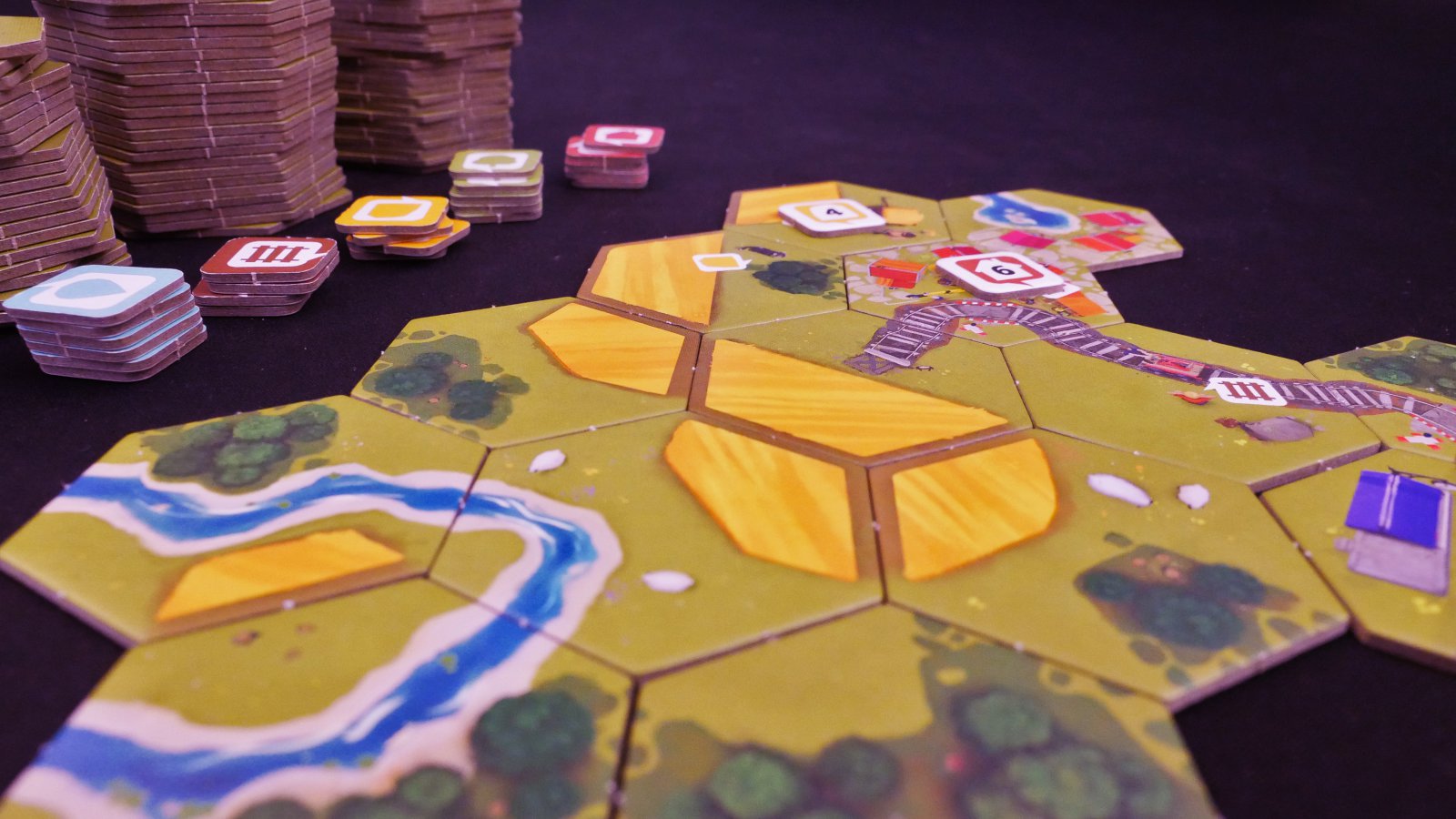
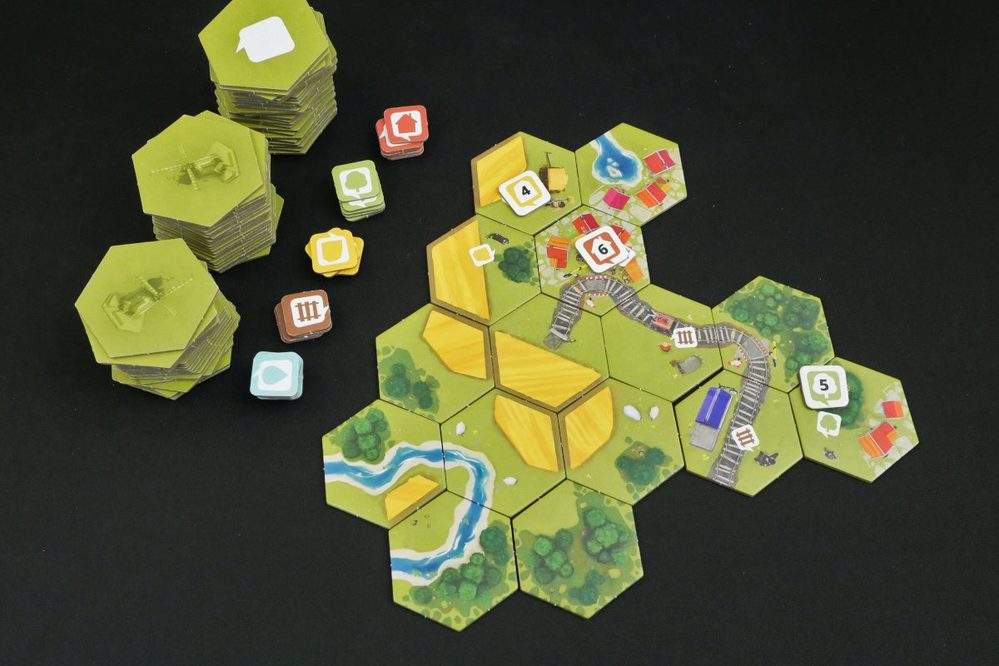
Dorfromantik is a peaceful, cooperative tile-laying game that can be played solo or with up to six players. What you're doing is simple: maximizing your score by building out various landscape regions, completing tasks in those regions, and fulfilling special conditions as they come up. Every task and special condition grants points. Do your best. That's it.
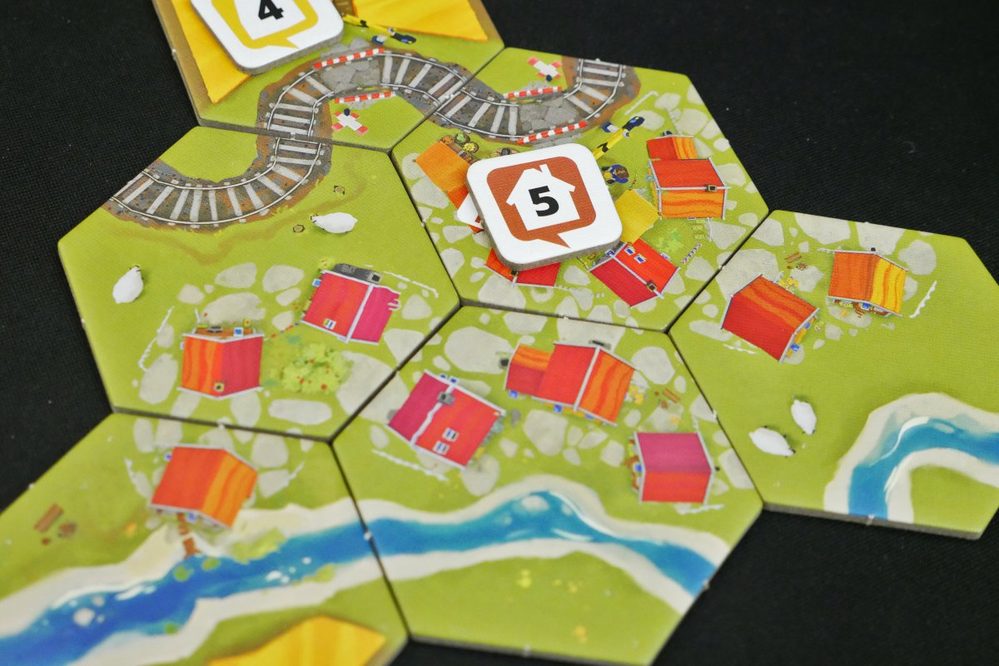
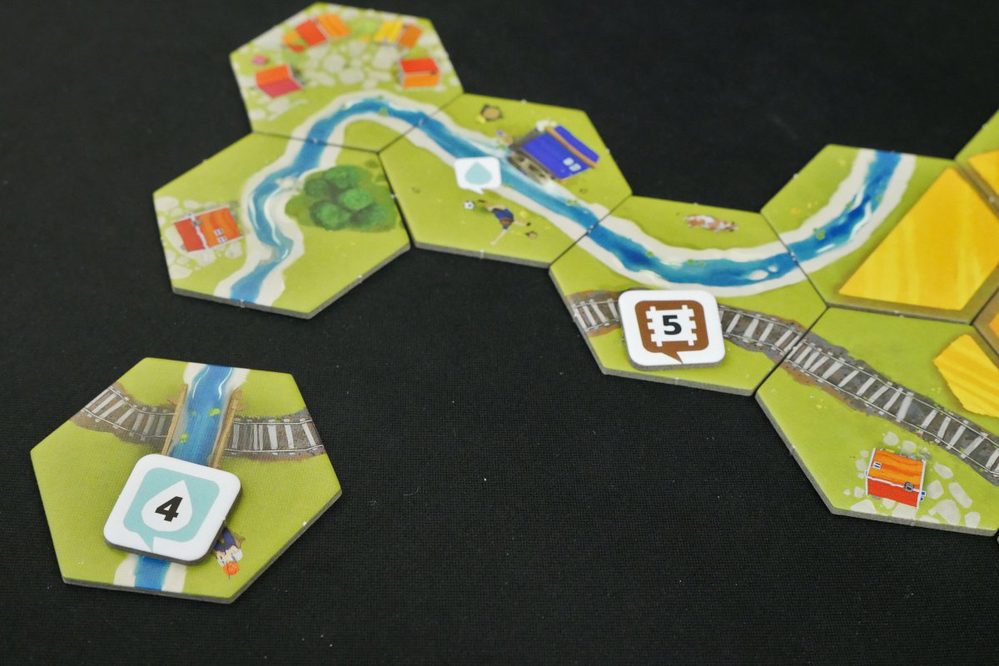
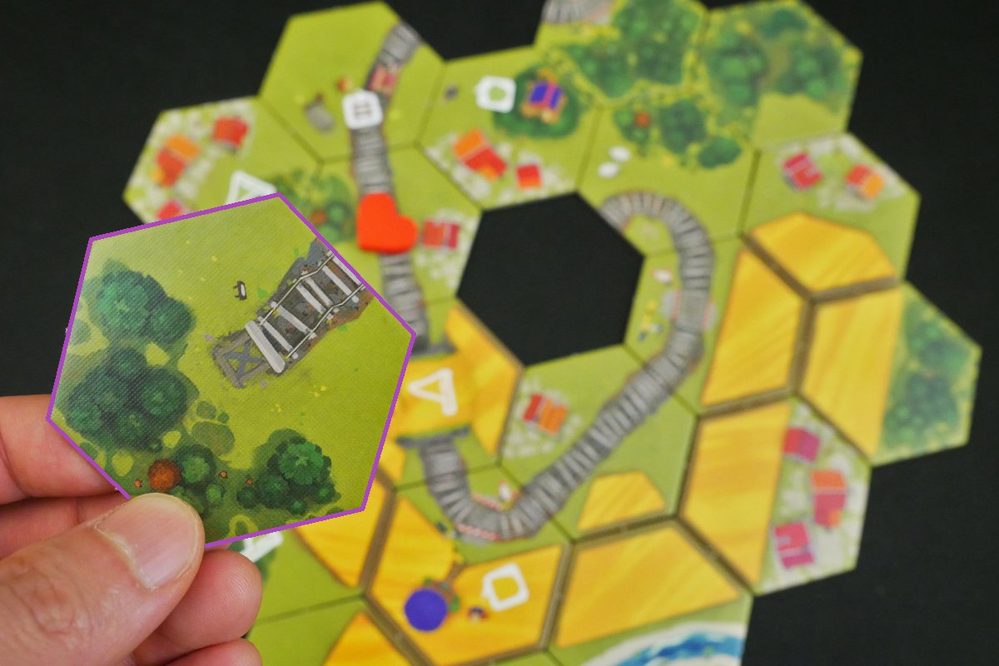
Tasks are straightforward and the main way to earn points. Each of the five landscape types (Forest, Grain, Village, Tracks, and Rivers) has its own set of tasks to complete. A task is simply a target number for the size of that region type to be built out. For example, a 5-Village task is completed once that Village's region includes at least five tiles; if completion becomes impossible, you lose the task and its potential points.
These five tiles create a contiguous Village grouping, so the task is complete.
There are always three tasks in play at any given moment. As soon as you complete one, you draw another task tile and add it to the landscape. Otherwise, you draw and place a regular landscape tile, which is how you fill out the map and eventually complete existing tasks.
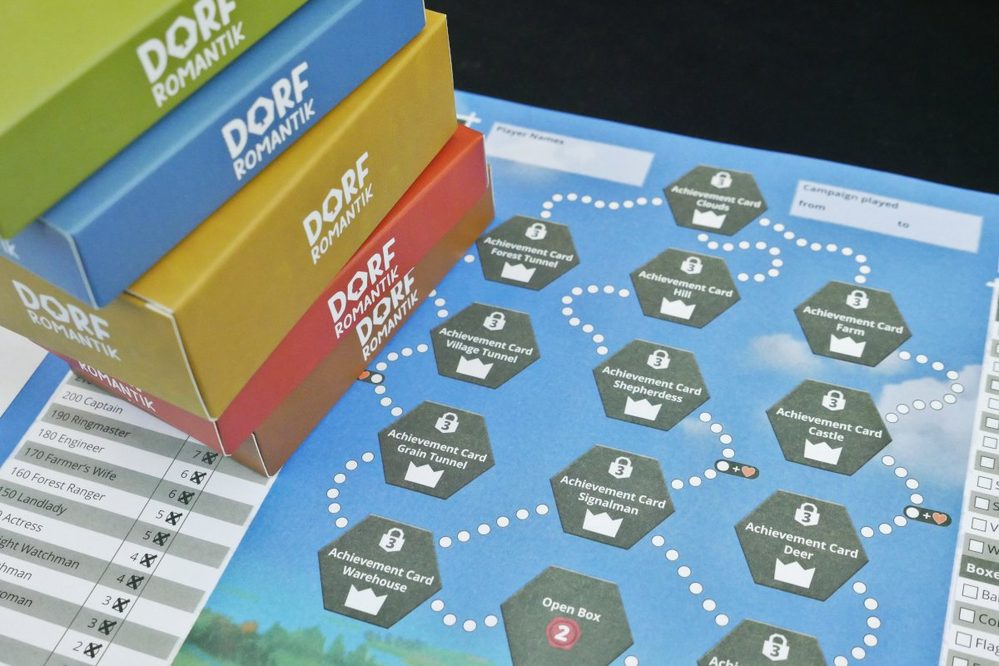
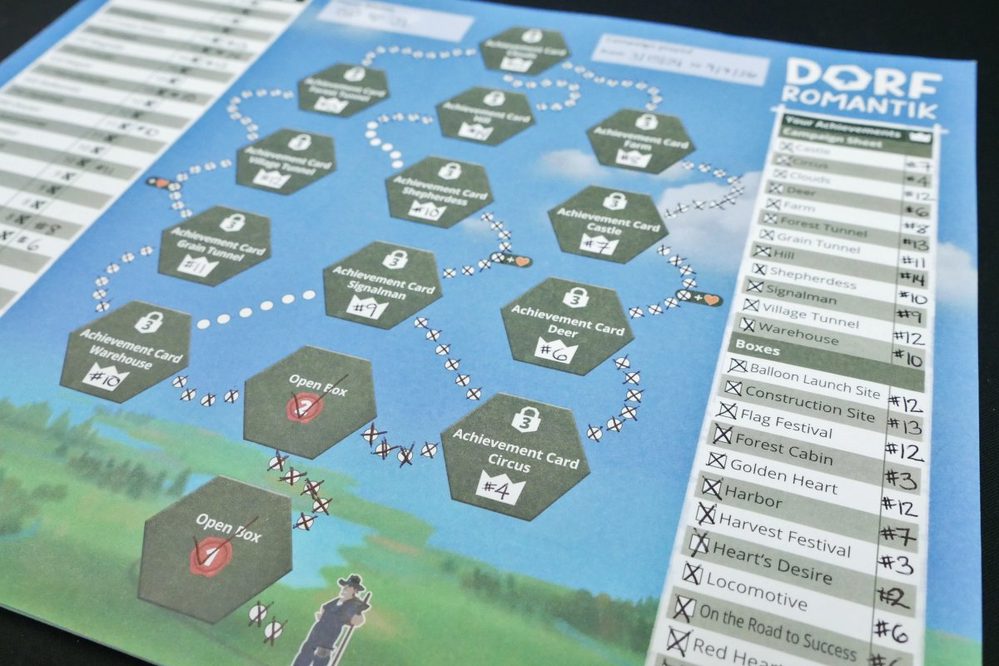
Underpinning all of Dorfromantik is its campaign system. When you finish a playthrough, you earn progress on your campaign sheet—the more points you score, the more progress you make. Progress lets you open up boxes and unlock additional content in the form of new special tiles that'll appear in all future playthroughs. Special tiles represent the possibility of earning even more points, but only if you can meet their special conditions.
Some of that additional content is also locked behind achievements, which are unique end-game objectives with success-or-failure thresholds. For example, you unlock the Forest Cabin by scoring 30+ points just from Forest Tasks in one playthrough. If you do, the Forest Cabin tile is added to all future plays.
You can't lose in Dorfromantik. You just play, score, unlock content, rinse and repeat until you've unlocked everything. At that point, you can keep replaying the fully unlocked game if you want—or you can consider it finished.
How It Feels to Play
Every Tile Flip Is a Small Gamble
Dorfromantik has somehow gained a reputation for being "boring," but I don't get that at all. Low stakes? Sure. You technically can't lose, and I can see how lacking that particular threat softens the pressure. But there are still fun decisions to make and tension as you build out your landscape. You just have to see it for what it is: a game of risk management.
Every tile flip is a mini slot machine moment. Will it fit your landscape? Help serve your current tasks? Or flop and fit nowhere, forcing you to make concessions? Every turn is quiet anticipation followed by the puzzle of figuring out where to place it for maximum value. When I need a straight river piece to connect two River tasks, flip, and it shows up? That's exciting.
Sometimes the tile placements are obvious, and sometimes you have no good options. That's a good thing. The obvious moments are feel-good moments, while the setbacks and obstacles keep the game state interesting. It's the same kind of hopeful anticipation that drives the suspense in bag-pulling games like Quacks, and it all comes down to that tile flip.
The Midpoint Pivot Creates an Interesting Arc
There's a real arc to a playthrough of Dorfromantik. In the early game, you're focused on setting up a good landscape for long-term potential—one that can support future tiles no matter what you draw. If you can complete tasks along the way, great. But the early game isn't really about that.
At some point, though, you need to shift gears. You realize you still have a stack of tasks to get through, and you need to get through them if you want those points. But the only way to bring out new tasks is to finish existing ones. If you shift gears too late, you're left with not enough landscape tiles to get those tasks done, and now you're scrambling while leaving points on the table.
Timing that midpoint shift is crucial, and there's no right answer as to when it makes the most sense. Dorfromantik is a constant tension between tile probabilities, potential task placements, resolving current tasks while also thinking about future tasks, what tiles are still to come, and balancing which tasks are worth pursuing versus foregoing. That arc gives it real forward momentum and an unpredictability that deepens your decisions.
The Real Test Is Juggling Your Goals
The challenge in Dorfromantik isn't just the completion of tasks; it's the juggling of numerous tasks and making sure none of them fall through the cracks. Once you're about halfway through the campaign and you've unlocked a good amount of special tiles, you'll start to feel this. With more and more conditional scoring opportunities opened up by special tiles, you'll find yourself boxing yourself out of old goals as new ones show up.
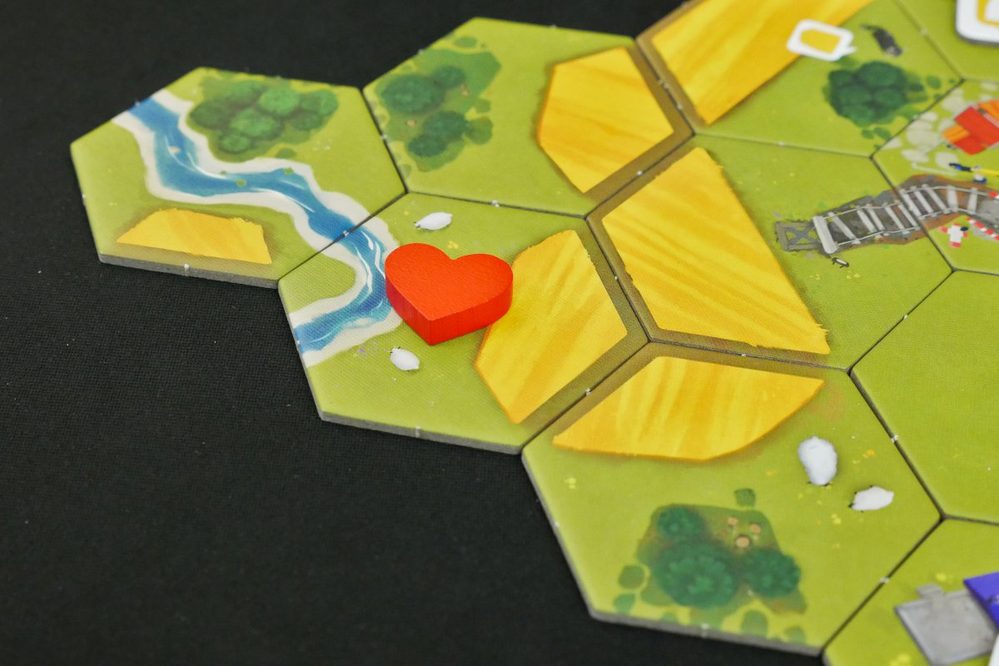
It happens to me on every single playthrough. I place a Heart early on, perhaps on turn 3. (A Heart on a tile scores 1 point for every adjacent tile with a matching edge.) Completing that Heart is my priority. A few turns later, I draw a 6-Forest task—that's a lot of points and I want to keep the task churn going, so that becomes my priority. Soon enough, I draw the Watchtower tile, which doubles the value of Village tasks in its region. That's even greater scoring potential, so I try to focus on that. Suddenly it's turn 50 and I still have that unfinished Heart from turn 3. How'd I let it get this far?
In a sense, Dorfromantik isn't so much about scoring points as it is about leaving as few points on the table as possible. Those might be the same exact things mathematically, but the psychology and texture are different. Every goal is easy points, but it's so easy to miss out on them—you can't complete them all, so which points are you going to risk losing?
Bad Luck Can Obstruct Your Best Plans
Given how simple and relaxing Dorfromantik is, perhaps it comes as no surprise how lucky it can be. But it's not the good kind of luck—the kind you can shape to your goals. It's arbitrary and negatively affects agency. Luck in Dorfromantik can seriously bone you, and it's the worst aspect of the game by far.
The order of drawn tasks and tiles has a significant impact on your scoring potential. For example, larger tasks can "tack on" to smaller tasks, so if you have a finished 4-River and then draw a 5-River, you can attach it and instantly complete it. But if you first finish a 5-River and then draw a 4-River, it can't get tacked on—you have to start a whole new river for that task. Since there's no control over the order in which tasks come out, it's up to luck.
This problem is especially evident with special tiles. If you draw the Flag Festival tile on turn 5, you have the entire rest of the game to strategize, play into it, and rack up its points. But if the Flag Festival comes out within the last 10 turns, you don't have enough time or tiles to do anything with it. That tile's potential points are effectively wasted through no fault of your own.
Not to mention the three random landscape tiles that are taken out at the start. If all three happen to be of the same type—like that one time they were all Tracks for me—then you're seriously hampered on scoring potential for that type. Those tasks become near impossible to fully finish. Plus, you don't even know which tiles were taken out, so it's not like you can plan around it.
Are your decisions still meaningful? Yes, absolutely. But the luck of the shuffle can limit how far your decisions can go. Even when you juggle your plans well and nail the midpoint pivot, luck will get in your way.
The Endings Are Hit or Miss
Dorfromantik endings are a mixed bag. Sometimes they're exciting and down to the wire. Sometimes they're anticlimactic.
One of my favorite recent gaming memories is when my wife and I were trying to complete a huge Triple Yellow Flag region to knock out an achievement, except we had painted ourselves into a corner. We needed to close off one final edge to secure the Flag points, but due to our prior placements that edge could only fit a very specific tile: a Track end-piece. We drew down to the very last tile, having given up all hope and thinking the end-piece we needed was probably removed at the start of the game... only for that last tile to be the exact one we needed! We hopped around like mad at our fortune. The very last tile. Wow. Impossible to believe if you weren't there.
Those moments are awesome, but not every ending is like that. Most times, you're simply drawing down and placing those last few tiles with no regard because you've either run out of scoring opportunities or can't complete the ones that still remain. When you're 10 tiles out from the end and still have 10 tasks left in your stack, you know you aren't getting to them. Those points are gone, so why bother. You run it out and it fizzles with a shrug.
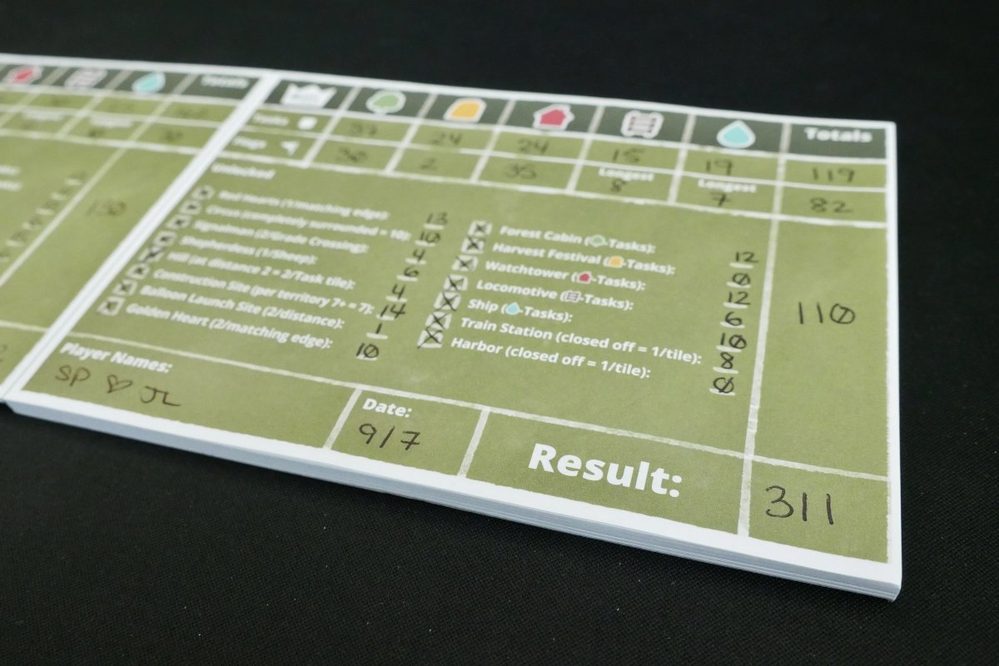
And then comes the most rote aspect of Dorfromantik: tallying up your score, which is its own ritual that can take 5+ minutes, especially after you've unlocked most of the extra content. You go down the score sheet, peering over the board to sum up your various subtotals, making sure you haven't accidentally overlooked a scored tile. It's tedious but unavoidable. (The video game has a clear leg up in this area with its instant digital scoring.)
It Never Stops Being Cozy
I need to take a moment to temper expectations. I don't want to make Dorfromantik sound thinkier and more strategic than it is. It's not a brain-burner. It has low cognitive load, low stakes, low pressure to perform. It has no lose condition, for crying out loud, and the always-make-progress-on-your-campaign design is extremely generous and easygoing.
Nothing about Dorfromantik is stressful or overwhelming. It's the epitome of cozy, and it's a top choice when my wife and I just want to relax for an hour. When you boil it down, Dorfromantik is really just a series of dopamine hits with some mild score chasing and achievement unlocking mixed in. If I had to sum it up in one word? Pleasant.
Player Count and Scaling
Even though I mainly play Dorfromantik with my wife, I can't deny that the co-op design is decidedly weak. You draw a tile, discuss what to do with it, then place it. You're effectively taking turns in a solo game—no one has their own hand, their own pieces, their own areas of influence. It truly is a shared "activity" more than a proper co-op game, like working on a jigsaw puzzle together but with a smidgen more conversation involved.
Still, that "shared activity" vibe is what makes it work for me. I don't play Dorfromantik for the cognitive challenge or the campaign progression. I play it as a relaxing way to pass the time, with the occasional high moments stringing us along like breadcrumbs. It's that shared experience—not the puzzle itself—that makes Dorfromantik worth playing. So I'd never play it solo. If you're thinking of going at it alone, you might as well just get the video game, which handles all the upkeep for you and results in a smoother play.
As far as best player count, I like it most at 2p with my wife. We share in the ups and downs of every tile flip, we discuss each tile placement with equal input, and we fondly look back on our journey through the campaign. I appreciate having her second set of eyes to catch missed potential tile placements and to remind me of forgotten back-burner plans.
I wouldn't play it at any higher player count (3p+), though. There just isn't enough strategic meat to drive meaningful discussions that require three or more voices. More than that, there's a tendency for alpha gamers and quarterbacks to dominate, inevitably forcing quieter players to slink back and turn passive. At 3+ players, I'd rather play something more substantive.
Replayability
Dorfromantik has strong but finite replayability, and that's due to its campaign system. You keep re-playing to hit higher scores and unlock more content. On my first game, I scored 100; on my fifth, I reached 200; by my tenth, I was clearing 300. Seeing your score go up on subsequent plays feels good, and knowing that you get campaign progress even when you score poorly lessens the blow of a bad playthrough.
And it's not just score chasing. It's about unlocking meaningful new content. New tile types offer new gameplay wrinkles that actually affect your decision-making, and the novelty of adding new tiles into the mix is itself fun and rewarding. Dorfromantik evolves over time, and that tenth playthrough is substantially more interesting than the overly plain first playthrough.
But that treadmill of replayability has an expiration date. Once you've unlocked everything (which took 15 plays for me and my wife), there's no reason to play again except to see how high of a score you can attain with everything in the mix. The puzzle itself stops changing and it loses some of its magic when there aren't any more achievements to pursue.
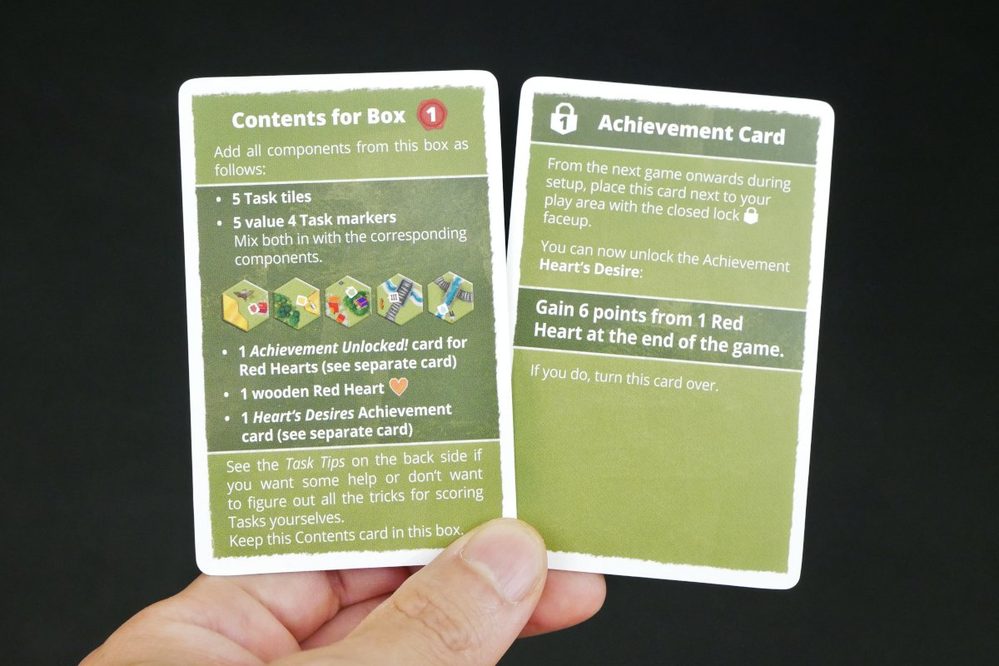
Can you reset the campaign and start over? Yep! Dorfromantik makes it easy, with every unlocked card showing which box it came from and which tile it's tied to. Every box also has a content overview card that indexes what's missing. You can then treat each campaign as its own speedrun challenge, trying to unlock everything in as few playthroughs as possible. It's not really my style of replayability, but it's nice to have that option in the box.
Components and Setup
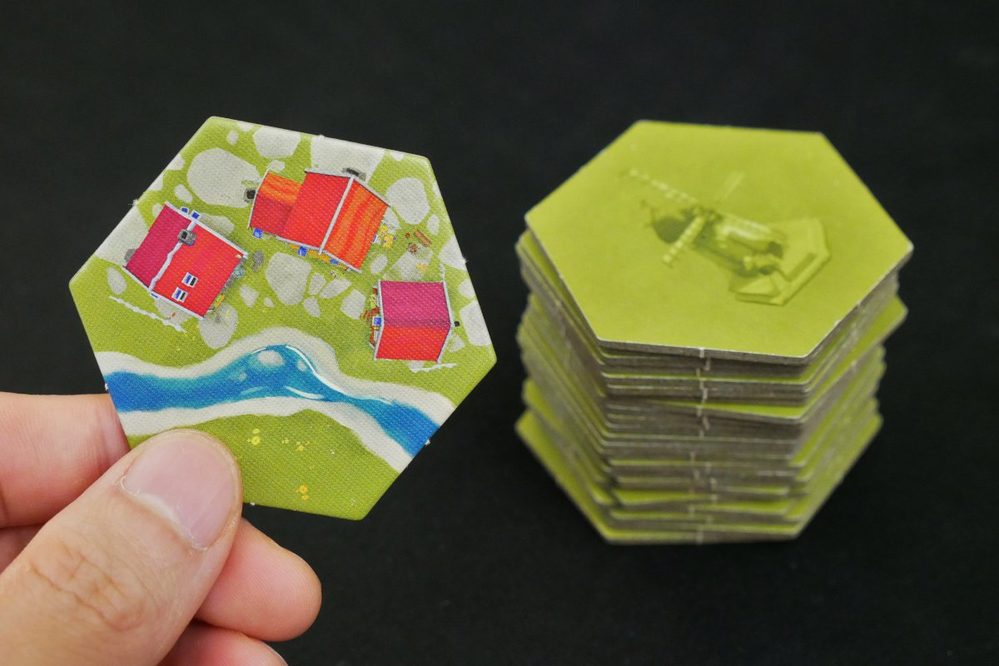
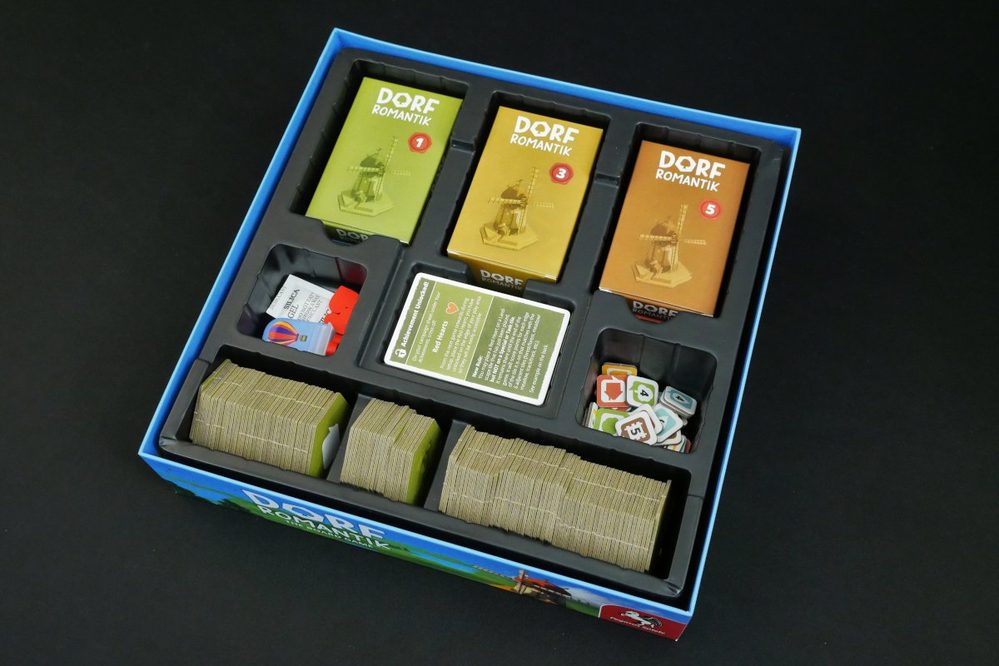
Dorfromantik is a remarkably streamlined game, and I attribute that to its custom box insert. It takes about 3–5 minutes to set up, and all you have to do is shuffle two times: first, remove 3 random landscape tiles from play, mix in the special tiles, and shuffle into one big draw pile; second, shuffle the task tiles into a separate pile. If you wash shuffle, it's fast. And since the insert keeps all three tile types separate, they're easy to pull out as needed. The whole game fits comfortably on a 3-by-3-foot table, too.
With dedicated wells for organizing the different tile types and markers, plus all the unlockable content pre-packaged into five boxes, it's almost impossible for anything to get mixed up. My wife and I took a 2-year break halfway through our campaign, and when we returned to it, I was afraid I'd feel lost and have to restart. But no. Between the insert and the reference cards, it was surprisingly easy to refresh ourselves and resume.
I also appreciate the pads of 20 campaign sheets (single-sided) and 50 playthrough sheets (double-sided), although the ratio seems off. For 20 campaigns, I'd expect at least 300 playthrough sheets. But that's a minor quibble. Overall, Dorfromantik is a role model for campaign game production.
The Bottom Line
Dorfromantik is cozy, but don't conflate that with boring—low stakes doesn't have to mean low tension. If anything, its worst flaw is how much impact luck can have on how well you score. I'm willing to tolerate that given how relaxed the whole experience is intended to be. Play the whole 15-session campaign with a partner whose company you enjoy. Don't get it for solo, and don't get it for groups of 3 or more. At that size, you're better off with a real cooperative experience like Bomb Busters or The Crew.