These 120+ Games Didn't Survive My Shelf
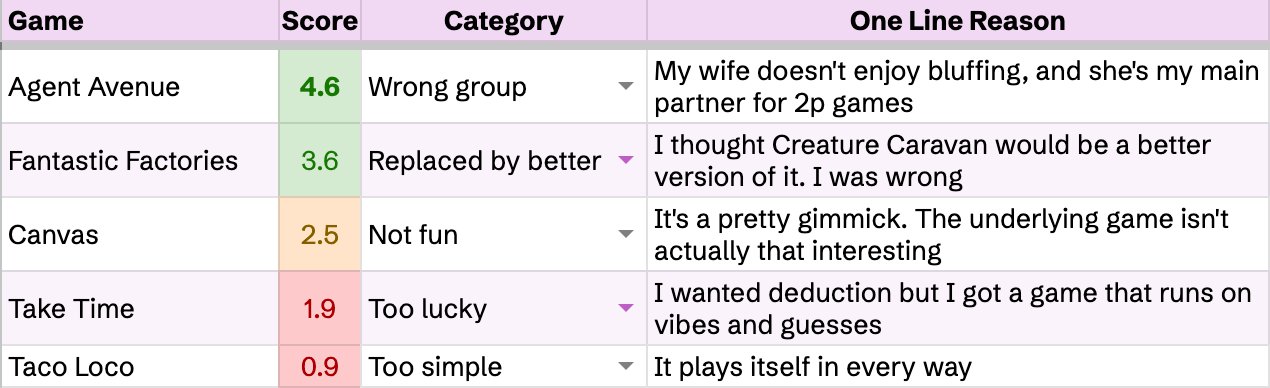
A free Google Sheet of every game I've culled, when, and why, plus an index of all my reviews. Updated monthly. Join my newsletter to get it.
I never sell or share your data. Unsubscribe anytime.

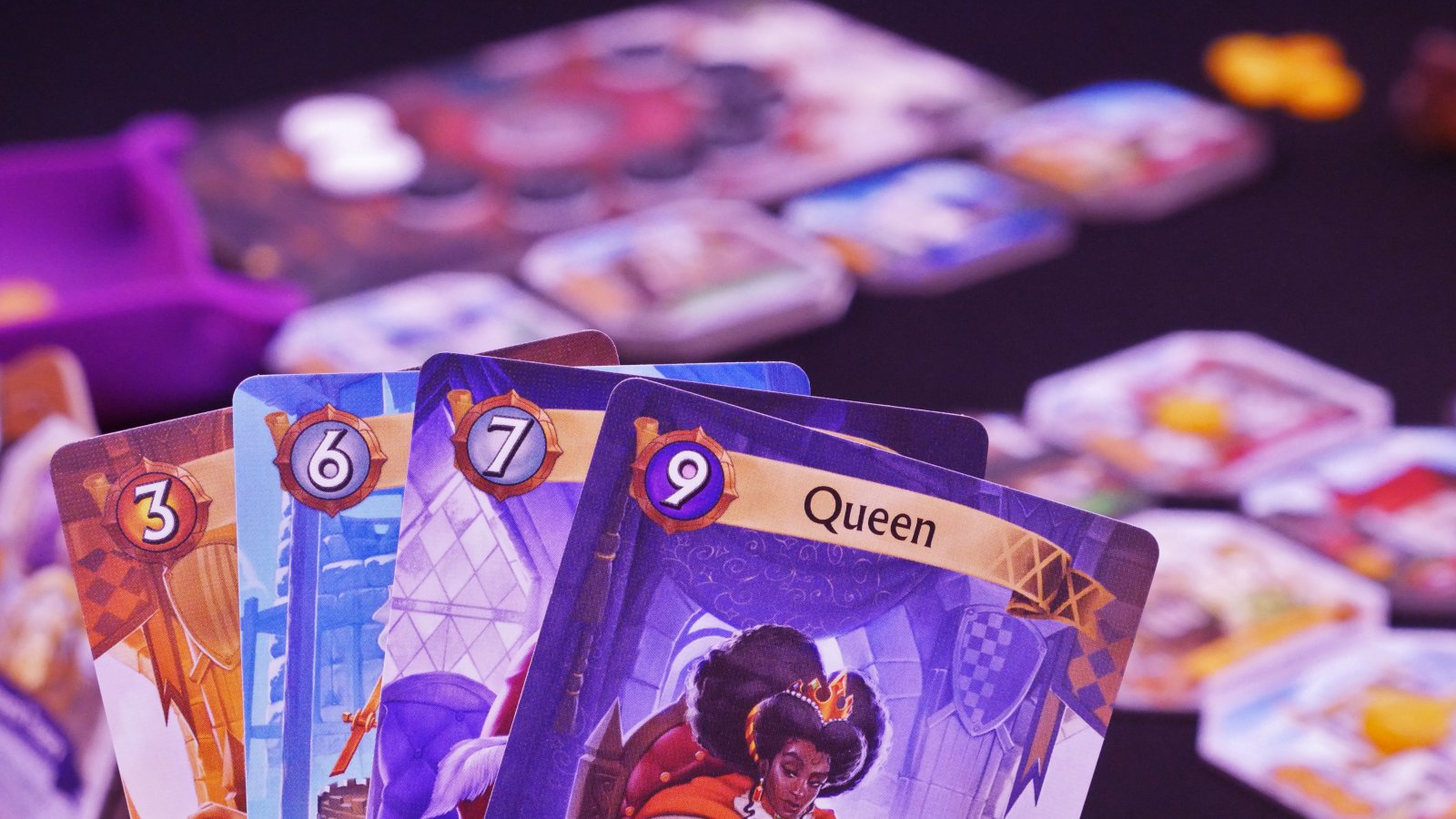
Citadels Duel nails the card draft and fumbles what comes after it. I enjoyed my three plays, but feel no urge for a fourth.
Game Info
Upsides
Downsides
Did Citadels need a two-player treatment? The internet says no, but I say yes. Citadels was one of the first modern games I played, and my memory is that it dragged and swung like crazy. You get assassinated and you miss a whole turn; your buildings keep getting destroyed, so it takes forever to hit the end-game trigger. But most of all, while the two-player variant made it playable, it was too much of a bluffing game.
Citadels Duel isn't just a variant. It's a complete spin-off that takes the best part of Citadels—the character action drafting—and revamps it for two players. In my first game, I failed to assassinate my wife three rounds in a row, yet she killed me every time she held the Assassin. There's real meat to the action process, and that's what I wanted. But what about everything else? Does Citadels Duel live up to the greatness of other 2p greats like Splendor Duel, Dice Throne, and The Lord of the Rings: Duel for Middle-Earth? Well...
This review is based on a review copy of Citadels Duel provided by Asmodee and Z-Man Games, but my thoughts and opinions are my own.
Citadels Duel is a two-player blend of several designs, where no single mechanism leads the charge. You have closed card drafting for action selection, a shared city grid built with tiles, a lot of take-that as you fight for control of the city and the council, set collection for points, all underpinned by a small but significant dose of deduction and guessing.
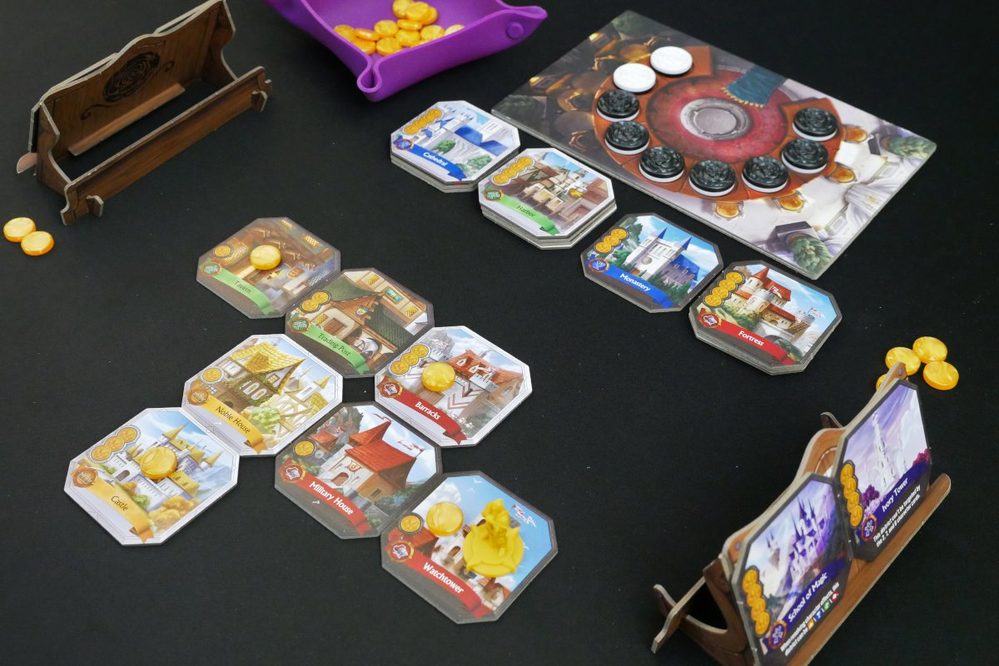
The game centers on a shared city, where you and your opponent place district tiles. Districts come in four colors, each corresponding to a "type" that can grant benefits for relevant character actions. Once placed, certain actions can change ownership of a tile, causing it to flip to its respective player's side. Off to the side, there's the council board where players vie to control more seats, with seats also changing ownership via certain actions.
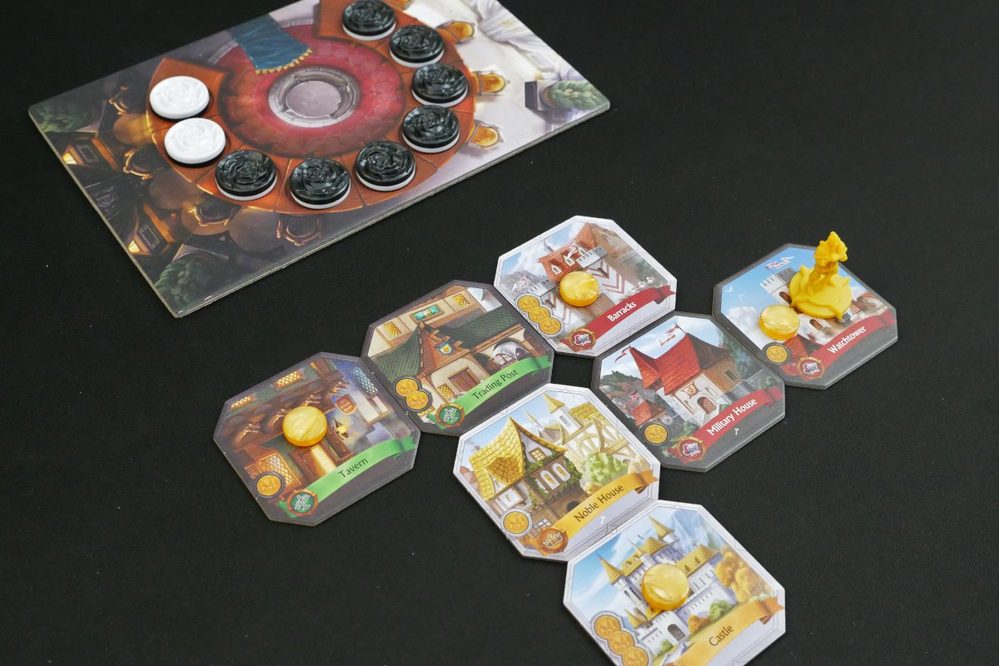
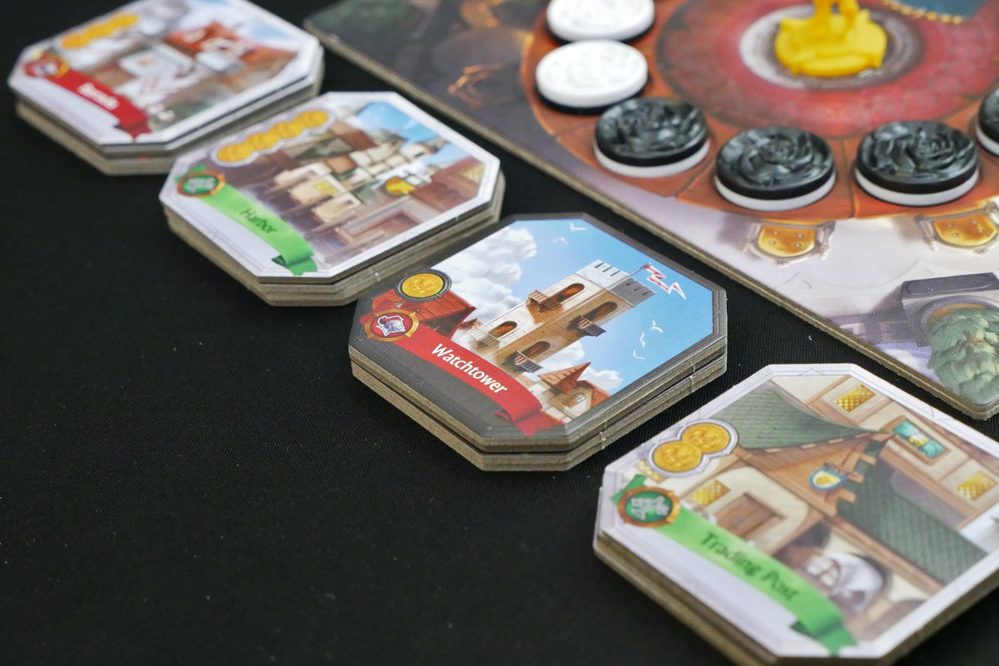
When building a district, you draft a district tile from one of four available piles, pay its cost in gold, and place that tile orthogonally adjacent to an existing tile in the city. The city grid can never exceed 4x4 in shape, so once a row or column is maxed, the city's limits have been reached and you have to place within those boundaries.
Every round starts with a drafting phase. You and your opponent are both dealt 4 unique character cards (essentially action cards), of which you choose 2 to keep and 2 to pass to your opponent. Then, from the 2 you kept and the 2 they passed to you, you keep 3 and discard 1. Drafting is now finished and you move onto the action phase.
There are 9 total character cards, each with its own initiative value. During the action phase, one of you counts out loud from 1 to 9—and when a number is called, whoever is holding that character resolves that character's action. Actions involve things like gaining coins, building districts, manipulating council seats, and taking ownership of your opponent's districts.
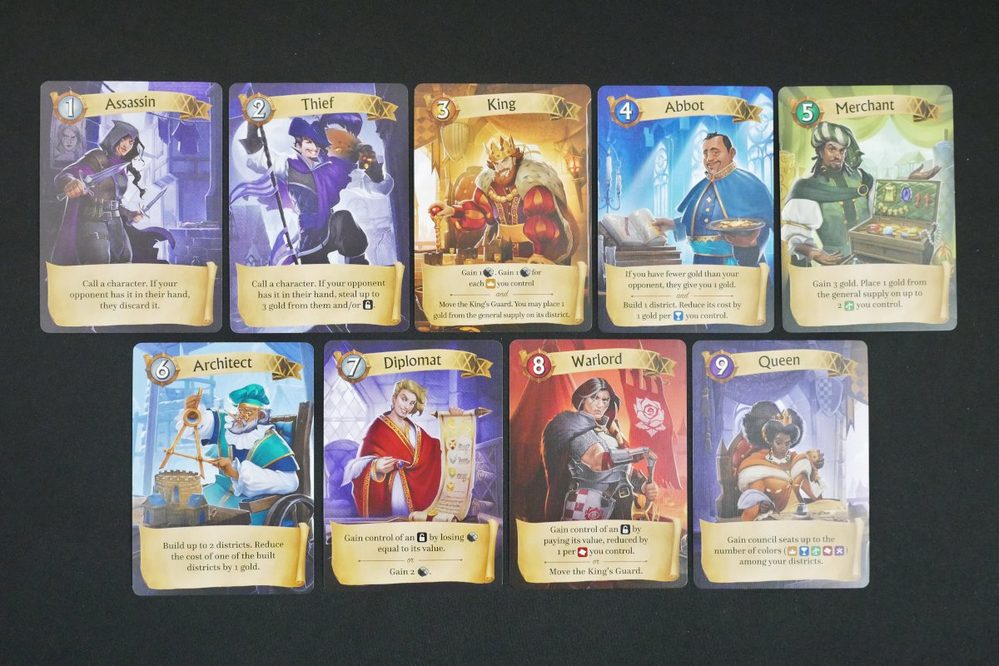
Once both players have finished resolving all three of their characters, the action phase flows into the expansion phase: whoever controls more seats on the council gets some gold and builds a district, while the other player chooses between gaining gold or building a district.
Rounds cycle through those phases (drafting → action → expansion) until the city's 4x4 grid is filled out. As soon as that last tile is placed, the game immediately ends and players score the values of all district tiles under their control, plus a bonus point for every two council seats they control.
The closed card draft is one big game of delicious opportunity cost sacrifices. You're dealt four of the nine characters at the start of every round, from which you must choose which two to pass to your opponent. When I look at a hand of Thief, Abbot, Merchant, and Warlord, I honestly don't know which ones to keep and which ones to give away—because every single action brings its own benefit, and they're all uniquely useful. You're pulled in every direction and you physically can't do them all. You must make sacrifices.
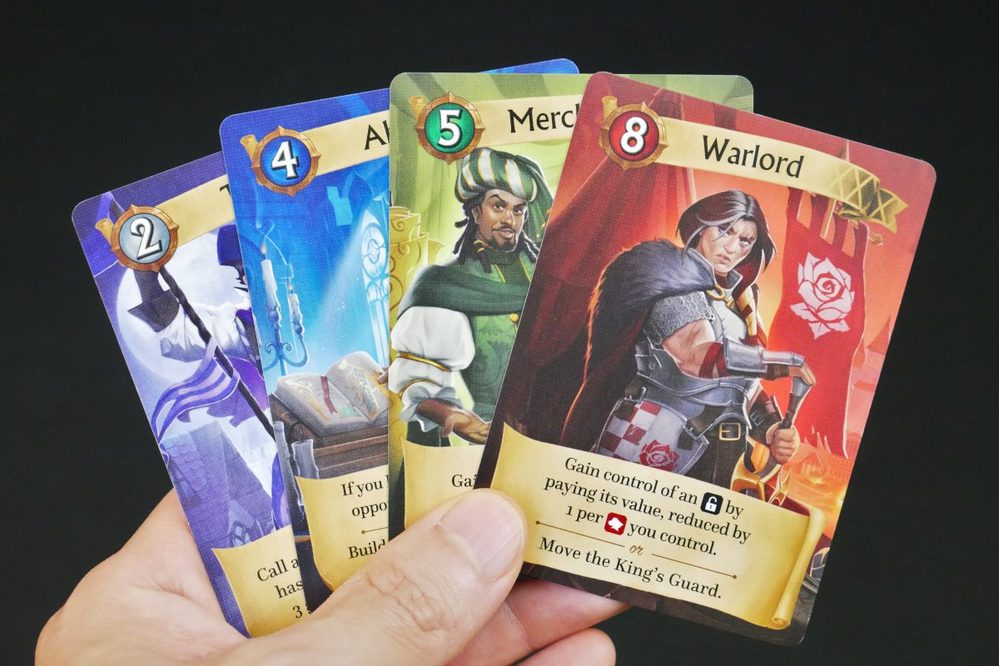
More importantly, whatever you give away becomes usable by your opponent. I may not have the gold to use that Warlord, but my rich opponent could steal my tile if I hand it over. And so I'm sitting there, with a furrowed brow, biting my lip as my leg shakes. My wife is on the other side, tilting her head back and forth before letting out an agonizing sigh. No matter which two you decide to give away, you're going to end up paying for it.
The Assassin and Thief turn every round into a gamble. Both actions require you to name a character, and only if the named character is in your opponent's hand do you get to resolve the Assassin's or Thief's ability. That means you're thinking about what your opponent could be holding, but ultimately making a guess and banking on your gut. If you get it right, the payoff is big—the Assassin lets you cancel a character outright, and the Thief lets you steal coins from the opponent's supply or districts.
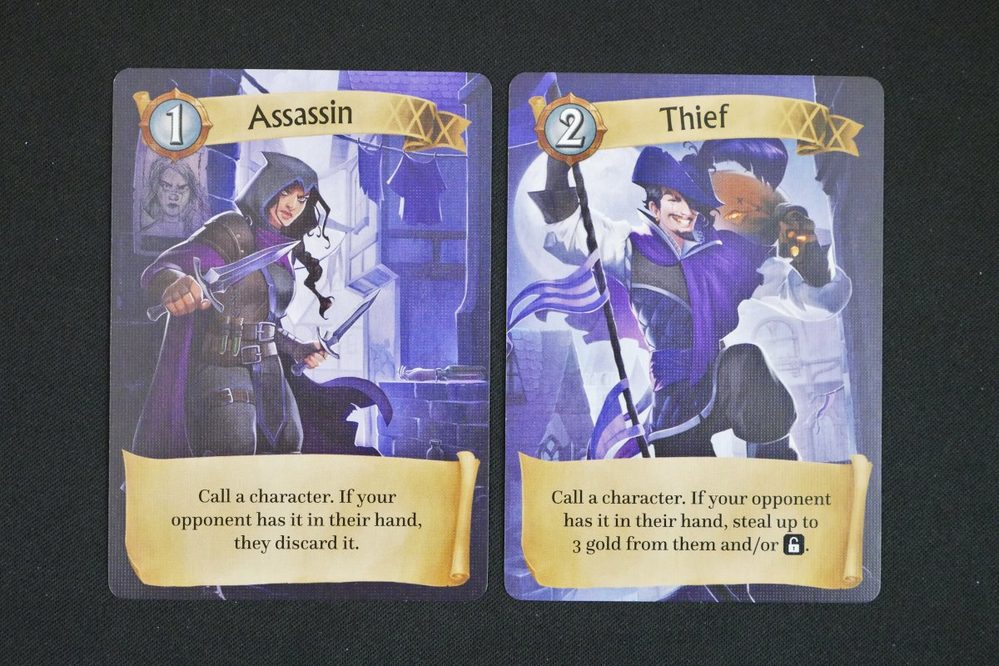
It isn't entirely luck though. You have information to work with: what you were dealt, what you passed over, what they passed to you. You can always guess one of the two you passed over, which is a fixed 50/50 chance. If your intuition sucks like mine does, you end up going three rounds in a row with failed Assassin/Thief calls, and those wasted actions add up over time. If your intuition is great, like my wife's is, you can kill a character or steal coins every time, building up an advantage through deduction and informed guesses.
Since you're only dealt four cards at the start of every round, you can't always play into the strategy you've built. The card you need may not show up. I once went a military strategy, amassing Red districts to cheapen the Warlord's ability. I spent the first five rounds earning gold and stacking Reds, then only drew the Warlord once for the rest of the game. All those other times, it was either dealt to my opponent or discarded as the leftover ninth card. Was it skillful for my opponent to deny me the Warlord? Yeah. Was it luck that gave the Warlord to him in the first place? Also yeah.
That blur is the problem. Red districts only pay off on a round when the Warlord shows up, so every round spent building them is actually a bet on a draw that may not come. The same is true for every other character that gets a discount for colored districts: King, Abbot, Merchant, Queen. It doesn't matter why the card doesn't come—all that matters is the wasted effort and resources that went into a plan that doesn't bloom. And that means you can only play to what you're dealt, not what you've built up as a plan.
Fixed character initiative forces you to plan the order your actions fire in, not just which characters to keep. The Assassin (1) goes before Thief (2), who goes before King (3), and so on. That means you aren't just evaluating how their different abilities interact, but also the sequence in which they'll happen.
But it's not just your own cards you have to worry about—your opponent can disrupt your sequence. I once wanted to use the Queen (9) while holding an unwanted Warlord (8). Should I pass it to my opponent, knowing they could use it to steal a district before I used that Queen? I hemmed and hawed for 3 minutes before finally passing the Warlord, and my wife did end up using it to steal a district from under me. My decision freeze didn't help me, but I couldn't avoid it—and I'm not even someone who typically suffers from AP.
The shared city building is underbaked, and much of that is due to the build bonus. Whenever you place a district, you can either place it next to same-color district tiles and boost the value of what you just placed, or you can place it somewhere else... for absolutely no reason. Seriously, no reason. A choice between a build bonus and no bonus is no choice at all.
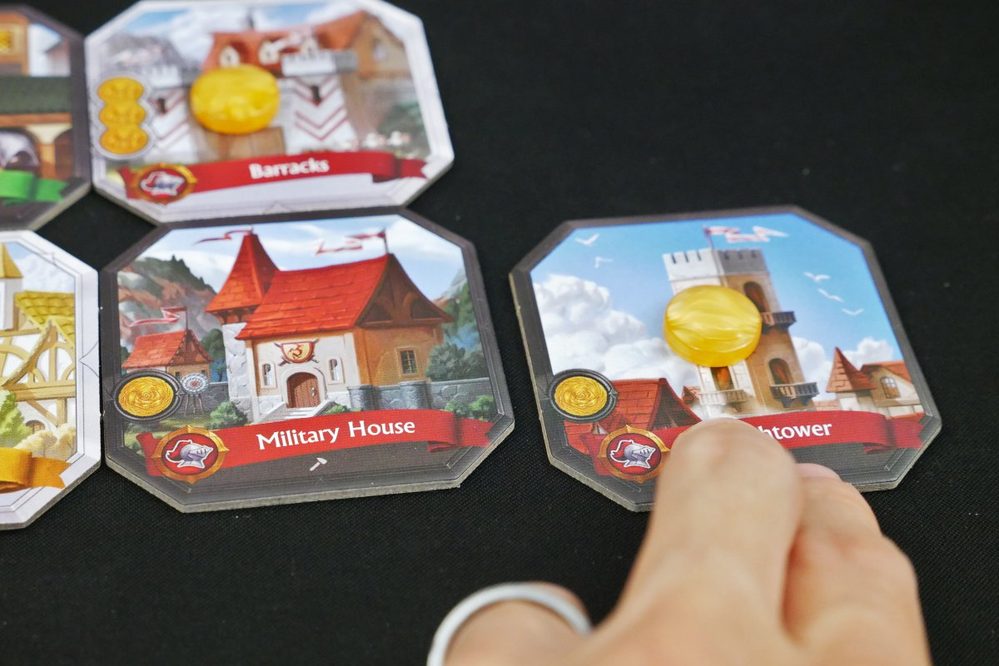
And that means every district tile placement decision is obvious. If there's a same-color district, you go next to it. If there isn't, or if there aren't any adjacent spots available, then you go literally anywhere. Visually, the city is the centerpiece of the game, but there's no gameplay here. While every individual tile might have a reason to exist, the spatial element is wasted. If only there were more reasons to place or not to place...
I like the idea of Citadels Duel more than actually playing it. Having played three times for this review, it hasn't left the shelf since.
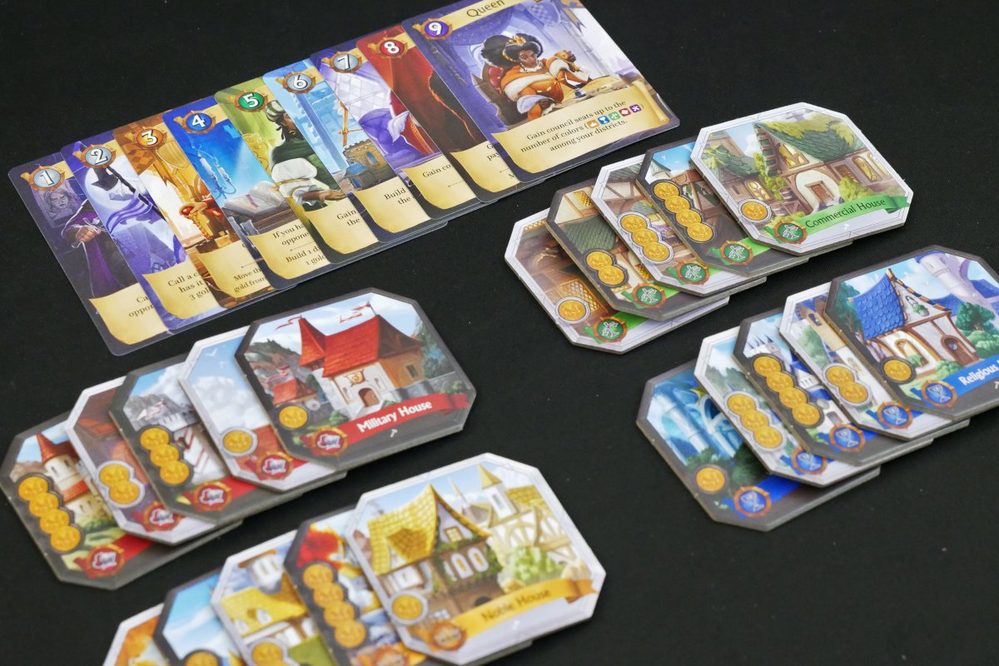
There's almost no variability between plays. You see the same 9 character cards every time, the same 16 district tiles in the drafting pool, the same city building experience with obvious placements. The two starter districts that seed the city are technically randomized, but the effect is minimal—it doesn't change how you play. And while players also start with two random "unique districts" with special powers, we only built a single unique district across our plays. Most of the time we forgot we even had them at our disposal.
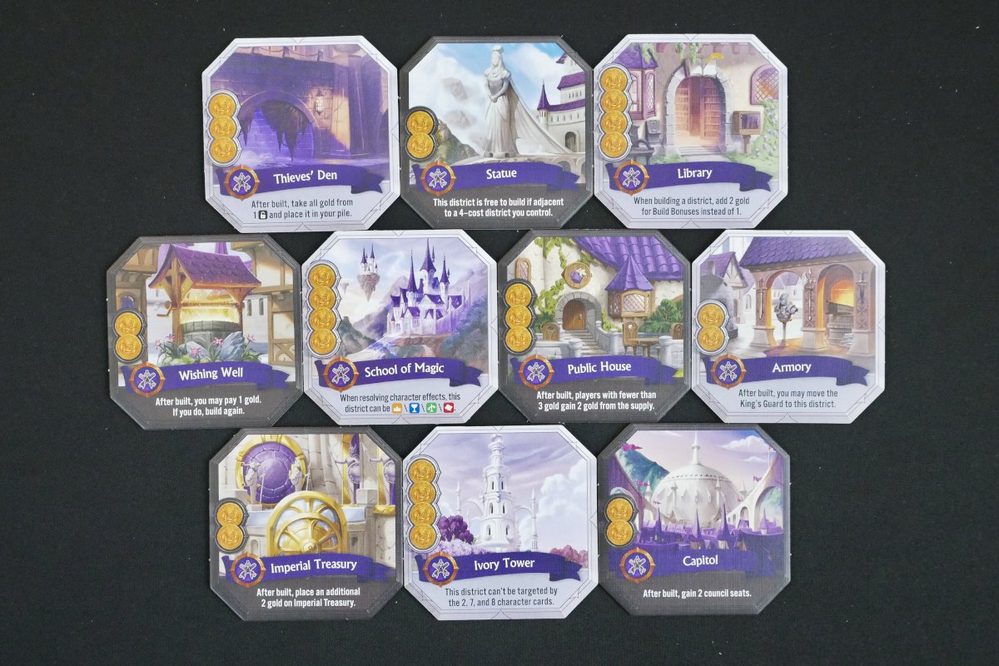
Ten minutes into my second play and I already felt déjà vu. By the end of my third play, wins felt a bit arbitrary. But the biggest barrier for me is its play time. Billed as a 30-minute experience, my own plays clocked in at 45, 50, and 38 minutes. A lot of that time is dragged out by the card drafting analysis paralysis—without that, it could be a 30-minute game, and it'd be better for it.
This is what a $30 game should look and feel like. Z-Man prioritized functional usability here, paying attention to little details that would otherwise cause friction during play. The clipped tile corners allow for easy flipping in the city grid, the black-and-white sides on tiles and council tokens clearly show possession, and the stands that privately hold your unique districts are quick to both assemble and disassemble, minimizing setup friction.
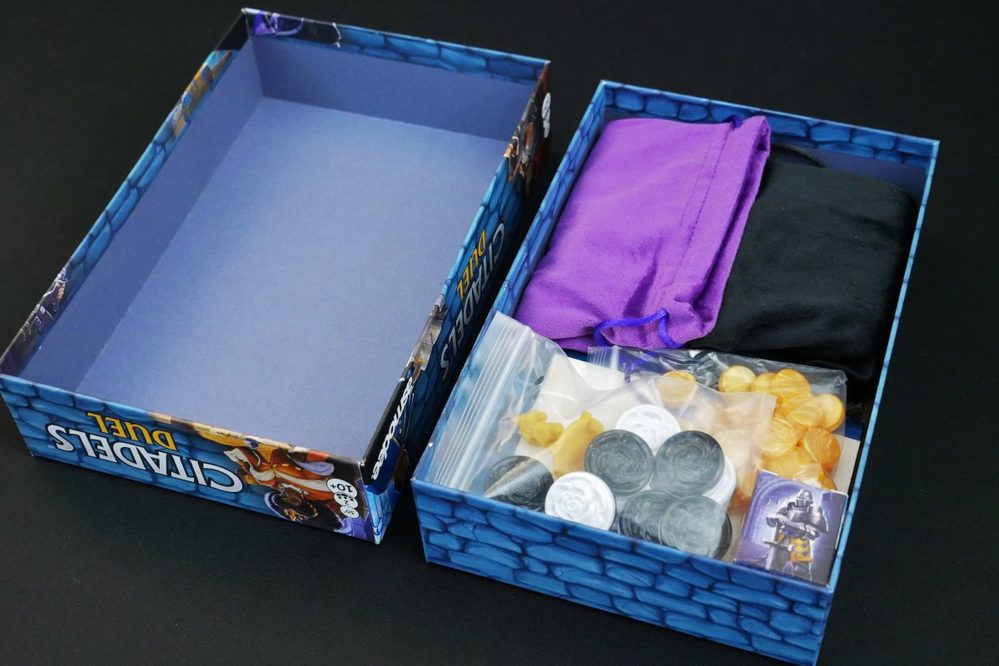
The plastic King's Guard adds a tangible focal point on top of the city tiles, the two cloth bags (from which you draw random tiles) have a premium quality to them—softer and lusher than you'd expect at this price point—and the dual-layer council board keeps the tokens in place amidst constant flipping. While there's no box insert to organize the pieces, everything fits back in with zero wasted space, and the size trade-off is worth it for easy storage.
Citadels Duel is a tactical two-player drafting duel with a playtime problem. The card draft creates tough choices, but those same choices invite analysis paralysis, so our games stretched up to 50 minutes against the box's 30-minute promise. Past the draft, district tiles have obvious placements, the card draft keeps you from executing on strategies you've built, and victories can swing on a single stolen tile. If you only play games a few times before moving on, this one's worth a borrow. But if you're looking for a game that earns a permanent shelf space, this one isn't it.
These 120+ Games Didn't Survive My Shelf
A free Google Sheet of every game I've culled, when, and why, plus an index of all my reviews. Updated monthly. Join my newsletter to get it.
I never sell or share your data. Unsubscribe anytime.
More Reviews