
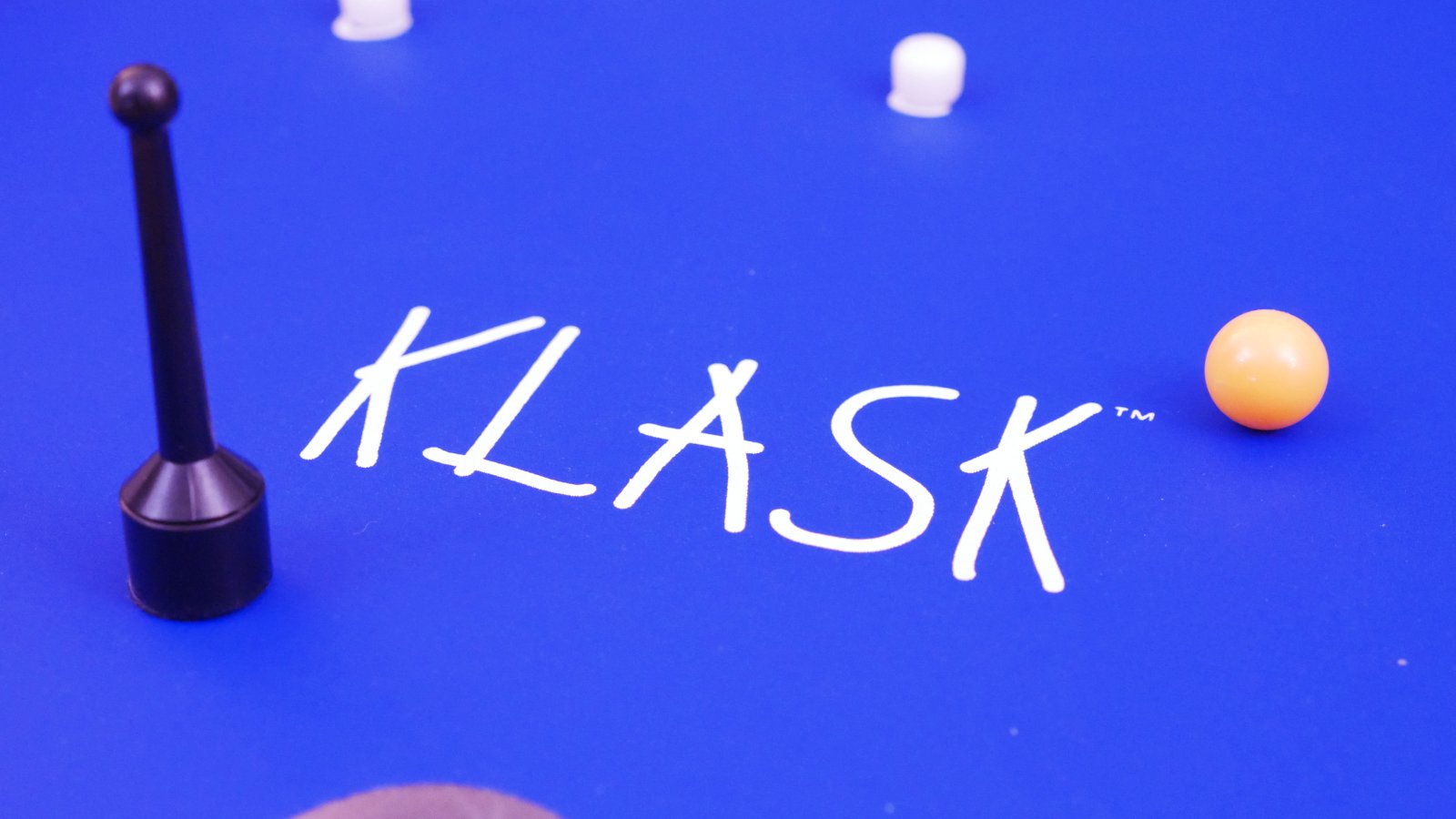
Ask five people whether Klask is a board game and you'll get five different answers. It's a toy, or it's a sport. It's a pub game, skill game, or tabletop game... not a board game. But it's marketed like one, and it has a listing on BoardGameGeek, so who am I to say otherwise? If DroPolter, PitchCar, and Jungle Speed count, then surely Klask deserves to sit at the table.
And I'm glad it does. I came in expecting a duller, watered-down spin on air hockey, thinking I'd be done and ready to move on in five minutes (much like I am with air hockey). But the first time a biscuit stuck to me, I immediately tensed up and hunkered down, wary of catching a double biscuit. I did eat a double biscuit, and I lost that game, and I wanted a rematch. On our first day with it, my wife and I ended up playing for an hour and a half.
This review is based on a review copy of Klask provided by Asmodee, but my thoughts and opinions are my own.
Overview
Klask is basically air hockey without the air, with a few small twists that make it more interesting. If you like air hockey, you'll like Klask—but even if you don't like air hockey, those twists might win you over.
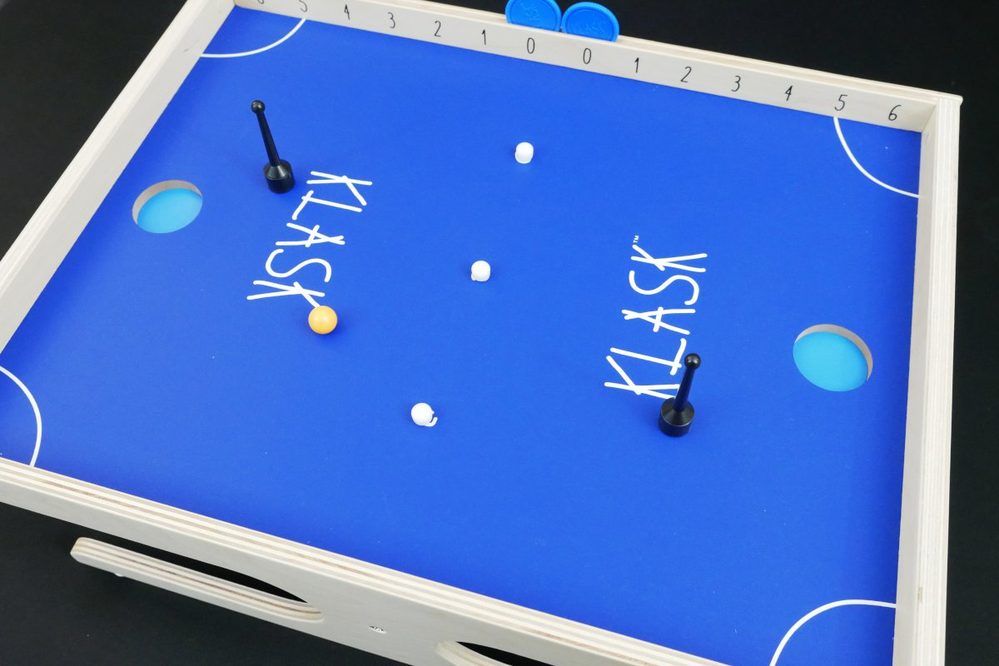
It's a two-player dexterity game played on a wooden surface in an arena measuring about 16.5 x 12.5 inches, one player on each end. You control your pawn (called a "striker") using a steering magnet on the underside of the board. Each player has an inset hole (called a "goal") on their side of the arena, and the objective is to knock the ball into their goal using your striker before they knock it into yours. That's one point.
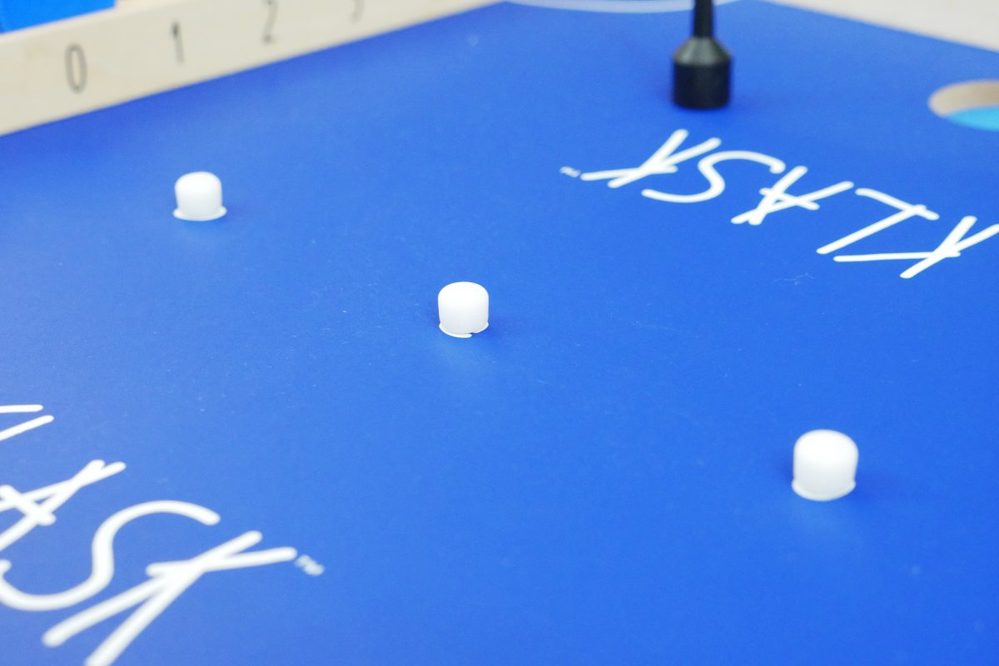
But here's where Klask rises above air hockey: three white magnetic pieces (called "biscuits") sit on the halfway line at the start of every point. If your striker gets too close to any of them, those biscuits will attract and stick—and if you ever have two or more stuck to your striker at the same time, you forfeit the current point. That's called a "double biscuit."
There are two other ways to forfeit a point: your striker enters your own goal (called a "klask"), or you lose control of your striker and it becomes unrecoverable. That means it leaves the arena, sticks to your opponent's striker, or ends up in the opponent's goal.
One game of Klask is played first to 6 points. That could be the end of it, but my wife and I like to play best-of-5-games because it's so fast.
Game Experience
It's All About Aim and Reflexes
The tiny scale of both striker and ball makes Klask a true test of reaction and hand-eye coordination. Whereas air hockey is played on a table, Klask is shrunken down to the size of a cutting board, and whereas air hockey's paddle and puck are as big as your palm, here the striker and ball are marble-sized. Precision is paramount—so many times I've struck the ball only for it to veer off where I didn't intend, or I've snapped to block a shot and totally missed.
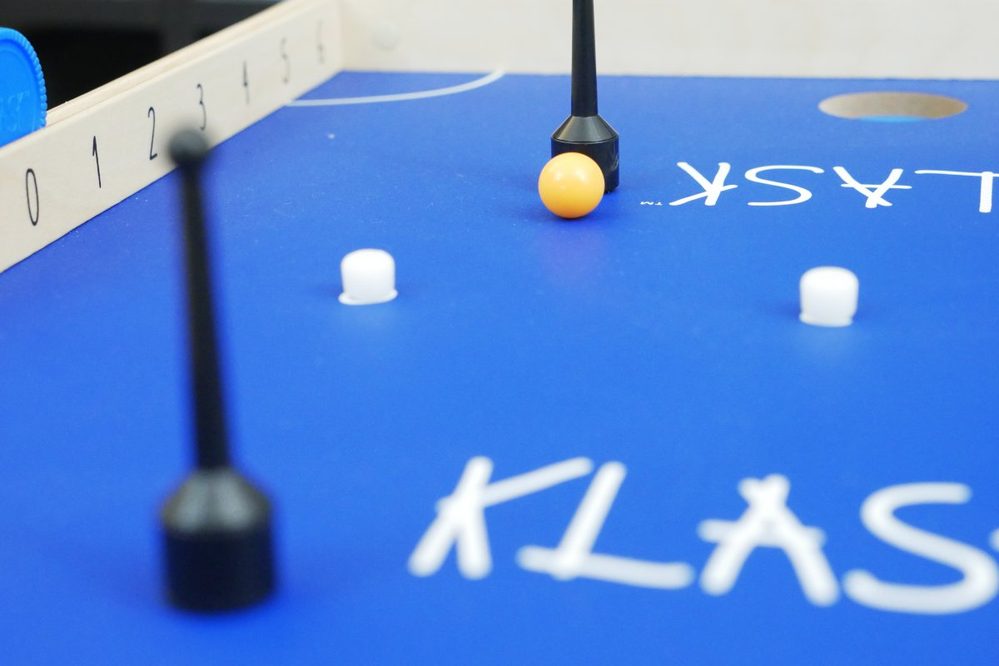
It's one thing to calculate the perfect angle that'll bounce a shot into the opponent's goal; it's another to hit the ball at that exact angle to get it where you want it to go. At this miniature size, the radius of striker and ball leaves no margin for error—even the slightest misalignment causes deviations. Combine that with a goal that's only as big as a poker chip and you have an action game that affords little room for lucky shots and random scores. Whoever has better reflexes, dexterity, and control will have a clear advantage on the board.
You Shoot Intentionally, Not Recklessly
With the goal being an inset hole, you have to strike with intention, not raw power. One thing I don't like about air hockey is how every shot is effectively a power shot—you slam it at the goal, slam it off the sides, slam it off your opponent's paddle. But in Klask, slamming will backfire. The ball zips around too quickly to react to, or it shoots over the edge and into your opponent's possession, or, most importantly, it falls into the goal and pops right back out because it's carrying too much speed.
My wife is a slammer type, and she constantly slammed the ball during our first dozen games. It's satisfying to do, I'll give her that, but it doesn't score—the ball goes in and out and into my possession, giving me the advantage. The hole is about 1/3 of an inch deep, so it's not like you have to be ginger or delicate when you shoot. You just can't rely on raw power like you can in air hockey, and that makes Klask more of a tactical shootout than a contest of force.
The Biscuits Force You to Move Carefully
Because the biscuits can move around freely, the arena becomes a dynamic field that punishes rash movements. Those biscuits start on the halfway line, but they aren't fixed in place—they can be knocked around by the ball, so biscuits end up on your side of the field, sitting there like mines ready to explode as soon as you get too close. And they're magnetic, so it's not just about not touching them; you have to give them significant berth.
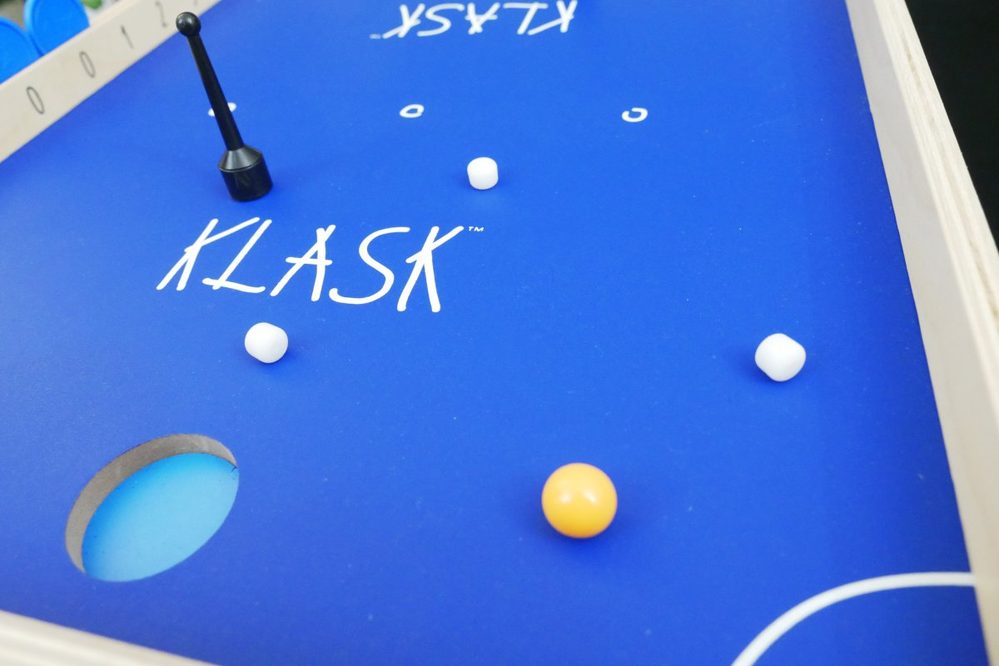
That's when the biscuits get real dangerous. My wife once hit all three biscuits onto my half, cutting me off from both corners and a good chunk of the right side. Blocking her shots was a nightmare while also dodging those sticky traps, and I had to ninja maneuver my way around to retrieve balls stuck in corners. Point after point, the playable field is always changing shape and forcing you to move with care, lest you wind up smothered in biscuits.
Double Biscuits Ratchet Up Tension
The double biscuit presents the biggest threat in Klask. It's the easiest way to forfeit a point, so you're always conscious of it, always focused and engaged as to not slip up. As soon as a single biscuit sticks onto you, it's like a burr—you can't shake it off no matter what you do. Whenever my own striker runs into a biscuit, I instantly slow down and start playing smarter. I can't afford to pick up another one or else I hand a free point to my opponent.
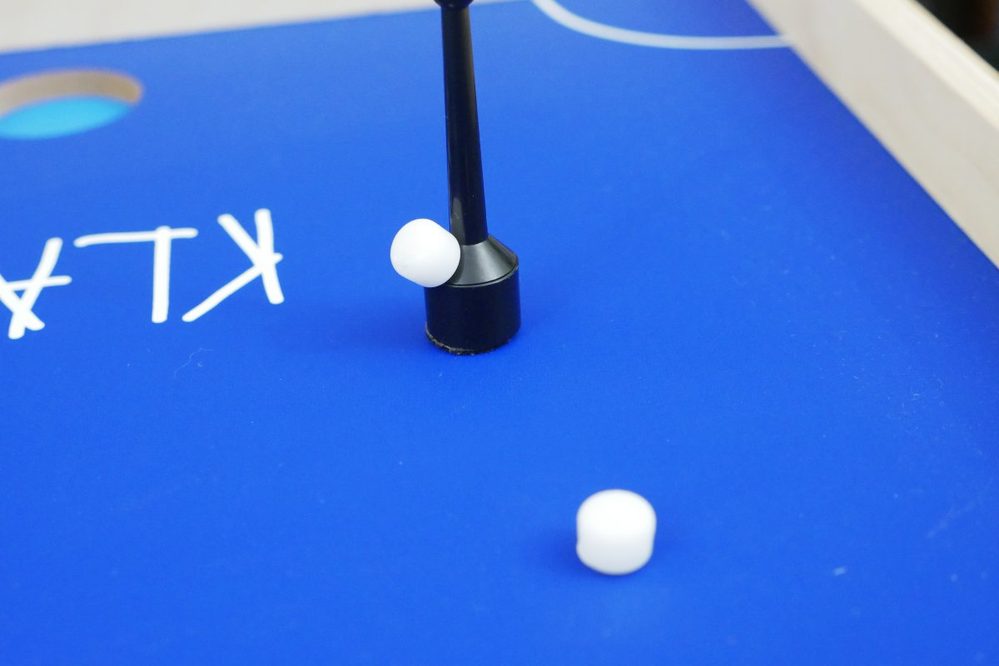
What's more threatening is that you can use biscuits offensively to put pressure on your opponent. My wife likes to hit them with the ball, blasting them my way like an aggressive billiards shot. And when it sticks, I can't be mad—I laugh, half impressed and half in disbelief, because it's a tough move to land. She earned it. My own preferred tactic is to hit the biscuits directly with my striker, which is way riskier but more accurate. Nailing a second biscuit to my wife is one of my favorite ways to score—something I can't do in air hockey.
It's a Race to Whoever Makes the First Mistake
Because there are multiple point loss conditions, you can never let your guard down or relax. You hold your breath on every point, especially when you're in the lead. Your opponent scores a goal, or you pick up double biscuits, or your striker falls in your hole, or you snap too hard and lose control of your striker—any of these can happen in a split second, which means the current point is always up for grabs by anyone. Even when you're behind, there's hope.
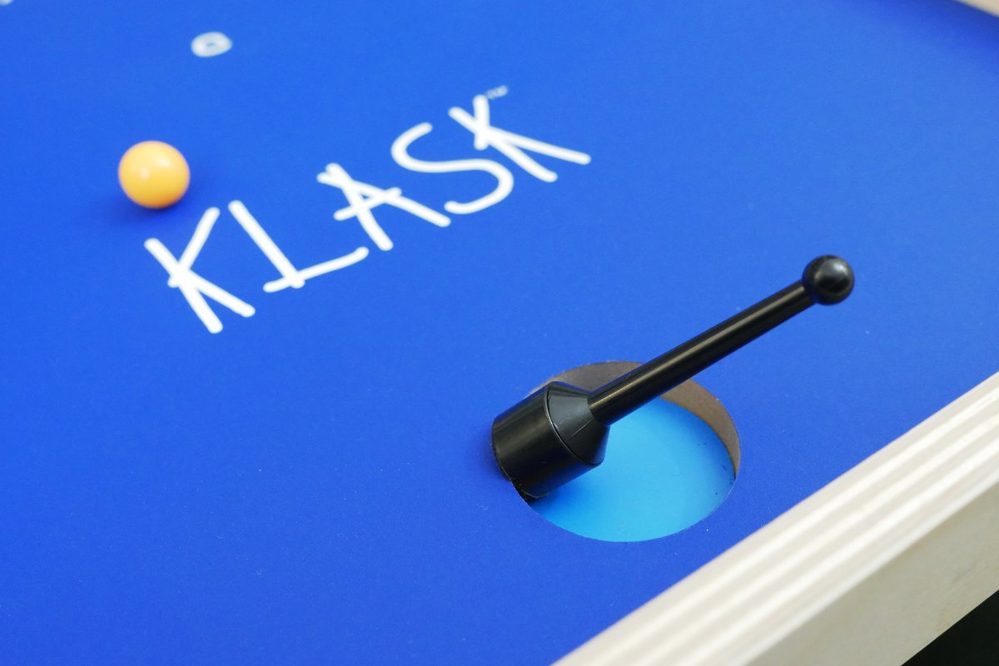
Klask is effectively a race to make the first mistake. If a single misstep is all it takes to forfeit a point, then every shot, every block, every zoom across a mine-laden field, every crawl around the edge of your own goal is a test—and if you mess up, you hand that point over. You have no one to blame but yourself, and that's what makes every point carry weight.
Anyone Can Learn, Play, and Have Fun With It
Because Klask's ruleset is so similar to many mainstream sports, the learning curve is non-existent. If you've ever played a field sport—or watched one played—then you'll grasp Klask with just a glance. One look at the striker-with-magnetic-handle and you understand how it works. The field has drawn white circles, indicating where the biscuits go. The holes are obviously goals where the ball is meant to go. It looks like hockey, it looks like soccer, it looks like lacrosse, and that familiarity helps it teach itself.
That makes it one of the most accessible dexterity games on the market. You can introduce this to anyone and they'll pick it up in under a minute. When Klask arrived at my house and I pulled it from its box, my wife immediately knew how to play just from the field design. "It's like air hockey!" she said, based on the front image on the box. And she was right.
Replayability
Klask is a modern classic worth coming back to. It's a great sit-down-and-play game that's easy to slip in and out of, even if individual sessions wear themselves out quickly and don't deepen over time.
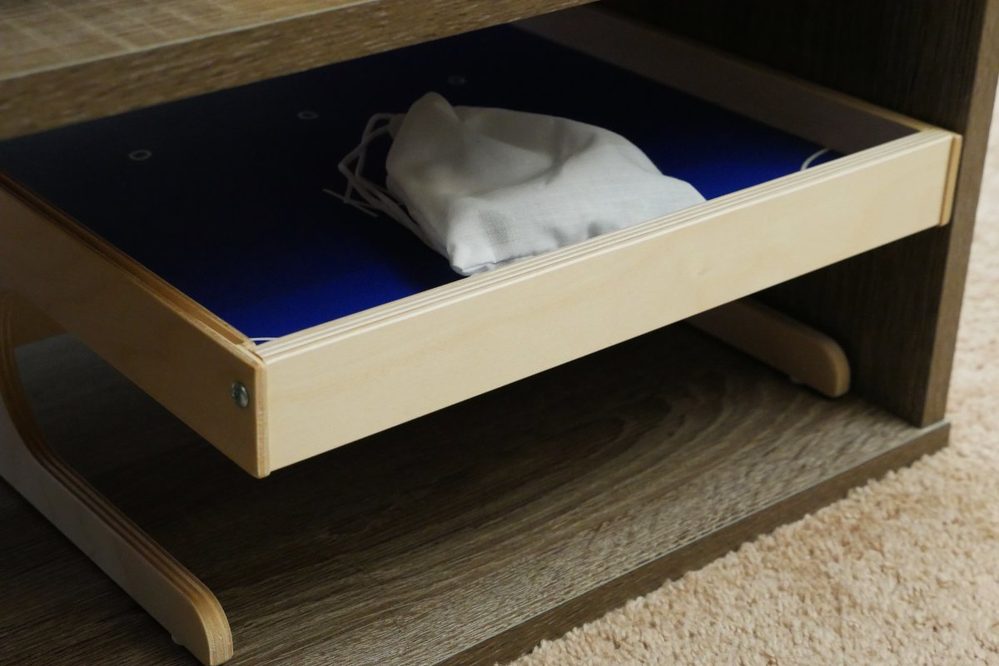
I keep mine under our coffee table, so it's within reach whenever we're in the mood for a game. A single round to 6 points only takes 3–5 minutes, so we can usually knock out a best-of-5-games in about 15–25 minutes. Sometimes we do a rematch, but mostly we don't. Because there's no modularity or variable setup, every game is the same—the only thing that can change is your aim and reflexes, so there's not much new to discover. I have dozens of plays under my belt and all those games blend together in my memory.
During the initial honeymoon phase, I used to enjoy several matches in a row. Now, one full match in a day is enough for me. But ask me to play again tomorrow and you can bet I'll say yes. Klask scratches the air hockey itch better than air hockey does, and that's what will keep it coming off my shelf on the regular (or out from under the coffee table, as it were).
Production Quality and Value
Klask carries a $70 price tag and that's a reasonable ask. Unlike most board games, which consist of cards and cardboard and maybe some plastic bits, Klask is a full-blown carpentry project and conversation starter. Someone who visits your home and spots it on a table is going to be intrigued, ask questions, and wanting to play even before you answer.
The entire arena is framed with 3/8-inch plywood, and the playing surface is medium-density fiberboard with a smooth top layer. It's sturdy and unshakeable, with wide legs also made of the same plywood, plus extra reinforcement on the underside. It's all screwed together—not glued—so it doesn't wobble, wiggle, or warp during play, which is key for competitive fairness. We play with one hand controlling our strikers and the other resting on a leg, which eliminates accidental movements from our striker hands.
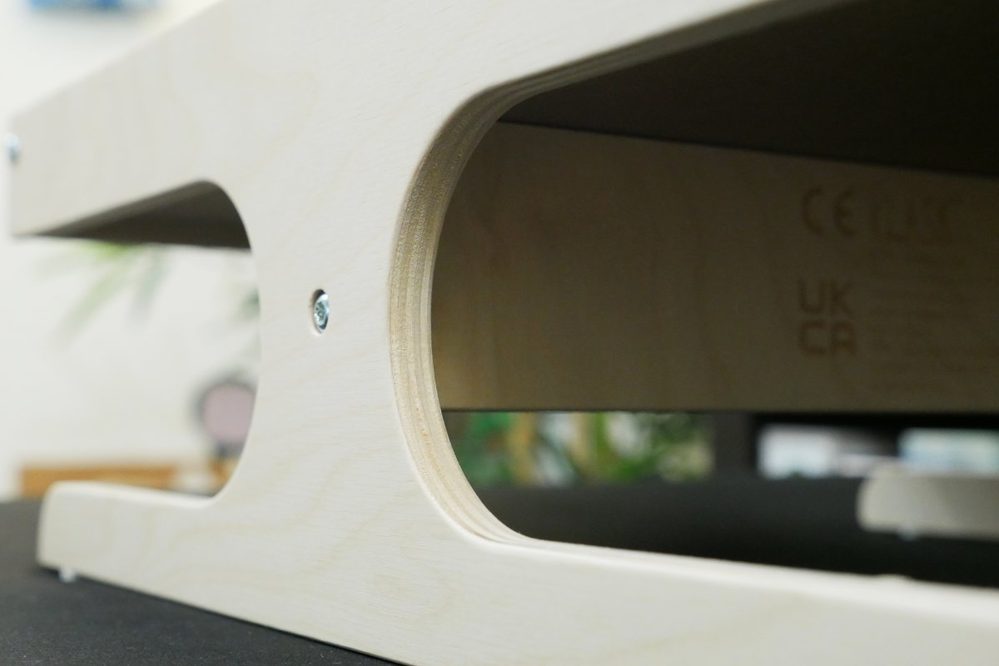
The one real downside to Klask is its size. Measuring 17.5 inches long, 13.25 inches wide, and 5.5 inches tall, it's a bulky product that doesn't stow away easily. It doesn't fold down and it absolutely doesn't fit in a Kallax. For small apartments and packed gaming rooms, Klask's biggest hurdle is figuring out where you're going to store it and how you're going to keep it safe from potential threats like bugs, moisture, and mold.
But it's worth it. With Klask, you're paying for the wood, build quality, and table presence. The rest of the components—strikers, magnets, ball, biscuits—are mostly just functional bits of plastic.
The Bottom Line
Klask is a must-play dexterity game. Don't be fooled by your first impression—it may look like a silly sport in miniature, but this wooden arena for two players is something special. It takes air hockey and elevates it, discouraging brainless power shots with its holes-as-goals design and adding an important threat layer with its magnetic biscuits on the field.
Get it if you want a sports-like shootout that you'll keep coming back to with a partner. Skip it if you don't have much storage space, or if you're expecting it to play differently from game to game.
Stop Buying Games
You'll Regret
Before your next game purchase, run it through this mental checklist that every seasoned gamer uses.
Free checklist, delivered instantly to your inbox.
No spam, ever. Unsubscribe in one click.