My wife and I are always on the lookout for the next word game we'll fall in love with. It is, after all, one of our favorite board game genres. But every game we try is always compared against So Clover!, which quickly crowned itself as word game king the moment we tried it. A Little Wordy is too light, Fiction: Banned Books is too fiddly, Hardback is too mechanical.
Word games are hard to get right. If the rules are too simple, the deduction and solving are anticlimactic; if there are too many rules, the word association (the best part) gets buried under mechanisms. So Clover! straddles the line, with feather-light rules that can be explained in under a minute, plus a satisfying puzzle on both ends—as the clue-giver and as the solver.
This review is based on my own personal copy of So Clover!, which I bought new from Cardhaus. Not a free review copy.
Table of Contents
View more
What It Is
So Clover! is a cooperative word association game where everyone first individually crafts clues for their own boards, then everyone comes together as a group to solve each player's board (without the owner of each board participating in their own, of course). You can think of it as two halves to the game: the clue-crafting first half, and the board-solving second half.
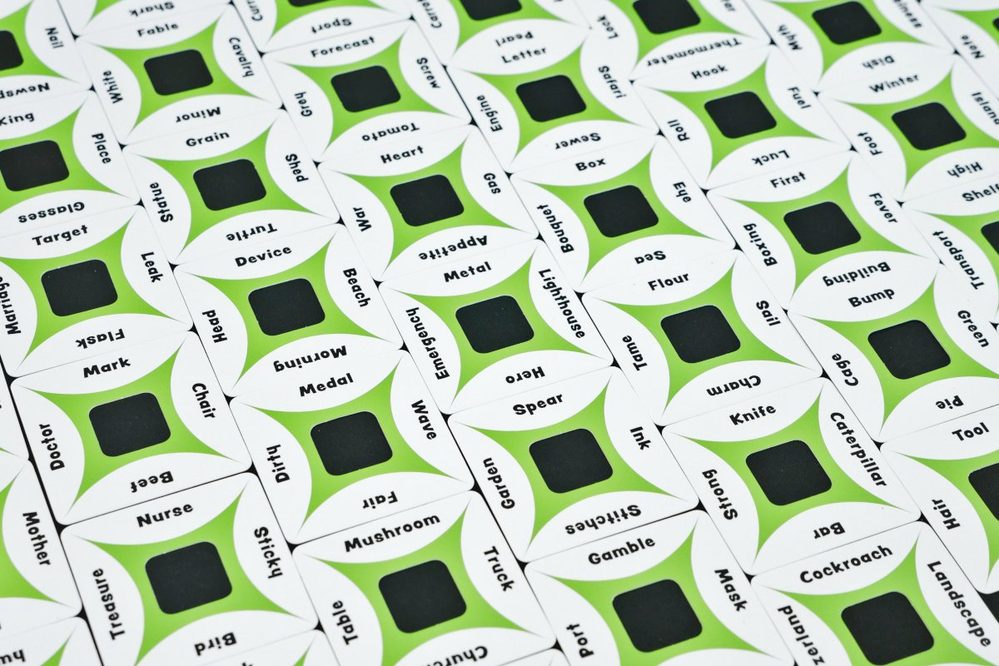
During the clue-crafting half, you're given your own Clover board plus 4 randomly drawn keyword cards. Each card is four-sided with a random word on each side. Your four cards are placed on your Clover board in a 2x2 grid, creating a square where each edge is a randomized pair of keywords.
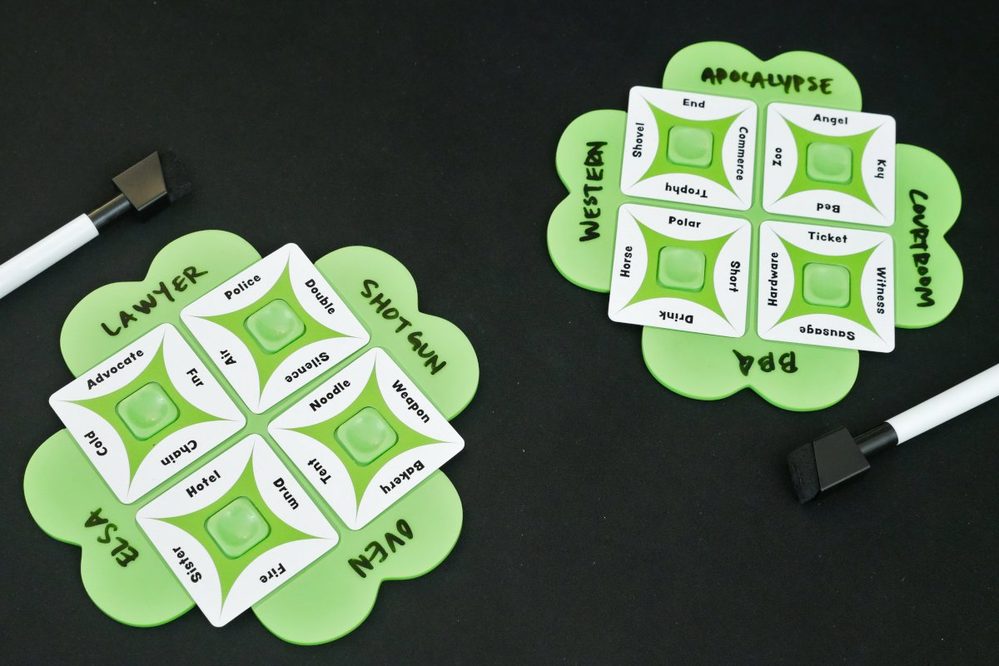
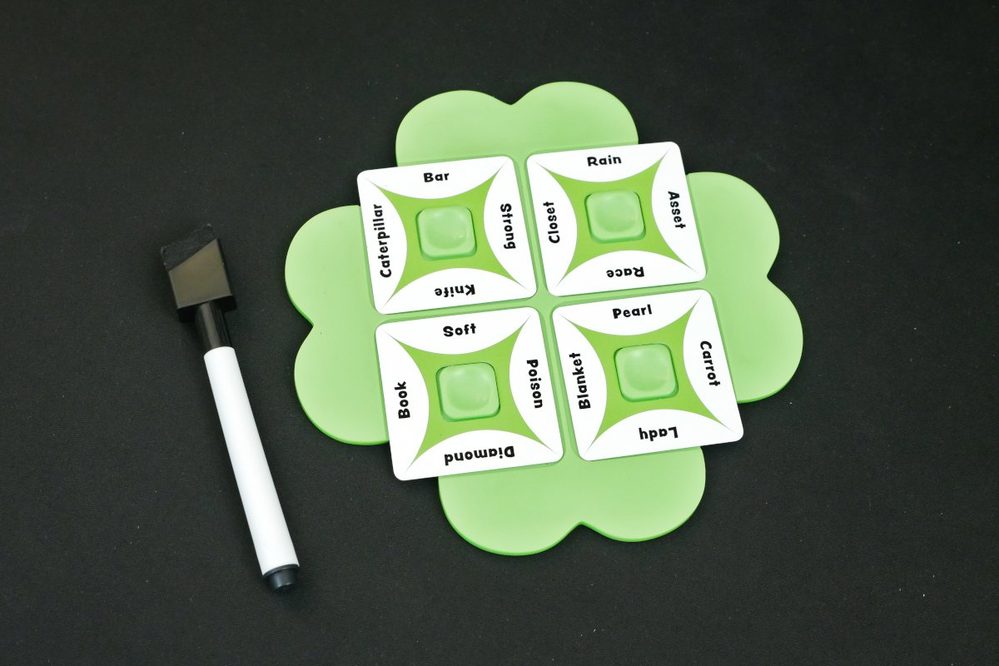
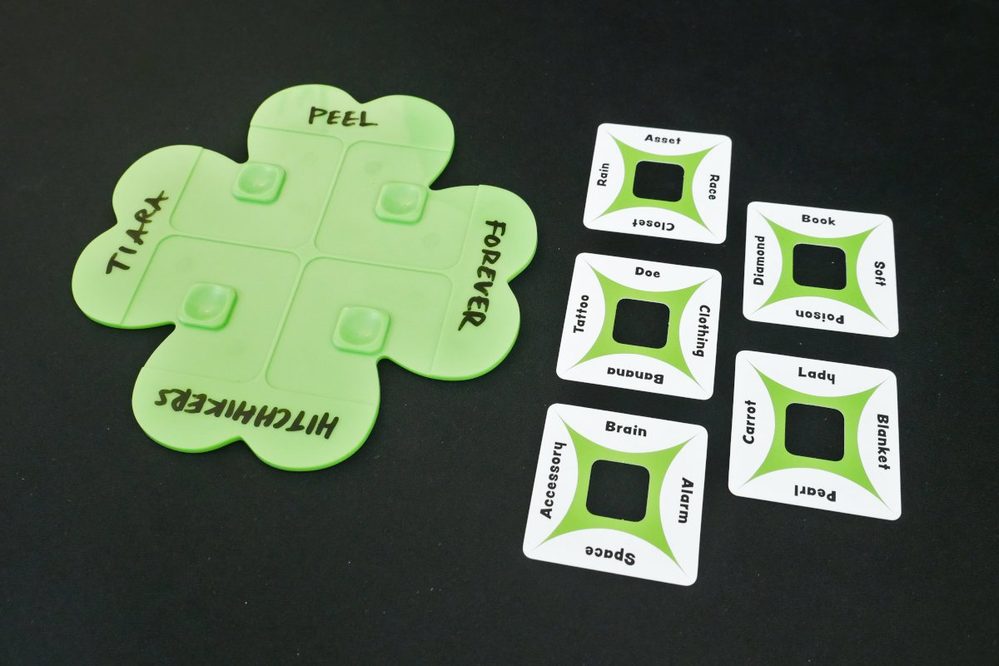
You start with a 2x2 grid and must craft clues for each side of pairings.
Your goal is to craft a one-word clue for each keyword pair. A good clue is one that relates to both keywords or ties them together. The rulebook has a few rules for invalid clues, but the most important thing is that each clue must be a single word. Once you've crafted clues for all four sides, you take the cards off your board and shuffle in a fifth random card as a decoy.
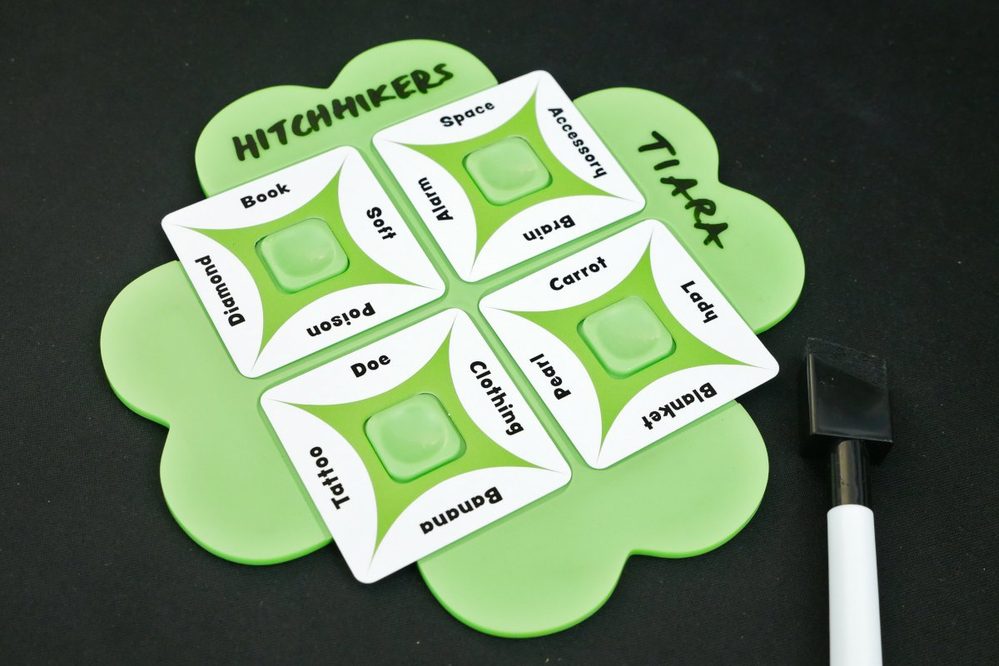
Here's a board with two clues written. Halfway done!
During the board-solving second half, one player will present their Clover board along with their 5 keyword cards (4 actual cards + 1 decoy card). Everyone else, as a team, uses the clues on the board to find the right keyword pairings. That means picking the 4 correct keyword cards and putting them on the board in their proper spots in their proper orientations.
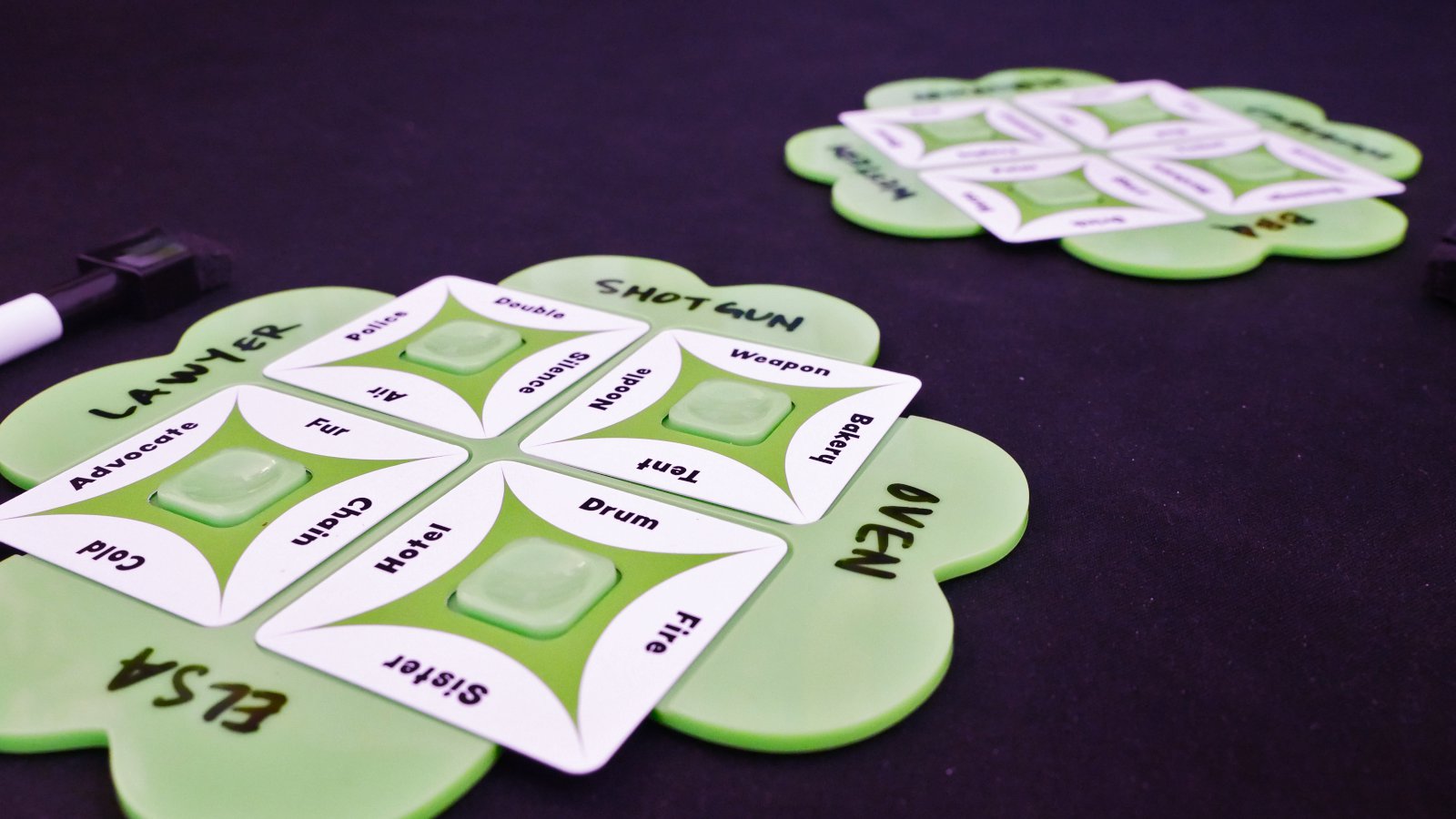
When you're solving someone else's board, you have to figure out which cards go where. The tricky part is, there's a fifth card mixed in as a decoy.
Once everyone agrees on a solution, the owner confirms whether it's right or wrong. If wrong, they remove the incorrect cards and the team gets one more attempt to get it right. Repeat for everyone else's Clover boards. That's it!
How It Feels to Play
It's Pure Word Association Done Right
You thought Codenames was pure word association? Not so fast. So Clover! is even purer—in fact, it's as pure as it gets. There are no assassin words to evade. There's no race against another team. It's just you against the 4 keyword pairings in front of you, and the entire challenge boils down to one thing: find a single word that ties together two random keywords.
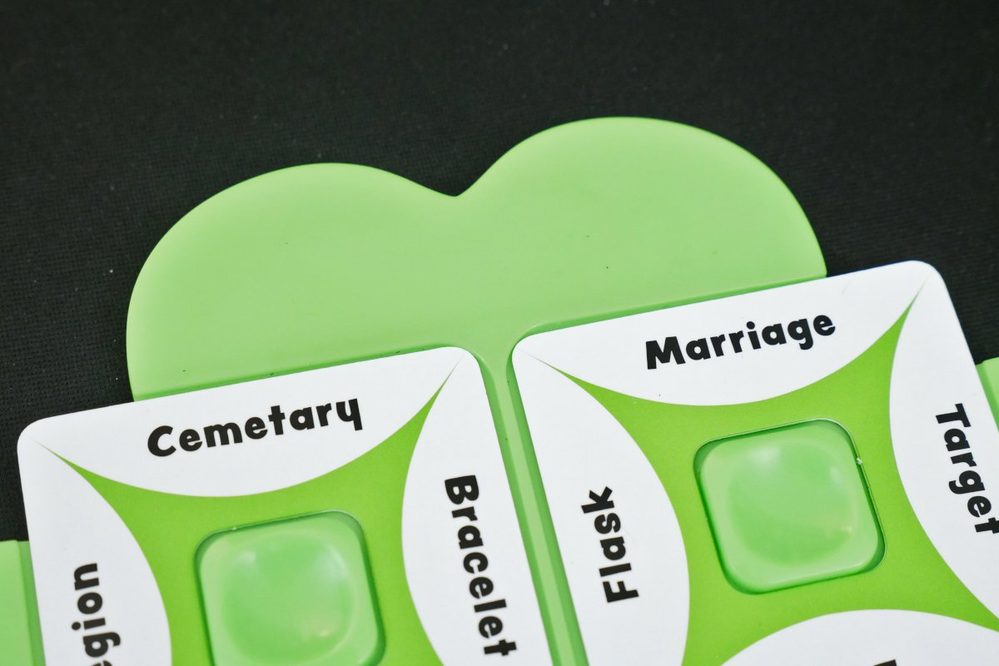
What clue would you put here for "Cemetary" + "Marriage"?
That purity is great because you get to focus 100% of your mental energy on it. You'll need every bit of creative power you can muster because some keyword pairings are real brain-busters. But that's okay. There's no manufactured reason to be unusually clever with your clues, and there's no time pressure. You can sit there and mine your brain for as long as it takes to forge the proper associations. (To a degree, anyway. If you take too long, the rest of the table will surely begin to shoot daggers your way with their eyes.)
I like word association games, but I don't like all word association games. They're at their worst when too many mechanisms get in the way of the actual association work. For games like this, I want minimal components, zero fiddliness, and a good challenge. So Clover! strips itself down until it's bare, and it's all the better for it.
The Difficulty Is Swingy and Uncontrollable
At the start of the game, you're given four random keyword cards that are randomly oriented in your 2x2 grid. You can't choose which keyword pairings to pursue—it's all up to luck where those cards happen to fall.
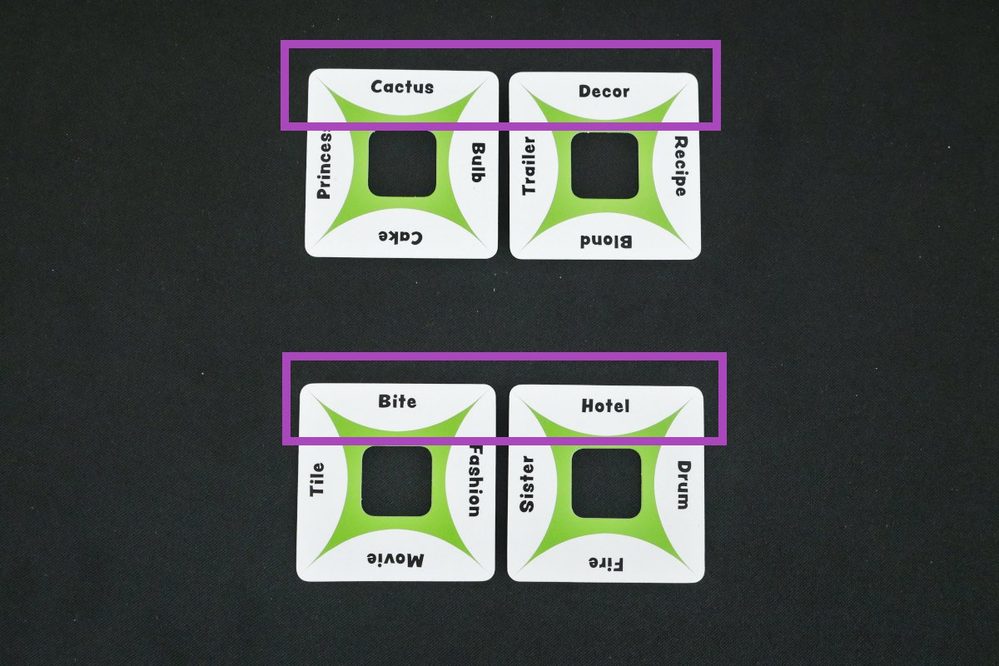
That means sometimes you get an easy pairing like "Cactus" + "Decor" and you can instantly think of a word that works, like "succulent." But other times you get a pairing like "Bite" + "Hotel" and struggle for 10 minutes without coming up with a single word, let alone a clue you're happy with. Eventually you just shrug and throw in a crappy word just so you don't hold up the table.
Some keyword pairings are easier than others. It's unavoidable.
So Clover! has 880 keywords across its 220 cards, and that's great for variety. But you also have to accept that some combinations are just plain better or worse than others, and you have no control over it. There's no way to dial down the difficulty for a newbie or ramp it up for a word-slinging pro, which can cause friction in a group with a wide gap in word association prowess.
It's not that this luck removes player agency or causes too much chaos. It's that So Clover! is a party-style game that's meant to be quick, easy, and accessible to everyone—and the lack of difficulty balancing makes the experience unpredictable. Getting an easy pairing as a pro is yawn-inducing, while getting a tough pairing as a newbie makes the game seem harder than it's worth.
Solving Someone Else's Board Is the Best Part
When the clue-crafting half is over, it's time to solve those boards one by one—and this is my favorite part of the game.
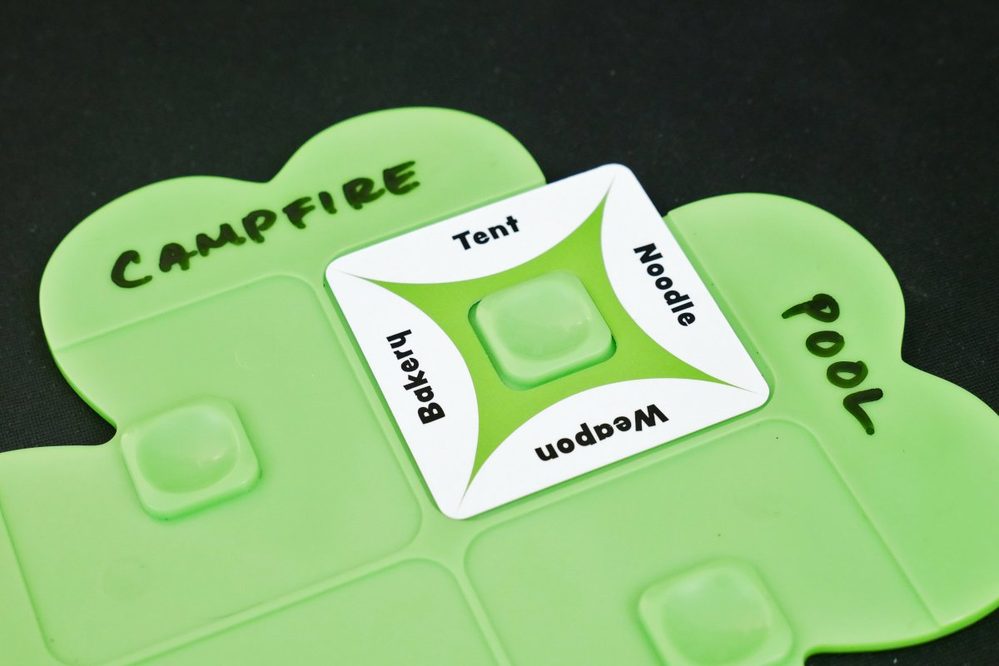
You're looking down at five cards and you know one is a decoy meant to throw you off track. On the board, the first clue stares up at you: "Campfire." You go through each of the keyword cards, turning them every which way as you try to figure out which keywords could relate to a campfire. "Tent" seems like a solid pick, so you set that aside as a possible fit.
When solving someone's board, you have to use deduction to figure out where cards could go—and where they can't go.
But you also know that every card actually matches with two clues. If one side matches "Tent," then one of the neighboring sides on the card must also match one of the clues neighboring "Tent." You see the clue "Pool." And what do you know! That side of the keyword card says "Noodle," and "pool noodle" seems intentional. Confident, you plop that card on the board in that slot.
It's not always this straightforward, of course. Sometimes you go through all the keyword cards and find that nothing seems to match a given clue. Sometimes there are too many matches, in which case you really need to use your deductive skills to eliminate the wrong ones. And when you get it right? You feel the rush of success. Being able to use clues to successfully rule out wrong answers is what makes this portion of So Clover! so satisfying.
Watching Others Solve Yours Is the Worst Part
My least favorite part of So Clover! is when my board is up for guessing. I present my board to everyone else, show them my five cards, then zip up my lips and zone out for the next 10 to 15 minutes. Because when you're the "Spectator" (the rulebook's term), you "cannot communicate in any way."
You're basically invisible as everyone else works together to figure out your clues. You don't answer any questions. You can't make any facial expressions. You could leave and take a lap around the neighborhood if you wanted to. And that sucks! Sure, there's some entertainment value in watching everyone try to solve your board, discussing why you might've chosen certain words for this or that. But it's still passive. You're just watching.
It's one thing to sit around and do nothing while waiting for your turn—that's not uncommon in board games. But So Clover! is a casual party-style game, and a party-style game should minimize dead air as much as it can. In a game like Just One, the "spectator" is only out of it for a few minutes max; in So Clover!, you're twiddling your thumbs for up to 10, even 15 minutes if your group is especially stuck. That's just too long for this genre.
It's a Situational Party Game
Word association games can sometimes be clunky and hard to learn, with Decrypto being one of the worst examples of a tough teach. But it's a mostly accessible genre, with hits like Codenames and Just One taking off because they teach so easily. So Clover! is on that end of the spectrum, and it's actually one of the quickest teaches in my collection. A minute max.
"Put these cards on your board, then try to create one-word clues for each pair of keywords. Later, we're going to guess the right keywords from your clues." It's as easy as that. The designs of the board and cards carry the explanation, and even non-gamers can easily grok what they're meant to do.
Yet despite that, So Clover! isn't one I reach for when playing with non-gamers. I treat So Clover! as a situational gateway game because of its unpredictable difficulty, which can throw newbies off. With people who are skilled at wordplay or tend to enjoy word games, it's a must to introduce. But for everyone else, I'd opt for one less daunting, like Just One.
Player Count and Scaling
So Clover! is best played as a 2-player game, which is funny because the box technically doesn't even list that as a playable count. (It says 3 to 6 players.)
My biggest gripe with So Clover! is waiting around in silence while everyone solves your board without you. With just 2 players, you can both simultaneously craft clues during the first half, then simultaneously solve each other's boards during the second half. You're fully active and engaged at all times, save for a few minutes when you've finished your clues and you're waiting for your partner to wrap up theirs. That's why I love it at this count.
At all other player counts, I don't like So Clover! nearly as much, and that's because I bounce off of everyone-talk-out-loud-and-solve-this-puzzle-together gameplay. As the player count increases, the problem only gets worse—someone invariably takes over as the alpha while others clam up, and you often have players "giving in" only to end up with wrong answers. If I'm solving a puzzle, I don't want it to be a group project. Just let me solve it! (For a similar game that plays better with bigger groups, check out Alibis.)
Replayability
So Clover! is a rare example of a game where variety is replayability. The underlying gameplay—of crafting clues for keyword pairs and reverse engineering those pairs from those clues—is pure, engaging, and challenging. As long as you have an infinite supply of keyword pairs, you could replay this puzzle an infinite number of times. And if my calculations are correct, the 220 keyword cards in all their orientations can produce over 500 billion possible boards. That's close enough to infinite for me.
To be clear, So Clover! is effectively the same exact puzzle every single time you play; it's just a different configuration of that puzzle. If you like the underlying word association and deduction, then it's infinitely replayable in the way sudoku or crossword puzzles are. But if you don't like pure word association, you'll bounce off of it on game one.
Components and Setup
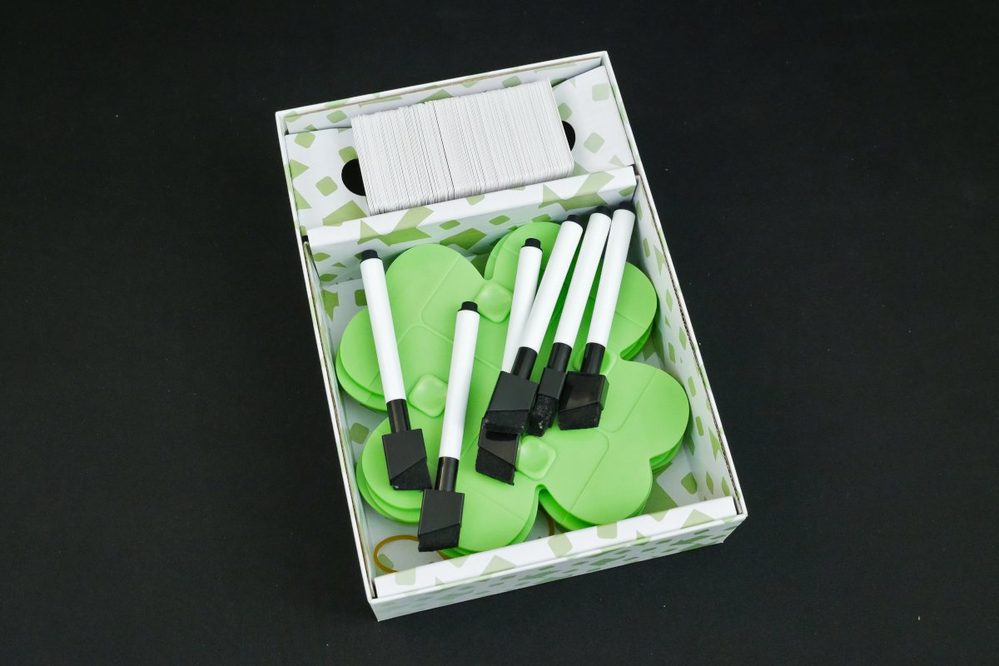
So Clover! is unique in its presentation. You've never seen a board like the Clover board in this game, and it's uniquely built for this particular game. When you see a green board with a dry erase marker, you instantly know it's So Clover!—that's how iconic the production is. It works and it sticks.
I love everything about it. I love how simple it is, how quick it is to set up, and how it doesn't take up any table space. You can unpack the boards and markers, grab four random cards, and be playing in a literal minute. You can place the board in your lap, so you don't even need a table. The markers are inky and the erasers erase cleanly. The keyword cards are intuitive and easy to read.
There's nothing I would add or change about So Clover!'s production. Even the box is no larger than it needs to be. I'm impressed.
The Bottom Line
So Clover! is the sharpest pure word association puzzle out there, and at 2 players it's nearly flawless—simultaneous play, no downtime, no alpha gamer taking over. At this count, it's one of the most replayed games in my collection. With bigger groups, I steer clear and opt for other titles like Just One and Alibis. If you like word association, So Clover! is a must-buy even if it isn't totally flawless; if you don't, this one won't change your mind.