I came to Toy Battle with a level of reluctance. It topped a lot of "best games of 2025" lists, and it rode on the pedigree of Paolo Mori, known for hits like Ethnos, Libertalia, and Captain Flip. Propped up by so much hype, I had no choice but to be skeptical—and doubly so because I've learned I don't really like one-versus-one abstract strategy that much. How could a game that channels Stratego ever land well with me?
In order for Toy Battle to pass muster, it has to do three things: be easy to learn and easy to teach, sidestep the analysis paralysis problem, and end with me not feeling stupid or hopeless when I lose. One game in, I wasn't sure what to think. A few more later, it reinforced why I have a play-multiple-times-before-reviewing rule. Toy Battle is more than it first seems.
This review is based on a review copy of Toy Battle provided by Asmodee and Repos Production, but my thoughts and opinions are my own.
Table of Contents
View more
What It Is
Toy Battle is a fast-paced, two-player-only game that blends area control with abstract strategy. The result feels like an evolution on checkers, where you're approaching each other from opposite ends of the board and overtaking each other's pieces as you vie for control. There's also some Stratego in the mix, with ranked pieces that can only overtake pieces that are strictly weaker in value.
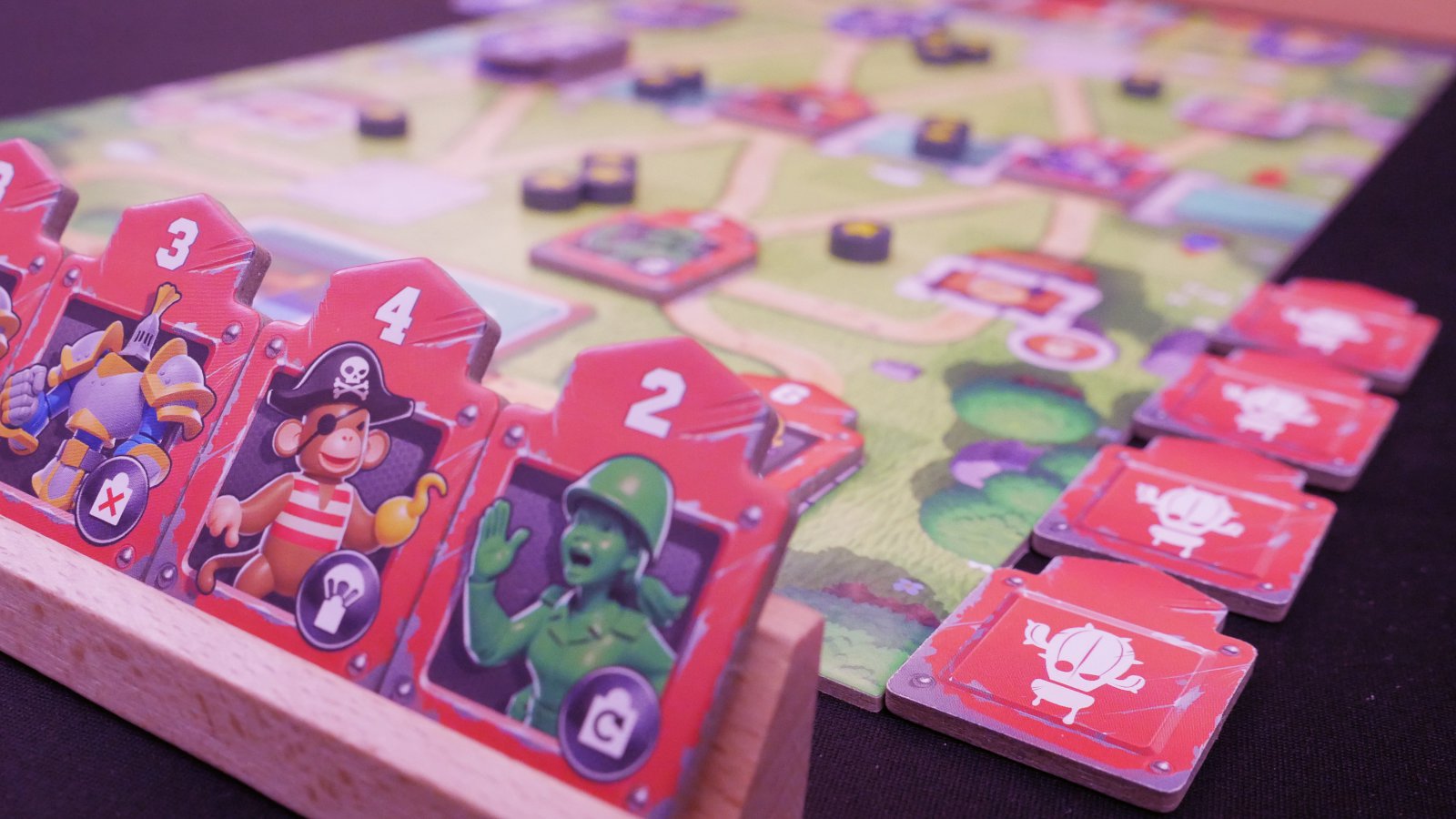
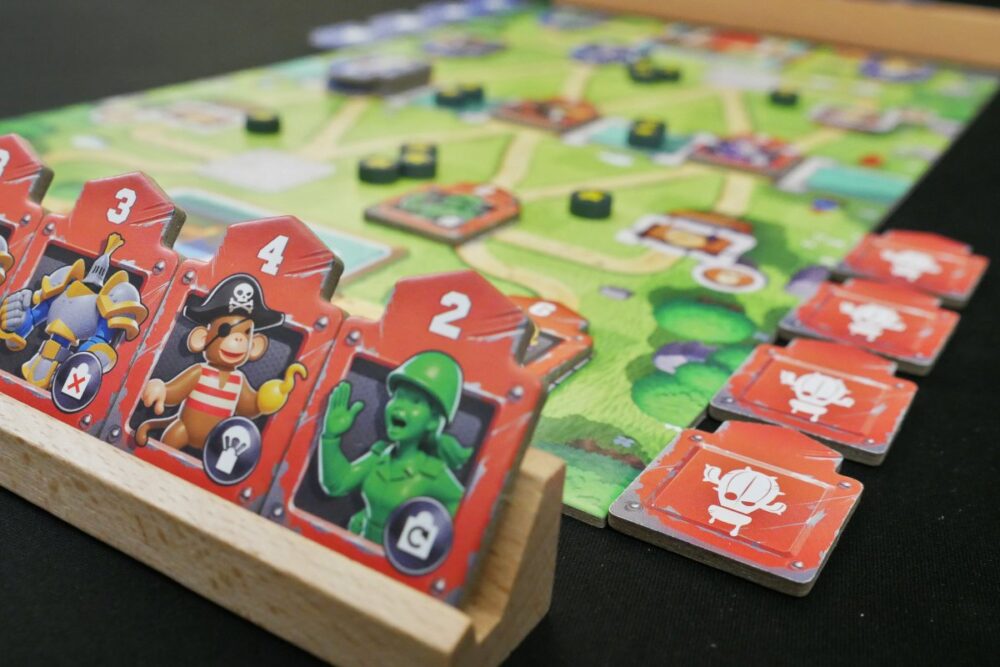
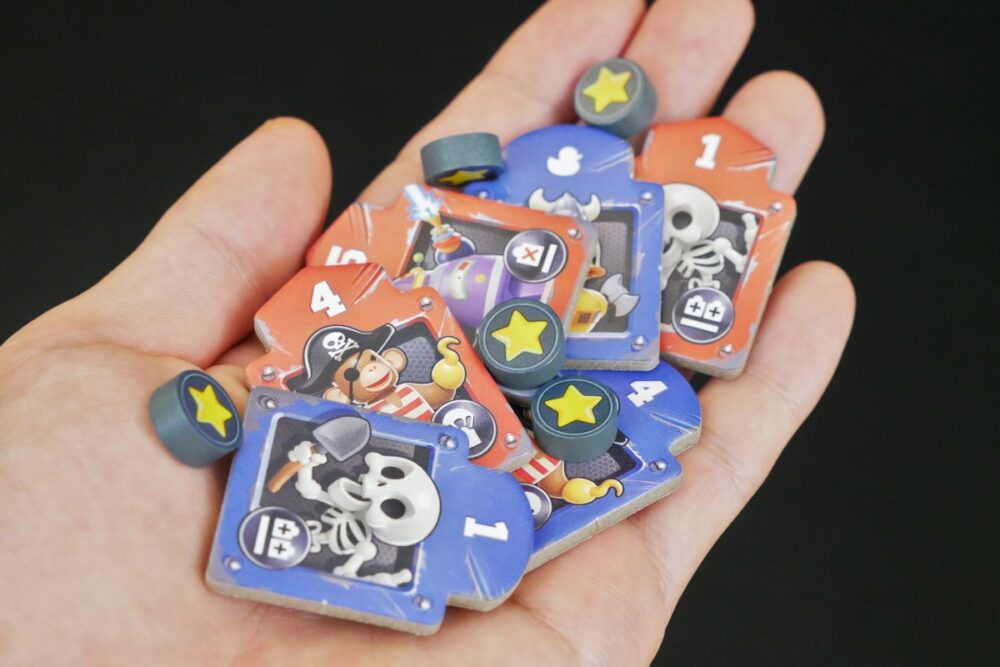
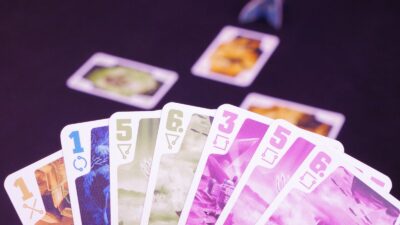
Where Toy Battle starts to carve out its own identity is in its tile rack. Like in Scrabble, you have a rack of pieces—but unlike in Scrabble, your rack can deplete if you don't actively replenish it. On your turn, you have two actions to choose between: either draw two tiles to your rack, or play a piece from your rack to the board. Your tiles are hidden from your opponent, and vice versa, so you're never quite sure what the other is capable of at any given moment.
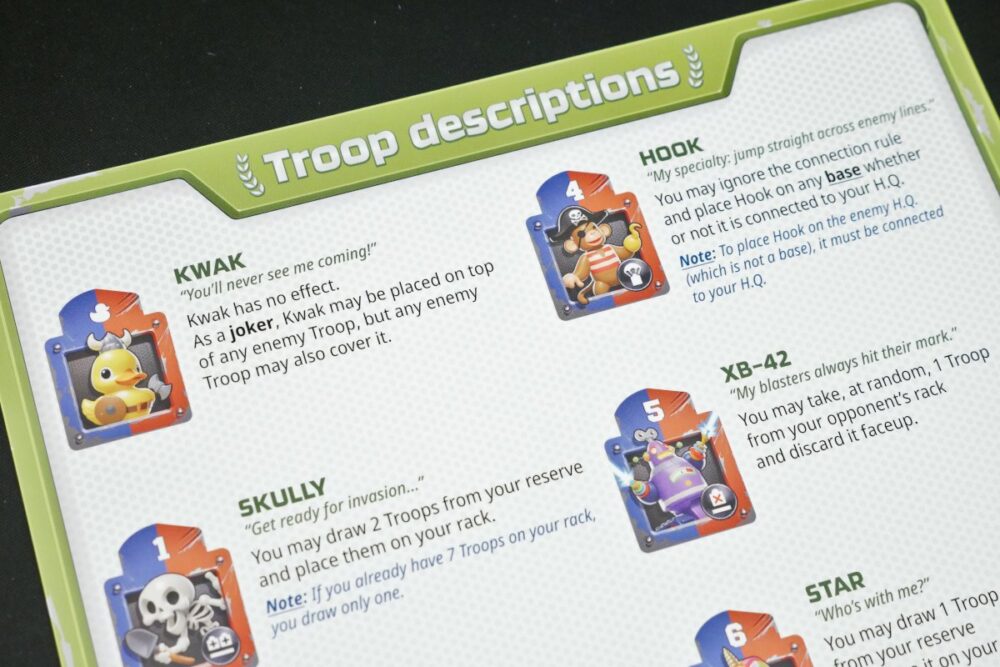
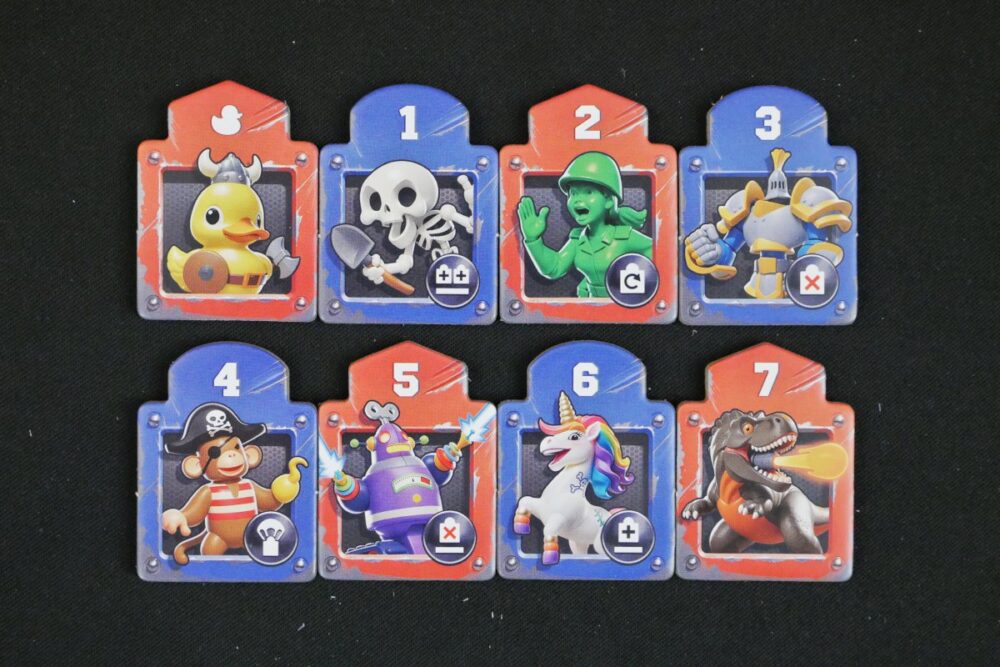
But the real heart of Toy Battle lies in the special abilities. Every time you place a piece, you trigger its unique rank action. For example, Skully (Rank 1) lets you draw 2 pieces to your rack, while Jumbo (Rank 3) lets you discard an enemy piece adjacent to where Jumbo is placed, and XB-42 (Rank 5) lets you randomly take a tile from your opponent's rack and toss it out of the game. Similarly, there are eight different maps and each map has special locations that trigger special abilities when pieces are placed there.
The game ends once somebody places a piece in their opponent's HQ. But that's not the only way to win. You're also vying to control various regions on the map, done by surrounding a region with your own pieces. The moment you control a region, you take all the Medals inside—and the moment you have enough Medals (the exact count depends on the map), you instantly win.
How It Feels to Play
Every Troop Is an Opportunity Cost Bet
Already on turn one, I'm staring at my starting rack of tiles and unsure which one to place where. At no point in the game is there an obvious "best spot" for your next "best troop." Toy Battle is constantly pulling you in multiple directions, whether to secure a region and collect Medals, or encroach on your opponent's territory and creep towards their HQ, or visit the special spots around the map for their special map abilities. Every action has an opportunity cost—for example, if you grab Medals, you're giving up ground on the frontline—and you're forced to commit in one direction or switch gears.
And it's not just about where you place your troops, but who you're going to deploy there. Every troop is its own little opportunity cost decision: the weaker ranks have stronger abilities, so you always have a reason to "save" a troop on your rack—you save the weaker units for their special actions, you save the stronger units for their ability to overtake enemy troops on the map. In that sense, every troop placement in Toy Battle feels like wasted potential. You didn't want to give up your Roxy (Rank 7) on that empty spot, but someone from your rack had to go there... and you didn't want to send the others.
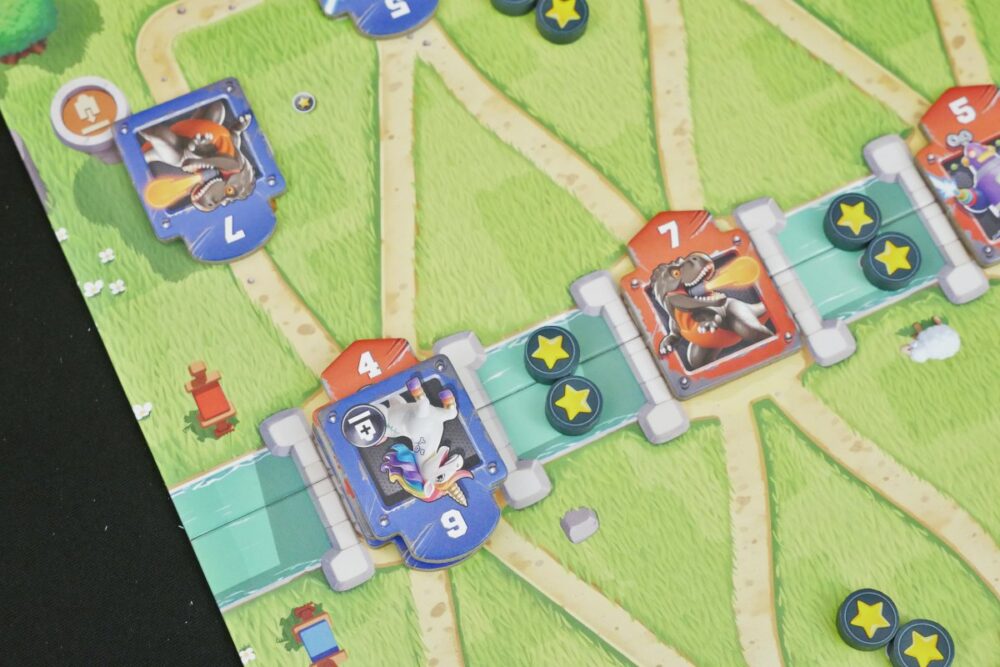
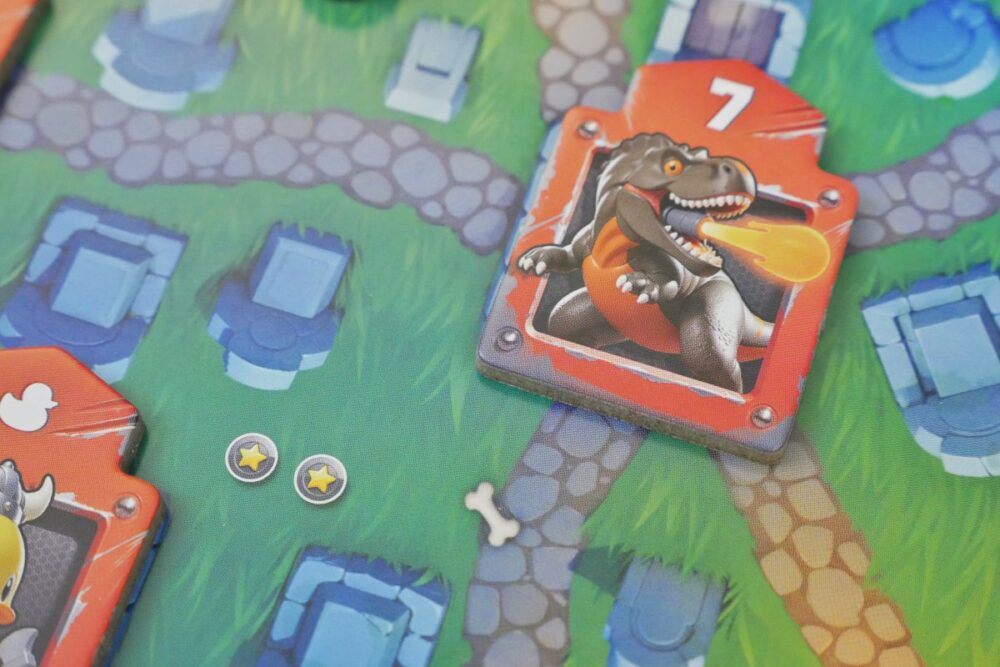
Roxy is the strongest piece, so I usually save him for chokepoints and key encroachments. But sometimes you just have to dump him on an empty spot for other reasons—in this case, I used him to complete this region and grab those two Medals.
And every single troop placement matters. The maps are small and tight (only 13 to 15 spots per map), so you don't have much room for error. Deploying your Kwak (Rank Wild) near your HQ lets you save your bigger troops for later, but it also leaves you vulnerable to an enemy Hook (Rank 4) parachuting in and cutting you off. Meanwhile, deploying your Kwak on the frontline helps overtake powerful enemy troops, but it's too unreliable to hold a frontline position because any enemy troop can easily overtake Kwak. Even between these two choices, the entire texture of the battle can shift, just from a single turn.
Imperfect Deduction, Fog of War
Every true skirmish has fog of war, and Toy Battle understands that. At the start of the game, each player removes four of their 24 troop tiles from the game, sight unseen. Right from the get-go, you have no idea what your true capabilities are—it's entirely possible that all three of your Roxy tiles were taken out, yet you have no way of knowing. Similarly, you only have a handful of tiles on your rack at any given time, as does your opponent. You have limited, imperfect information at all times.
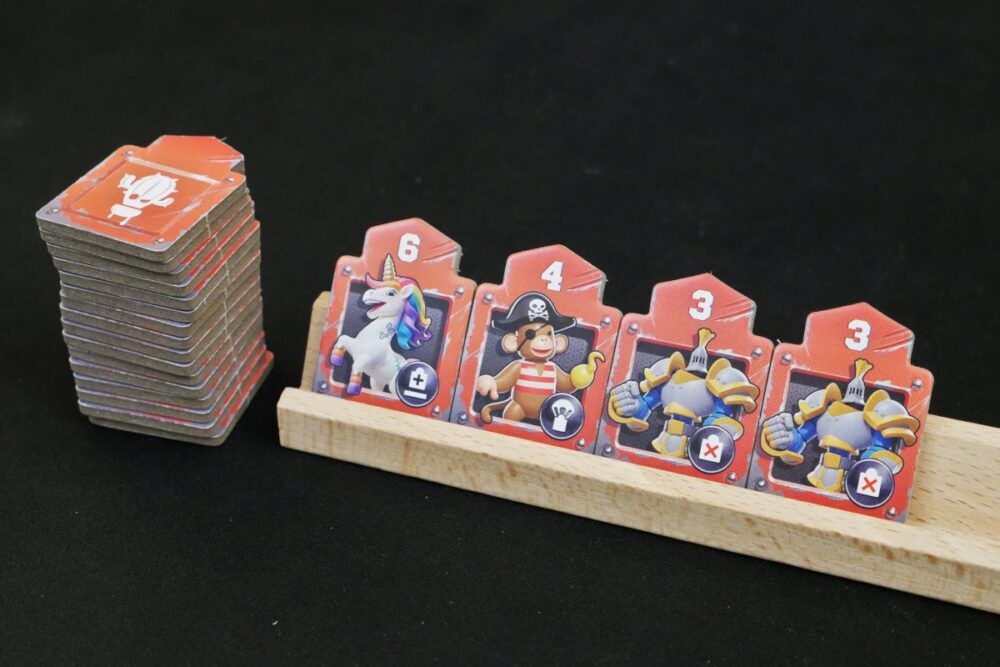
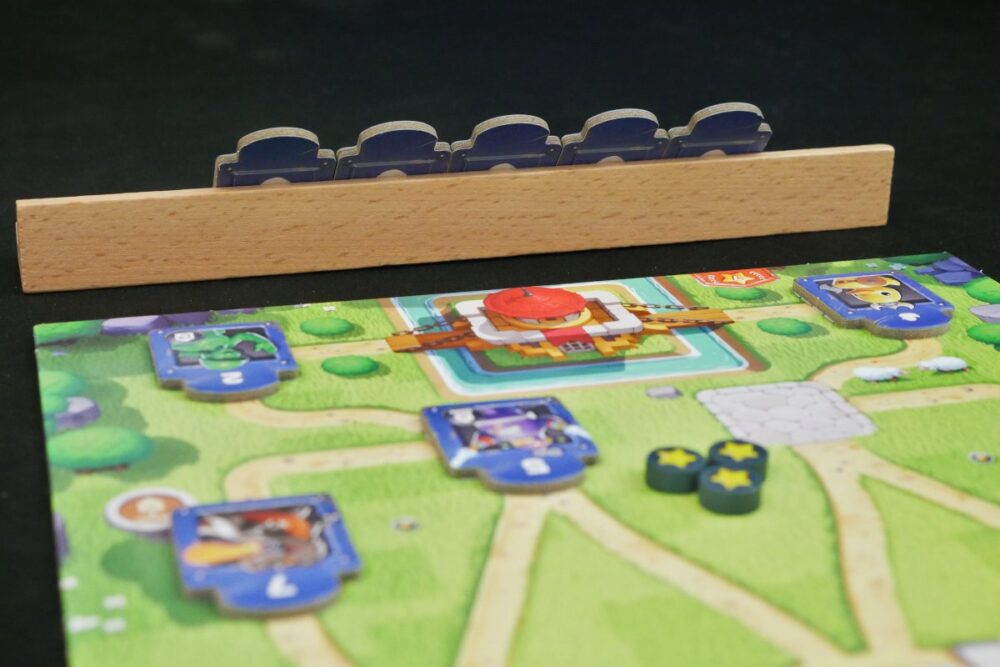
You can't see what's in your opponent's rack, but as more of their pieces come out, you have more information for making deductions.
Toy Battle is a test of your deductive sense and ability to make tactical pivots, not your aptitude for long-term planning and grand strategies. You look at your opponent's rack with six tiles, but you don't know what they're holding. You look down at your two Jumbos, a Hook, and a Star on your own rack... and you have to make a move. You can push the frontline with Star, but it's risky because they could slam down a Roxy on top. But if they already played two Roxy tiles, then they only have one left—and maybe it was taken out of the game at the very start. Every turn, you're playing the odds. Every turn, you're gaining more information about what remains in your tile pool and what could be sitting in your opponent's tile rack. You have to pierce through that fog of war and hope that your bets play out in your favor over time.
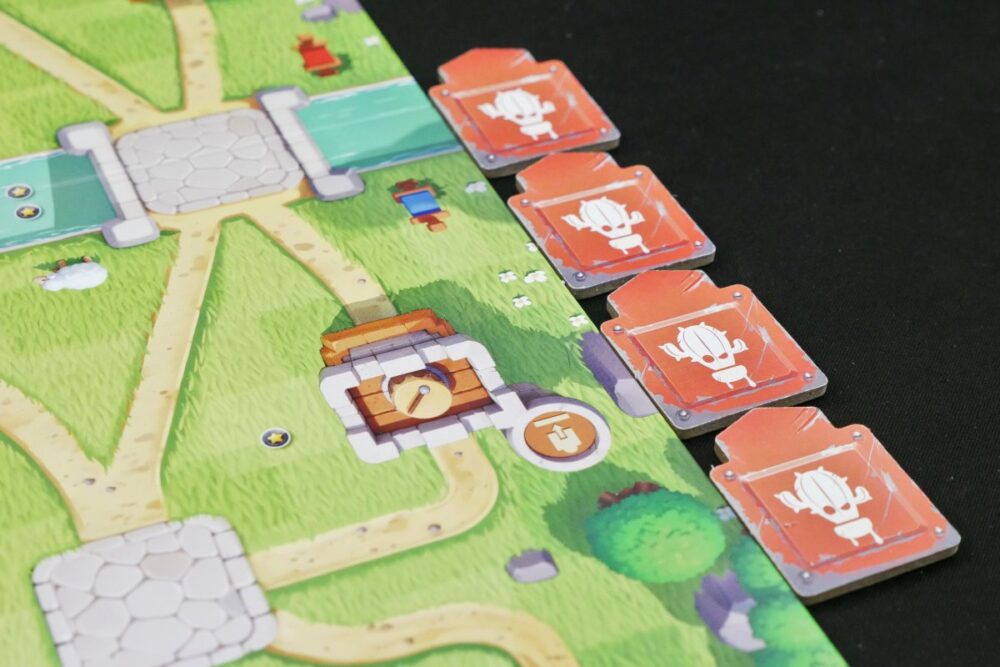
At the start of the game, each player sets aside four troops. They're randomly chosen and you don't know what they are, introducing some luck and uncertainty.
But for as tense as the fog of war can be, it does introduce an artificial imbalance. The removal of four troops each at the start makes it impossible to ever have perfect knowledge and "math out" your victory... but someone ends up with a weaker set of pieces. You just don't know who got the short end of the stick until the battle is over and you compare. If you unknowingly lost all three of your Roxy tiles, that puts you at a disadvantage—and my main problem with this is the "unknowingly" part. A two-player battle should never put someone at an invisible disadvantage, and it could've been solved as easily as letting you see which four tiles you're losing when they're taken out.
It Ebbs and Flows and You're Never Out
Every game of Toy Battle is a living, breathing skirmish with a shape and texture that expands, contracts, and twists. You place a Cap'n on the frontline, allowing you to deploy an XB-42 in front and rush into the enemy's territory. They parachute a Hook onto your Cap'n, stranding your XB-42. Your rack is running low, so you have to "skip" a turn to draw two tiles, giving your opponent the chance to deploy their own Cap'n plus a Skully, which completes a region and snags all the Medals within. In just four turns, you're on your back foot.
That constant ebb and flow is what keeps Toy Battle moving forward. A single troop placement can be a huge leap forward, accomplishing multiple things at once: covering a nasty troop, surrounding a region, cutting off their pathways, discarding a rack tile, etc. And that swinginess is what keeps you hooked—even when your back is to the wall, you know that your opponent's momentum will eventually die down and you'll have a chance to swing back.
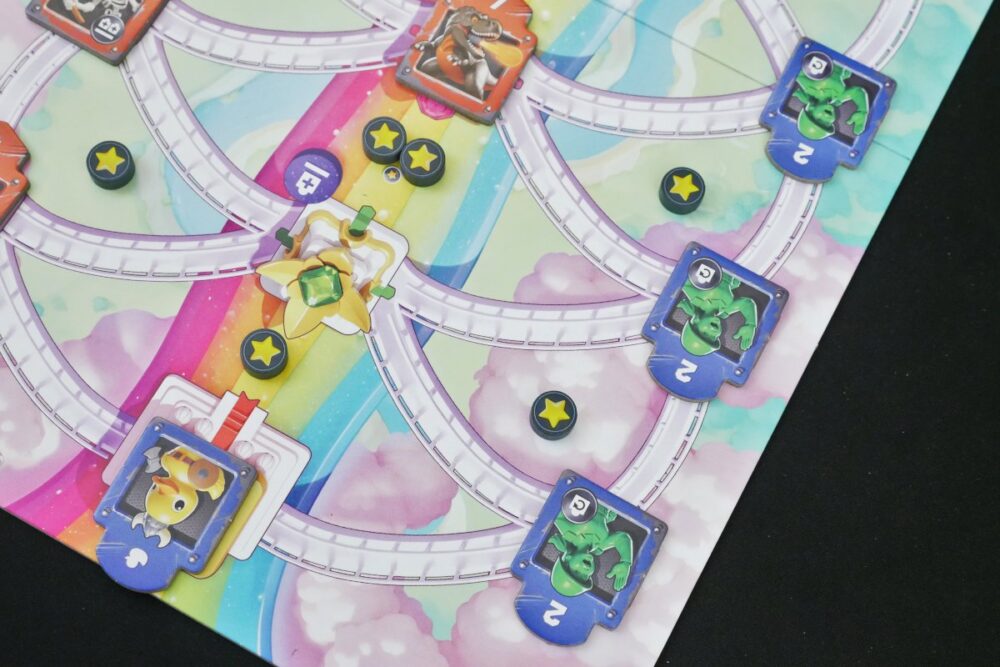
Sometimes you just get pummeled out of nowhere. Here, my opponent chained three Cap'ns in a row to surge up the side route and bum rush my HQ. Ouch.
And that means you're never out. You always have a chance to claw yourself out of sticky situations. I once put relentless pressure on my wife with five straight turns of encroachment, hoping to crack her HQ and secure an instant win... but she patiently held her ground with Jumbos, Stars, and XB-42s. When I ran out of troops and spent three turns drawing more tiles, she rushed out with Cap'ns, surrounded six Medals, then tussled with me for a few more turns before securing the last two Medals, clinching the win. That sense of always having a chance is crucial in a head-to-head battle, else you'd mentally check out early and feel deflated. Here, it's taut tension to the end.
Confrontational But Not Mean
I tend to steer clear of two-player abstract strategy games with lots of direct conflict because I just don't care for zero-sum conflict. I hate losing pieces, planning several turns ahead, missing big capture moments, and feeling like my options are evaporating before me. High-strategy head-to-head games make me feel dumb—not a quality I want in a game. But Toy Battle leans into that confrontational style and manages to make it light, cheerful, and palatable.
Toy Battle is designed for constant clashing. Much like when you were a kid and recklessly duking it out with action figures and toys, here you're doing the same: bam-bam-bam as you and your opponent repeatedly overtake each other's pieces. It happens so quickly and so frequently that it doesn't feel mean. You sit there in quiet contemplation, knowing that any troop you place is going to be captured at some point because the map is so tiny. You let out agonizing groans, not because you lost a piece but because your opponent played a troop you weren't expecting.
In games like chess, Onitama, and Hive, you're trying to preserve and build while hindering your opponent—and in those games, losing your position hurts because you spent so much effort getting there. Toy Battle is, by contrast, a mad rush. There's no time to build anything. It's over in 10, maybe 15, minutes. You place a Star down, your opponent immediately crushes it with a Roxy, and it sucks but it doesn't sting. That makes it easier to stomach.
The Learning Curve Is Front-Loaded
Toy Battle is both as simple as it looks yet also with a slight learning curve. My entire first game was spent peeking at the player aid reference every turn, reviewing each troop's special ability and making sure I wasn't mixing them up. After that first game, which took about 15 to 20 minutes, I'd internalized most of it and no longer needed the aid.
It helps that each troop has a small icon in the bottom corner to remind you what it can do, but those icons don't have the most intuitive designs. As a fresh player, you won't know what they mean—you can't decipher them without further context. But once you know what each troop does, the icons make sense. They're good as reminders, not teaching tools.
The troops aren't complex, but you have to get used to them before you can start playing Toy Battle with real intention and strategy. The icons in the corners are useful once you know what they mean, but they don't mean much before then.
Once you're over that initial hump, Toy Battle has no obstacles to contend with. Turns are simple, rules are light with no edge cases, and the victory conditions just make sense. It's easy enough to explain to a non-gamer, yet engaging enough for hobbyists and enthusiasts. I'd happily introduce this to my non-gaming friends and I'd expect them to feel comfortable within 1–3 games.
The More You Play, The Better It Feels
Toy Battle is one of those games that ages like wine. After my first game, I wasn't too impressed. I'd rushed up one side of Castle Field, nearly captured the enemy's HQ, took a few turns to draw more troops, and lost all my momentum as my opponent won by Medals. It all felt a bit... random. I couldn't see their troops, placements felt constrained and arbitrary, and the climax came so abruptly that I had no time to feel any tension building up to it.
But the more you play, the more the nuances reveal themselves. As you internalize the troop abilities, you familiarize yourself with the kinds of moves and swings you can perform. The more you understand the tug-of-war flow of the skirmish, the more you understand how to control tempo. As you grasp the pros and cons of each troop and the effects of map layout and map abilities, your decisions become more intentional.
Being able to see through the randomness is key to enjoying Toy Battle, and you can only do that after playing several times. Only when you know what everything does can you start making deductions about what the opponent is holding, predictions on what troops you might draw next, and strategies for controlling a map. The first time you're able to look ahead and pull off a three-turn chain of troop placements to secure a big Medal region, you'll feel the rush that Toy Battle wants you to feel—that of an actual commander on a battlefield.
Replayability
I don't care for games that seek replayability via variety. If you throw 20 characters or 10 maps or 500 cards into a box yet none of it changes the gameplay itself, then there's ultimately no value there. That's not the case with Toy Battle, which shakes things up with eight maps of variety. But here, the variety isn't just surface-level—each map is its own real mini-game.
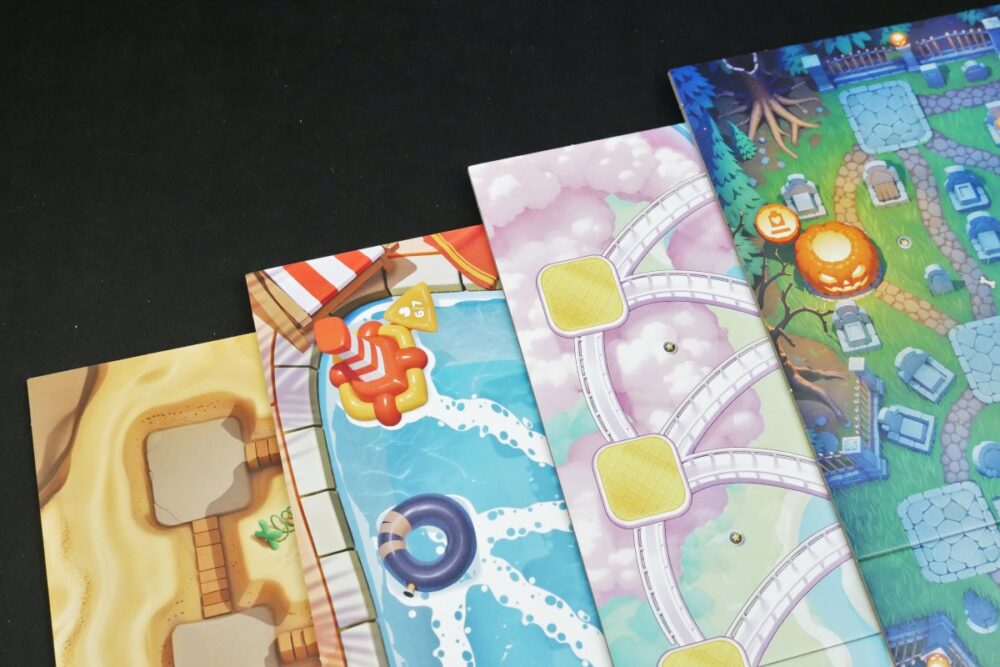
Toy Battle has four double-sided map boards, with each map changing up the gameplay in small but real ways. Like playing matches on different maps in Counter-Strike 2 or StarCraft 2, it keeps things fresh and encourages different strategies.
Castle Field has special spots that let you recall troops from the map back to your rack. Volcanic Jungle's special spots let you force-move enemy troops to adjacent spots. City of Clouds draws troops from your pool to your rack while Cursed Cemetery draws troops from your discard pile to your rack. Tropical Pool only allows specific troops to be deployed on certain spots, while Caribbean Sea has no special spots but is totally asymmetric in layout. While each twist is small, they shift the core flow in non-trivial ways. The same strategy plays out differently on Battlefield versus Station Metal-X.
But even on a single map replayed indefinitely, Toy Battle delivers. The game boils down to figuring out the "best move" on any given turn given your current rack of tiles and the current board state—and that puzzle is never the same. Starting with two Kwaks and a Skully already feels like a different game than starting with a Hook, an XB-42, and a Roxy, and that's true whether you're on Castle Field or Caribbean Sea. Calculating all your opportunity costs, deducing what your opponent could have, making bets with every tile placement... every turn is a fresh, unsolvable puzzle.
Components and Setup
Toy Battle comfortably fits on a 3-by-3-foot table and sets up in minutes, which is exactly what I want from a fast-paced skirmish like this. You flip all your tiles face-down, give them a wash shuffle, distribute the Medals on the map, and you're ready to play. It's compact and doesn't get in its own way.
The theme is a stroke of genius—kiddish, inoffensive, widely relatable and therefore accessible. You're taken on a whimsical journey across eight different map flavors, each one being the "home land" for one of the eight different troops. It's technically a thinky abstract strategy match, but Toy Battle's theme helps lift everything up so it doesn't feel as niche or intimidating as other head-to-head strategy games like Blitzkrieg or Undaunted. It's obviously lighthearted, and that means it doesn't scare away non-hardcore gamers.
The rest of Toy Battle's production is practical, effective, without going overboard. Maps are legible and troop tiles are easy to distinguish, apart from the iconography issue I flagged above. The tiles are made of chunky cardboard and both the tile racks and Medal markers are wooden, so the whole game delivers a well-made tactile experience. For the price, you can't ask for more.
The Bottom Line
Toy Battle is a 15-minute skirmish that delivers on its $33 price, but it earns that price over time. Your first game will feel arbitrary and thin. But once the troop abilities and maps click, it's a tight, tactical tug-of-war that rewards both deduction and gut decisions. Even if you dislike abstract strategy (like me), give it a try. Losing doesn't sting, and that alone makes it worth keeping.