Stop Buying Games You'll Regret
Avoid buyer's remorse with my downloadable 8-question checklist—free when you subscribe to my newsletter.
One monthly email with my latest reviews and articles. No spam, ever. Unsubscribe in one click.


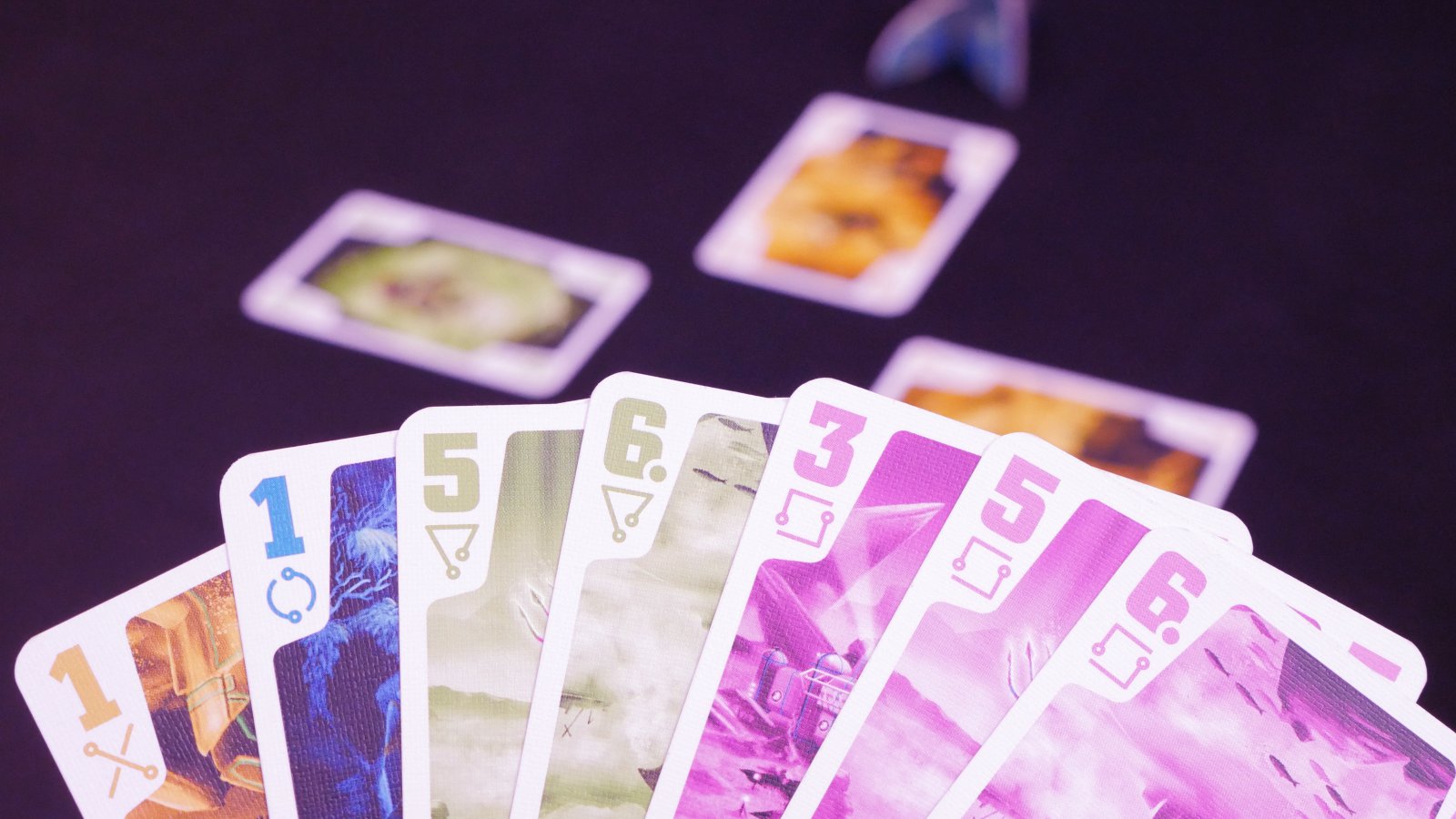
The Crew: Mission Deep Sea is a cooperative trick-taking card game that turns silence into a rich deductive experience.
Game Info
Upsides
Downsides
I almost passed over The Crew: Mission Deep Sea entirely on the basis of it being a trick-taking game, a genre I don't care for. But the cooperative design drew me in, so I grabbed a copy and came at it with high skepticism. Games like The Mind and Hanabi had soured me on limited communication, and I had zero expectation that The Crew would land any better.
But it did. The Crew was the first game I played where limited communication didn't feel like a gimmick you had to build your own meta around. The trick-taking and silence are both structural—the real game is deduction, and not just that but collective deduction while bound and gagged. It gives you enough tools to negotiate within that silence, and that's what makes it work.
This review is based on my own personal copy of The Crew: Mission Deep Sea, which I bought new from Amazon. Not a free review copy.
In The Crew: Mission Deep Sea, a deck of 40 cards is dealt out to everyone at the table. It's a trick-taking game with two big twists: first, it's cooperative, and second, there's no verbal or physical communication allowed. Each player has their own goal(s) to accomplish, and you all need to work together to play cards to each trick in a way that gets everyone what they want.
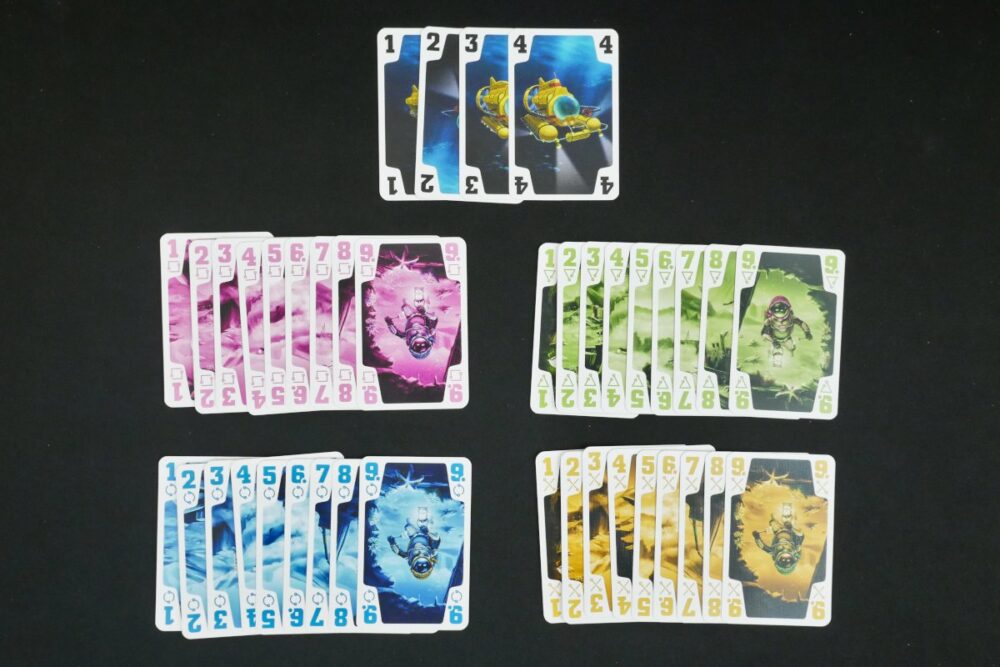
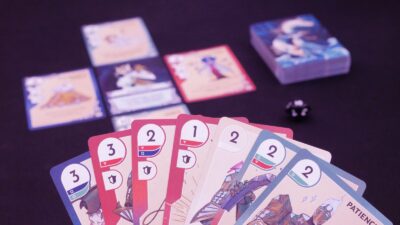
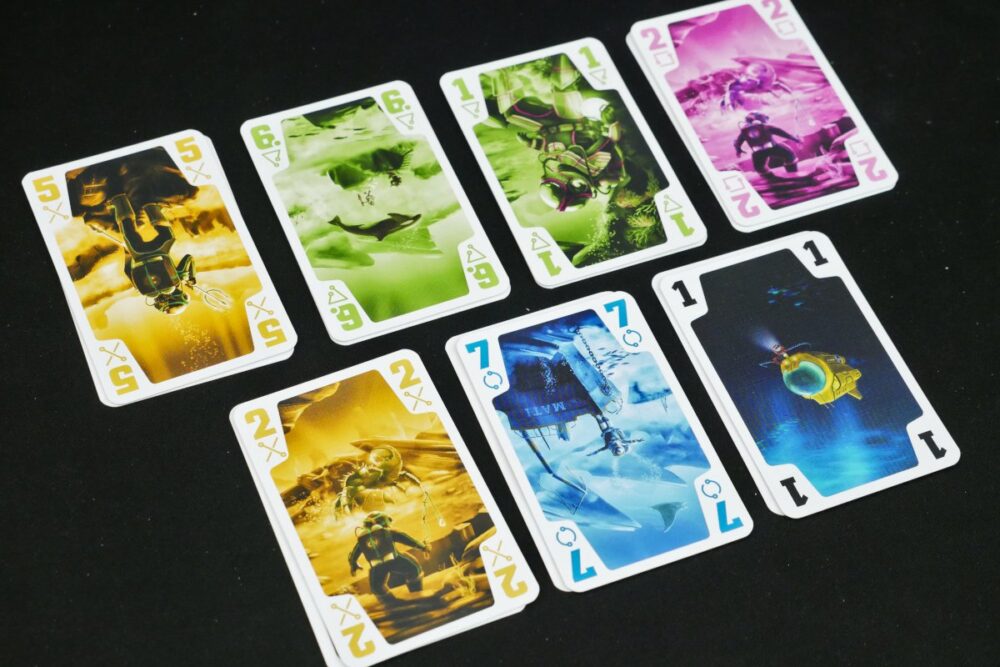
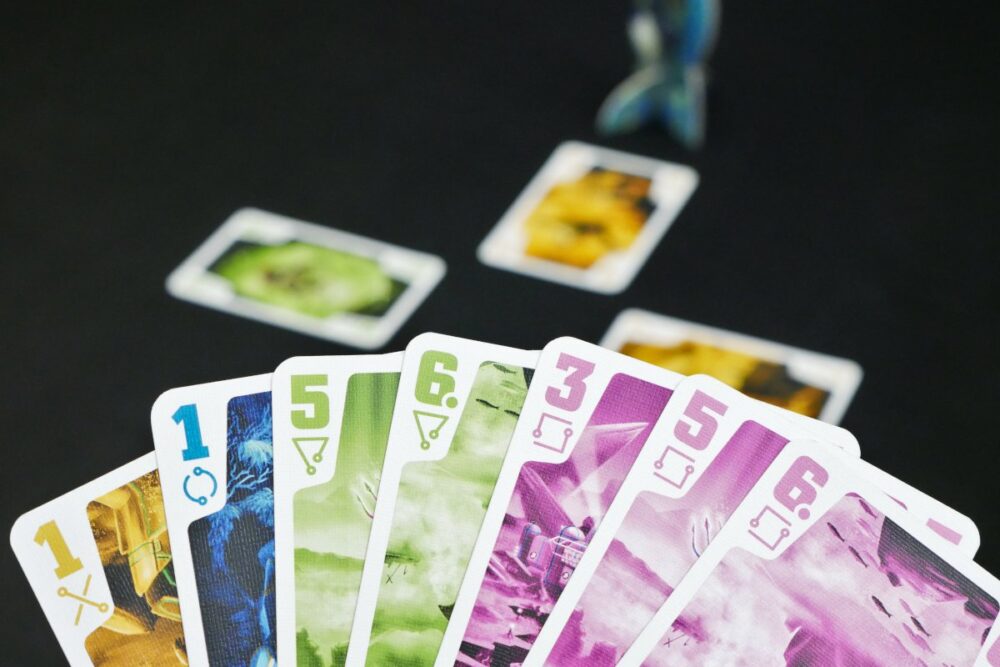
The deck is comprised of 4 colors or suits (Blue, Green, Pink, Yellow) with each color numbered 1 through 9. On a turn, The Crew is your typical trick-taker: the active player leads with a card, then everyone else in turn order plays a same-color card. Whoever played the highest card of that color "wins the trick" (i.e., collects all the cards that were just played) and becomes the active player for next turn. That's the core rhythm: someone leads, all else follow.
What if you don't have a same-color card? That's when you can play any card from your hand, but you can't win the trick even if you play the highest value. Only cards of the same color as the lead can win a trick—unless you play a Submarine. In addition to the four color suits, there are four Submarine cards numbered 1 through 4. A Submarine is a "trump," meaning it always wins a trick. But again, you can only play a Submarine if you don't have a same-as-the-lead-color card; otherwise, you must follow suit.
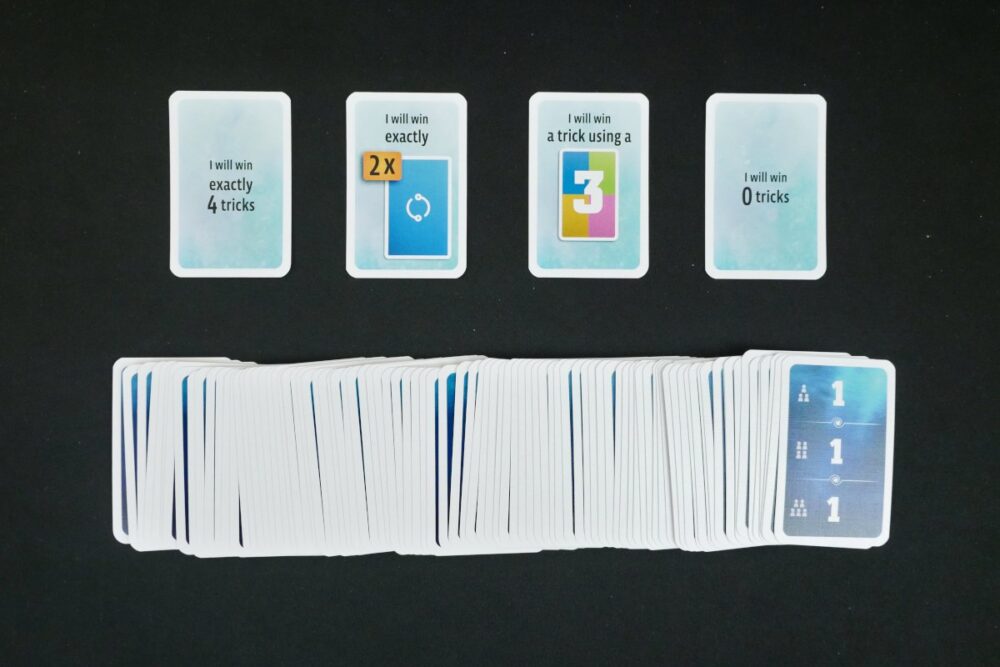
Why are you trying to win tricks? Well, you are and aren't. At the start of the game, task cards are randomly drawn according to the group's desired challenge level—more task cards, more difficult—and the group goes around drafting those task cards based on what each player thinks they can handle with the hand they've been dealt. Example tasks include "I will win exactly 4 tricks," "I will win exactly 2 Blue cards," "I will win a trick using any-color 3 card," or even "I will win 0 tricks."
Whoever is dealt the Submarine 4 is designated the Captain. The Captain leads the first trick and also acts first when drafting task cards.
You play until all cards have been played (that's 10 total tricks in a 4-player game), and you collectively win if everyone successfully completes their task card(s). If anyone fails a task or realizes that a task is no longer possible to complete, the game immediately ends in a group loss.
The Crew isn't a card game—it's a 10-step puzzle where you can't see all the pieces at your disposal, so you have to take it one step at a time and suss out that information as you go. At the start, you know what you're holding and you know what tasks every player chose to draft, so you have some insight into what everyone is holding. But it's only with actual play that you can sniff out what you need to know to make informed decisions.
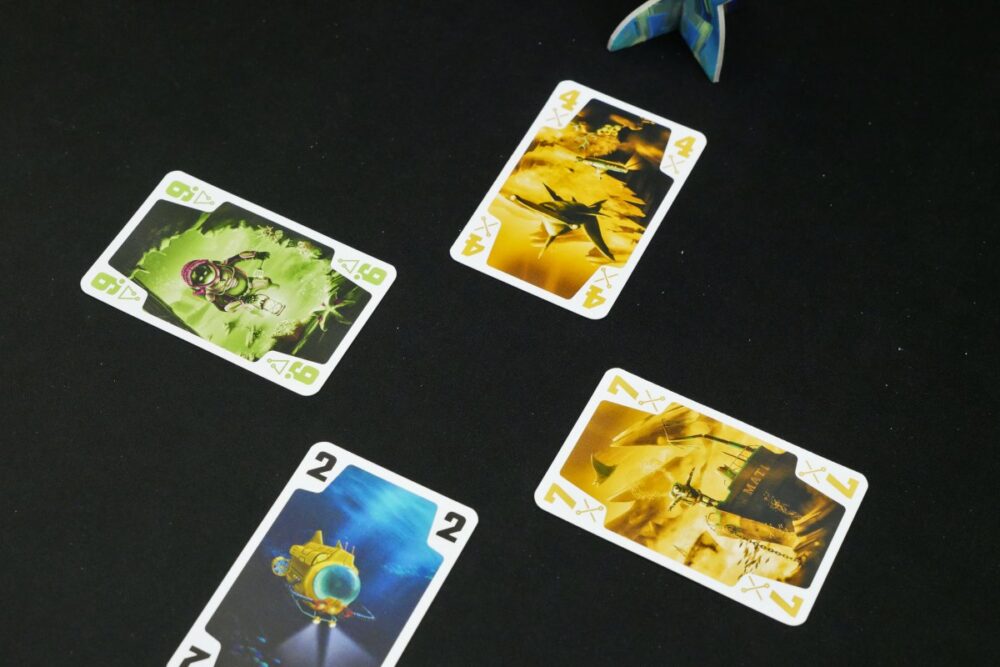
For example, Chad drafted the "I will win the first 3 tricks" and "I will win the 1, 2, and 3 Blue cards" tasks. That means they likely aren't holding those cards (because winning a trick with those low-value cards would be tough) and they likely are holding three higher value Blue cards (which they intend to win those 1/2/3 cards with). I start as the lead. Knowing the above, I might lead with my Blue 4. Jack follows with the Blue 2, Chad plays the Blue 7, and Derek puts in a Pink 9. Chad wins the trick, and now he leads the next one.
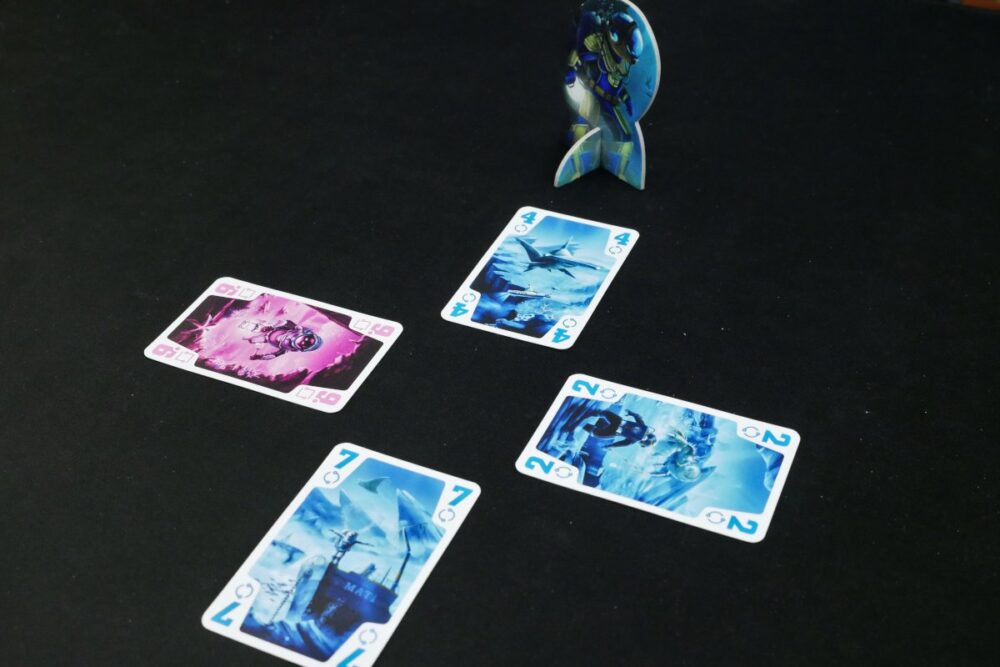
But what else have we learned? Derek put in a Pink, so he doesn't have any Blues in hand. I don't have the Blue 1 or Blue 3, so either Jack or Chad holds them. That gives me plenty to go off to help Chad with his tasks, and the next trick will tell me even more. Meanwhile, Derek could've played any card in his hand since he lacks a Blue—why did he play the Pink 9? I can peer into his mind and suss out his intentions, all from a single played card.
And that is the game. The Crew is all about piecing together those missing details while making sure tasks are solved before time runs out. It's like a train on an unfinished track, laying down more ahead of it as it chugs along.
The Crew is as much about deducing vital details as it is about giving hints. The fog of "no communication allowed" that hangs between all of you is brutal, and that means you all need to tap into the same mind-melding wavelength if you want any chance of success. To that end, The Crew gives you more than just the cards in your hand. You also have a sonar token, which acts as a one-time ability for giving explicit information—not just about your hand, but about a specific card in your hand and how it relates to its color.
At any time, as long as you aren't in the middle of a trick, you can put one of your cards on the table, face-up for all to see, and then the sonar token on top in one of three locations: along the top edge and you're saying "this card is the highest of its color in my hand"; along the bottom edge and you're saying it's the lowest of its color; in the middle and you're saying it's the only card of that color. (Sonar tokens can't be used with Submarine cards.)
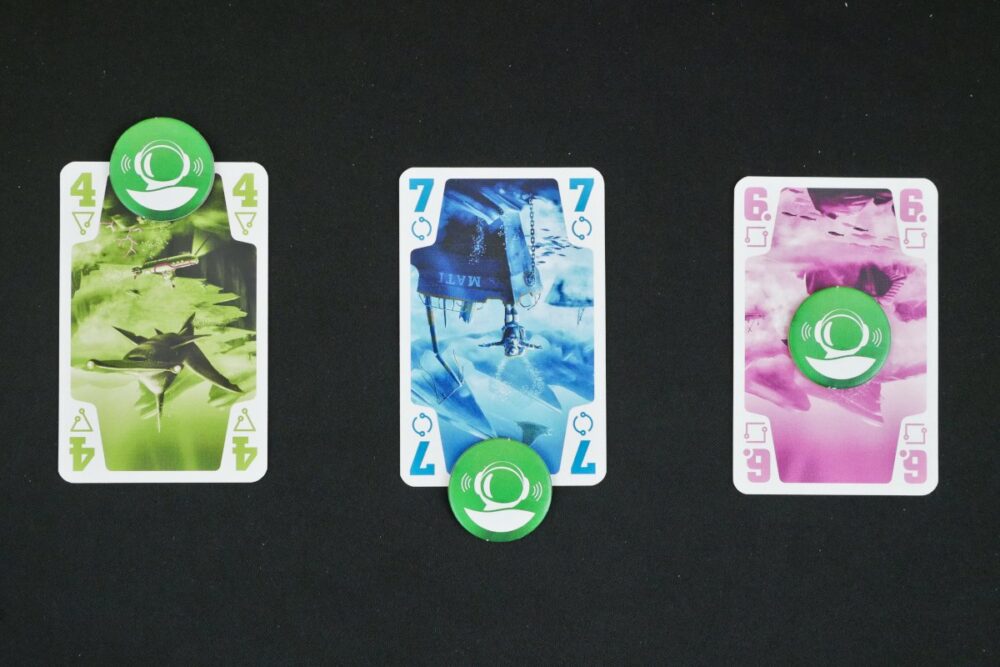
Timing your sonar token is everything. You don't want to randomly put it down at the start, waving your "this Blue 8 is the highest in my hand" for no reason. But if you have the "I will win no Yellows or Greens" task, then maybe let everyone know you have the Yellow 9 with the sonar token. Or, if you have the "I will win no Pinks" task, you realize all the high Pinks were played, and you still have the Pink 5, you might use your sonar token to let everyone know you're in danger—that Pink 5 might accidentally win a trick and lose your task.
The silence of The Crew is thrilling, not choking, precisely because there are so many avenues to take in and give away information. If you only had the cards in your hand, it'd be suffocating; with sonar tokens, you have enough agency to solve the puzzle and feel like you're working together.
Don't get me wrong: you're equipped with the tools to hint and deduce, but it's not an abundance of information. The Crew makes you work for it—makes you work with each other for it—and one misread, one misplay, one small mistake can mean the end. It feels like a ticking time bomb, with every trick a wire snipped, played with bated breath and sweat on the brow. And there are plenty of times you'll snip the wrong wire. I know I have.
But losing isn't painful in the same, sucky way it feels to lose a game of Risk, Munchkin, or Twilight Imperium. You haven't invested hours and hours into the game, only to watch victory stripped from you. It's 10 minutes tops, and it either explodes or it doesn't. If it does, so what? You debrief as a group, then shuffle up and try again. No lingering misery or regret. And that low-cost failure is important because the deduction and teamwork are so demanding, preventing it from feeling too punishing or exhausting.
And that post-loss debrief is one of my favorite parts of The Crew. Everyone relives the past 5–10 minutes, with Derek asking "Why'd you play that on round two?" and Jack lamenting how he painted himself into a corner with his Submarine play on round five. You get to build some camaraderie, then you suit up, re-arm the bomb, and take another stab.
To get the most out of The Crew, you really have to play it with the same group over and over. It's more than the sum of its mechanisms—it's a game about learning each other's styles and silently reading each other through the medium of cards played. And so a game between newbies looks nothing like a game between veterans who know the game, and a game between strangers looks nothing like a game between friends who know each other.
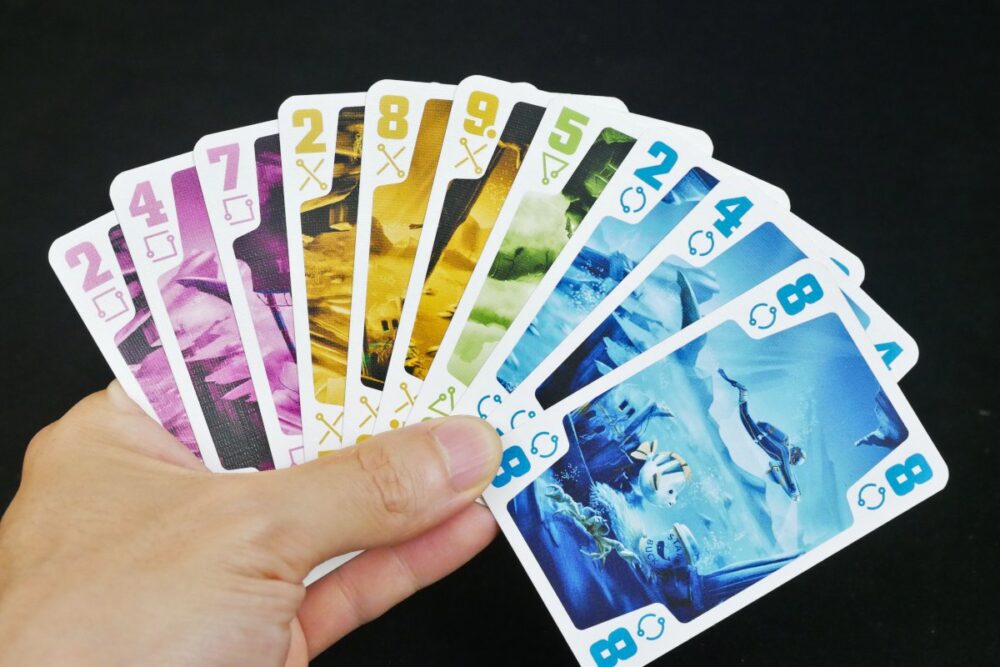
You sit down for the first time, stare at a hand of colored cards, and your instinct tells you that lots of high-value cards is good and low-value cards are bad. Five games in, you realize that depleting an entire color from your hand lets you start dumping unwanted cards. Ten games in, Derek stands out as the genius of the group, able to orchestrate several turns ahead, so you naturally look to him for guidance even when he isn't the Captain. Twenty games in, your honed instincts now see a lot more—Chad leads with a Yellow 4 on the first turn and somehow your gut tells you he's out of Yellows.
But none of it is artificial meta-driven nonsense, like you'd find in Hanabi. Unlike in Hanabi, you don't need to tack on your own invisible conventions to make sensible plays. The Crew isn't about developing a shared meta language; rather, it's navigating the structure that's presented to you together. And because of that, there's no single "correct" way to play. No matter your group's skill level and personalities, there's a way to make it work.
I don't like games that incorporate memory when memory isn't the central conceit. That's why I'm fine with it in, say, That's Not a Hat and Wandering Towers, but it rubs me the wrong way here. The Crew explicitly rules that tricks are "set aside face down" when won, and you can only peek at the cards from "the trick won most recently." In other words, everyone is responsible for memorizing what's been played and what's left.
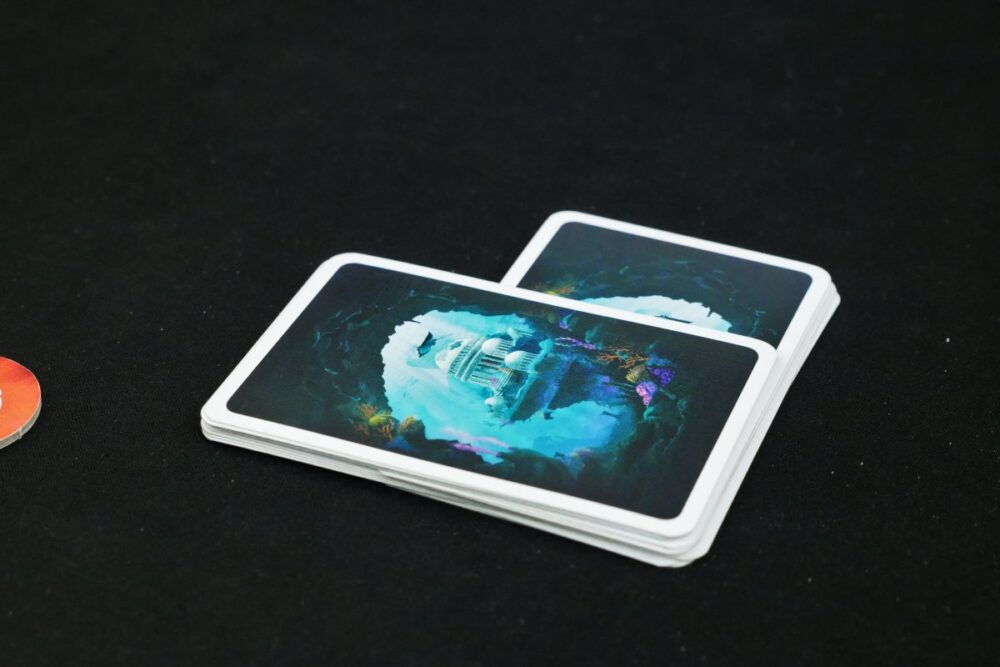
But The Crew is most interesting for the reveals, the deduction, and the forward thinking. Once a card shows up—for example, the Submarine 2—that should be considered open information: everyone saw it, and everyone should have access to it whenever they want. When you're six turns deep, can't remember whether Chad played a Submarine 2 or 3, and you get it wrong? You can derail the whole game for everyone, not because you made a bad decision, but because your brain just couldn't hold that detail. It's even worse when you've been playing all night, as dozens of tricks will easily blend together.
Memory doesn't deepen the challenge; it's a burden and an inconvenience. Memory is not a skill; it's a faculty, and I don't like success hinging on whether revealed information stays or fades in someone's mind. That's why I house-rule it and always play with face-up tricks.
The Crew has two separate learning curves. For anyone who's familiar with classic trick-taking games—e.g., hearts, spades, euchre, bridge—will know everything they need to start playing in under a minute. You just explain the cooperative twist and how each player only need to win tricks that progress them towards their own task(s).
But for anyone who's never played a trick-taking game before, The Crew can be a shaky teach. You'd be surprised how strange the concept of a trick-taker can be to someone unfamiliar, and explaining that core mechanism while layering on the cooperative elements can make for a confusing introduction. While only a minor weakness, it's one worth knowing about, especially if you're going to pick it up as a casual game to play with a family of non-gamers.
If anyone at the table has never played a trick-taker before, I'd first bust out a deck of regular playing cards, fly through a game or two of hearts to get them acquainted with what tricks are, then teach The Crew.
The Crew was clearly designed for 4 players, as most traditional trick-taking games are. The 40-card deck splits neatly with four suits and four Submarines, and the 10-trick length strikes the right balance: enough turns to give and take information meaningfully, with a good variety of tasks that feel well-balanced. It's the standard by which the other player counts are judged.
At 3p, two players are dealt 13 cards and one 14 cards. With bigger hands, you have more information to work with, but you have larger groups of colors so it's harder to deplete and get into a position to not follow suit. There are fewer sonar tokens in play, so fewer opportunities to give hard information. With fewer players to spread tasks between, you're more likely to double or triple up, making them harder to complete and more likely to run into bad synergies. Getting stuck with "I will win exactly 4 tricks" and "I will win no Yellows or Greens" is rough—not impossible, but it'll sure feel like it.
At 5p, everyone is dealt an even 8 cards and plays only 8 tricks. It shortens the runway you have to share and develop information, navigate tasks, and ensure the right people are winning the right tricks. Meanwhile, there are more sonar tokens in play, so you have more hard information. And with smaller hand sizes, the luck of the initial deal matters more—you may not have the cards you need to set up future turns and navigate your tricks. It almost feels like turbo mode: faster, shorter, bigger swings.
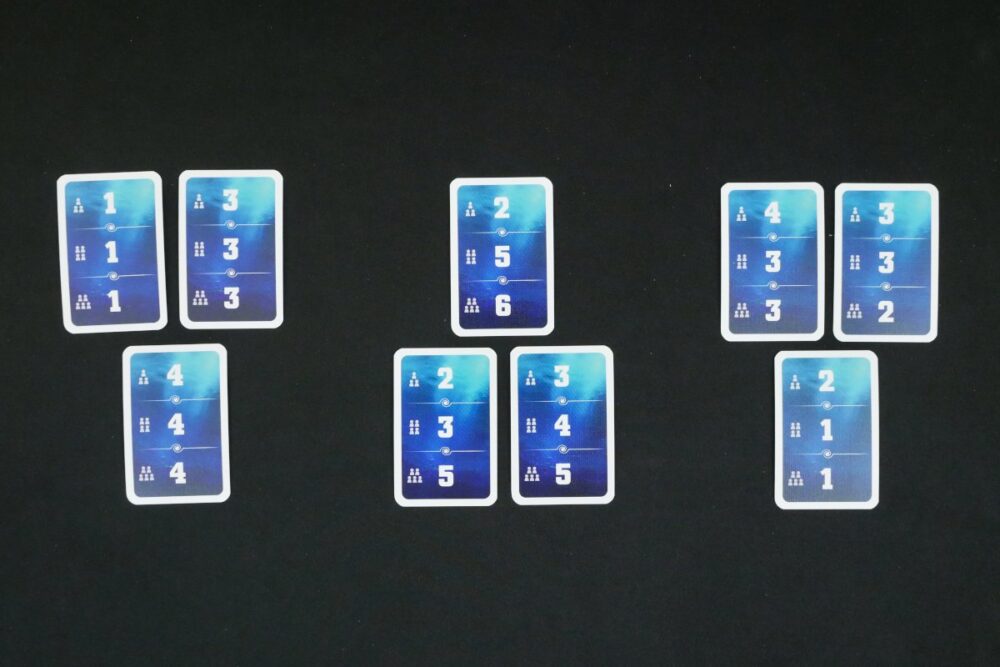
The Crew tries to mitigate this with scaled difficulty ratings for each task card. For example, "I will win the Green 6" is a 1 difficulty at all player counts, but "I will win a trick that contains only even-numbered cards" is a 2 difficulty at 3p, 5 difficulty at 4p, and 6 difficulty at 5p. That's why The Crew never feels broken at any count—the tasks always work. Does it make up for the non-task quirks? No. Does that mean I wouldn't play 3p or 5p? Also no. I'd happily play at any count, but you have to know they're different experiences.
To play The Crew with two players, you employ a phantom third player named Tonoja. But it's not so much a third player with its own decisions as it is just a third hand that's played open. You treat Tonoja as a third player—meaning a card from Tonoja's hand is played every trick, and Tonoja has a seat at the table in turn order—but the Captain controls which of Tonoja's cards are played. Tonoja's hand is comprised of 7 face-down cards, then 7 face-up cards on top; when a face-up card is played, the card below it is flipped and revealed.
At 2p, The Crew is more of a straightforward puzzle than a deductive game of mind-melding. Both players end up with 13 cards, so both can see 20 cards (7 from Tonoja). It's a lot more information to work with, so you can do a lot more forward planning. The game is less about figuring out what each other has, more about navigating Tonoja to reveal the cards you need for your tasks. Indeed, those face-down cards are a big switch-up: suddenly, there are blind inaccessible cards, meaning you physically can't complete tasks sometimes (like "I will win the Green 6") until they're uncovered.
It fundamentally changes the game from playing tricks in proper sequence to clearing Tonoja's cards. It's not a worse game, as my wife and I actually enjoy it quite a bit. But it's a different game—one that's more strategic, thinkier, especially if you're the Captain. With the Captain effectively playing two hands, you have more control, responsibility, and pressure. Again, not the same experience, but one that's worthy of its inclusion.
It's the deductive challenge that keeps The Crew ever engaging, and it's the task variety that gives you a brand-new deductive challenge each play. The tasks are the structure that give tricks meaning, and every task changes which cards matter. Between that and your random hand of cards, you're never making the same decision twice. I'm normally skeptical of replayability through variety, but it works here—with 96 task cards that can be combined in any order or amount, you essentially have infinite puzzles to solve.
And those puzzles come in whatever difficulty level you prefer, as you can adjust difficulty on the fly to match your group's skill level and desired challenge. Each task card has a difficulty value, and you simply choose a target difficulty level as a group and randomly draw task cards until the sum of task card difficulties equals your target. (If a task would put you over the target, you keep skipping until you find one that works.) As your group gets better, you can ramp up the target level and deepen your relationship with the game.
A deductive mind-melding challenge like The Crew could easily land flat and die if it were too easy or too hard. Being able to tweak the challenge with this much granularity means it can be the perfect puzzle for any table, any session. I've played over 50 times and still don't see it going stale any time soon. When I just want to chill, I aim for difficulty 6+; when I want a challenge, 10+ is good; and when I really want to sweat, 15+. Your own values will differ.
The adjustable task system is what makes The Crew so addictive. The first time I played, it was with three other family members and we sank hours into it, ticking up the difficulty with every win, debriefing after every failure, and growing closer together as we strengthened our silent communication. It's one of my all-time favorite gaming memories, and it instantly cemented The Crew as one of my favorite games—one that earns a permanent spot on my shelf.
The Crew's production is near perfect. As "just" a card game, it doesn't need bells and whistles—and in fact, too much extra would harm its portability. With just a deck of cards, sonar tokens, and a Captain marker, it's easy to pull out and play anywhere, any time. You just shuffle up and deal, shuffle up and deal, over and over again until your other obligations force an end. It takes a minute to set up and requires virtually zero table space. All you need is personal space for your task card(s) and collected tricks, plus a central area for the current trick.
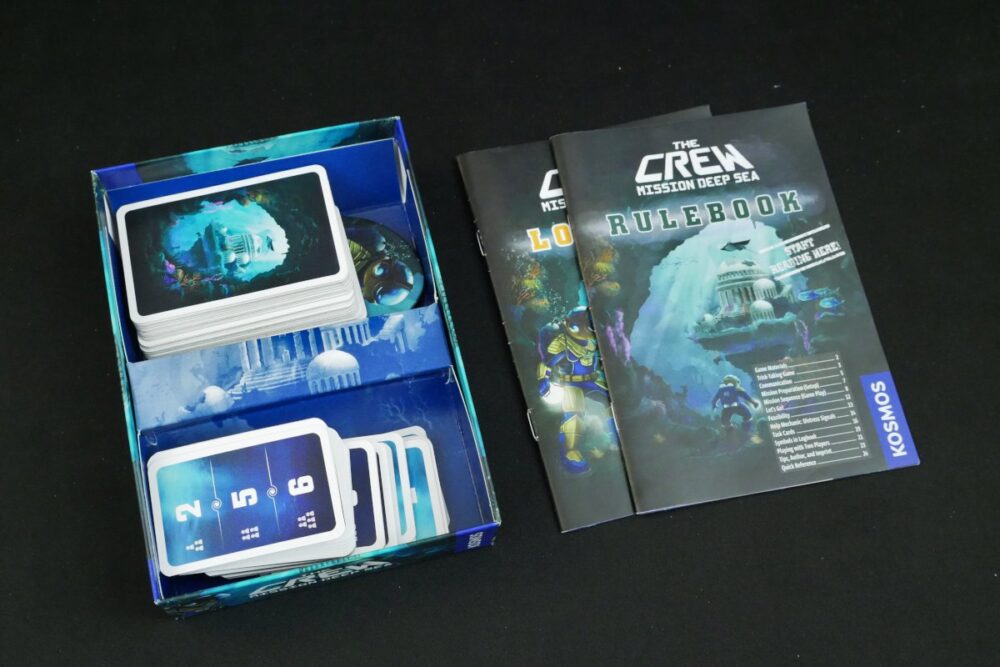
The dings are minor and few. For example, the theme? Whatever, who cares. The theme could've been anything and the game would be just as good because numbers and deduction don't care about theme. The cards are well-designed, legible, and linen-finished, but they get grimy fast so I highly recommend sleeving this one. And I do wish the box, while small, was smaller. It'd be tough with the main deck and the task deck, but a more truly pocket-sized box would make it an essential travel game.
Overall, it's a serviceable production with no glaring issues that get in the way or take you out of it. It's a card game—you don't need much.
The Crew: Mission Deep Sea is the best $15 you can spend in the board gaming hobby. It's cheaper than others in this tier, including Scout and Point Salad, while packing a punchier, more memorable experience and a smooth on-ramp into cooperative play—perfect for non-hobbyists who like card games. Buy it if you have a standing group willing to fail loudly and often. Skip it if your table falls apart at even the hint of thinky deduction and silent teamplay.
Stop Buying Games
You'll Regret
Before your next game purchase, run it through this mental checklist that every seasoned gamer uses.
Free checklist, delivered instantly to your inbox.
No spam, ever. Unsubscribe in one click.
More Reviews