Abstract strategy is far from my jam, so I tend not to review them out of respect and courtesy. But Boop Shuffle caught my eye because it was cute, light, portable, and most importantly card-driven. Maybe drawing from a shared deck would fix my biggest misgivings with the abstract strategy genre (namely high mental strain and brutal skill gaps).
My first 10 minutes with Boop Shuffle felt fresh, and I really thought there was something special here. But by the time that first game wrapped up, I started seeing the cracks—and those cracks eventually became deal-breakers. With Boop Shuffle, the initial excitement of its highly reactive card deck fades into a plodding, thinky, quiet snoozer.
This review is based on a review copy of Boop Shuffle provided by Smirk & Dagger Games, but my thoughts and opinions are my own.
Table of Contents
View more
What It Is
Boop Shuffle is a head-to-head abstract strategy game played on a 6x6 grid, called the Bed. Each player is assigned opposing colors (gray versus calico) and the goal is to get three Cats of your color in a row. But it's not as easy as it sounds because they'll "boop" each other around the Bed, making it tough to get them where you want them to go and even knocking each other off the edges.
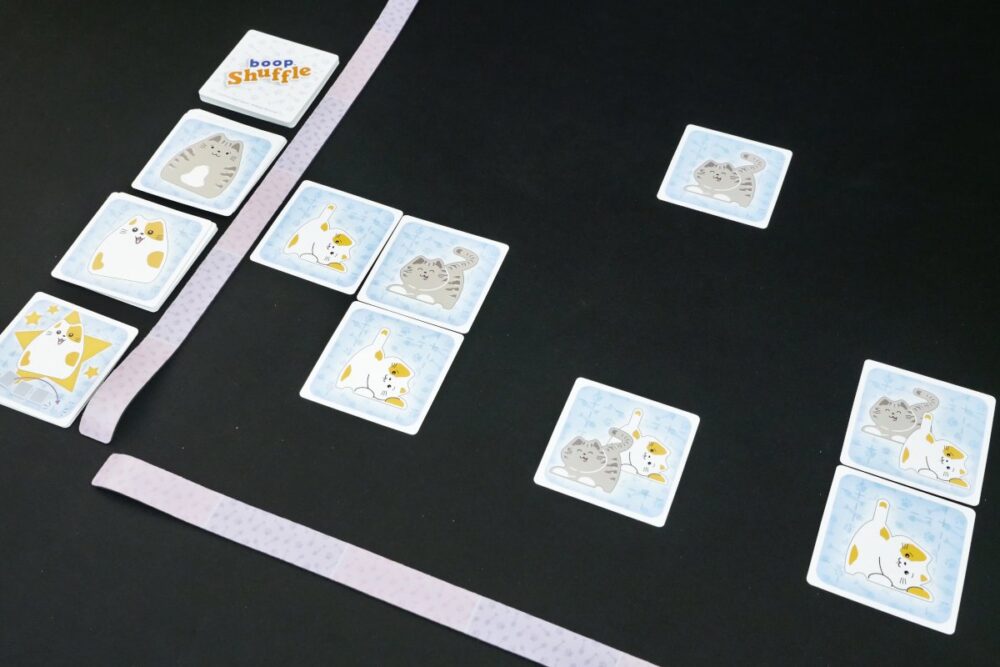
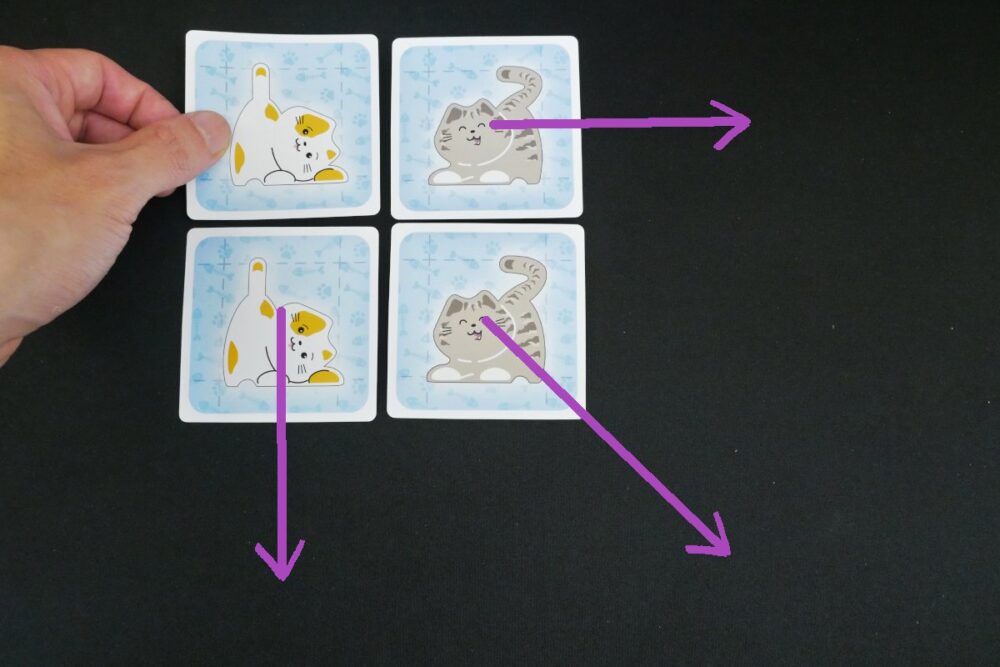
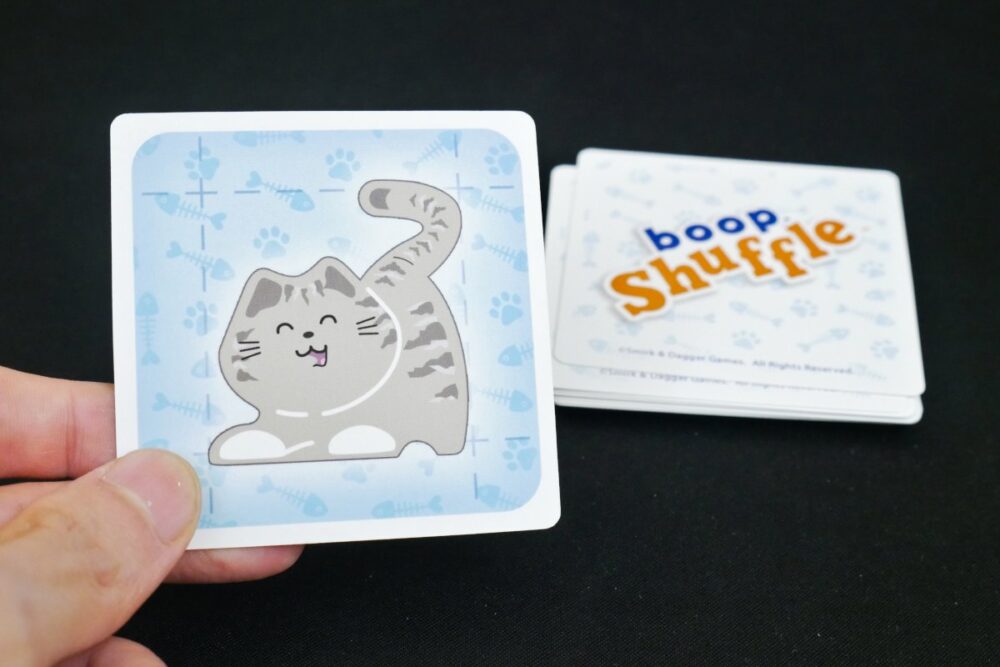
It's all played using a deck of cards, with each card representing a feline. You draw a card, which might be of your color or your opponent's color. Either way, you play that card to the grid, somewhere adjacent to an existing card. When you do, it "boops" all surrounding cards—up, down, and diagonal, every card gets pushed one grid space away from where you just placed your card. (Unless, of course, it's blocked by a card in the spot it would've gone.)
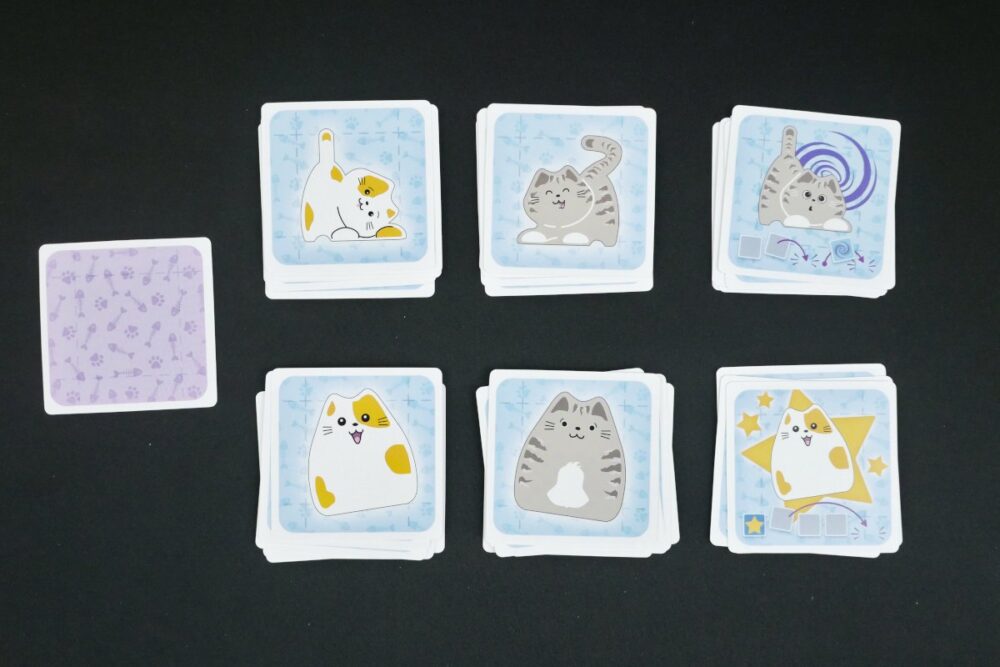
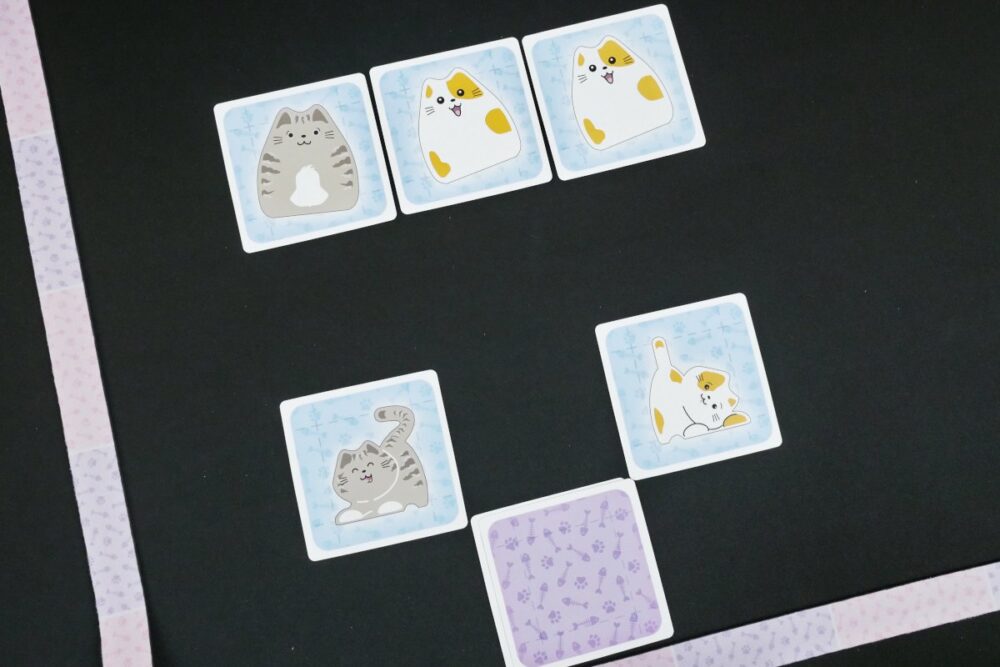
Top row: Kittens in calico and gray, plus special Kittens. / Bottom row: Cats in calico and gray, plus special Cats once graduated. / Left: A lone Blanket with its own behavior.
If a feline is ever booped off the edge of the Bed, it gets discarded. Once the draw deck is depleted, the discard pile is reshuffled into a new draw deck, thus keeping an active cycle of cards in play. In other words, felines are constantly being booped off and placed back on the Bed.
Now for the kicker: the feline draw deck starts with Kittens only. You and your opponent must maneuver your Kittens around the Bed to make three in a row, which then "graduates" all of those Kittens-in-a-line into Cats. While Kittens can't boop Cats, Cats can boop Kittens and other Cats. Once you graduate enough Kittens to Cats, you can start aiming for three Cats in a row—and as soon as you get three Cats in a row, you win.
How It Feels to Play
Easy to Learn, Hard to Grok
Boop Shuffle is easy to learn but hard to grok. It takes 5 minutes to teach and you'll clearly understand what you're trying to do—get three of your felines in a row—but maneuvering the pieces on the grid is a nightmare. You can't just place your felines where you want them to go, but rather you need to boop them into place. That means you always have to think at least two turns ahead. Since every placement shifts the grid pieces around, you're always thinking about how you're going to shift them back.
By placing this Kitten here, all surrounding Kittens are booped away 1 space.
There's a real slide-puzzle-esque quality to the movement in Boop Shuffle, and as someone who hates slide puzzles, I struggled to fully make sense of it. And it's not just because it's a visual-spatial challenge—I'm normally quite comfortable in my visual-spatial abilities. What I really struggle with is planning several moves ahead, and that's why I shy away from abstract strategies as a whole. Boop Shuffle demands a lot of that, and the result is a game that's prone to analysis paralysis. It takes time to churn through those possibilities.
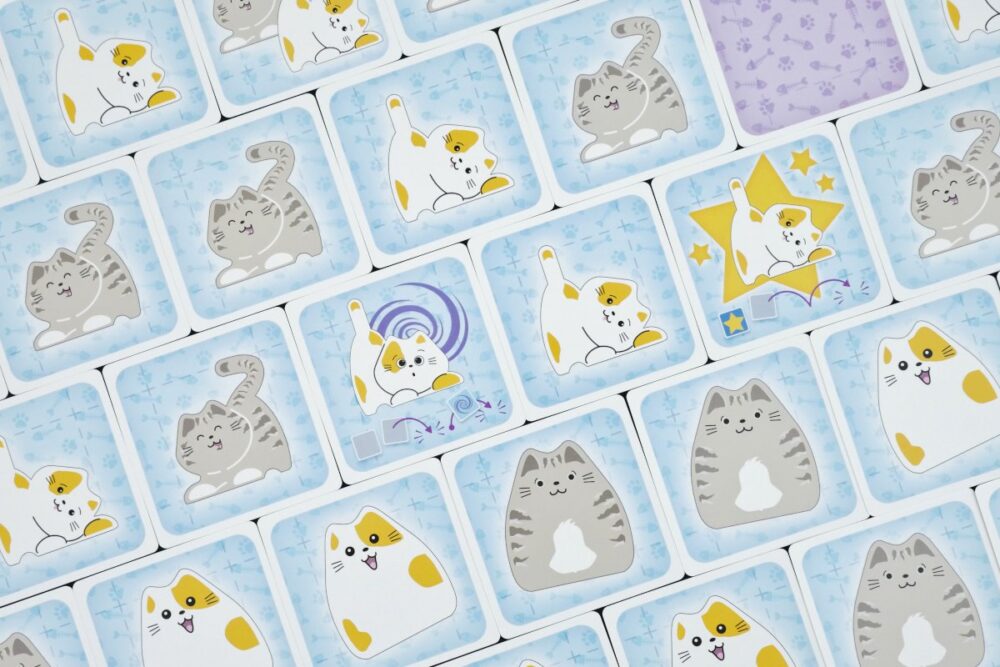
Not to mention the special felines with abilities. Normally, a feline just boops its surrounding felines by one space. But there are also "wild" felines that count as either color, "super" felines that boop others further than usual, and a "blanket" that temporarily covers a feline and renders it out of play until the blanket is booped off. While they're simple enough to not overcomplicate the game, they add to the tactical complexity with branching options, making movements even harder to grok than with just the basic felines.
Luck Creates and Strips Away Agency
You will feel the presence of luck in Boop Shuffle, lurking just beneath the surface of that double-edged sword of a draw deck. You aren't just choosing where to put your own pieces, as you would in chess or Hive or Onitama. You draw a random card and the feline could be yours or your opponent's.
That's a different type of decision every turn, where placing your own feline involves different mental calculations than placing your opponent's. You may not be in control of which felines you draw, but you have agency over where they go—and that's the most interesting part of Boop Shuffle. You have as much sway over the gray felines as you do the calico felines. You can use your opponent's cards to, for example, boop their own off the Bed.
You can draw either your own or your opponent's felines. Either way, you place it.
But a chain of bad luck can make it feel like you have no agency as far as executing your strategy. More than once I was able to put myself within spitting distance of victory, with two Cats perfectly lined up and awaiting completion. I knew I had a few Cats waiting for me in the draw deck, too. But turn after turn, I only drew their felines and my opponent drew my felines, using them to maneuver their own into place and eventually break my line altogether. For four turns, I begged the deck to give me my third Cat so I could clinch the win—or even just a Kitten that I could at least graduate—but to no avail.
Turns out, you need to draw the right feline at the right time in order to complete your rows. That's not agency; that's up to the gods of fate. If you hate luck in your abstract strategy, you'll want to stay away from Boop Shuffle.
The End Game Is Anticlimactic
For me, two-player games are at their best when the end sneaks up on you—or, at the very least, when you don't know who's winning until the buzzer finally sounds. In Boop Shuffle, you see the end coming from a mile away.
Because in order to win, you need to have two Cats lined up. So as soon as you see your opponent with a Cat, you're on guard for that second Cat—and as soon as that second Cat lines up, you resign yourself to the luck of the draw. Now it's just whether you're able to draw a Cat in time to break that line, or whether your opponent gets their third Cat first.
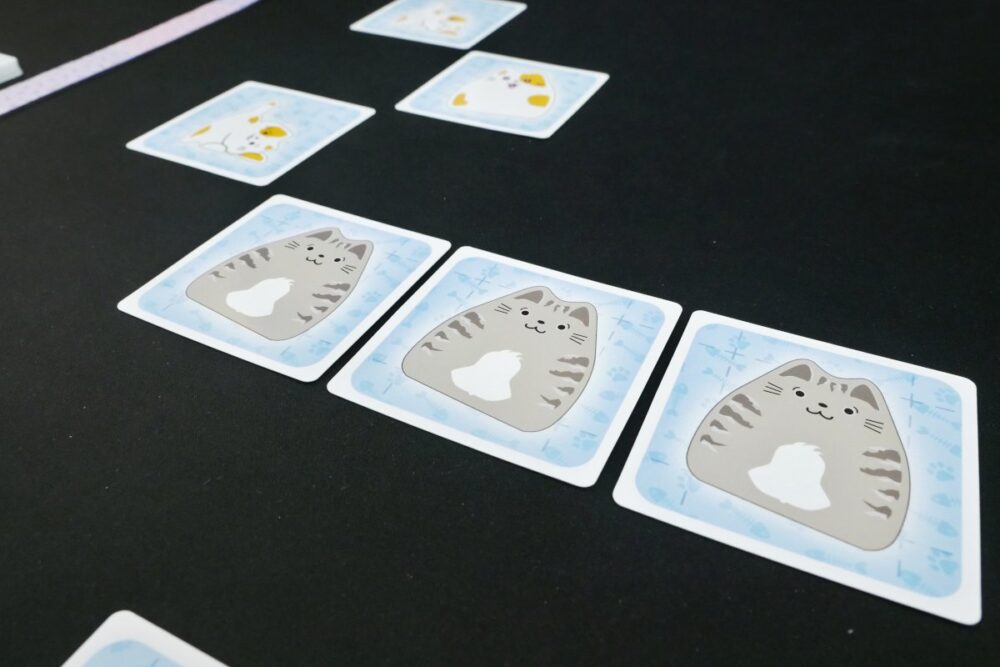
Once you see two Cats in a row, you can sense the end is nigh.
Is there hope, anticipation, and tension in those moments? Of course. Are there interesting decisions leading up to the climax? For sure. But as soon as that winning card is drawn, it's not an exciting victory or crushing defeat that you feel—it's more of a deflation. An inevitability. They top-decked what they needed and that's that.
Pacing Swings Too Wildly for a Light Game
As with any two-player abstract strategy, there's an inherent tug-of-war feel to Boop Shuffle. You're pushing for control of the grid, you're racing to graduate your Kittens to Cats faster than your opponent can, and they're doing the same back at you. Everyone's felines are repeatedly getting booped off the edge of the Bed and the grid state is constantly fluctuating in someone's favor. That part is interesting. You're on your back foot, then you're dominating, then you're pushed back again. There's real tension with that ebb and flow.
But it can drag for way too long. Boop Shuffle doesn't have enough structural restraint to keep that back-and-forth from overstaying its welcome. The result is unreliable pacing, the thing I dislike most about what should otherwise be a breezy, fast game. You can go through the entire draw deck without making any progress—no graduations from Kittens to Cats, only boops off the Bed—and progress will stall until it's reshuffled again. I've had some games last only 15 minutes while others crossed the 1-hour mark.
If your idea of fun is 3-steps-forward-3-steps-back, and if you don't mind that tug-of-war recycling over and over until someone manages a breakthrough, then Boop Shuffle might be for you. I prefer games that are more predictable in length and flow—especially when they're lighter fare like this—and the wild swings in game duration are enough to put me off of Boop Shuffle.
Player Interaction
Boop Shuffle has a kind of direct player interaction you don't see often: your own felines belong to you, and same for your opponent, but anyone can move anyone's felines. The only restriction is that you don't get to choose when you can do that—it's up to the cards you draw. But when you do draw your opponent's feline, you can place it anywhere, ideally in a spot that's bad for them while also booping felines in your favor.
And that creates this feeling of being in control but also not. You can force your opponent into tight corners by wastefully placing their precious cards. You can see the three-in-a-row they're going for and disrupt it with whatever card you draw. And yet, everything you do is always being interrupted by their placements. It's a mental skirmish with lots of give and take, but it never feels mean. Constant disruption is the name of the game.
At the same time, there's very little table talk. Boop Shuffle is mainly played in your own head as you analyze this chaotic-yet-strategic board and try to make it do what you want it to do. My wife and I have gone entire games without uttering a single word—and when we do say anything, it's to curse the other for booping our felines into bad positions. Don't go into this one expecting a lot of casual, jovial chat. It's not that kind of game.
Replayability
In one sense, Boop Shuffle is the same exact game every single time. You get your Kittens in a row, grow them into Cats, get your Cats in a row, all while trying to harness the chaos of the ever-shifting Bed. There's no variable setup, no special classes, no asymmetric abilities, no modules to mix and match. For all intents and purposes, nothing changes except the shuffled deck.
And yet, no two games are alike. Your actual decisions are different every turn depending on which card you draw (regular felines versus special felines, Kittens versus Cats, in your color or your opponent's, or the neutral blanket), and the way the decision space unfolds is different based on what's out there in the grid. Playing a Gray Kitten into a sparse grid is a much simpler calculus than playing that same Gray Kitten into a crowded grid where you'll end up booping and scattering a handful of felines.
So while Boop Shuffle doesn't have any innate variability, it doesn't need any to hold your interest—as long as you're interested in the first place. It's still an abstract strategy game at heart, and whether it sings or falls flat for you will ultimately depend on how you feel about the genre as a whole.
Components and Setup
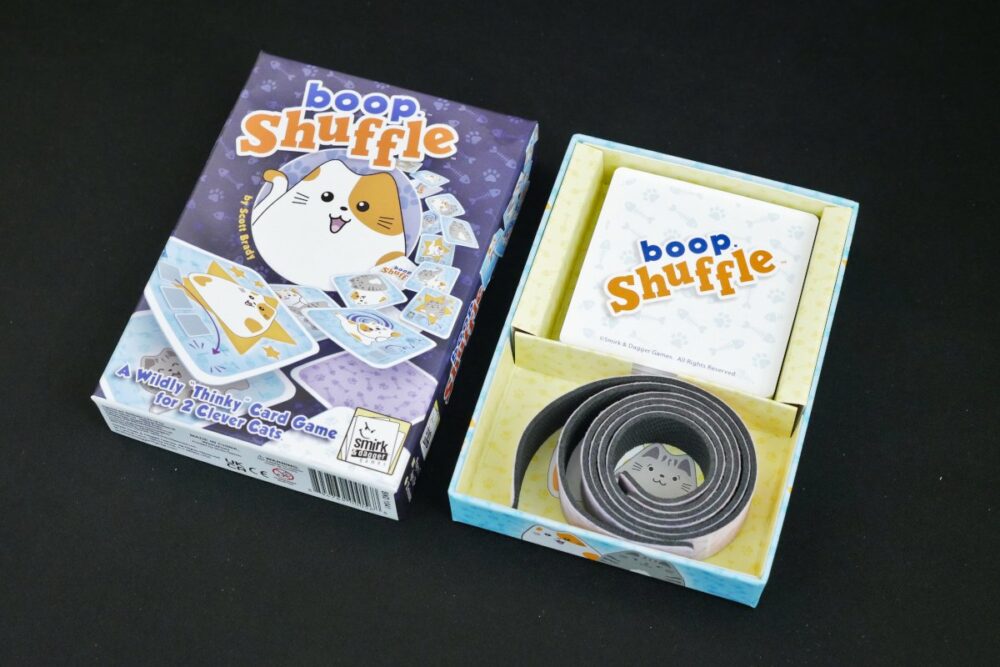
I simultaneously adore and dislike Boop Shuffle's production. Is it cute? Absolutely, and cute enough to draw in non-gamers who'd normally never touch abstract strategy. Is it portable? You bet, and I love how it crunches down into a slim box that's easy to slip into a bag and take anywhere. Not quite small enough for a pocket, but it's not really a pocket-type game anyway. While setup only takes a minute or two, you do need at least a 3-by-3-foot table to comfortably hold the grid and side card piles.
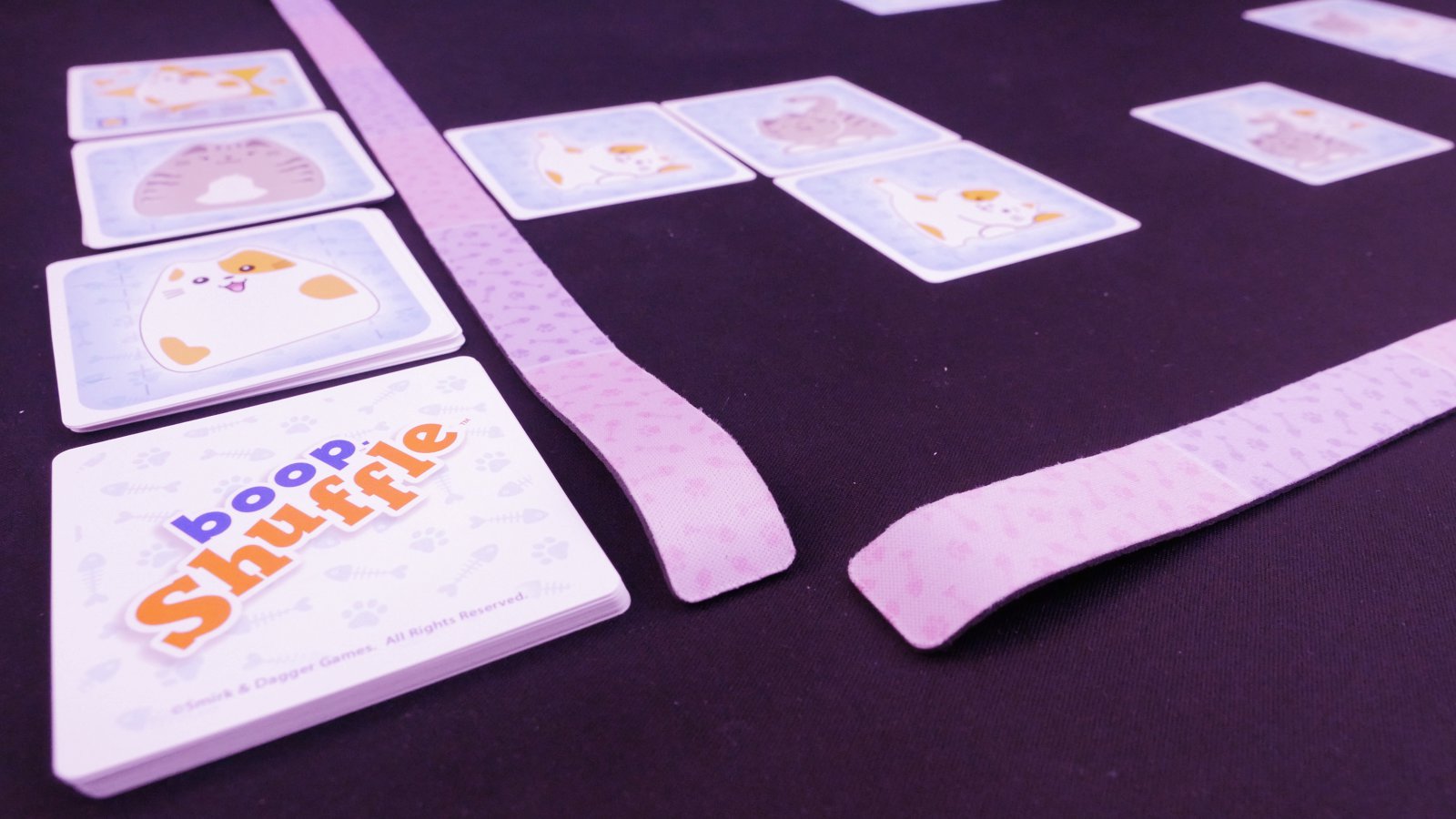
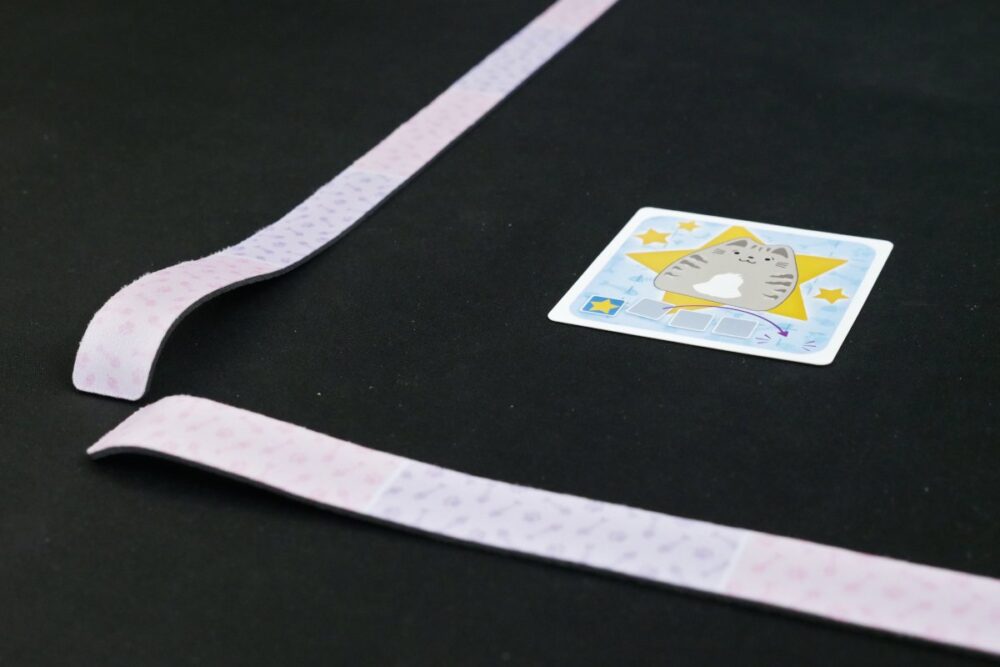
But I can't get over the two neoprene strips that are used to mark the grid boundaries. It's functional enough to work, but it just feels wrong—almost like it's hacked together. It's bad enough playing on an invisible field where you have to constantly make sure all the cards are lined up properly and haven't shifted, and it's error-prone when only a few cards are in play. Add in the neoprene strips and it just feels... prototypey.
It bothers me that the neoprene strips don't lay flat.
Unfortunately, I can't think of a better solution. Again, those neoprene strips are practical for portability, but the resulting experience doesn't land well with me. I wouldn't want a full-blown board, nor would I want a flimsy cloth mat. Am I just being picky? Maybe. But if you're as picky about table presence and game feel as I am, you may want to think twice.
The Bottom Line
Boop Shuffle is a thinky abstract strategy experience packed into a $15 box you can easily throw in a bag. If you want a portable two-player abstract with real tactical teeth, and if you don't mind that it can drag in the mid-game and deflate in the end-game, Boop Shuffle belongs on your shelf. If you can't stomach abstract strategy, the cute theme and portability won't win you over.