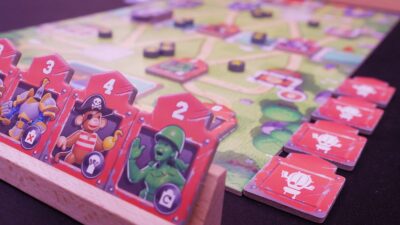
Hand management? Check. Two-player cooperative? Check. Incredible production quality? Check! Everything about Kinfire Delve felt right up my alley, and I came in with glowing anticipation. But by my final game, it had sapped my will to play again. There's a lingering misery at the heart of this game, and you need some level of masochism to enjoy it.
Kinfire Delve has a punishing design that only pays off for a specific kind of player, and it's the wrong game to jump into if you're expecting casual card play or a fun romp of an adventure. It's beautiful, absolutely, but it's also cruel and demanding... and all of that is intentional. Do not be deceived. This game is more than just an optimization puzzle—it's a test of spirit.
This review is based on my own personal copy of Kinfire Delve, which I bought used from BGG's GeekMarket. Not a free review copy. There are actually three games in the Kinfire Delve series; I've only played Vainglory's Grotto. This is a review of the Kinfire Delve system based on that experience.
Table of Contents
View more
What It Is
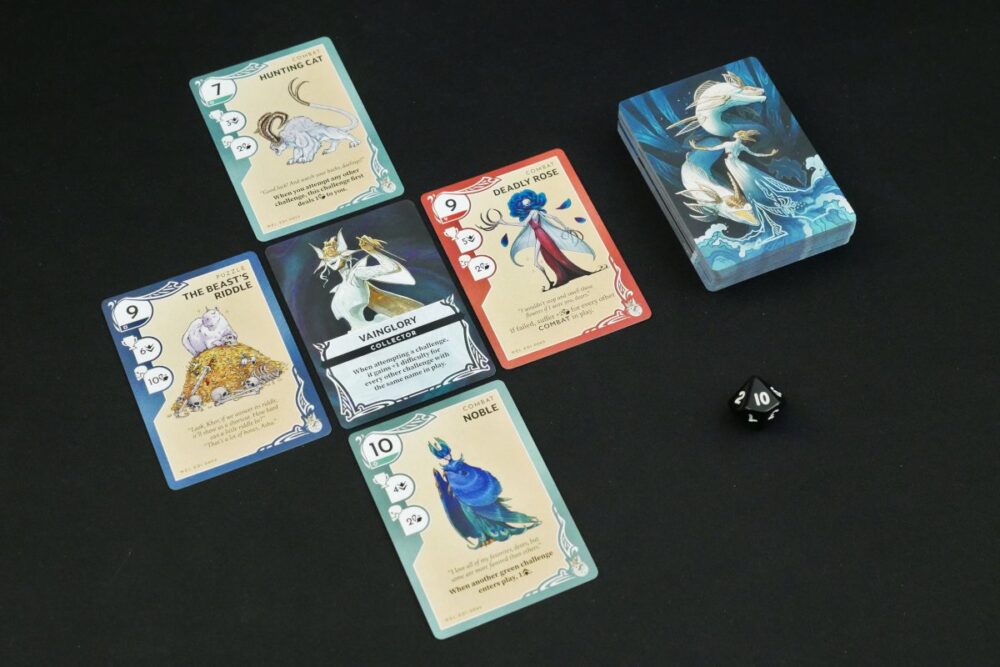
Kinfire Delve is a two-player cooperative dungeon delve—except instead of a dungeon, it's a deep, deep Well. You and your partner play as Seekers, with each Seeker having its own unique deck of action cards. You'll delve down this Well together, fighting monsters and overcoming tests via card play and dice rolls. At the bottom of the Well awaits one of three versions of the Master (i.e., the boss). If you can defeat it, you win.
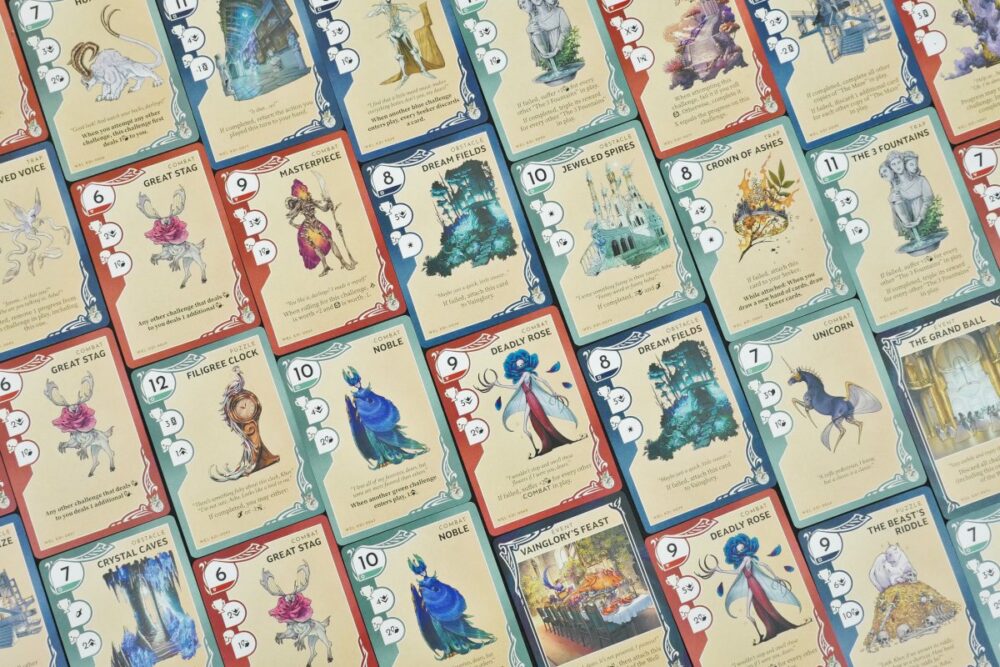
The Well is represented by a 57-card deck, and you'll need to get through that entire deck to reach "the bottom of the Well." But that doesn't mean you'll encounter all 57 cards. As you defeat monsters and beat challenges, they'll grant rewards—and the most common reward is "to delve down the Well," which means discarding a number of cards from the top of the deck. In reality, you'll only have to deal with a quarter of the deck (or so) per game.
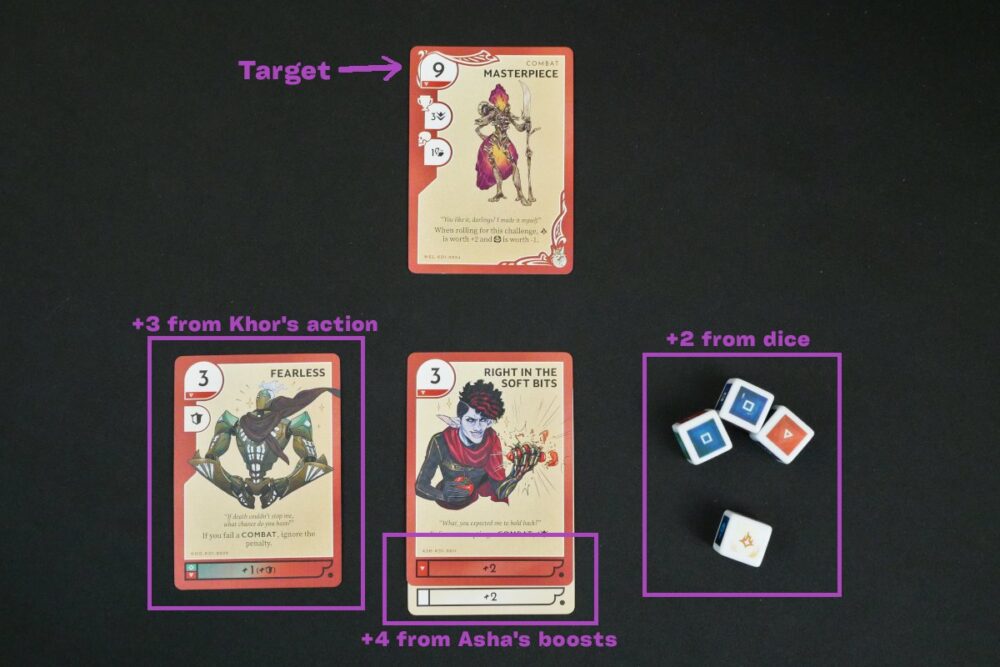
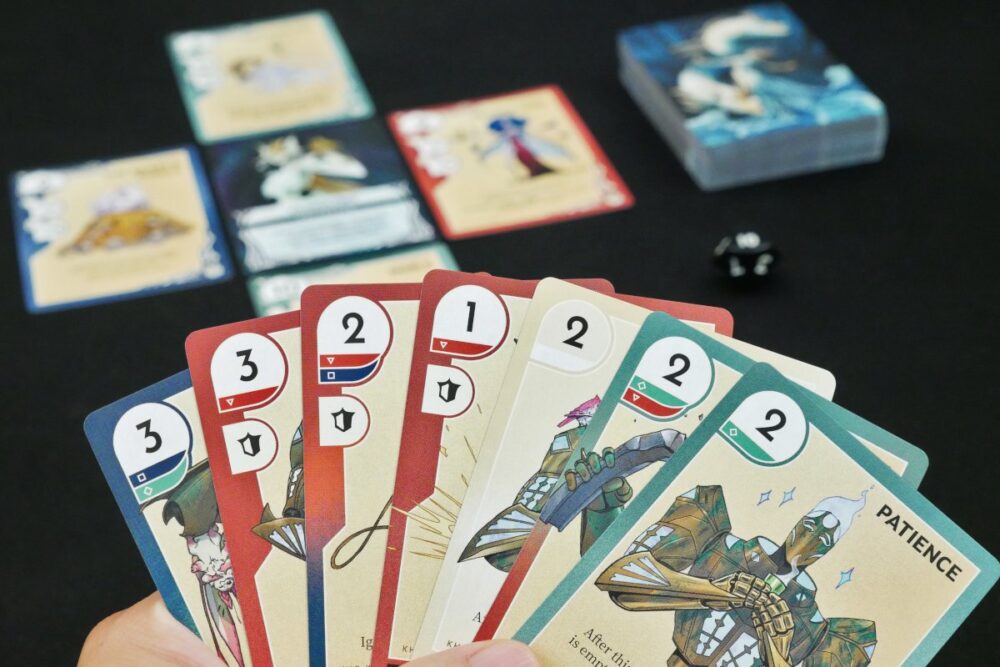
Most challenges are mechanically simple: a challenge card has a difficulty target, and you play action cards from your hand to apply "progress" to a challenge. Your partner can then "boost" your action with cards from their own hand, adding even more progress. Then you roll the dice, which adds more progress for every die face that matches the challenge's color.
If the sum of your progress exceeds the challenge's difficulty target, you take its reward, discard the challenge, and draw another in its place. If you don't exceed, the progress is stored on the challenge (so it's easier to defeat) but you also take a penalty (e.g., damage). There are always four challenges on the table, and you can choose which one to engage on your turn.
When you run out of cards in your hand, you don't just draw back up—you also have to take a permanent exhaust card, which adds negative twists that make things trickier. You also have a single health pool starting at 10, which is shared as you and your partner take damage. Can you delve down the Well and defeat the Master before running out of health or exhaust cards?
Each Kinfire Delve game has its own unique Well deck, two unique Seekers, and a unique Master in three versions. In Vainglory's Grotto, the two Seekers are Asha and Khor while the Master is Vainglory. You can mix and match any of the Seekers to play any Kinfire Delve game, but not the Master or Well decks.
How It Feels to Play
Every Card Is a Test of Sacrifice
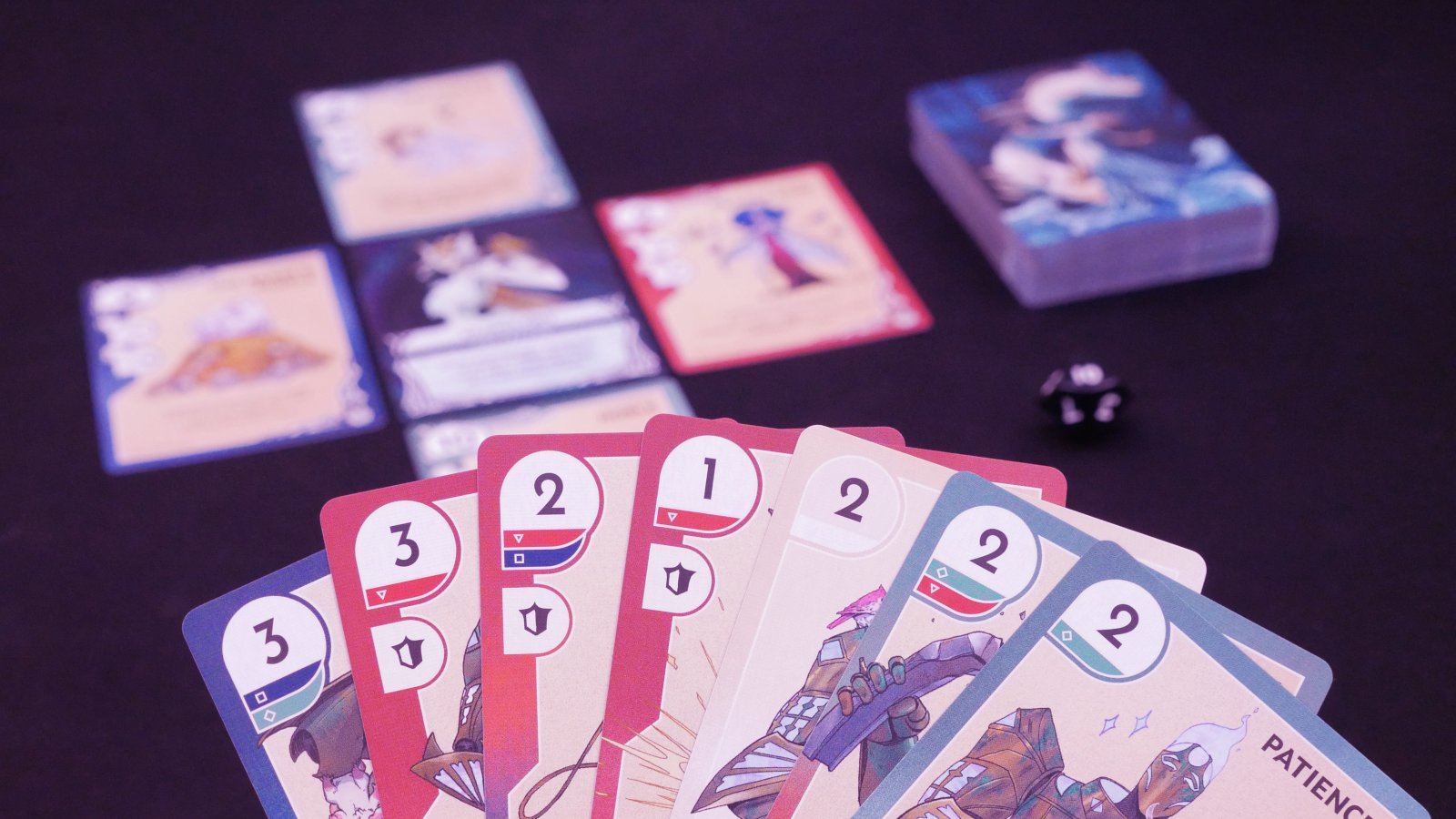
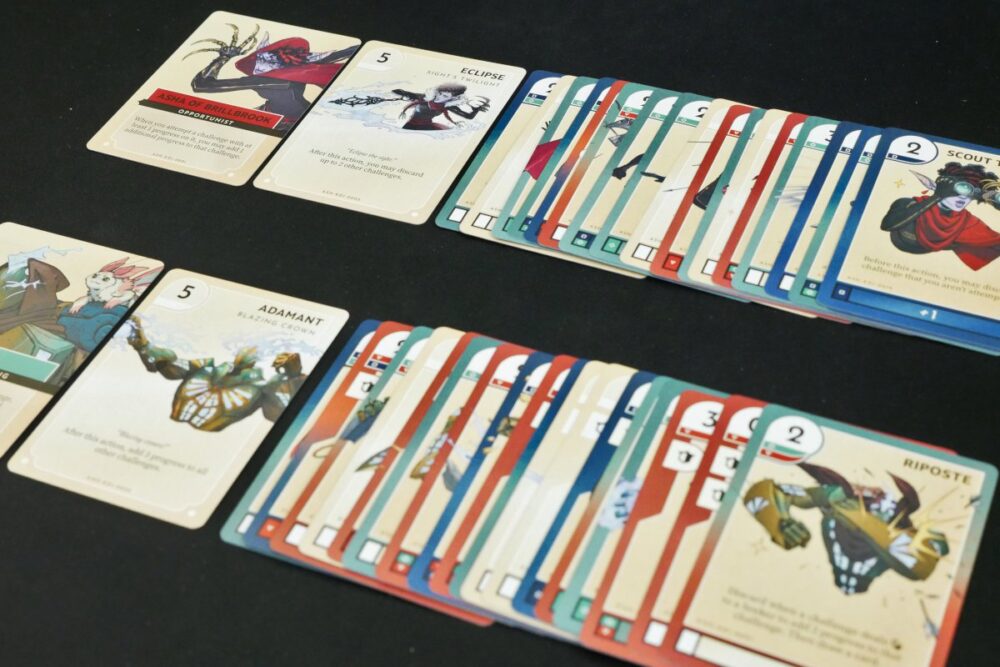
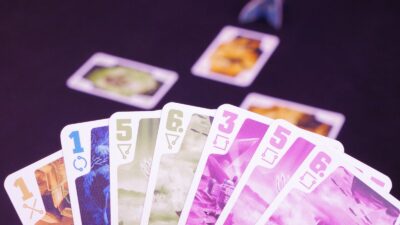
Kinfire Delve isn't so much a game of hand management as it is a game of hand disposal. Your instinct is to hoard all the cards you've drawn because they're all good—each action card is useful in three ways: for its progress value, for its special ability, and for its boost value.
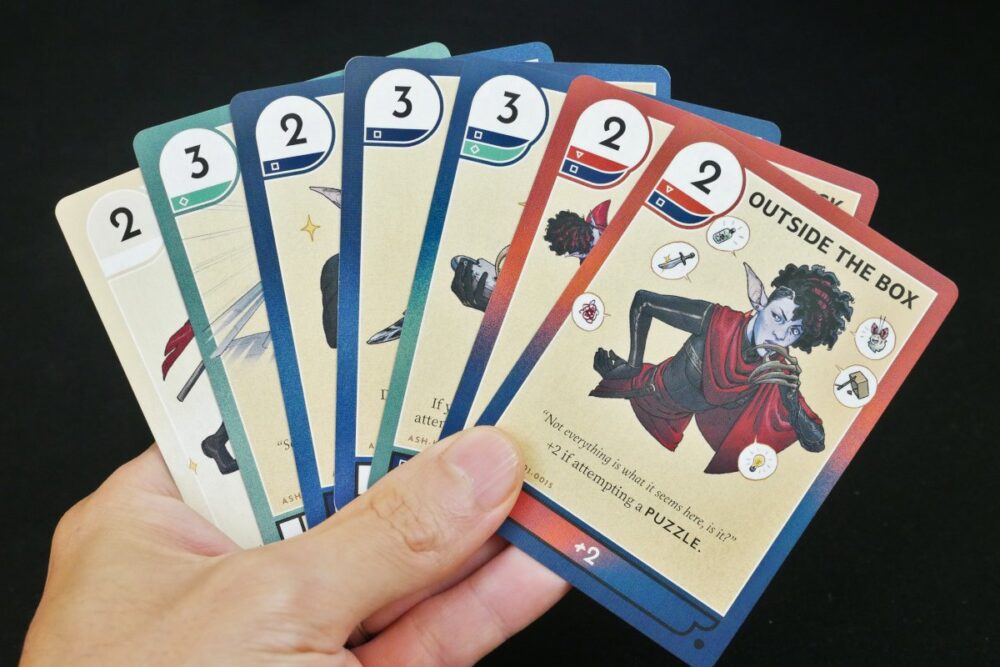
That means every single card in your hand is an opportunity cost calculation. Do you save your only remaining red action card in case you need to attack a red challenge later? Or for its situational card text ability, like Asha's Outside the Box ("+2 if attempting a Puzzle") when you're up against a Puzzle challenge? Or use it for its boost, which would help your partner beat a challenge now and protect you against penalty damage, but effectively "wasting" the card because you didn't get full value from its "real" aspects?
For example, Asha's Blinding Flash says "If you fail a Combat, ignore the penalty." That's an excellent card to keep on hand for chipping down a high-difficulty challenge that you can't defeat in one go—you really want to hold onto it for that. But Blinding Flash also provides +2 boost, and maybe your partner needs that boost to take down the Hall of Memory right now. Both options are genuinely good, so sacrificing one is genuinely hard.
Kinfire Delve boils down to this core struggle: waiting for optimal timing to spend cards well, and knowing when to let them go prematurely as situations force your hand. Most actions cards are balanced well in their three-part aspects, and that makes every card feel like an agonizing bet with no right answer. That's tough decision-making done right.
Too Much Attrition Robs the Fun
Kinfire Delve is a game of attrition: you have finite resources and must beat the Master before those resources run dry. Perpetual attrition is one of my least favorite design concepts. Attrition is a negative snowball—the further you go, the less you have, the harder things get, making it harder to go further. It's emotionally draining. It feels like anti-progress. It just isn't fun to endure.
To put it another way, Kinfire Delve is punishing. Not only are you forced into tough opportunity cost bets when playing your cards, the penalties are harsh when you inevitably make bad bets. There are so many ways to take damage, but healing is extremely stingy—there are only three challenges that offer healing: the two Unicorns and the Vainglory's Feast event. You won't even see those cards most games, so healing is effectively non-existent. Not to mention exhaustion, with two of the exhaust cards reducing the total available challenges on the table from 4 to 3 to 2. With fewer available challenges, you have less flexibility in which cards you can play, strangling you further.
I'm not against optimization puzzles. That's not what I'm talking about. It's one thing to earn your resources and do your best with what you have—it's another to be given almost everything up front and told to hold out as long as you can while being pounded. I like growing vegetables in a garden and maximizing my output; I don't like taking a backpack of snacks into the wilderness and seeing if I make it out the other side before I starve. Kinfire Delve is the latter. It leaves little recourse for when you make mistakes or when bad luck strikes, and I want to be able to recover from bad outcomes.
Bad Luck Can Spoil Your Decisions
To fully enjoy Kinfire Delve, you have to be okay with bad luck derailing your best decisions. Any single bad roll doesn't hurt too much, but many bad rolls can and do accumulate—and a back-to-back string of terrible rolls can quickly shut the doors of opportunity in your face. Those four little dice have caused me so much anguish across my delves.
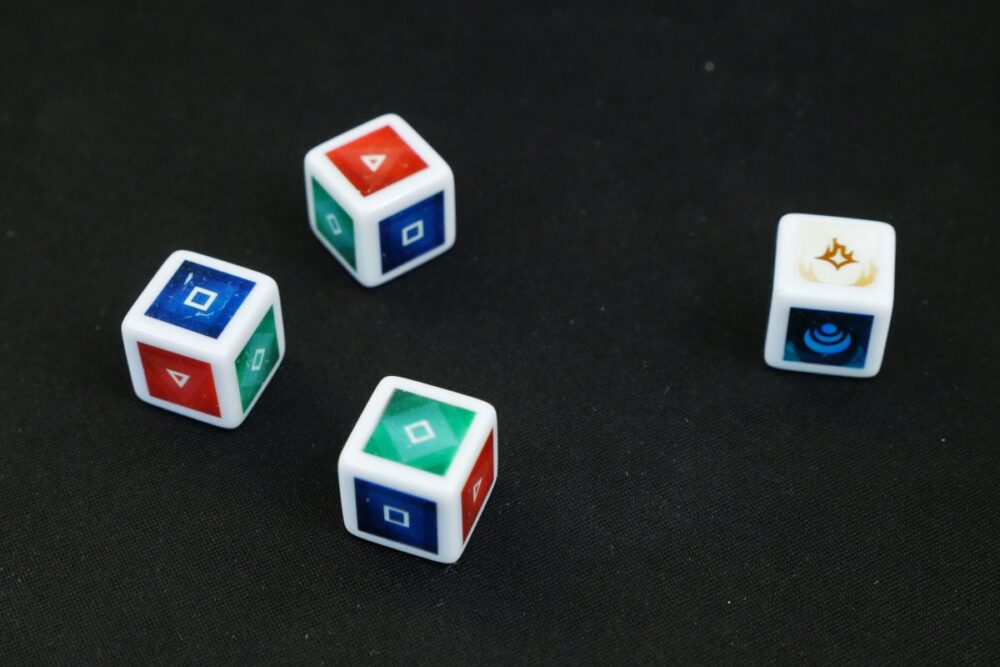
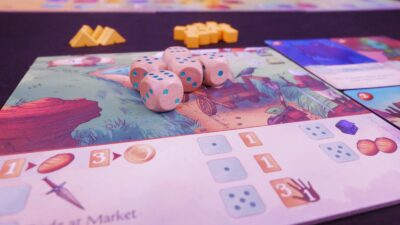
The Light/Dark Die has a 50/50 chance of success (meaning +1 progress to the challenge you're attempting), and the three Skill Dice each have a 1/3 chance of landing on the three colors (each matching color is also +1 progress). Do the math and you have an 87% chance of matching at least one success to your current challenge. So, imagine my frustration when I went seven turns in a row without a single die success, and it was still pretty early on in the delve. It crunched us hard for the rest of the game... and we ended up losing. Those early bad rolls can compound quickly.
Left: Skill Dice that each provide +1 progress if they match the color of the challenge you're attempting. / Right: Light/Dark Die that provides +1 progress if it lands on Light.
RNG can also bite in other ways. Some cards let you discard challenges, which is great for getting rid of unwanted Well cards. Imagine my surprise when I got rid of the Night Garden event, only for the next draw to be... another Night Garden. Burning a precious card for no benefit like that? Yeah, it stings. Or take the Consumed exhaust cards, which instantly end the game when the third Consumed is drawn. I once drew all three Consumed as my first three exhaust cards, halving the runway of my game through no fault of my own.
I like luck and risk management in games, but only when it generates interesting decisions. In Kinfire Delve, it almost always makes sense to bank on at least one success from the dice—the probabilities support it and there's no real decision to be made. And with the card draws, you have no influence over them. Bad luck there is punishing with no agency.
The Coolest Mechanism Is Underdeveloped
For all the thought and design that went into Kinfire Delve, I'm stunned by the lantern mechanism and how underdeveloped it is compared to everything else.
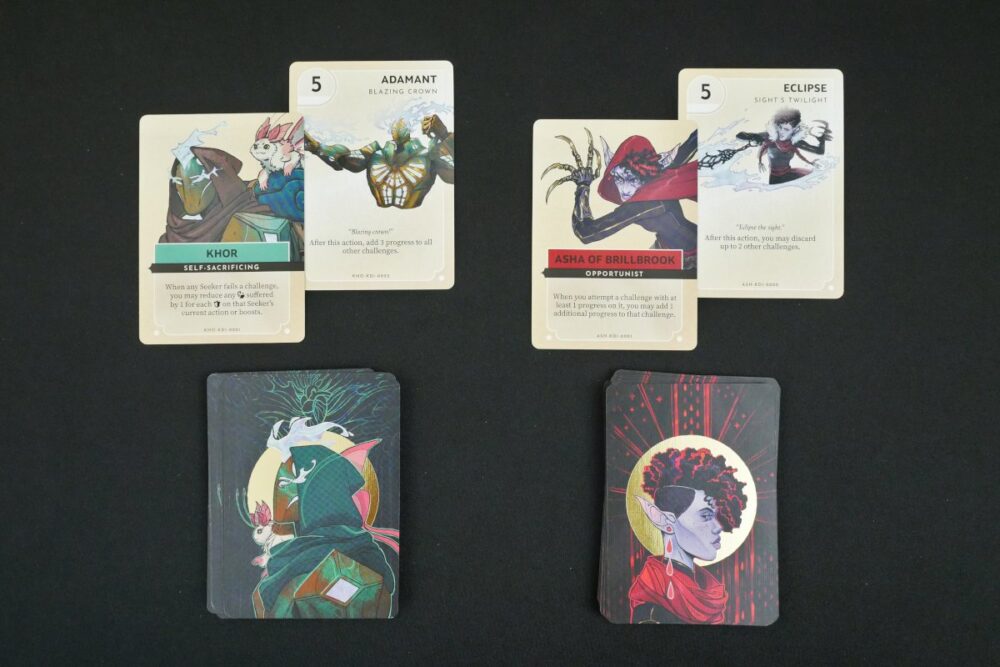
Every Seeker has a special "lantern" action card that's more powerful than any of the regular action cards. For example, Khor's Adamant adds 5 progress to a target challenge and 3 progress to all other challenges. Meanwhile, Asha's Eclipse adds 5 progress to a challenge and lets you discard up to 2 other challenges. These lanterns are so good, they help you claw yourself out of tight situations that might otherwise wreck you.
But lanterns start the game as "uncharged." You have to charge them before you can use them, and once used they go uncharged again. To charge, you have to defeat certain challenges that offer lantern charges as rewards. And guess what? You can go an entire delve without ever seeing one of those cards—or in my case, I went three straight games without seeing a single one.
What's the point of a character defining mechanism that may not show up for entire games? The lantern concept is fantastic, but it just doesn't come into play often enough to matter. An additional charging mechanism—one that's more reliable, frequent, and in the player's control—would've been a huge positive here. As-is, lanterns feel tacked-on. (Multiple lantern abilities would've also been great, but that might be asking too much.)
It's Not a Gateway Game
Kinfire Delve has simple bones, but that simplicity is muddied by all the card text. Almost every action card also has a text ability on it, like Khor's Kindness ("After this action, choose a Seeker to draw 2 cards") or Asha's Coup de Grâce ("+3 if attempting a challenge with at least 2 progress on it"). When you're staring at a hand of these cards, it can be tough—especially if it's your first time playing, and especially if you don't do well with text-heavy card games in general. It's worse if your memory is bad, as you'll constantly be scanning and re-scanning every card in hand to refresh yourself on what you can do.
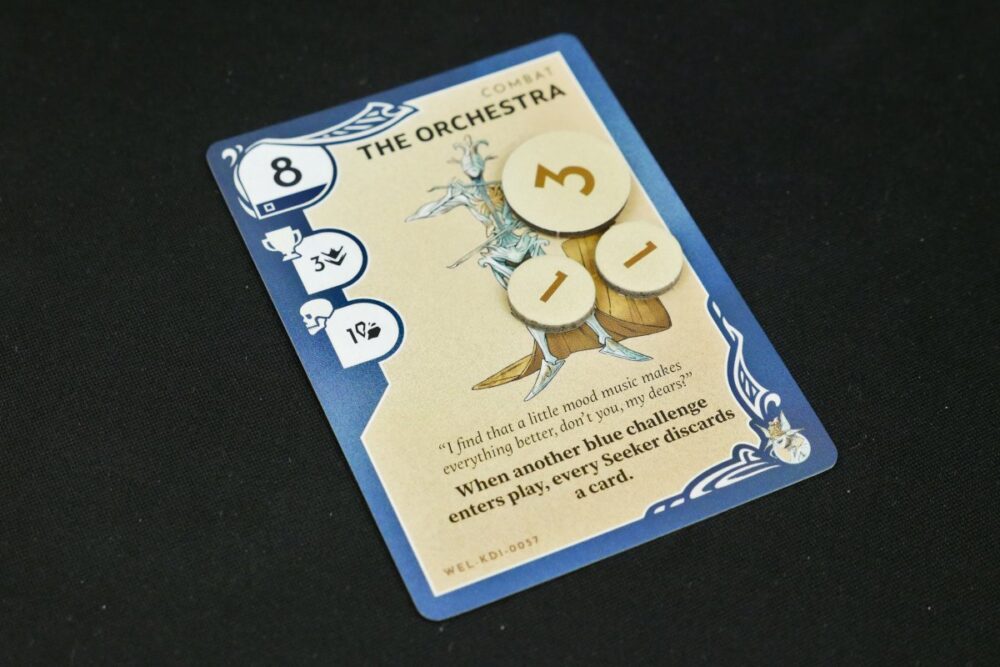
Nearly every challenge has card text, too. You can think of the text on challenges as temporary rule tweaks. For example, The Orchestra's text says "When another blue challenge enters play, every Seeker discards a card." That's a new rule you have to remember for as long as The Orchestra is in play. Another example is Beloved Voice, which says "If failed, remove 1 progress from each challenge in play, including this one." When there are multiple in play, it's easy to lose track and forget stuff.
Kinfire Delve is complicated enough that Incredible Dream had to put out an FAQ to address a bunch of edge cases and clarifications.
While any individual instance of card text is no problem on its own, it's when they all cross-interact that the structure loses clarity. Several times per game I find myself wondering "Hmm, how does this work?" because the card interactions have a lot of edge cases that aren't addressed in the rulebook. It's bad enough that Incredible Dream has had to publish (and then update) a Detailed Timing Breakdown FAQ that explains how each phase has a certain order of resolution when multiple cards collide (i.e., "Start of turn," "When you attempt," "Before this action," "When boosted," "Before rolling," "After this action," "End of turn," and more.)
All of this extra complexity precludes Kinfire Delve from being anything less than a game for hobbyists. It's certainly no gateway game.
Player Interaction
One thing Kinfire Delve gets very right is how it encourages cooperation and minimizes alpha gamer potential. You simply can't get down the Well by relying solely on your own cards while your partner does the same. The attempt-fail-penalty design of challenges means you can't whittle away at monsters, else you'll take on too much damage with each fail. You have to boost each other to hit vital successes and sidestep the worst penalties.
And that means communication. As the active player, you have to announce your intentions and ask questions: "If I attack the Hall of Memory, can you boost me at least 2?" As the support player, you have to make known what you can do: "I have a +3 boost with 2 shields if you're able to attack the Deadly Rose." (You can freely discuss what's in your hand—colors, numbers, or specific card effects—but you can't physically show your cards.) I like that back-and-forth with my partner, and it really feels like solving a puzzle together.
Whoever's the active player gets final say in what they play. No one can quarterback each other, yet you have to talk and work together in order to optimize the puzzle. That's the bullseye in cooperative design, and not a lot of cooperative games hit that mark like Kinfire Delve does.
Solo Mode
Going into solo mode, I was worried—that it'd be too tight, too claustrophobic, too difficult. With only 8 cards in hand and having to burn my own cards to boost my own actions, I thought I'd constantly be running out of cards and exhausting myself long before making it down the Well.
But as it turns out, when you're the only Seeker, you get to have all those exhausts to yourself—you don't have to share them with a partner. Kinfire Delve is a more deck-churny game when solo, where you have perfect knowledge of all cards at hand and the ability to plan your moves several turns ahead, unimpeded by the fog of war that hangs between you in 2p. For example, when you draw Khor's Tireless ("If played as the last card in your hand, draw a new hand of cards without gaining an exhaust"), you can mold your entire strategy around that as your last-played card. You're in greater control when alone.
But without a partner, Kinfire Delve loses much of its soul. Working together and overcoming that fog is what makes the delve worthwhile. Alone, you're just tossing cards, rolling dice, and getting pummeled by a relentless attrition puzzle that's more tiresome than it is exciting. In the end, slowly bleeding to death isn't as fun without someone sharing in the misery.
Replayability
On paper, Kinfire Delve promises endless replayability—but that replayability only holds up depending on what you're looking for. If the attrition-optimization puzzle is your main draw, and if you don't mind a game that does its best to wear you down and grind you into dust as you sacrifice your limited hand of cards, then this game offers near-infinite puzzles to solve via its randomized Well deck, even though each puzzle asks the same thing.
Meanwhile, if you're in it for a fresh dungeon-delving adventure that offers a variety of different experiences, you won't find it here. The delving puzzle is essentially the same every time, and there are effectively two different puzzles in one box: one as Asha and one as Khor. You'll see an entire Seeker's deck in one playthrough, so there's nothing new to discover on repeat plays.
As for the Well deck, even though you only see about a quarter to a third of it on any given playthrough, the decision space is remarkably samey. Whether you're up against a Marionette or Unicorn, the actual card play, dice rolls, and making opportunity cost bets is repetitive turn to turn. The only thing that truly feels different on a repeat play is the Master, which comes in three flavors with each flavor having its own unique mechanisms—but even then, it's only at the very end of a delve, and only three possible options.
The novelty of Kinfire Delve stales fast. You can extend it by grabbing the other Kinfire Delve boxes, but that extension will be finite.
Components and Setup
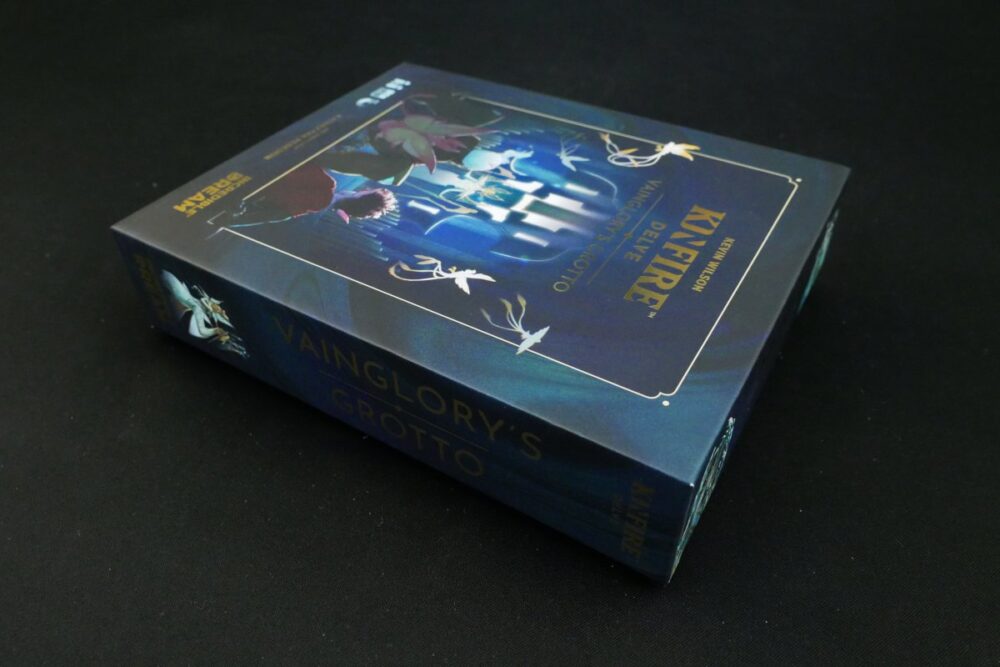
The absolute most striking thing about Kinfire Delve is its immaculate presentation. If ever there was a 10-out-of-10 board game on production, it's this one. Right from the get-go, your eyes and hands are treated to a gorgeous box design that's wholly its own—compact yet hefty, with gold-foil lettering, and a lid that stops just short of the full box height. The whole package screams premium, and the inside is just as good.
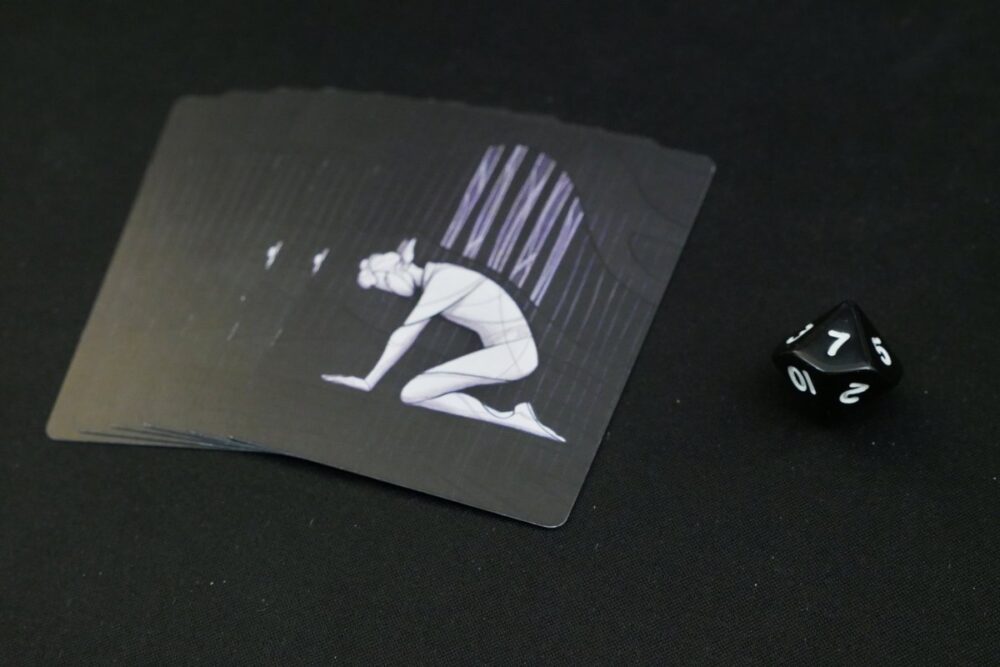
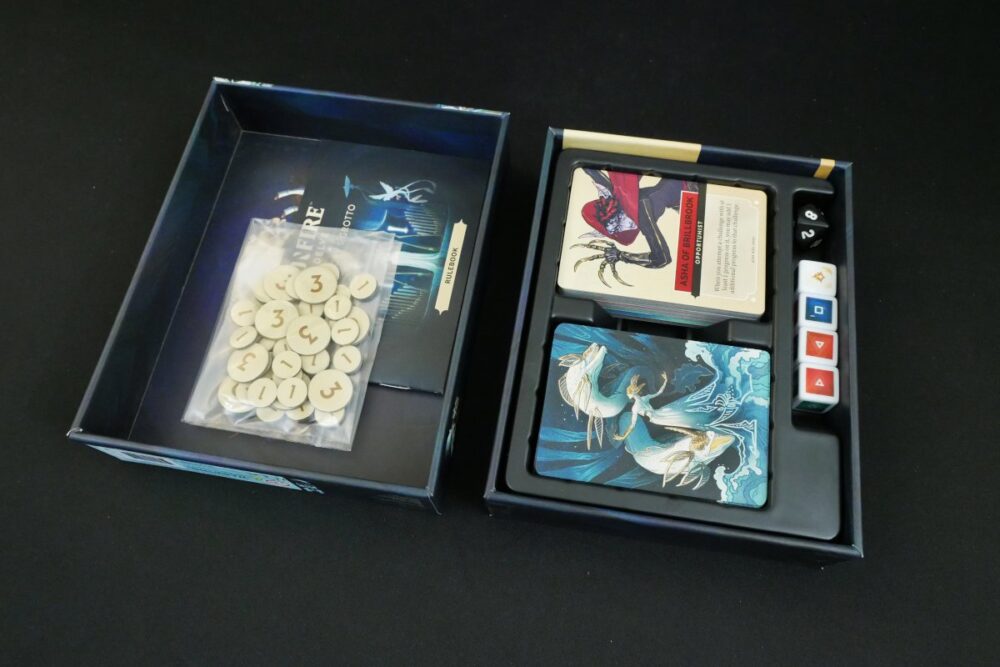
The plastic insert is robust with no wasted space: two wells for the cards, plus a separate trough for the dice, and a baggie for the progress tokens. More impressive are the cards themselves. Every single card is a work of art that feels straight out of a high-tier graphic novel, with a boldly vivid color palette, an intuitive graphic design that just makes sense, and fonts that are candy to the eyes. (Every Seeker card even has a gold-foil design on its back.) And the custom dice, while screen-printed, look great and feel great to roll.
I also appreciate that it sets up fast and fits on a small surface, no doubt thanks to that practical insert. You pick your Seekers, shuffle your decks, shuffle the Well deck, and set aside the Master and exhaust cards. You draw up and you're ready to go within minutes. And on my 3-by-3-foot playing table, we only need half the playing space—a bit of personal space for our Seeker piles, plus a central area for the Well and supply.
Is any of this necessary? Absolutely not. Does it elevate the experience? You bet it does. If you've ever opened a package from Apple or Bose versus a cheapo foreign accessory off Amazon, you know how much of a difference that initial impression can make. I can confidently say I've never seen another board game that beats Kinfire Delve in presentation quality.
The Bottom Line
Kinfire Delve has an enormous wow factor—it's easily the best-produced board game I've ever handled. Any collector should get the whole Kinfire Delve trilogy on the basis of its artistry alone. But production can't fix design, and this is a punishing attrition game at its core. If your idea of fun is squeezing value out of a shrinking hand while soaking up bad luck, it delivers; if you're here for a fun dungeon-delving adventure, it's a twice-and-done experience. It's ultimately too stressful for me, and I'll be culling it from my shelf.