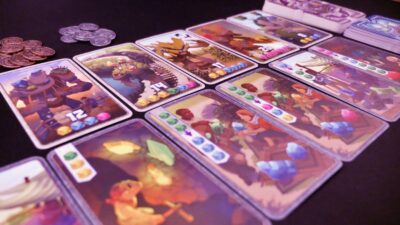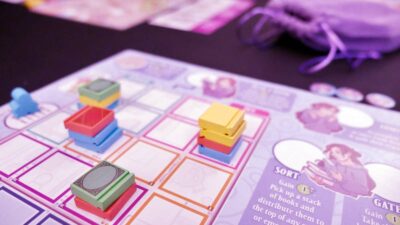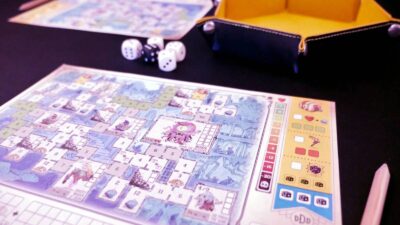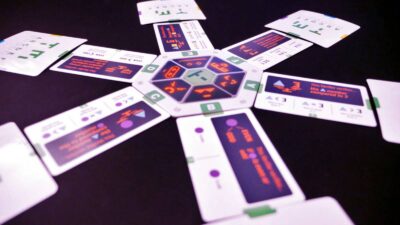

It's always fun when a board game proves me wrong. I was skeptical of the "auto battler" genre when it exploded in popularity across PC and mobile games, and I was just as skeptical of it when it came to board games. I just didn't think an auto battler could stay interesting after the novelty wore off—and Tag Team served me some humble pie.
I played it 15 times the very weekend I got it, and I'm still itching to play more. Who knew a game so simple could be so interesting? Here's everything you need to know about how Tag Team plays, what gives it the magic sauce of success, and why it's a solid add to any board game collection.
This review is based on a review copy of Tag Team provided by Hachette Boardgames, but my thoughts and opinions are my own.
Overview
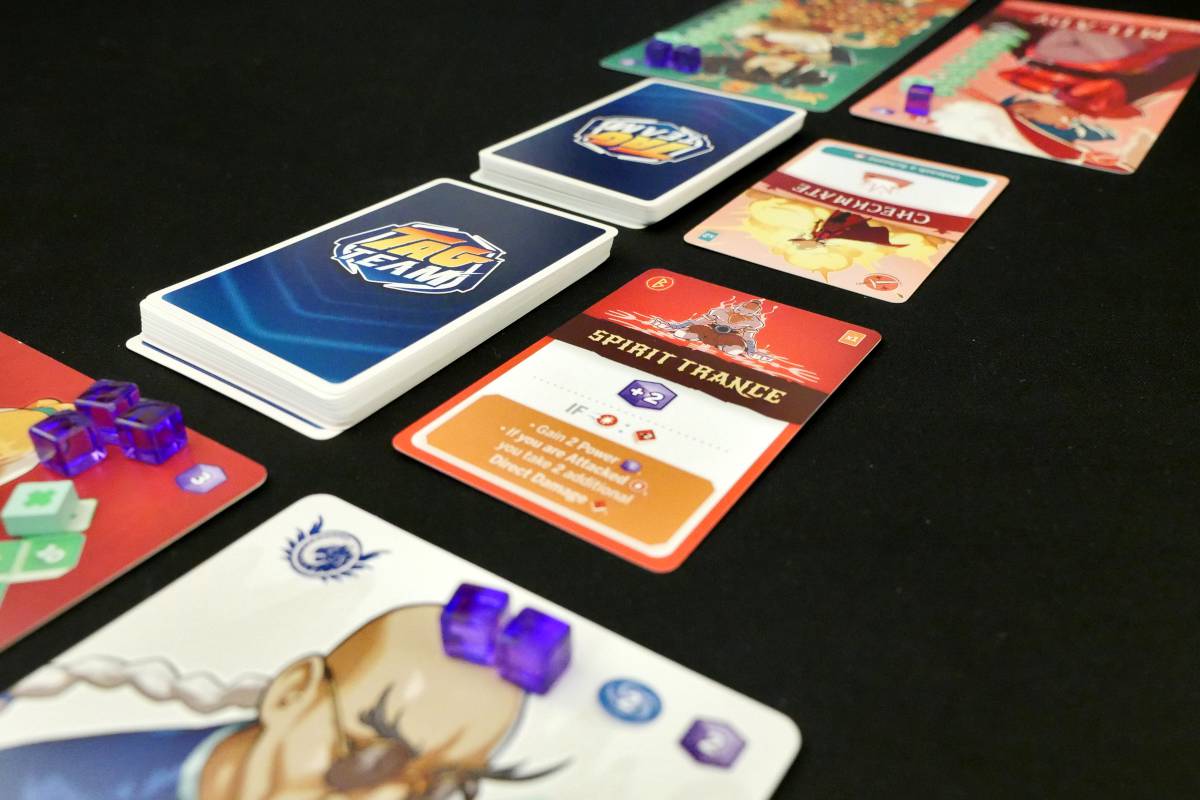
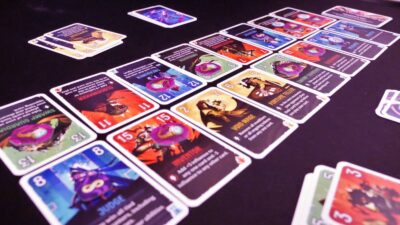
Tag Team is a 2-player deckbuilder where each player starts with a 2-card deck and progressively adds 1 more card to their deck every round. But every time you add a card to your deck, you then "auto battle" your deck against your opponent's deck—that means flipping your top cards, resolving their effects, flipping again, resolving again, and repeating until your decks run out. It's like the War card game, except you're in control of your deck.
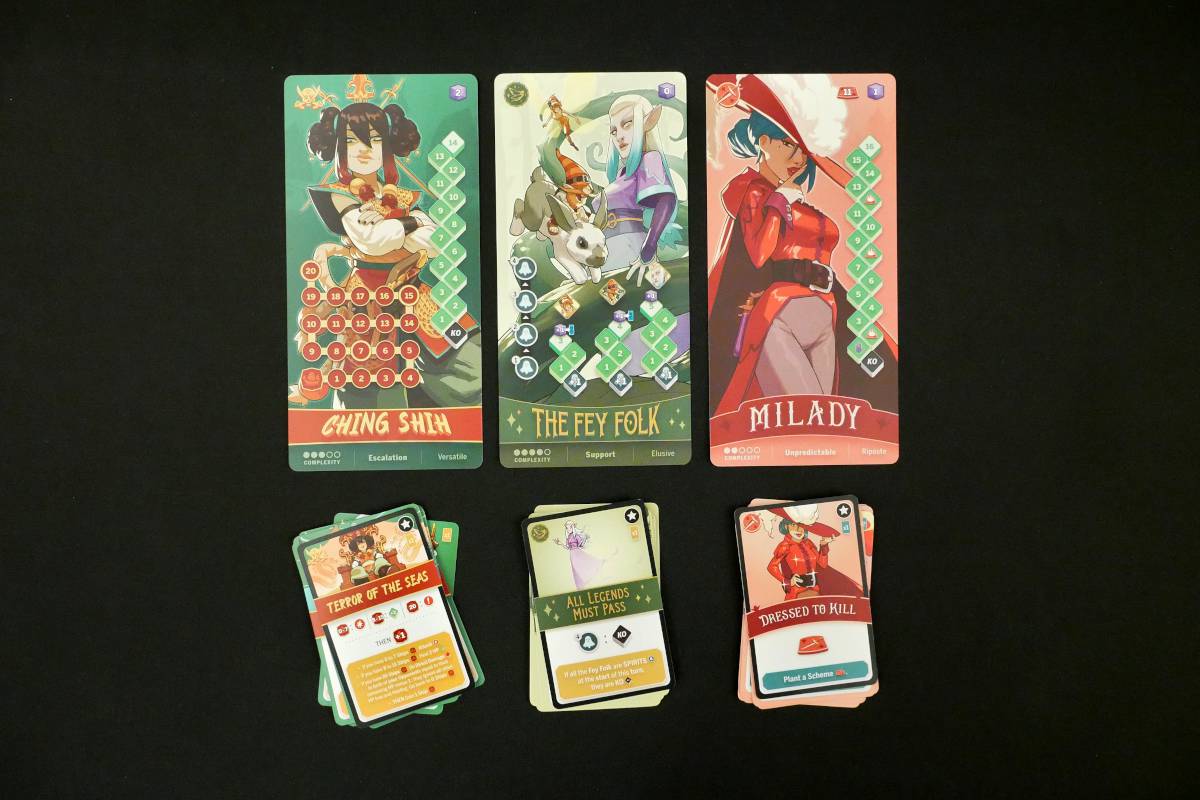
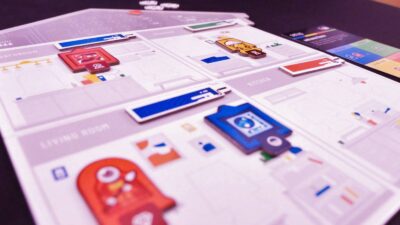
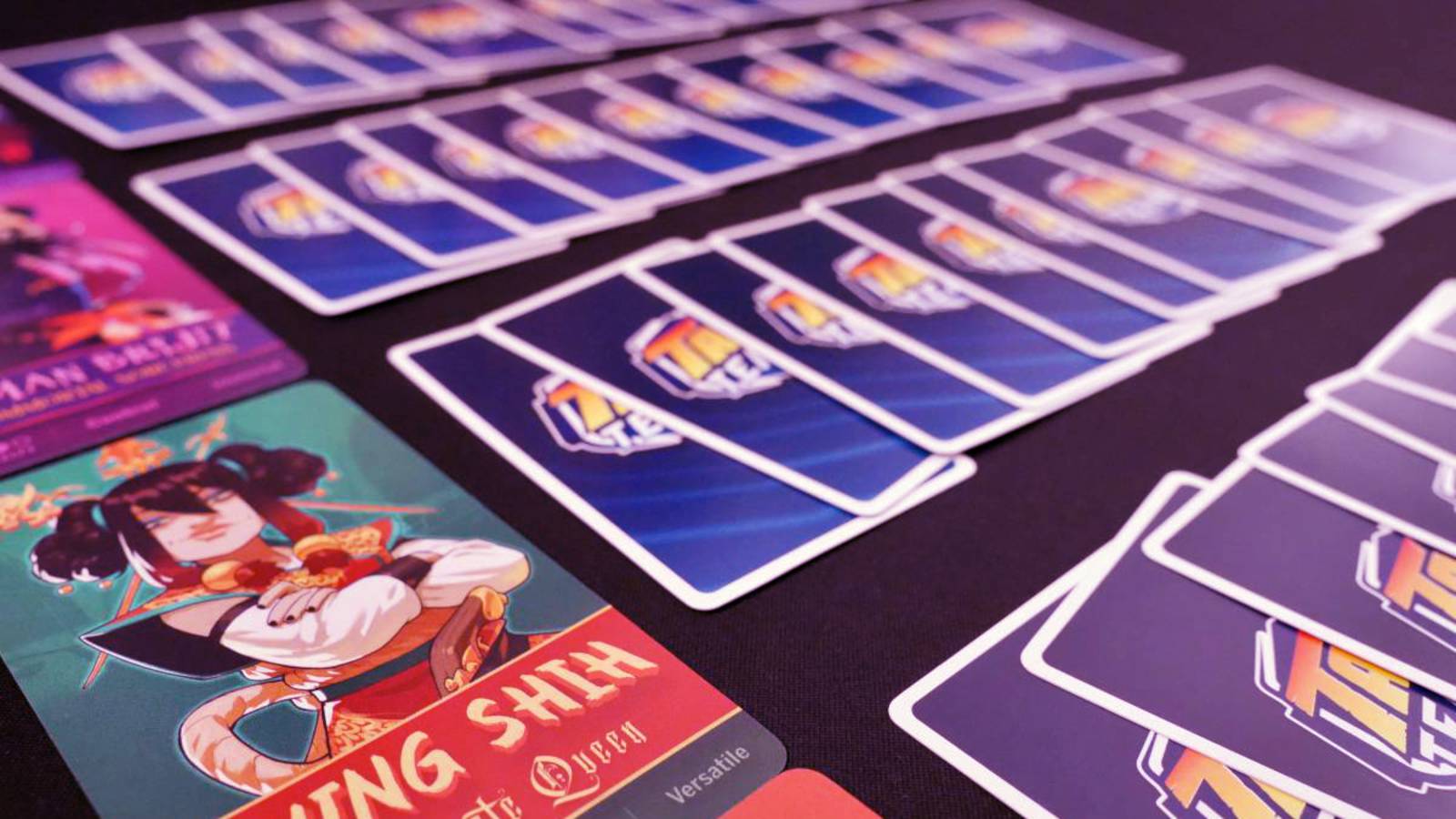
Tag Team comes with 12 unique Fighter decks, with each Fighter deck consisting of 10 cards. (That's a total of 120 cards.) Each Fighter also comes with a Fighter board, which you use to track its health, power, and any Fighter-specific mechanisms. Every Fighter is unique with its own play style, and those minor differences make a big difference in gameplay.
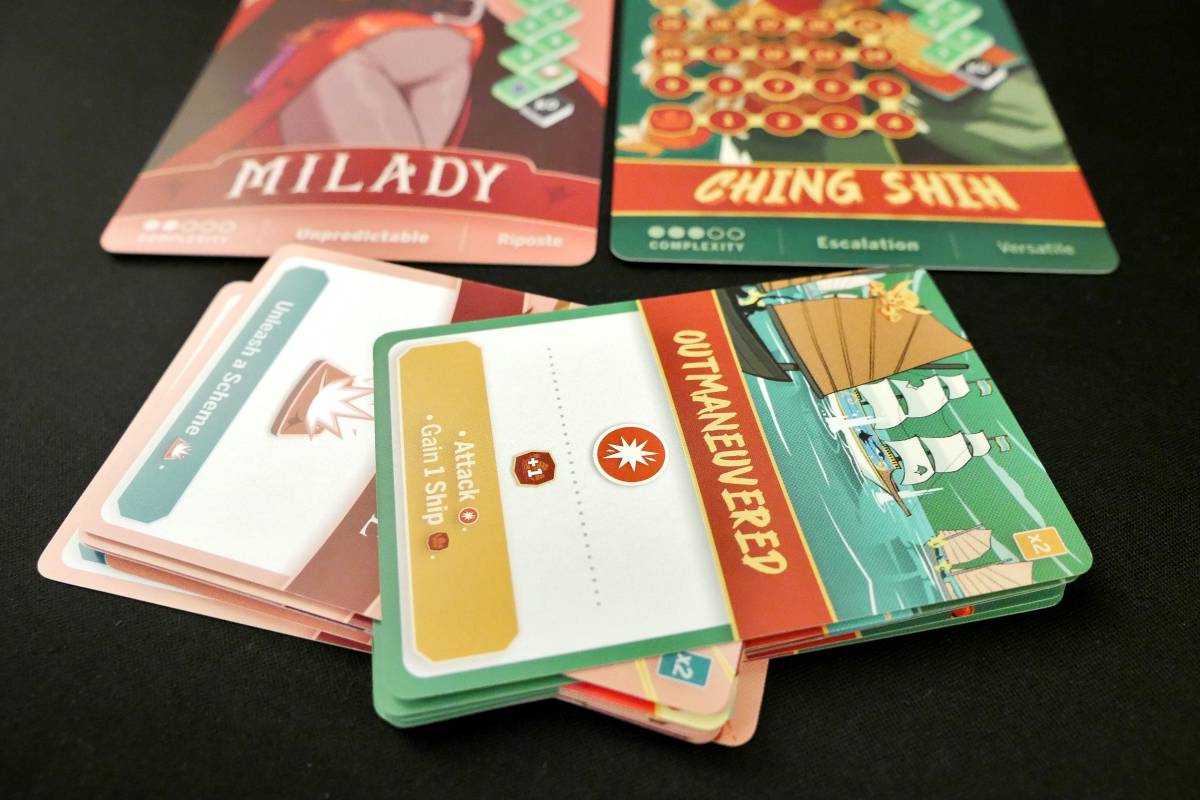
But the twist in Tag Team, as you might surmise from its name, is that you combine two Fighter decks into one. That means you have two Fighter boards, each tracking its respective Fighter's condition, and you're building a play deck that represents the actions taken by your Fighters.
Technically, Tag Team says you're supposed to conduct a draft to determine your team: each player is dealt Draft cards that represent half the Fighters, choose one Fighter, then swap the remaining Draft cards and choose a second Fighter. But you can skip this. Feel free to just choose whichever two Fighters you want. Who's going to stop you?
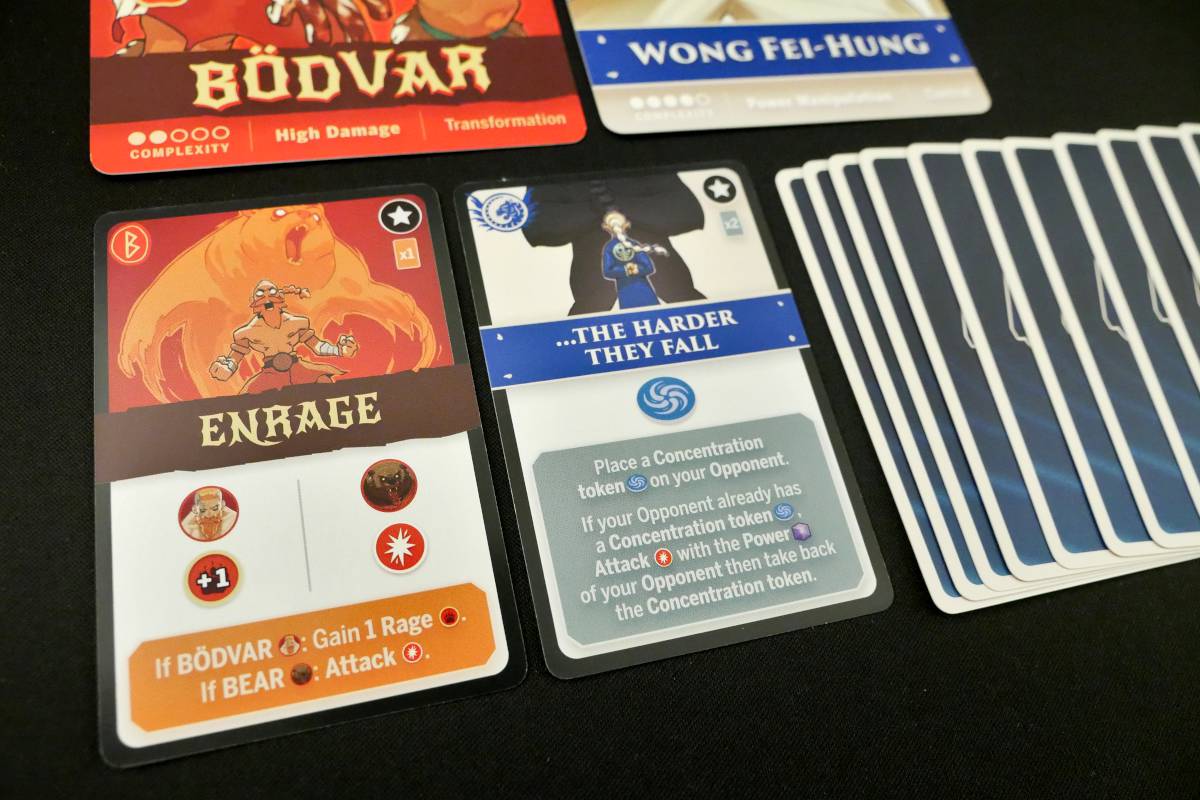
Each Fighter has a starting card, which seeds your initial 2-card play deck. The remaining 18 cards (9 per Fighter) are shuffled together to form your draw deck. Over the course of the game, you'll be drawing from your draw deck and adding to your play deck.
For example, if I choose to play as Bodvar and Wong Fei-Hung, I'll have a starting 2-card deck that consists of Bodvar's starting card and Wong Fei-Hung's starting card. Then, every round, I'll be drawing from my combined Bodvar/Wong Fei-Hung draw deck and adding 1 card to my play deck. Over time, my play deck will consist of both Bodvar and Wong Fei-Hung cards.
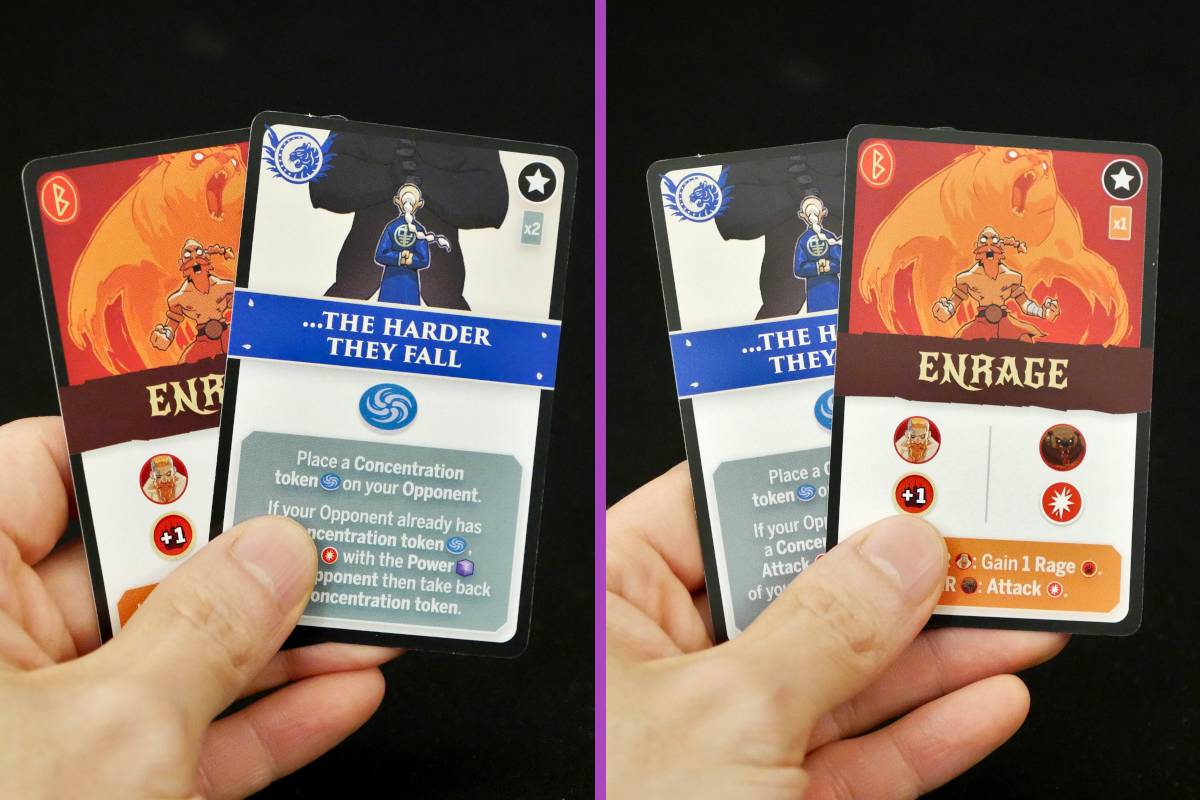
You get to decide the order of your initial 2-card play deck. Keeping to the previous example, I get to determine the order of Bodvar's starting card and Wong Fei-Hung's starting card in my play deck. This is the order they'll come out when I auto-battle my play deck against my opponent.
But once the order is decided, it's locked in forever. The order of your play deck can never be modified. You'll be able to add cards, but you won't be able to move cards around—so be careful when building your play deck.
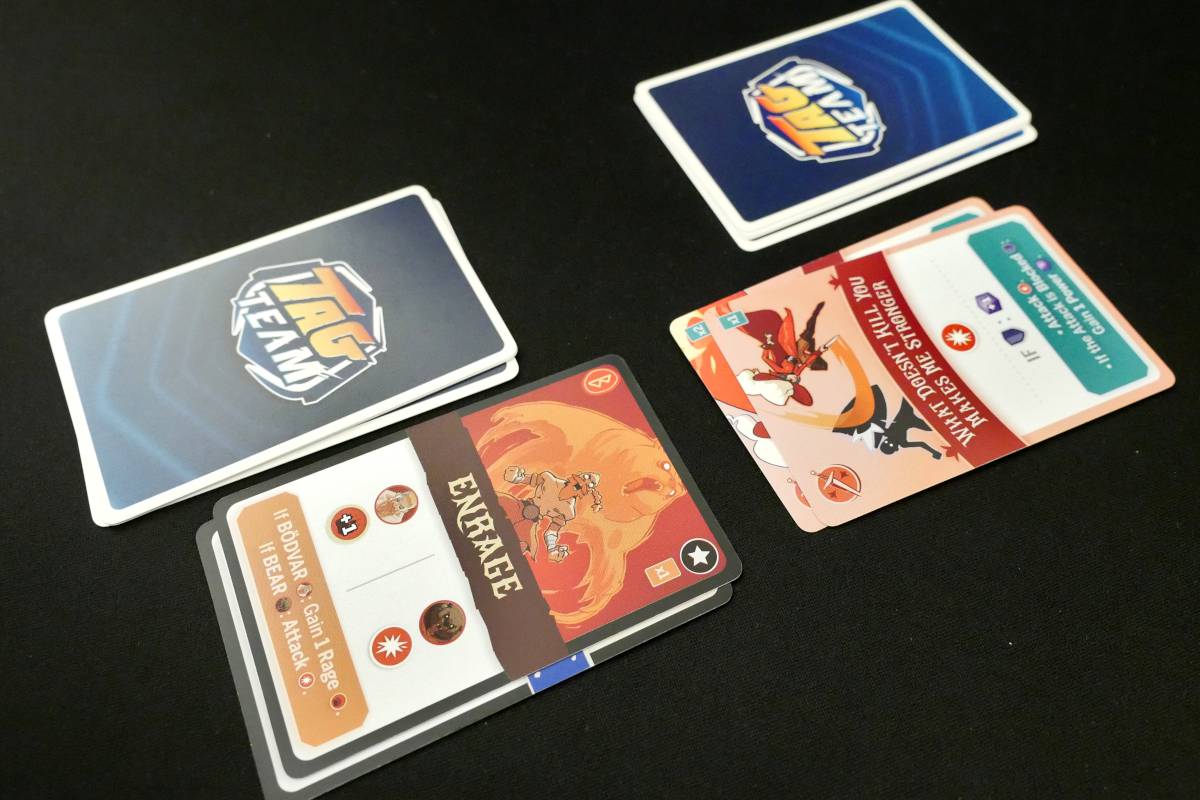
When you auto battle, your Fighters act independently. Every time you flip your play deck's top card against your opponent's top card, the Fighter on your card is acting against the Fighter on your opponent's card. All damage and effects are resolved between those two Fighters.
For example, suppose I flip my top card and it's Bodvar's Berserk! card against your top card, which is Joan's Hand of the Righteous. That means this particular encounter is between Bodvar and Joan, with Bodvar dealing damage to Joan and Joan dealing damage to Bodvar. When we flip again, the next encounter might be between Wong Fei-Hung and Joan.
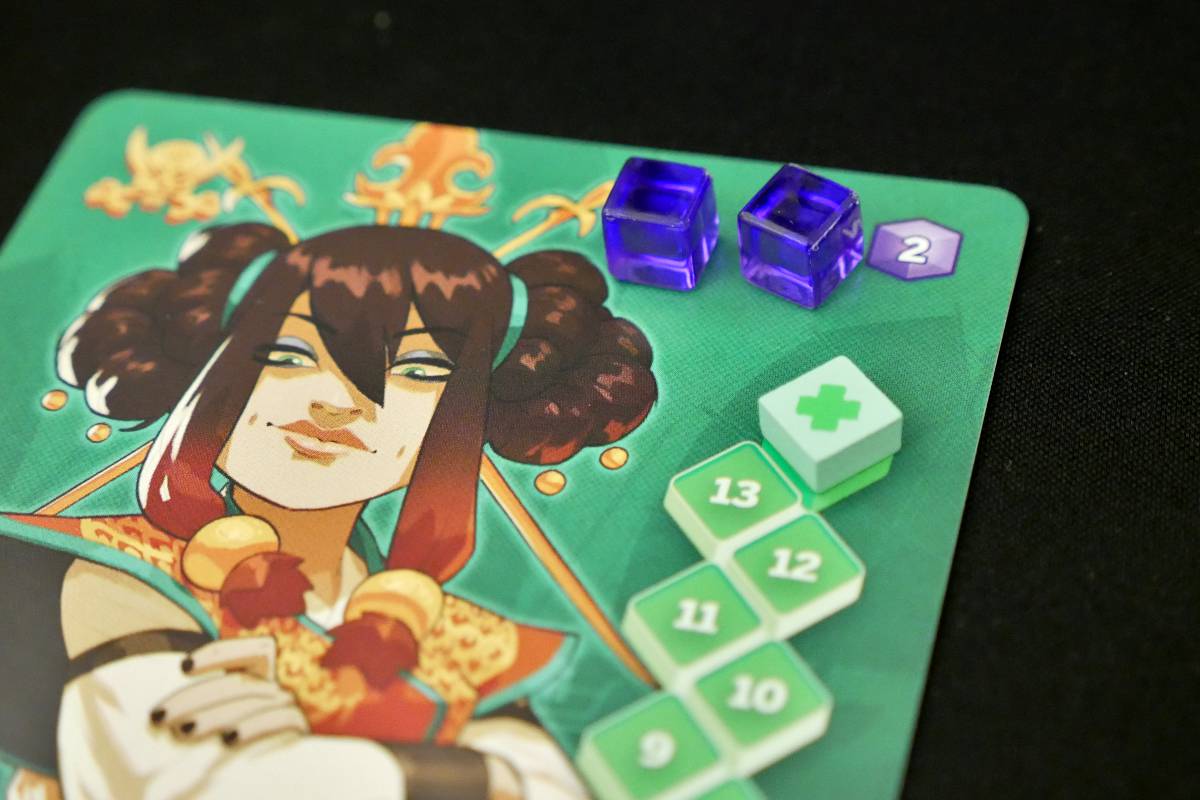
In addition to health, each Fighter has a fluid amount of Power. Power is represented as cubes on the Fighter's board, and Power represents how much damage the Fighter inflicts when attacking. Power can be gained or lost over the course of the game in various ways.
These Fighter-versus-Fighter encounters are where all of the magic happens, and that's because all of the different Fighter cards have various effects that influence how the overall 2v2 fight progresses.
I don't want to run through every possible effect, but here are some of the most common and important ones:
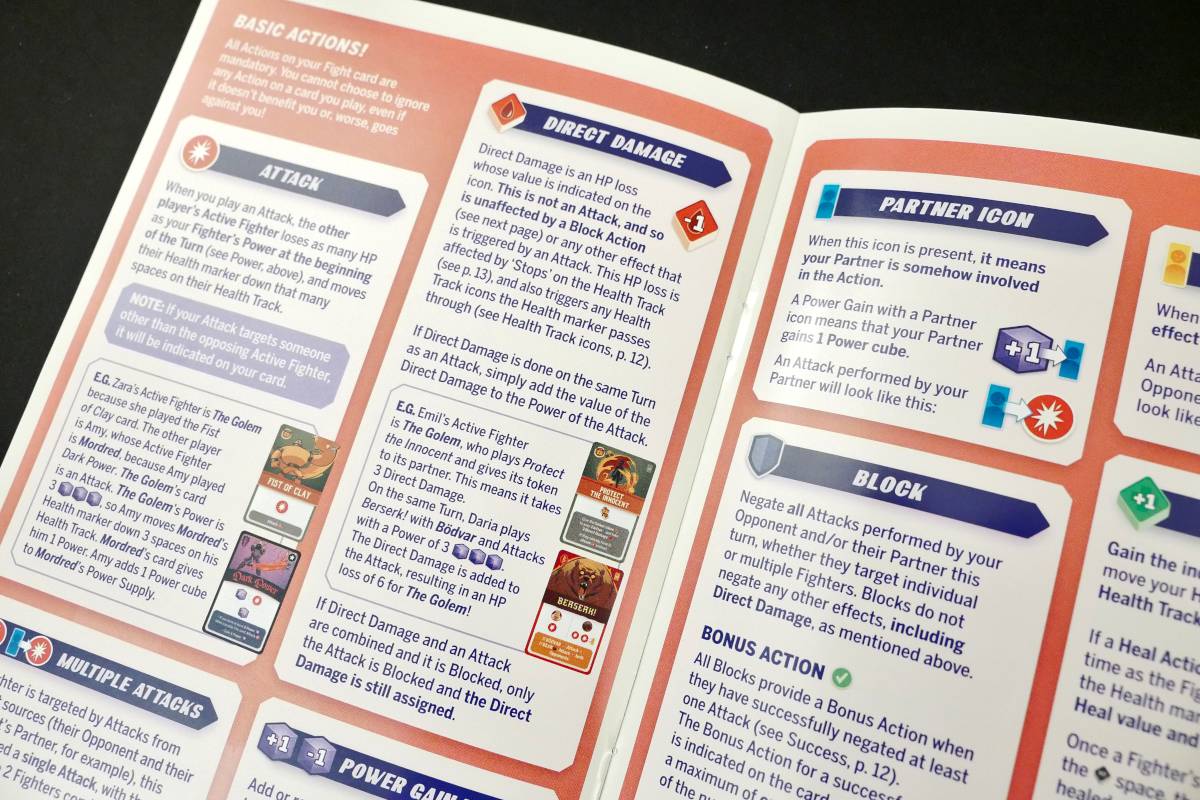
- Attack: The Fighter deals damage to its Opponent in the encounter.
- Multiple Attack: The Fighter deals damage to the Opponent's Partner. (Yes, a Fighter can get hurt even when they aren't the one who shows up in a particular top-card-flipped encounter!)
- Power Gain/Loss: Add or remove Power cubes from the Fighter. Some cards also allow Power cubes to be transferred between Fighters.
- Block: In the Fighter's current encounter, if the Opponent's card has an Attack effect, it gets negated. When an Attack is successfully Blocked, the Fighter might also gain a special bonus effect.
- Heal: Move the Fighter's health tracker up.
- Cancel: Completely cancel the Opponent's entire card.
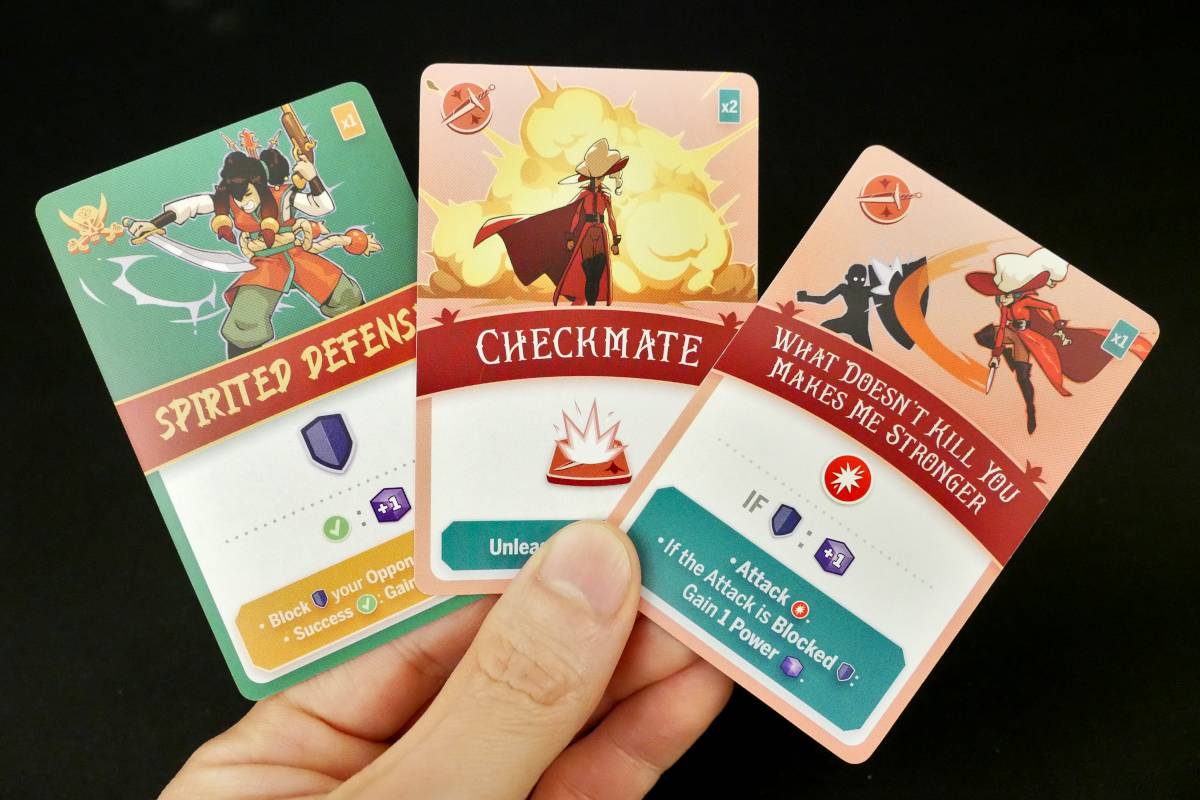
After the Fight phase (which is all the auto battling described above), it's time for the Build phase. You draw 3 cards from your draw deck, then select 1 card to add to your play deck. The other 2 unselected cards are placed back at the bottom of your draw deck.
When adding the card to your play deck, you can insert it anywhere you want—on top, on bottom, or between any two cards. But remember, you can't reorder your play deck! The existing order of cards is locked in, and once you insert a new card, that card's order in the deck is also locked in.
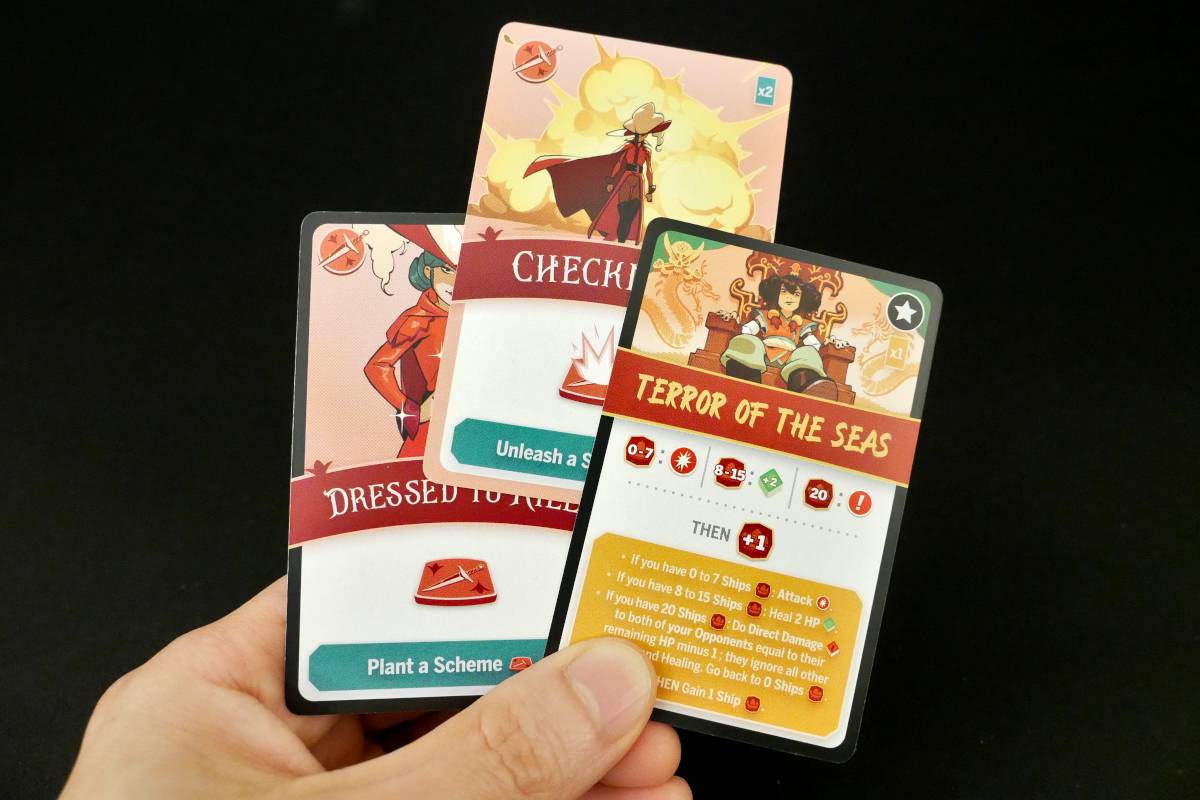
When both players are done with the Build phase, it's time to run the Fight phase again and perform another auto battle—except this time the outcome might be totally different because of the newly inserted cards.
Tag Team has a few other minor mechanisms that add layers of depth to combat, such as the bonuses along certain Fighters' health tracks. Every time a Fighter's health drops below or raises above these special bonus points, it gains whatever bonus is shown. Health tracks can also have Stop points, which immediately stop the health tracker's movement, regardless of whether it's moving up or down the track.
The cycle of Fight phase and Build phase repeats indefinitely until one Fighter is Knocked Out (health drops to zero), which means that player loses.
Setup and Table Footprint
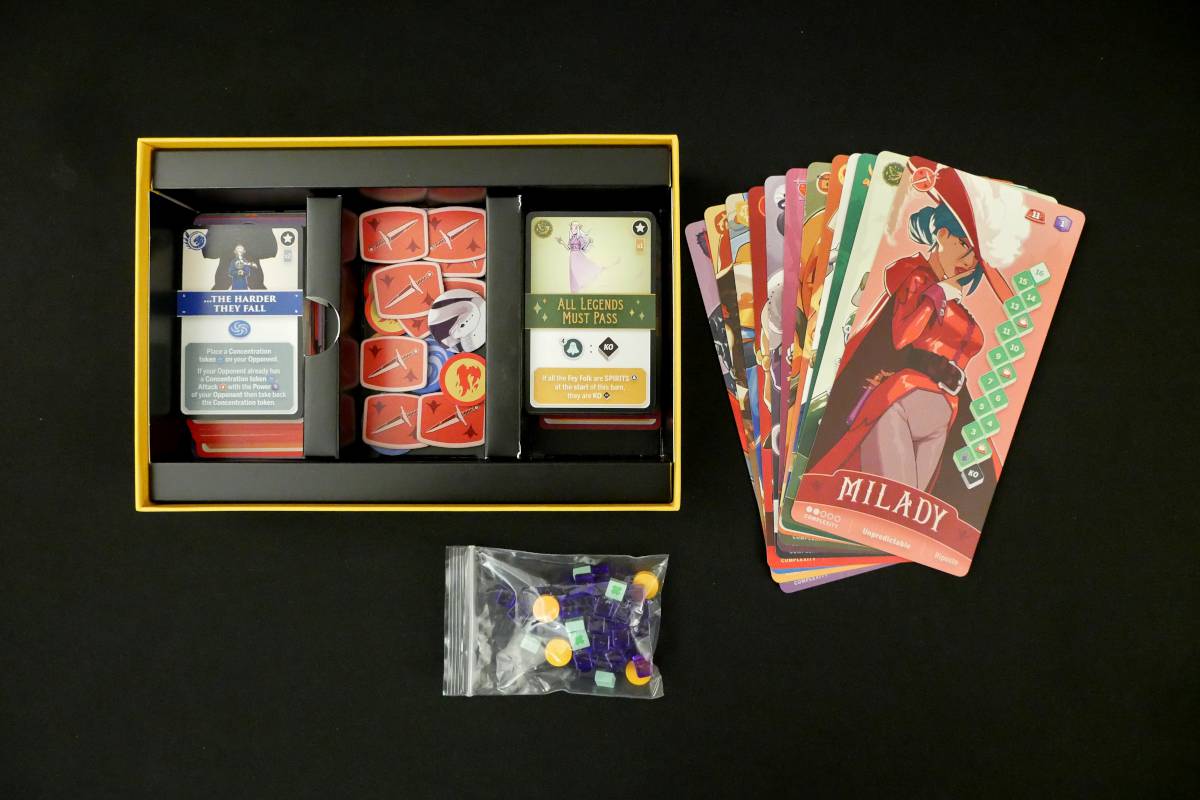
Tag Team is a relative breeze to set up, with just a little bit of deck searching and component retrieval. Once you and your opponent pick your Fighters—whether via draft or however else—you have to find each Fighter's individual deck, then shuffle your two Fighters' decks together. Depending on your team, you also have to get each Fighter's special pieces (like the Scheme tokens for Milady). Lastly, get your Health tokens and set aside the Power cubes, ideally in something like a token tray.
All in all, it takes about 3-5 minutes to set up a matchup from scratch. Most of that time is spent finding the decks and shuffling them together. If you do an exact rematch, it takes about 1 minute to reset; otherwise, it takes about 3-5 minutes to pack away your Fighters, pull out other ones, shuffle, etc.
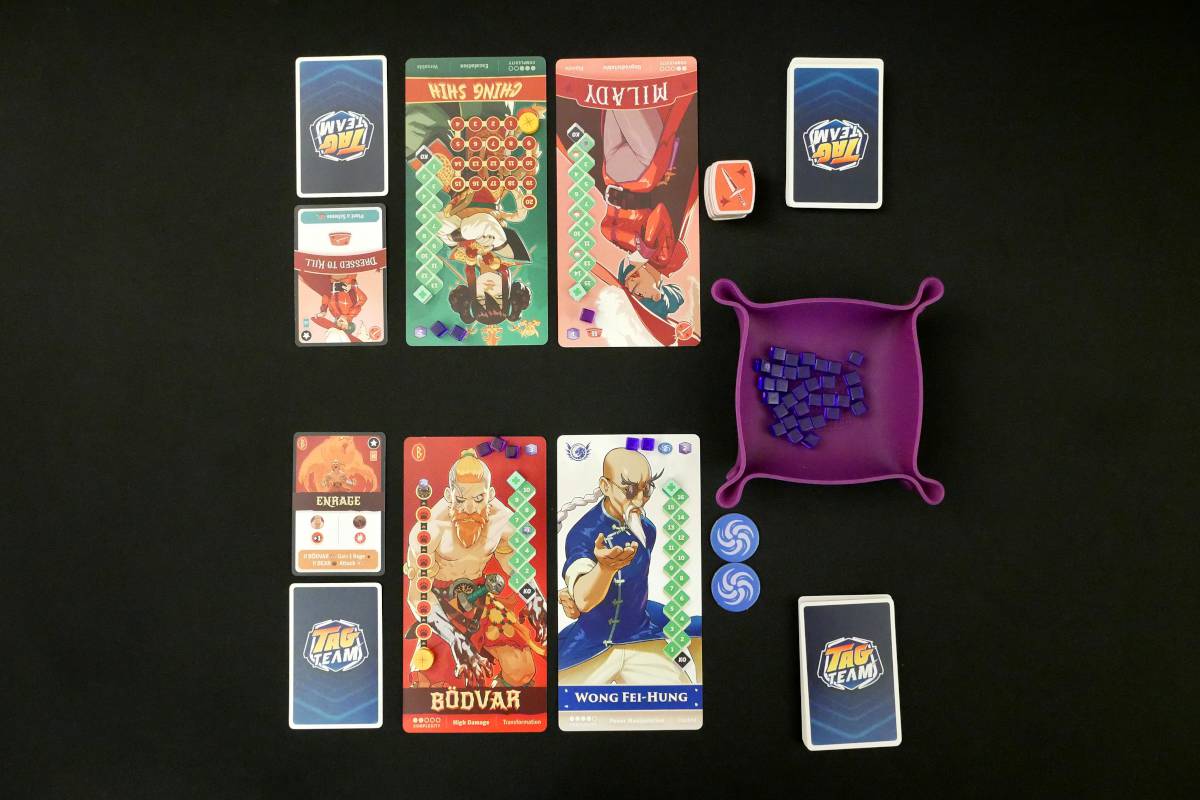
I love that Tag Team is such a compact experience, not just in gameplay but also in table space requirement. Each player just needs a bit of space for their two Fighter boards and personal deck, then a little more space for a shared area where you can run the auto battle. It's not like you can play on the couch or anything, but you'll have no trouble on any reasonable surface.
Learning Curve
While Tag Team is pretty simple and straightforward, it does have a learning curve. It's one of those games where the first few plays will take twice as long because it needs to click, but once it does, it's smooth sailing—and it's also one of those games where you need to learn the game as well as the individual Fighters. Each Fighter has their own unique mechanisms, with some more complex than others.
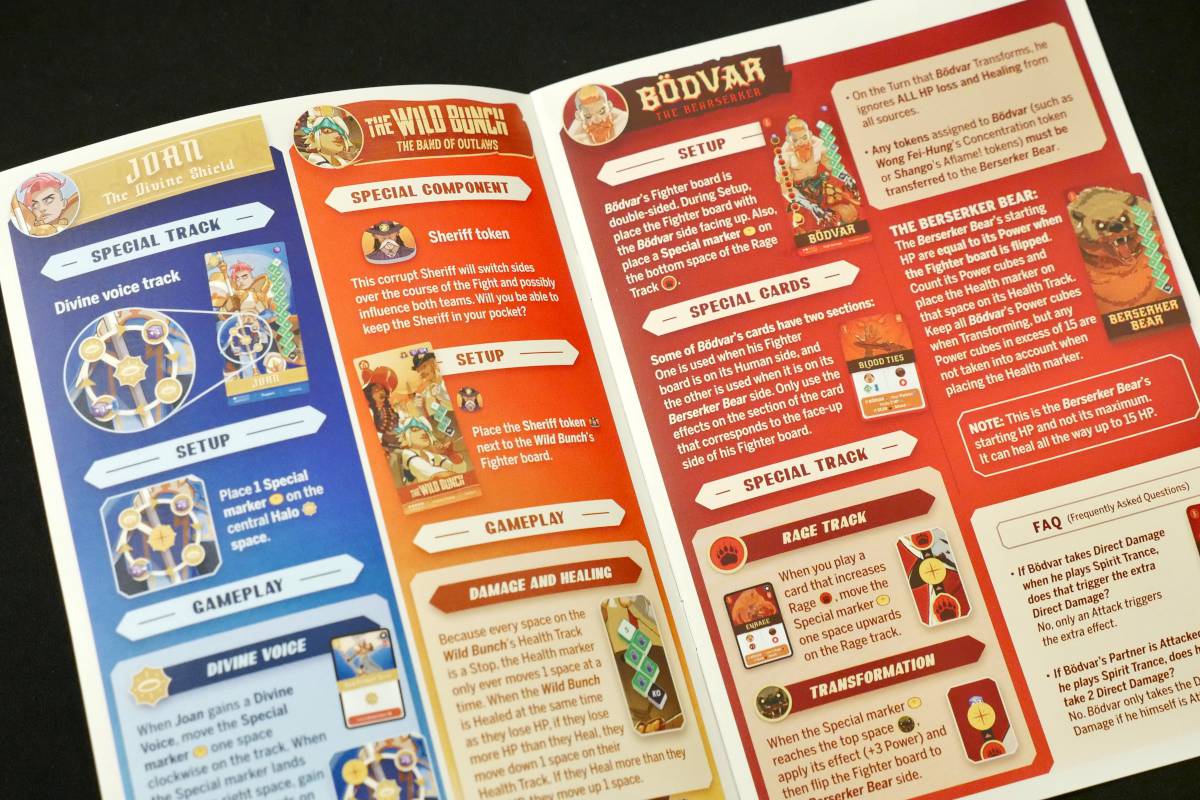
All that said, even the most complicated Fighters are still pretty straightforward, and they all intuitively fit into Tag Team's basic auto battling framework. Once you grasp the core gameplay, every Fighter is easy to pick up—and the Fighters' Guide has nifty FAQs for each one that explain how they work and how to deal with edge cases and ambiguities.
In short, Tag Team demands a small bit of mental investment but the payoff is totally worth it. It's certainly simple enough for any level of gamer to dive into, but even some non-gamers should be able to handle it, too.
Game Experience
Decision Space
Tag Team is an auto battler, so you have to set your expectations before diving into it. Yes, it's true that this game "plays itself" while you sit back and watch, but I wouldn't call it a shallow game! Rather, Tag Team is the accumulation of lots and lots of micro decisions, each one seemingly insignificant but part of a bigger whole, like a snowflake within a snowball.
Let's explore some of these micro decisions to be made in Tag Team.
Which two Fighters am I going to combine together?
Every Fighter has its own approach to combat, ranging from heavy direct attacks to wily attrition-based abilities to debilitating control schemes. Some are better doing their own thing while others are more support-oriented, able to empower their partners to do more than usual.
This means your team composition could be the most important decision you make. Does Mephisto synergize well with Mordred? Or would you be better off partnered with The Golem? Will your strategies and tactics get in the way of each other, or will they amplify one another? Learning the play styles of every Fighter and how they complement and clash is part of the fun.
And if you're doing the draft (as recommended in Tag Team's rulebook), then there's an extra layer to this. You'll have to draft your first Fighter from one half of the roster, then your second Fighter from the other half—paying attention to what's available will inform your possible team combos.
Which card am I going to add to my play deck?
During the Build phase, you get to draw three cards and choose one to add to your play deck. This is the "main" decision in Tag Team, made repeatedly after every auto battle—and it isn't as simple as it may seem at first.
The key factor to consider is, obviously, the card effects. Is your strategy to wear down your Opponents with frequent small-scale Attacks? Or use Golem to endure several rounds of hits while you power up Mordred's super-strong Attack? Or try to score an insta-win with a five-stack of Shango's Aflame tokens? Or overwhelm the other player with Milady's Schemes? You have two Fighters in your play deck, but you have to draft the right balance of cards per your strategy. And with only three cards to choose from, you may have to adapt your strategy depending on what's available.
Also, every card has an indicator at the top right that shows how many copies of that card exist, with most having two or three copies but some only having one copy. If you draw such a card and skip adding it, you may not get another chance to add it. Meanwhile, skipping a common card might be fine—or you might want to load up on them.
Meanwhile, you also have to consider this: the more cards you add of a specific Fighter, the more vulnerable that Fighter becomes. After all, every time that Fighter flips during battle, they're probably taking damage! So, yes, you could go all-in with a single Fighter to wreak havoc, but they're also going to be pummeled every round. Will they live long enough to win? Should you balance your deck instead? I don't know!
Where am I going to place that card in my play deck?
Since your play deck can never be reordered, it's important to be smart about where you insert your new cards. One mistake can ruin your upcoming auto battles and turn the tides against you.
For starters, you want your existing play deck to unfold well and play nicely with itself. Earlier cards can set up later cards, allowing you to set up combos and prepare devastating attacks. Buffs and debuffs at the top of the play deck can strengthen the impact of cards lower in the play deck, and the right sequence can result in some big plays. That's as much true for a single Fighter as it is for your two Fighters synergizing together.
But card placement is also about shifting (or maintaining) the matchups between your play deck and your opponent's play deck. Want your powered-up Mordred attack to land against your opponent's near-death Joan? Maybe you slip your next card into third slot, which moves your Mordred attack into fourth slot, pitting it against the Joan card you saw in the fourth slot of your opponent's deck last round. That could be a game-winning shot!
What was the order of my opponent's play deck?
Yup, there's a memory element to Tag Team. With every auto battle, you get to see your opponent's entire play deck in action—and you better remember what you see because that'll inform your deckbuilding decision in the next Build phase. Whether you're matching up a Block action against an Opponent's Attack action, or trying to Attack a specific enemy Fighter, or realigning an action sequence that went out of sync, you need to know what your opponent's play deck looks like.
But would I call Tag Team a memory game? No, I don't think so. It's only one aspect of the overall game, and you could potentially win without ever memorizing your opponent's card order. Even so, my favorite thing about Tag Team is that you're constantly re-encountering your opponent's entire deck every single round. Forgot what their second card was? You'll get to see it again in the next battle. Plus, you can focus on memorizing a single card or two if you can't memorize the entire deck. It's forgiving like that.
So while it does give you a leg up when it comes to executing your strategies, you don't need to have good memory to enjoy Tag Team.
How do I expect my opponent to alter their deck?
Even if you know every single card in your opponent's play deck, you can never guarantee a perfect matchup—because their deck, like your deck, is constantly evolving with newly inserted cards. Yet while you won't be able to know what new card gets added to their deck (until you see it in battle), you can still do some guesswork as to how their deck might change.
Again, this sort of hinges on whether you can remember your opponent's deck order. But if you can, you might be able to see what kind of strategy they're going for—and if you can see that, then you might be able to sniff out their weak points and where they might insert their next card to change their lineup in a more favorable direction.
This also hinges on your knowledge of the different Fighters, their abilities, and their synergies. The more you know how Maman Brijit works, for example, the more you'll know about how her play deck might be built and what you can do to counter her strategies.
Again, all of these decisions may seem pretty minor in isolation, but it's how they feed into each other and layer upon each other that makes Tag Team interesting. Yes, ultimately you just "run your deck" and see what happens, but the way you control your deck's makeup is the heart of it all.
Luck Factor
Tag Team is unpredictable, but it isn't lucky. In fact, there's very little randomness in its mechanisms. The only real bit of luck is during the Build phase, when you draw three cards and pick one to add to your deck. Here you're at the mercy of chance, but two factors help to mitigate that: first, you're choosing one from three, and second, the draw deck is pretty small with minimal variance. Sometimes the entire draw for a Build phase can suck, but those turns are rare. Overall, you have plenty of agency.
In the auto battling portion, Tag Team is fully deterministic—but, again, unpredictable. While both you and your opponent have full control of your respective decks, there are many branching possibilities that can play out in different ways from single decisions. One key turn can flip the odds, and those moments can feel lucky even if they aren't random.
Still, it's not like it's frustrating. You can see every step of the deckbuilding process, and you have every tool at your disposal to win. Smart plays can delay, offset, or even break those lucky swings.
Tag Team isn't a crunchy strategic showdown where the best player always wins, nor is it a pointless luckfest where the winner is determined by coin flip. The better player will win more often. (My wife is proof of that!)
Fun Factor
It's hard to describe what makes Tag Team so darn engaging, but if I had to put it into words, I'd say that it's a game of surprises.
When you boil it down, you're really just making one core decision every round—where to put the next card in your deck—then you sit back and watch how your deck plays out against your opponent's. There's a lot of anticipation with each card flip as you hope the matchups fall in your favor, and those moments are exciting. Inevitably your opponent will have added an unexpected card in an unexpected spot, throwing a wrench into your plans... and you're doing the exact same to them.
It's that constant ebb and flow of anticipation and surprise that keeps me hooked. So many times I've flipped a card thinking it'd clinch a win, only to be crushed by my opponent's new card placement. I've had stand-up moments where a single round unexpectedly blew a Fighter apart or allowed me to catch up in one fell swoop. And that's fun!
Pacing
Tag Team is great because it's so fast-paced. It packs a ton of action into a short play time—just 10 minutes once you know the Fighters—and that helps it rise above other 2-player duel games that drag their feet.
Turns are super snappy. You draw three, pick one, add it to your deck, and that's it. But there's a rising tension with every subsequent turn, as you have an increasingly established deck and more possibilities of where to stick each additional card. Every turn's decision is quick to make, but each decision feels more important than the last.
The auto battling phase is also fast. You flip, resolve, flip, resolve, repeat until every card is shown, and the cards are all simple enough that they can be resolved in seconds. The auto battling also has a rising tension over time as Fighters accumulate Power cubes with every turn. That means each battle is more punishing than the last, and Tag Team accelerates to a nail-biting conclusion long before it outstays its welcome.
Tag Team expertly ramps up to an exciting climax, with very little downtime and not much opportunity for analysis paralysis. That snappiness makes it one of the greatest 2-player games in terms of fun-per-minute.
Player Interaction
Tag Team is all about head-to-head interaction. You're creating direct matchups between your cards and your opponent's cards. You're memorizing their evolving deck. You're knocking each other down to zero health. It's a snowballing race to see which Fighter dies first.
Fortunately, the interactions never feel mean or punishing. The Fighters are well-balanced and there's enough uncertainty in the auto battle design that you never feel like you're in a hopeless situation. You can always swing back and clinch victory from the jaws of defeat. Plus, the game plays so quickly that you don't have time to feel bad when you lose.
Fiddliness
In Tag Team, all the Fighter boards have health tracks with wooden health markers. Some Fighter boards also have additional tracks for special markers that affect cards and abilities, and some Fighters also have cardboard tokens that further influence how their abilities operate. These bits—along with the Power cubes—are constantly being moved around, added on, taken off. While I wouldn't say it's fiddly, the manual manipulations are worth noting.
Also, the Fighter boards are not dual-layered, making them prone to accidental bumps. One time I mistakenly kicked my table leg and knocked all the Fighters' health and special markers off their tracks. We couldn't remember all their positions, so we had to start over. You have to be careful with these things when playing Tag Team.
Replayability
By modern board gaming standards, you might look at Tag Team and think it lacks content. Only 10 cards per Fighter? You play through once as Shango and you've already seen all her cards, so you might think there's no point in playing as her again... but you'd be wrong. Tag Team's clever design is able to extract a lot of replayability out of minimal 10-card decks.
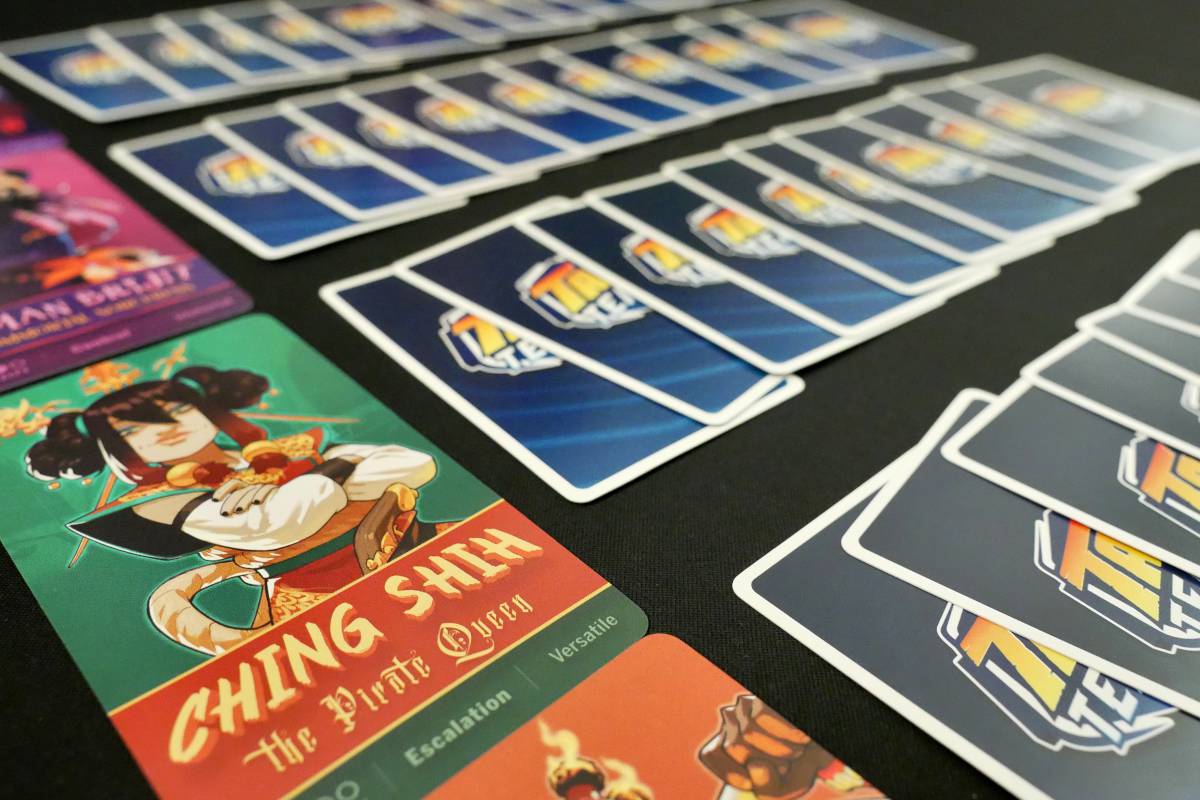
There are three big reasons for that:
- The order in which you draw cards can significantly shift how your deck builds and plays. The same 10 cards can produce drastically different outcomes depending on their order—and that's two-fold between the order you draw them from your draw deck and the order you add them into your play deck.
- You're weaving two Fighter decks into one, so there are 66 possible combinations ("12 choose 2"). Every Fighter's style gels differently with every other Fighter's style, resulting in subtly nuanced interactions and synergies that open up lots of variability.
- Your opponent's play deck matters as much as yours. There are 495 possible 2v2 matchups in Tag Team ("12 choose 4"), and each matchup demands its own approach to your deckbuilding strategy. You aren't just playing your cards—you're playing against theirs.
But beyond all the variability, Tag Team is just a breezy joy to play. The core gameplay is well-paced with very little downtime, with the right amount of decisions to keep things engaging from start to finish. It never reaches brain burny status and it isn't prone to analysis paralysis, so it's a lovely game to play when you don't want to think too hard.
Tag Team is more than just a compelling experience. To me, it's the ultimate 2-player card duel for both casual and hobby gamers alike. It threads the needle so well between fun, strategy, and agency without any of the mental load or stressfulness that often come with card duel designs. I keep coming back to it and I have a great time with it every time.
Production Quality
Scorpion Masqué blew me away with their production on Sky Team, and it's the same story here with Tag Team. Everything about this game feels high-quality without edging into "unnecessarily extravagant" territory. It all comes together so well, so smoothly, and so intuitively. I only have one ever-so-slightly-minor complaint—otherwise, the production is perfection.
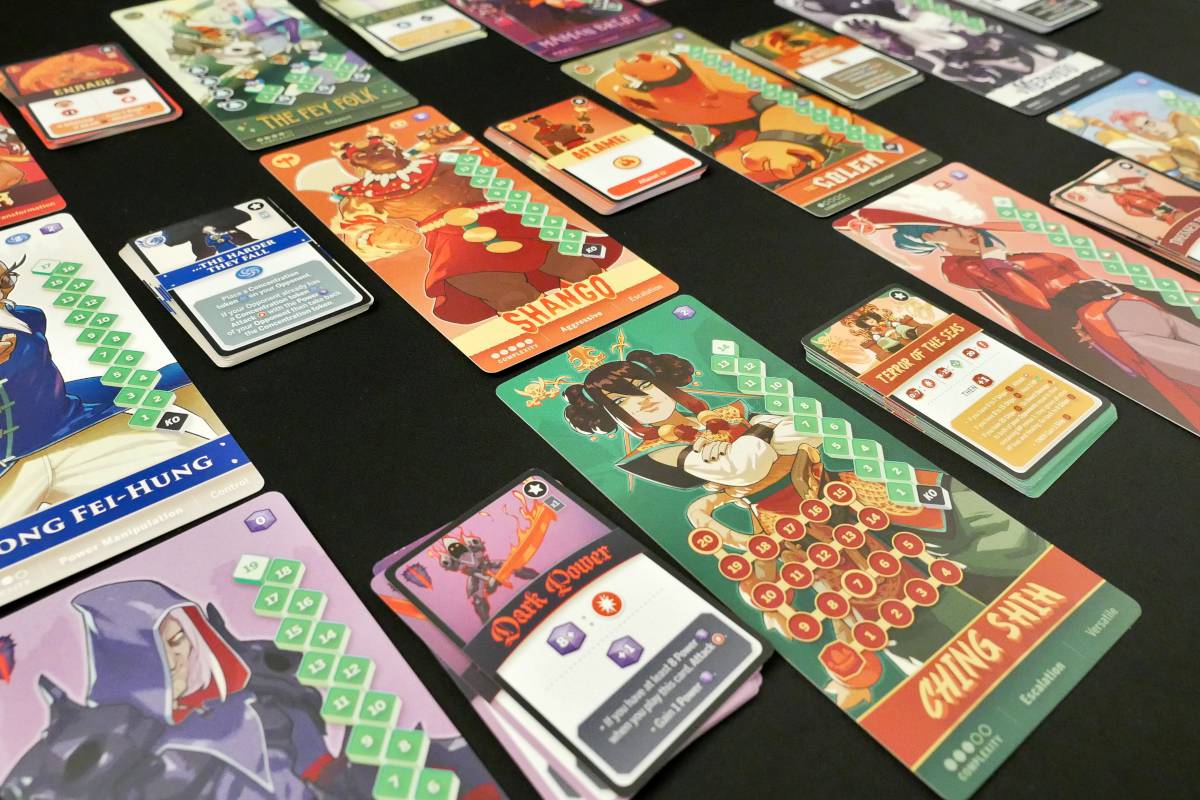
The art direction and character designs look fantastic, catch the eye, and draw you into the game. There are 12 Fighters in Tag Team and each one is loosely based on a well-known figure from history, literature, or legend—but each one has been given their own twist of personality and fantastical design. Every Fighter has their own identity and gameplay style, and that's impressive with how simple and compact the game is. I love the art and I've yet to play with someone who thinks otherwise.
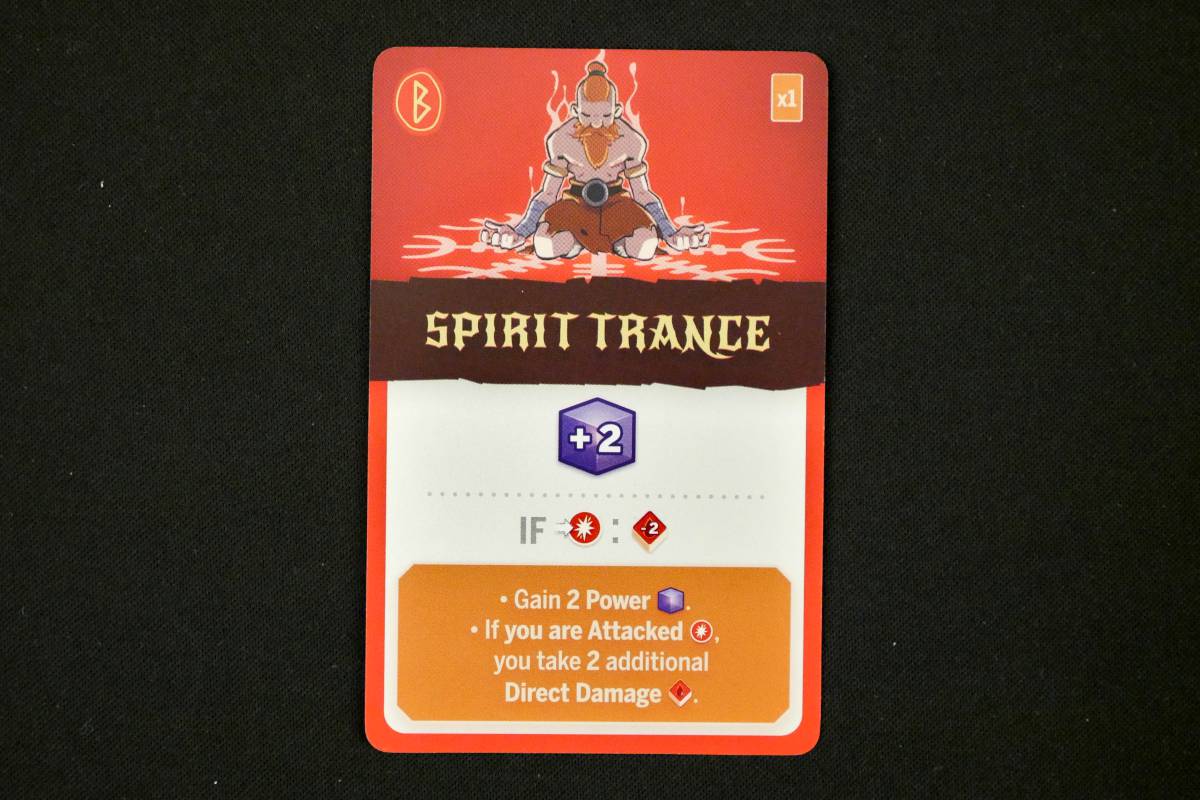
The card design is immaculate, with a perfect balance of readability, iconography, and aesthetics. A lot of thought went into the graphic design—kudos to artist Xavier Gueniffey Durin—and it plays a huge role in why Tag Team is so easy to pick up and play. The iconography is intuitive, the card layout is clean, there are small touches everywhere to help you understand what you can do. And if you ever forget what an icon means? Every card has a full text explanation at the bottom.
The Fighter boards are not dual-layered. Tag Team would've certainly been better if the boards were dual-layered (see "Fiddliness" section), but I'm not sure the benefit would've justified the cost increase or the box size increase. For me, the lack of dual-layered boards in Tag Team is acceptable.
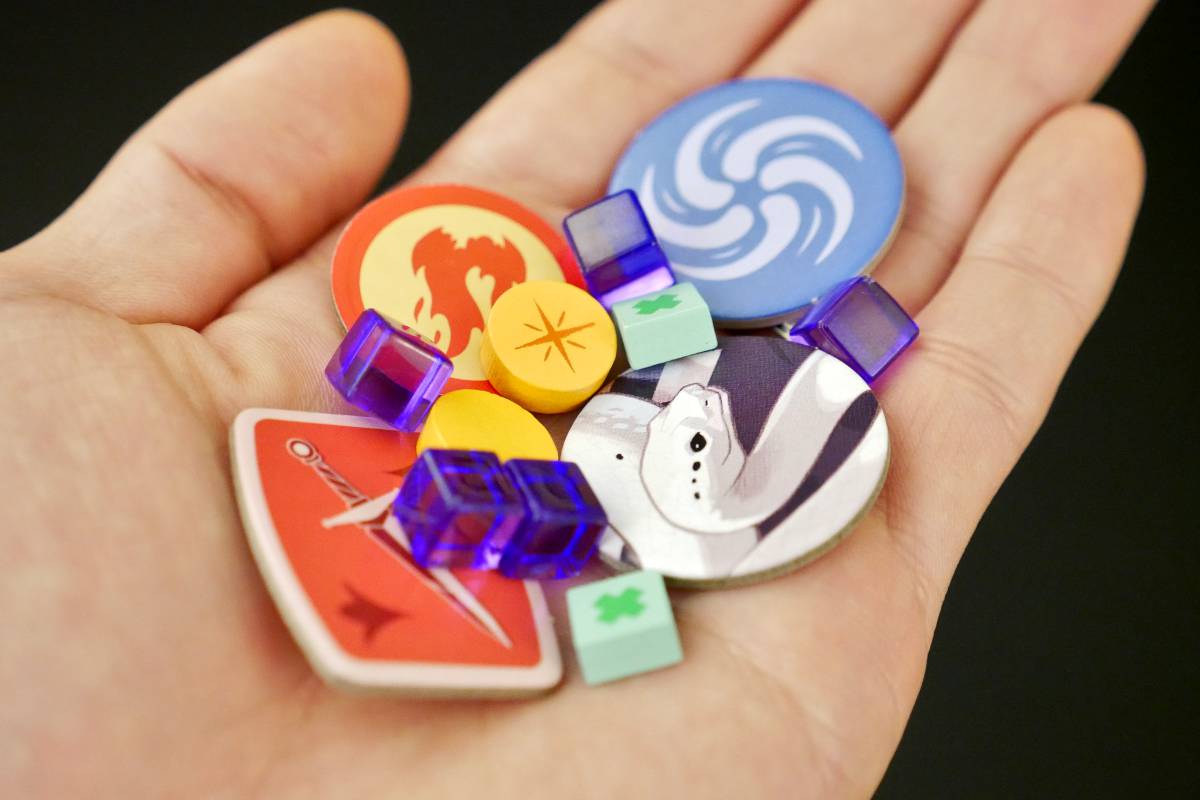
The mixture of cardboard, plastic, and wooden pieces is great. Could Tag Team have opted for only cardboard chits and gotten away with it? Yes, and it'd be functional. But the variety between cardboard tokens, plastic cubes, and wooden markers elevates the tactile experience. It's a small thing, sure, but one that has a real psychological effect. Tag Team feels great to play because these unnecessary touch-ups add polish and refinement.
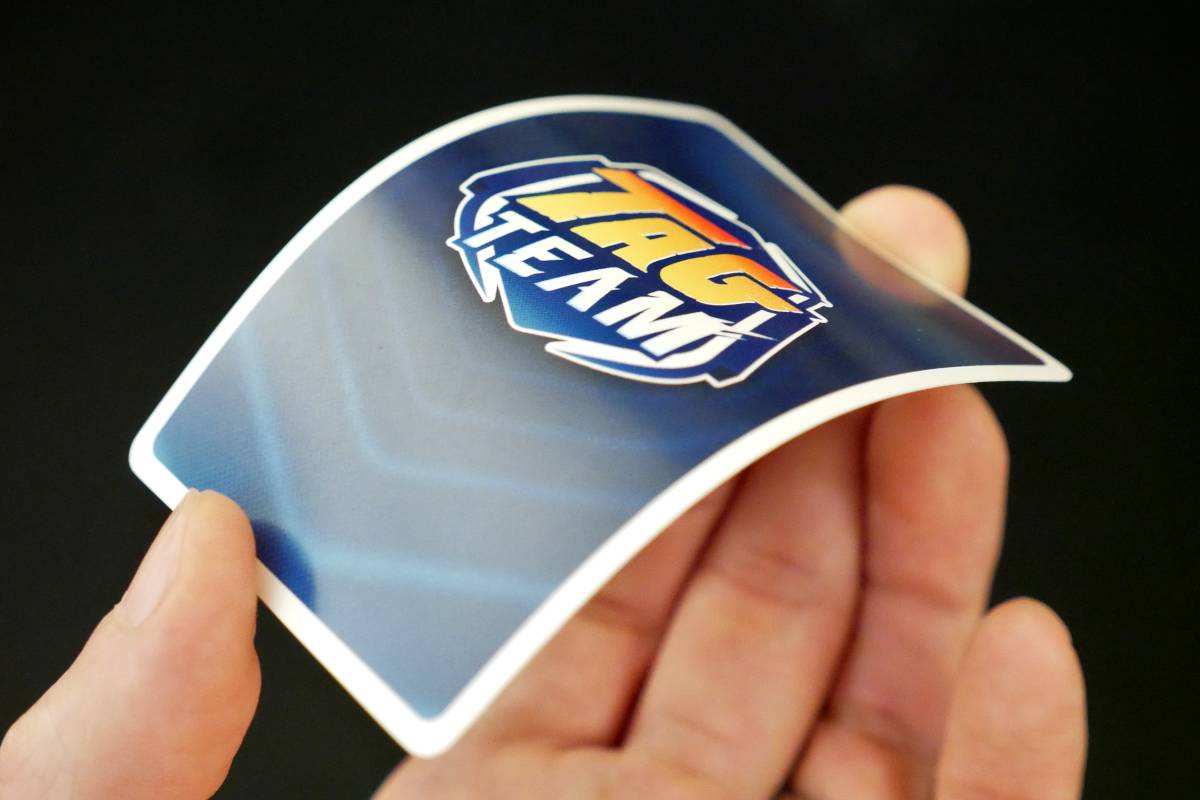
You'll probably want to sleeve the cards. There's no getting around the fact that Tag Team is a deckbuilder, and that means lots of shuffling. No matter the card quality, expect the cards to get worn over time—which isn't such a big deal in a typical deckbuilder, but can be exploited big time here with hidden information and memory being crucial mechanisms. Sleeving will help mitigate the impact of marked cards.
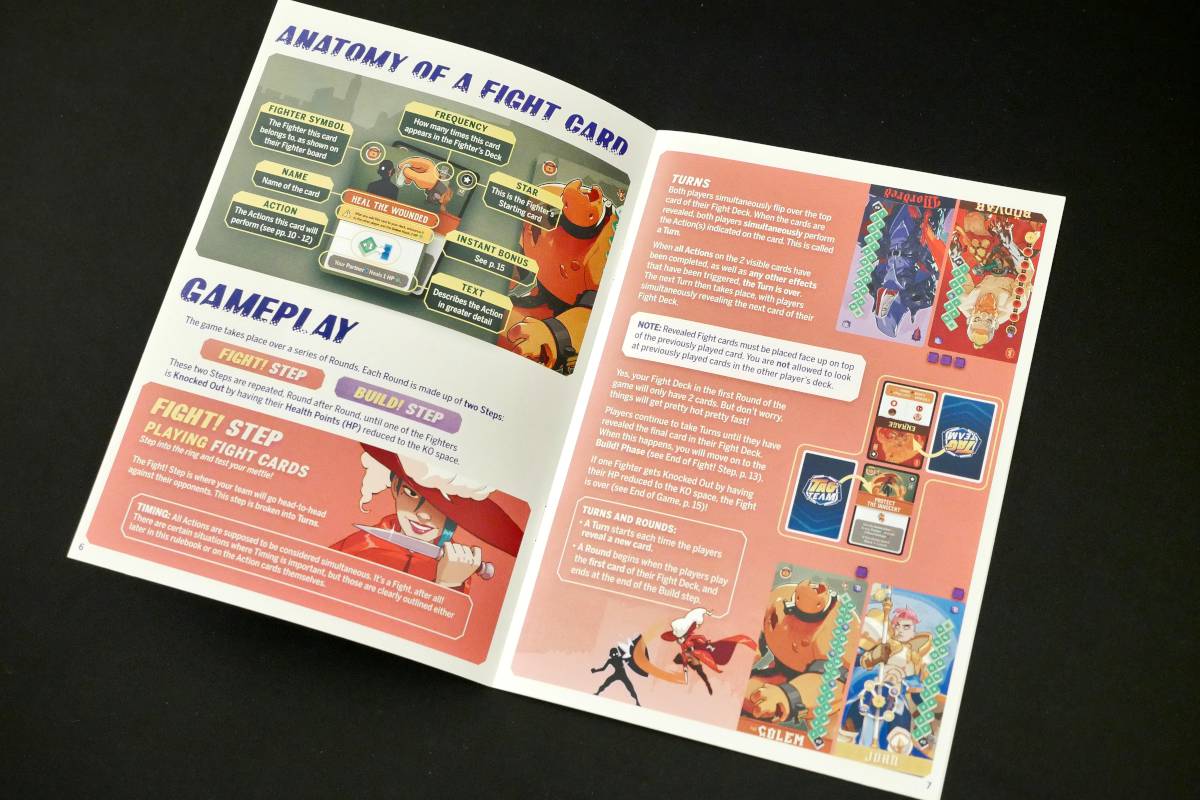
The rulebook is smartly laid out and cleanly teaches the game. I only had to read through Tag Team's rulebook once to fully grasp how to play, and the flow through that rulebook made it easy for all the concepts to click. If I ever need to check on a ruling, the relevant sections are clearly designated and I can find what I need right away. Rounded out with plenty of helpful diagrams and illustrations, it's exactly what I want in a rulebook.
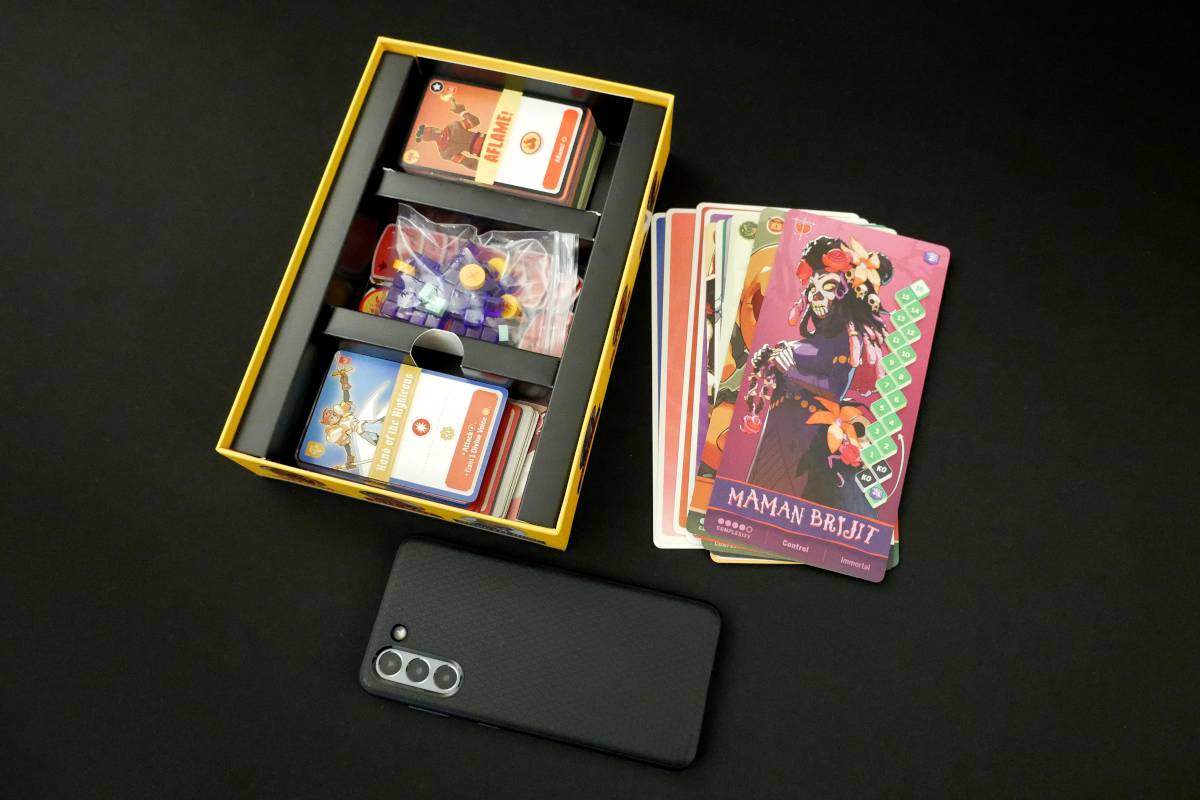
The game box is a little big for a 2-player card game, but it isn't egregiously large. Here's the ultra-minor complaint I mentioned earlier: Tag Team's box could be notably smaller even without changing any of the existing components. I'd love to pack it on a whim and take it with me when traveling, but it just takes up too much space for the game size. While I get why companies like bigger boxes, it robs portability.
The Bottom Line
Man, I love Tag Team. It feels like the 2-player card duel game I've been looking for all these years. The decisions are important, but it isn't stressful or prone to analysis paralysis. There's uncertainty, but it doesn't feel random or lucky. And it plays very fast! I love the game arc, the pacing, the production, the replayability. It's a must-buy.
Amazon • Barnes & Noble • Noble Knight Games • Target • Walmart
Stop Buying Games
You'll Regret
Before your next game purchase, run it through this mental checklist that every seasoned gamer uses.
Free checklist, delivered instantly to your inbox.
No spam, ever. Unsubscribe in one click.