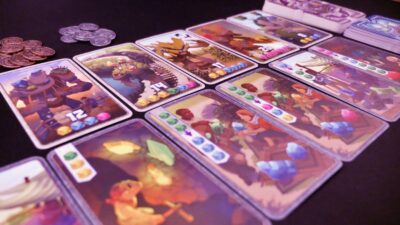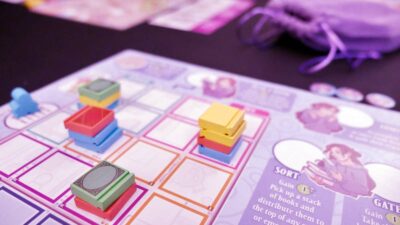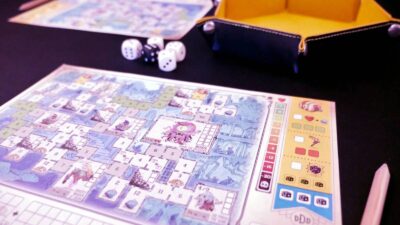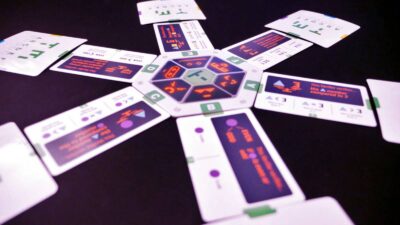

It's been over seven years since the original Railroad Ink came out, and while I've always wanted to play it, I never had the opportunity. So color me excited when I heard about the tile-based sequel Railroad Tiles, and even more excited when Horrible Guild sent me a copy to play.
While there are some likable bits here, the overall experience has been something of a letdown. If you've never played a tile-layer before, you might really enjoy this one. But if you have? You might find it quite average. It's more of the same in this increasingly crowded genre.
Here's everything you need to know about how Railroad Tiles plays, what's good about it, what isn't, and why it's ultimately unremarkable.
This review is based on a review copy of Railroad Tiles provided by Horrible Guild, but my thoughts and opinions are my own.
Overview
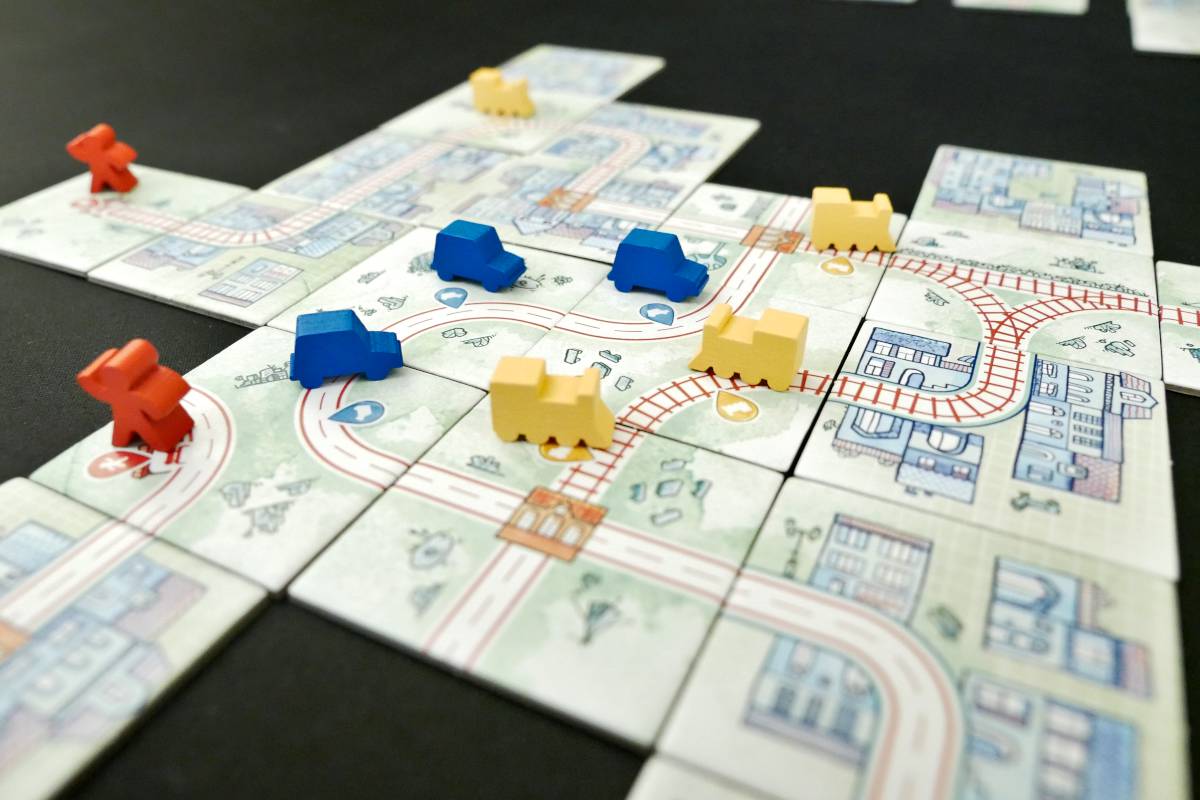
Railroad Tiles is a tile-based tableau builder in the same vein as hits like Cascadia, Kingdomino, and even Sprawlopolis. You draft tiles to add to your city and try to earn the most points by optimizing your placements, with various scoring opportunities competing for your attention.
Every player starts with a different tile. Technically, a set of tiles is supposed to be drawn from the bag and then drafted by players, but I prefer to just randomly deal one tile to each player. It doesn't seem to make a huge difference and it cuts down a bit on setup time.
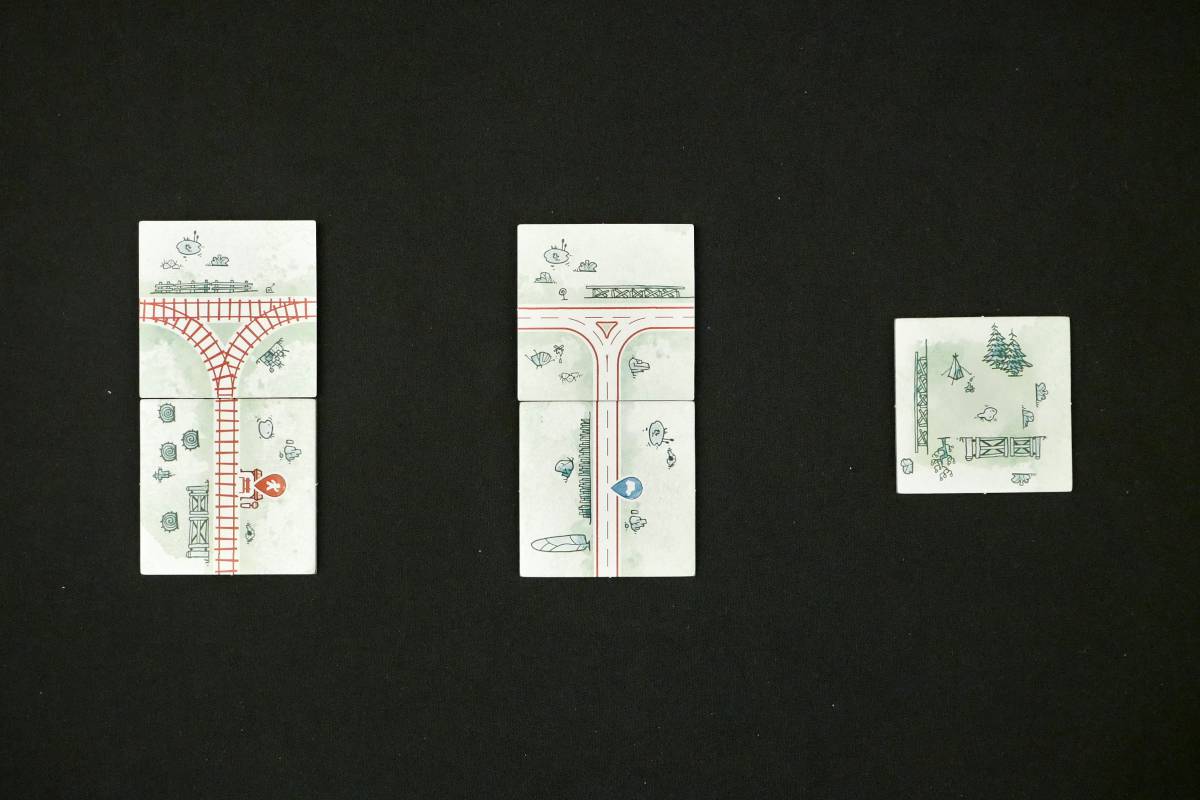
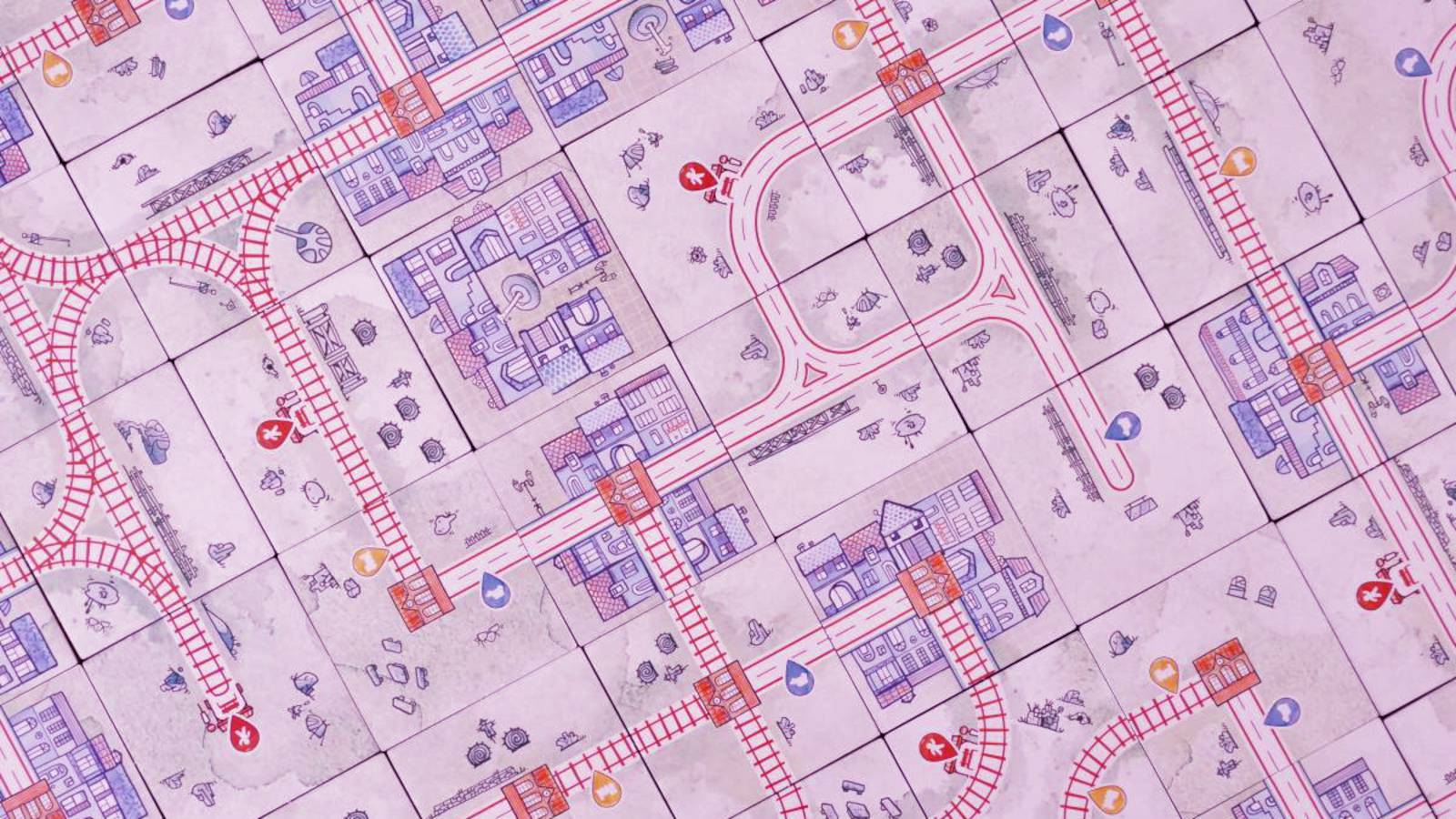
The tiles in Railroad Tiles are square in shape and thus have four sides. Each side can be one of three connection: Railroad, Highway, or Empty. As you acquire tiles, you'll be adding them to your growing tableau—but when placing, a tile must always touch side-to-side with at least one previously placed tile, and all touching sides must be of matching connections. (In other words, a Highway side must always touch another Highway side, etc.)
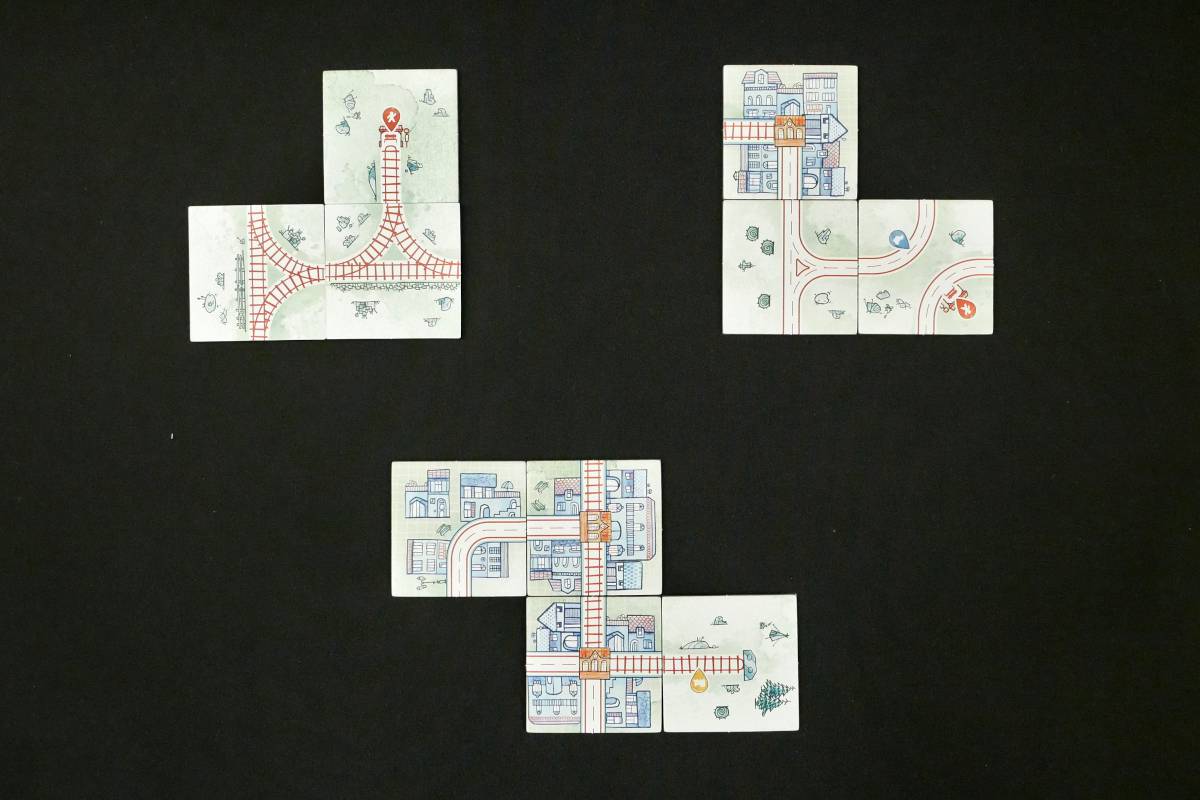
The tiles also come in two body types: Field tiles and Town tiles. Fields and Towns can be placed next to each other without issue, but you'll want to place Towns next to other Towns to create Cities. A City is any adjacent grouping of three or more Towns—diagonals don't count—and every City is worth 5 points at the end of the game.
The size of a City doesn't change its point value. A 3-tile City and a 7-tile City are both worth 5 points, so try to create as many 3-tilers as you can!
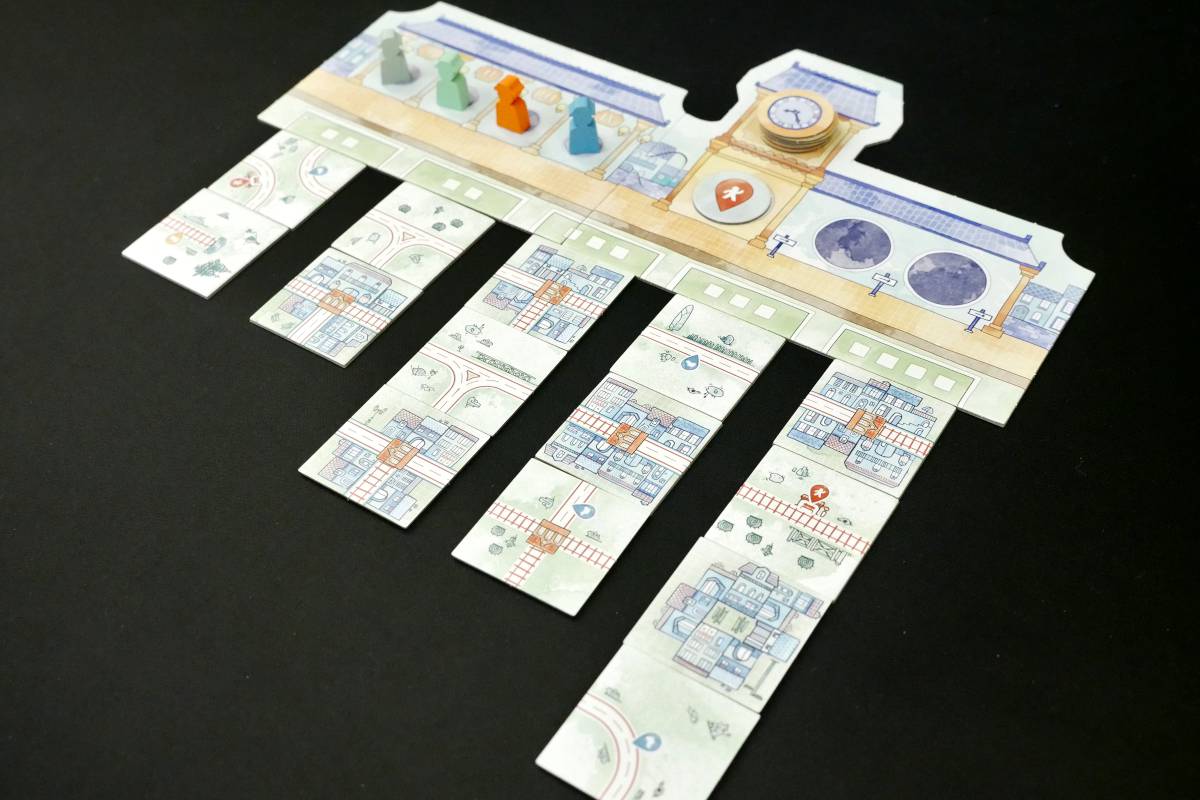
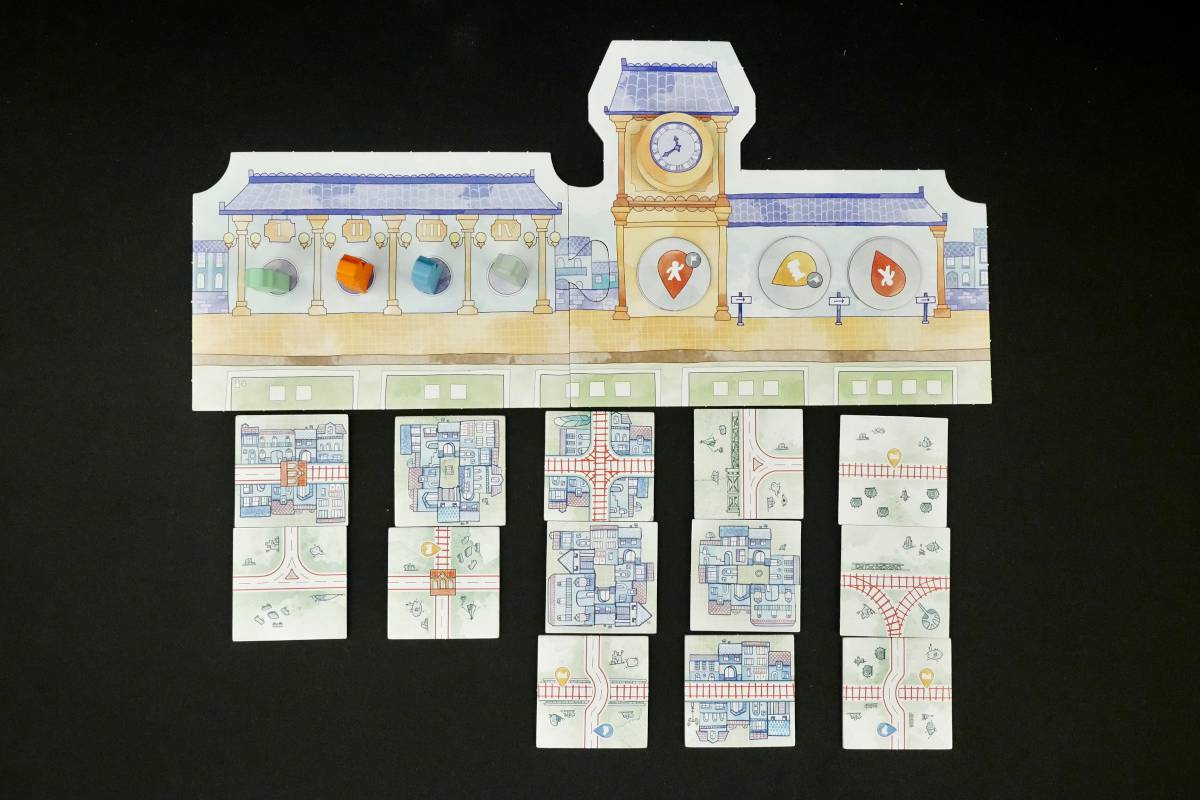
So, how does tile drafting work? Well, it all starts with the nifty Station Board, which has columns that are filled by random tiles pulled from the bag. Each column designates how many tiles it has, with "earlier" columns having fewer tiles and "later" columns having more tiles.
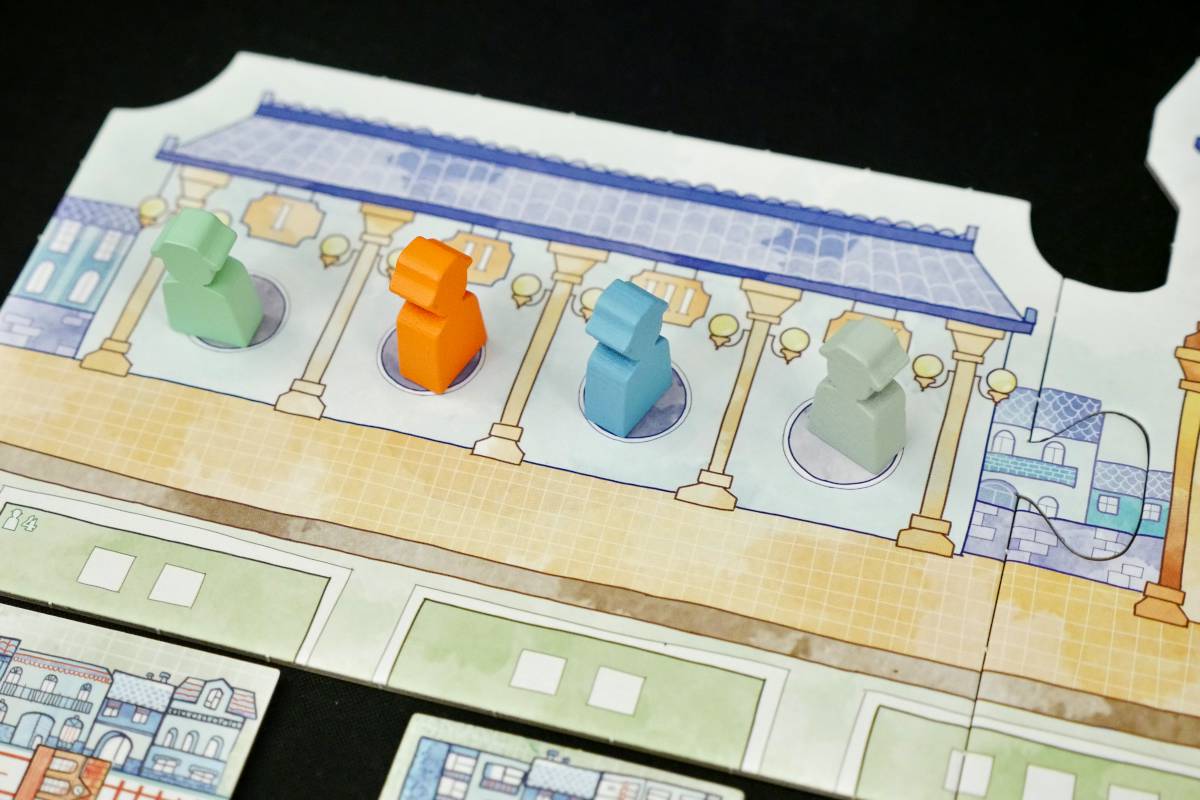
In turn order, each player chooses which column of tiles to take and add to their own individual tableau. But here's the catch: the column you select in the current round will determine your place in next round's turn order. If you pick the 4-tile column, you'll go last next round; meanwhile, if you pick the 2-tile column, you'll go first next round.
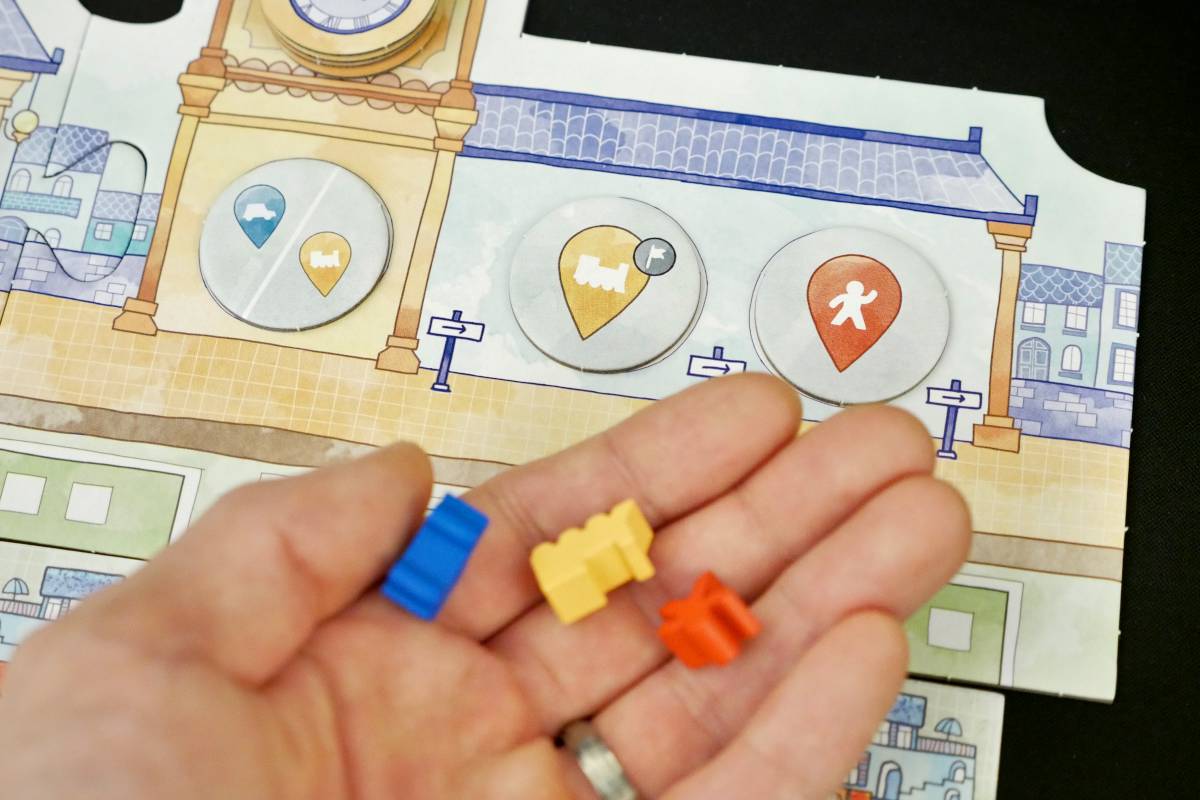
After everyone has drafted their tiles, there's the pawn placement phase. During this phase, every player gains placement pawns equal to what's shown on the Station Board with the Placement Tokens, and those placement pawns can be placed on certain spots in each player's tableau.
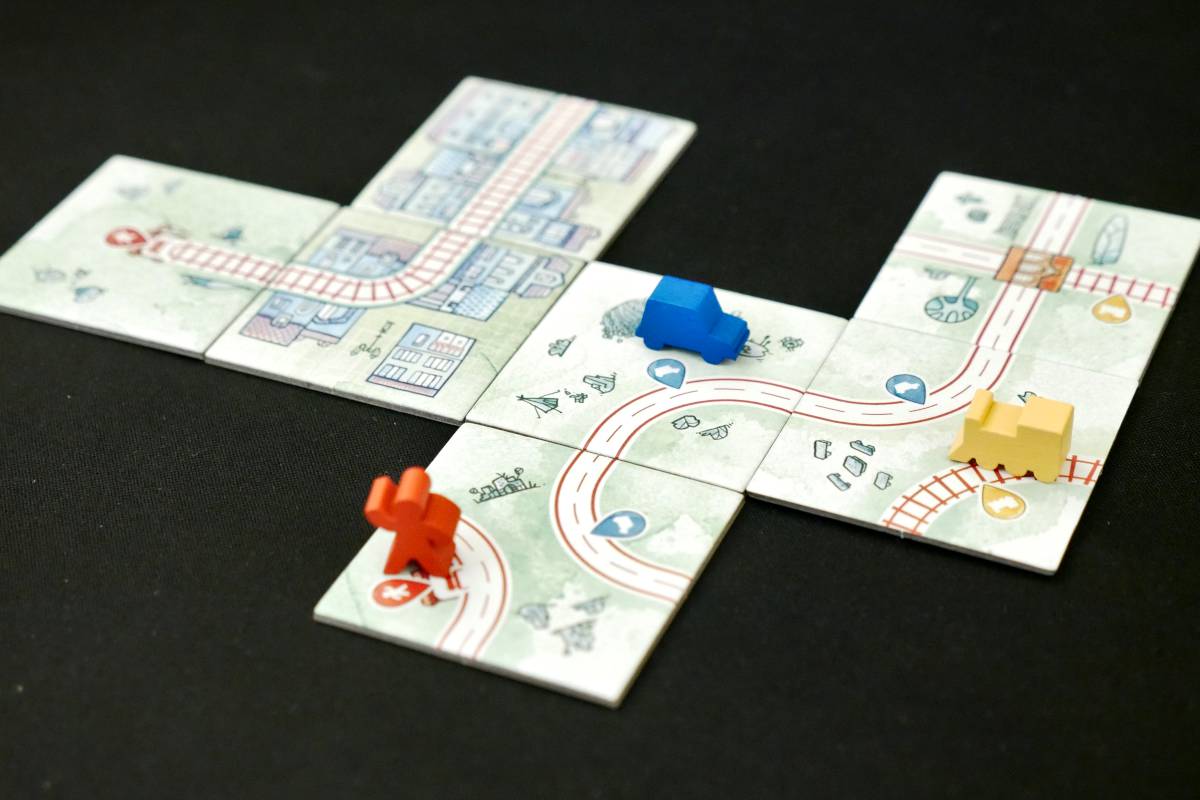
You might've noticed that some tiles have Pinpoints, which are the spots where you can place their corresponding pawn types: Car, Train, and Person. A Pinpoint will always be on either a Highway or Railroad, which is important because you increase your score by creating networks that connect Pinpoints of the same type to each other.
When you place a pawn on a tile, you earn 1 point + 1 additional point for every other pawn of the same type on the same network, up to a max of 5 points. (Beyond the 5th one, each pawn is worth 5 points.)
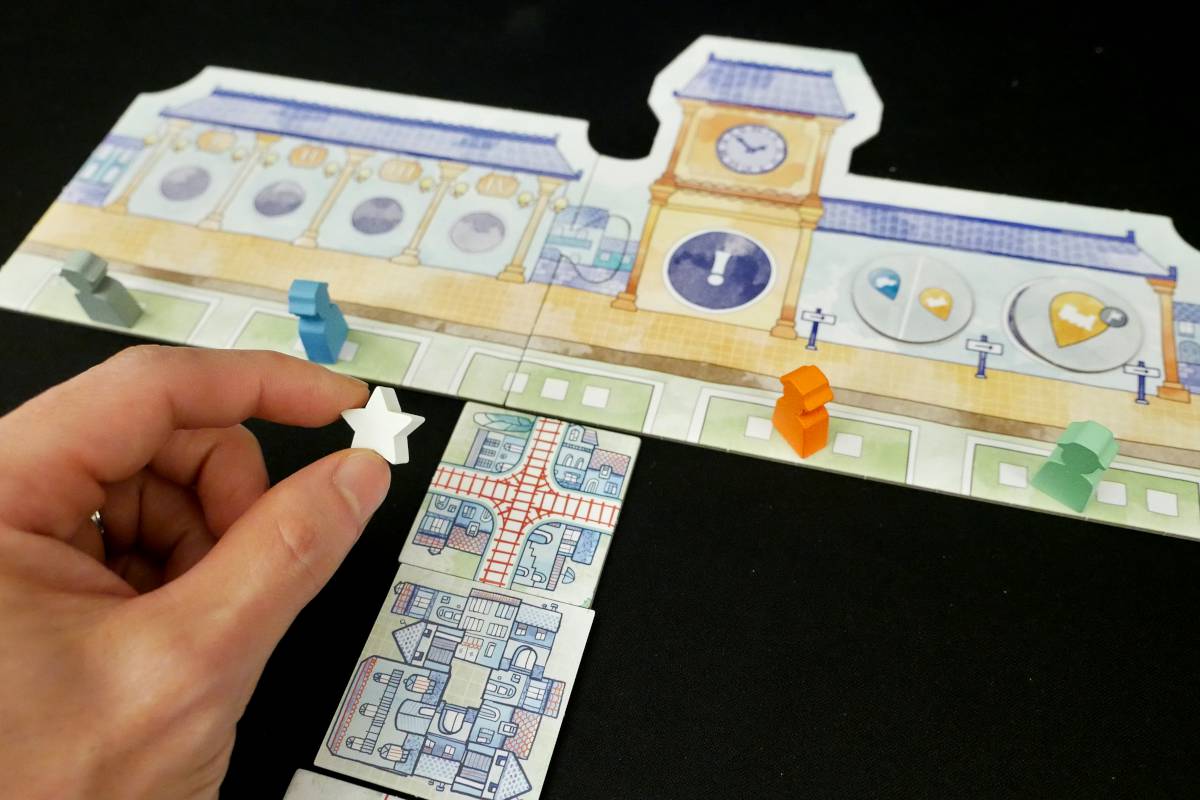
After the placement phase, there will be one column with leftover tiles that weren't taken by anyone during the drafting phase. Those tiles stay in that column, but a Star token is also added to it—anyone who drafts that column in the future will get the tiles and any Star tokens on it.
Star tokens are useful because you can spend them during the pawn placement phase to change one pawn into another type, helping you to optimize your point gains. Unspent Star tokens are worth 1 point at the end.
The empty columns are then refilled with new tiles from the bag, the next Placement Token is revealed from the stack, and the next round starts.
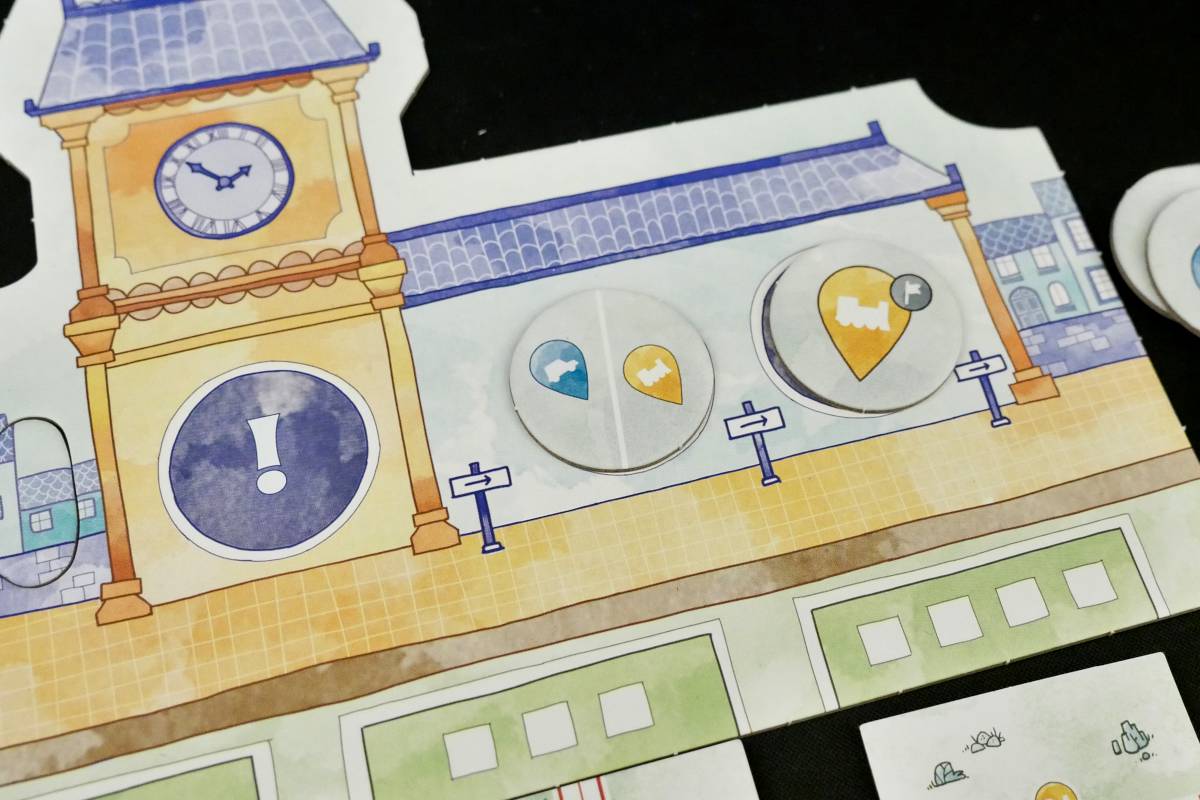
Railroad Tiles ends after 8 rounds (which are tracked by the stack of Placement Tokens), then players earn points for the following:
- All points gained while placing pawns.
- +5 points for every City (grouping of Town tiles).
- +1 point for every tile in the "largest rectangle" in your tableau.
- +1 point for every unspent Star token.
- -1 point for every "opening" beyond your 5th. An opening is any side of a tile that has an unconnected Railroad or Highway.
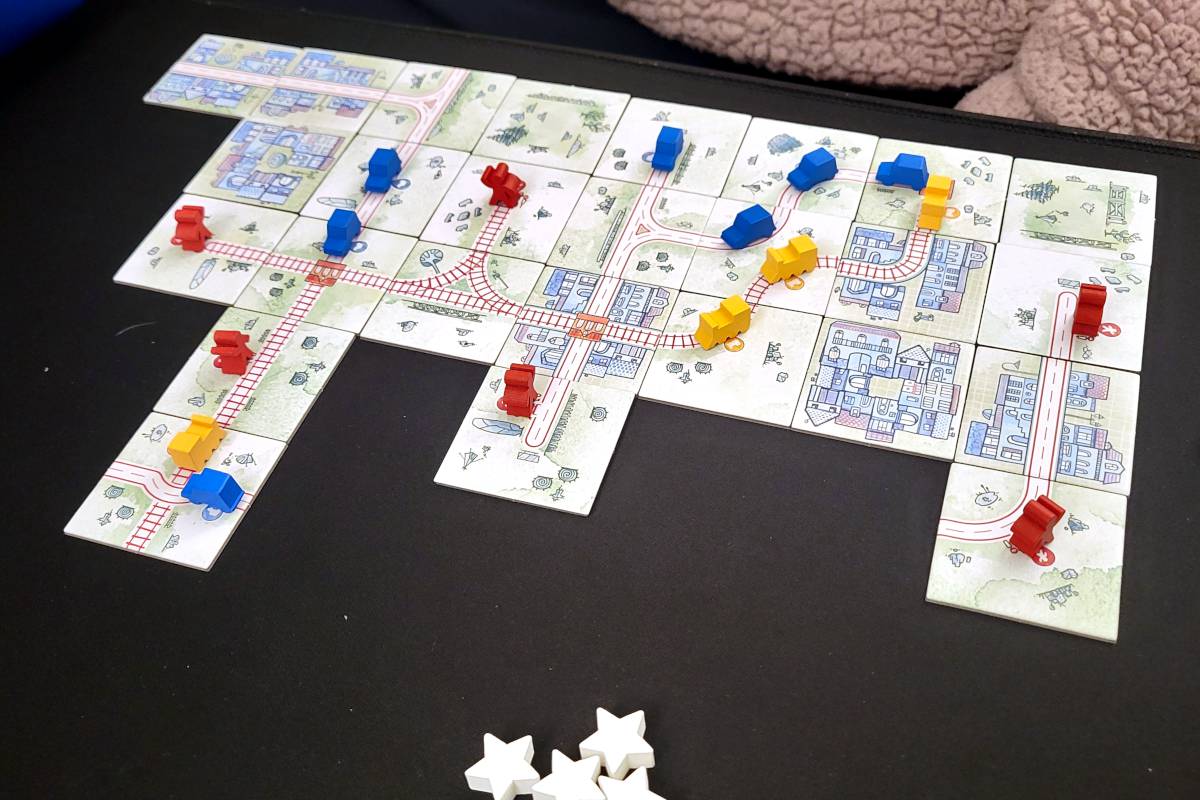
And that wraps it up. Whoever has the most points wins!
Advanced Mode
Railroad Tiles comes with optional Objective tiles that give you more ways to earn points based on how you build out your tableau. Objective tiles are like any other tile—they fit into your tableau—except there are 7 different Objective types and each has its own scoring criteria.
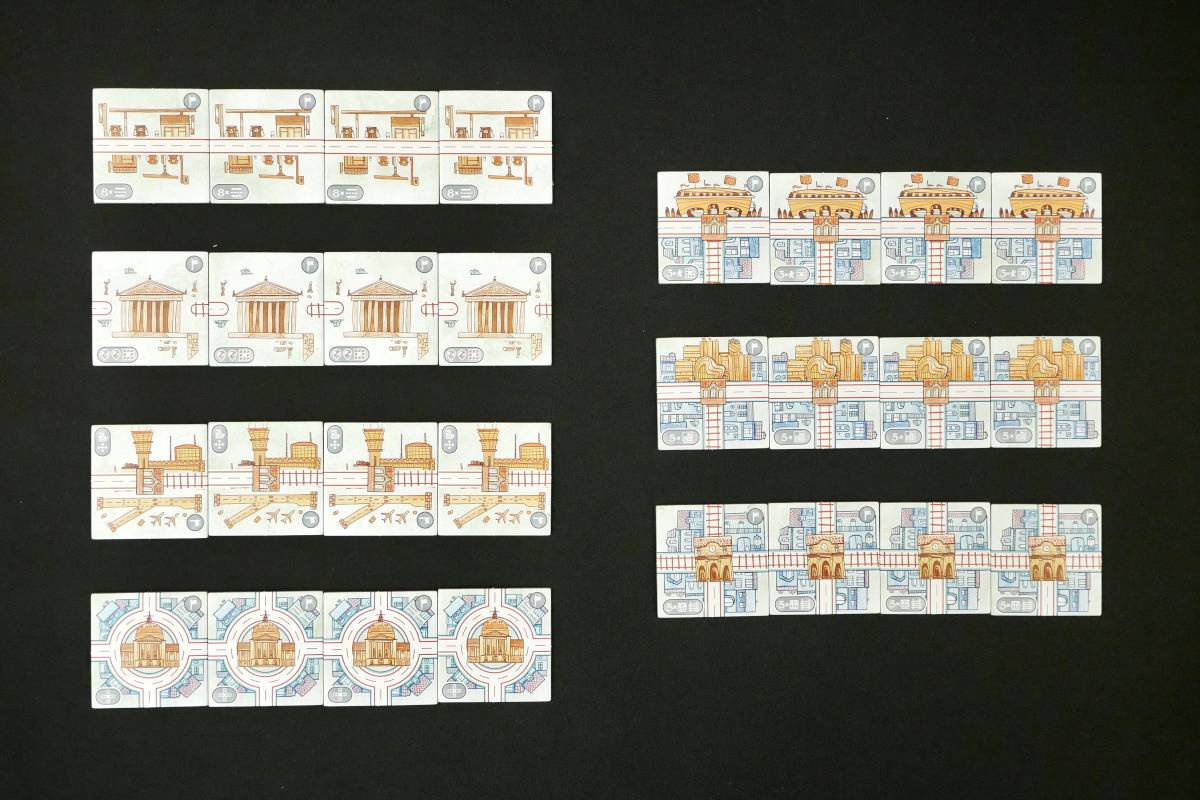
To play with Objectives, choose 3 of the 7 Objectives to use in the game, then give each player the same set of 3 Objective tiles. The Objective tiles are set aside at the start. Then, at the end of every round when the next Placement Token is revealed, check if it has a little flag icon on it—if it does, then every player chooses one of their Objective tiles to add to their tableau.
At the end of the game, each completed Objective earns 5 points.
Setup and Table Footprint
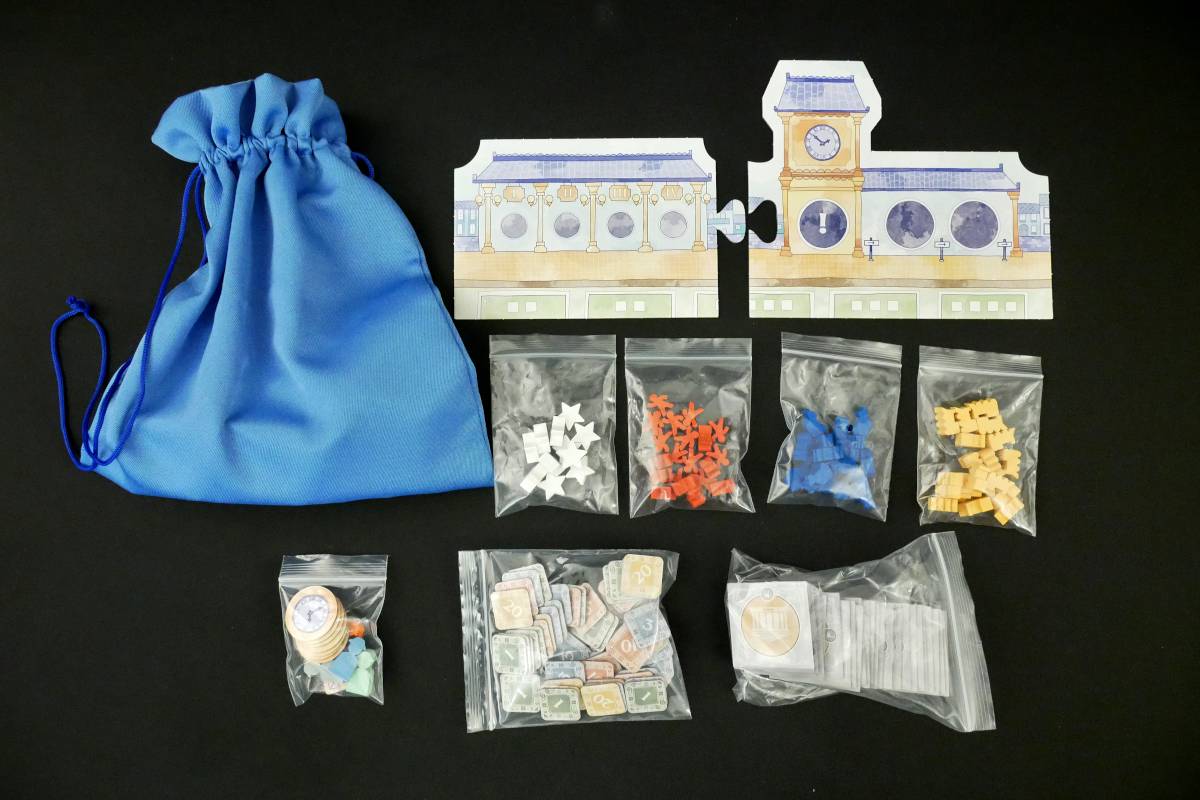
For how light the gameplay is, Railroad Tiles is a little annoying to set up. It's not like there's so much going on as to be overwhelming, but you get the sense that the juice isn't worth the squeeze.
You have to pull the tokens and pawns from their baggies (and into token trays if you use those), then pick from the Objective tiles and distribute the same exact set to each player, then set up the Station Board and shuffled Placement Tokens. Lastly, mix up the bag of tiles.
Again, it's not a lot—but it's more than I want to deal with in a game that's as light and breezy as this one is. I find it's actually a real barrier to me pulling the game off the shelf. When I'm in the mood for something like Railroad Tiles, I tend to go with another that's faster to set up.
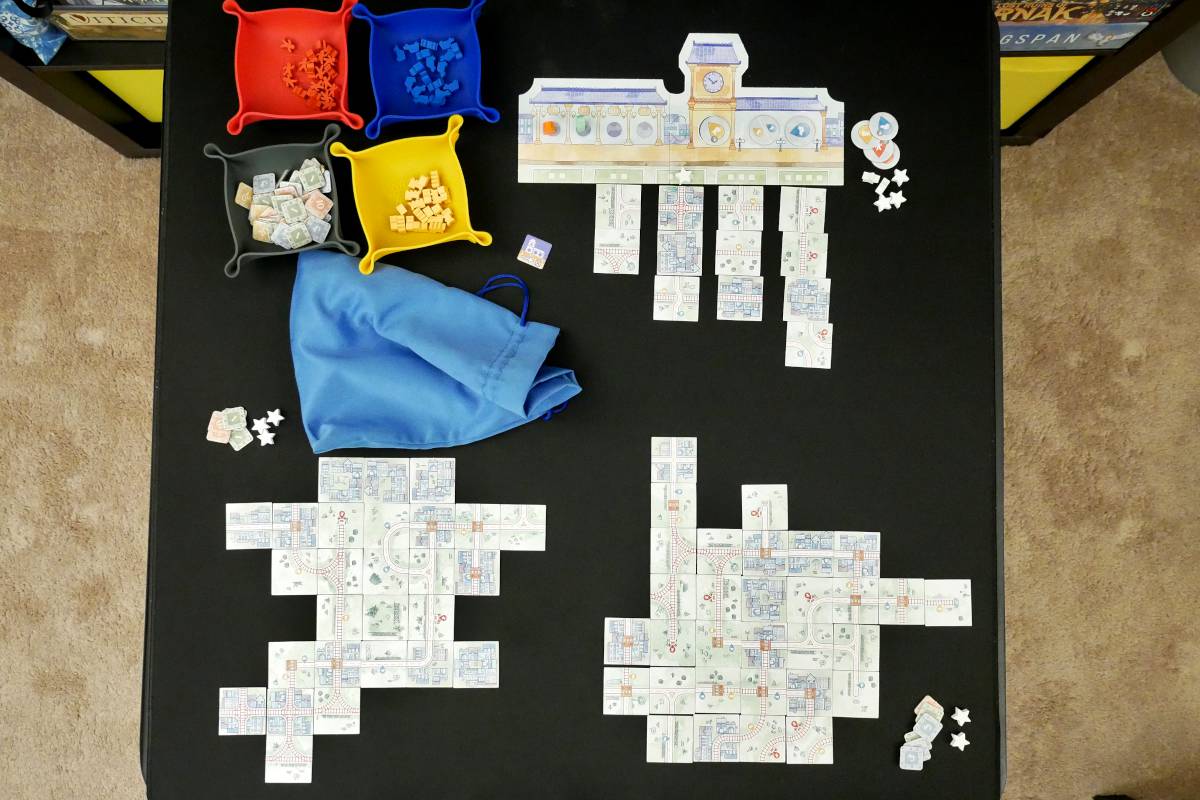
Railroad Tiles needs a good amount of table space per player, which shouldn't be a surprise given that each player is building out a large grid of tiles. Compared to Cascadia—and I'm sure lots of people will make the comparison—I find that Railroad Tiles demands more space. The tiles are slightly bigger and you play more of them per game. Add in the Station Board and drafting rows and you can easily run tight on space.
Learning Curve
Railroad Tiles doesn't have any unique mechanisms and it doesn't throw any curveballs, so it's pretty easy to pick up, especially if you're well-exposed to modern board games. And while there are a handful of moving parts, it can be approachable to non-gamers as long as the game host knows how to play and can run the administrative aspects.
And it's nice that you can choose to play without the Objective tiles, which simplifies things even further. The core flow of drafting tiles, laying tiles, placing tokens is intuitive enough for anyone to grasp, and once you get used to that, you can frictionlessly add Objectives next time.
Game Experience
Decision Space
Railroad Tiles presents two main decisions on your turn: which tile set are you going to draft and how will you place those tiles in your tableau? Though they're intertwined, let's tackle these individually.
When it's your turn and you're looking at the columns of tiles, you're evaluating each set in order of these factors:
- Will they fit into my current tableau? More importantly, can I fit them in a way that helps me grow my "largest rectangle"?
- Do they provide me with Pinpoints for this round's pawn placements? More importantly, do they extend my current Railroad and Highway networks so those pawn placements score bigger points?
- How many tiles are provided by the column?
- Do they provide me with Town tiles so I can create and/or complete Cities across my tableau?
- Do they help me set up and/or complete my Objective tiles?
- In the early game, do they expand my tile placement possibilities? In the late game, do they close off my dangling openings?
This might seem like a lot to think about, but each factor is pretty quick and easy to evaluate. For example, the column with 4 tiles is generally better than the column with 2 tiles, the tiles with Pinpoints are better than those without, the ones with Railroads are better if you're building a Railroad, etc. In fact, it's so straightforward that you're basically just going through a simple mental flowchart when drafting tiles.
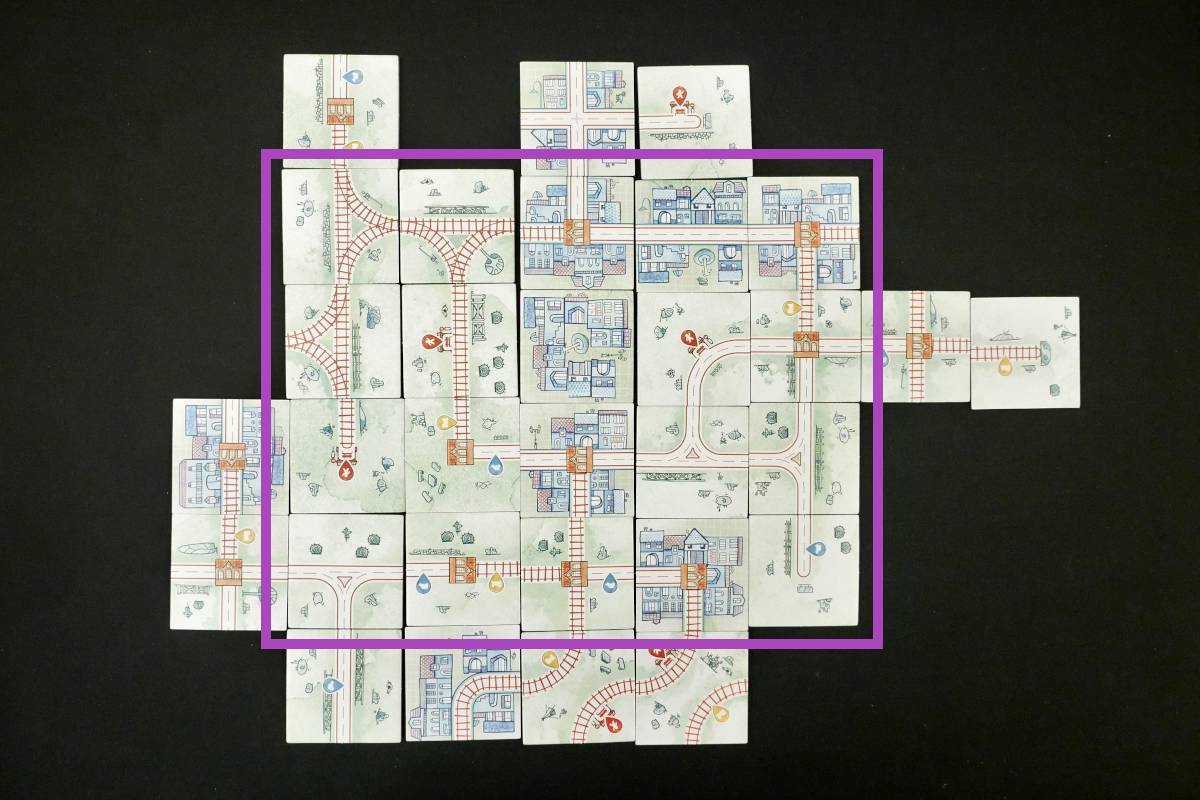
And that's because the scoring in Railroad Tiles pretty unbalanced. For example, the point potential from "largest rectangle" is so large that it's your highest priority by a long shot. In every game I've played, the player with the largest rectangle won. Why? Because it ends up comprising anywhere from one-third to one-half of your entire score. The second highest source of points is from chained pawn placements, so tiles with Pinpoints are really important and no-brainers when it comes to drafting.
In short, Railroad Tiles has one "correct" way to play—build the largest rectangle with the most Pinpoints—which corners you into a specific play style and simplifies every decision to the point of it being "on rails."
You aren't just drafting tiles, of course. You also need to place them in your tableau, and you need to place them optimally. Unfortunately, the spatial tile placement puzzle in Railroad Tiles isn't very interesting.
The best way to describe it is that it goes for breadth rather than depth. You're drafting multiple tiles on a turn, and those tiles can fit into your tableau in numerous ways. It's combinatorial, so there are lots of possible tile placements to consider in your head—but it's also shallow because certain tile placements are obviously better than others.
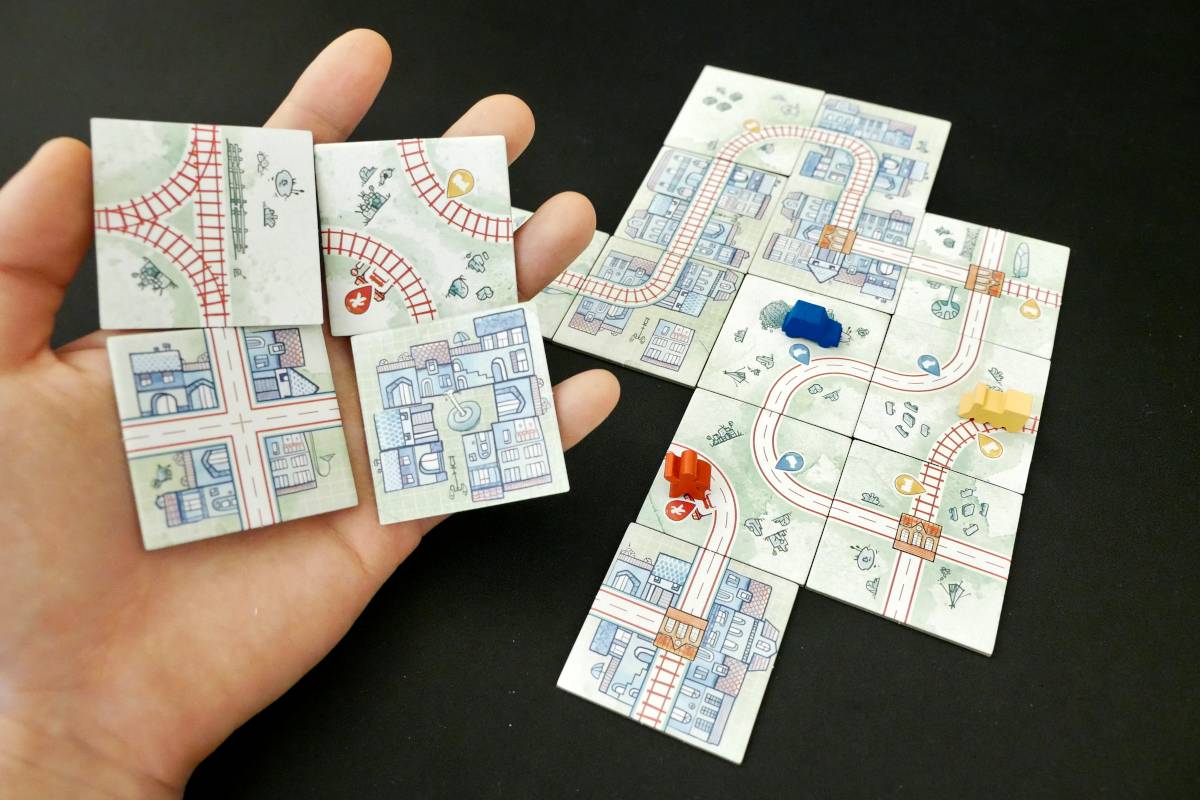
This means Railroad Tiles is prone to a kind of analysis paralysis (a lot of time going through all the possible tile placements, rotating tiles, flipping tiles, calculating point values, etc.), but that time is mostly spent on rote processing rather than interesting decisions. You're rarely stuck between multiple options, and it's not like you have various strategies to pursue. You're just churning through possibilities to find the best one.
I'm also disappointed in the turn order mechanism. In Railroad Tiles, the next round's turn order is determined by the current round's column drafting order. If you grab the column with 4 tiles this round, you draft last next round; meanwhile, if you grab the 2-tile column this round, you draft first next round. It sounds interesting on paper, but falls flat for two reasons.
First, the value of a tile set is fluid. The core idea is that there's supposed to be a trade-off: getting 4 tiles is "better" than 2 tiles, so you balance it out by giving up first pick in the future. But it rarely works out that way. The best set is whichever serves your tableau's needs. For me, the best set might actually be the 2-tile column because one of those tiles perfectly fills a hole in my tableau's rectangle. Meanwhile, it's possible that none of the tiles in the 4-tile column even match my tableau, making that set worthless to me.
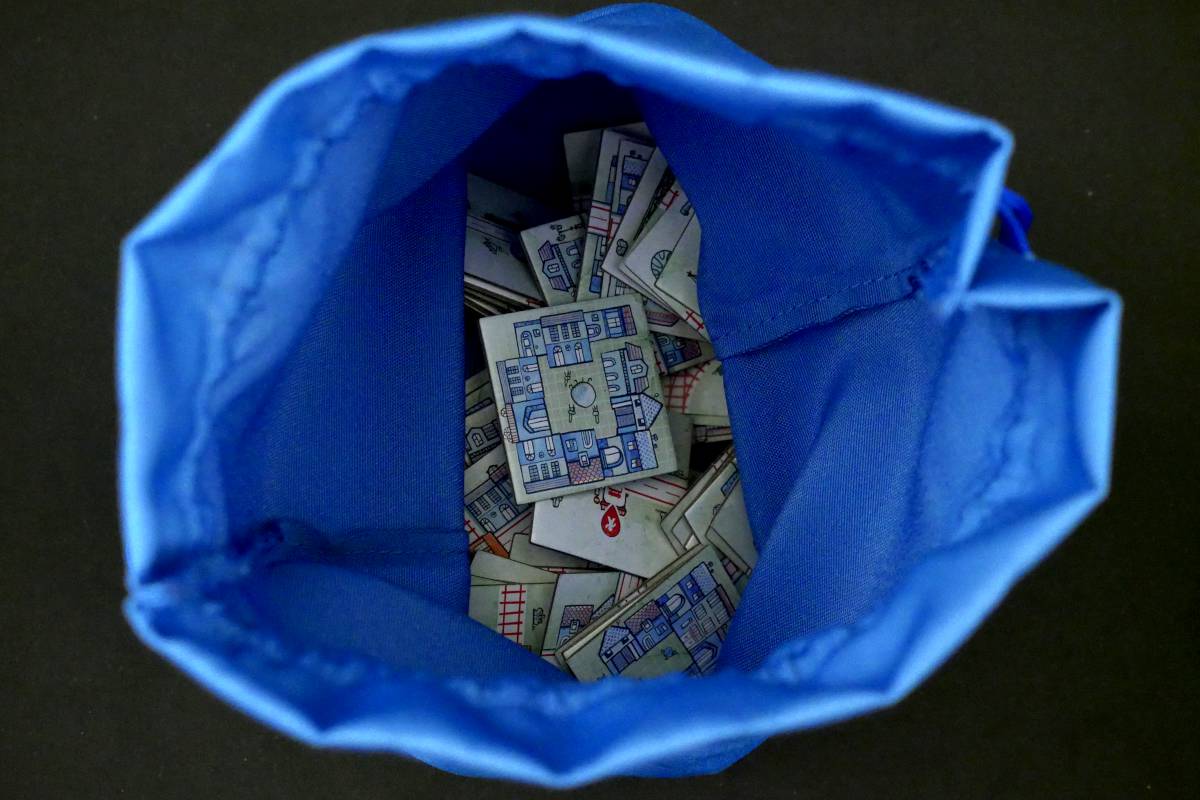
Second, you can't really plan ahead. Not every tile in the bag will come out during the course of a game, and you have no idea which tiles will come out next round. There's no guarantee that any of them will be good for you, and there's no guarantee that you'll ever see the ones you need to fill in crucial spots. Sacrificing the current round's draft pick to get an earlier pick next round just doesn't make sense because your choices next round might all suck. There's a disconnect between this round and next round.
Combine those two issues and you have a clear condemnation of the tile drafting turn order mechanism in Railroad Tiles. There's no reason to consider your future turn order—just draft the best column you can on this turn, then hope for the best next round.
Luck Factor
As I mentioned in the "Decision Space" section, there's too much luck in the tiles that come out. You might start off building your tableau in a certain direction, but key tiles may never show up—or someone else might draft them simply because they happened to be earlier in turn order than you. That's beyond your control and frustrating when it happens.
It's doubly frustrating when playing with certain Objective types, like the Stadium which requires 3 Person pawns on its surrounding tiles. That means you need to draft at least 3 tiles with Person Pinpoints that fit into your tableau around your Stadium tile. There are only so many tiles with Person Pinpoints in the game, though, and the way they're drawn and distributed across the columns for drafting could mean that some players end up with no chance to complete the Objective just because of turn order.
It also matters the order in which tiles come out. A certain tile that appears in round 2 might not fit your tableau at the time, but the same exact tile might be the one you need in round 6. Unfortunately, it has already come out and won't be able to save you anymore. More broadly, the earlier tiles dictate how your tableau grows, then you need to figure out how to fit the later tiles into whatever your tableau has become.
After several plays of Railroad Tiles, I walk away from it with the sense that it isn't very strategic—it's a tactical affair. You're at the mercy of luck every round, and you're just trying to make the best of whatever situation you find yourself in. With scores relying so heavily on "largest rectangles" and Pinpoint networks, whoever has the luckiest drafts will likely win.
Fun Factor
Railroad Tiles is a quiet and thinky game, one played mostly in your own head. There isn't much table talk, no exciting moments, no real highs or lows. It brings out a muted sense of internal tension as you're hoping for certain tiles to show up. You're silently running through all possible tile placements, evaluating the tile sets to find the best one to draft. There's some satisfaction when things work out, some frustration when they don't.
All in all, I hesitate to call Railroad Tiles fun or enjoyable. It's more of a comfortable time killer with spatial puzzle-solving DNA.
Pacing
In one sense, there's a definite game arc to Railroad Tiles with rising tension as your tableau grows bigger, your opportunities expand, and your score accelerates. With exponential growth between your largest rectangle and Pinpoint networks, you always feel like you're making progress. With end-game scoring, you feel like you're always in the game even if you're behind. It snowballs over 8 rounds to a soft climax.
But in another sense, I can't help but notice the flatness of the overall Railroad Tiles experience. The decisions you make every round are the same: evaluate tiles for fit and value, then slot them in. Every turn feels the same, even though you're earning more points per turn. You don't have to pivot or adapt or evolve. The tiles just come out and you pick the best ones.
There's also a surprising amount of downtime if you're playing with people who aren't gifted in visual-spatial analysis. Like I mentioned above, it can take a while to go through all the possible placements after drafting a set of tiles, especially in the later rounds when your tableau is larger with more open sides. Flipping, rotating, trying out different combos to find the biggest score gains—it can take a while. If you're quick, you might be waiting a lot.
And you know how I said the 8 rounds snowball to a soft climax? That climax is really soft. Not quite anticlimactic, but close to it. You finish your final placements, you sum up your final scoring bits, and that's it.
Player Interaction
Railroad Tiles is very much a multiplayer solitaire game. You have your own tableau, you're focused on your own decisions, and you can't affect anyone else's results. You draft tiles, plug them in, and that's it.
And there's no hate drafting here. You never want to take a column just because it's beneficial to someone else—you'd only be shooting yourself in the foot. If you take a column and it happens to be the same one someone else wanted? That's just a bonus. This kind of "denial" interaction does happen, but it's usually by sheer coincidence and not intentional.
Railroad Tiles is vulnerable to cheating. Since everyone is heads-down in their own tableau, it's totally possible for someone to cheat and not get caught. They can easily move their tiles around, or take more points for a pawn placement, etc. And this can easily happen by accident, not even with mal-intent. All the more reason to play it as a solitaire game without paying any mind to what anyone else does—aim for your own high score.
Player Counts
All of the problems mentioned above in the "Decision Space" and "Luck Factor" sections are exacerbated at the 3-player and 4-player counts. It's more lucky and more unpredictable. Plus, there's more downtime as you wait for people to figure out which columns they want to draft and how they want to fit their tiles into their tableaus.
Those problems are still there at the 2-player count, but you're less likely to get impeded during the draft because there are four columns for two players, and there's less downtime to suffer through. If I'm going to play Railroad Tiles, I'd most prefer to play at 2 players.
Fiddliness
For as simple and lightweight as it is, Railroad Tiles feels a little too fiddly and clunky for my liking. There are too many phases and steps to go through every round, and I'm not convinced the gameplay warrants this degree of upkeep. For reference, here's how the steps go:
- Round setup phase:
- Reveal the next Placement Token. If there's a flag on the token, every player adds one Objective tile to their tableau.
- Refresh the columns by pulling tiles from the bag.
- Tile selection phase:
- In turn order, choose a column of tiles to draft.
- When a player drafts a column, they add those tiles to their tableau, obeying the rules of tile placement.
- Pawn placement phase:
- Look at all the current Placement Tokens. For each token, every player gains a corresponding pawn to place on their tableau.
- Star tokens can be spent to change a pawn's type.
- When placing a pawn, gain point chips equal to the scoring value of that pawn based on the network it's placed on.
- End of round phase:
- In 2-player mode, flip the 2-Player Token to decide which remaining column to discard—then discard those tiles.
- Add 1 Star token to the column that wasn't drafted by anyone.
- Move each player's Turn Order pawn back to the Turn Order area in the order that they drafted the columns this round.
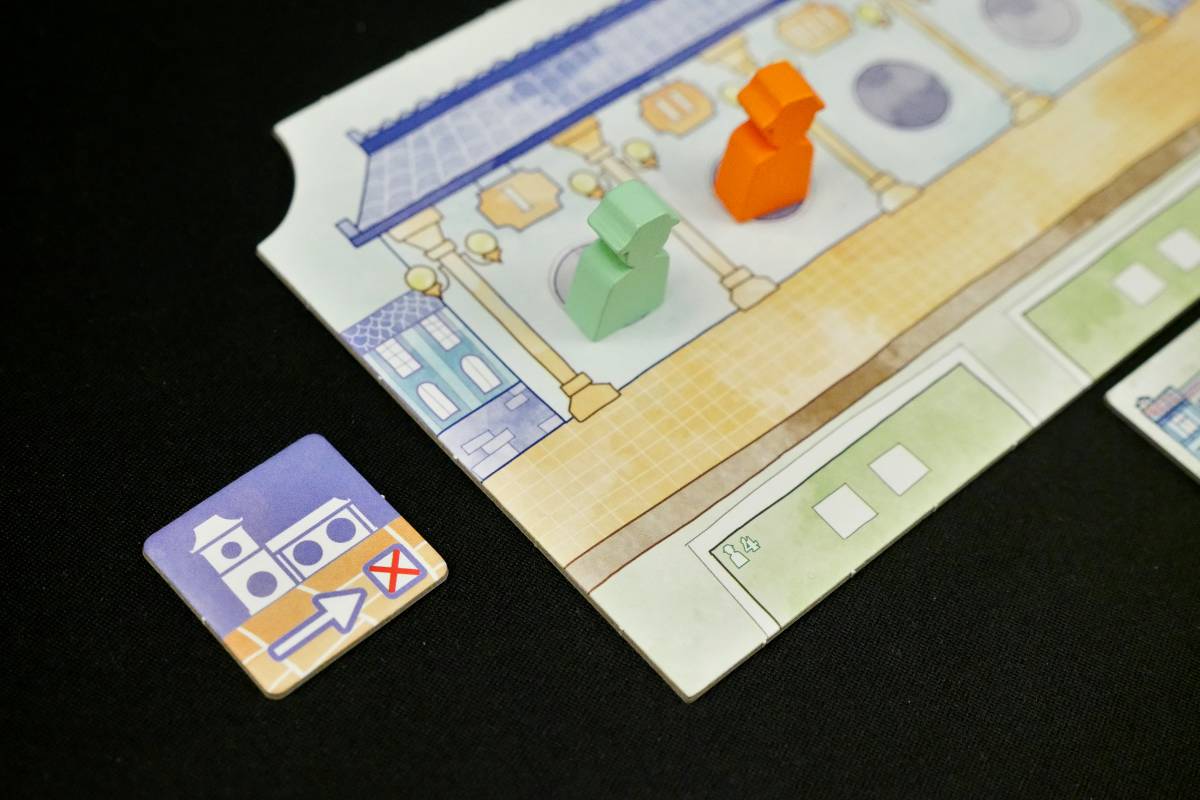
I'm no stranger to complex games, but this flow just feels clunky. I've forgotten a step here and there at times, and I always need to keep the rulebook reference nearby to make sure I'm not skipping or bungling the proper order of phase resolution. It's especially bad with the 2-Player Token, which feels like an afterthought.
Replayability
In many cases, a board game loses its replayability once its novelty has worn off. Railroad Tiles doesn't have much novelty to start with, nor is there much to explore from play to play. Sure, you have random tiles that you draft and fit into your tableau, and sure, your decisions do matter to an extent... but not enough. As a result, the whole experience feels samey and monotonous.
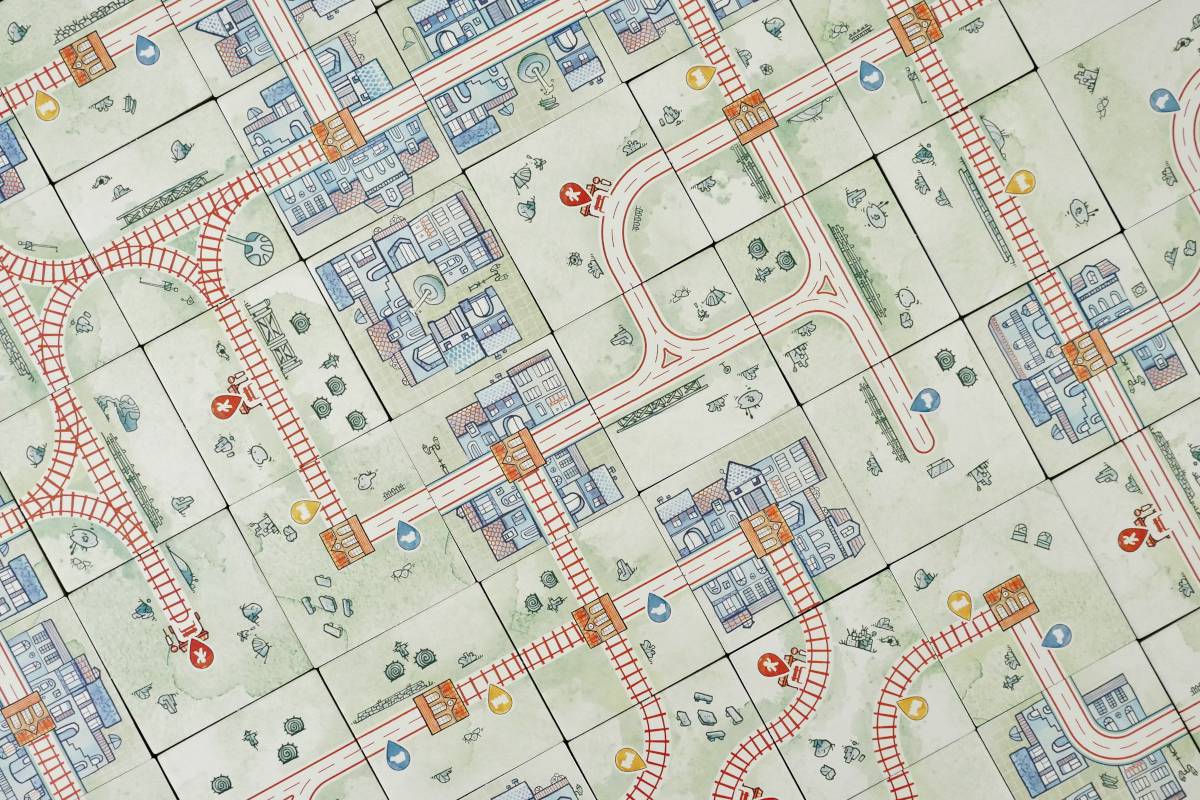
Put it another way, Railroad Tiles is pleasant enough on any given turn, but it doesn't offer anything more beyond that. With it lacking a real game arc and a punchy climax, there's nothing memorable about it, nothing exciting about it, nothing compelling enough to draw me back. The imbalanced scoring incentivizes a certain style of play and the Objectives don't shake things up enough. It has no highs, no lows, and not enough depth to maintain interest.
I've played lots of great games where you "do the same repetitive action over and over" without getting bored or feeling flat. (Examples include Welcome To..., Castle Combo, and Tag Team.) Those games succeed because their decisions have depth, while Railroad Tiles goes for breadth—and for that reason, it's shallow and forgettable.
Production Quality
Railroad Tiles is nicely made and I wouldn't expect any less from Horrible Guild. Their productions tend to be solid without being extravagant or gratuitous, with a keen focus on visually appealing artwork. If nothing else, their stuff is a joy to look at and handle. A lot of that is here, too.
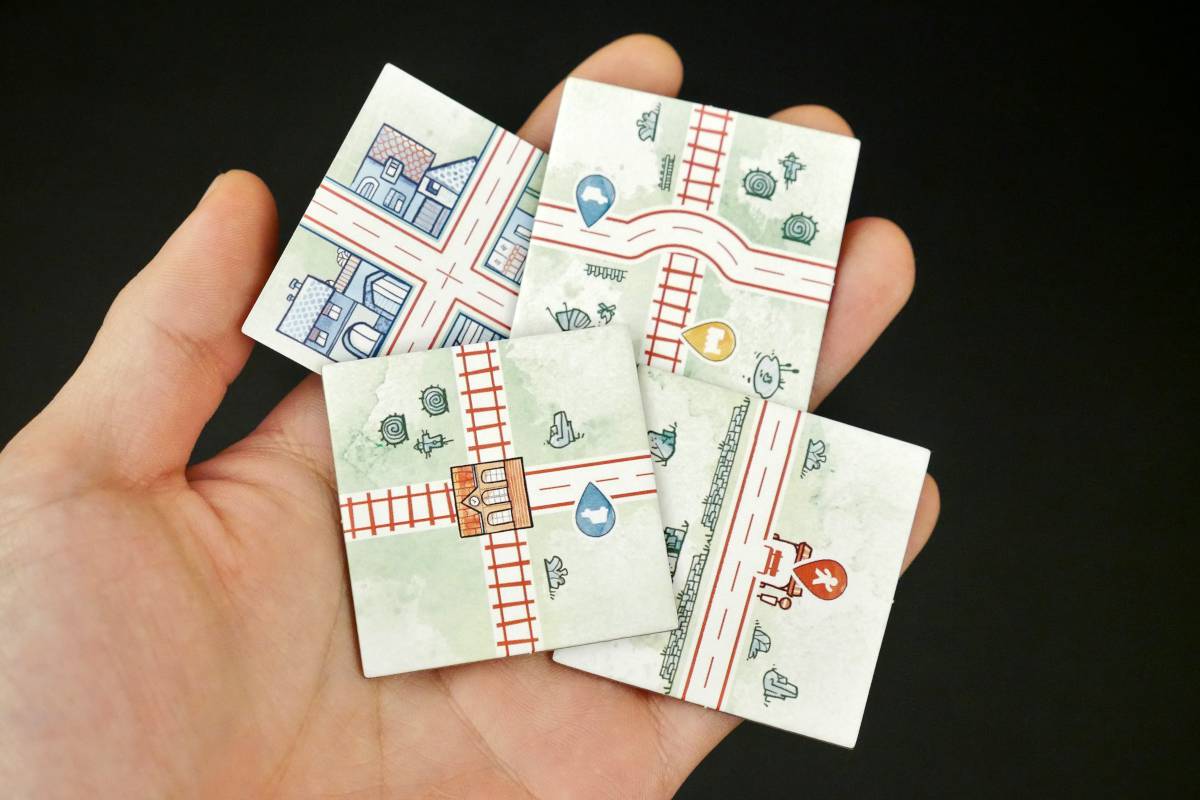
It has a charming and quaint aesthetic that's approachable. I might be dating myself here, but did you ever have one of those race car rugs as a kid? When I look at Railroad Tiles, I get the same sense—except with more of a watercolor twist. It's like a children's book. Gentle and playful. That makes it easy to enjoy and introduce to people.
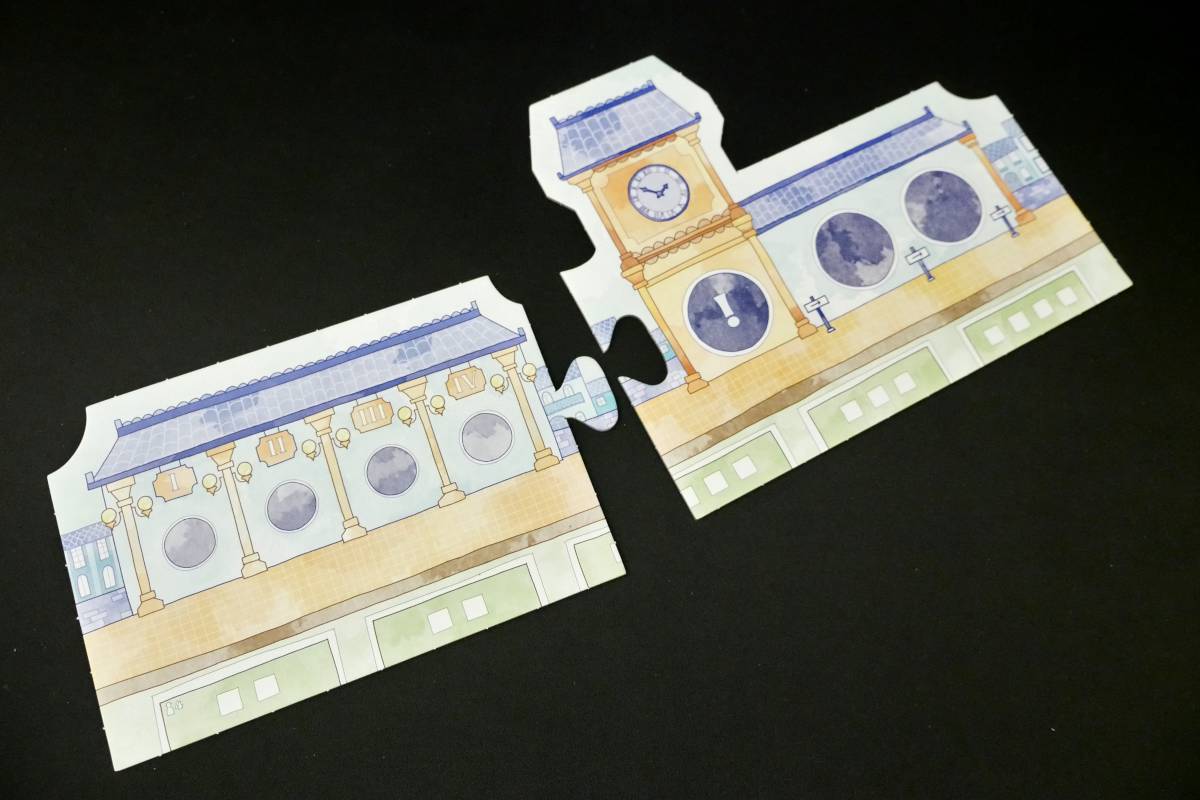
The Station Board is well-designed and guides the game flow. Railroad Tiles would be playable without the Station Board, but it does provide a lot of practical value. It tells you things like how many tiles per drafting set, what the drafting order is, and when the round ends. Overall, Railroad Tiles is smartly produced to ease things as much as possible.
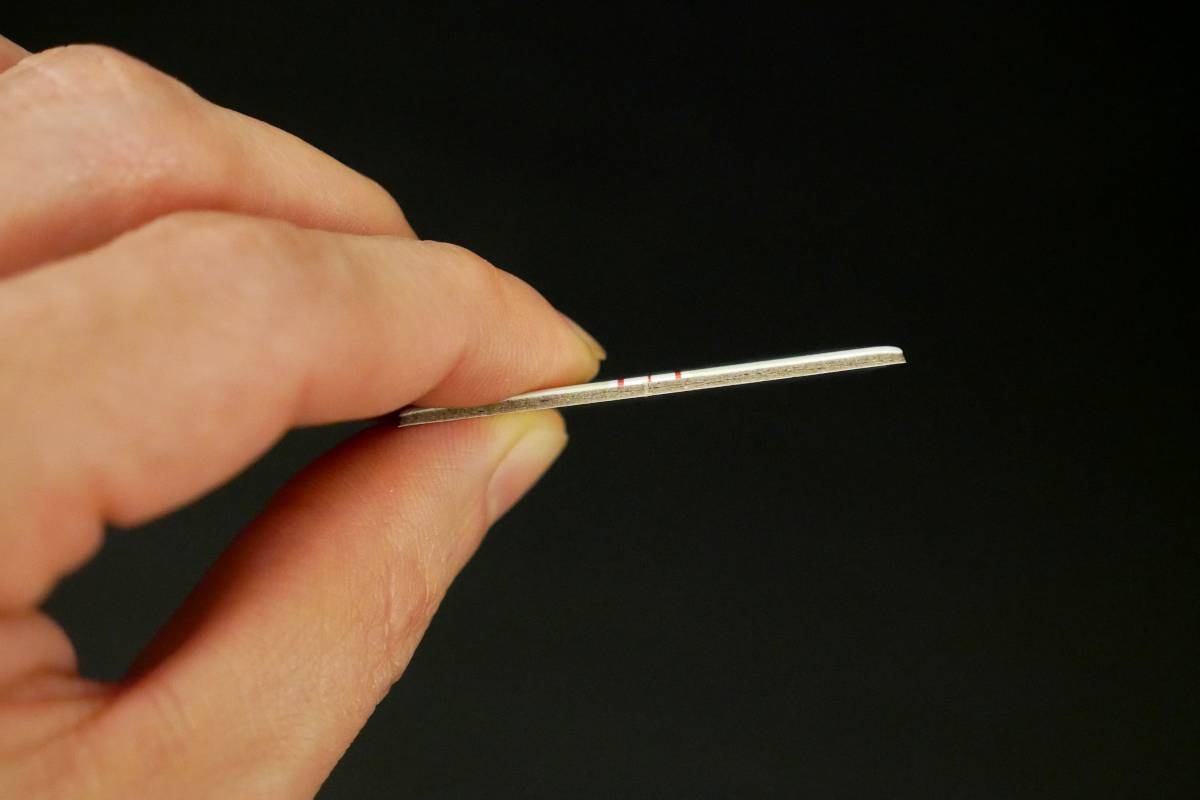
The cardboard tiles are fine. I wish they were smaller but thicker. Compared to other tile-laying games like Cascadia, AQUA, and Kingdomino, the tiles in Railroad Tiles feel weak. They're cumbersome to shuffle in the tile bag because they're too wide, and they aren't very satisfying to handle because they're so thin—and you do handle them often. It may not seem like a big deal, but it doesn't seem right for the price.
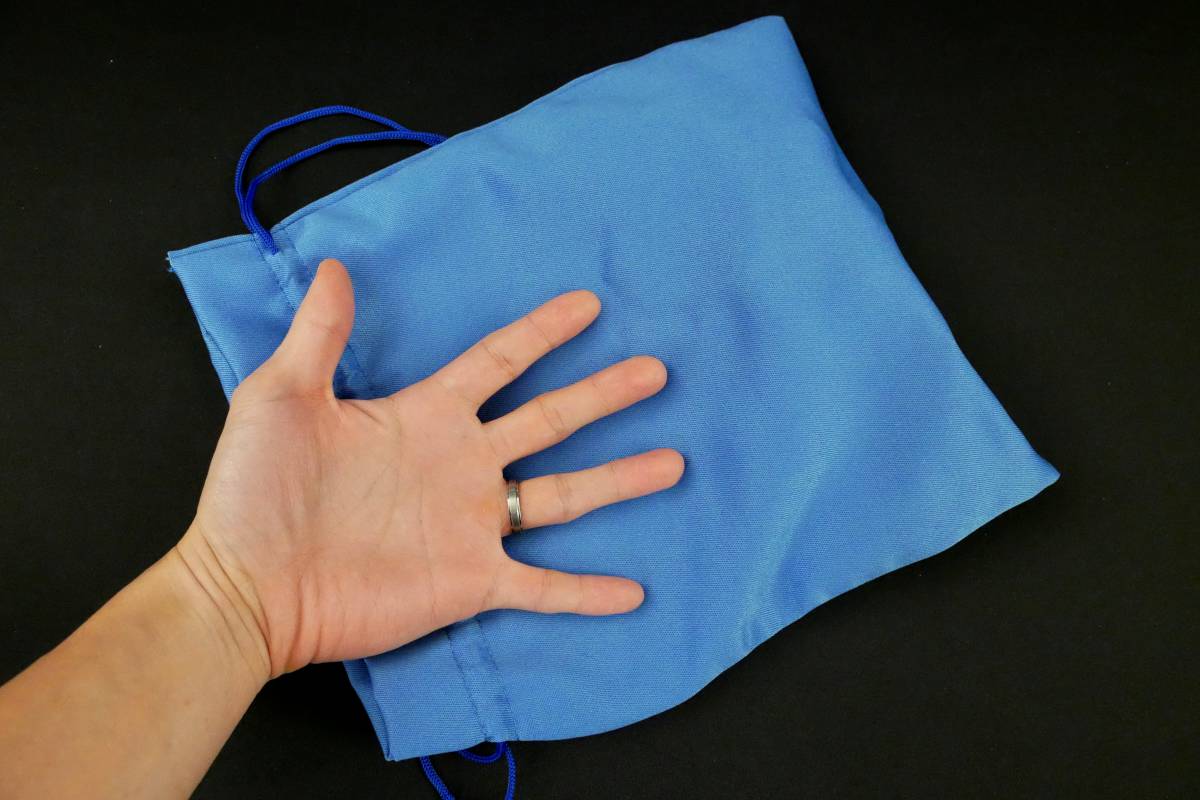
The bag is spacious and doesn't feel cheap. After playing several other bag-pulling games with undersized bags, I really appreciate the oversized design of the bag in Railroad Tiles. It's not just big enough to stick my hand inside, but even large enough to shuffle everything around inside without tiles spilling out or crushing each other. Very convenient.
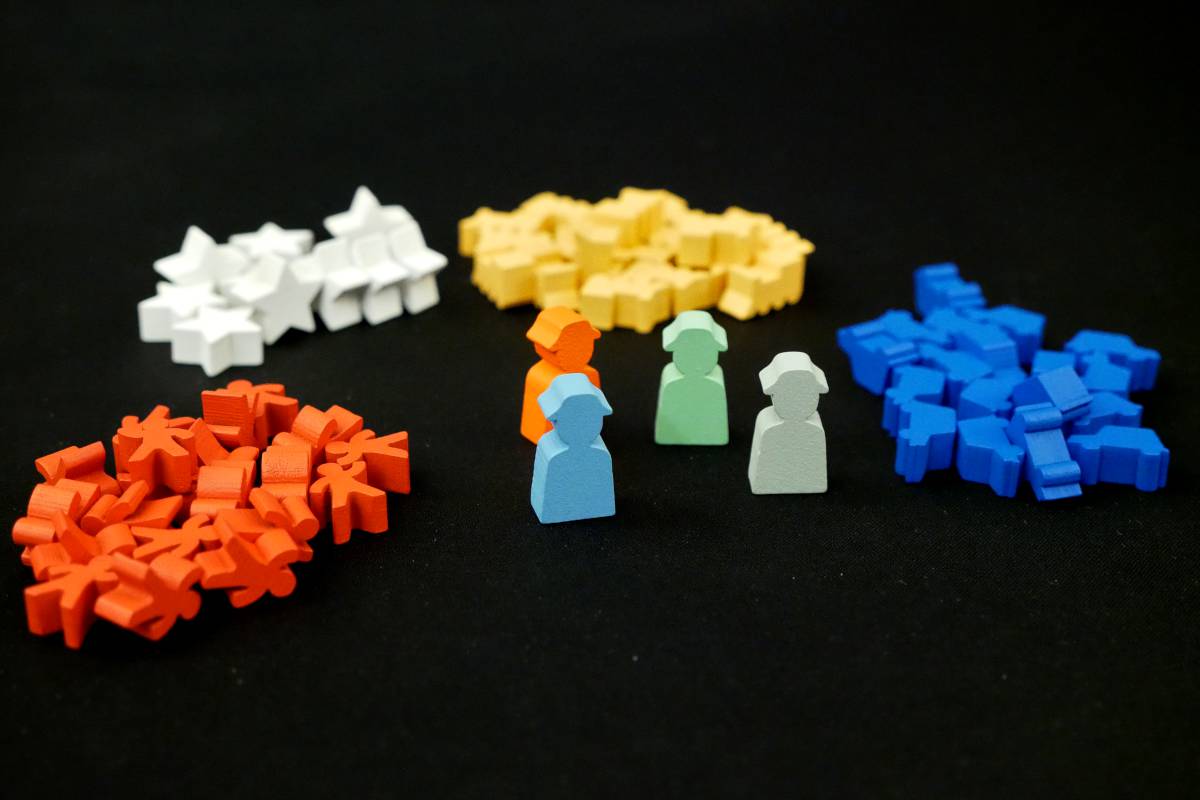
The wooden pawns are a nice tactile touch. They're small, but they need to be in order to fit on the tiles without it getting too cluttered. Their colors are stark and easy to tell apart, and they're easy enough to pick up and place. Did they need to be wooden pawns? Probably not. But it's nice, for sure.
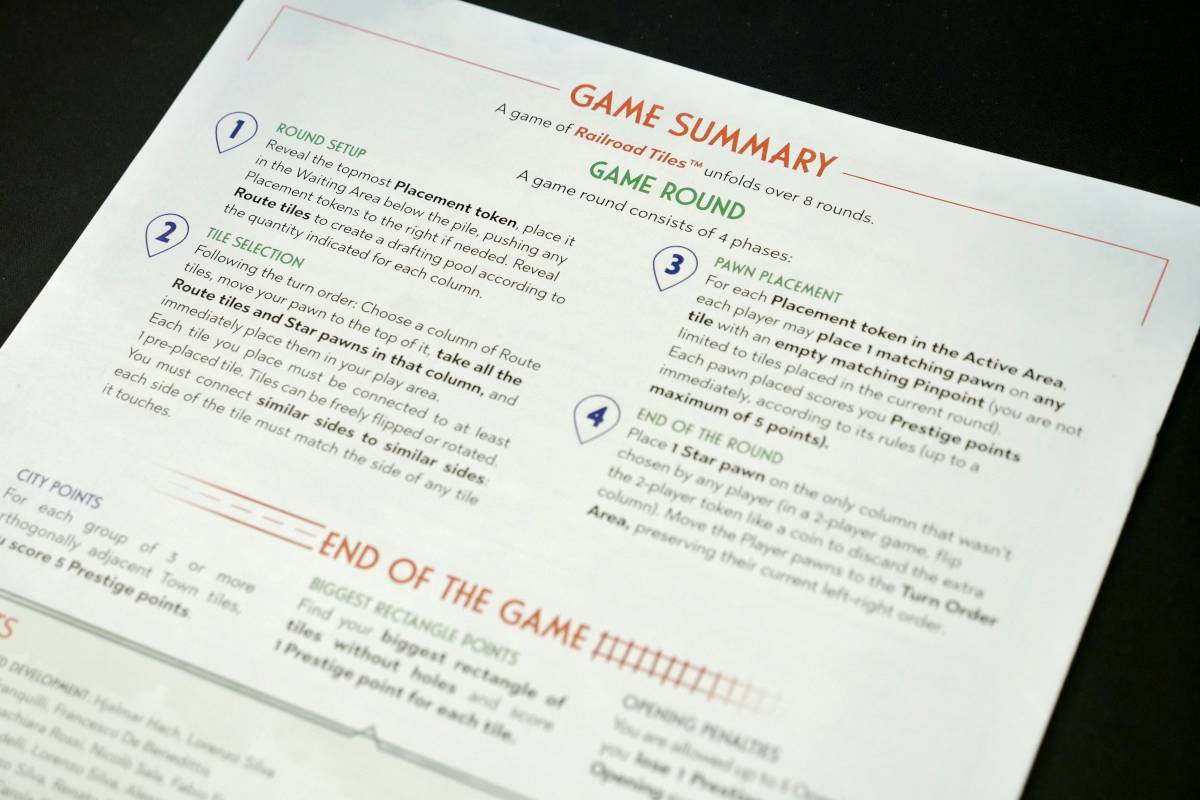
I appreciate the quick reference on the back of the rulebook. With how clunky the game flow feels, the quick reference saves the day. I'm constantly looking at it to make sure I don't miss any steps while shifting from phase to phase, and it's nice to have for scoring at the end, too. In fact, it's so useful here that it boosts the overall score by a full point for me.
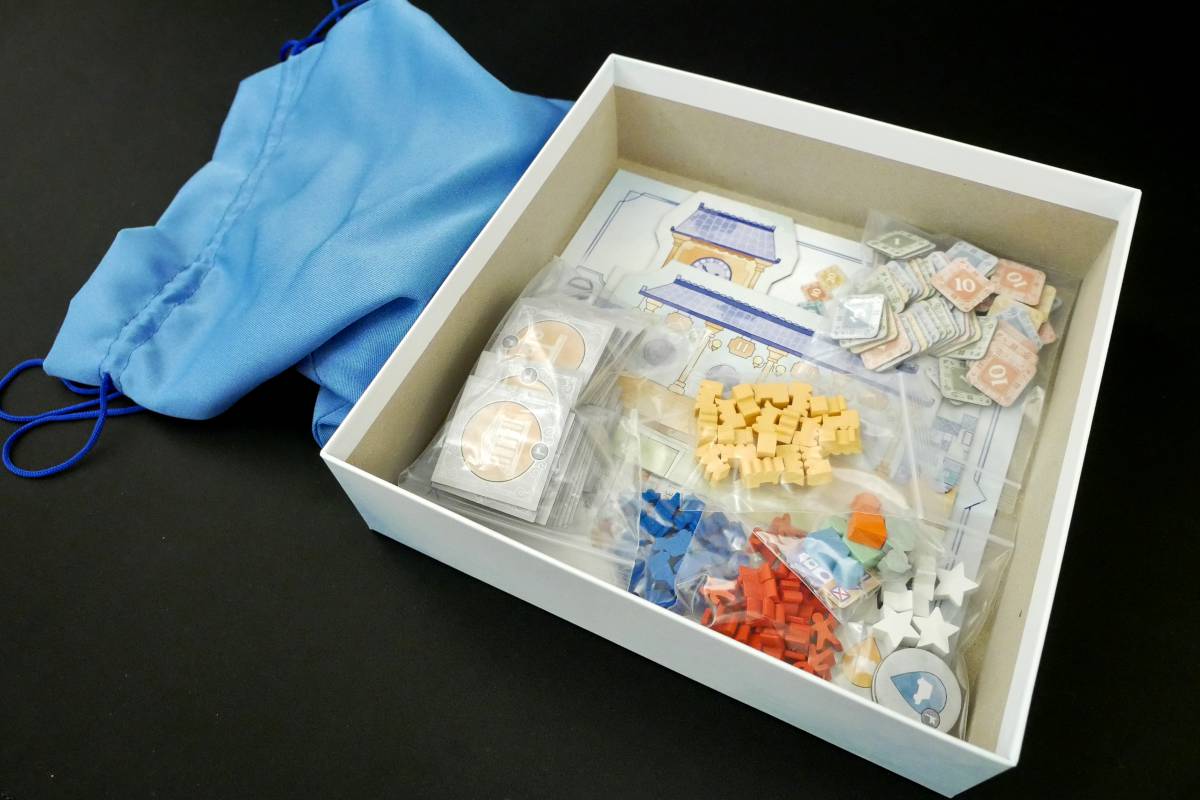
The game box fits everything and is no bigger than it needs to be. While the big bag of tiles takes up a lot of space, Railroad Tiles has no trouble packing everything back in without any lid lift—and it does so without the box being unnecessarily large. It's actually smaller than your typical Ticket to Ride-sized box, which I appreciate. A small box for a small game.
The Bottom Line
Railroad Tiles is pleasant but unimpressive. There's nothing groundbreaking here. It fills the exact same niche as other tile-laying, pattern-matching, multiplayer solitaire games for a small group. But it's hard to recommend over those other games because it's too lucky, too clunky, and too pricey for what it is. It isn't bad—it's just unexceptional.
Stop Buying Games
You'll Regret
Before your next game purchase, run it through this mental checklist that every seasoned gamer uses.
Free checklist, delivered instantly to your inbox.
No spam, ever. Unsubscribe in one click.