
Board games come and go. Most barely get a year in the spotlight before they're forgotten and replaced by newer releases, and even the super popular ones may not make it past five years. True classics are rare in the board gaming sphere—but Ra is one of them.
Only a handful of games from 1999 are still even remembered, and among the ones that are, none of them beat Ra in sheer popularity and renown. The 2023 revamp by 25th Century Games certainly helped, but this game was still generating buzz before that.
To be honest, I was skeptical going into my first Ra play, thinking it'd be overrated... and I'll happily eat crow on that. In this review, I'm going to do my best to show you why Ra remains one of the cleanest, most well-designed, most enjoyable board games of all time.
This review is based on my own personal copy of Ra, which I bought new from Game Nerdz. It's the 2023 version by 25th Century Games. While all editions of Ra have the same gameplay, the production quality of this one is significantly different (improved) versus past editions by Windrider, Rio Grande, Uberplay, and Alea.
Overview
While Ra is best known as an auction game, it's really a push-your-luck set collection game at heart. You play the role of an Egyptian king who's tasked with leading your kingdom to prosperity, and you do that by vying with other kings (i.e., other players) for precious resources while avoiding the disasters that threaten your land.
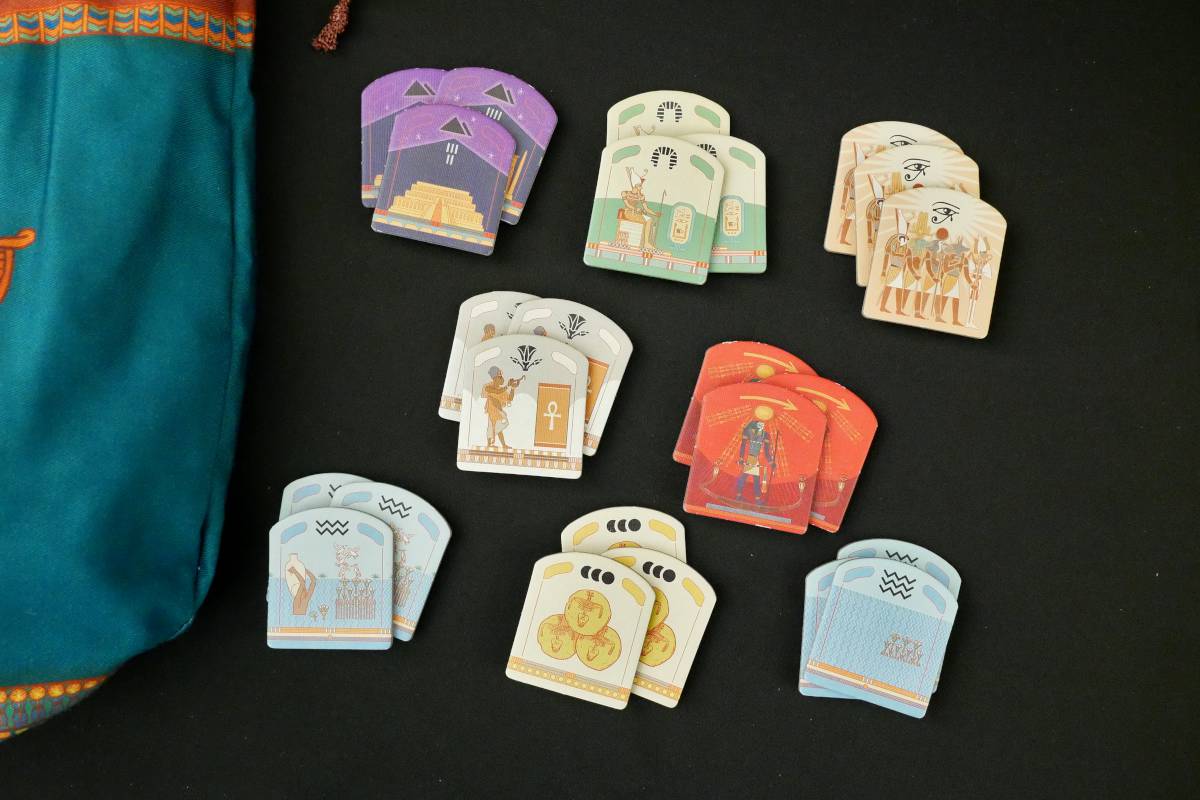
Core to Ra is a bag of tiles. These tiles comes in 8 different types: Monument, Civilization, Nile, Flood, God, Gold, Pharaoh, and Ra. The first 7 tile types are used for scoring, with each one scoring in its own unique way. The final tile type (Ra) is used to trigger an auction.
On your turn, you have three possible actions. You can only do one of the three actions, and then your turn is over:
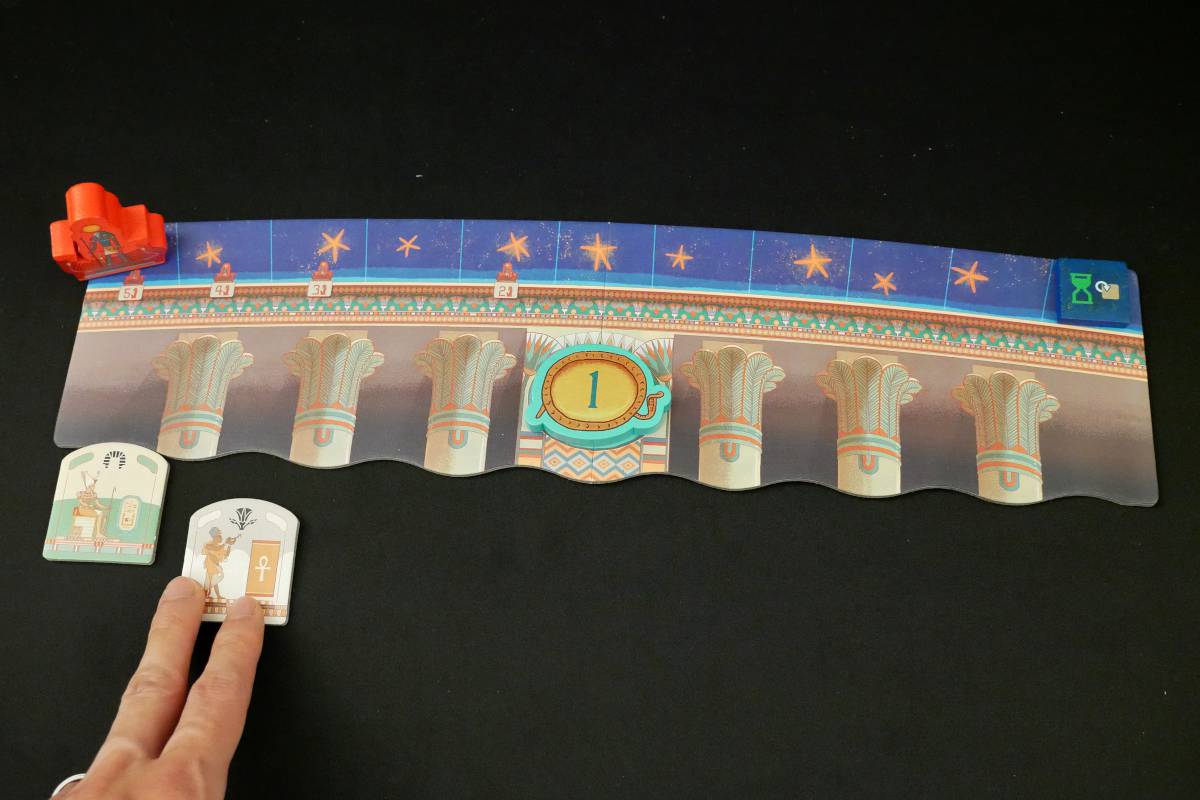
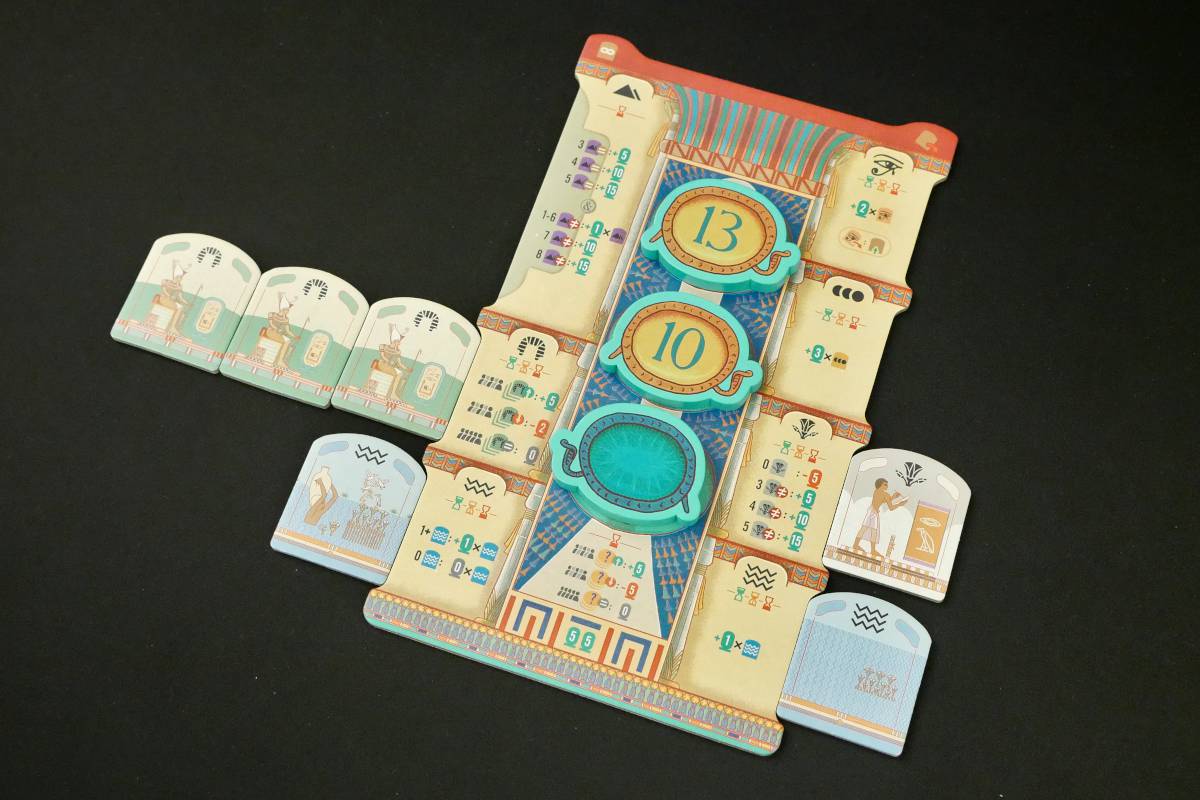
The first possible action is to Draw a Tile. Take the bag, shove your hand in, rummage around, and pull one out. That tile gets added to the Auction Track, which is where the current lot of auction tiles is kept. And that's it! That's the end of your turn...
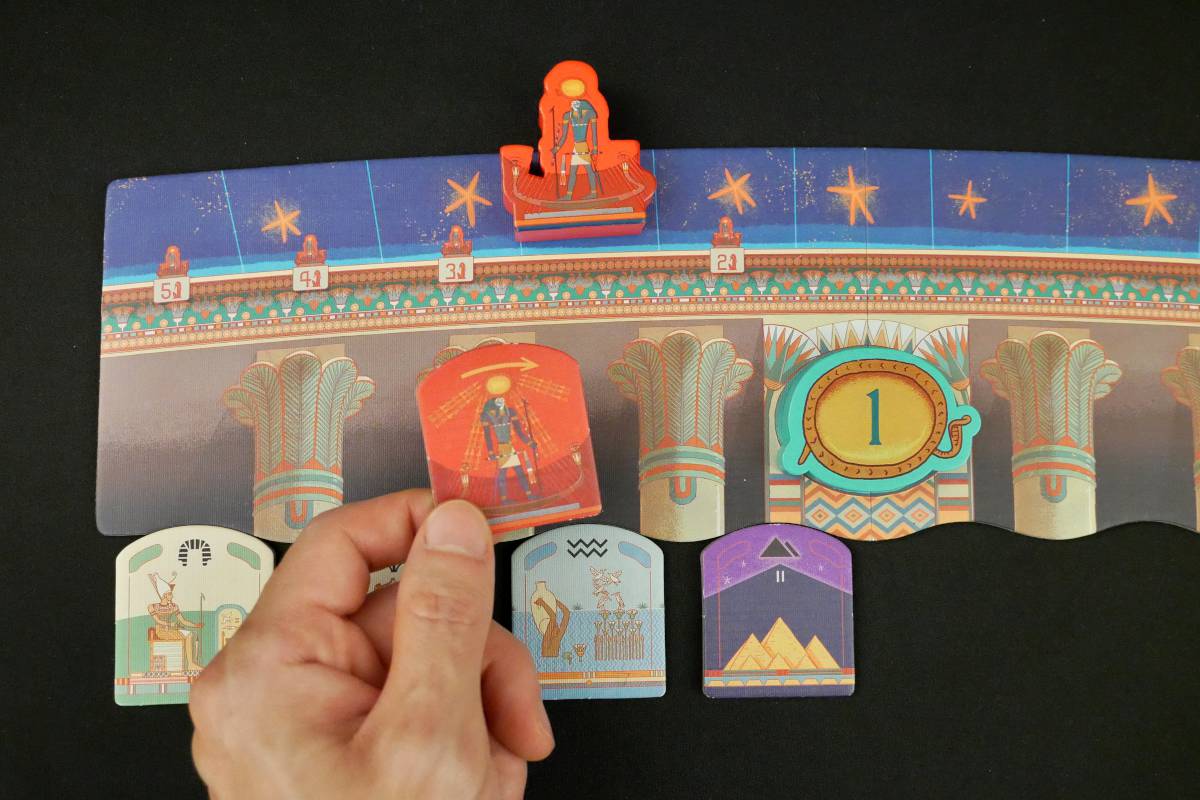
...well, unless you pulled out a Ra tile. Unlike every other tile type, the Ra tile is special and doesn't get added to the Auction Track. Instead, it moves the Sun Boat one space along the Epoch Track, then triggers an auction. (More on how the auction works below.) If moving the Sun Boat brings it to the last spot of the Epoch Track, the auction is skipped and the Epoch immediately ends. (More on Epochs below.)
If the Auction Track is full, you can't do the Draw a Tile action. You must either Invoke Ra or Spend a God Tile instead.
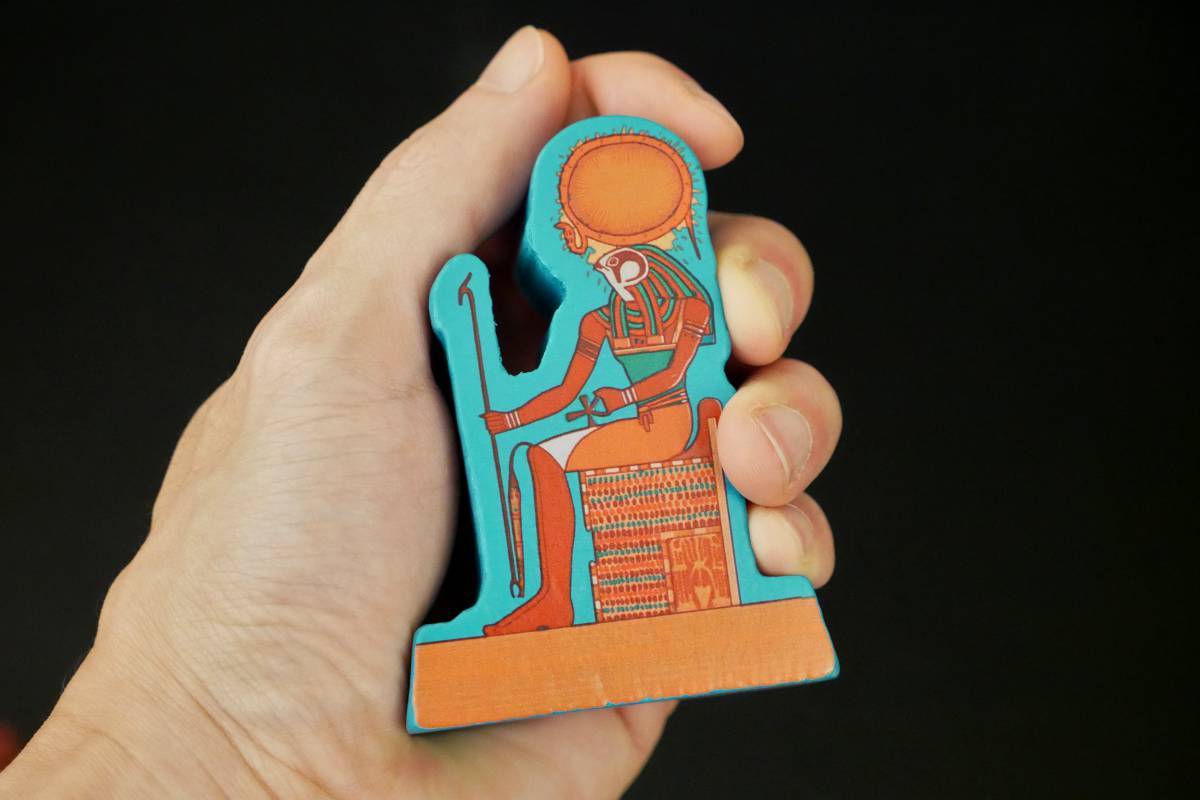
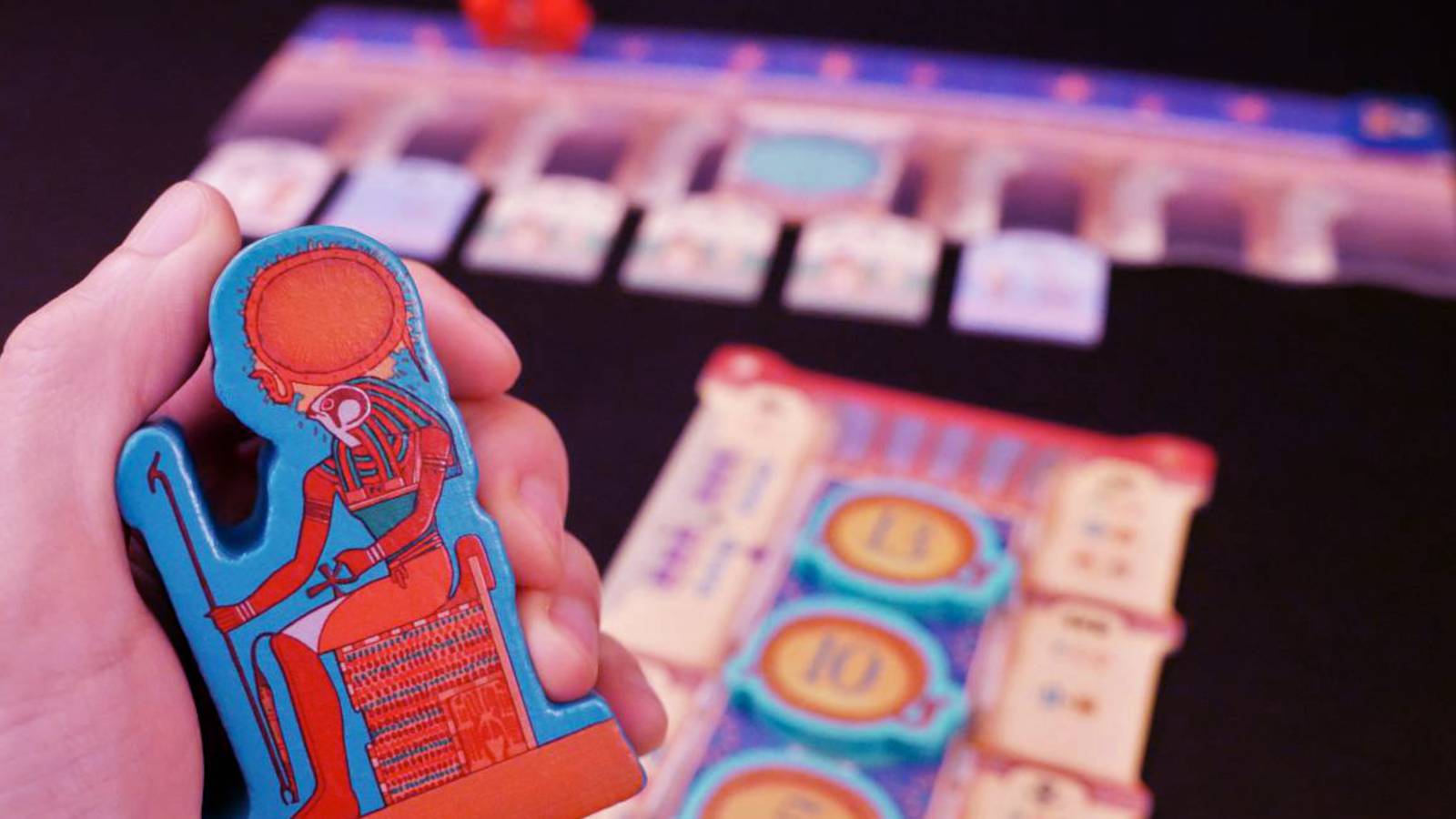
The second possible action is to Invoke Ra. The game comes with a thick, chunky statue that you simply grab and wield to invoke Ra, which immediately begins an auction. (More on auctions below.)
Unlike drawing a Ra tile (see above), invoking Ra does not move the Sun Boat along the Epoch track.
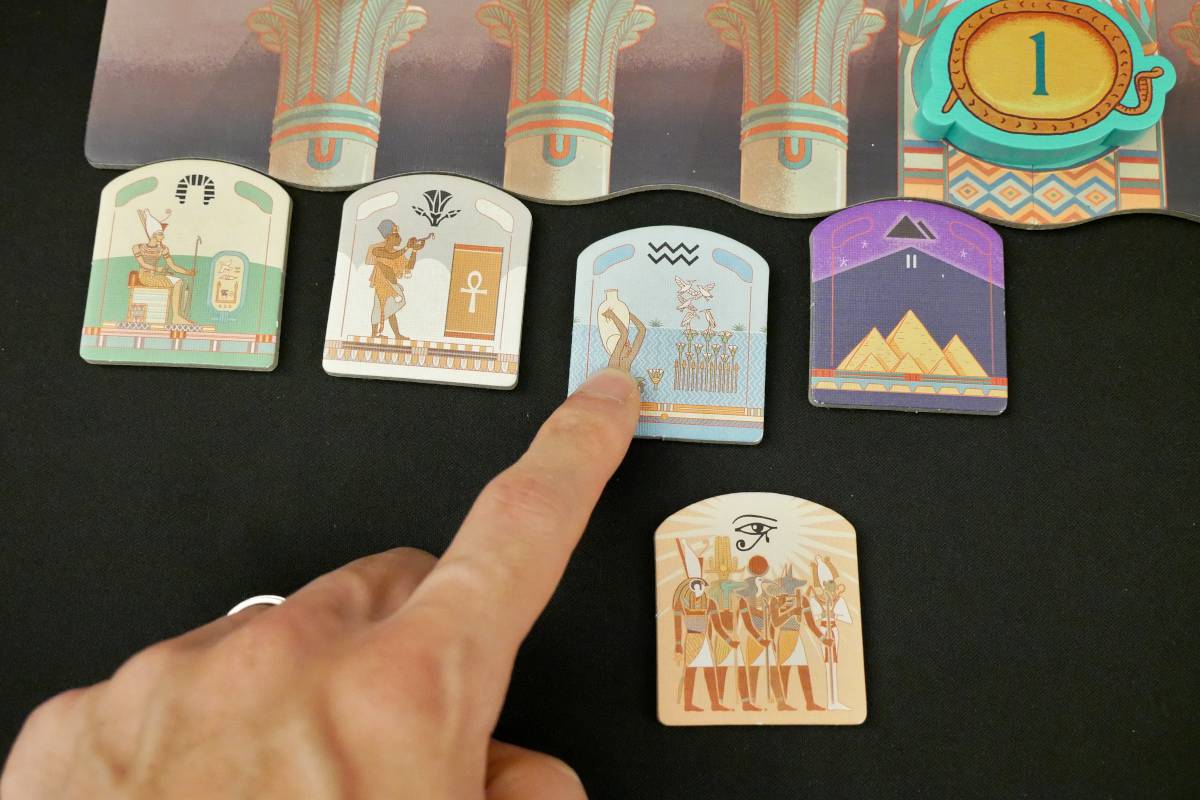
The third possible action is to Spend a God Tile. If you have any God tiles in your kingdom (which would've been acquired by winning past auctions), then you can discard any number of God tiles from your kingdom to take an equal number of non-God tiles from the Auction Track. Yoink!
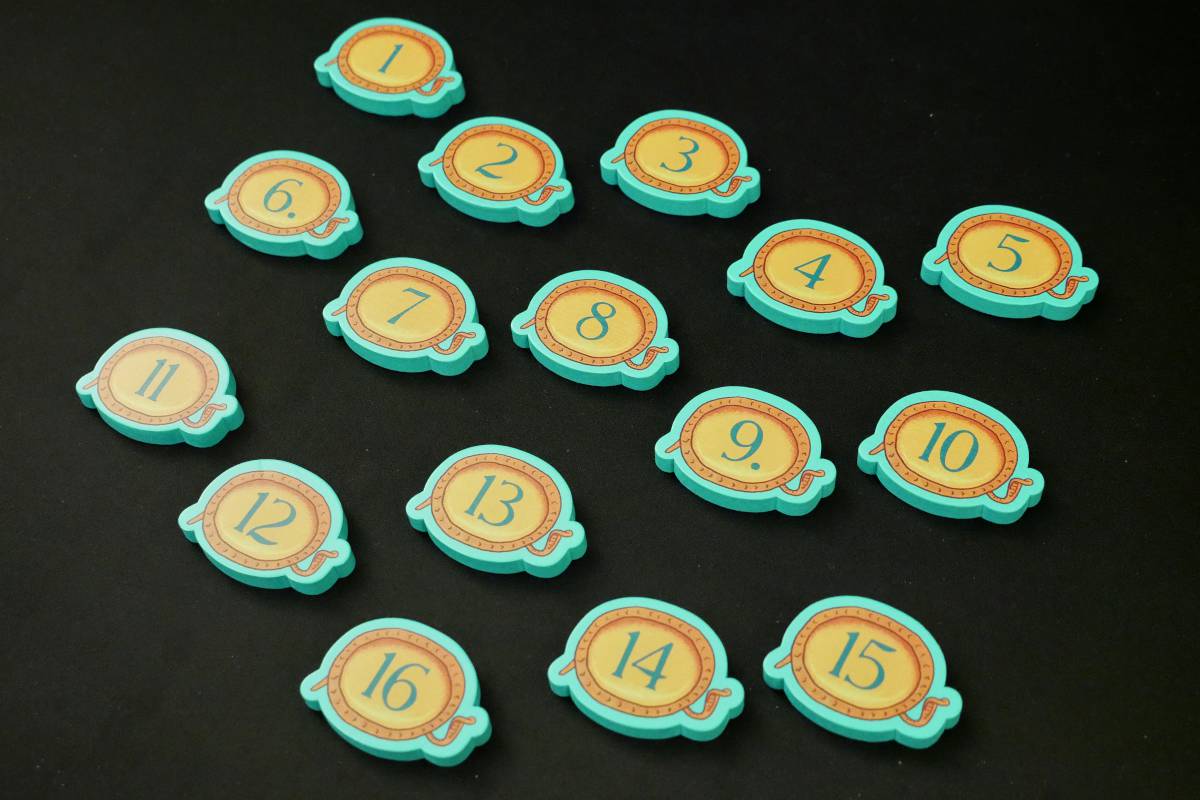
Before we talk auctions, let's talk Sun Disks. Sun Disks are numbered 1 through 16 and there's only a single Sun Disk of each number. These Sun Disks represent your bidding power in auctions. They're the "currency" you use for making bids, unlike the "money" you'd normally use in an auction.
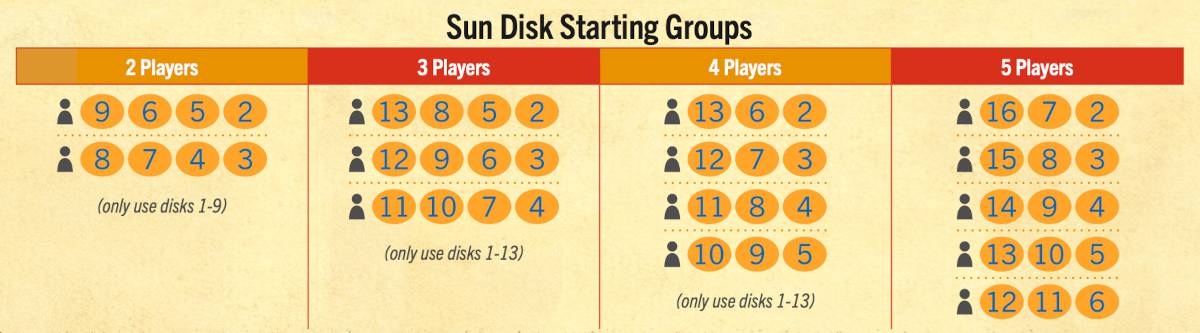
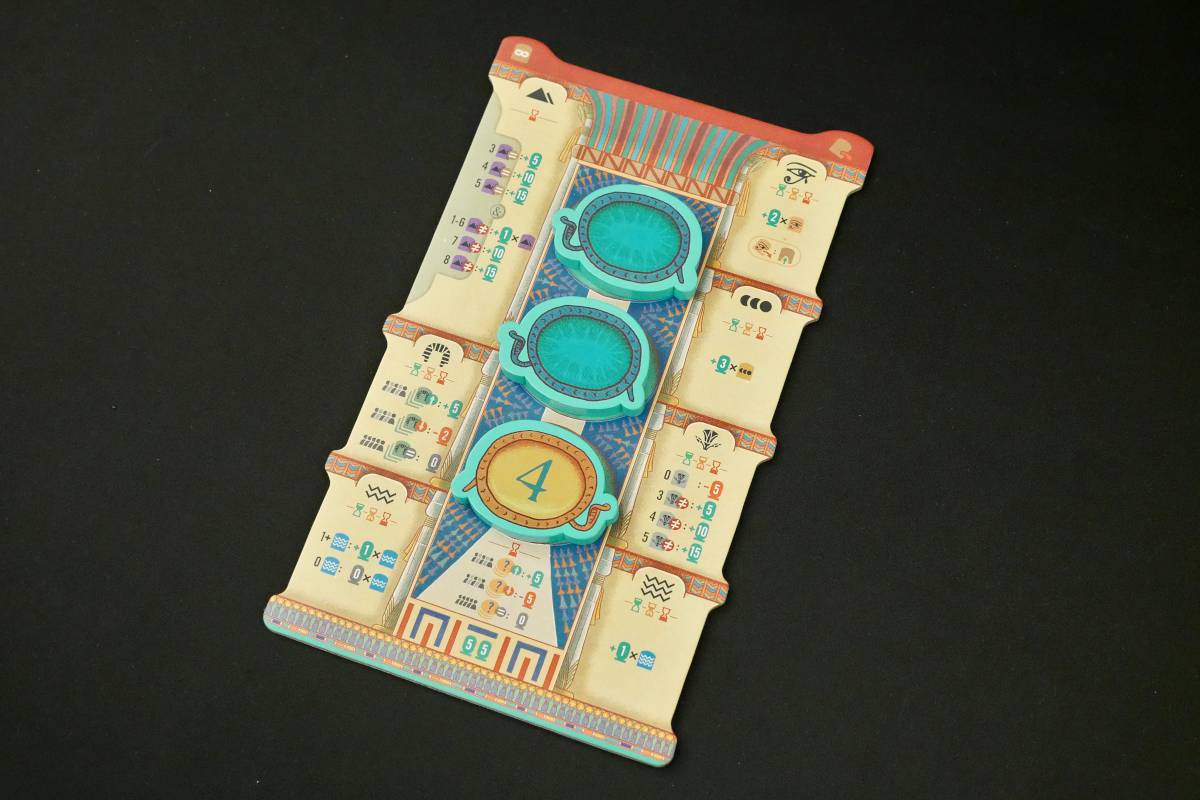
Every player starts with a set of three Sun Disks (with 4 to 5 players) or four Sun Disks (with 2 to 3 players), with each starting set fixed according to each player's board. Meanwhile, the 1-value Sun Disk starts on the Auction Track, belonging to no one. (This will be important later.)
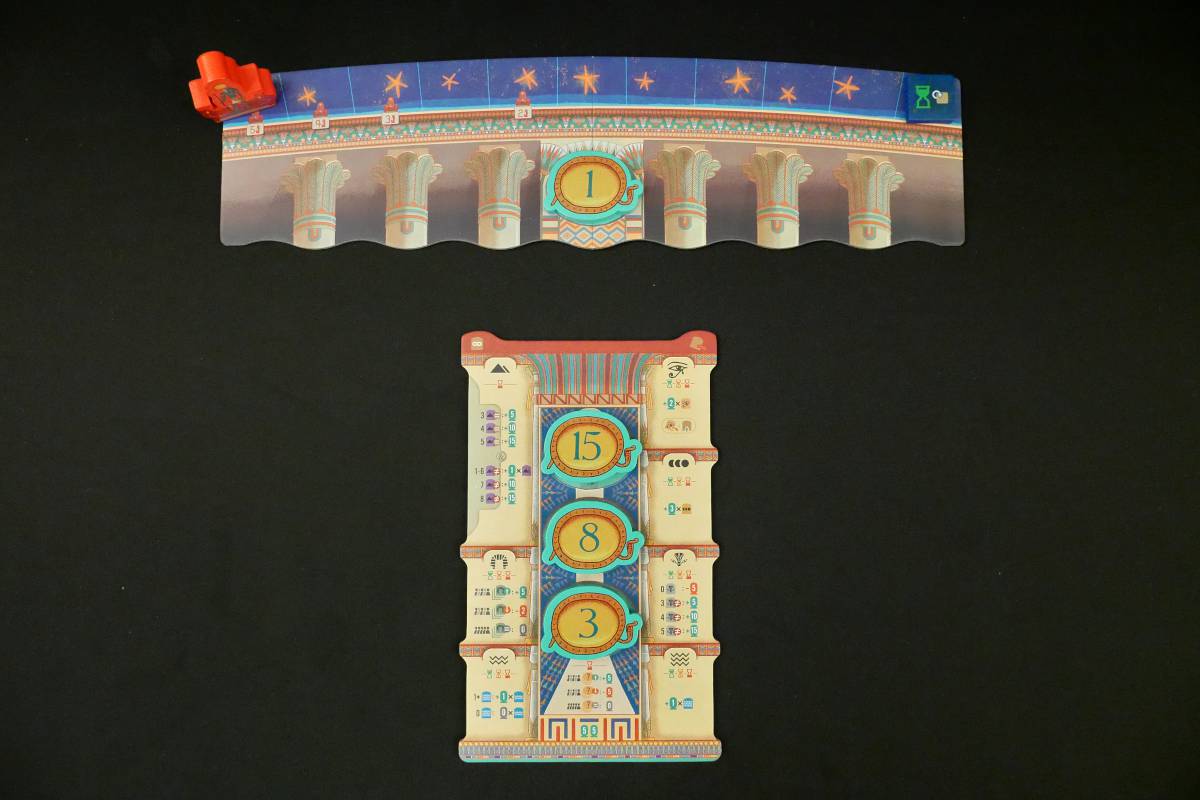
Sun Disks are used for bidding in auctions, with the highest-value Sun Disk winning any given auction. When you win an auction, the Sun Disk you used is swapped with the Sun Disk is on the Auction Track. Then, the Sun Disk you just got is flipped face-down on your board; it can't be used for the rest of the current Epoch. Everyone else gets their Sun Disk back.
Once all of your Sun Disks are spent for the current Epoch, you're out! You don't take any more actions and don't participate in any more auctions until the next Epoch.
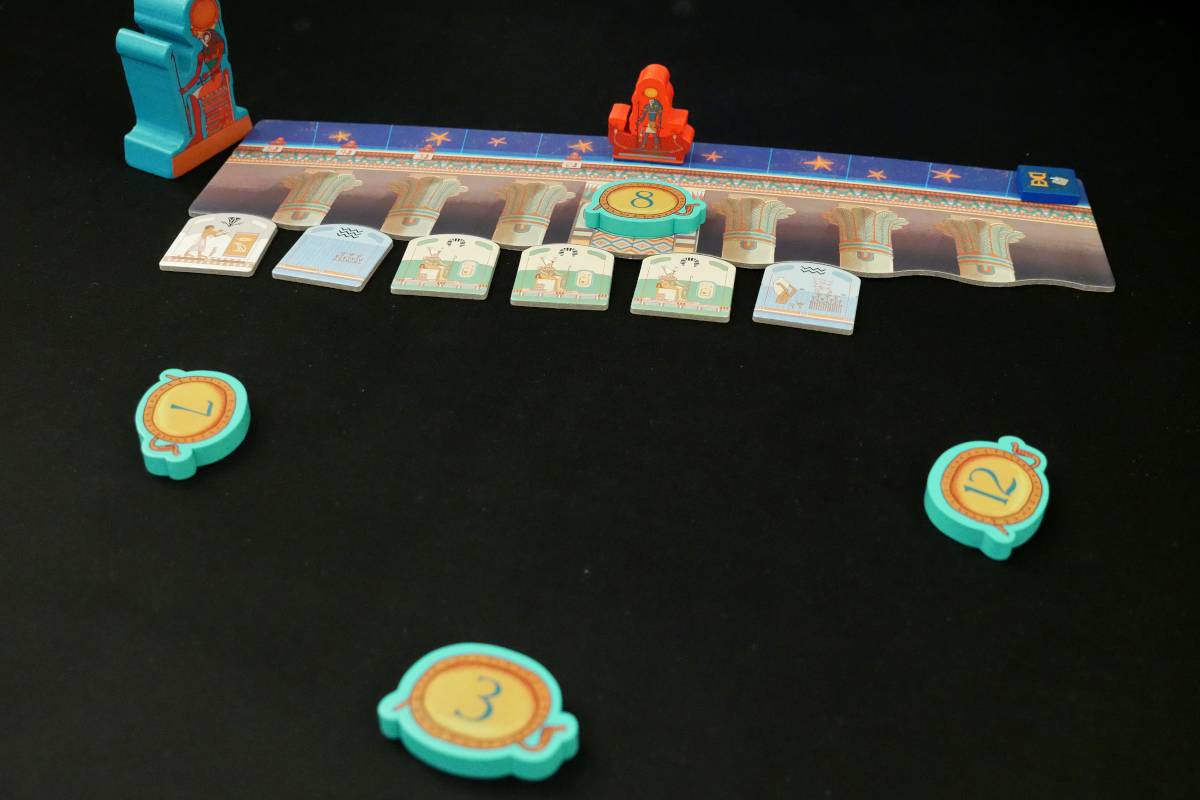
How does an auction work in Ra? The auction begins with the player to the left of whomever triggered the auction, and it goes once around the table in player order. Players can do one of two things:
- Bid using a Sun Disk. Take one available Sun Disk from your player board and present it as a bid.
- Pass. Do nothing and save your Sun Disks.
This is a once-around auction, so each player has only one opportunity to take an action. Whether you pass or bid, that's it! You can't take back your pass, nor can you re-bid with a higher Sun Disk.
Once every player has either pass or bid, the auction ends and the current lot of auction tiles is won by whomever bid the highest-value Sun Disk. The winner swaps their Sun Disk with the Sun Disk on the Auction Track, while everyone else keeps their Sun Disks. (No penalty for "losing" auctions in Ra!)
Okay, so what happens if everyone passes?
- If the auction was triggered by a Ra tile: Nothing happens. All auction tiles remain as they are.
- If the auction was triggered by someone invoking Ra and the Auction Track is full: All auction tiles are wiped from the Auction Track and discarded from the game.
- If the auction was triggered by someone invoking Ra and the Auction Track is NOT full: The player who invoked Ra is not allowed to pass if everyone else passes! In this case, they must bid a Sun Disk. Only if someone else bids are they allowed to pass.
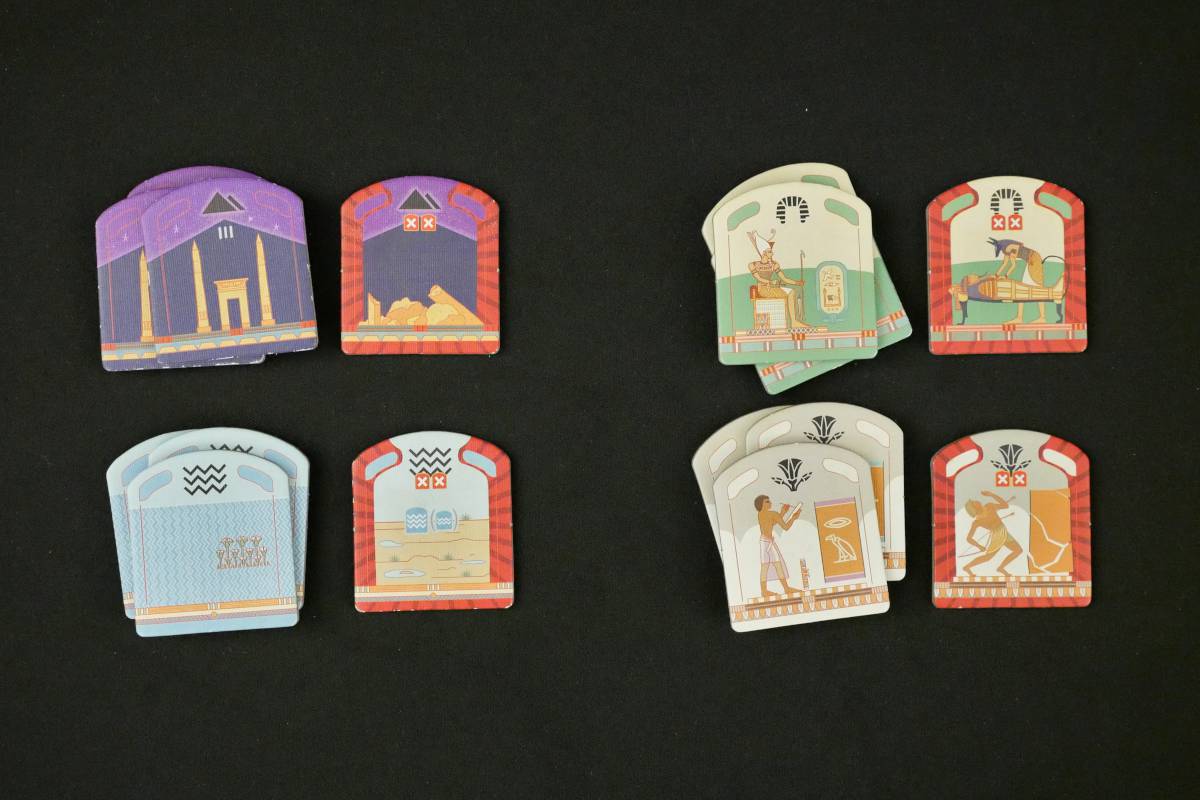
There's one final element to know about: Disaster tiles. Not every tile in Ra is good. These so-called Disaster tiles are added to the Auction Track when pulled from the bag (just like any other tile).
However, when you win an auction that contains Disaster tiles, each Disaster tile causes damage to your kingdom, forcing you to discard two tiles depending on the type of Disaster tile you acquired. Then, the Disaster tiles are discarded from the game.
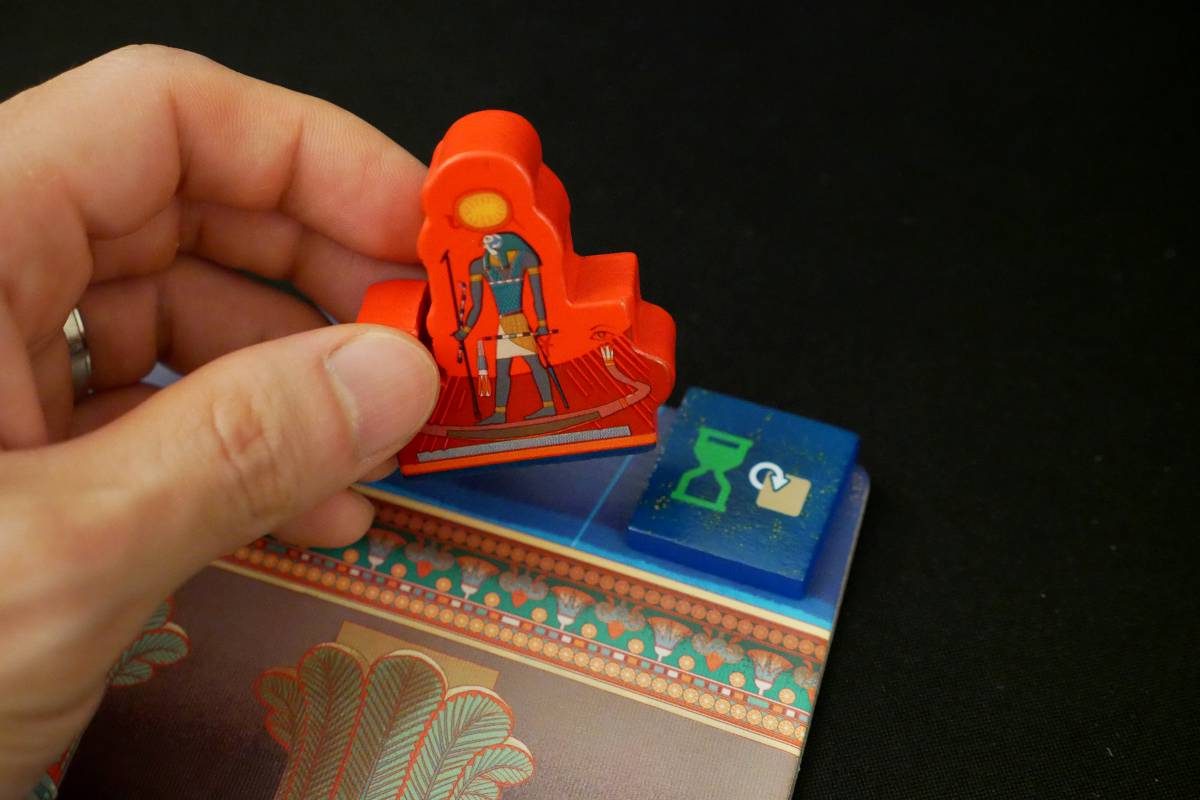
Ra is played over three Epochs. You can think of an Epoch as one "round" of the game, with each Epoch tracked using the Sun Boat across Epoch Track. The current Epoch ends when either:
- Everyone has spent all their Sun Disks. (Without any Sun Disks in play, no one can bid in auctions anymore.)
- The Sun Boat reaches the last spot on the Epoch Track. (The Sun Boat moves when Ra tiles are pulled from the bag.)
At the end of an Epoch, all players score the current state of their kingdoms, with each tile type scoring in its own unique way depending on what you've collected and how many you have. All Sun Disks are flipped face-up, then the next Epoch begins.
Earning points and losing half your kingdom. The scoring in Ra is a bit too involved to list in full, so here's the gist of it: Some tile types offer flat points. Some only score once you have a group of same tiles, while others score more points for collecting a variety within that tile type. Some are even competitive, so only the one with the most of that tile type earns points while whoever has the fewest loses points.
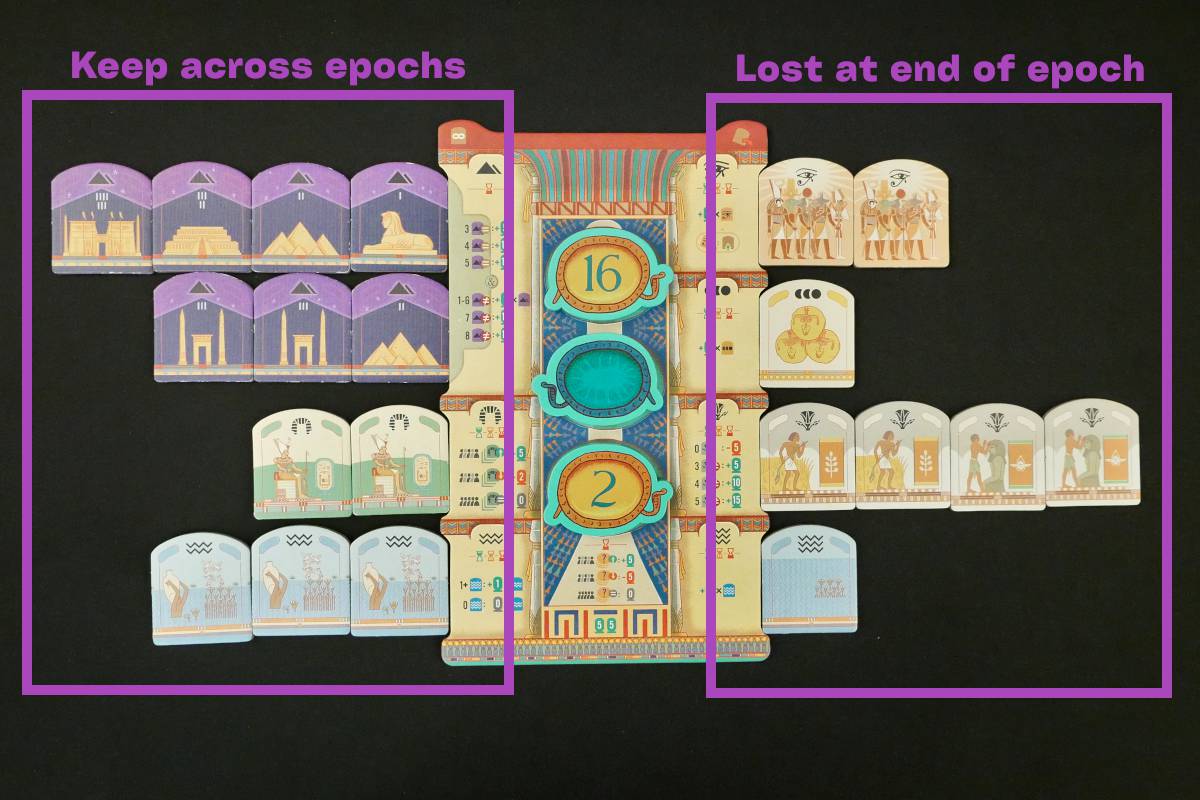
What's interesting about Ra is that when the Epoch ends, you lose half of your kingdom. The tiles on the left side of your player board (Monument, Pharaoh, Nile) stay, but the tiles on the right side (God, Gold, Civilization, Flood) are wiped out. Your state at the end of an Epoch could be drastically altered as you head into the next one, which keeps you on your toes.
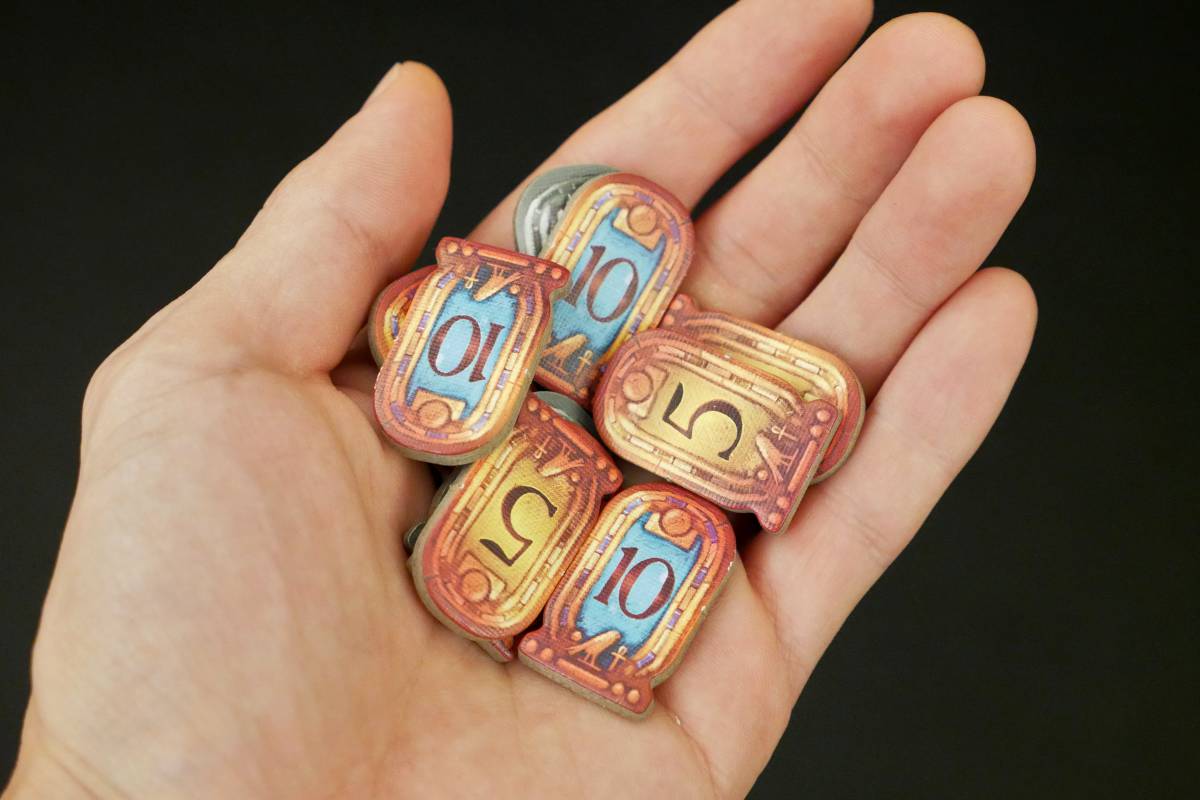
End game scoring. Your final score is your accumulated points across all three Epochs, plus or minus the final Sun Disk bonus/penalty. At the end, all players sum their Sun Disk values. Whoever has the highest value gets bonus points, the lowest loses points. And that's it!
Setup and Table Footprint
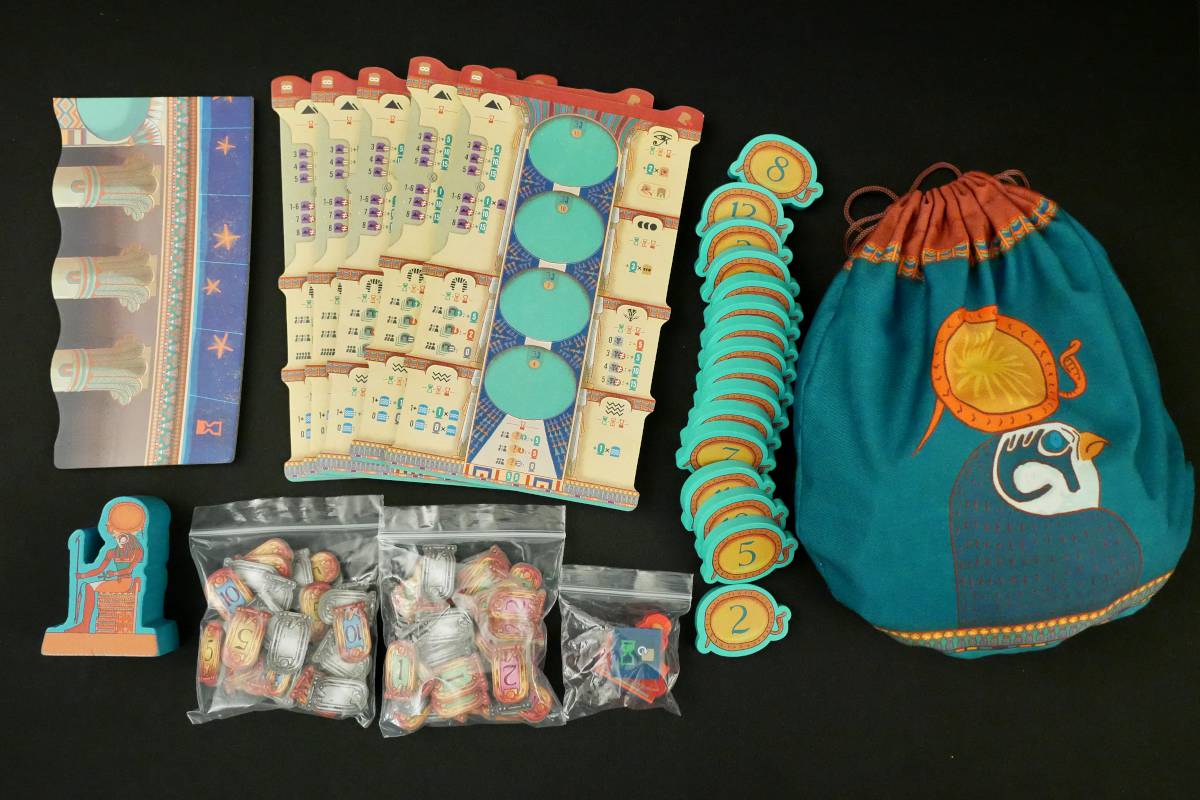
Of the many things to like about Ra, the relatively quick setup stands out because it makes for a game that's easy to pull out. The Auction Track goes in the middle and you throw both the Sun Boat and 1-value Sun Disk on it. The Ra statue and scoring tokens sit nearby.
What I love, though, is that each player board tells you exactly which Sun Disks you start with depending on player count. It completely eliminates any guesswork or confusion.
The bag, which already has all the tiles in it, can be mixed around if necessary. Then you're ready to go!
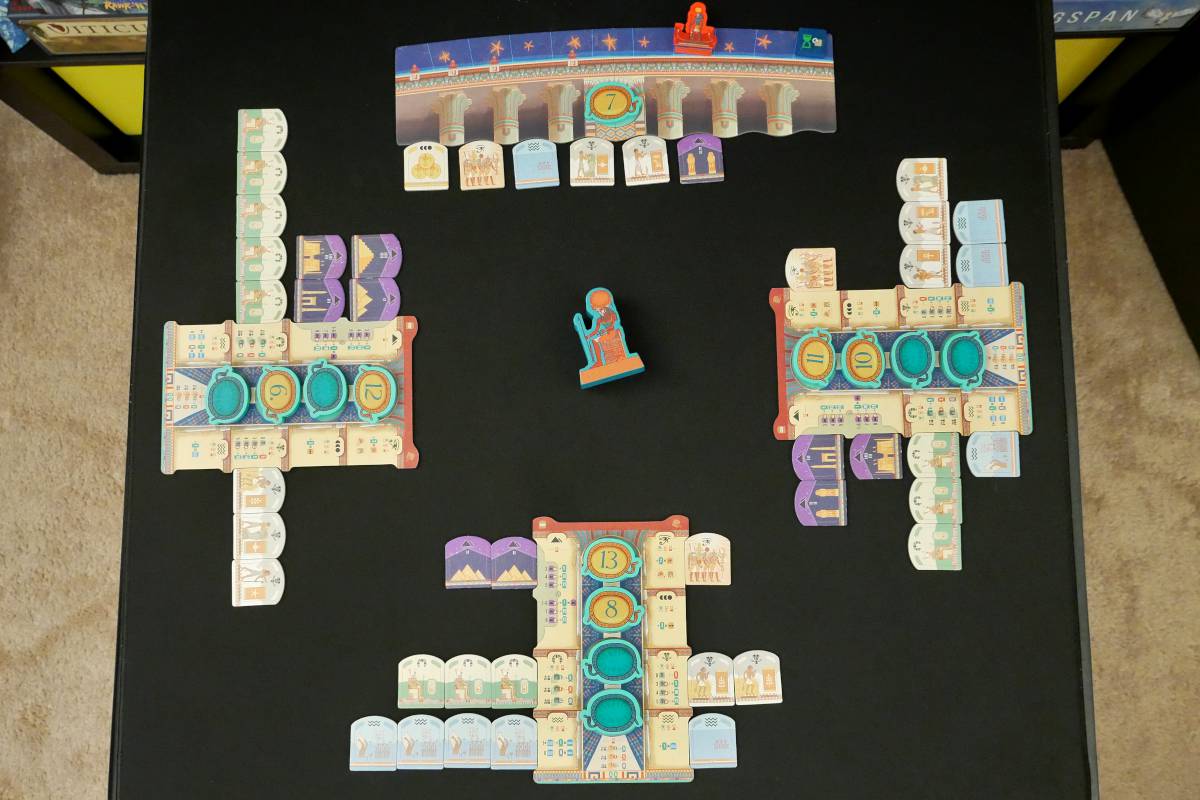
If table space is at a premium for you, then Ra might cause issues. I'd say it has a sizable table footprint, but it's reasonable and could've been a lot worse considering all the tiles in play. The player boards are what take up the most space, but they're so helpful for organization and scoring that I consider them essential and I'm glad they were included in production.
As tiles amass on either side of player boards, it can start to feel tight, especially on smaller tables. But the nice thing about Ra is that you can stack your tiles to get around such space constraints. Is it less convenient to play this way? Sure. But it works!
Learning Curve
Ra is somehow both simple yet takes a bit of time to wrap your head around. The actual game flow is straightforward: pull out a tile, build up the auction lot, and eventually auction it off. There are some rule quirks that can trip you up—like when you aren't allowed to pass in an auction—but overall it's surprisingly smooth.
The part with a learning curve is the scoring of all the different tile types. With 7 different scoring tiles and each one scoring in its own unique way, it can feel overwhelming for first-timers and non-gamers; each one is simple on its own, but it's a bit much altogether. You'll probably need one full playthrough to comfortably get it.
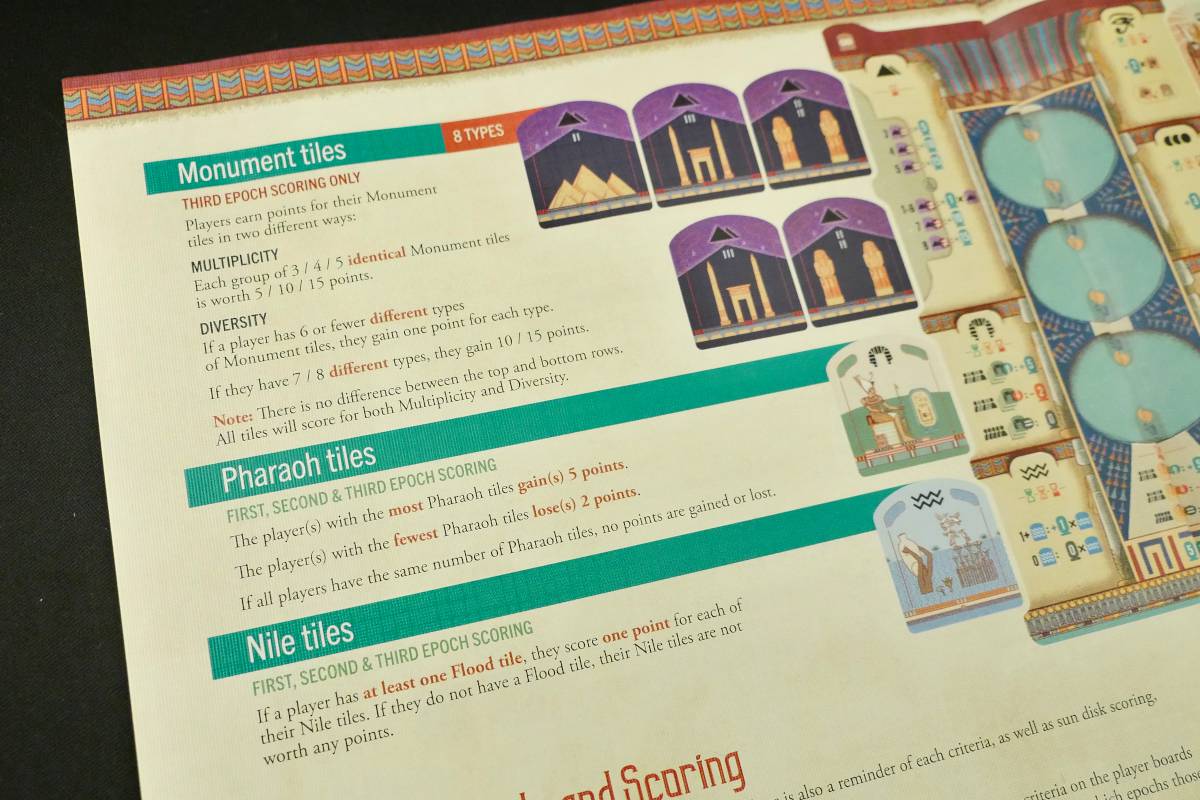
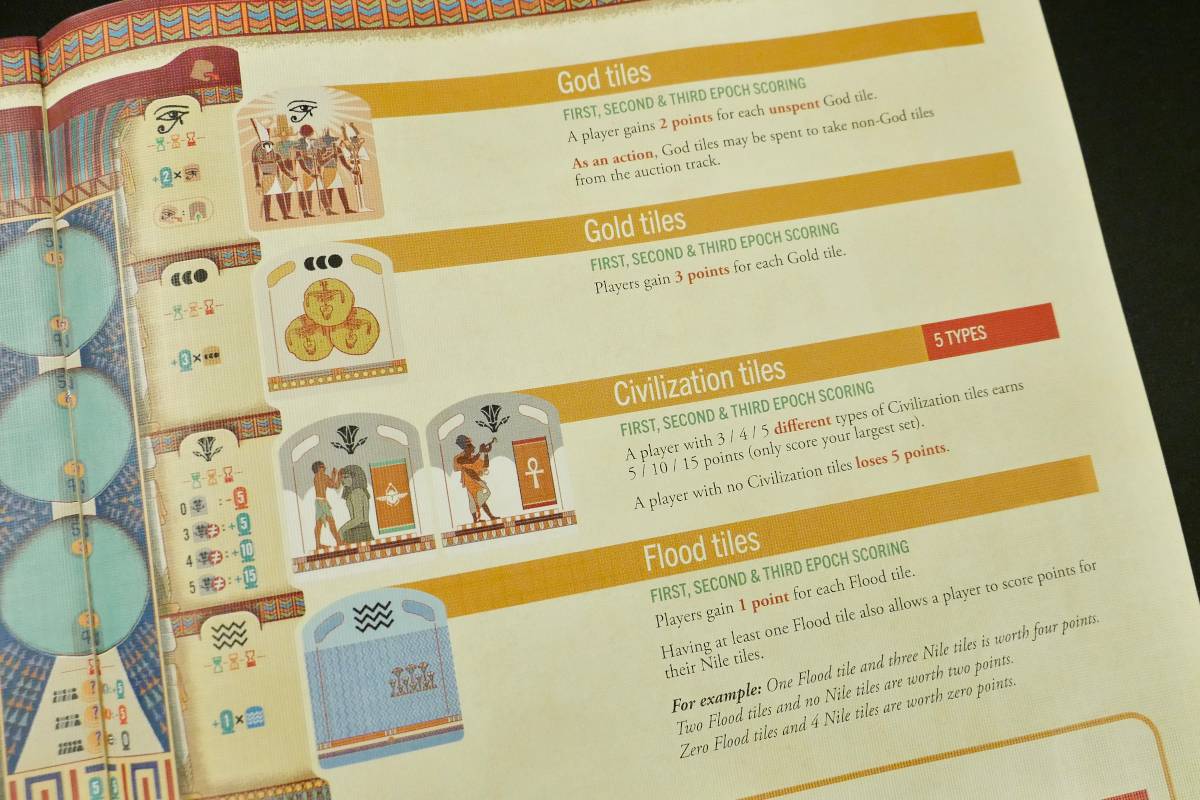
That said, every player board explains how each tile type scores and you wouldn't believe how helpful that is when teaching and learning. Once explained, players can just stare at their boards until it clicks, asking any questions that might come up for the confusing ones. (The Monument and Nile/Flood tiles are the toughest to explain.)
Once you understand scoring, Ra is smoother than butter. Get over that initial hump and you'll find that it's one of the simplest games of its kind, packing a deeper and richer experience than you'd expect for something that doesn't have too many rules.
Game Experience
Decision Space
Every decision in Ra is driven by one main factor: the value of an auction lot is always changing. With every tile that's pulled out and added to the Auction Track, you have to reassess. If you need a Flood tile and one just appeared, then the lot is more valuable. But if you have the most Pharaoh tiles and a Pharaoh Disaster tile just appeared, suddenly the lot isn't looking so hot anymore. It might even be negative value for you.
But in Ra, the value of an auction lot is different for each player. You may want to avoid the Pharaoh Disaster tile so you don't lose your lead, but if I don't have any Pharaoh tiles at all, then the Pharaoh Disaster tile doesn't matter to me. Should this lot come to auction, you'd probably pass... and I could probably get it for cheap.
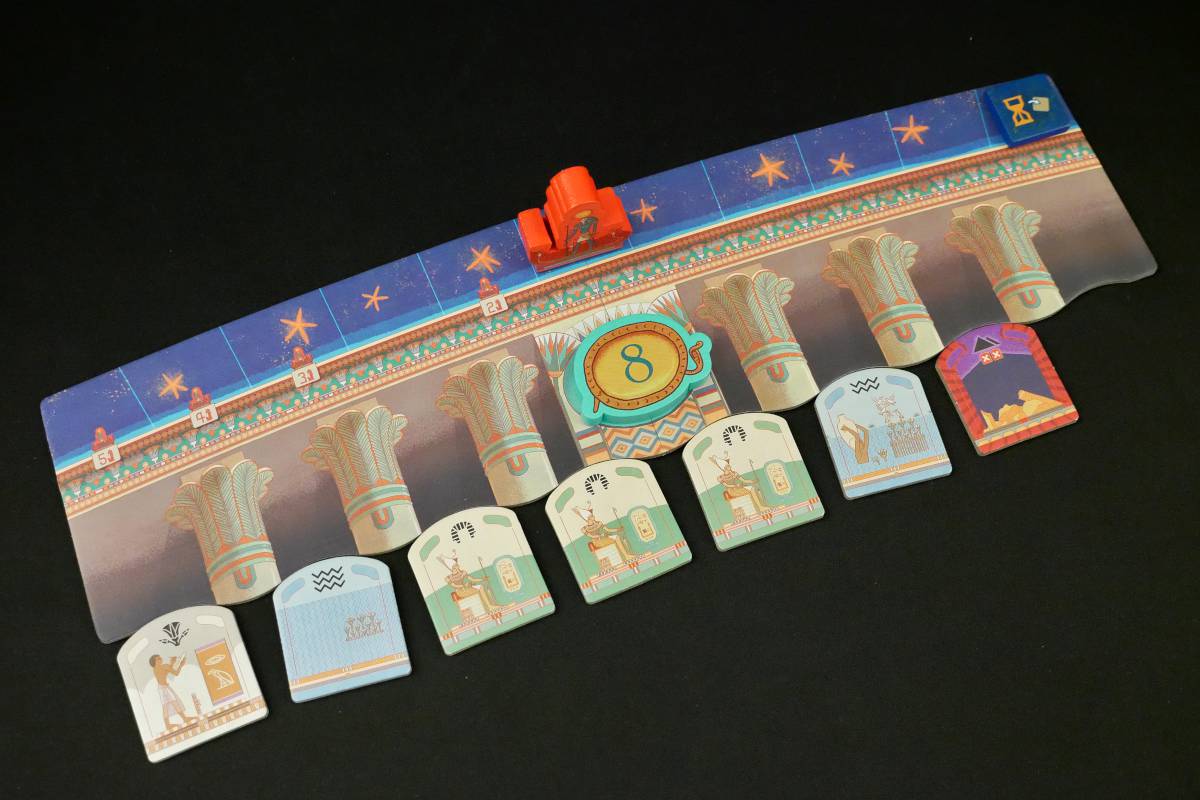
And that's the beauty of Ra. As you play across the Epochs, every player's kingdom grows in a completely different way, causing each auction lot's assessment to differ in each player's eyes. Making that assessment and exploiting those differences is key to success. For example, if I can tell that you really want the current lot, then I might bid really high and force you to spend your highest Sun Disk for it. But if I misread you, then I might be stuck with a subpar lot that I overpaid for. Now that's juicy tension!
The Sun Disks are what make the auctions so interesting. For starters, Ra uses a once-around auction system, so you only have one chance to bid per auction. You also only have three Sun Disks (or fewer if you've already spent some), so your choices are limited. Do you bid low and hope that everyone else dislikes the lot enough to let you have it? Or do you bid high to ensure that you get it, even if it means overbidding? The goal is to use the highest Sun Disk you think will win and no higher... or pass, of course.
But that's not all. When you win an auction, your Sun Disk is swapped with the one on the Auction Track. This is another element that shifts the value of a lot for each player. If there's an 8-value Sun Disk on the track, you probably don't want to spend your 16-value Sun Disk for it because you're weakening your bidding power in the next Epoch. But if the lot is full of goodies? Maybe it's worth making that sacrifice.
In Ra, you have to manage your Sun Disks as much as your tiles. Yeah, you're trying to score the best tiles you can, but you're also planning ahead and trying to set yourself up with high-value Sun Disks so you can keep scoring tiles in the next Epoch. Or in the last Epoch, you're trying to max out your Sun Disks to win those final bonus points. This tension in two directions keeps Ra engaging from start to finish.
As interesting as the auction lot valuations are, I'd say there's another aspect that's even more interesting: knowing when to invoke Ra and force an auction. When you invoke Ra, bidding starts with the player on your left and you're the last one to go. This means you're in the best position to make the most calculated bid because you can see what everyone else does first.
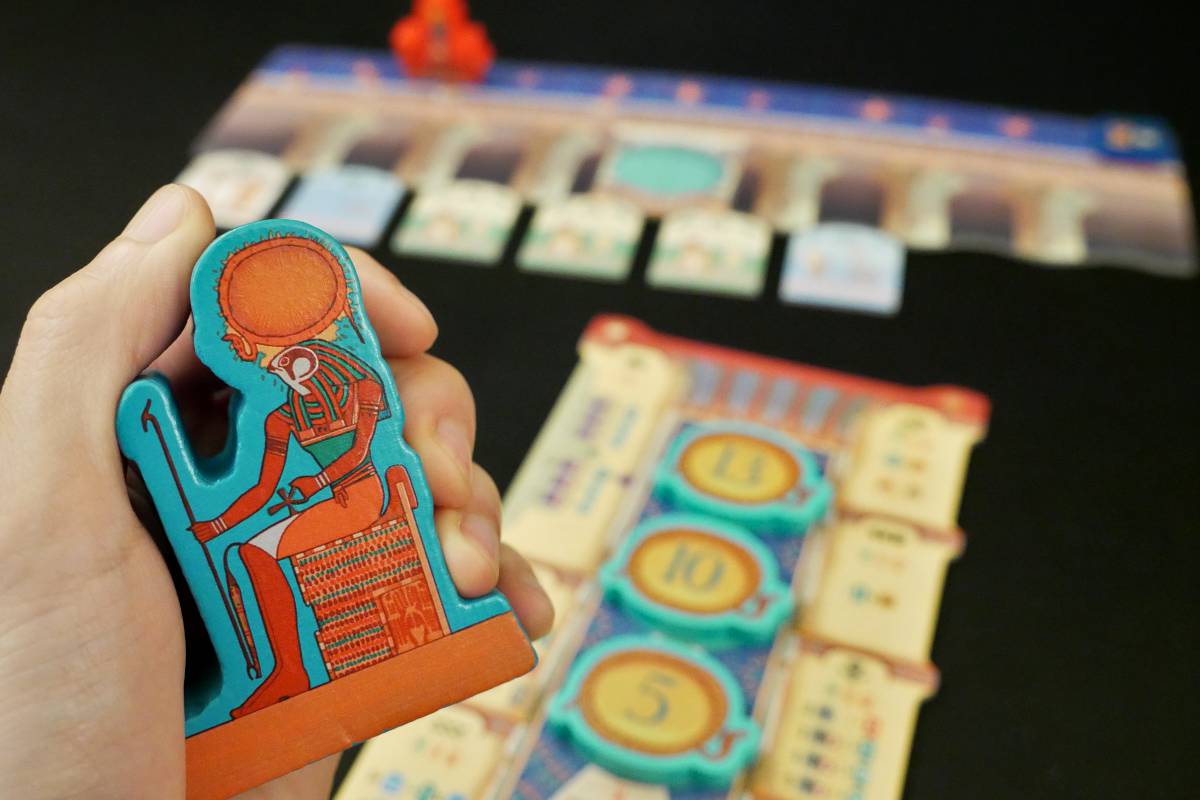
More importantly, you're forcing everyone's hands when you invoke Ra. Why? Because when Ra is invoked, the invoker must bid if everyone else passes. Or in other words, when Ra is invoked, the current lot will be taken—so if someone wants those tiles, they have to bid on it now. This can be a great way to force people into spending Sun Disks, but it's risky because you might be the one losing a Sun Disk if you misjudge.
If that doesn't sound like a big deal, remember: you only get three or four Sun Disks per Epoch (depending on player count), so you can only win three or four auctions and then you're out for the rest of the Epoch. You have to make each Sun Disk count, earning as many tiles as you can with each one. Being forced into a premature auction can be tough: do you spend your Sun Disk now or hope for a better auction that may not come?
I think I'm making Ra sound a lot crunchier than it is. Sure, these are the kinds of things you're considering as you play, and it's what makes the gameplay interesting. But there's too much going on to math everything out in your head, and there's too much uncertainty to make any decision with 100% confidence. In the end, Ra is played mainly by intuition.
You only have so many possible actions—you either pull a tile or invoke Ra, and when it comes time to auction, you only have three or four Sun Disks to bid with—and that limitation means Ra never feels like a brain burn. Analysis paralysis rarely happens. Somehow, Ra manages to be deeply engaging yet widely approachable. What a feat.
Luck Factor
Ra has a bit of luck in it, but don't worry: it's the fun kind of luck.
With games like Quacks of Quedlinburg, people have rediscovered the joy of pulling stuff from a bag and seeing what happens. That's here in Ra, too, with every pull of a tile shifting the current auction lot. Obviously, bag pulling is inherently lucky—you get what you get, and often it isn't what you hoped for—but that's not a problem here.
The luck in Ra is "input randomness," which means the luck part happens and then you make decisions based on it. The auction lots are fascinating because they're randomly changing all the time. It's what keeps you on your toes and constantly reassessing things. The luck here can't suddenly derail you out of nowhere; if you get boned by luck, it's because you made a bad decision in response to the luck.
Ra also has a lovely "push your luck" aspect to it.
Let's say you're looking at the current auction lot, it looks pretty darn good for you, and it's now your turn. Are you going to invoke Ra and put yourself in the best position to win it now? Or are you going to hold off and hope it grows even juicier by your next turn? What if a Disaster tile comes out and throws a wrench in it? Or what if someone else invokes Ra? Are you going to risk that?
And don't forget about player elimination. As Sun Disks are spent, players will eventually drop out for the remainder of the current Epoch. That means you could be the last one remaining, at which point you're freely pulling tiles from the bag with no one to stop you. But every time you surface a Ra tile, the Sun Boat moves one step closer to ending the Epoch! How juicy can you make the auction lot without busting? Will you be able to spend all your Sun Disks before the Sun Boat ends the Epoch?
Fun Factor
Ra isn't a party game, but it has party energy.
It's fun to collect sets and build up a kingdom. It's fun to participate in auctions and see how different players react to the same lots. There's a lighthearted spirit that permeates any Ra session, with just enough space between decisions for banter and table talk. And the push-your-luck elements are thrilling yet never devastating.
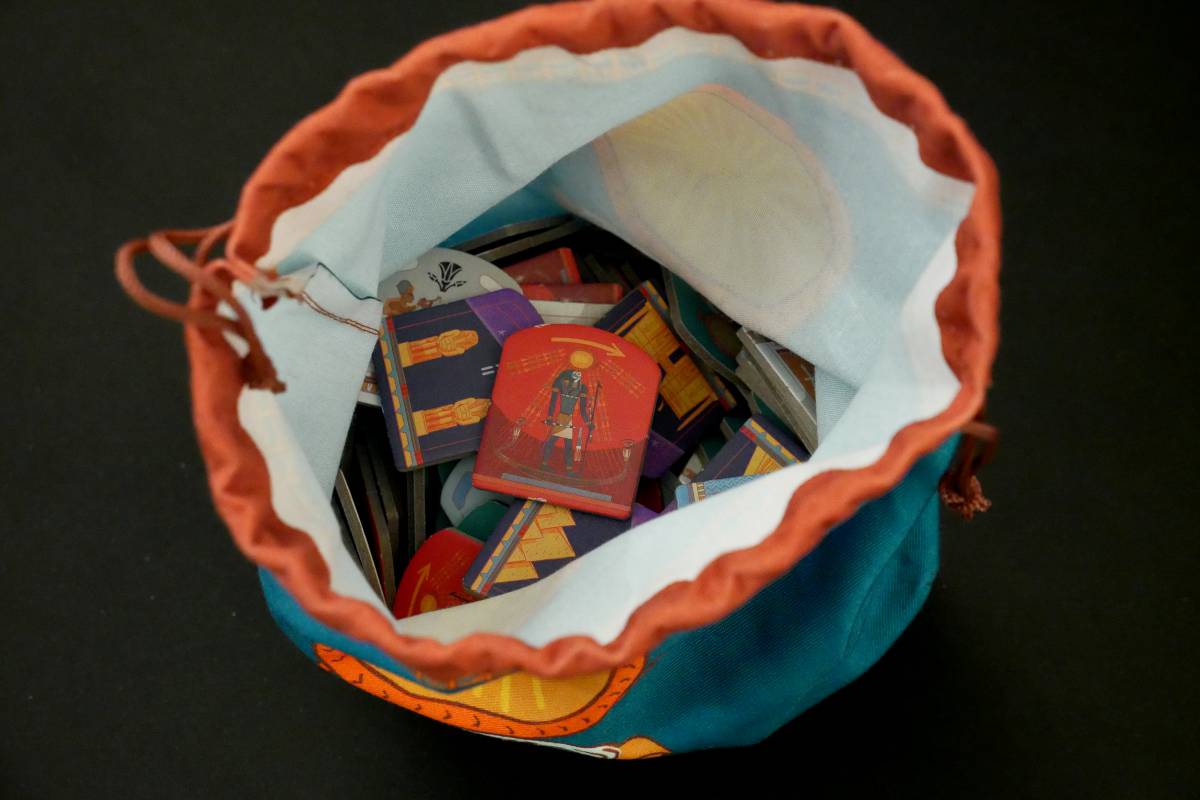
But the most fun occurs when one player is left in the Epoch. While they're freely pulling tiles from the bag, everyone else inevitably starts rooting for Ra tiles to show. It's a bit of a meme now in board gaming circles, but it's absolutely true that people will start chanting "Ra! Ra! Ra!" with every tile pull. I love those moments when someone is pushing their luck, we're all calling for Ra... and that beautiful Ra tile appears. The whole table erupts in cheers and laughter while the busted player knows they only have themselves to blame for pushing their own luck too far.
Pacing
Ra is phenomenally paced. On most turns, you just pull a tile from the bag and you're done. It's snappy and never bogged down by analysis paralysis or super-thinky decisions, and it's punctuated by auctions that are equally fast because they're once-around. It's go-go-go right from the start with close to zero downtime.
Meanwhile, the tension builds from Epoch to Epoch. As your kingdom grows, you know which tiles you need and which lots you really need to win. Tiles are also never returned to the bag, so you feel the pressure when you're hoping for tiles that have run low. There's a definite rise towards a climax, and you're never fully sure who's going to win.
Player Interaction
I've seen Ra often called a "high interaction game," but that can be misleading. The interaction is mostly indirect in the form of mind games, reading each other's intentions, and outwitting one another. If you like that kind of psychological jockeying, you'll have a blast. If you'd rather blow each other up and destroy each other's kingdoms, there's none of that here.
Player Counts
The Ra experience slides from "tactical and strategic" on the lower end of player count to "chaotic and party-like" with more players. That's not a judgment against either end, though. I've played at 2 and I've played at 5 and I've thoroughly enjoyed both.
I like Ra with 2 players. It's a lot more in-your-head, where you really have to read your opponent's mind so you can win auctions without overbidding while also forcing them to overspend whenever possible. It comes down to timing, valuation, making sure every auction you win is better than the auctions they win, and managing Sun Disks. At 2 players, Ra is less exciting and more psychological.
But at 5 players, much more happens between your turns, so you have less control over things. Auctions are tougher to win and it's harder to evaluate each player's thought processes. You're mainly trying to avoid mistakes and bad bids. At higher player counts, Ra is played less in your head and more in your gut, with laughter and energy all around.
All in all, I'd say the sweet spot for Ra is either 3 or 4 players, but it's great at every count—yes, even 2 players.
Fiddliness
Ra has lots of tiles, but it isn't fiddly. Those tiles are basically glorified cards. You collect them, you arrange them in your tableau, and you're done. There actually isn't much to fuss around with even if the game looks like it takes up a lot of space. It's very clean to play.
Replayability
I'm always down to play Ra. It's got everything you could want in a game: simple rules, engaging decisions, low mental burden, tactile satisfaction, snappy turns, tension and suspense, stand-up-and-cheer moments, with no two games being alike thanks to the randomness of the tile bag.
Indeed, there's plenty of depth to explore with repeat sessions. The whole game is about evaluating auction lots and making strategic bids. That's the kind of puzzle that can't be "solved" because there are too many dynamic factors at play. You win some, you lose some, you never play perfectly—but you feel like you can. That's one of the big things that keeps me coming back.
Production Quality
Ra first released in 1999, but nearly every iteration of the game has been ugly, betraying the family-friendly gameplay that makes it a classic. I avoided it for years because of that. But the latest revamp by 25th Century Games is so good that I'm not just calling it the definitive version of Ra—it's the gold standard to which all other board game productions should aspire.
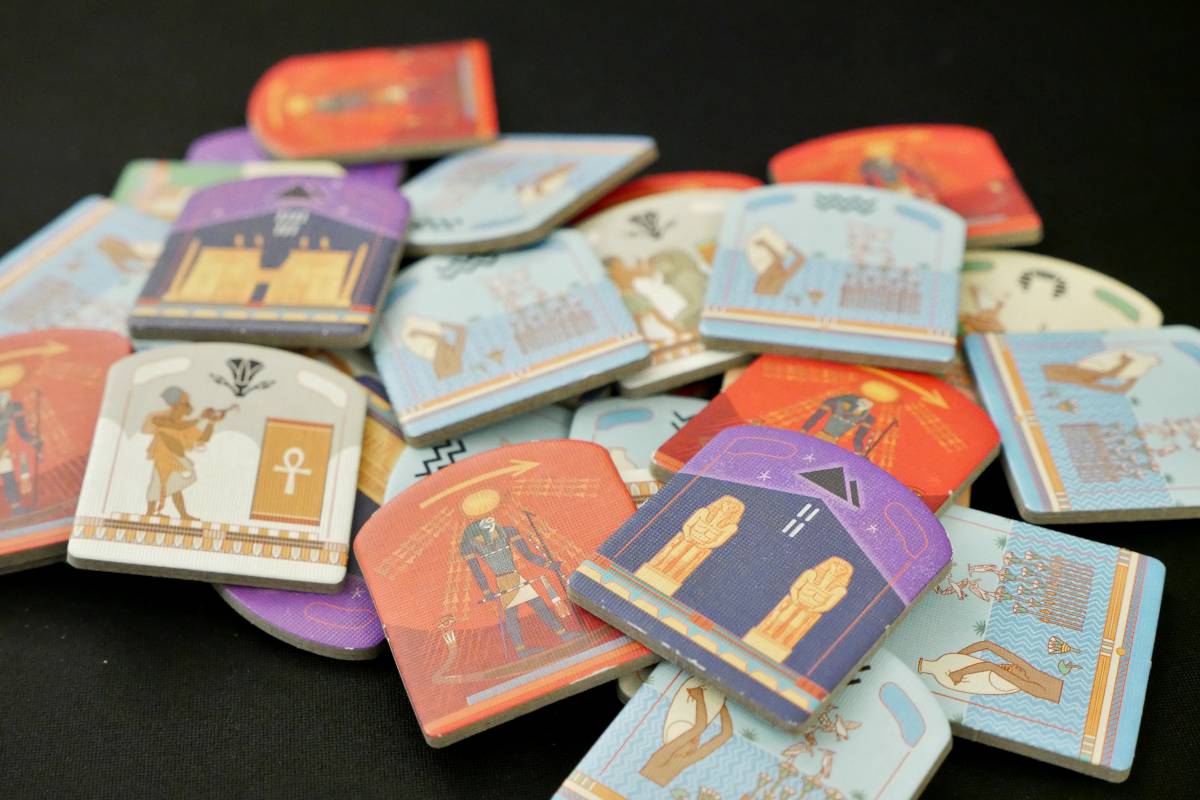
The artwork and graphic design are A+++ all around. 25th Century's Ra possesses an aesthetic that's fully unique in the board game landscape, and Ian O'Toole's work immediately sets it apart. It's colorful, it's coherent, it pops, and it has an identity of its own. But more than just looks, it's entirely functional. Every tile and board is jam-packed with information that makes the game easier to learn and play. Every detail is there for a reason. Nothing is wasted. This visual overhaul takes Ra from "great" to "legendary."
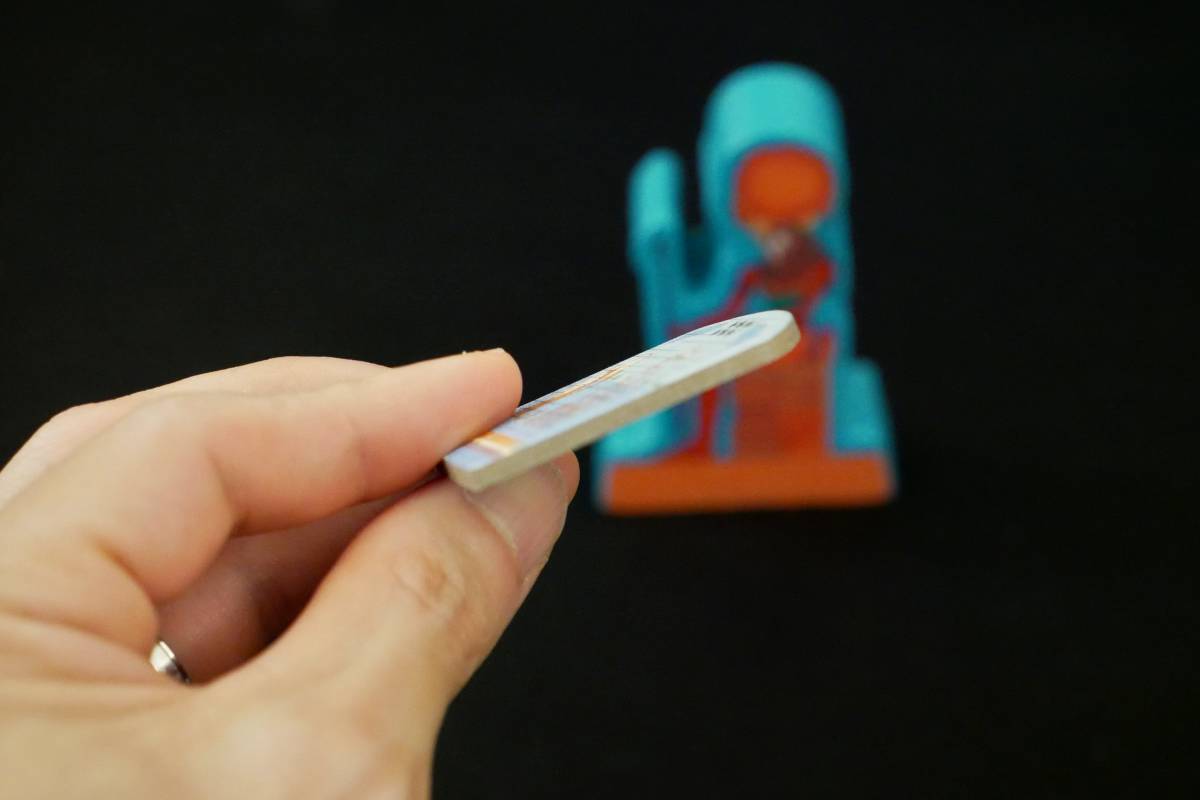
The component quality is right up there with the best. Ra is very much a tactile experience, with about 90 percent of the game spent pulling tiles from a bag. Those cardboard tiles are thick and chunky and feel satisfying to the touch. More than that, the wooden Ra statue is so extra—not only in its material, but also in its size. Did it need to be so big? Nope. But I'm glad it is because it's so fun to snatch this enormous block of wood when invoking Ra, and it wouldn't be the same if it were just a token or meeple.
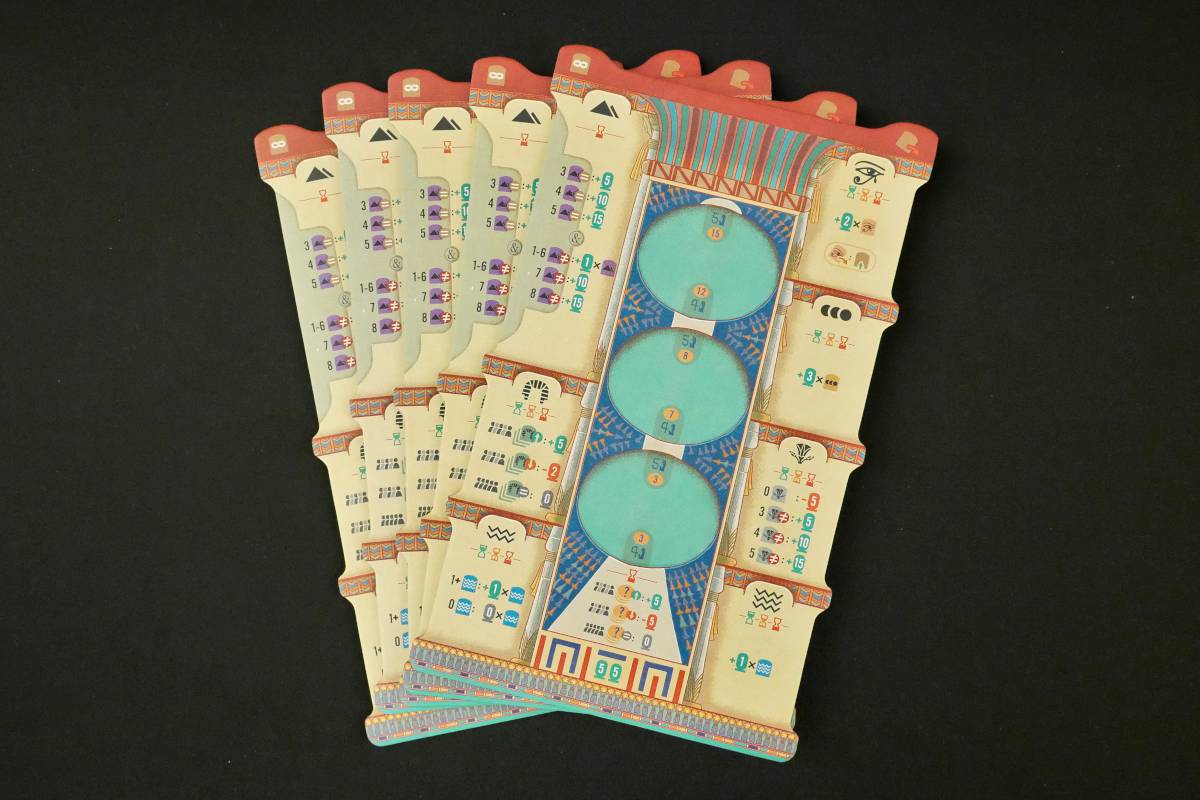
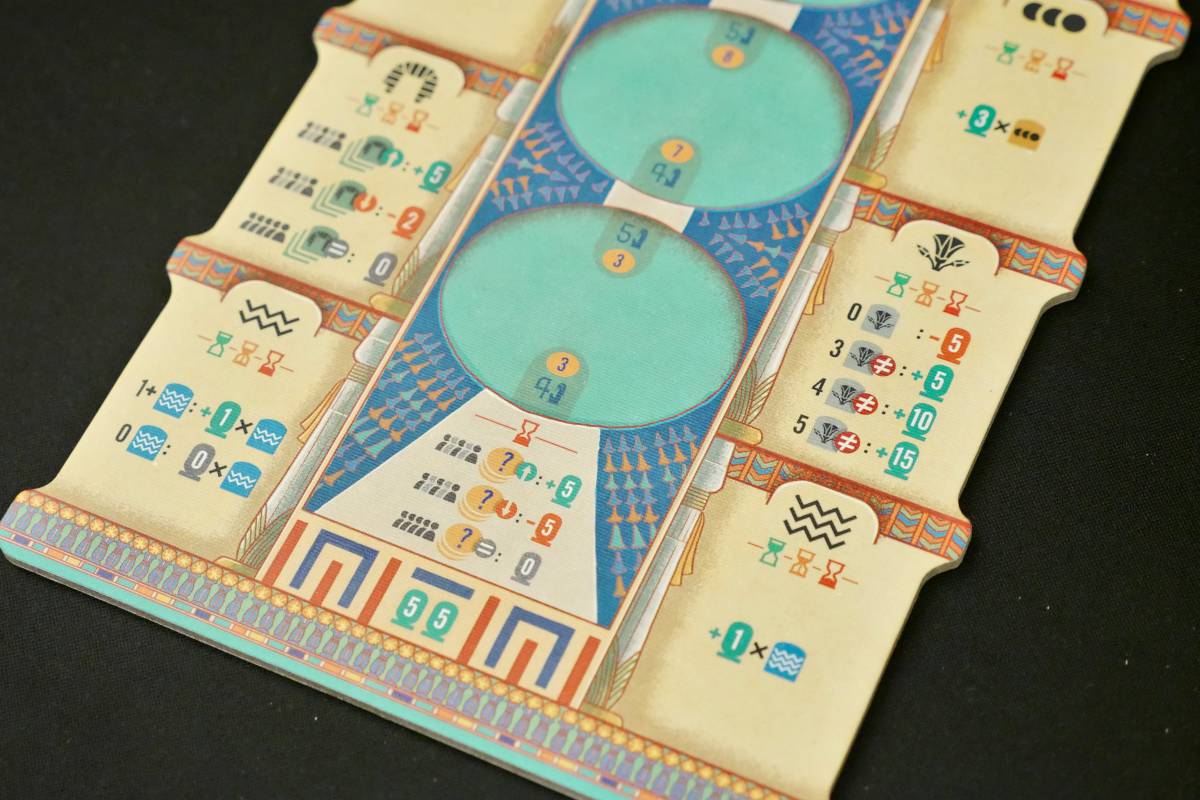
The player boards are the key to why this edition of Ra is an all-time great. Forgive me but I can't help gushing about these player boards and what they bring to this game. They relieve so much of the mental load and ease the learning curve. You don't have to memorize the Sun Disk setup, or how every tile works, or when each tile scores, or how many points you earn. The player board tells you everything. It even has the overall tile distribution. The player board doubles as a player aid and I love that.
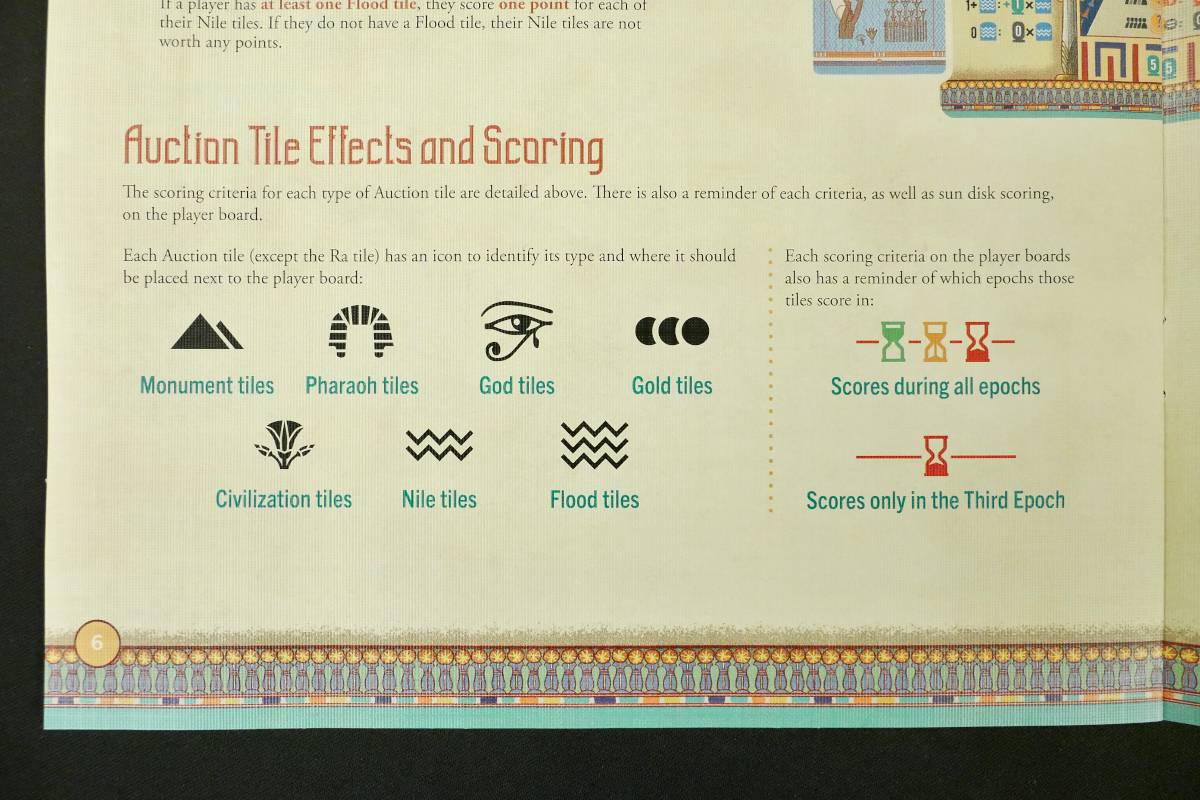
Ra is supported with language-agnostic iconography all over the place. Now, to be fair, the icons can be overwhelming at first—a lot of them don't make sense until you know how to play the game. But once you do? It all falls into place and it's easily intelligible. I'm not always a fan of icon-heavy games because it can add mental strain when it's done poorly. Here, it's done well enough that it conveys more with less.
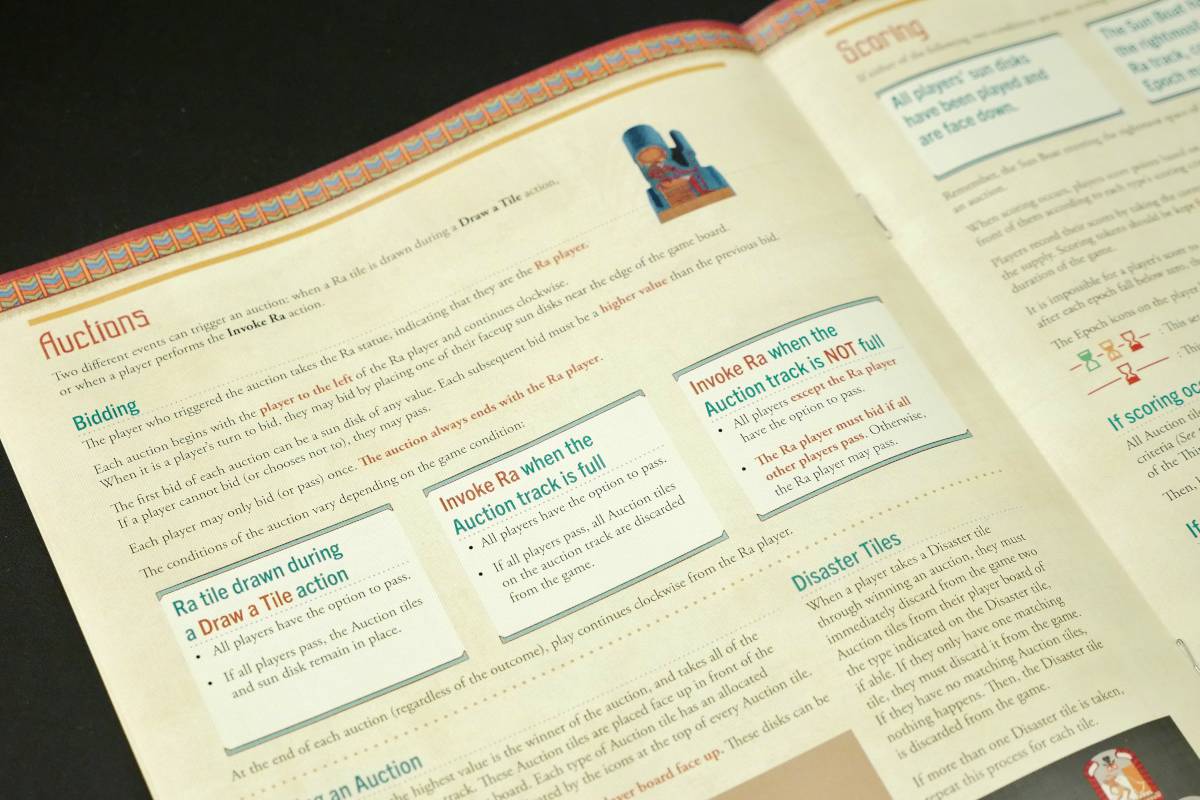
The rulebook is gorgeous and laid out well. I only had to read through once to fully grasp how Ra plays. It unfolds in a logical manner, with helpful illustrations that support the text and clear up ambiguities. I rarely find myself needing to re-read anything, but for the few times I did, it was easy enough to find what I needed to know.
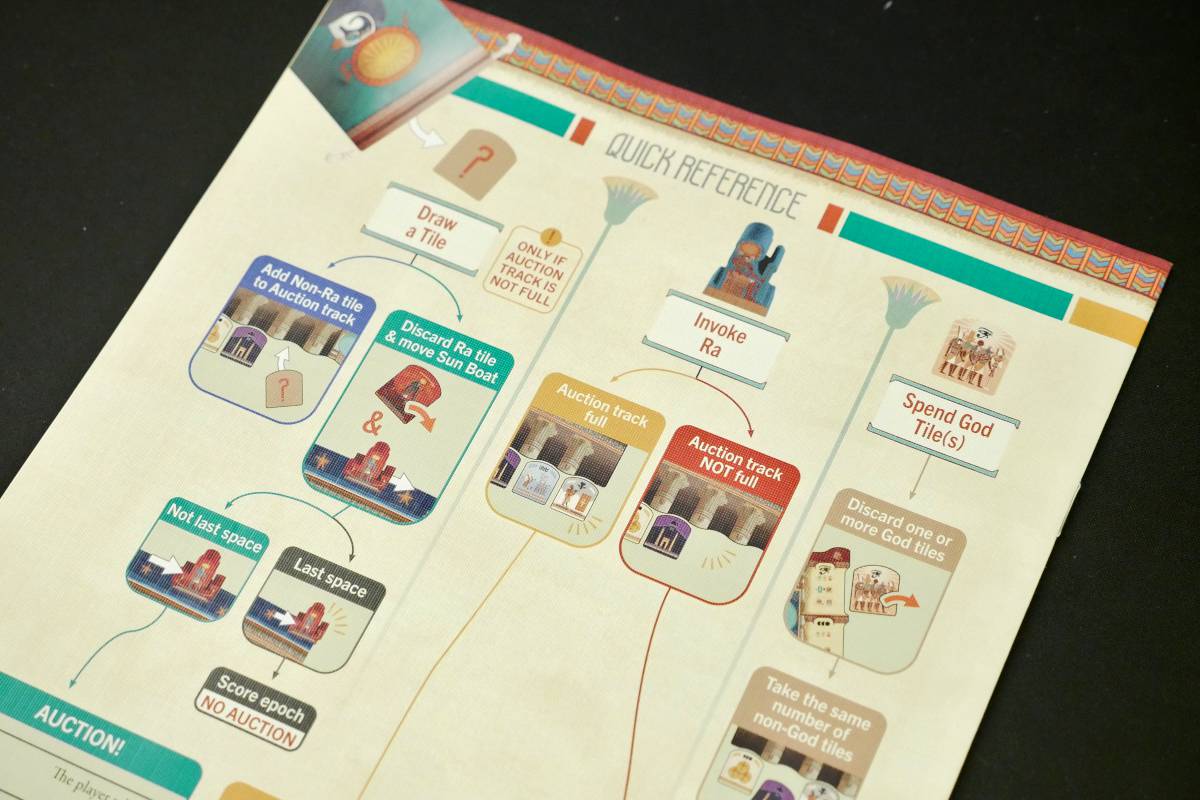
There's a helpful Quick Start reference on the back. I can go many months without playing, then come back and instantly remember how to play just by referencing the back side of the rulebook. No need to open it up and re-read everything. Between the Quick Start reference and the player boards, Ra is one of the most accessible board games I've played in a long time.
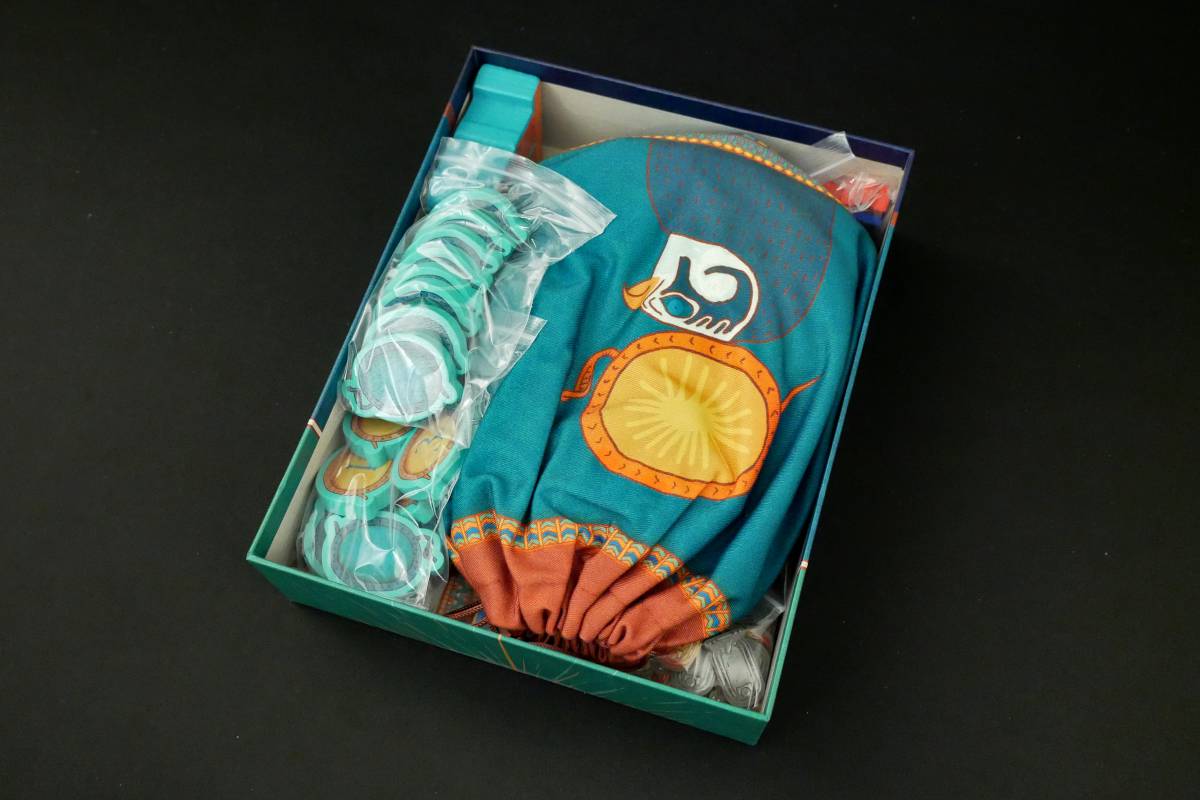
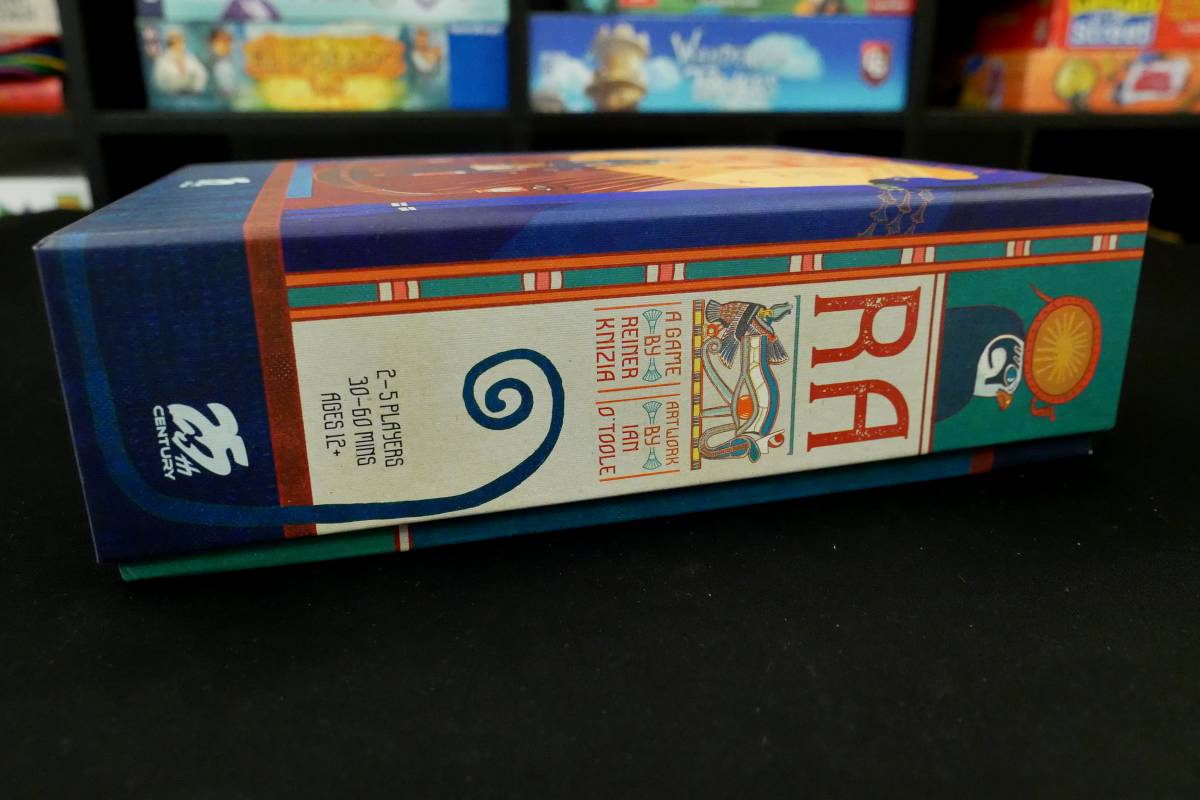
The game box is too small! My biggest complaint with Ra is a minor one overall, but it really grinds my gears: the game box has unique dimensions that are smaller than standard. That'd be fine... except it isn't large enough to comfortably fit all the components inside. No matter how I organize it, the lid gets lifted and doesn't sit flush. The only way to get it flat is to dump all the tiles out of the bag before storing. (No way I'm doing that.)
The Bottom Line
Ra is a classic for good reason. This family-weight blend of auctions, set collection, and pushing your luck is beautifully produced, widely accessible, and just so darn enjoyable. It melds together two things I love: it tickles my brain without overwhelming it, and it evokes a party mood despite not being a party game.
I'm always down to play it and it's always more fun than I think it'll be. That's why Ra will always stay in my collection.
Stop Buying Games
You'll Regret
Before your next game purchase, run it through this mental checklist that every seasoned gamer uses.
Free checklist, delivered instantly to your inbox.
No spam, ever. Unsubscribe in one click.