
Back during my elementary school days, I used to map out dungeon layouts on the backs of my finished tests. I was bored, I had nothing else to do, and my RPG-obsessed brain needed an outlet for my imagination—so not only did I draw maps of interconnected boxes, I also tried turning them into a game. Alas, I was too young to figure that part out.
Then, one day I came across Dungeons, Dice & Danger... and all those childhood memories came flooding back. Sheets of paper. Interconnected boxes representing rooms in a dungeon. Monsters, treasures, traps. Someone had taken my idea and actually made a game of it! I knew I had to play it ASAP, if for no other reason than sentimentality.
But is it any good? Here's everything you need to know about Dungeons, Dice & Danger, how it plays, where it stands in the crowded genre of roll-and-write pen-and-paper games, and whether it's worth adding to your collection.
This review is based on my own personal copy of Dungeons, Dice & Danger, which I bought new from Cardhaus. Not a free review copy.
Overview
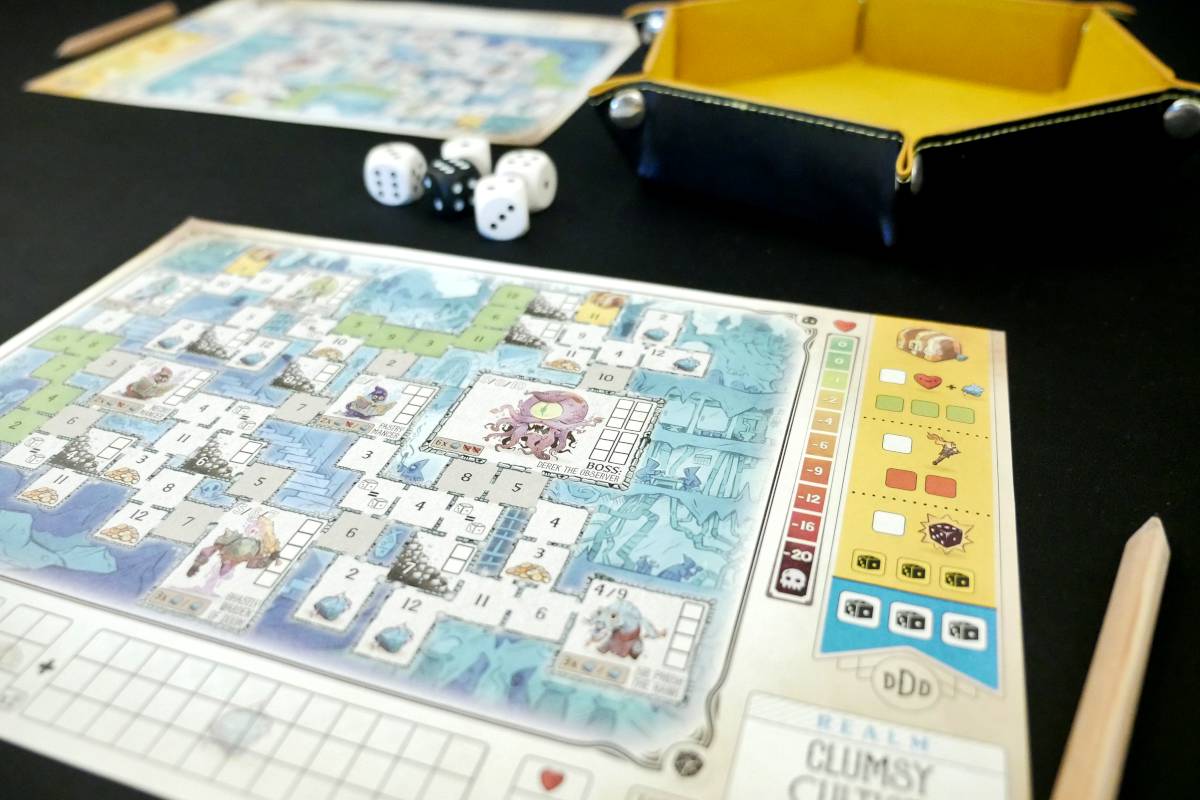
Dungeons, Dice & Danger is a 1-hour journey of rolling dice and crossing off boxes, all in the pursuit of collecting treasure (points) and slaying monsters (end game trigger). There are 4 different dungeon maps to explore, each with its own small twist to the gameplay, but they all pretty much play the same. Let me give you an idea of how it plays.
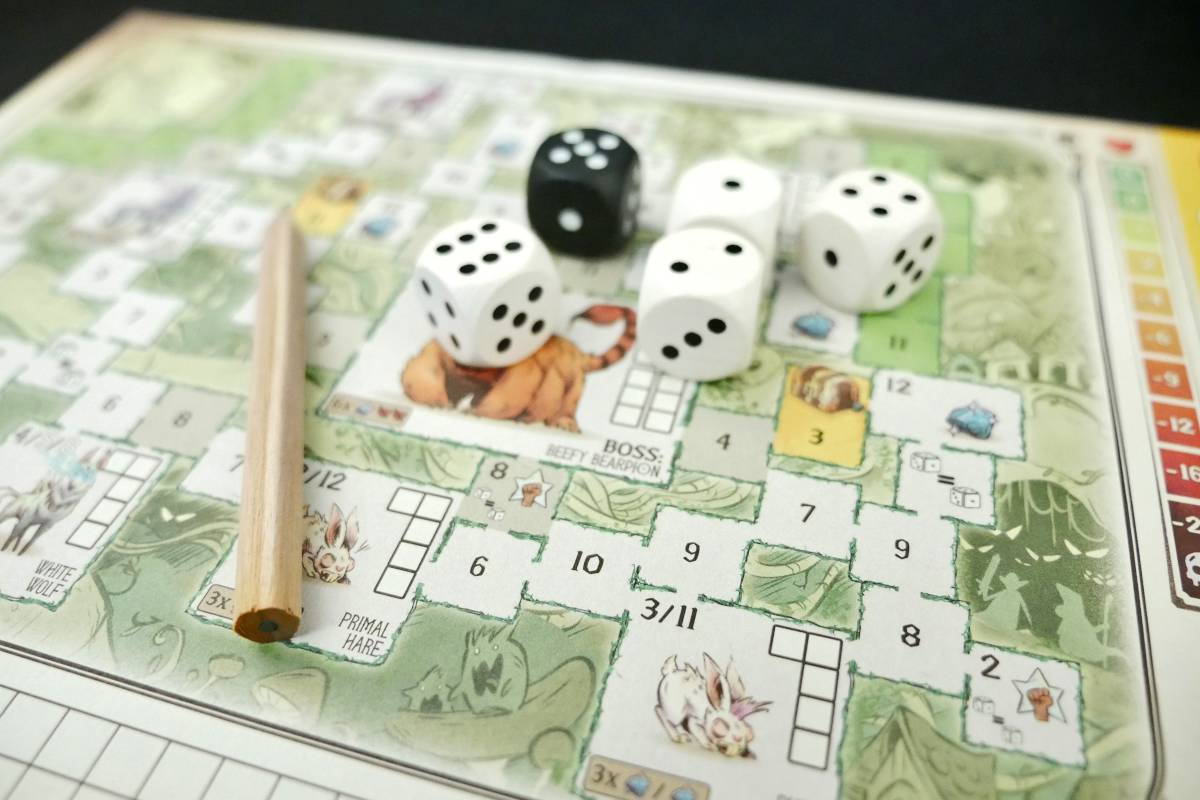
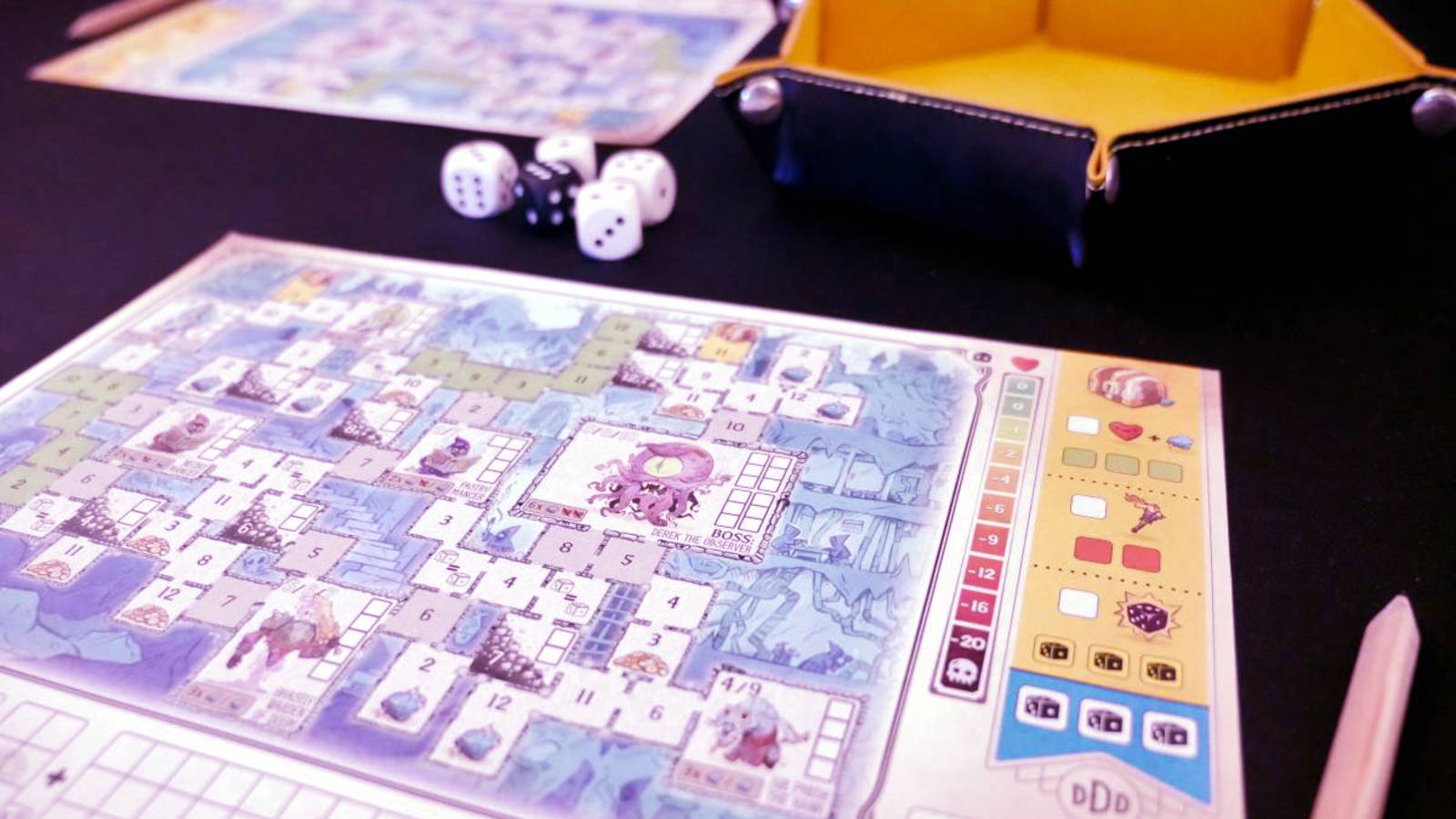
A game of Dungeons, Dice & Danger consists of a single sheet of paper (the dungeon map), a set of 5 dice (4 white and 1 black), and a pencil. I actually prefer to play with a colored marker for visibility—pencil can be hard to see on the paper sheets and pen isn't much better.
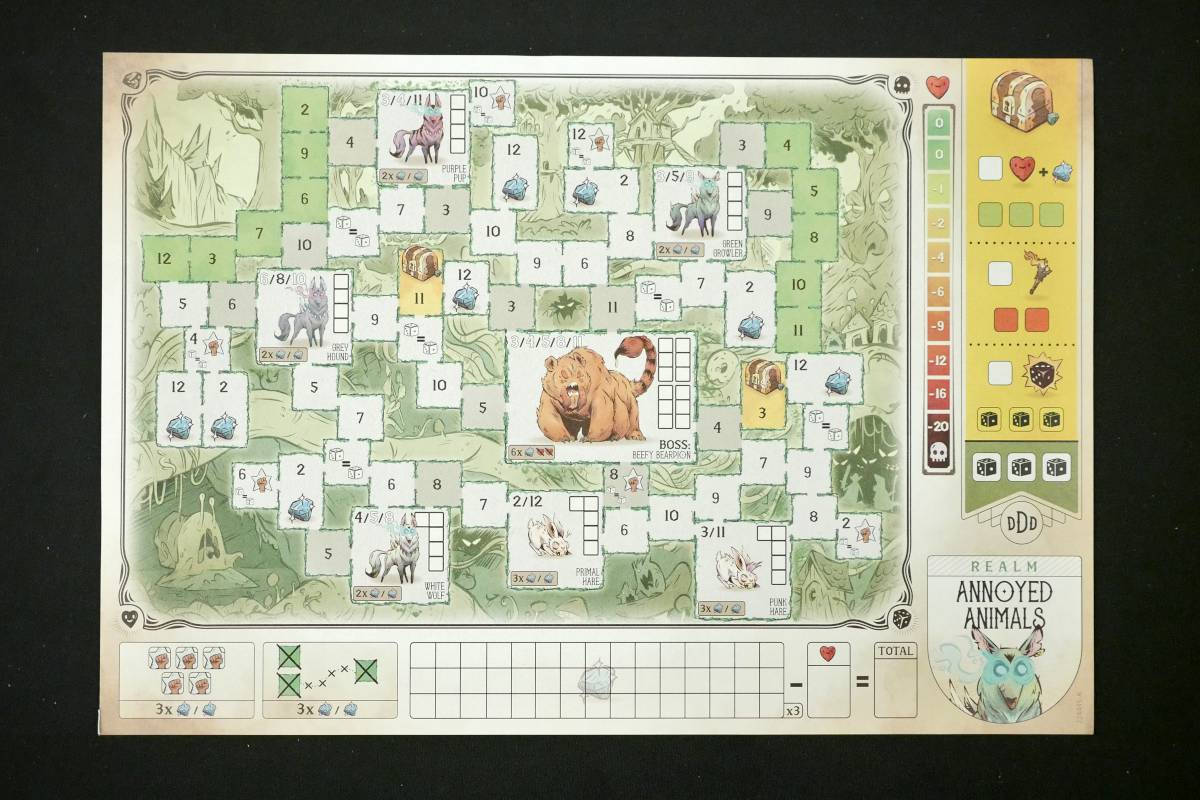
Every dungeon map is a network of connected rooms, with each room labeled a number between 2 to 12. You'll traverse the dungeon by rolling dice and matching these numbers. Some rooms also have additional features, like Gems, Treasure Chests, Double Dice, and Monsters.
Some of the rooms are green, which are "starting spaces." You're always allowed to cross off a starting space; otherwise, you can only cross off a room if it's adjacent to a previously visited room.
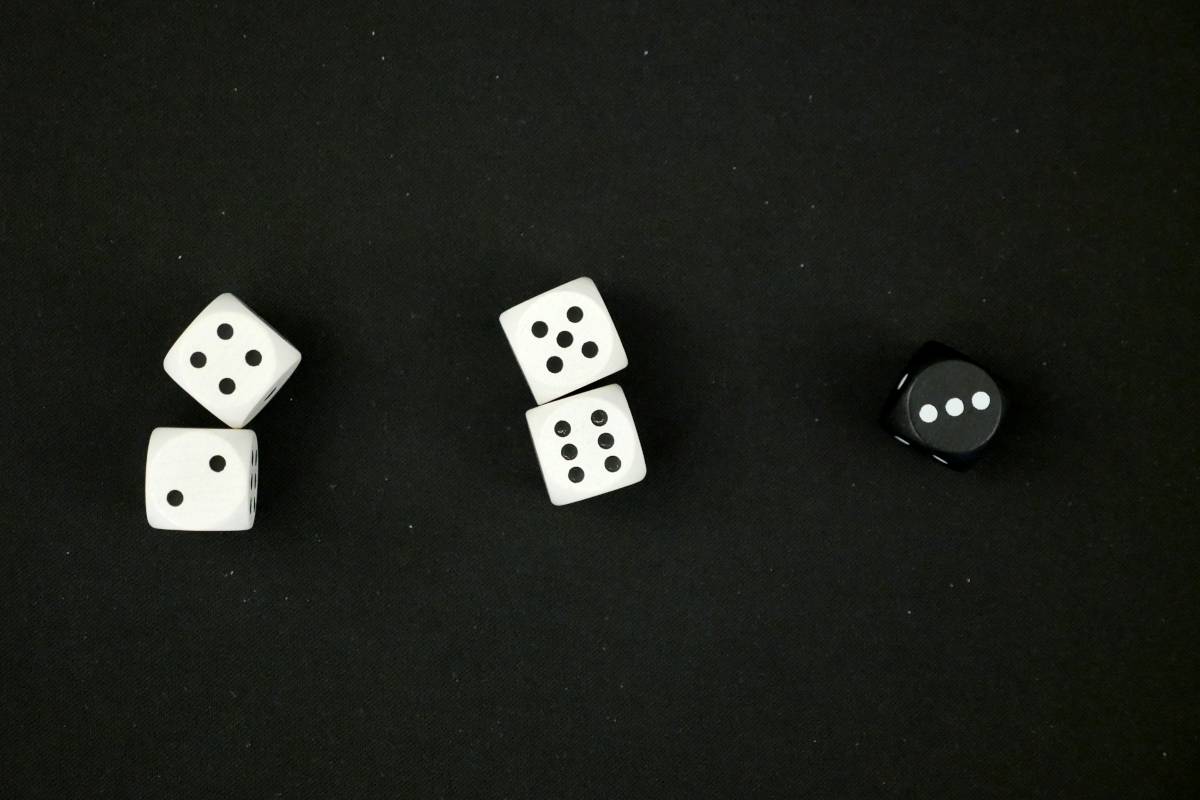
On your turn, you roll all 5 dice and then create two separate dice pairs from the results. You take the sum value of each dice pair and cross off rooms with corresponding numbers on them. For example, if you paired 2+4 and 5+6, you would cross off one room numbered 6 and another room numbered 11.
Some rooms have a Double Dice icon, which means you can only visit that room with a pair of same-value dice (for example, 1+1 or 4+4). Some rooms have a number and a Double Dice icon, in which case you'll need the specific pair of same-value dice that equals that number.
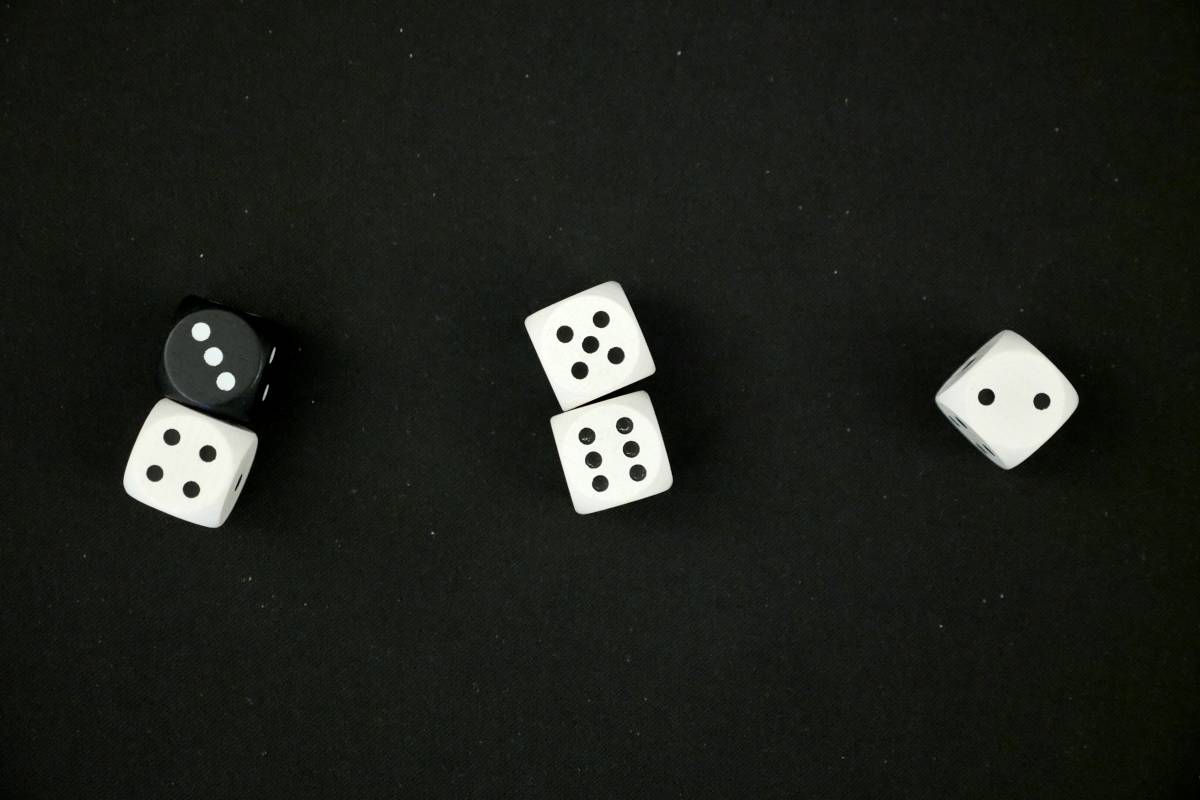
Simultaneously, every other player uses the same exact dice results to build their own two dice pairs. So, you might've paired 2+4 and 5+6, but someone else could choose to pair 2+5 and 4+6, and someone else could choose to pair 2+6 and 4+5. Everyone builds their own pairs from the same dice.
The one caveat here is that they aren't allowed to use the black die. Only the active player (the one who rolled the dice) is allowed use of the black die. Everyone else can only use the white dice.
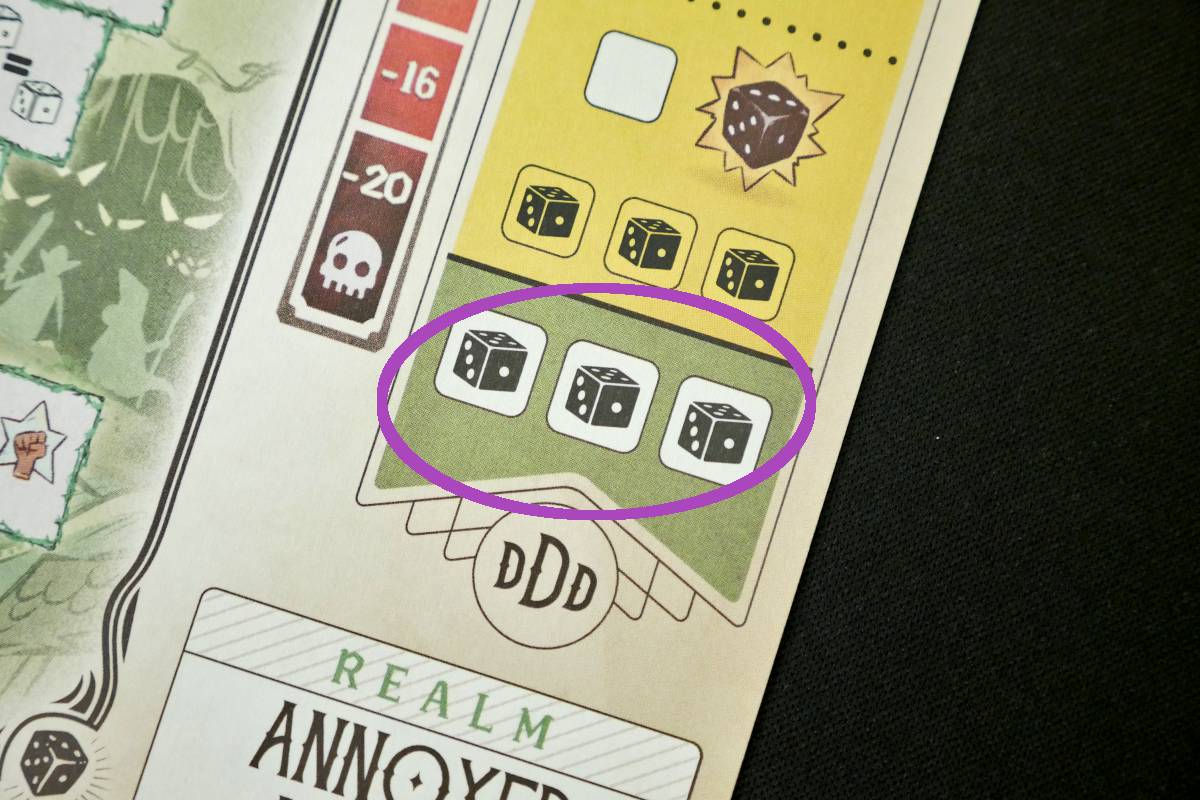
But there's a caveat to the caveat: everyone has a Black Die ability that allows them to use the black die even when they aren't the active player. The Black Die ability can be used up to 3 times, tracked using boxes that are crossed off whenever it's used. Use them wisely!
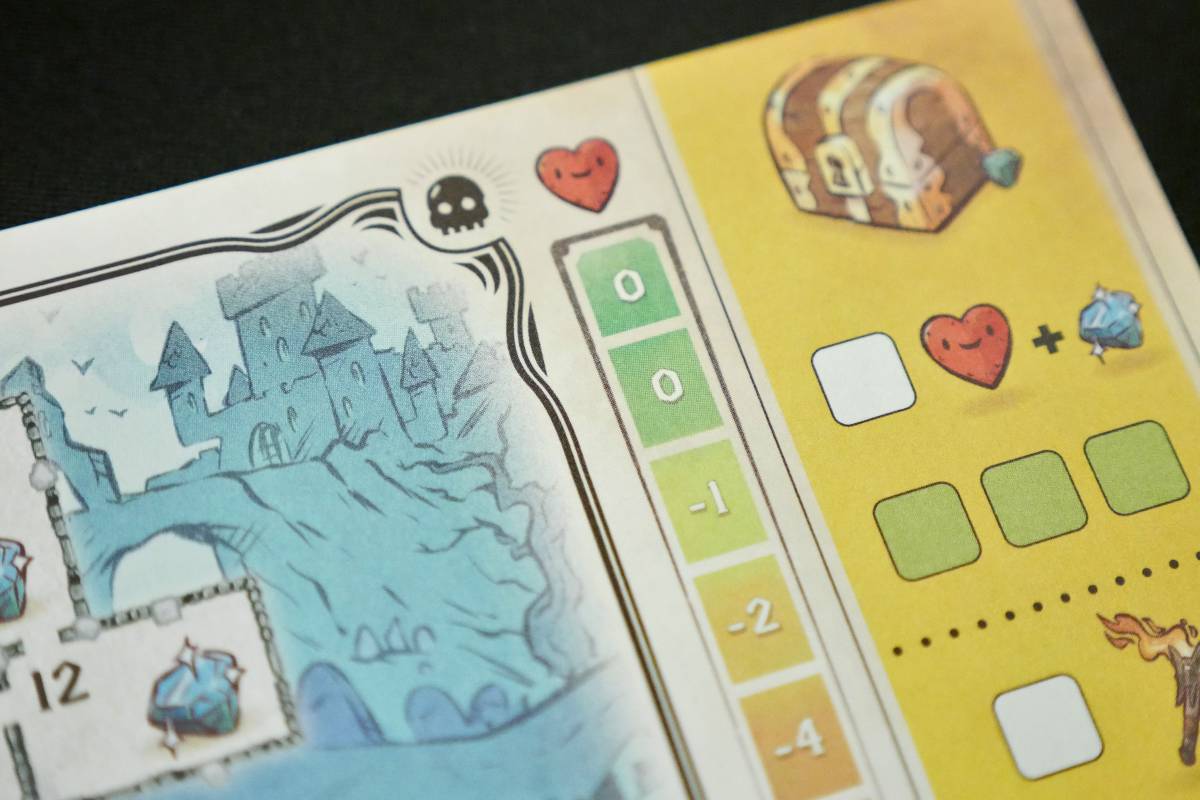
What happens when you can't cross off any rooms? Suppose you come up with dice pair values of 7 and 12. You're able to cross off a 12, but you don't have access to any 7 rooms. Well, too bad—you're taking damage!
You have a health track on the side of the map sheet. Every time you're unable to cross off a room, you cross off the top-most available box on your health track. The more health you lose, the bigger the point penalty you'll take at the end of the game... and if you lose too much health, you'll die outright and be eliminated from the game entirely.
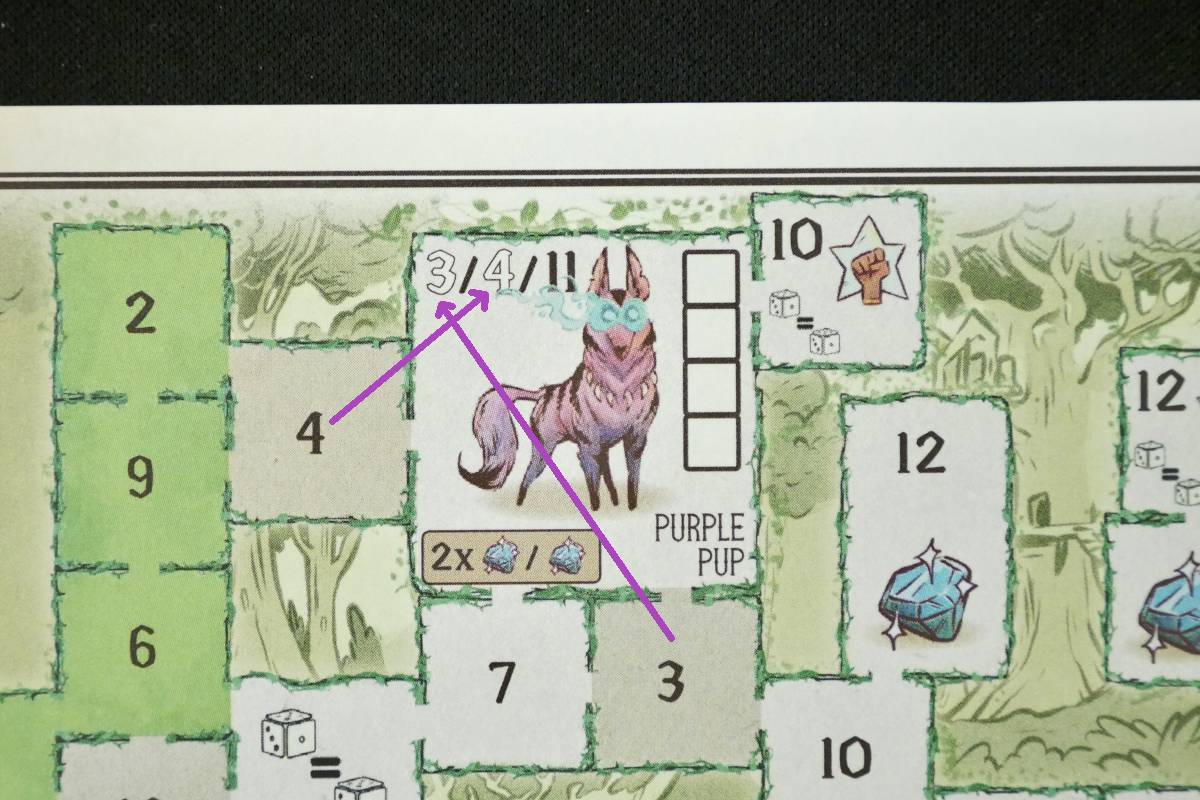
There are also Monster rooms. Monster rooms are special in a few ways. First, you have to visit a Monster multiple times in order to slay it (tracked using the boxes in the Monster's room). Second, you can visit a Monster using multiple numbers, but those numbers first have to be "unlocked" by visiting one of the gray rooms adjacent to the Monster.
Third, every Monster offers a reward when slain. The first player to slay a particular Monster gets the major reward (shown on the room), but gives a "free hit" on that Monster to everyone else. Other players can still slay that same Monster on their own sheet, but they only get to claim the minor reward (also shown on the room).
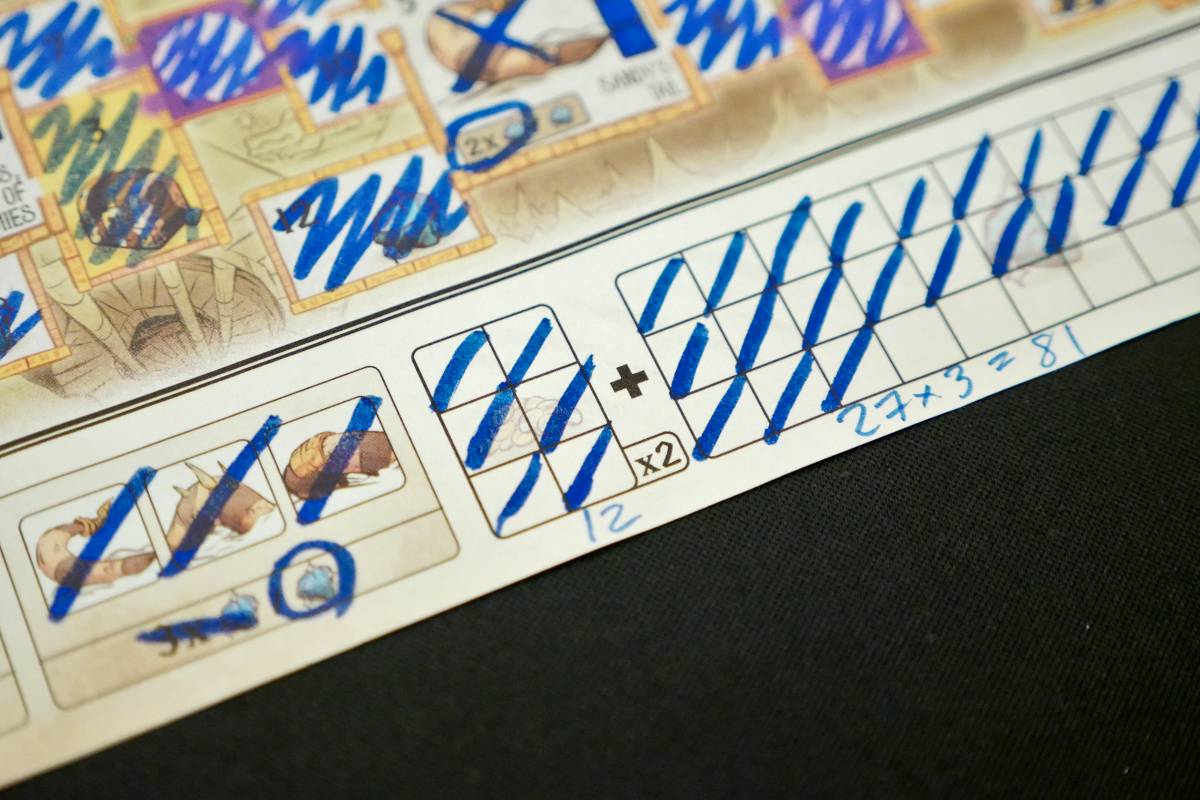
Gems are your primary source of points. You'll get Gems in various ways: visiting rooms that have Gems, defeating Monsters, completing the map's race objectives, and a few other less-common bonuses. You track Gems gained by crossing off boxes in the Gem tracker at the bottom of your sheet, and every Gem is worth 3 points at the end of the game.
Some dungeon maps also have Gold rewards. Gold acts in pretty much the same way, except it's worth 2 points each at the end of the game.
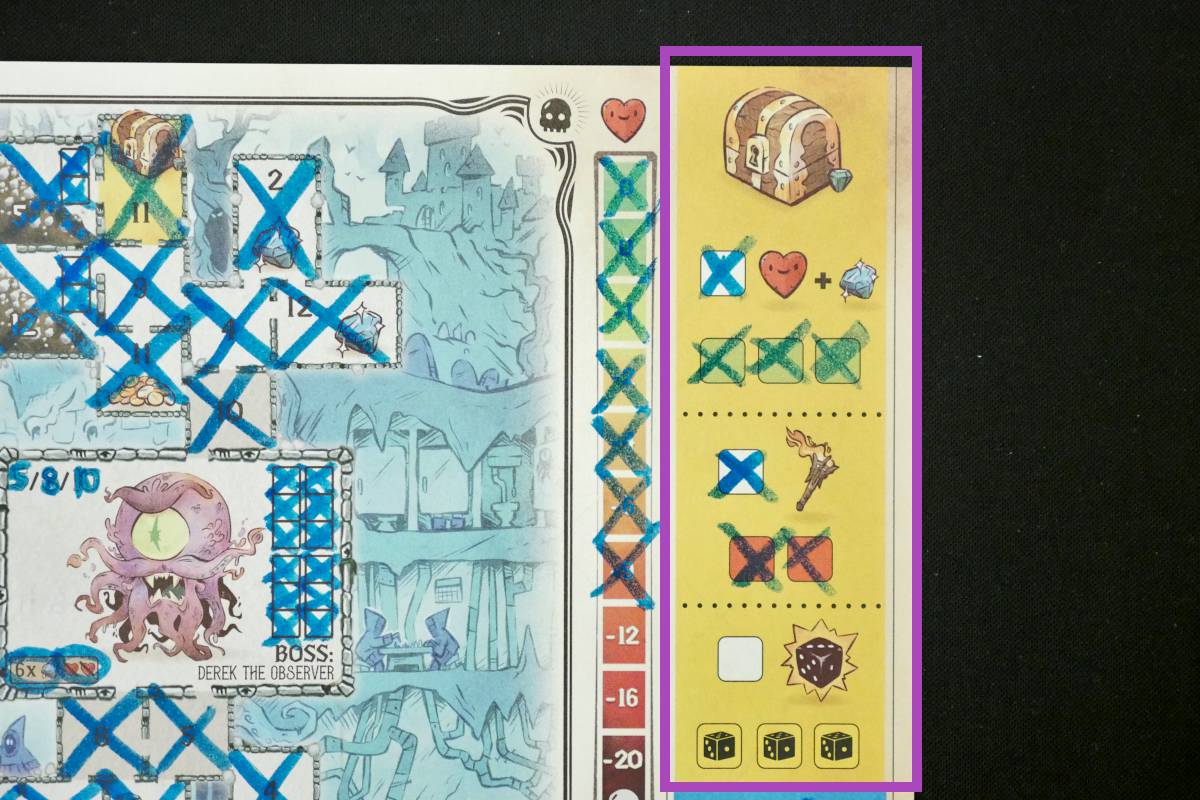
So, what do the Treasure Chests do? Contrary to what you might expect, Treasure Chests don't grant Gems or Gold—instead, they grant special abilities. When you visit a Treasure Chest, you get to "unlock" one of three special abilities on the side of your sheet:
- Extra Life + 1 Gem: You gain 3 extra health boxes that you can cross off in place of your health track whenever you receive damage, preventing you from losing more points. You also get 1 Gem with this ability.
- Torch: You can cross off any room on the map at any time, as long as the room is adjacent to a previously visited room. It can also be used to inflict damage to Monster rooms. You have 2 total uses of the Torch.
- Extra Black Die: You gain 3 extra uses of the Black Die ability, allowing you to use the black die even when you aren't the active player.
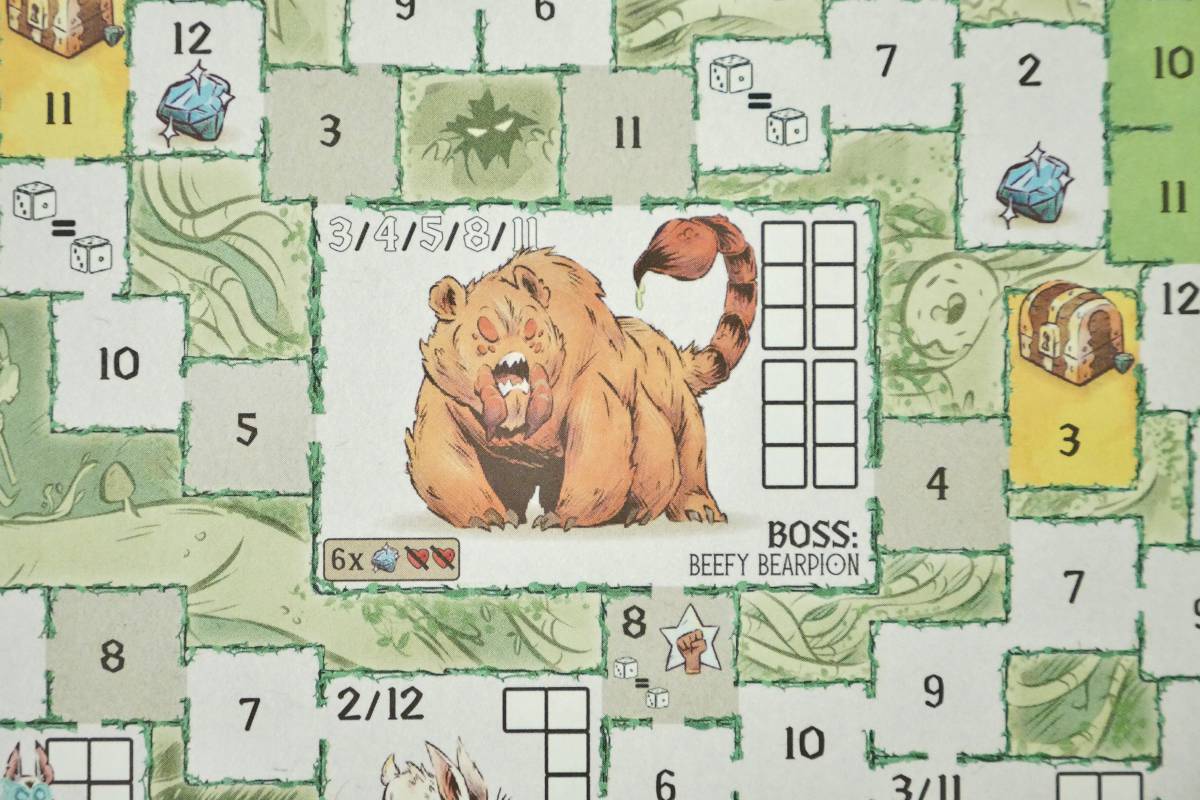
Every dungeon map also has a Boss Monster. The Boss Monster is mechanically similar to a regular Monster, except bigger and badder. It has more health and better rewards, but also deals damage to the first player who slays it. (Everyone else can slay the Boss Monster afterwards without taking damage.) Unslain Boss Monsters are worth consolation points at the end depending on how much damage you've done to it.
Dungeons, Dice & Danger ends when every Monster is killed. That means each Monster has been killed by at least one player—it does NOT mean that one player has to kill all the Monsters on their sheet!
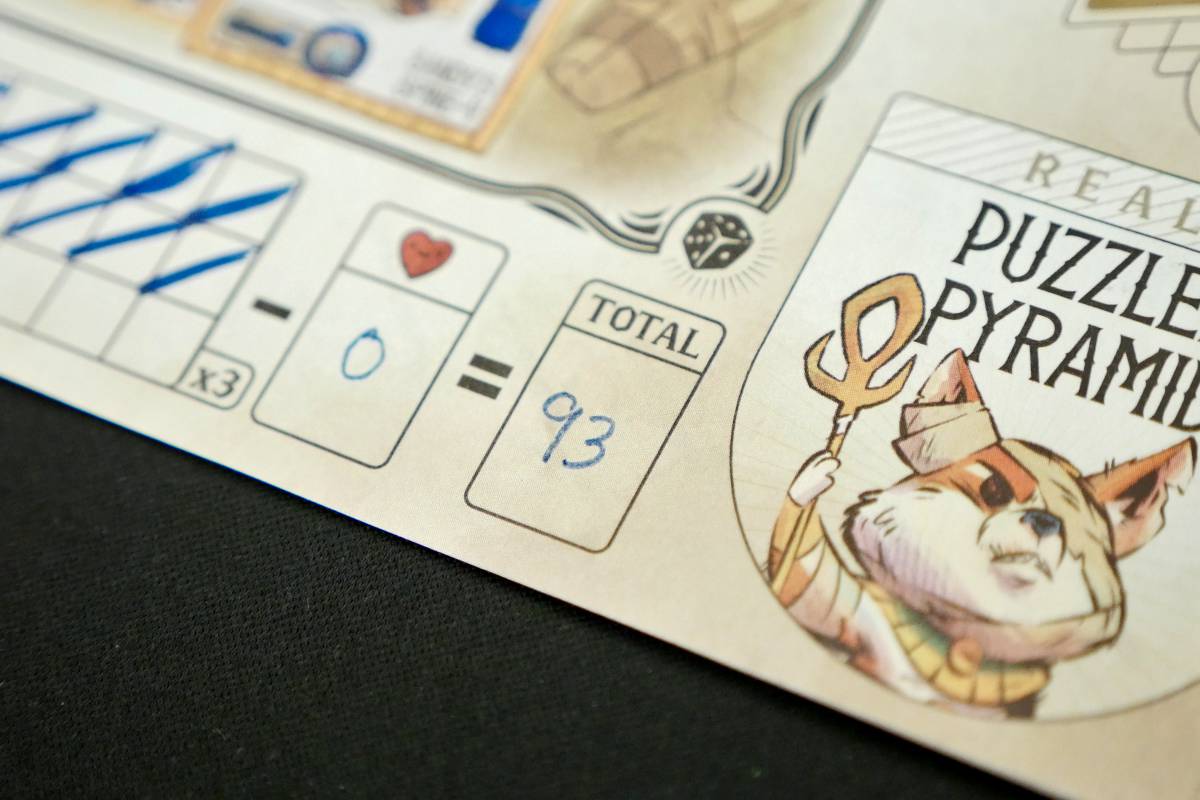
At that point, you sum up your points along the bottom of the sheet and see who has the highest score. (It's mainly your Gems minus your Health, plus any bonuses specific to the map you're playing.)
Setup and Table Footprint
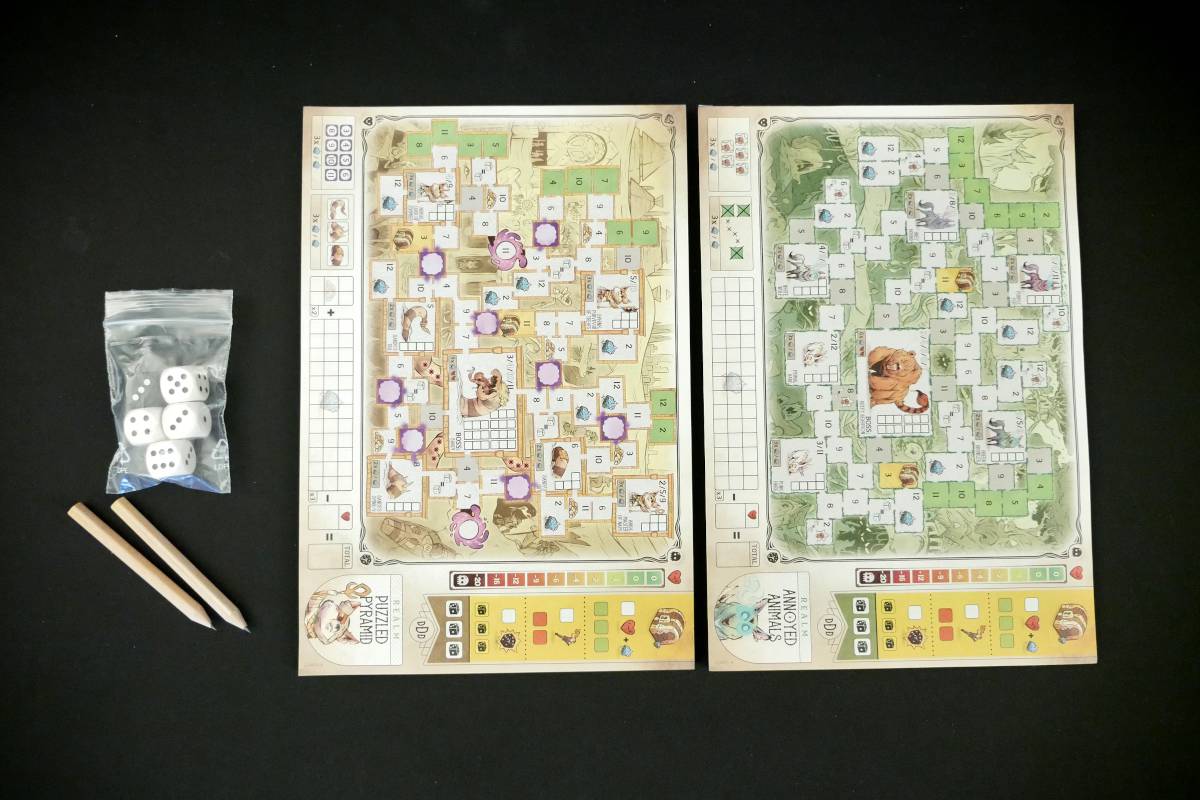
One of my favorite things about Dungeons, Dice & Danger is the super simple and easy setup. Even for a roll-and-write, it's fast and ready to go.
All you need to do is pick which dungeon map you want to play—and that's pretty much it! Grab the dice from the box, get your marker/pencil/pen ready, and you can start playing right away. 'Nuff said.
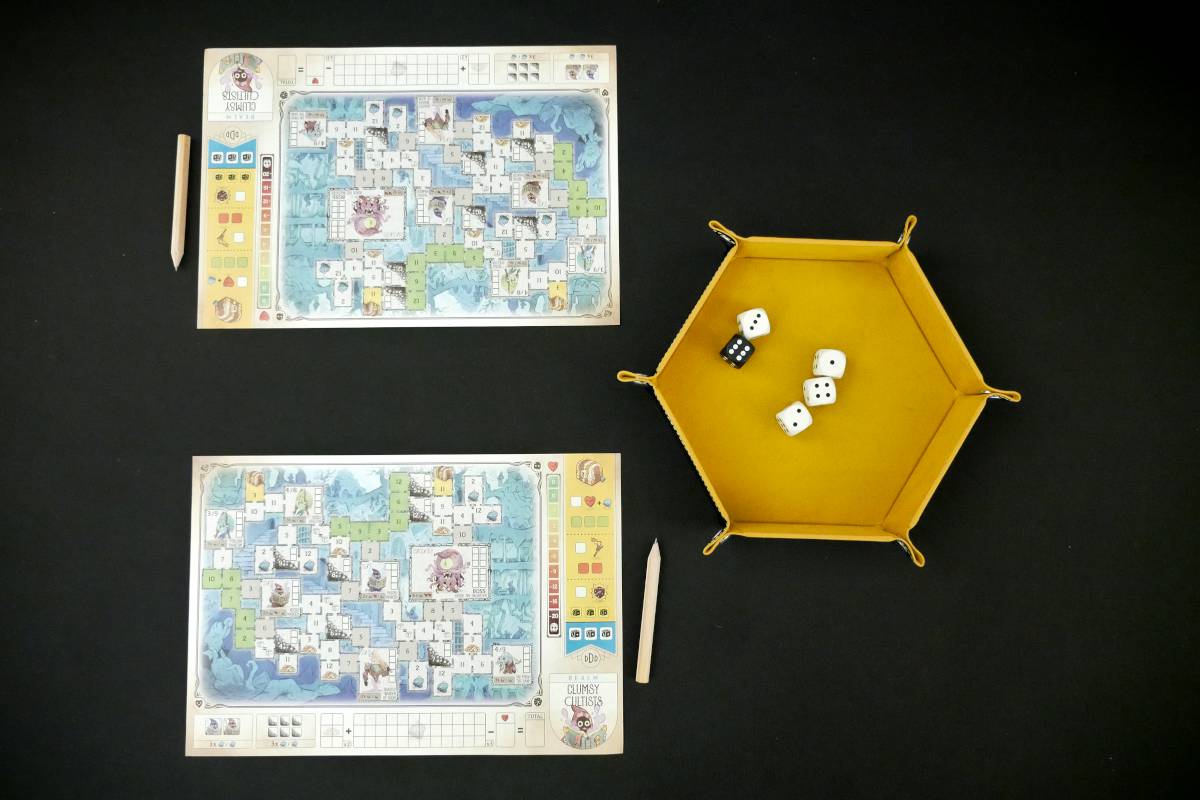
Another favorite aspect of mine is that Dungeons, Dice & Danger doesn't require much table space at all. You just need personal space for your dungeon map, plus a small shared space for the dice.
In fact, my wife and I have played this game several times on the couch. You just need a hard surface to write on (we've used laptop trays, clipboards, books, and even the game box itself) and a dice tray for the dice. It's one of my favorite board gaming accessories and it shines here with how it contains the dice and lets you play on a couch, in bed, or wherever else.
Learning Curve
Dungeons, Dice & Danger has more rules than you might expect for what's ultimately a straightforward roll-and-write. I find that it's harder to teach than it is to play, but once you get over that hump it's pretty smooth.
The core turn structure is so simple: the dice are rolled, you create your own dice pairs, then cross off corresponding rooms. But the factors that go into your decision? Of which dice to pair and which rooms to visit? You need to know about all the other stuff to make smart plays.
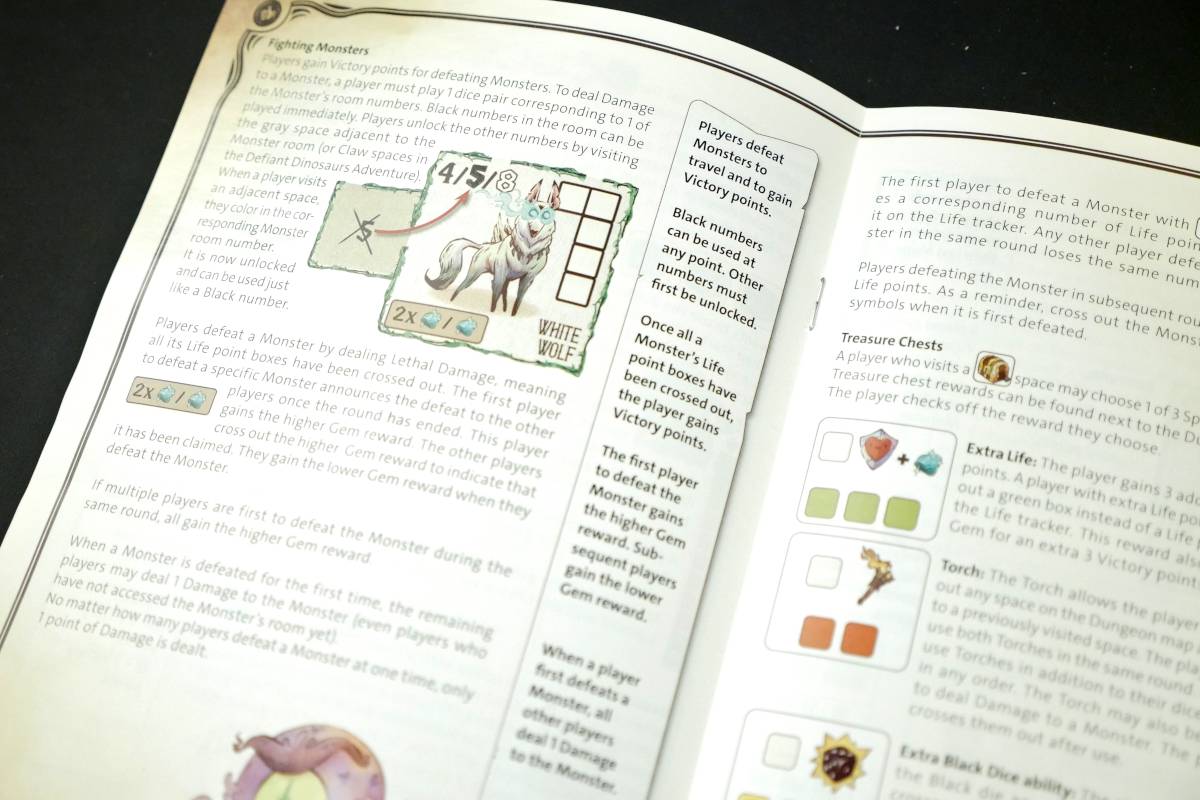
While the Gems are easy enough to understand, you have extra rules around Monsters and Boss Monsters, plus the Black Die ability, plus the special abilities earned through Treasure Chests, plus the race bonus goals, plus the health tracker, plus the unique elements on each dungeon map...
It's all rather light in isolation, but it can get complex once you mix them all together. Dungeons, Dice & Danger edges right over the threshold into "gamer" territory—I'd only introduce it to someone who's familiar with strategy board gaming. Definitely not as a first roll-and-write!
Game Experience
Decision Space
In one sense, the decision-making in Dungeons, Dice & Danger is quite simplistic. It all boils down to a single decision every turn: how will I pair these dice that were just rolled?
And it's not like you have that many options. If all 4 white dice (A/B/C/D) come out to different numbers, you have 3 possible pairings (A+B/C+D, A+C/B+D, A+D/B+C). If 2 of the 4 white dice are repeats (A/A/B/C), then you only have 2 possible pairings (A+A/B+C, A+B/A+C). With 3 repeats (A/A/A/B), you're stuck with A+A/A+B. Same with 4 repeats (A/A/A/A), where you're stuck with A+A/A+A. Again, not that many options.
At its most surface level, Dungeons, Dice & Danger is about selecting the best dice pair for yourself. You'll be looking at all the rooms open to you—the ones adjacent to your visited rooms—and comparing them against the pairs you can make. It's straightforward, although the constant evaluation of dice pairings can be mentally draining over the course of an hour.
While I wouldn't say it's a game prone to analysis paralysis, I will say it can take a while to process all the possible dice pairings and come to a final decision, especially when a black die is involved.
Speaking of, the game really opens up with that 5th black die. When all the dice have different values, you have 15 possible pairings! Fewer when you have repeated die values, of course, but still... that 5th black die can make a huge difference, which highlights the power of the Black Die ability.
So in another sense, Dungeons, Dice & Danger is all about smart timing and clever use of your Black Die ability. It's not like the Black Die ability offers any points at the end of the game for not using it, so you do want to use it—all of it, if you can. The key is to get the most value out of it every time.
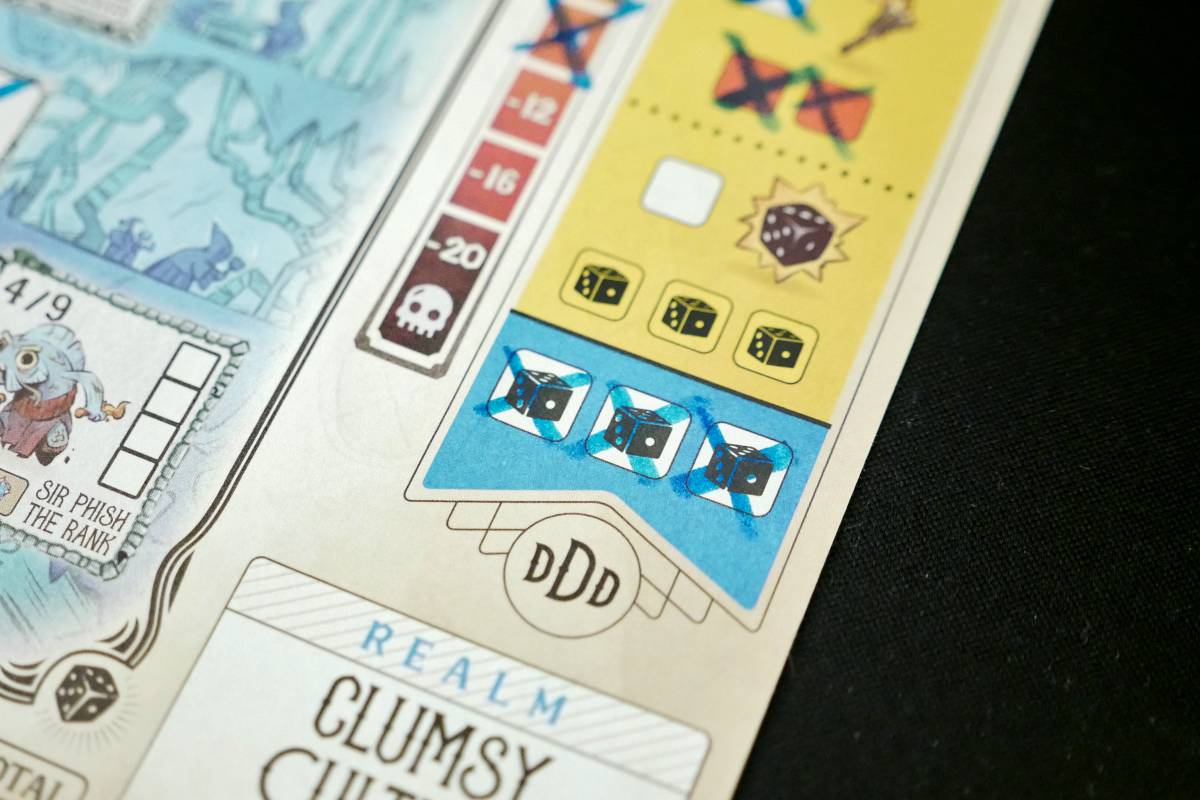
Maybe that means saving the Black Die ability to get you out of a bind with unusable white dice rolls. Or maybe it means jumping on a chance to slay that Monster before someone else does. Or maybe you spend it on an 11-value pair that opens another striking option against the Boss Monster, giving you more ways to hit it for the remainder of the game.
Thoughtful and wise use of the Black Die ability is how you make big moves in Dungeons, Dice & Danger. It's both small yet huge.
Lastly, you have to realize that Dungeons, Dice & Danger is a game of probability management. Any time you're left with dice sums that can't cross off any available rooms, you're going to lose health—so it stands to reason that you want to keep as many outs open at all times.
In other words, you want to avoid crossing off all rooms of the same value because that'll leave you vulnerable to that sum being rolled. You also want to prioritize crossing off the rarer numbers (like 2, 3, 4, 10, 11, 12) when you can because those are harder to roll. Meanwhile, leaving open the common numbers (6, 7, 8) will reduce the likelihood of you getting stuck.
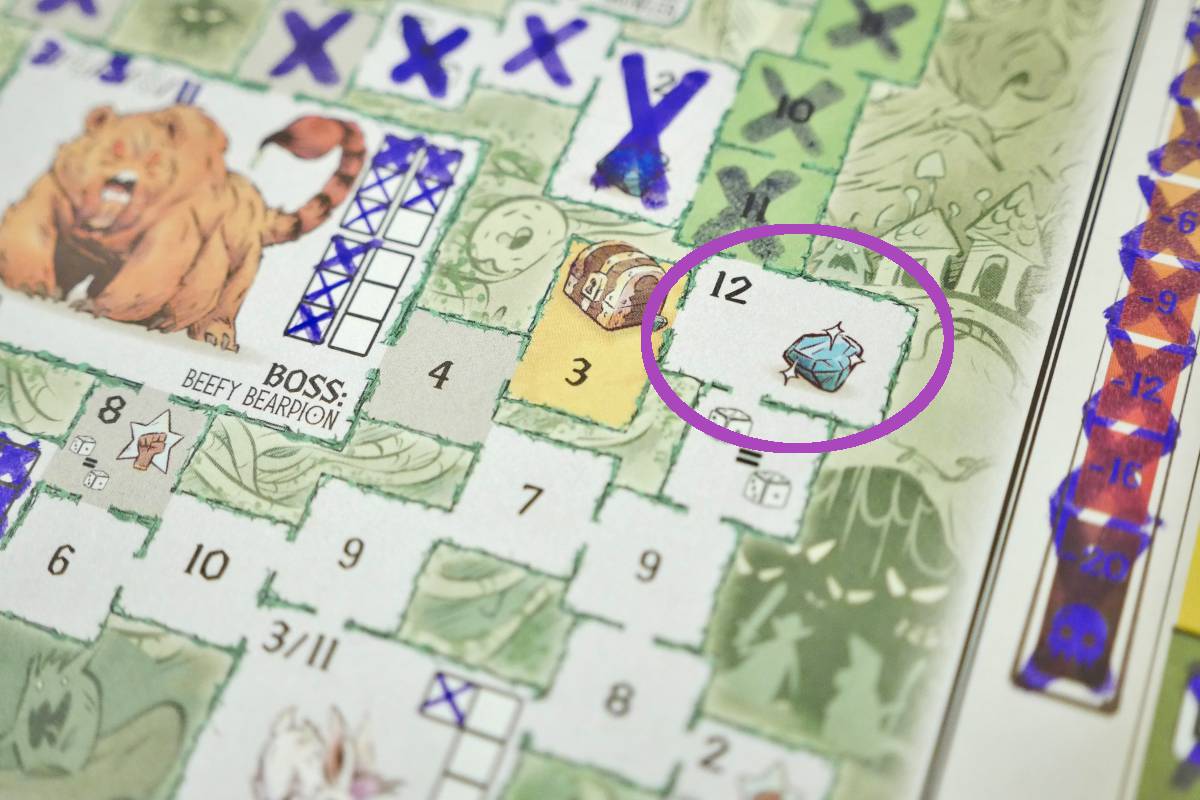
The same idea also applies to the physical layout of rooms in the dungeon. Some rooms are chokepoints that block off entire sections, and you want to visit them sooner than later otherwise you'll be limiting yourself. The more adjacent rooms you can have available at a time, the safer you'll be—you need to be mindful of which rooms you visit and don't visit.
Add it all together and you'll see that Dungeons, Dice & Danger is all about racing to score points without ever backing yourself into a corner.
Luck Factor
While there's a non-trivial amount of luck in Dungeons, Dice & Danger, you'll find enough ways to mitigate it that it doesn't feel unfair.
- You get to choose your pairs. Every time the dice are rolled, you get to pick which sums to use for yourself. You're never blindsided by an unpredictable result. Dice mitigation doesn't get better than that!
- You have the Black Die ability. If you're ever hit with a truly terrible roll and you can't make any lemonade out of it, you can always spend one of your Black Die uses to save yourself.
- You also have special abilities. Each of the special abilities from Treasure Chests lets you sidestep bad luck in its own way.
Now, here's the most important thing: at the end of the day, all players are working off the same exact dice rolls. If one roll happens to be unlucky for you, it's because the sum total of all your decisions leading up to that point put you in that position—and that branching variation from player to player is what makes this game interesting!
Fun Factor
Dungeons, Dice & Danger is a heads-down game without much talk. You'll spend nearly all your time evaluating dice pairs and figuring out which rooms to cross off. The main fun of it rests in those dice evaluations and the satisfaction that comes from choosing pairs well.
There's also a good bit of tension in the race to slay Monsters. Not so much that it's core to the experience, but enough that you'll feel moments of "Aw man! I was just about to kill that one!" throughout every game.
It's not the game to play if you're seeking boisterous action, lots of banter, or frequent surges of excitement. It's a thinky and low-energy game, mostly played in your head, with some minor competition against the other players. I have to be in the right mood for it, but when I am, it can be enjoyable.
Pacing
I really enjoy the process of crossing off boxes, making my way through the dungeon, collecting treasure, and slaying the Monsters. That steady progression is satisfying, sort of in the way that crossing off items on a to-do list is. Every round is momentum.
And while Dungeons, Dice & Danger does take its time reaching its end, the path there is fun and exciting, punctuated by the different races—the first to slay any given Monster, the first to achieve the special bonus goals, while collecting as many Gems as you can before the end is triggered.
Plus, there's very little downtime thanks to the simultaneous play every round. Even when you cross off your rooms faster than everyone else, you don't have to wait long before the next dice roll. That constant sense of action keeps the game moving along, turn by turn.
In all my plays, the game has always ended around the 60-minute mark, give or take 5 to 10 minutes. If nothing else, Dungeons, Dice & Danger is surprisingly consistent in its pacing.
Player Interaction
As is often the case with older roll-and-writes (yes, I know Dungeons, Dice & Danger is only a few years old, but roll-and-write designs have evolved quite a bit since its time), player interaction is almost insignificant here.
It's mainly indirect interaction in the form of racing: you're trying to be the first to do stuff, whether that's slaying the different Monsters or completing the bonus goals. The only time you can actually affect anyone else is when you slay a Monster, giving everyone else a "free hit" against that Monster on their own sheets. Apart from that, nothing.
You never have to pay attention to what anyone else is doing. It might give you a small leg up to know what others are going for (so you can achieve it before they do), but you don't have to. You can play from within your own little bubble and do pretty well... and maybe even win!
Player Counts
While Dungeons, Dice & Danger goes up to 4 players, I'm going to say it's best at 2 players. The main reason is that you get to be the active player more often (every other round as opposed to every third or every fourth round), reducing the impact of luck and making it feel more strategic. Being able to use that black die more often makes all the difference.
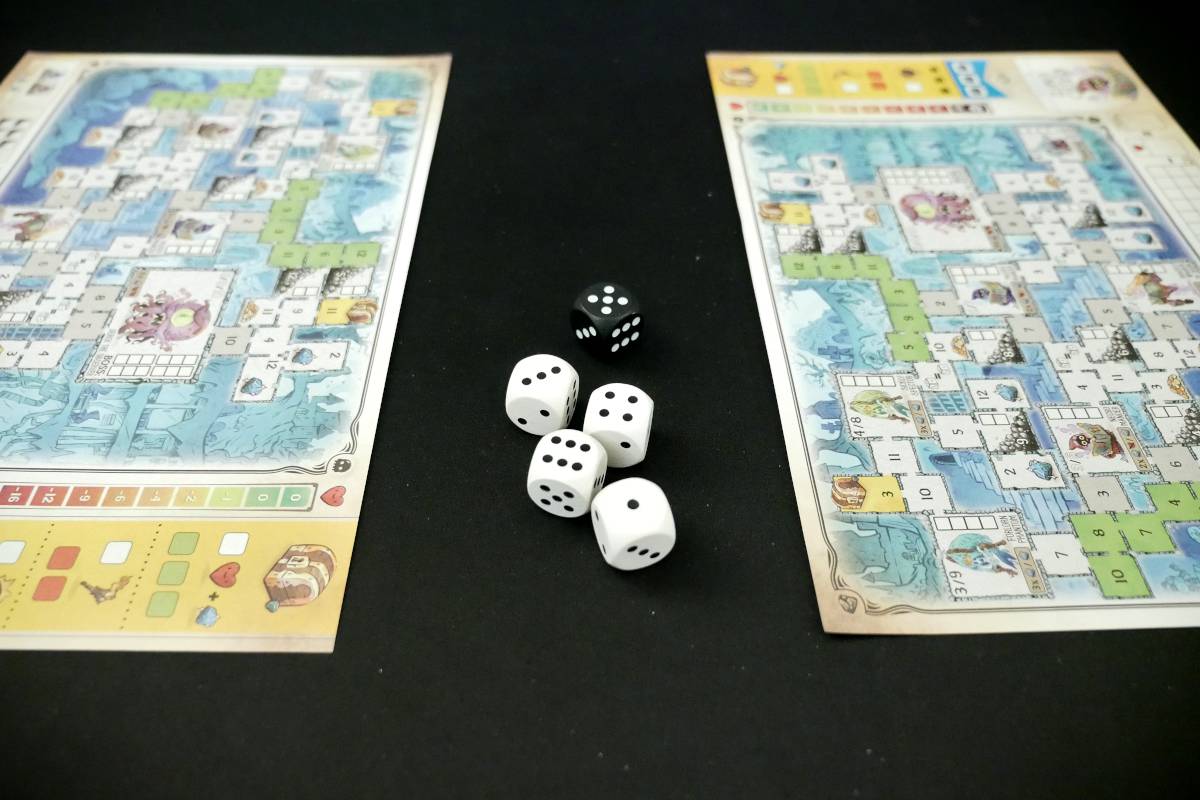
It also keeps the race elements more interesting. With more players, you're less likely to score the primary reward on any given Monster or bonus goal, so there's less excitement there—the racing tension is weaker. Plus, the game tends to end faster and feels less substantial because of it.
As for the solo mode, it's pretty good. You can read more about that down below in the "Solo Mode" section, so I'll just say that it's essentially the same game with a few tweaks that keep it tense and puzzly despite having no one to race against. I still prefer it at 2p, but I like it solo, too.
Replayability
I find that Dungeons, Dice & Danger is adequately replayable. Obviously, with 4 dungeon maps (50 sheets each), there's enough variability to stay novel for at least a dozen plays or so. It may start to feel stale after you've played each map around 3 times. Or it may not! Depends on how you like it.
I like that it's both lucky and strategic. You have to make do with the dice rolls you get, but you also have enough control to maneuver yourself into and out of situations. It's light enough to be cozy but engaging enough to hold your attention from start to finish. It doesn't play on autopilot. You can't completely check out and still expect to win.
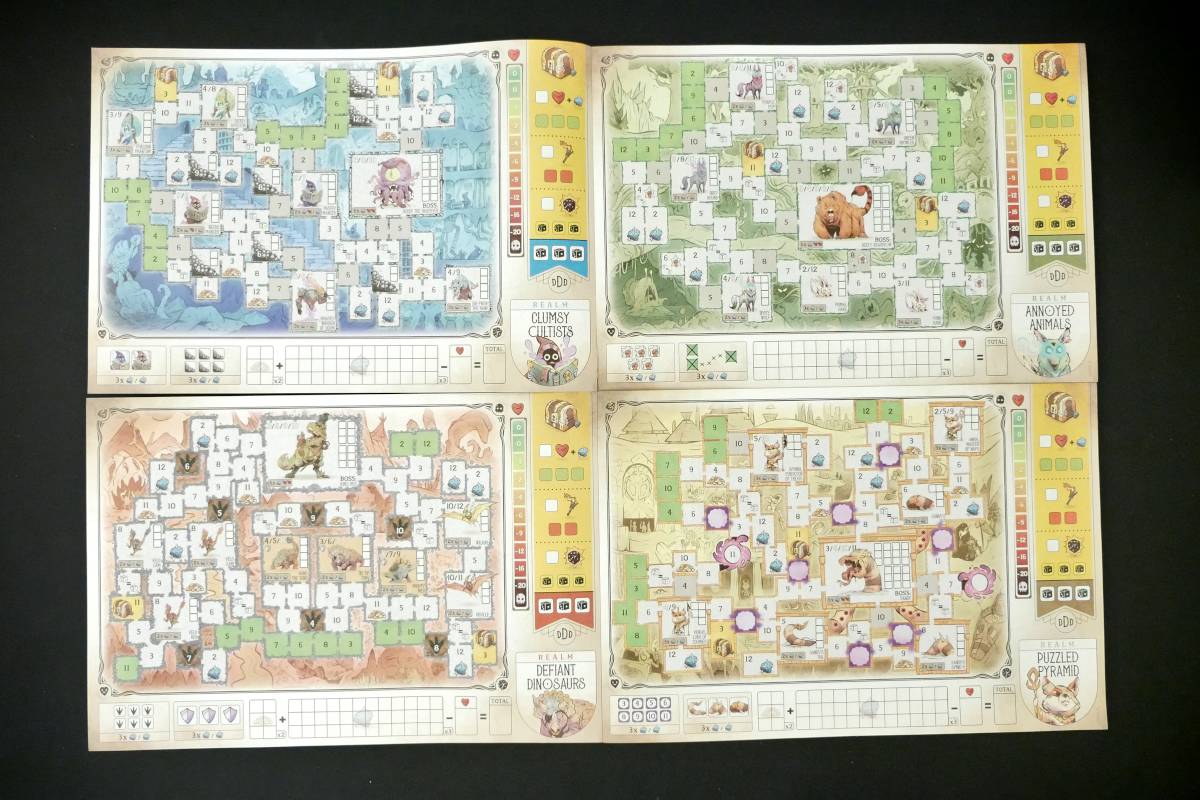
That said, there's only so much to explore. Every sheet is the same as the sheet before it, so it'll start to feel repetitive after a while. It's the kind of game that's good to pull out a few times a year—not the kind of game to play every single week... unless you're absolutely smitten by the coziness that comes from rolling dice and crossing off boxes.
Solo Mode
The solo mode of Dungeons, Dice & Danger plays nearly the same way as the regular game, except with some minor twists:
- You can never freely use the black die. If you ever want to use the black die, you must use your Black Die ability.
- You lose 1 health if you don't inflict at least 1 damage to a Monster during a round. However, you can avoid taking this damage if you forfeit your second dice pair for that round.
- You ignore the point penalty of your health track at the end of the game. However, if your health track is depleted, the game still ends.
- You always get the higher reward when slaying Monsters or completing bonus goals. The race element is moot.
You can see how this would be a more puzzly experience. Your movements are more restricted because you can only use the white dice, plus you have to worry about striking Monsters every round (or else suffer even more restricted movement). It's a balancing act that forces you to really think about which dice pairs to use and when to forfeit your options.
The solo mode is a satisfyingly engaging puzzle for passing the time, wrapped in the trappings of a dungeon to explore. It may not be my absolute favorite, but it's among the better solo roll-and-write experiences out there.
Production Quality
Dungeons, Dice & Danger is middle-of-the-road when it comes to production. While there's nothing wrong with any of it, there's also nothing about it that stands out or wows me. It's perfectly fine in every way.
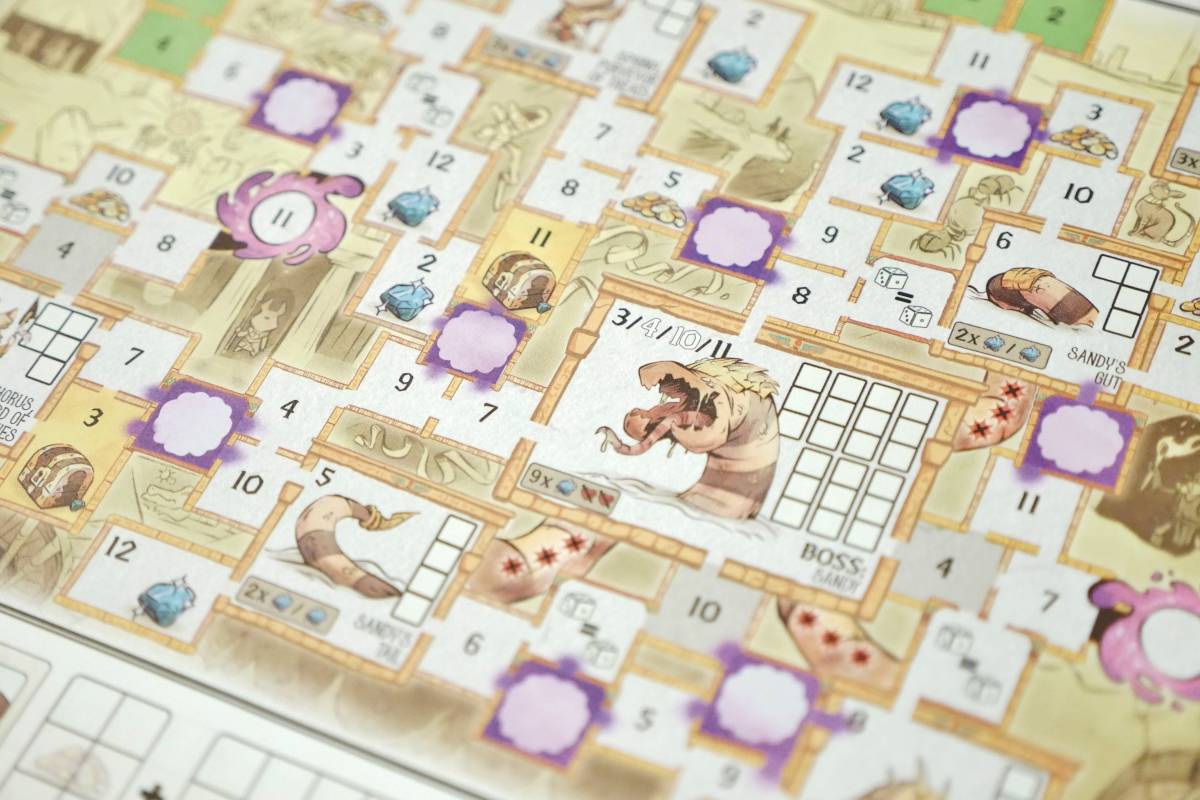
The dungeon map designs are both readable and usable. The graphic design is really pleasant. I can easily tell what number is on a room, and the various icons and Monsters look great, infusing the map with personality and making it feel like a real game (and not just a sheet of paper). Dividing the sheet into a sidebar and bottom panel was also a smart move, making it super easy to track stuff without getting confused.
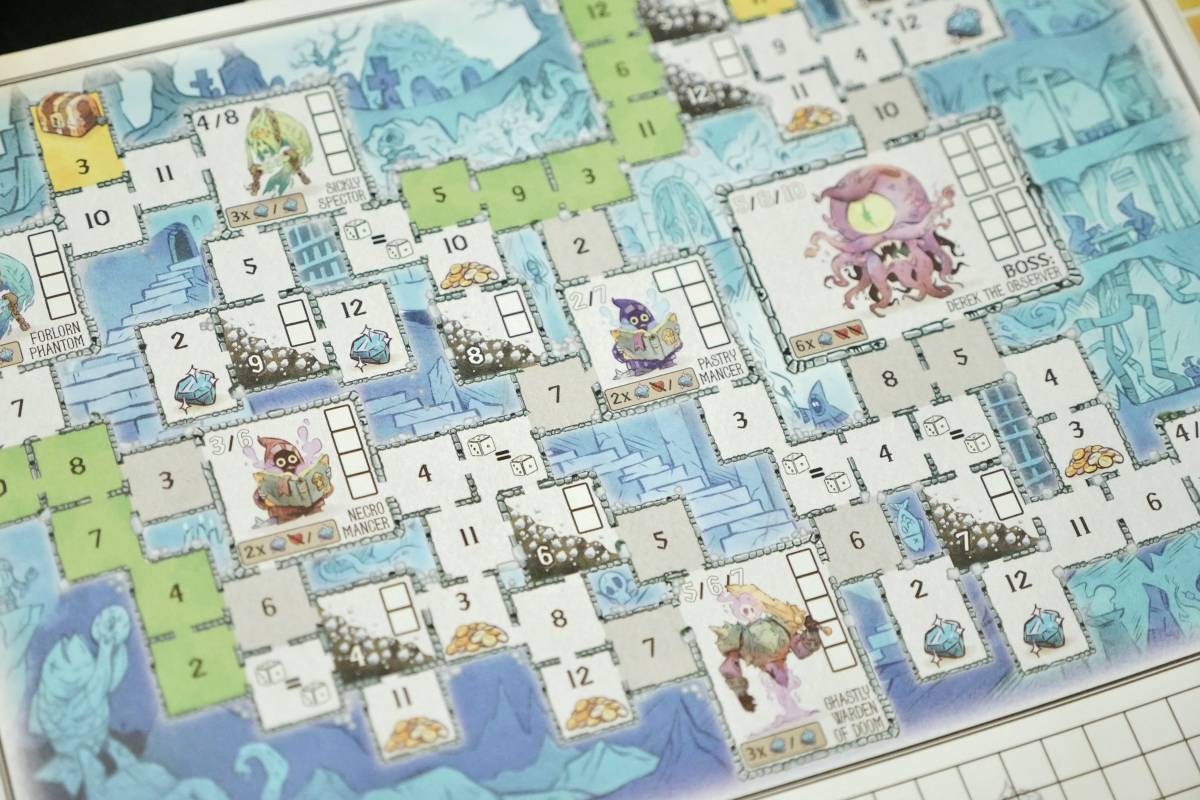
Every map looks different with its own aesthetic. While the first map is foresty and approachable, the other maps have more adventurous atmospheres with their own personalities: one map is frigid and icy, another map is sandy and barren, and another is a prehistoric wasteland. They keep the game from feeling too samey from play to play, which is nice.
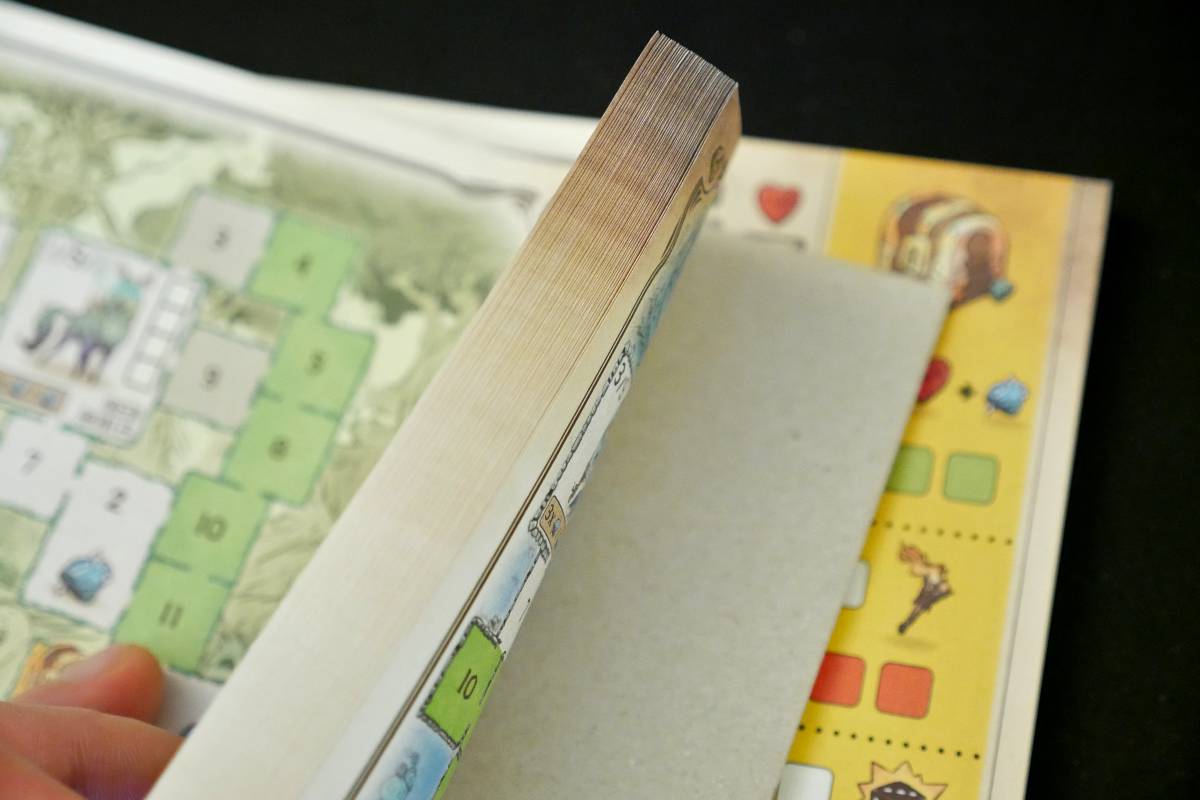
I appreciate the inclusion of 50 sheets for each map. Keep in mind, these are big sheets with lots of colorful imagery, so they certainly could've held back a bit—especially at its affordable price. Note that they're double-sided, which can be a little annoying to manage as you'll want to hang on to used sheets with unused backsides. Still, I appreciate the amount.
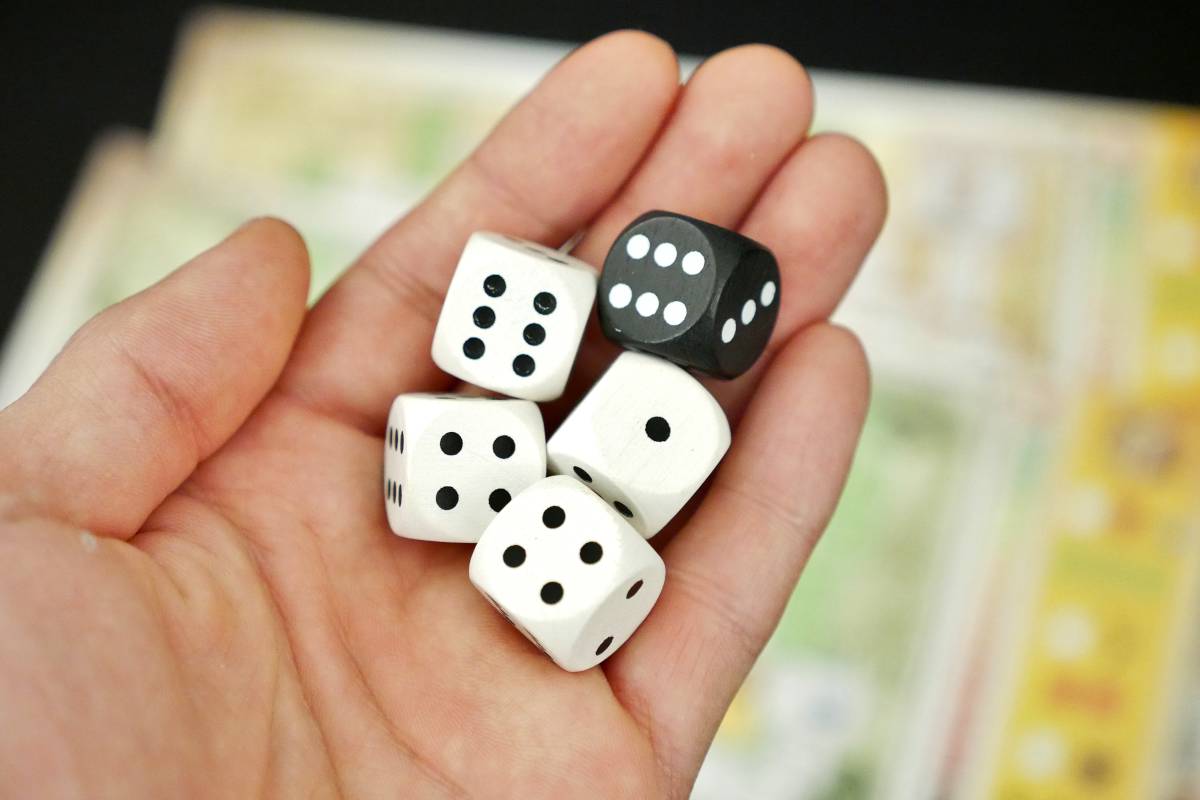
The wooden dice are good but nothing special. I mean, they're comfortable to use and they get the job done, so don't get me wrong. I'm not complaining about the dice at all. The size is right and the pips are easy to read even from across a table. But there's nothing special about them. A bit more personality would've been nice, if extra.
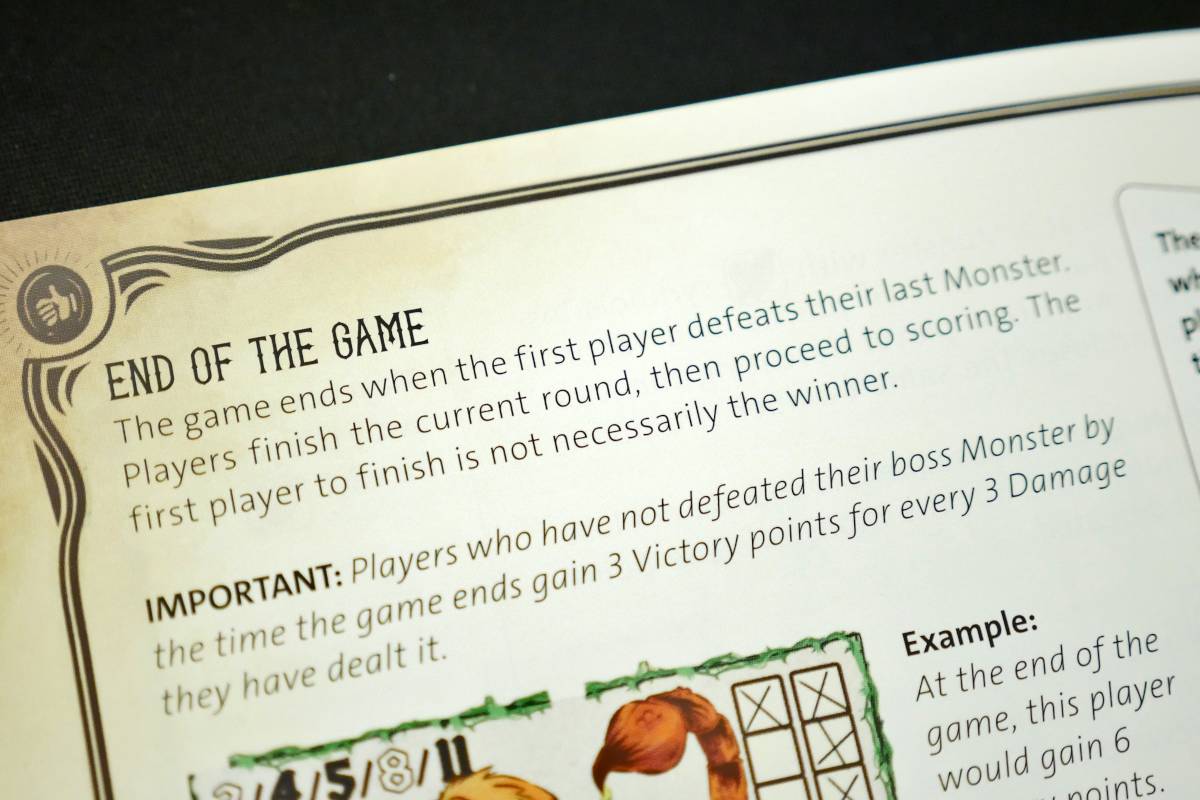
My only big complaint is with the rulebook. Dungeons, Dice & Danger was clearly translated into English from another language (most likely German) without a strong quality assurance pass, resulting in a rulebook that's somehow both verbose yet ambiguous. Some of the English rules are flat-out wrong when compared to other languages! It's bad enough that you can find unofficially compiled errata on the BGG forums.
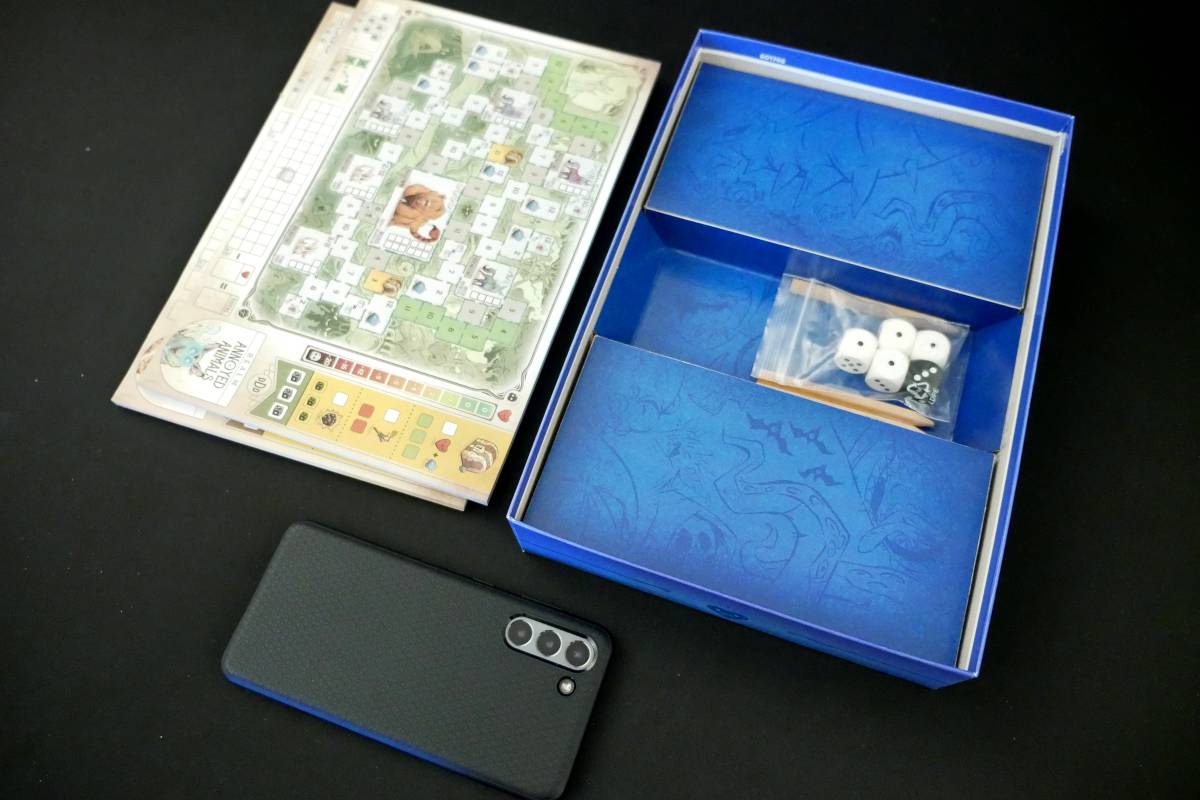
The game box size and insert are reasonable. It's a big box for such a straightforward roll-and-write, but I like the size of the sheet and I realize the box can't go any smaller with sheets of this size. The insert is passable and gets the job done. Overall, good but nothing to write home about.
The Bottom Line
Dungeons, Dice & Danger is a solid roll-and-write experience and a good entry point if you're looking for something a tad more advanced than the usual lightweight fare in this genre. The dice pairing is fun (though it can be tedious at times) and there's enough strategy to offset the luck of the dice. It may not blow you away, but it's good!
Stop Buying Games
You'll Regret
Before your next game purchase, run it through this mental checklist that every seasoned gamer uses.
Free checklist, delivered instantly to your inbox.
No spam, ever. Unsubscribe in one click.