
How important is theme in a board game? That's what I find myself asking after playing Décorum, which brings its theme to life a little too well. Lots of board games simulate real-world activities—like firefighters rescuing people, vintners making wine, or nobles being executed during the French Revolution—but they're usually abstracted to a degree.
Décorum is fully in your face with its theme: what it's like to live with a passive-aggressive partner (or roommate) who refuses to communicate like an adult. In fact, it's so successful at it that this is the first time I thought a game was too true to its theme.
But does that mean it's a good game? Here's everything you need to know about Décorum, how it plays, what my experience with it has been like, and whether it's one to add to your own collection.
This review is based on a review copy of Décorum provided by Floodgate Games, but my thoughts and opinions are my own. I played through 16 scenarios with my wife in the 2-player mode. I wasn't able to play with 3 or 4 players, so please keep that in mind with this review.
Overview
Décorum is a cooperative logical deduction game with limited communication, wrapped in a theme that I'm sure most of us are all too familiar with: living with a partner or roommate and struggling to make compromises so that both of you are satisfied with the way your home is decorated and furnished. Oh, easier said than done.
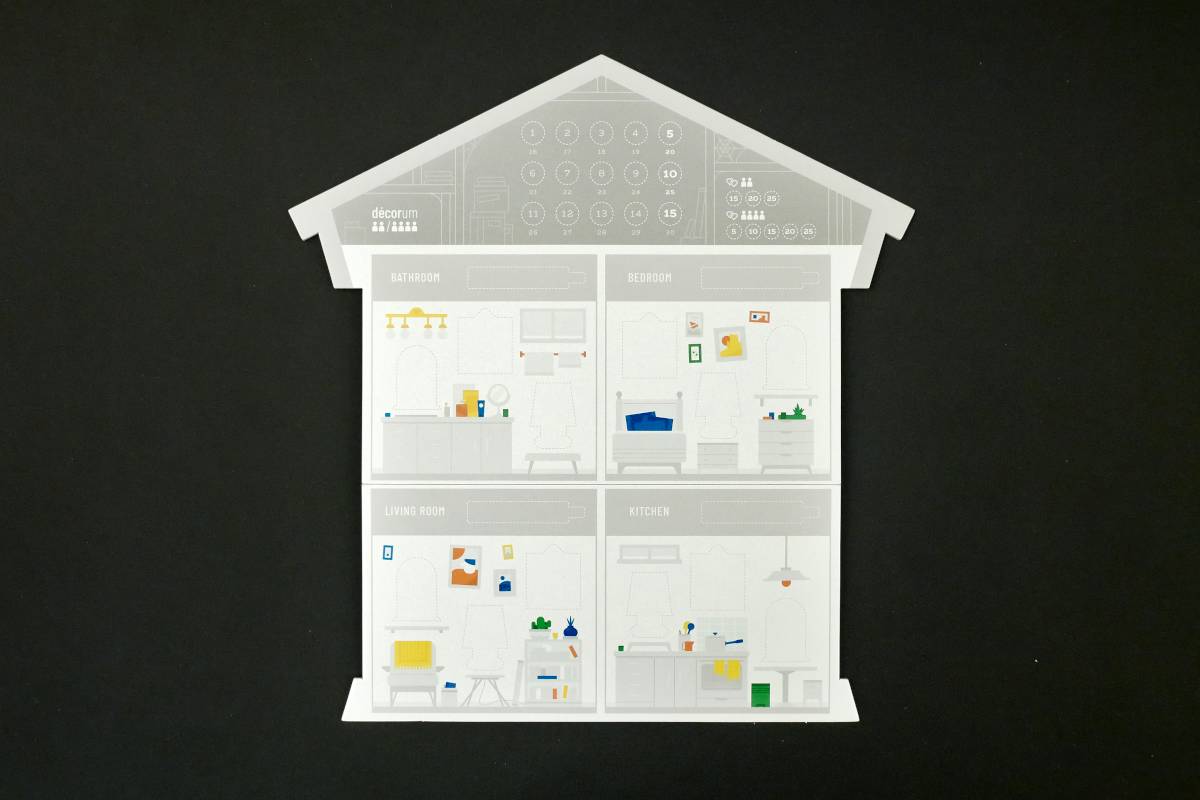
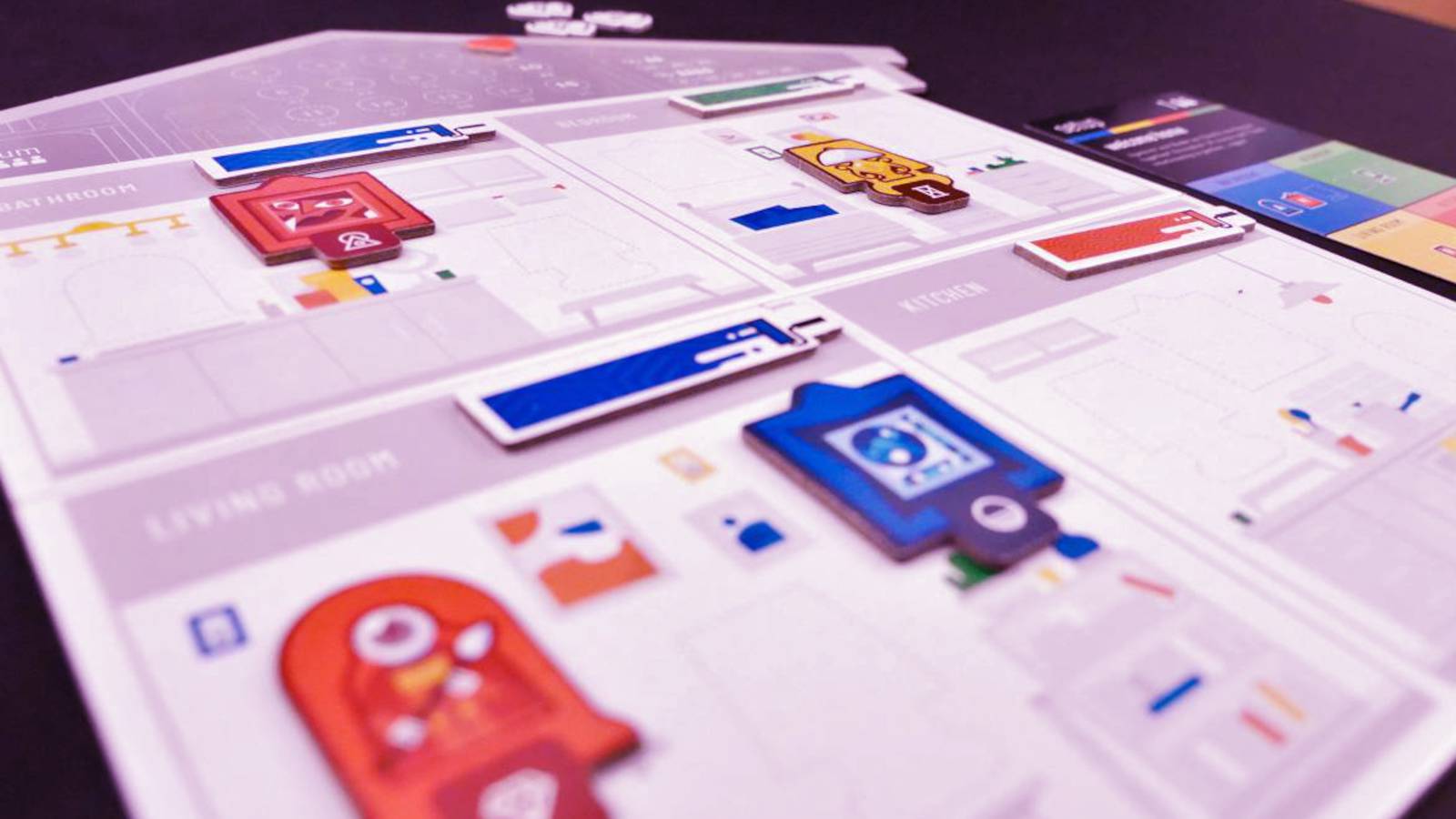
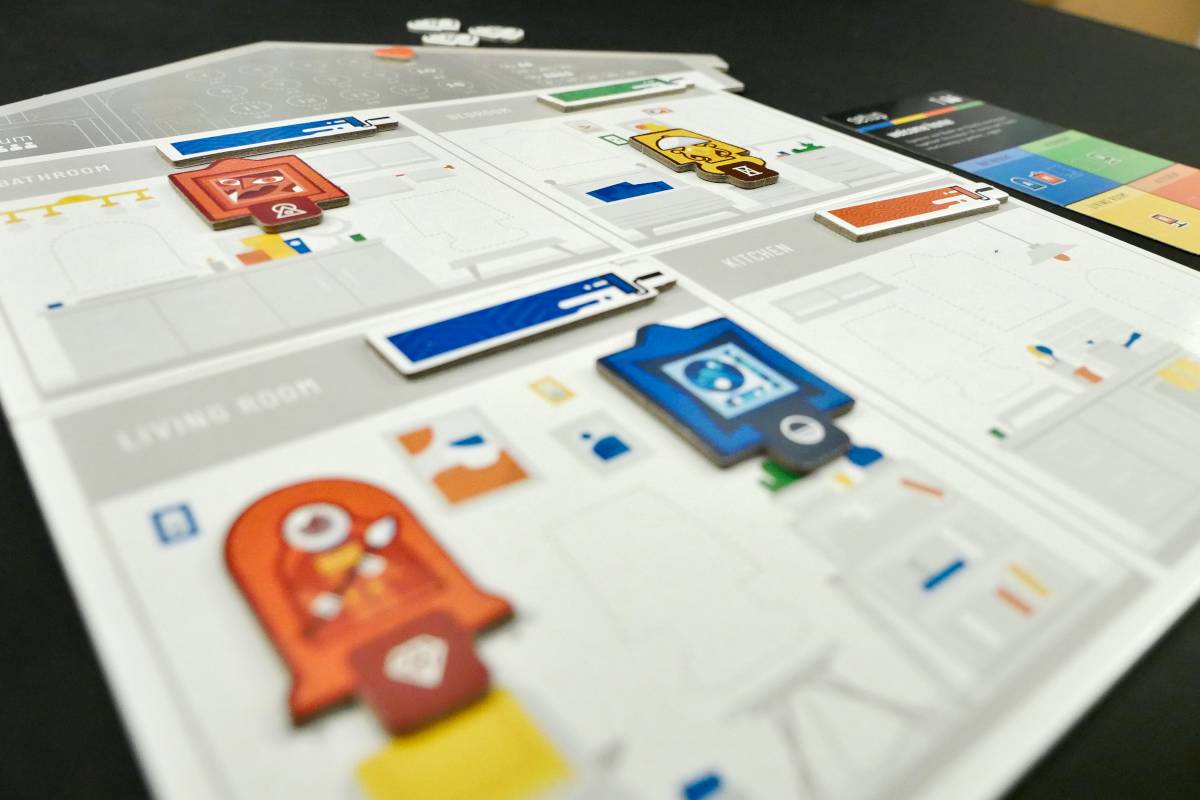
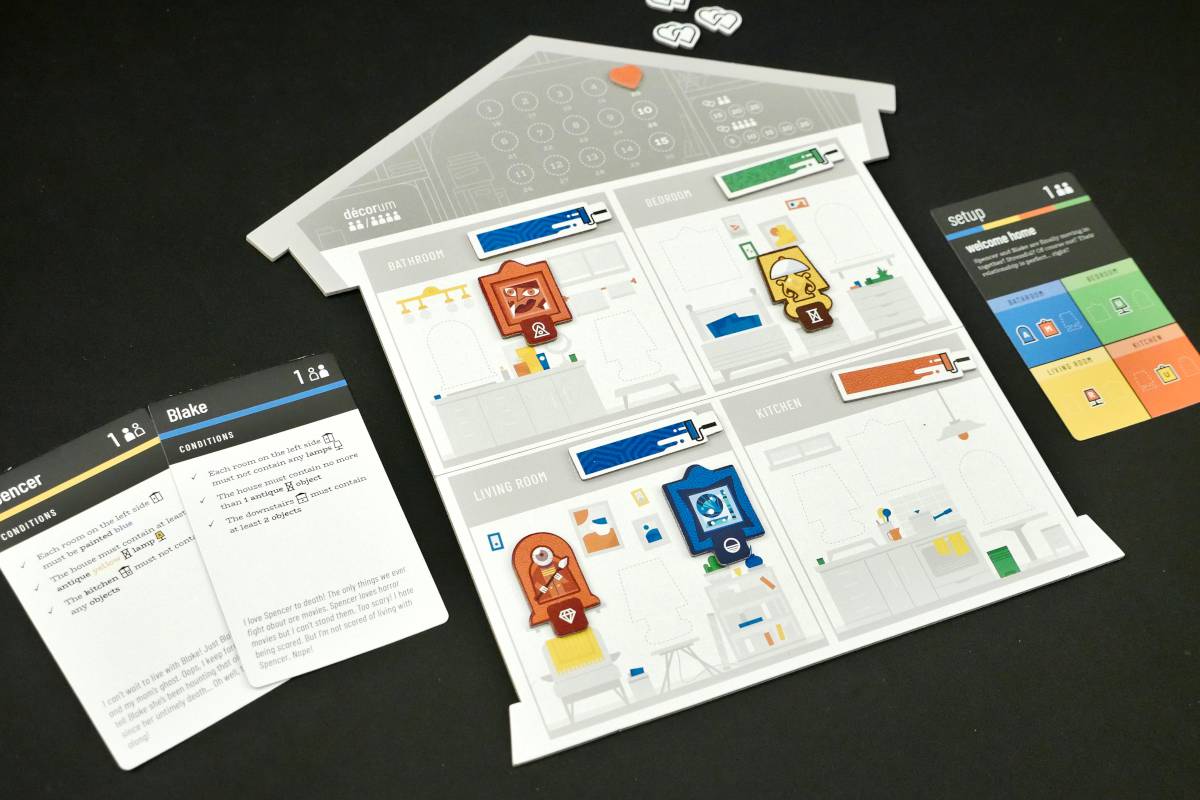
Décorum is played on a central House Board, which is comprised of four separate rooms: Bathroom, Bedroom, Living Room, Kitchen. These rooms are arranged in a 2x2 square. Each room has exactly three object spots, one for each type of object: Lamp, Painting, Curio.
Over the course of the game, these object spots may or may not get filled with objects. You'll be adding, changing, and removing objects from the various spots as you try to decorate the house in a way that fulfills your personal objectives. Meanwhile, your partner is doing the same to fulfill their own personal objectives... and you're bound to clash.
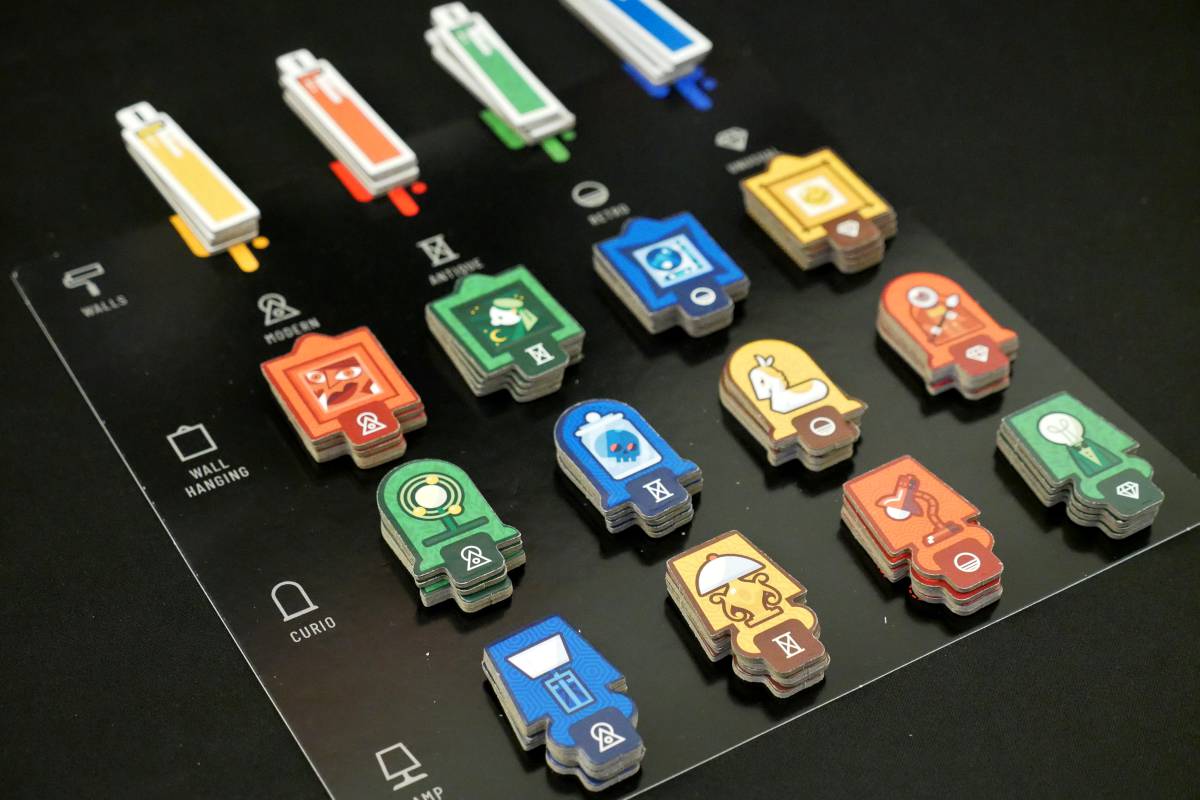
Among the objects, you'll find that they come in 4 different colors (Red, Blue, Yellow, Green) as well as 4 different styles (Antique, Modern, Retro, Unique). Each room can also be painted in one of those 4 colors (Red, Blue, Yellow, Green). These objects, colors, and styles are all managed on the Object Board, which makes it easy to see what's at your disposal.
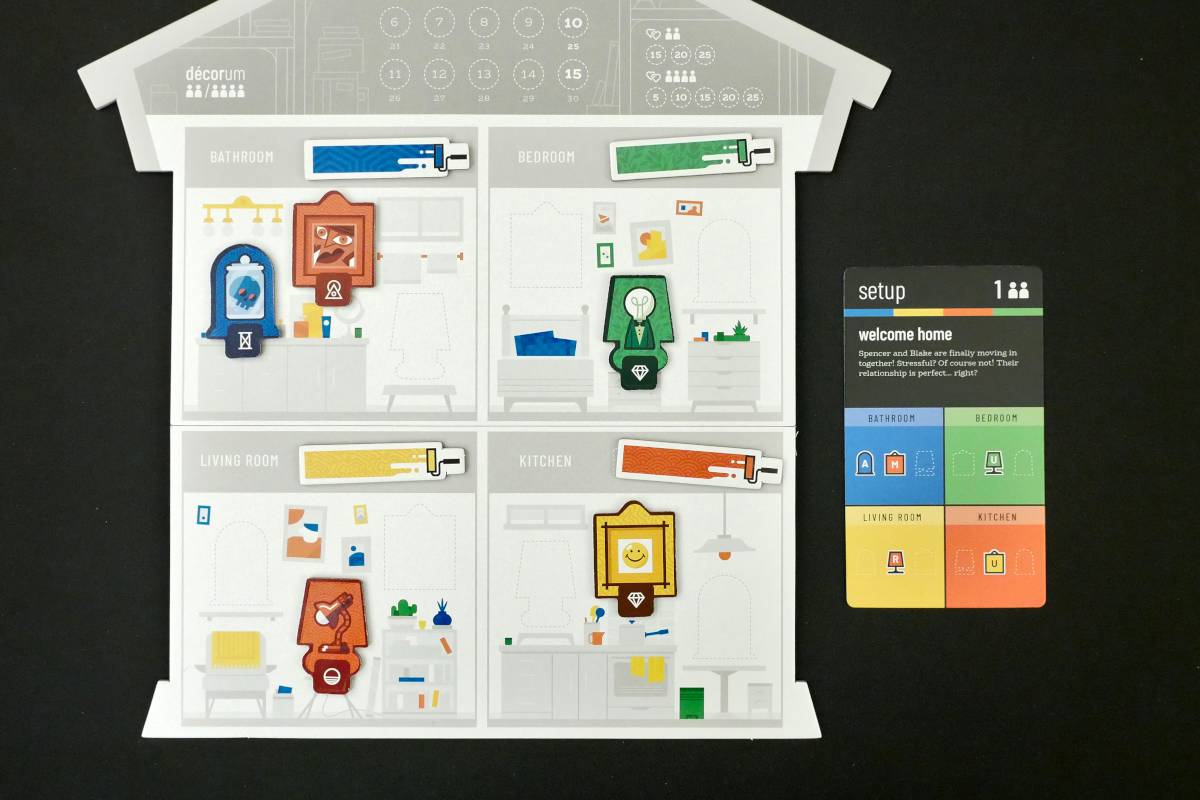
Décorum is played in campaign fashion, with the 2-player game consisting of 20 increasingly difficult Scenarios. (The 3/4-player game has its own set of Scenarios, which generally play out the same way with minor twists.)
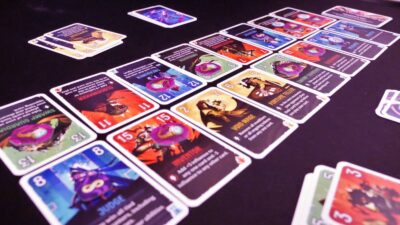
In each Scenario, there's a Setup card that shows you the initial state of the house: every room is painted a starting color, and every object spot might be either empty or filled with a specific object.
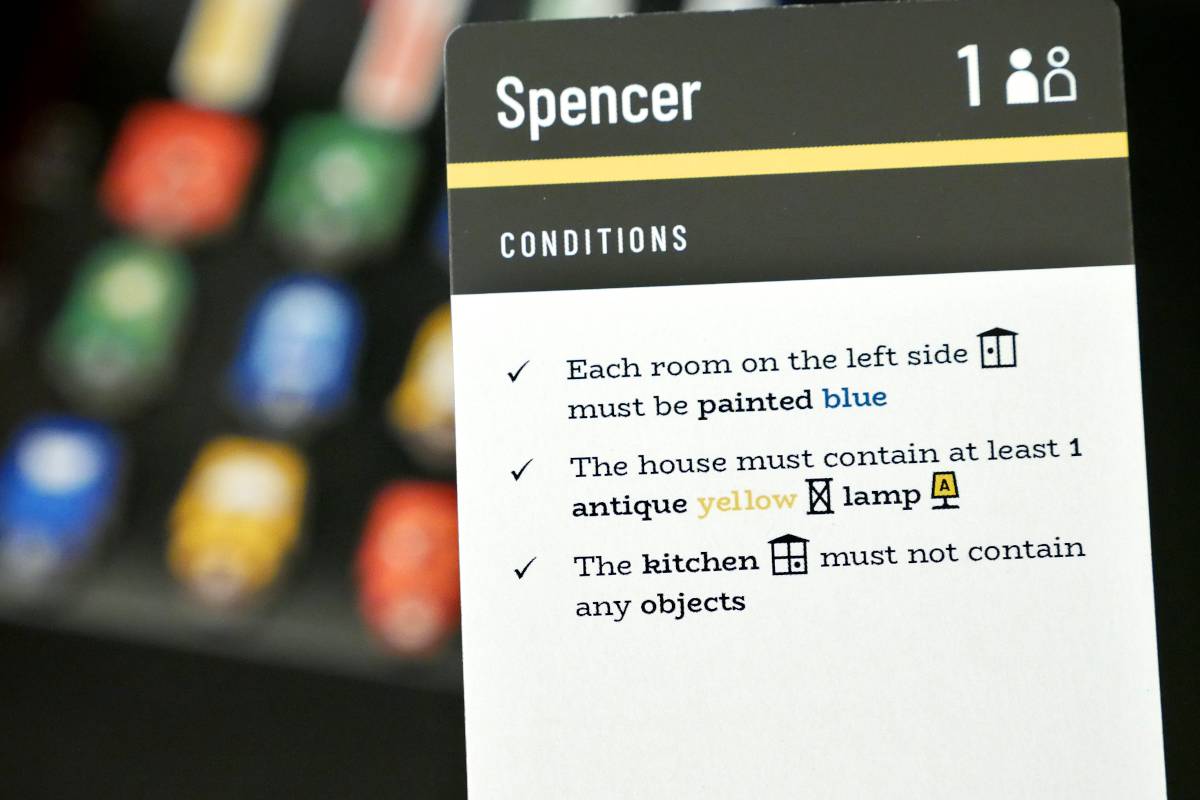
You also get a secret Condition card that lists all the decorating objectives you need to meet in order for you to be "Fulfilled." Your partner also gets their own secret Condition card with their own set of hidden objectives... which may or may not clash with yours.
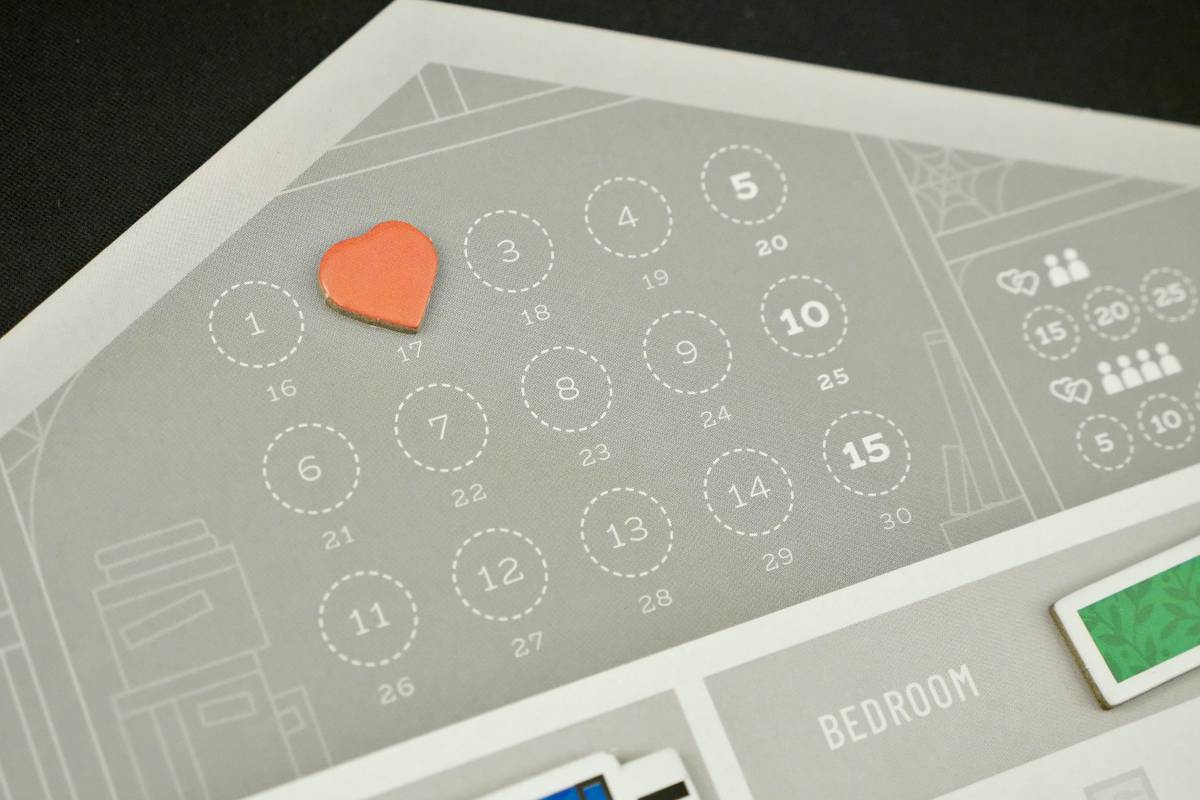
Décorum is played over 30 rounds, with each round consisting of 1 turn for each player. On your turn, you do the following actions in order:
- Change something about the house. Add or remove an object. Or swap one object for another of the same type (i.e., you can change its color or style). Or swap the color of a room's paint.
- Check if you're Fulfilled. After you've made your move, if all of your Conditions are met, you tell your partner: "I'm Fulfilled."
When your turn is done, your partner will then Comment on your move by saying either "I like that," "I don't like that," or "I'm neutral about that." This will give you insight into their Conditions for the house. For situations that aren't clear-cut positive or negative, your partner can also say things along the lines of "I guess I can work with that."
This is the ONLY bit of communication allowed in this game! You are not allowed to talk during Décorum, and you shouldn't give any "hints" with your response that would give away extra details about what your Conditions are.
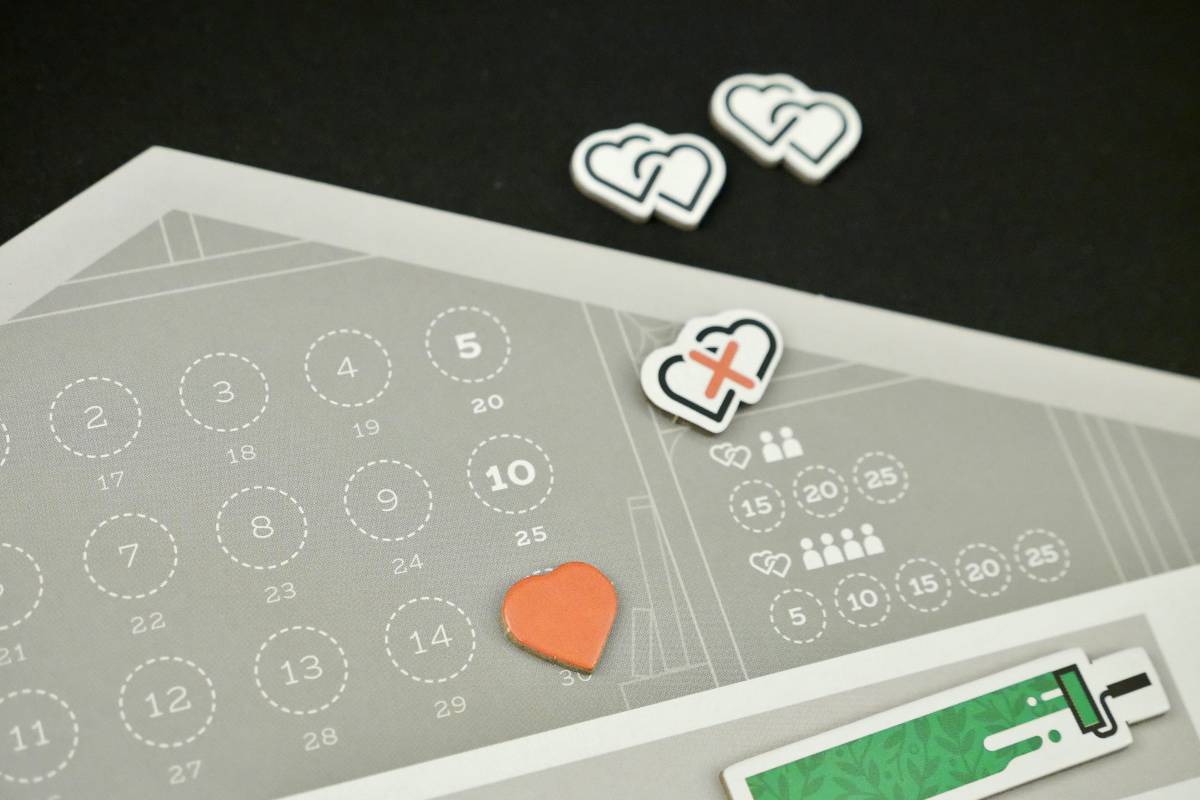
As you might glean, Décorum can be pretty difficult. Fortunately, there are three times across the 30 rounds when you can share a bit of information with each other. You'll hold a Heart-to-Heart after rounds 15, 20, and 25, where you each read aloud one of your Conditions. Knowing even one of your partner's Conditions can help a lot with future rounds.
A Scenario will end in one of two ways:
- If you're both Fulfilled within 30 rounds, you win.
- If round 30 passes and someone is still not Fulfilled, you lose.
Décorum also provides optional scoring rules, where each met Condition is worth 3 points and each unused Heart-to-Heart is worth 2 points. Or in other words, the best score is if you can win within 15 rounds, with score drops for winning within 20, 25, and 30 rounds.
Either way, that's it. You reset the House and Object Boards, then move onto the next Scenario with new Conditions to work through.
Setup and Table Footprint
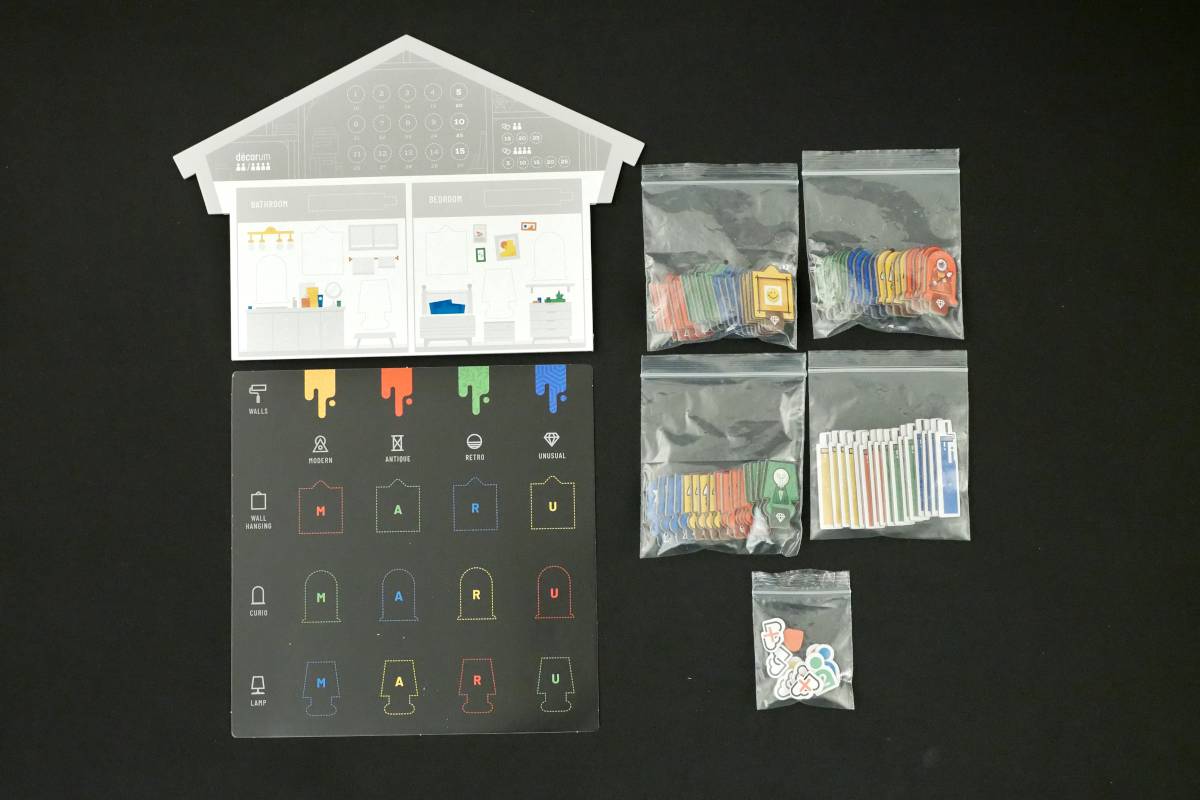
Décorum is sort of a pain to set up unless you can provide your own baggies for separating the different chits. It's a pain because you have to sort through all the objects and stack them by color and type for the Object Board. Same goes for the Paint markers, though they're a little easier.
The box does come with some plastic bags, but they were too big and too few for me. Only after I split up the objects by type into their own little baggies did setup become tolerable, and even then it still takes a few minutes because you also have to pull out a Scenario and initialize the state of the House Board according to the Setup card. Not a deal-breaker, but an inconvenience.
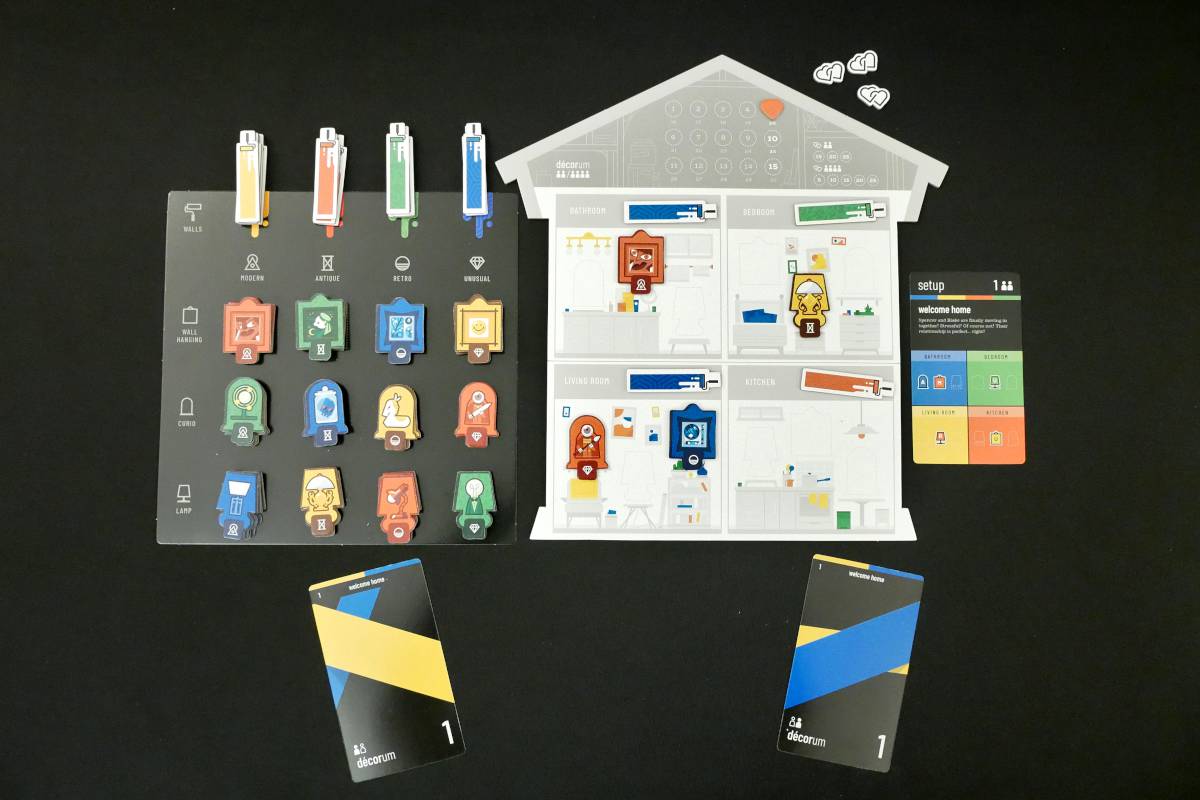
Fortunately, it doesn't take up too much table space. Everything is confined to either the Object Board or the House Board, and there's nothing else except for the Condition cards (which we usually just hold in hand). I like that it's close and intimate, allowing you and your partner to sit side-by-side while you're both quietly fuming at each other's house changes.
Learning Curve
Décorum is surprisingly easy to pick up and learn. You have the House Board with the object spots clearly outlined in each room. You have the Object Board that's intuitive to set up. The Scenario cards clearly tell you how to initialize the house and what your Conditions are.
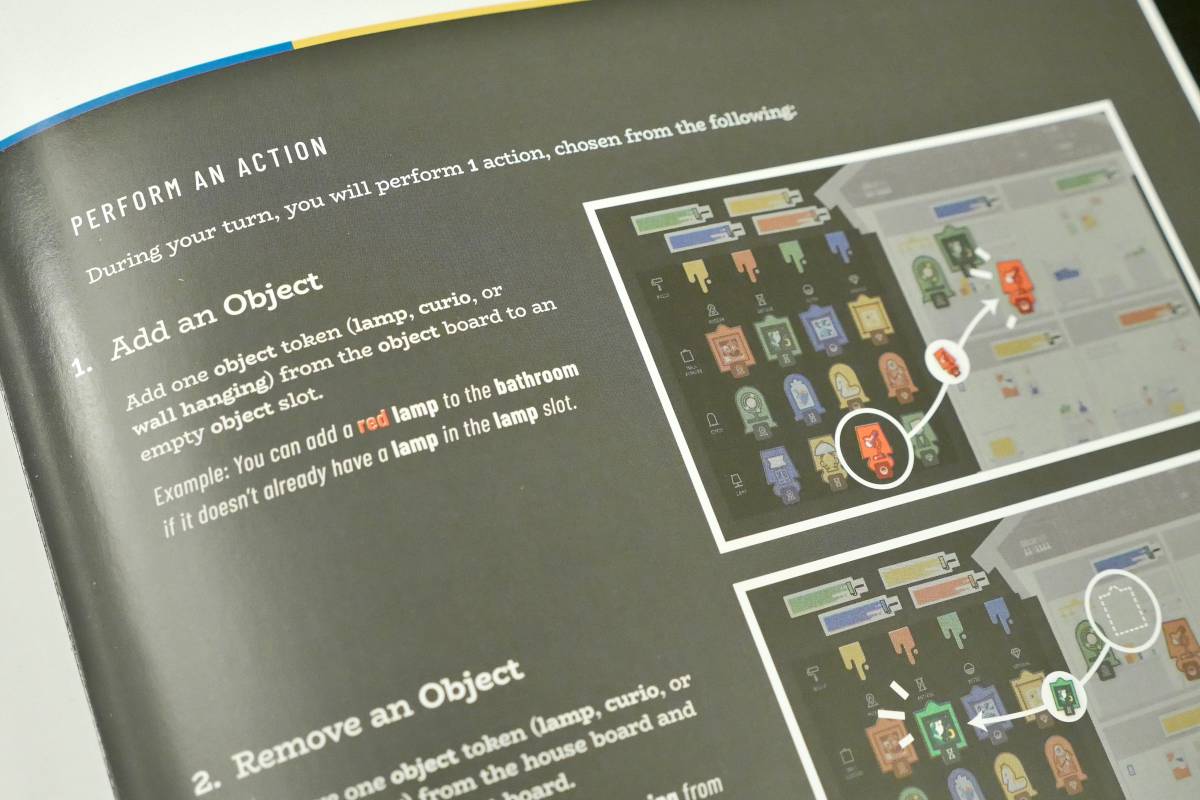
Furthermore, your turns are super simple and make perfect sense. Adding, removing, or swapping out objects? Painting rooms a different color? Only one action per turn? There's nothing confusing about that.
The whole concept of decorating a house and butting heads with another who lives under the same roof is so relatable that the rules basically explain themselves, and the clean production helps make it all the more digestible. I think a non-gamer would have no trouble learning Décorum. (They might struggle to play well, but that's something separate.)
Game Experience
Decision Space
Décorum subverted my expectations. I went into it thinking I'd get a logical deduction game, but the more I played it, the more I realized "logic" and "deduction" play a backseat role—if they play a role at all.
On the surface, Décorum bills itself as a game of secret Conditions, mind reading, and trying to appease each other with as little spoken as possible, in an effort to reach a house that's satisfactory to both players. Through your partner's small Comments, you're called to dig deeper and deduce what they really want, the things they're unwilling to say out loud.
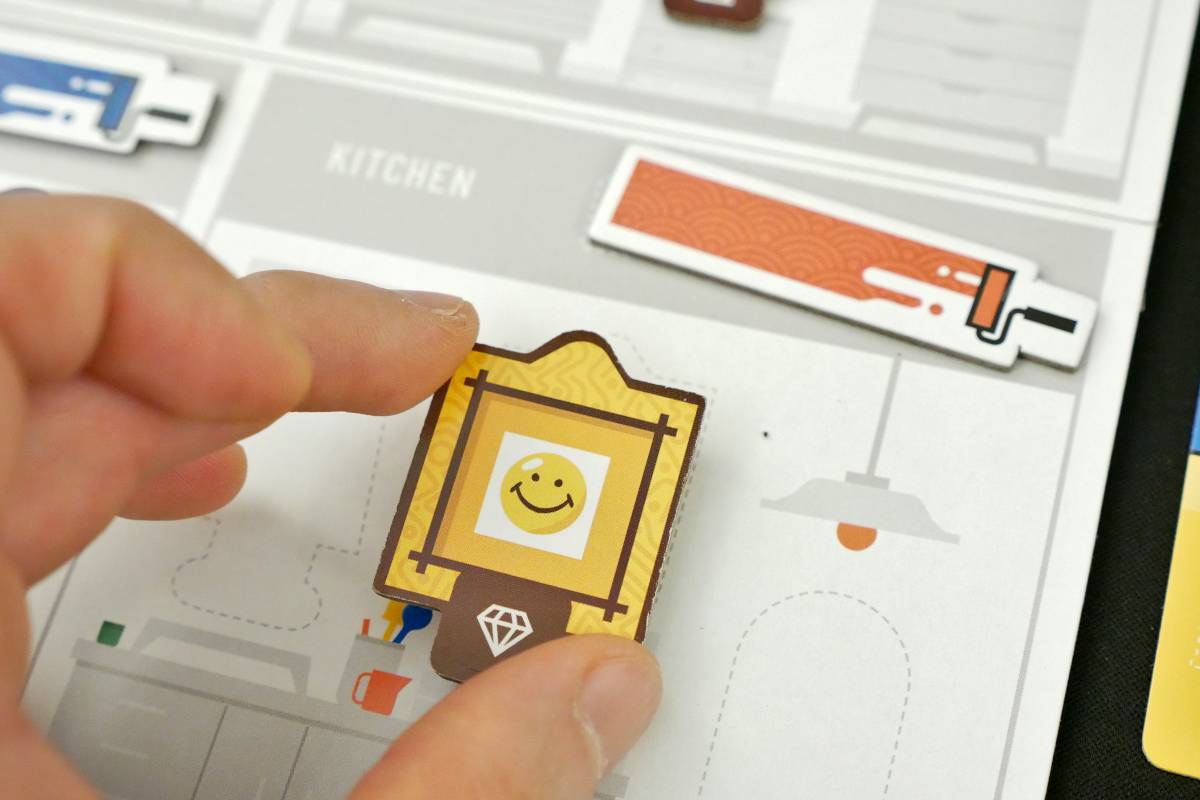
You place a Yellow Unusual Painting in the Kitchen and they say, "I don't like that!" Ah, okay, so you make a mental note that Yellow Unusual Paintings shouldn't go in the Kitchen. Five rounds later, your partner places a Yellow Unusual Painting in the Kitchen. "Huh?!" you think to yourself. "Why didn't she like it when I put it there? What was she telling me?"
That brings me to the biggest problem I have with Décorum: you can't actually deduce your partner's Conditions with logic. Well, you technically can... but it's extremely unlikely that you will, and that's because the game simply doesn't offer you enough concrete information.
In effect, the one bit of data you can collect is when you make a change to the house and your partner says "I like it," "I don't like it," or "I'm neutral about it." But what do they mean? Good luck figuring it out! Remember, your partner has 4 or 5 different Conditions to meet. Their Comment could pertain to any of those Conditions—and you have no way of knowing which one.
What about the Heart-to-Hearts? Doesn't that address this complaint? Sort of, but the Heart-to-Hearts introduce their own problem. I go into this more down below in the "Fun Factor" section.
Of course, you can also glean information from how they change the house. Maybe they change the Bedroom to Red Paint, or maybe they remove that Blue Antique Curio from the Bathroom. Surely that should tell you something about their Conditions? Well, not necessarily...
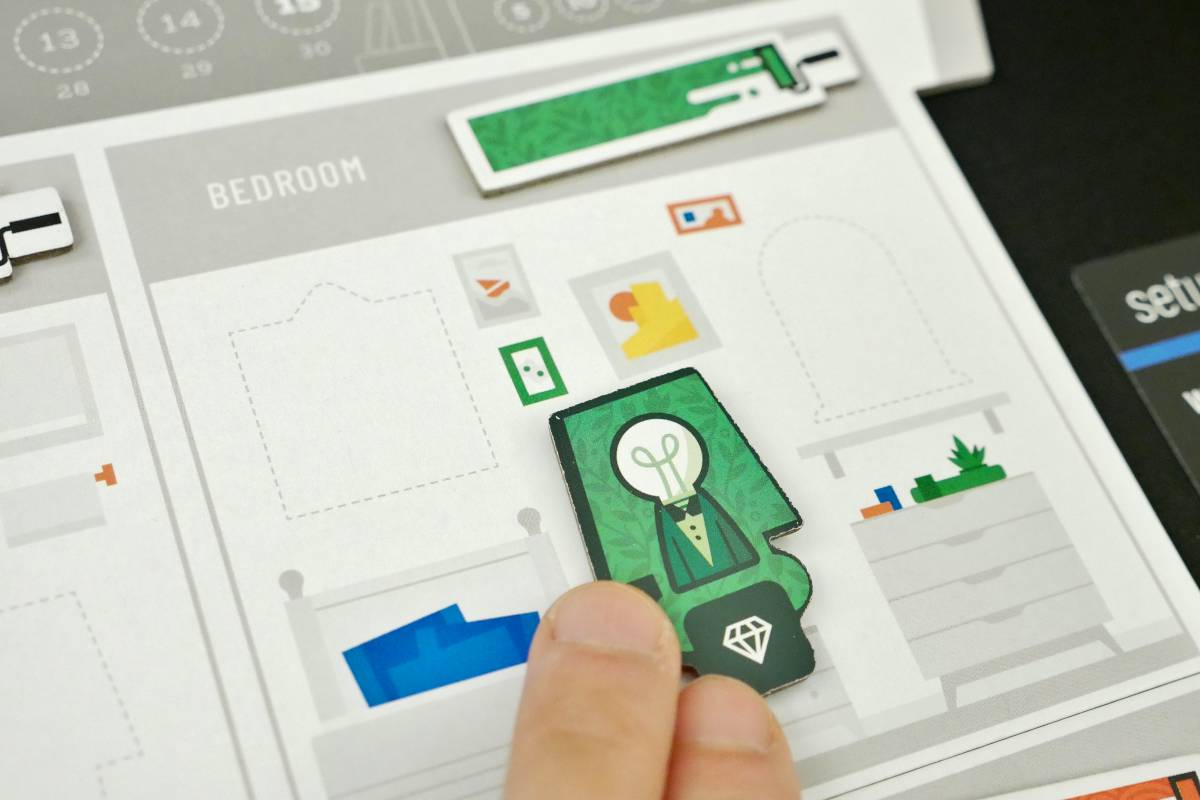
The game only lets you make one move per turn, so sometimes you need to make intermediary moves that don't fully make sense. For example, maybe you need a single Green item in the Bedroom, but also zero Unusual items in the Bedroom... so you remove the Green Unusual Lamp. Your partner could read that as "No Green items in the Bedroom!" Or any number of other interpretations. I hope you're starting to see my point.
Décorum is murky and opaque, so logical connections are hard to make. I'd even say it's impossible, especially in the later Scenarios. Trying to read your partner's mind from their Comments is a fool's errand. You end up only playing to your own Conditions, which brings me to my next criticism.
Despite everything I wrote above, Décorum feels like it plays itself.
Logically, every Scenario is designed so that each player has a set of Conditions that complements the other player's. Or to put it another way, every Scenario must have at least one solution where both player's Conditions are fulfilled. You'll never have mutually exclusive Conditions.
This means both of you will eventually converge on that solution. As long as you're focused on your own Conditions and making changes that edge you closer to being Fulfilled, you're progressing. Same goes for your partner. If you're both slow-stepping towards victory, you'll eventually get there.
Sure, there are moments when you clash. You might put a Red Retro Lamp in the Bathroom and your partner takes it right back with a snap: "I don't like that!" Okay, fine. Is there another way I can achieve my Condition? If yes, I'll try that. If no, I'll come back to this later after the house evolves a bit.
As long as neither of you are being boneheadedly stubborn, you'll probably end up at a working solution. Probably.
Luck Factor
Décorum is sort of lucky and random, but not in the usual sense. Almost everything is open information, and whenever changes are made to the house, they're all made out in the open. Each Scenario has its own logic and anyone who plays a certain Scenario is playing the exact same setup as anyone else who plays that Scenario. In that sense, no randomness.
But the murkiness of Décorum's decision space can make the game seem random, as you're often shooting in the dark as you try to glean useful info about your partner's Conditions.
It's a lot like Battleship now that I think about it: the ships themselves don't move once set up, so there might not actually be any "randomness" involved... but you still have to take educated guesses, and those guesses can lead you astray if you don't stumble upon "good guesses" soon enough. Applied to Décorum, you're often making changes in the house just to see what your partner says about it. Some moves are better than others, but you don't know enough to discern good from bad—so you have to guess.
Is that luck? Maybe, maybe not... but it sure feels like luck.
Fun Factor
Décorum's greatest flaw? It's not very fun.
You don't have to be a genius to see what the game is going for—it's written right on the box with its tagline: "A game of passive aggressive cohabitation." The gameplay is designed to simulate the frustrating reality of sharing a living space with someone. Perhaps it even has a strong lesson to teach, about how we need to openly communicate our wants and seek compromises if we're to live in harmony. That small, passive-aggressive comments ("I don't like that") aren't constructive and don't actually convey much information, leaving others at a loss of what you really mean. In that sense, Décorum is a work of art. It drives home these points by showing you how frustrating it is to live with someone like that.
But I don't want my games to be frustrating! If I had to sum up the experience, I'd say it feels like you're working on a sudoku puzzle except someone is randomly changing your numbers every round. You're constantly undoing each other's progress, all the while scratching your head at what they want. Décorum feels more like bottled-up couples therapy than it does a game. Every Scenario ends in relief, not satisfaction.
Speaking of satisfaction: Décorum lacks that, too. Puzzles are great because they give you that victorious rush when you solve them. Not so here. When you win, you don't feel like you deduced the solution—you feel like you stumbled upon it. And when you lose? You don't know what you could've done better, and you can't replay it (see the "Replayability" section).
And don't get me started on the Heart-to-Hearts. They serve as a way to inject information into the game, but they give away too much. Unlocking a Heart-to-Heart feels like peeking at the back of a logic puzzle book for a hint. You learn one of your partner's Conditions, but it cheapens the victory. It takes away from the satisfaction of winning. It takes away from the fun.
Pacing
For all my complaints, at least Décorum is paced well.
Turns are super snappy. You only have one thing to do, after all, and it's not like you have a huge chain of strategy to plan out. You make a guess and hope for the best, then it's your partner's turn. Back and forth it goes for somewhere between 10 to 30 rounds, with rising tension as you progress towards your goals. Will you get it done before time runs out?
Honestly, you'll spend most of your time reading and re-reading your Conditions and checking and re-checking them against the board state. The House Board changes so often, you're constantly re-assessing every room to see if your Conditions are still met or not. It can get repetitive at times, but overall the game's pacing is pretty smooth.
Player Interaction
One issue that frequently reared its head while playing Décorum is that the game is (un)surprisingly fragile. A small, unintentional error on one player's part can actually break the game—not uncommon in games where each player has hidden information that other players need.
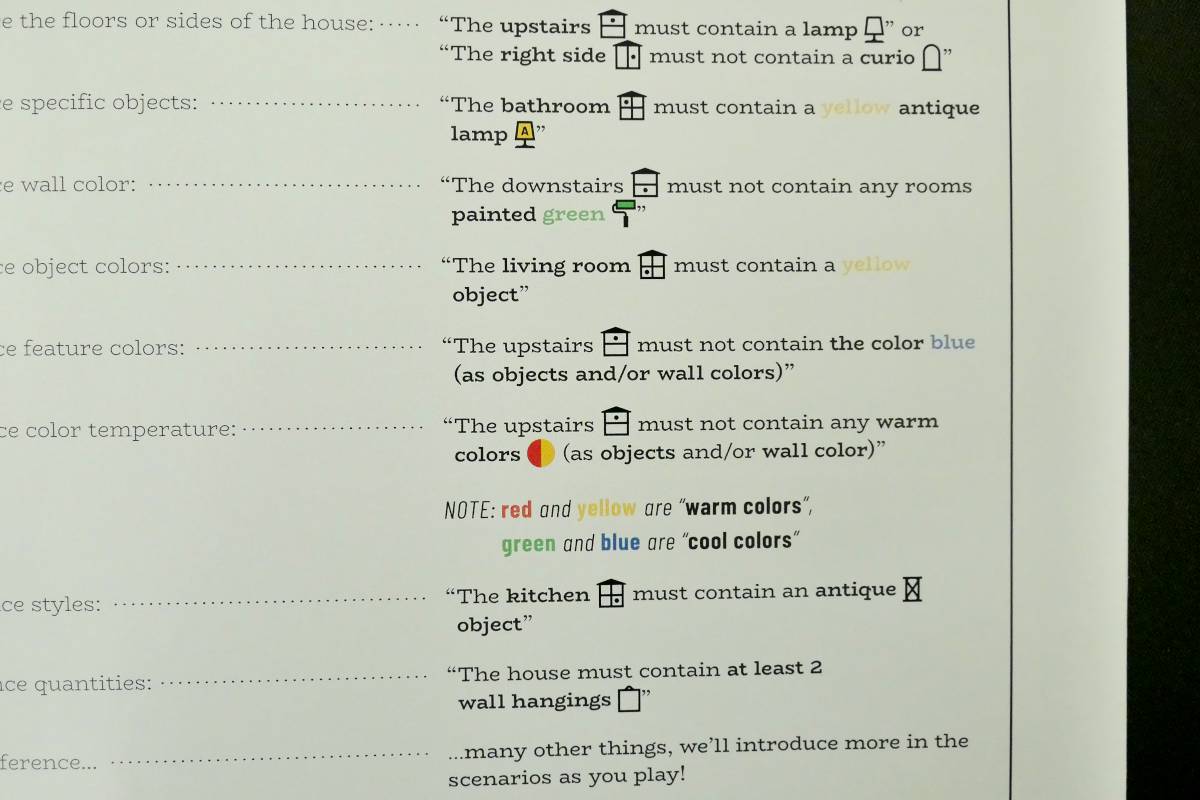
If a player misreads or misinterprets one of their Conditions, the logical puzzle can become impossible to solve as you butt heads trying to do something that's literally impossible. Similarly, when a player makes a Comment, they have to judge the last move as either positive, negative, or neutral—but if they're inconsistent when judging moves, their Comments can mislead their partner and derail the Scenario.
It sucks because this is the only way for players to interact in Décorum, yet it's so prone to mistakes. It's fully possible for you both to say "I'm Fulfilled!" and flip over your Condition cards... only to see that someone got something wrong, rendering the results invalid. That really sucks.
Fiddliness
For a game that's about constantly moving and changing tokens on a board, Décorum actually isn't very fiddly (at least until the later Scenarios where the House Board does get cluttered).
It helps that you only change one thing every turn, and token management is the entire game so it's not like it has anything else to get in the way of. If anything, the worst part is the Round Tracker. With turns being as quick as they are, we sometimes forgot to move the Heart token and that got annoying. But overall, fiddliness is of no concern.
Replayability
To me, Décorum is a one-and-done game. That in itself isn't always a negative—for example, MicroMacro: Crime City is a one-and-done which I loved—but it does bring this one down. Why? It's hard to put my finger on it... But if I had to sum it up, it'd be that Décorum isn't a satisfying experience.
As I explained in the "Decision Space" section, there's way less deduction in Décorum than I expected. The information is too murky and the logical connections too opaque, so much of your success comes down to dumb luck and coincidence. Meanwhile, the Heart-to-Hearts make me feel like I'm peeking at the back of the answer book for hints, cheapening the satisfaction of beating a Scenario. In short, winning doesn't feel victorious.
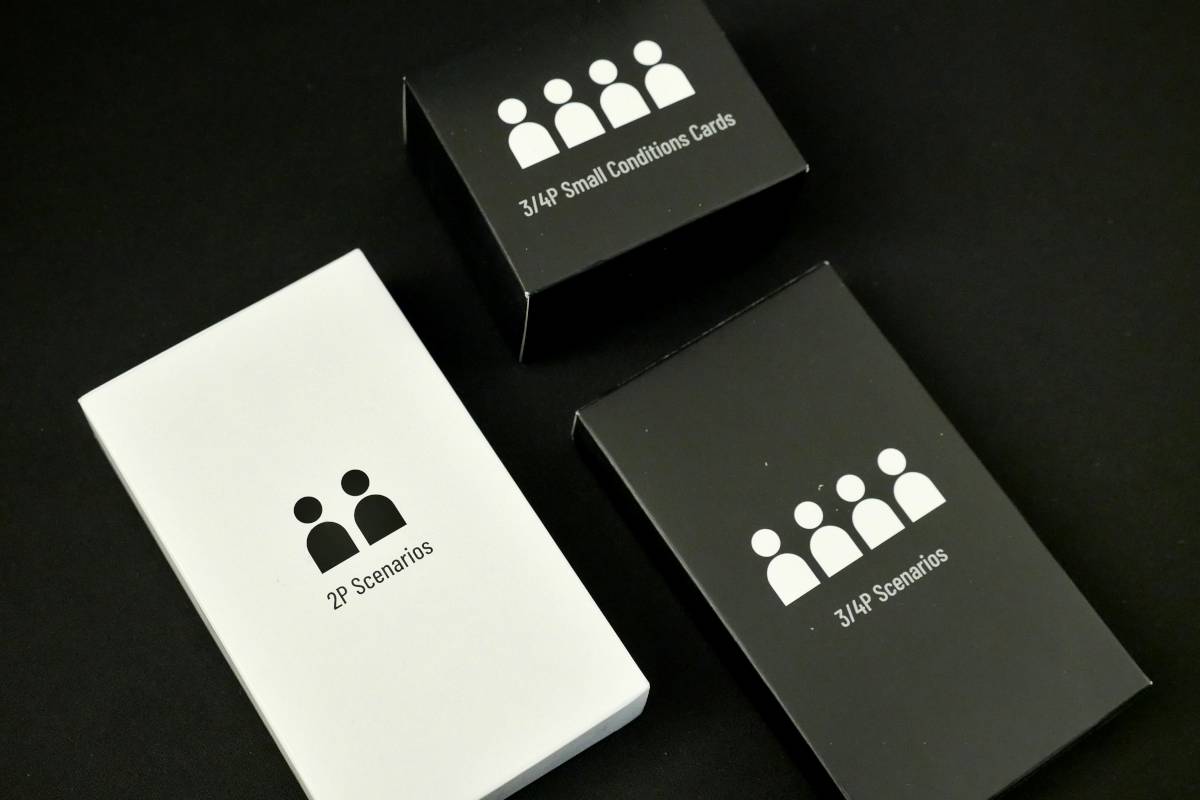
And the Scenarios in Décorum aren't replayable. Once you've played through one, you know what the secret Conditions are, which defeats the point of trying it again. You can only replay it if enough time passes for everyone to completely forget a Scenario—but even then, if you still remember one or two of the Conditions, it'll throw everything off.
As I pen this review, I've played through 16 of the 2-player Scenarios and I've given it a few weeks to think it over. My final opinion is that I'm probably never playing it again. We had an enjoyable enough time with it, but there's nothing that compels me to come back to it. I've seen everything it offers... and one time through is more than enough for me.
Production Quality
Décorum is better produced than most games, but part of it feels overindulgent—maybe even pretentious. Sure, it plays well and it has an eye-catchiness to it that stands out, but it's also a bit off-putting with how it insists upon itself. It's like it's smirking at me. Am I reading too much into this production? Could be. But if you set that part aside, it's a well-made game that (mostly) doesn't get in its own way.
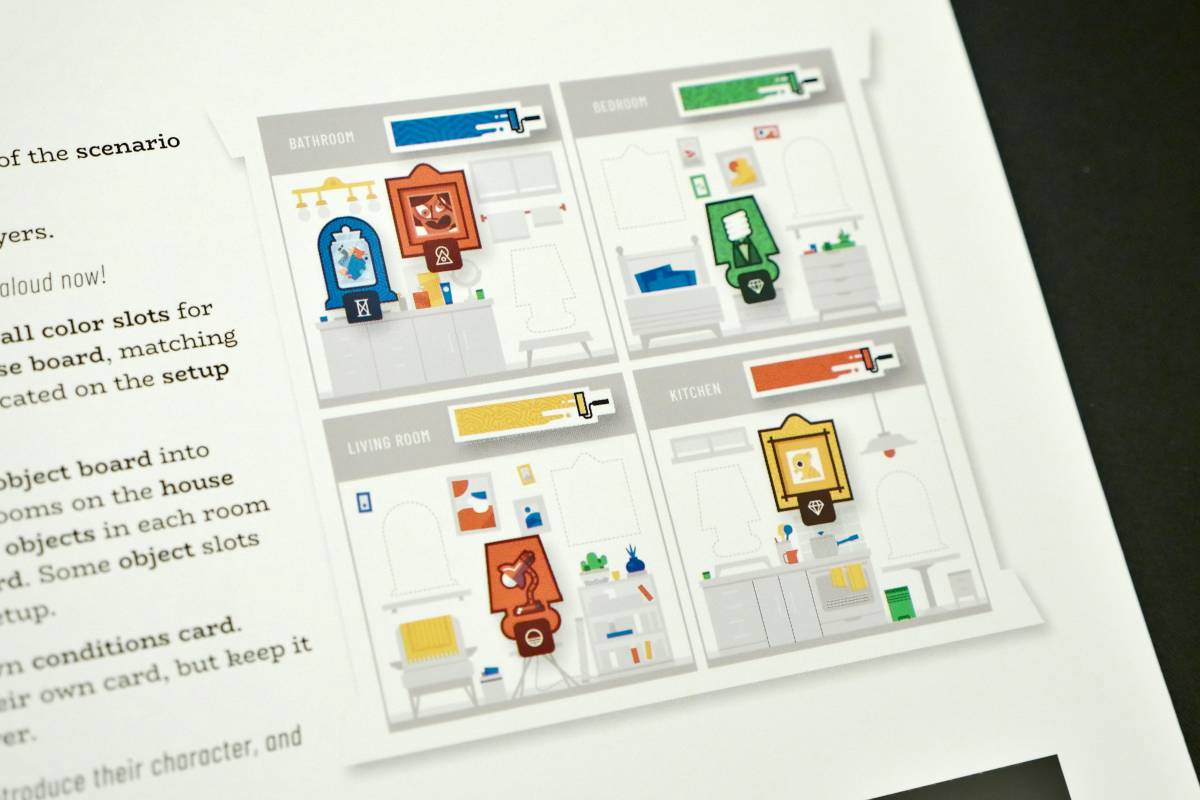
The theme is relatable and the aesthetic is inviting. There's a playfulness to the graphic design that edges into silly territory but doesn't quite go all the way. There's also a minimalism that evokes a sense of emptiness, at least at first. Once you get into the later Scenarios, the house takes on a more "lived in" vibe with all the objects. Nothing here is offensive nor mundane. It's widely approachable without feeling generic.
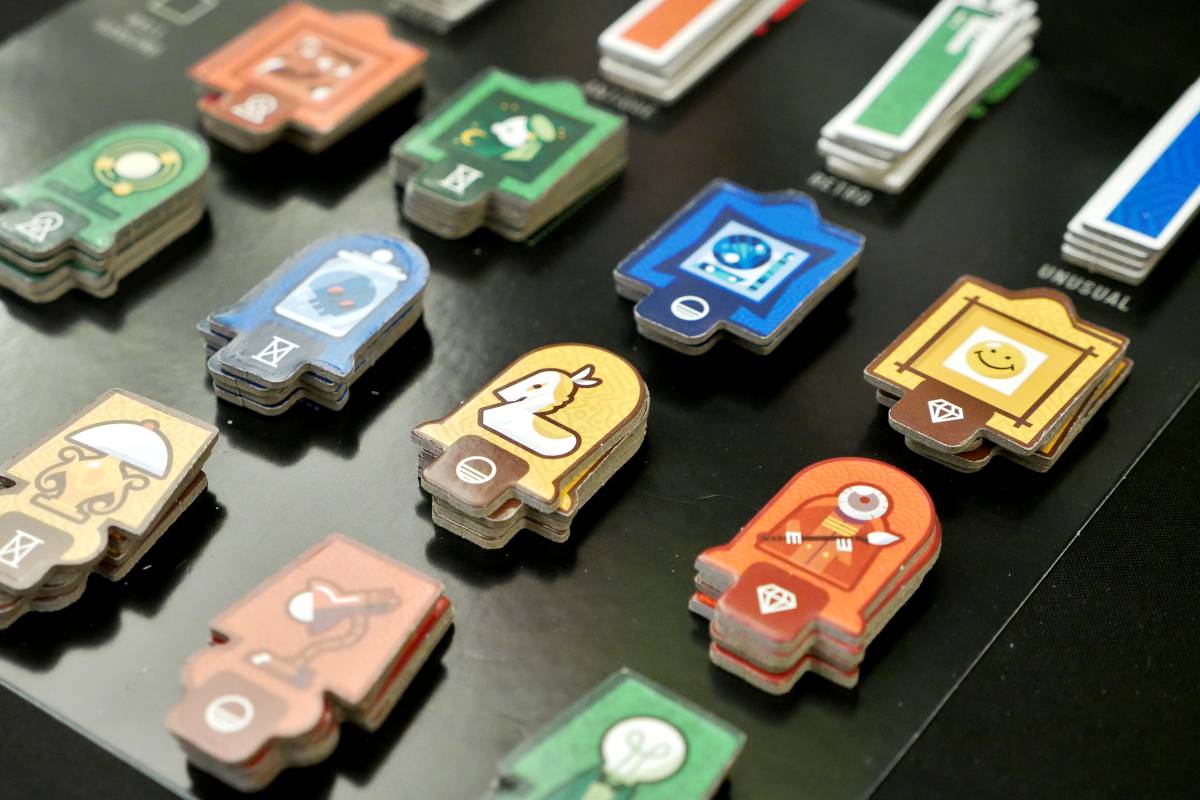
I appreciate the bold colors, distinct shapes, and icon designs. I never once mixed up any of the objects. The silhouettes are all different, the colors are strong, and the icons are unique. Overall, the readability of Décorum is excellent (except for one bit that I mention down below), and that helps ease the mental load of processing an ever-changing House Board.
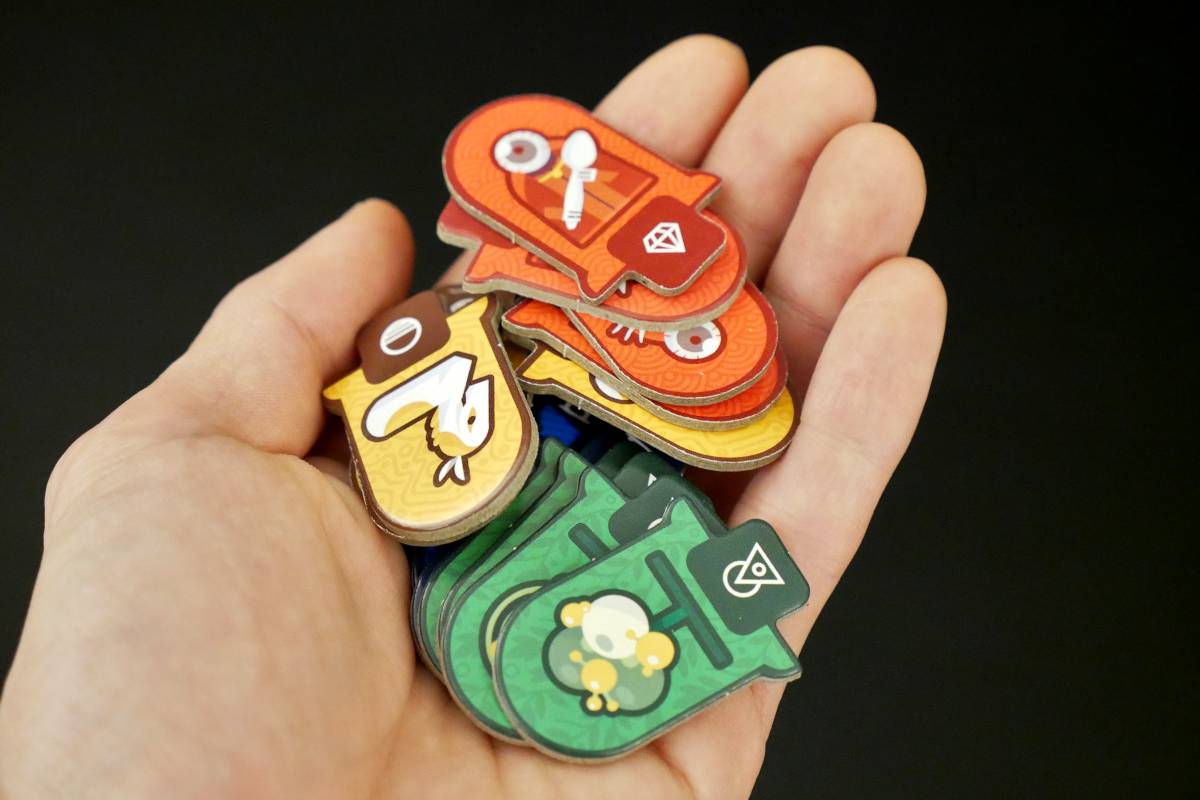
The tokens are thick and the cards are good enough. I have no concerns about durability here, as the cardboard tokens are chunky and the cards don't actually get physically handled that much. I also don't have durability concerns because I don't see this one being played very often (see the "Replayability" section for more on this).
Spoiler alert: At Scenarios 12 and 15 in 2-player mode, Décorum introduces new gameplay elements in the forms of "Gifts" and "Pets," which are extra cardboard tokens that need to be managed between rooms. The Pet tokens suffer from readability issues—they're difficult to tell apart and they clutter up the house with too much visual busyness—so much so that I gave up on playing through the remaining Scenarios.

The cute little backstories for each Scenario fell flat for me. I get that they're just flavor text. I get that they're fun little ways to inject some personality into an otherwise abstract deduction game. But it was all too quirky for me. I rolled my eyes at several of the pairings and eventually stopped reading the flavor text altogether.
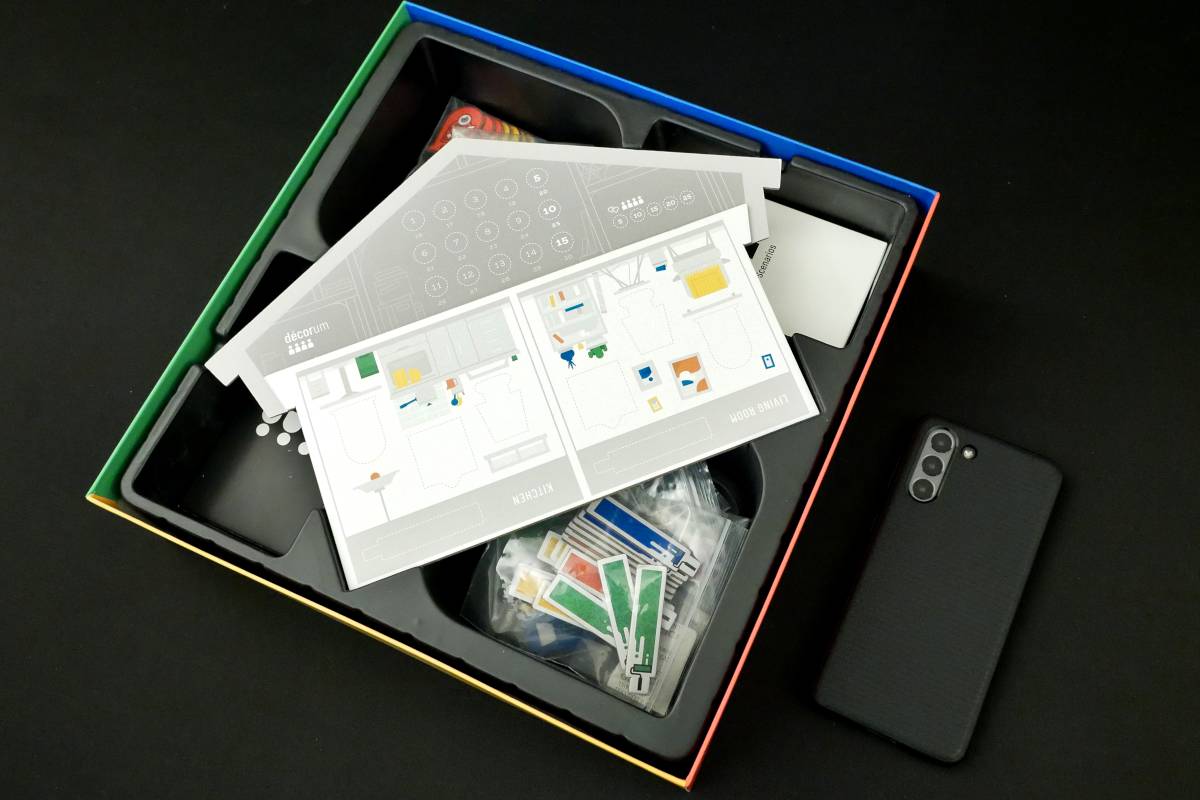
I hate the game box design. While the insert is thematic with heart-shaped wells and a snug spot for the House Board, it has so much wasted space. Not only does it makes the box way bigger than it needs to be, but it's also a bit inconvenient. If you bag all the tokens like I did, shoving them into the heart-shaped wells is a nuisance. It tries to be too cute.
The Bottom Line
Décorum didn't live up to expectations. I went into it hoping for a satisfying logical deduction experience, but what I got was a frustrating object lesson in the importance of open communication. Décorum is visually nice, but the gameplay is too ambiguous, fragile, and irritating. I wanted to love it... but I don't see myself playing it again.
Stop Buying Games
You'll Regret
Before your next game purchase, run it through this mental checklist that every seasoned gamer uses.
Free checklist, delivered instantly to your inbox.
No spam, ever. Unsubscribe in one click.