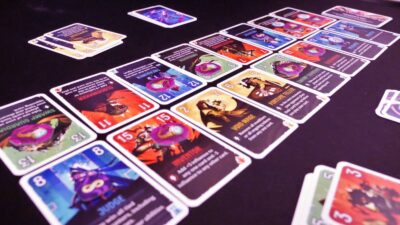
Core Gameplay: Hand management, engine building, open drafting
Player Count: 2 to 5 players
Play Time: About 15 minutes per player
Rules Complexity: Simple
Retail Price: $40
Upsides
Super easy to learn and play. A great introduction to hand management and engine building gameplay
Engaging enough that it isn't boring or mindless, despite how simple it is
Snappy turns and strong forward momentum. Not much downtime (except at 5 players)
Top-notch production with high-quality cards and crystals that are fun to play with
Downsides
More luck than you might expect for a strategic engine-building game
Card market can stagnate with no way to keep it refreshed (without using house rules)
Not much player interaction. The tension when racing for Golems is too subtle
Feels empty and flat, without many highs or lows, resulting in weak replayability
Quick Takeaway
Century: Golem Edition is a good game. It's an excellent introduction to the engine building genre, and the above-average production is sure to make you feel good while playing. But it's a bit too pure, too streamlined—it lacks the oomph that would keep me coming back. It's enjoyable enough while playing, but unremarkable and forgettable otherwise.
I was suckered into Century: Golem Edition. I heard such good things about it, mainly that it was a better pure engine-building card game than Splendor (which I'm pretty meh on), plus it has such a cool theme and high-quality components. I knew I had to at least try it out.
Based on Century: Spice Road, the Golem Edition is a reskin that takes it from boring spice trading on the Silk Road with wooden cubes to a fantasy land of Golems who need colorfully translucent crystals. At first glance, I can tell why people love it. It's simple but full of personality! But once the novelty factor wears off, its true colors come out... and it's not so shiny.
Here's everything you need to know about Century: Golem Edition, how it plays, why it's a great introductory game for non-gamers but not a game with a lot of staying power, and whether it's the kind of game you may or may not want to include in your own collection.
This review is based on my own personal copy of Century: Golem Edition, which I bought new from Cardhaus. Not a free review copy.
Table of Contents
View more
Overview
Century: Golem Edition is a hand-management, resource-conversion, engine-building game. You have your own set of action cards that you'll be playing every turn, and those cards gain and convert resources of different types. You then spend your resources to buy Golems (victory points). If you can amass the most points by game's end, you win.
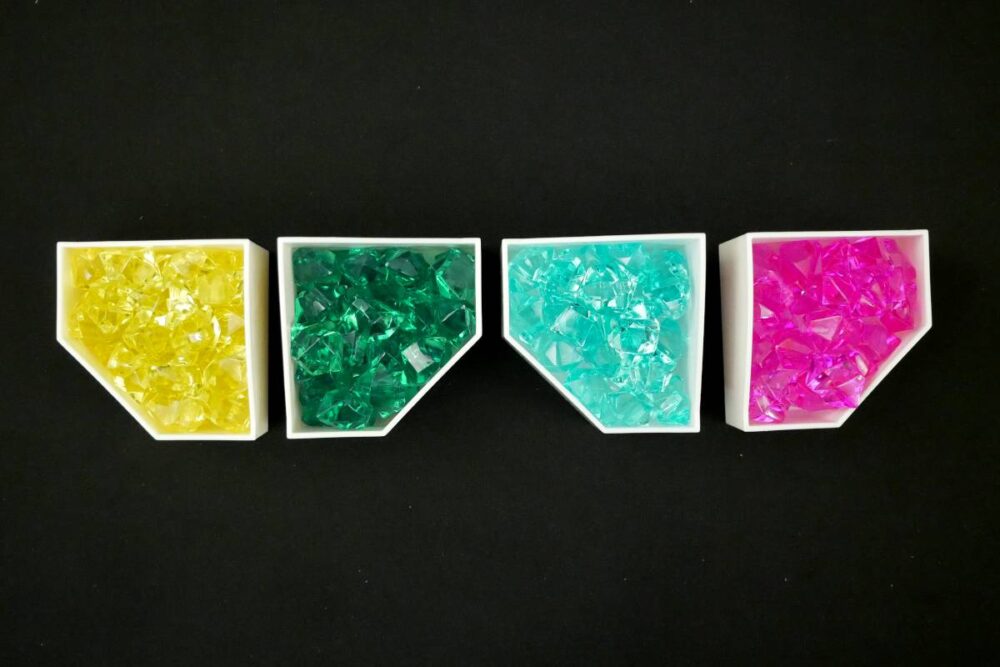
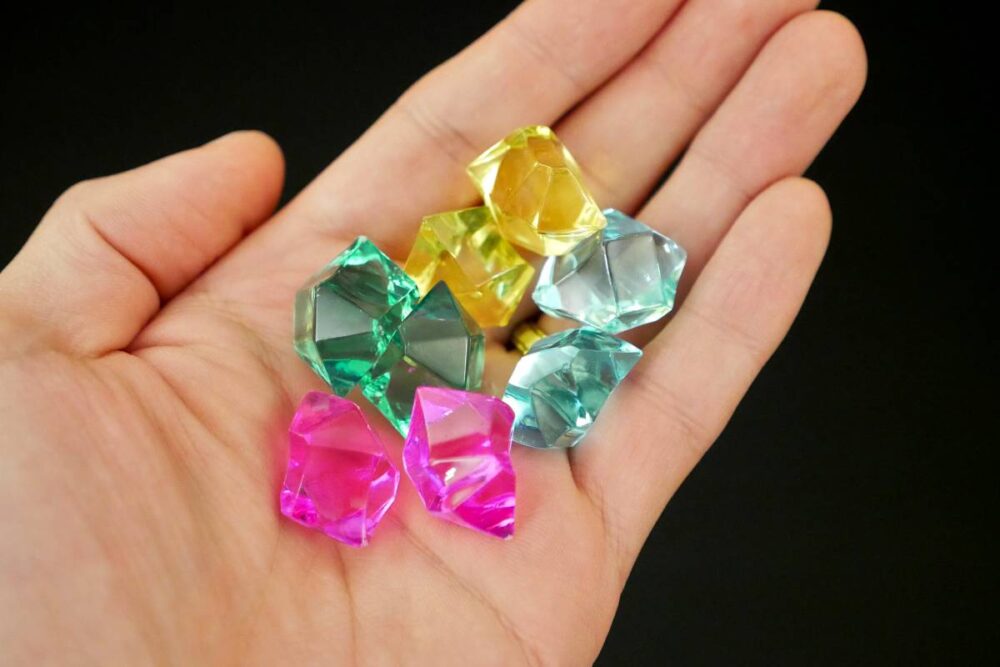
At the core of Century: Golem Edition are crystals, which come in four values from lowest to highest: Yellow < Green < Blue < Pink. These crystals can be converted from one kind to another via action cards, and then spent to buy Golems once you have the right crystals.
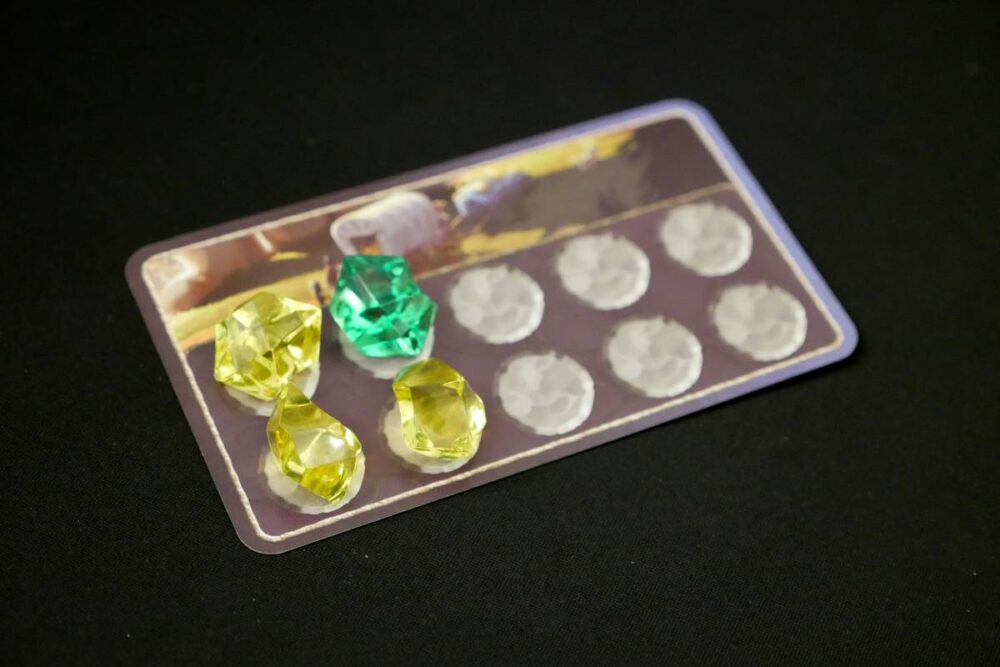
Every player has a Caravan for storing crystals. The Caravan has a limit of 10 crystals, so that's part of the challenge: you aren't just amassing crystals but rather juggling them while staying within the limit. If you have more than 10 at the end of your turn, you have to discard the excess.
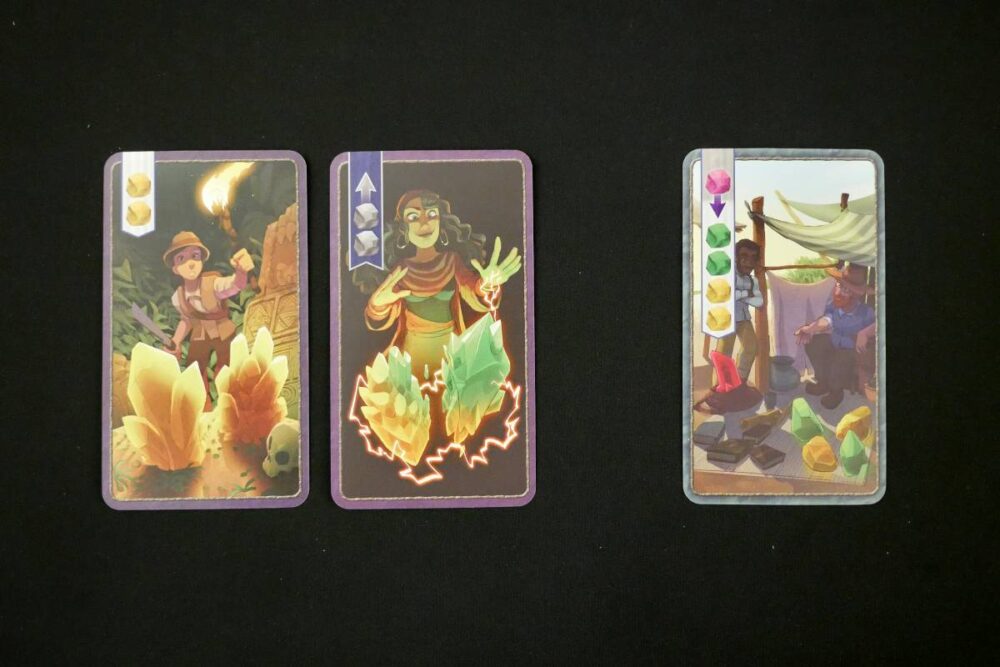
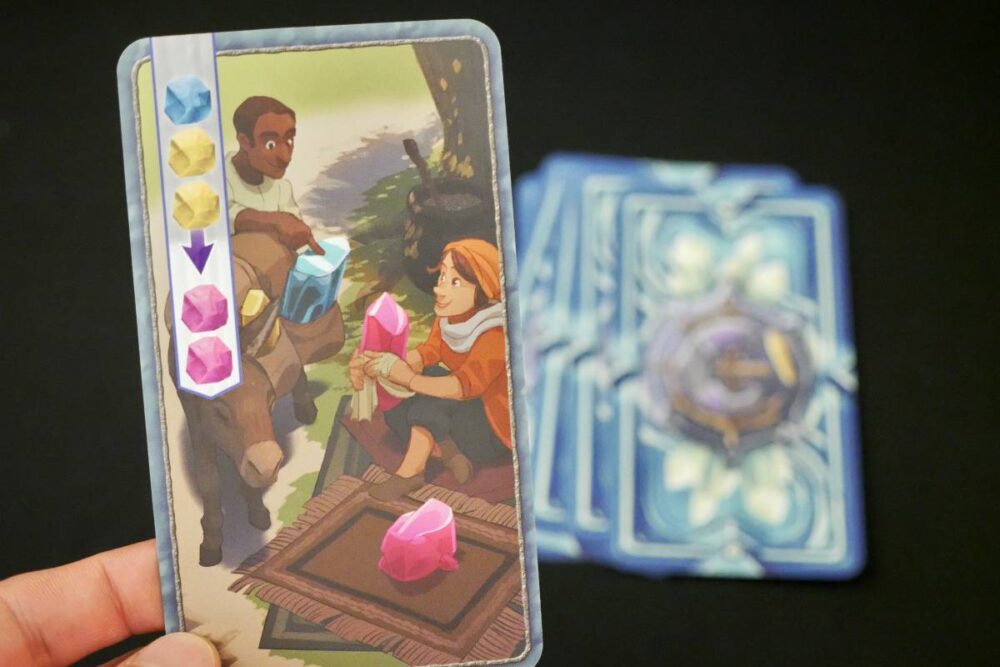
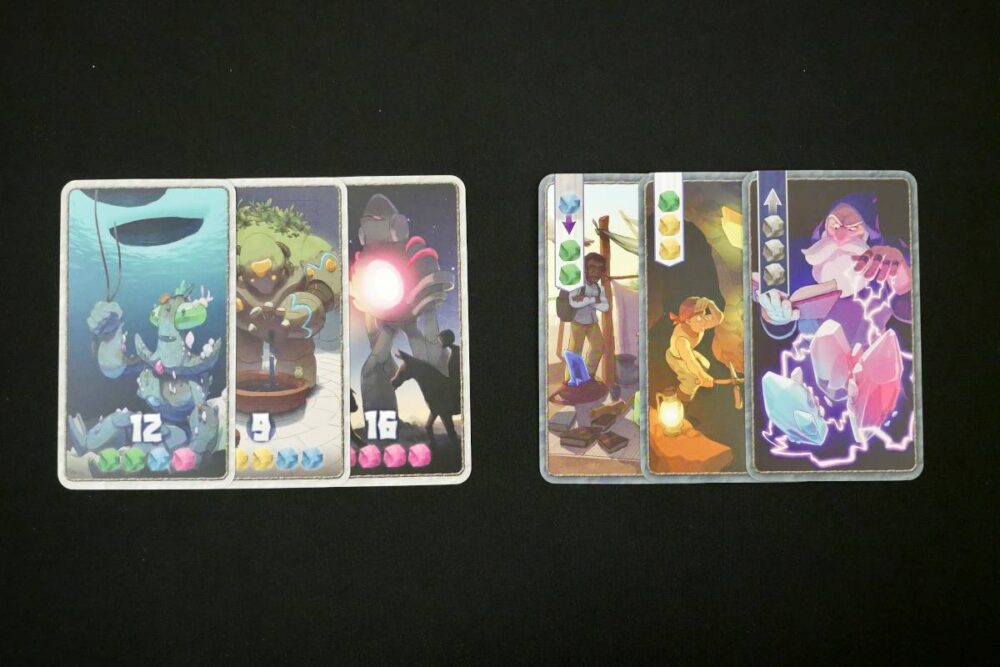
The left two cards are the same starting cards that all players start with: a Crystal card and an Upgrade card. The right card is a Trade card from the market.
Each player starts the game with the exact same 2 action cards. What's important here is that while players start with the exact same cards, their decks will diverge over time as they acquire different cards.
Action cards fall into three different types:
Crystal card: Gain the crystal(s) shown on the card.
Upgrade card: Exchange a crystal in your Caravan for the next higher type. Perform once for each upgrade icon on the card. Can be repeated on the same crystal (e.g., upgrade a Yellow crystal to Green then Blue) or on different crystals (e.g., upgrade two Yellow crystals to Green).
Trade card: Exchange all the "before" crystals on the card for all the "after" crystals on the card. Must have all the "before" crystals in possession to perform the exchange. Can be repeated multiple times as long as you have the necessary crystals.
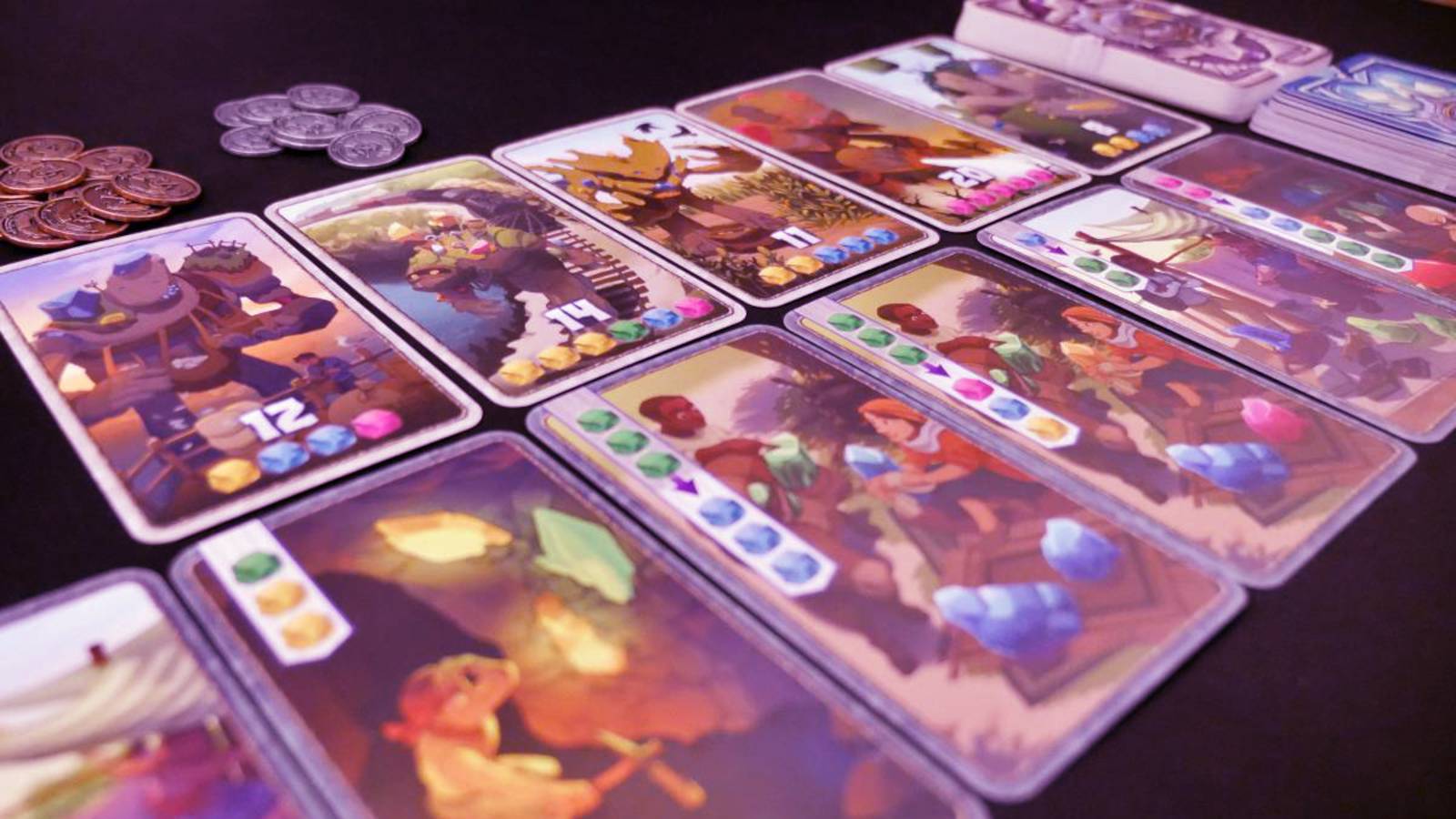
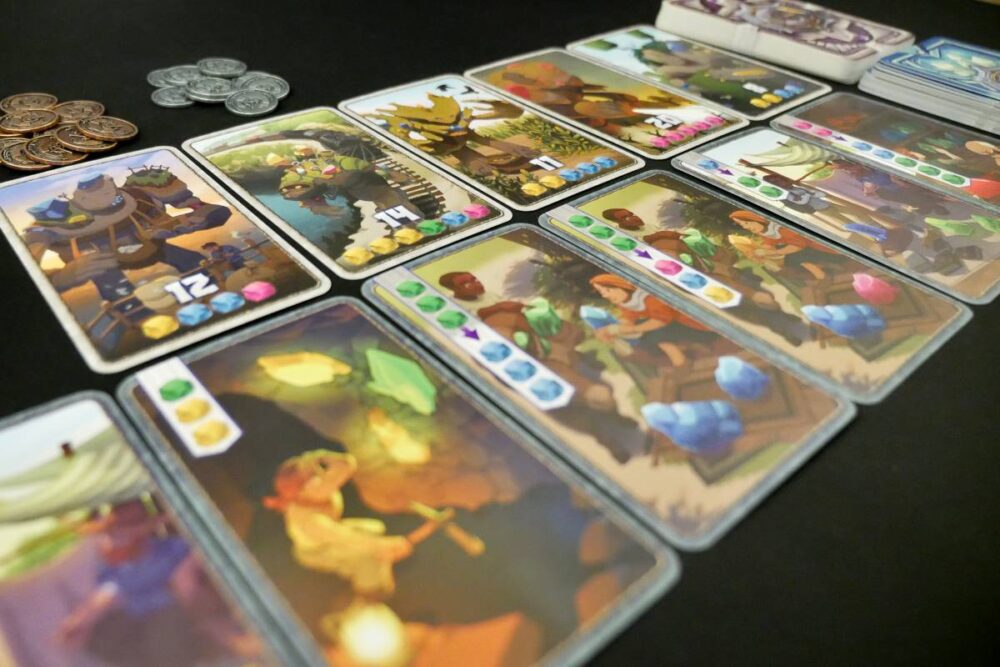
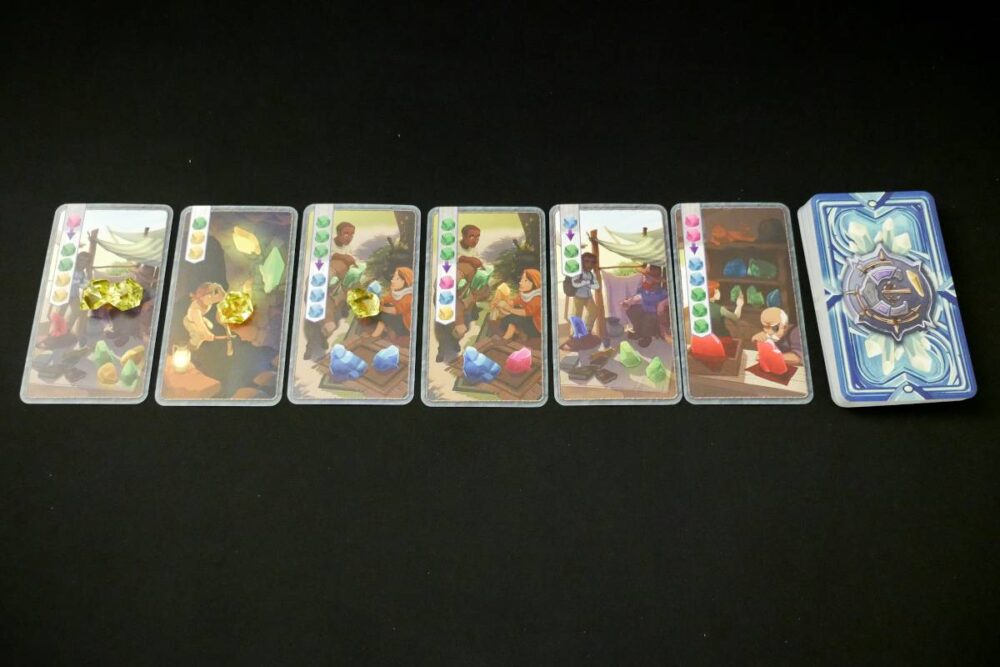
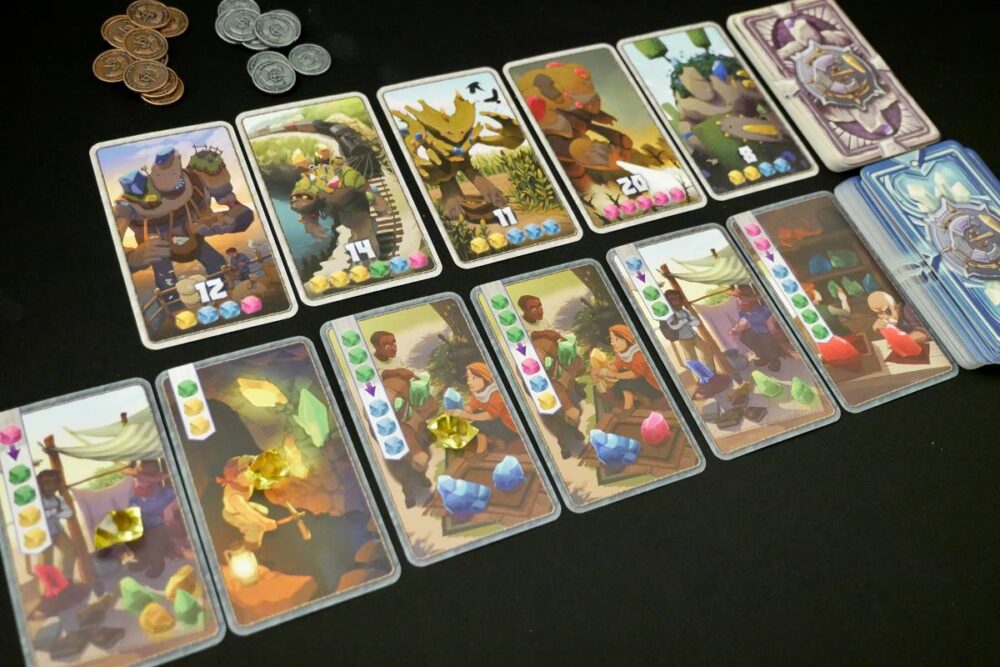
In the center of the table is a 6-card Merchant market. Merchant cards are action cards. Players will be acquiring cards from the market and adding to their hands, providing new ways to gain and manipulate crystals.
When acquiring a Merchant card from the market, the left-most card is always free. To acquire a different card, you'll have to pay 1 crystal (of any type) on each card to the left of the one you want. When you acquire a card, you also gain all the crystals that happen to be on it.
When a card is taken, all cards to the right shift over to fill in the gap. Then, a new card is drawn in the right-most spot of the market.
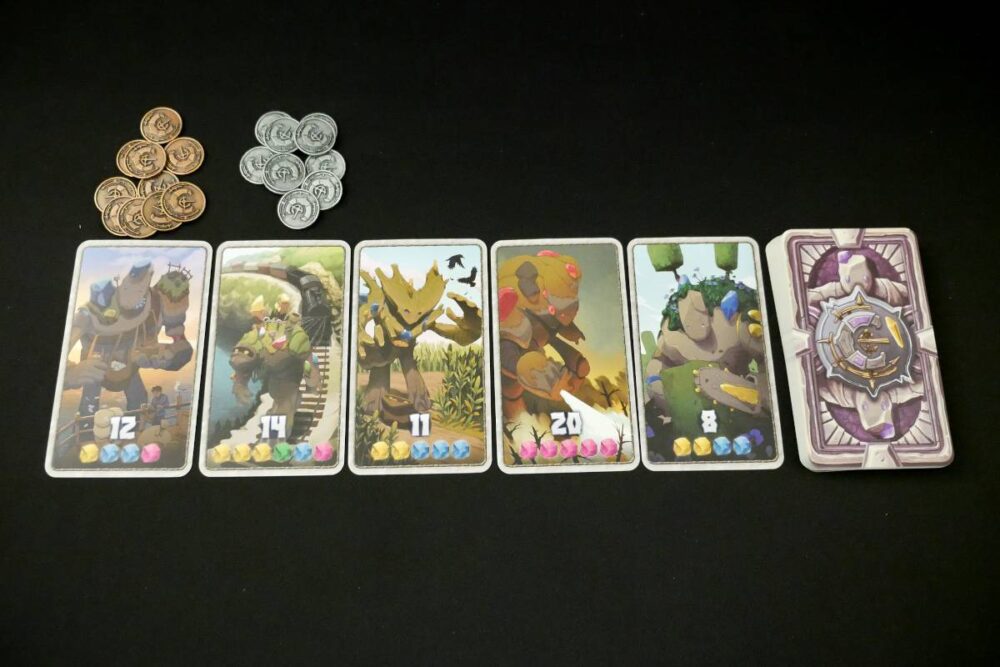
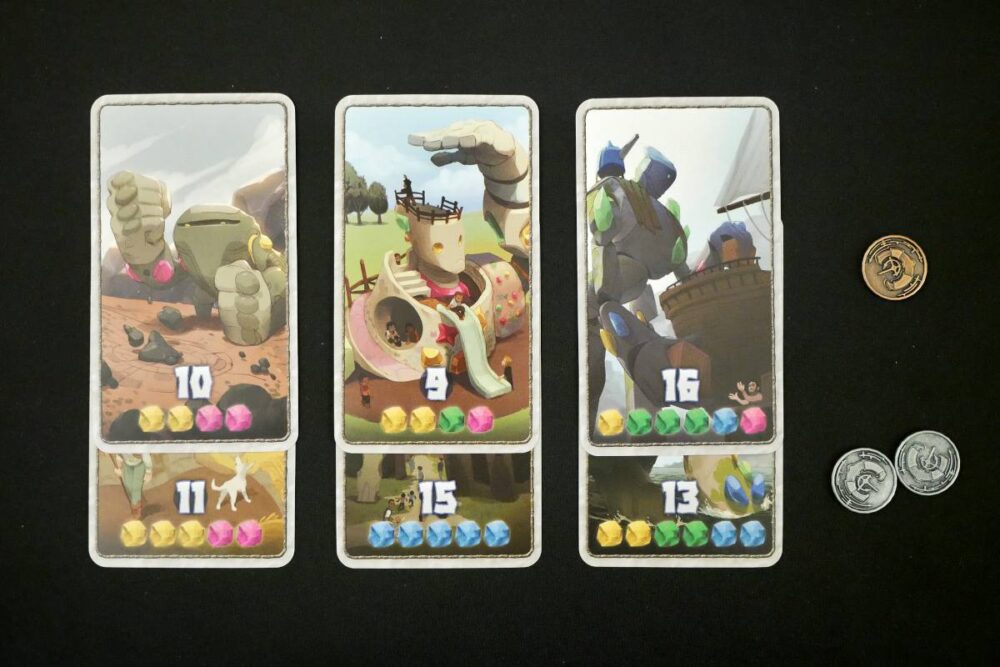
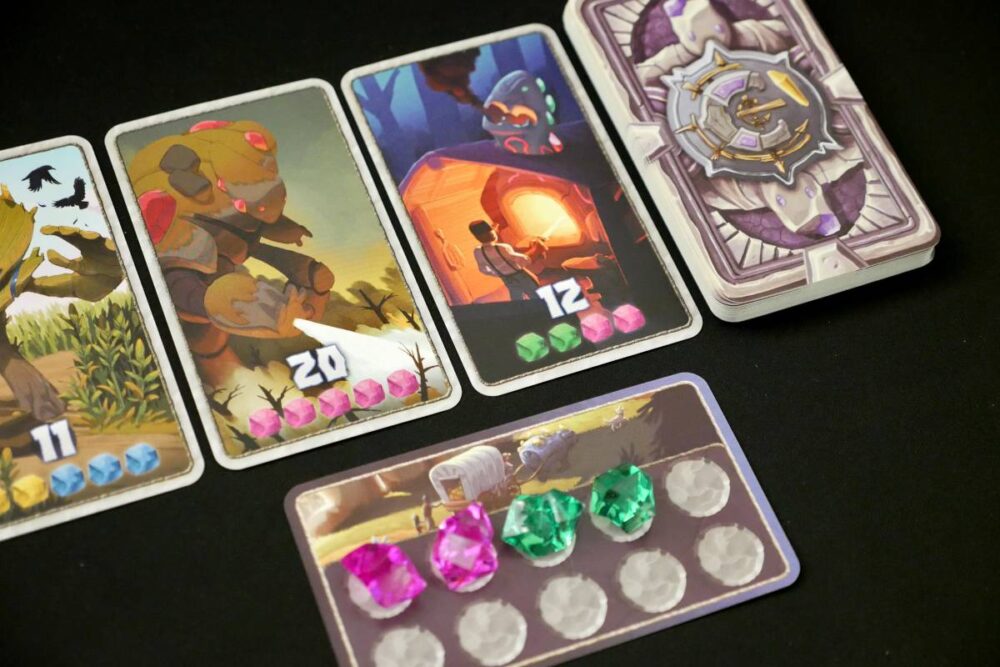
The same goes for the 5-card Golem market. Every Golem card needs a specific set of crystals in order to buy. Once bought, the Golem card doesn't actually do anything—it's worth points and nothing more. The remaining Golem cards to the right shift over and a new one is drawn, filling the now-empty right-most spot of the market.
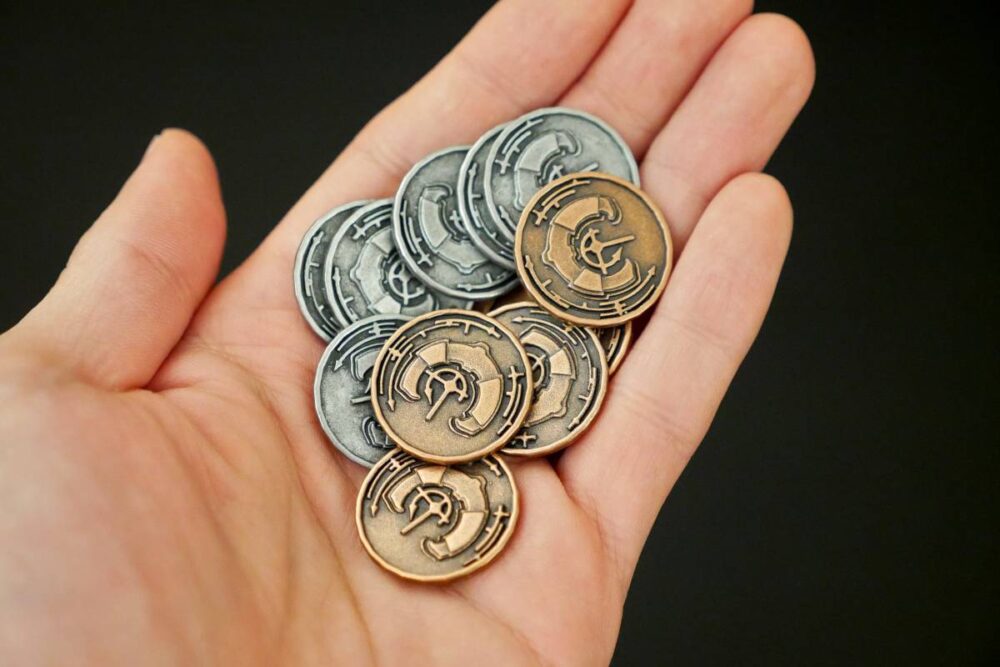
When buying the left-most Golem, you'll also get a Copper Coin with it (worth 3 points at the end). When buying the second-left-most Golem, you'll get a Silver Coin with it (worth 1 point at the end). These coins make "unwanted" Golems more enticing as they slide down the market—but when they run out, they're gone.
Century: Golem Edition proceeds turn by turn, with players able to do one of the following actions on their turn:
Play a card: Pretty self-explanatory. Once played, the card stays in front of you. (You'll get it back later.)
Acquire a card: Take a Merchant card from the market into your hand. If it's the left-most one, it's free; otherwise, pay a crystal to every card to the left of the one you're taking.
Reclaim all played cards: All of the cards you've played return to your hand. Resting is your entire turn.
Buy a Golem: Spend the requisite crystals from your Caravan to acquire one of the Golems from the market.
With the end game triggered, I would score 79 points: 74 for the six Golem cards, plus 3 for the Copper Coin, plus 2 for the Silver Coins.
Round and round it goes until someone buys their 5th Golem (or 6th at smaller player counts). When that end game trigger happens, the current round will complete (so everyone has equal turns) and then everyone sums their points. Whoever has the most wins!
Setup and Table Footprint
Century: Golem Edition is pretty easy to set up. You just have to shuffle the Golem and Merchant decks, draw the market for each deck, and place the Copper and Silver Coin piles above their respective Golem spots. Give each player their Caravan and starting action cards, then put out the supply of crystals in order of value (from Yellow to Pink).
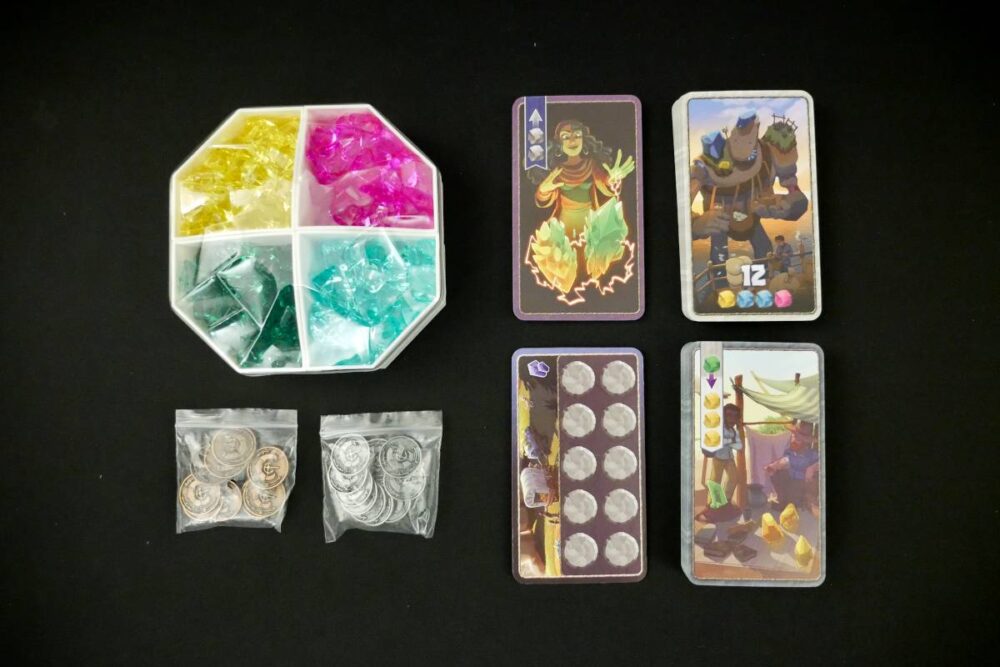
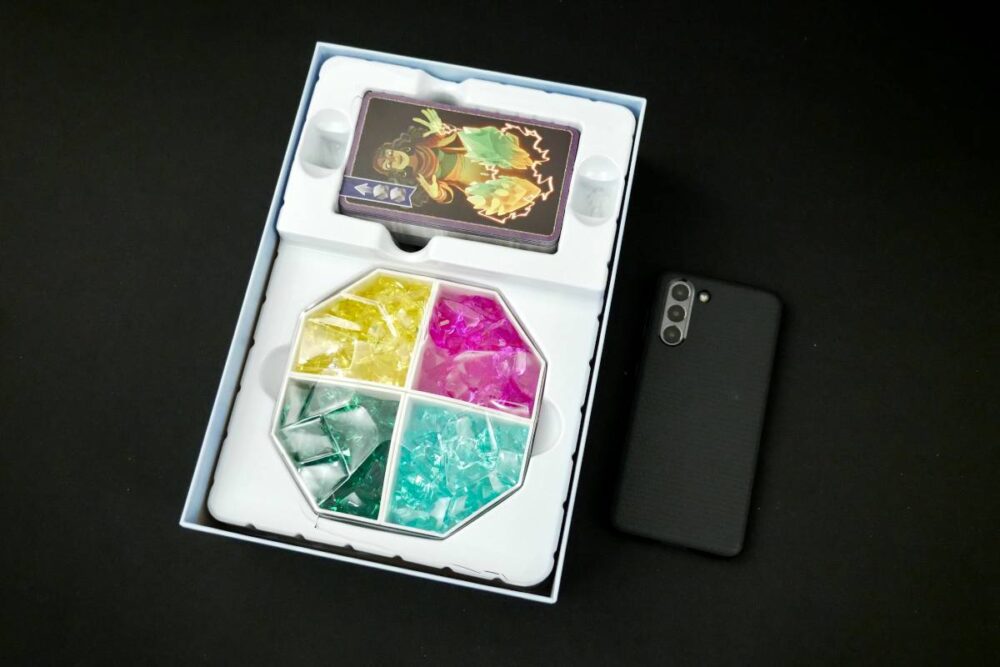
Setup is made simple thanks to the included trays for each of the crystal types, which you just pull out of the box. You can be up and running in just a few minutes, making it very easy to hit the table.
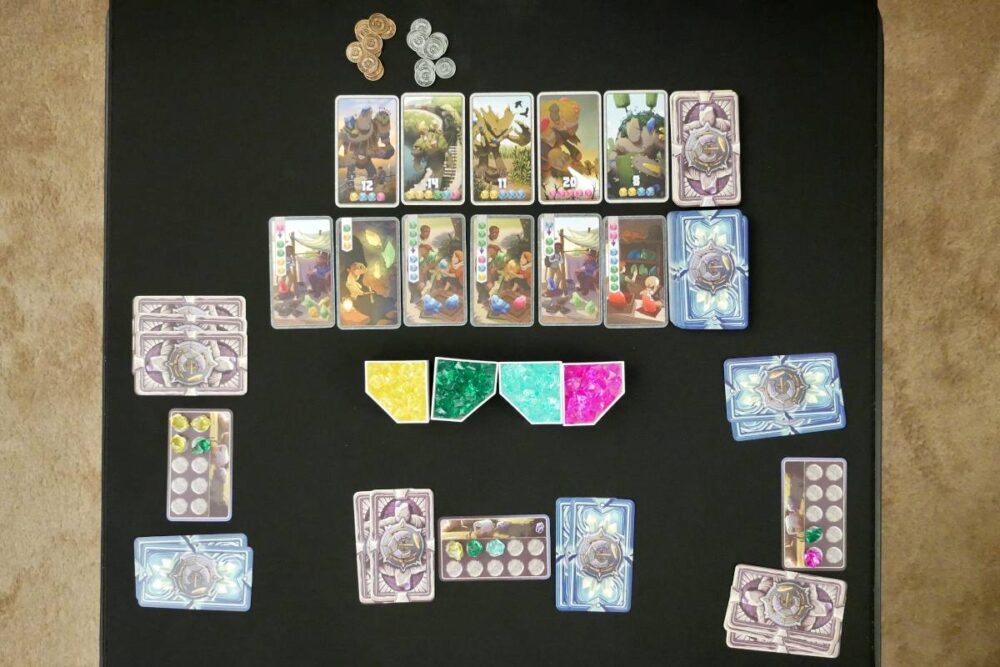
Example 3-player setup on a 3-by-3-foot table. The market takes up the most space because the cards are huge. Players don't need much personal space.
Century: Golem Edition also doesn't take up much table space. The 5-card Golem market and 6-card Merchant market are sort of big together, but the crystal trays are compact and organized, and each player only needs enough space for their Caravan (small) and discard pile (also small).
Honestly, the box for this game betrays its table footprint. You think you're getting a moderately chunky experience but actually it's space-efficient, streamlined, and smooth. I appreciate that.
Learning Curve
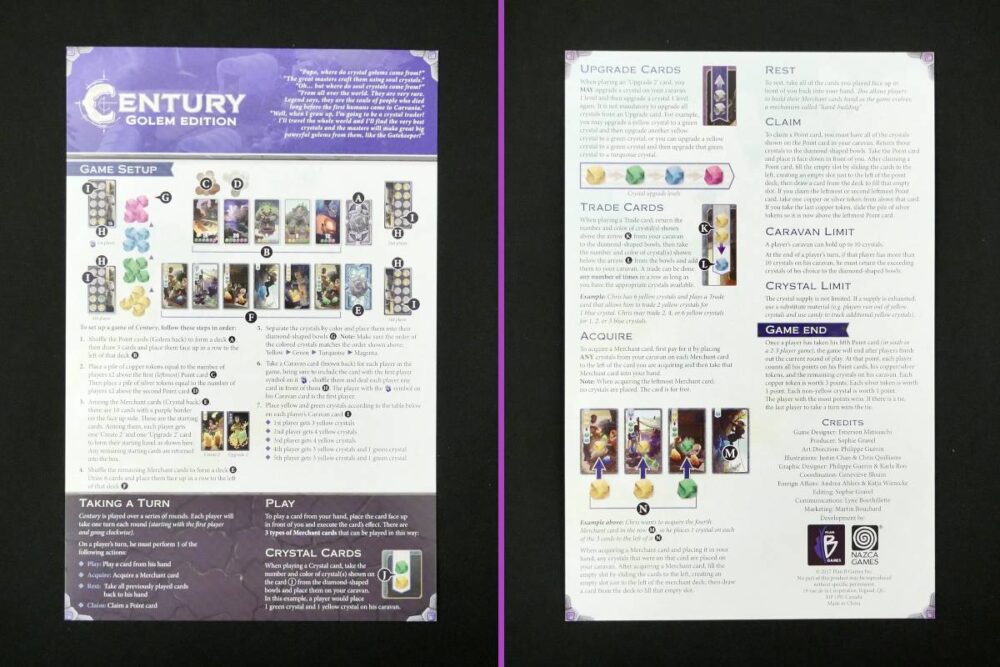
Century: Golem Edition isn't a hard game to learn at all. The core concept is simple. The actions and market are simple. The crystals are simple. I mean, the whole rulebook fits on a single double-sided sheet, so that should drive home how uncomplicated it is.
This is the entire rulebook! One sheet, front and back. 'Nuff said.
Century: Golem Edition is an excellent entry point for someone who wants to get into board gaming but has no exposure to modern games. It's one of the cleanest and smoothest games I've ever played, boiled down to its purest essence: hand management and resource conversion. It's also great for beginners because it has low mental load.
There are only a few elements that are slightly gamery, like the Copper/Silver Coins for Golems, the paying of crystals to buy certain Merchant cards, and the sliding of cards as they're bought. But they're no problem to learn, even for most non-gamers.
Game Experience
Decision Space
Century: Golem Edition is all about action efficiency. That means figuring out which cards work best together to create your crystal-conversion engine. You want to get the crystals you need in the fewest turns possible, all so you can buy the most valuable Golems before anyone else does. Every decision you make compounds upon the last one, and small mistakes can snowball into big inefficiencies that you'll end up regretting later on.
Which cards work best together? Well, that depends on what shows up in the Merchant market. One of the key skills in Century: Golem Edition is seeing what's out there and spotting the synergies. You need a good balance of Crystal cards (for gaining new crystals) and Trade cards (for exchanging crystals), and you need to smartly use your Upgrade card to bridge the gaps in your engine. And that's what it really boils down to: acquiring cards that most efficiently bridge the flow from Yellow crystals to Pink crystals.
Here's another way to think of it: you're trying to build a hand of action cards that chain (or combo) smoothly. You start with one or two good Crystal cards, which seed you with crystals. Then, you need Trade cards that can turn those lowly crystals into bigger ones as quickly as possible, but you want those Trade cards to "match" well with each other. Every step of your engine should support the next step as you exchange crystals.
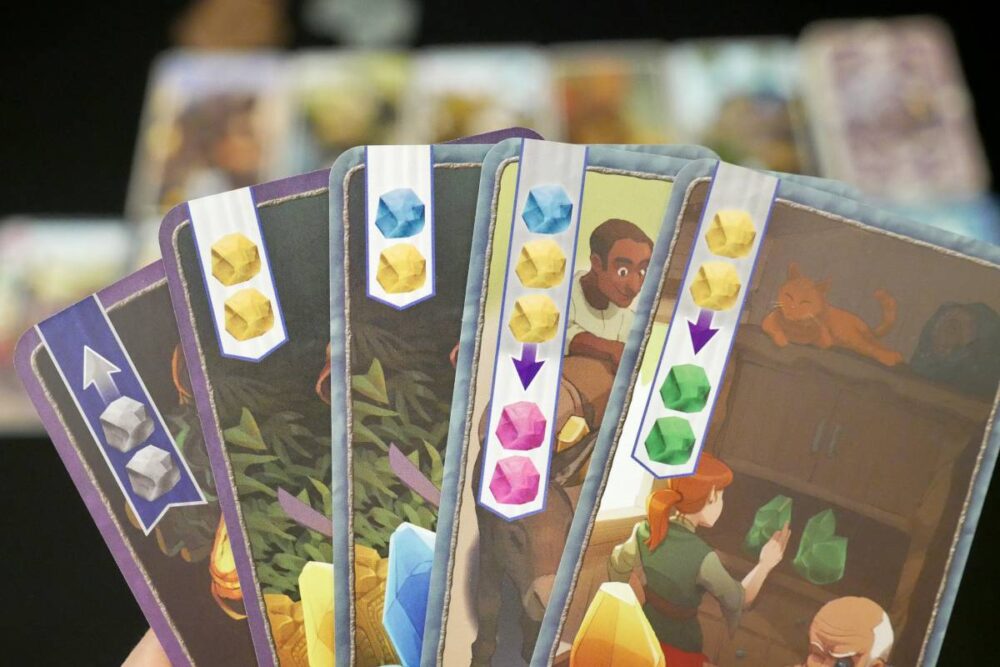
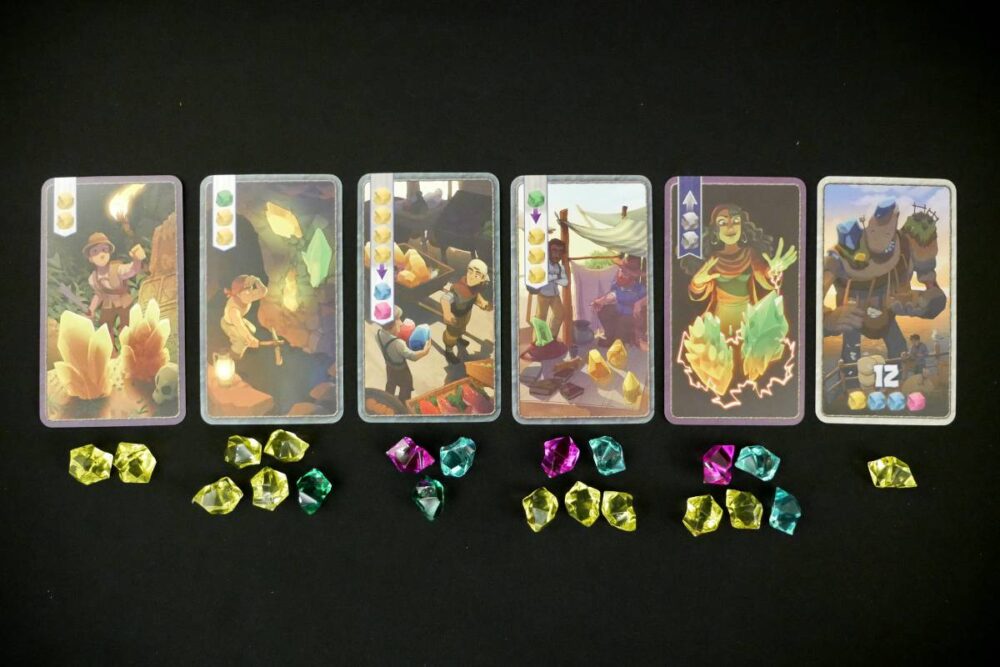
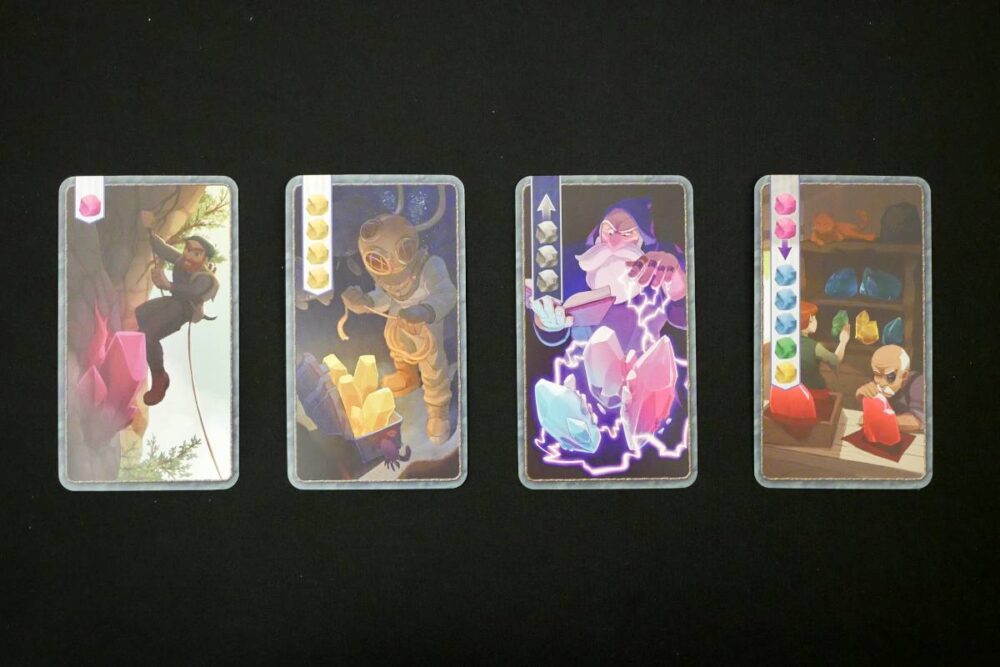
Let me illustrate with an actual example. Here's a chain of action cards that you could acquire, representing your engine:
And here's how the chain would resolve, turn by turn:
Play Starter card. Gain 2 Yellow crystals.
Play Crystal card. Gain 1 Green 2 Yellow crystals, resulting in a total of 4 Yellow 1 Green crystals.
Play Trade card. Exchange 4 Yellow crystals for 1 Blue 1 Pink crystals, resulting in a total of 1 Green 1 Blue 1 Pink crystals.
Play Trade card. Exchange 1 Green crystal for 3 Yellow crystals, resulting in a total of 3 Yellow 1 Blue 1 Pink crystals.
Play Upgrade card. Upgrade 1 Yellow crystal twice, making it Blue, resulting in a total of 2 Yellow 2 Blue 1 Pink crystals.
Buy Golem card. Spend 1 Yellow 2 Blue 1 Pink crystals to acquire the 12-point Golem card, leaving 1 Yellow leftover.
Acquiring new Merchant cards and building your hand is the main chunk of the game, but you also have to play your hand well. Playing your hand well means two things: first, making sure your cards are played in the right order to get the crystals you need, and second, timing your Rest action to reclaim your cards often but not too often.
Let's tackle the first point first. You might acquire a set of Merchant cards that work well together on paper, but it may not hold up in practice. Maybe you can churn out a bunch of Pink crystals, but you can't neglect Green and Blue crystals—many Golems needs a mixture of crystal types. That means you need to be able to pivot and crank out Greens and Blues as needed, and figuring out how to do that with the cards left in your hand is where a lot of the tactical fun is. Acquiring synergistic Merchant cards is strategy; playing those cards and making specific crystals is tactics. You need both.
When you're down to the end of your hand, you'll likely want to Rest.
And then there's the Rest action. By Resting, you can "reset" your engine by bringing all your cards back into your hand, but you're sacrificing a turn to do that. Someone who Rests every 6th turn is going to get twice as much done than someone who Rests every 3rd turn, which means you want to hold off on Resting for as long as you can. Sometimes a premature Rest can be the right move, though, if it'll get you the crystal(s) you need to claim a high-value Golem. Knowing when to do that is part of playing smartly.
All of this resource conversion is restricted by your Caravan's 10-crystal limit. You can't just hoard Crystal cards or lean into Trade cards with massive exchanges—too many crystals are wasteful, representing inefficiencies in your crystal-chaining engine. This extra layer of constraint is what makes Century: Golem Edition puzzly, as you need to get as much done as you can while keeping your engine slim. Wasteful actions only bog you down.
All in all, Century: Golem Edition is thinky but not overwhelmingly so. There's enough puzzly goodness to keep you engaged as you try to crank out the right crystals at the right time to claim the best Golems before they're gone. But analysis paralysis isn't a huge issue here. You can quickly tell which Merchant market cards are good or bad for you, and once you've got your engine going, it's just about choosing which card to play.
Luck Factor
Century: Golem Edition is a tactical game due to its surprisingly high luck factor. I'm not saying it's a total crapshoot, but a good amount of gameplay is affected by the luck of the draw.
I'm mainly talking about the markets. You have 6 cards to choose from in the Merchant market, so your options are finite as far as picking one that synergizes with what you have. You can't look ahead and anticipate future cards, so you can't plan for a specific strategy. The market is what it is, and you have to cobble together bits and pieces that are "good enough" most of the time. You're rarely able to craft a "perfect" engine in this game.
Here's an example of luck: I have 2 Pinks and 2 Greens, someone buys a Golem... and the next one in the market needs exactly what I have!
Similarly, there's the randomness of the Golem market. There will be times when someone buys a Golem, which then reveals a new Golem in the market... and somehow you already have the exact crystals to buy that one. You weren't intentionally going for it, yet luck just happens to bring out the right Golem at the right time for you. It's admittedly fun when it happens, but you can't deny that it is random and lucky.
I'd also be remiss if I didn't point out that some Merchant cards are strictly better than others. For example, the Upgrade 3 card that lets you upgrade 3 times on your turn (as opposed to the Upgrade 2 that everyone starts with) is really good for any engine. There's also the 4 Yellow Crystal card, which gains 4 Yellow crystals straight from the supply (compared to the 2 Yellow Crystal card that everyone starts with). When cards like this show up, whoever grabs them will likely have an engine advantage... and it sucks when they're taken before you even have a chance to snatch them yourself.
All in all, there's certainly more strategy than luck in Century: Golem Edition, but you can't go into it expecting a pure strategy game. The luck element is non-trivial. You have to be able to go with the flow, pivot your plans as new cards show up, and manage your engine and crystals in a way that makes it easy to adapt and shift gears as needed.
Fun Factor
There are two aspects of Century: Golem Edition that drive the fun: the puzzly nature of building an efficient engine, and the tension of racing for cards in the market and hoping no one takes what you want.
The puzzly engine building keeps you mentally engaged. Piecing together the different Crystal and Trade cards into a functional engine isn't easy, and that's what makes it satisfying when it finally starts revving up. You may or may not actually reach that point in any given game—Lord knows I've often ended up with a crappy engine that sputters and struggles to do anything meaningful—but figuring out how cards work together is half the fun.
And the race for Merchant and Golem cards keeps you under pressure. You can't just sit back and leisurely amass an eclectic jumble of cards with no rhyme or reason to them. You'll be halfway to fulfilling that 20-point Golem card when someone else snatches it from under you. Every wasted turn puts you one step further behind everyone else, and that constant threat of falling behind injects the game with subtle tension.
That said, Century: Golem Edition is pretty quiet and subdued. It doesn't stir up much table talk or banter. You're in your own head as you study the market, buy the cards you need, and run your engine. Even when someone takes the card you wanted from the market, it's silent disappointment more than anything else. If you're looking for thrilling excitement, you won't find it here. Century: Golem Edition is a low-energy game.
Pacing
Century: Golem Edition's biggest boon is its pacing. It plays quick. Your turns are snappy. You either play a card, acquire a card, or reclaim your spent cards. Boom, boom, boom. You don't have that much to consider when making decisions, so your turns fly by round after round. It keeps the game chugging along at a brisk pace and there's always forward momentum.
That momentum is always accelerating, too. Every new Merchant card you acquire is extra fuel for your engine. As your engine becomes more and more capable, you can do a lot more between Rest actions and you're more effective at churning through crystals. Your turns at the start of the game are limp and small, while later in the game you're swimming in excess. There's a clear upward game arc with a sudden climax as the final Golem is bought.
My only pacing complaint is that the Merchant market can stagnate. It's possible (especially at lower player counts) to reach a point where everyone but one player is content with their engines, so they stop buying Merchant cards. That last player still needs more Merchant cards, but new ones have stopped showing up because no one is buying anymore... so their options are to churn the market themself (and waste turns doing so) or limp along with an engine that isn't working well (and probably lose).
It's bad enough to be a significant detractor. When the Merchant market stagnates, the overall experience can really suck for any players who still need more cards. That's why I really like the Market Churn variant that keeps the market fresh. I won't play without it.
Player Interaction
Apart from the open drafting of market cards, there's no player interaction in Century: Golem Edition. Your engine is your engine alone. Nobody can harm you or get in your way, nor can you do anything to anyone else. You only care about your own progress and don't have to pay attention to others.
And that's even true with the open drafting. Yes, there's a race element in that you want to claim high-value Golems before they're gone, and yes, you're racing to grab the best Merchant cards first. But there's no hate drafting here. It's hard to gauge what cards someone else wants, and even then it's counter-productive to waste your turn just to deny someone a Merchant card. You draft for yourself and that's it.
In the end, Century: Golem Edition is multiplayer solitaire. If you want a "nice" game with zero direct conflict, then it's excellent. If you want to block each other and crush your opponents, this isn't the game for you.
Player Counts
Century: Golem Edition plays best at 3 to 4 players. This is the perfect player range because it keeps the market churning, allowing you to see more cards and pick ones that work well together. And the game still feels briskly paced at these player counts, without outstaying its welcome.
Don't get me wrong: the game is still pretty good at 2 players! But the market can stagnate (make sure to use the Market Churn variant) and there's less tension with fewer opponents to race against.
Meanwhile, at 5 players, the pacing is noticeably slower (too much waiting between turns) and the market actually churns way too quickly (too many cards taken between turns), which exacerbates the luck factor.
Fiddliness
I don't find Century: Golem Edition to be fiddly at all, even with the constant gaining and exchanging of crystals. They're sized well so they're easy to pick up and handle, and the included trays (plus the Caravan card) keep all the crystals tidy and organized.
The only part that feels on the verge of fiddly are the markets, specifically the Merchant market. There will be times when those cards are taken almost every turn, which means sliding everything over and drawing a new card. Sliding, sliding, sliding can get old, especially if you aren't playing on a smooth neoprene surface (which you should be).
Replayability
Century: Golem Edition is enjoyable enough, but that's all it is: enjoyable. It's a super-streamlined engine builder and it's a great example of the genre. If someone wants to know what an engine-building game is like, this will be the first game that comes to mind and I'll point them to it.
But Century: Golem Edition lacks staying power. The puzzle of drafting cards that work well together isn't all that interesting once you've done it a few times, and the gameplay itself is repetitive. While I love the idea of playing cards and recalling them with a Rest action, the individual actions are too simplistic here. The game is perhaps too streamlined.
More importantly, however, I just don't get much excitement or satisfaction out of the experience. The race for high-value Golem cards can be tight, but even when one is snatched from right under your feet, you just shrug and move on. No nail-biting tension. No real thrills. And doing a bunch of crystal conversions just to buy Golem cards isn't exactly the most fun thing to do. Snagging a high-value Golem is about as mundane as it gets.
In short, there isn't enough strategic depth or emotional stimulation to hook me on Century: Golem Edition. It's... fine. I'd happily play it if someone suggested it, but I'd never suggest it myself. I look at it sitting on my shelf and feel no urge to play. When I'm in the mood for a multiplayer solitaire engine-building experience, I'm looking elsewhere.
Variants
Market Churn
I mentioned above in the "Pacing" section that the Merchant market can stagnate when nobody wants the current market cards anymore. This sucks for players who have weaker engines, who want to acquire more cards but have no way to reveal fresh options without wasting a turn acquiring unwanted cards. And even when they reveal fresh cards, someone else could snatch them up before it gets back to their turn.
Hence, the Market Churn variant: When someone buys a Golem card, the left-most Merchant card is discarded along with all crystals on it.
That's it! Very simple, and it actually provides three benefits. First, it keeps the Merchant market from stagnating. Second, it puts more pressure on players to grab Merchant cards because they could disappear. Third, it's a slight catch-up mechanism—buying a Golem card potentially gives other players a way to bolster their engines.
It's good. I'll always play with this variant. (Credit to @xenith on the BGG forums for coming up with it, as far as I can tell.)
Production Quality
Century: Golem Edition is dazzlingly produced. I just love looking at it, feeling it in my hands, experiencing all the goodness of it—there's so much to appreciate, as there should be given the hefty retail price.
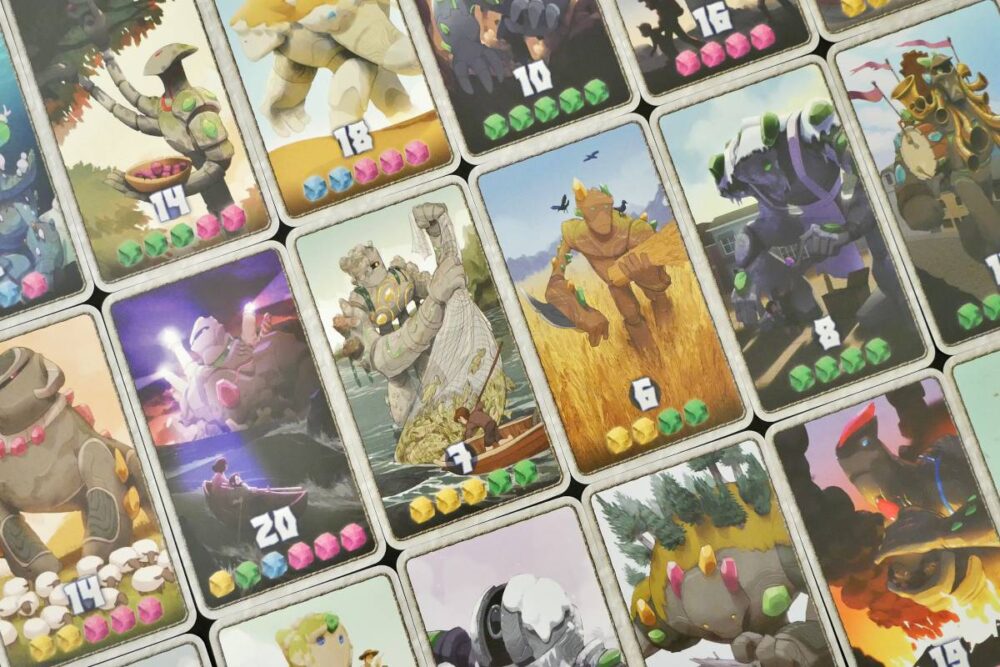
The artwork is lush, warm, fantastical, and inviting. It's so good that I actually want to play a full-fledged RPG in this Golem world! The card art invokes a fleshed-out fantasy vibe with so many cool and unique Golem designs, from small ones prancing in fields to enormous ones towering over establishments. The theme really draws you in.
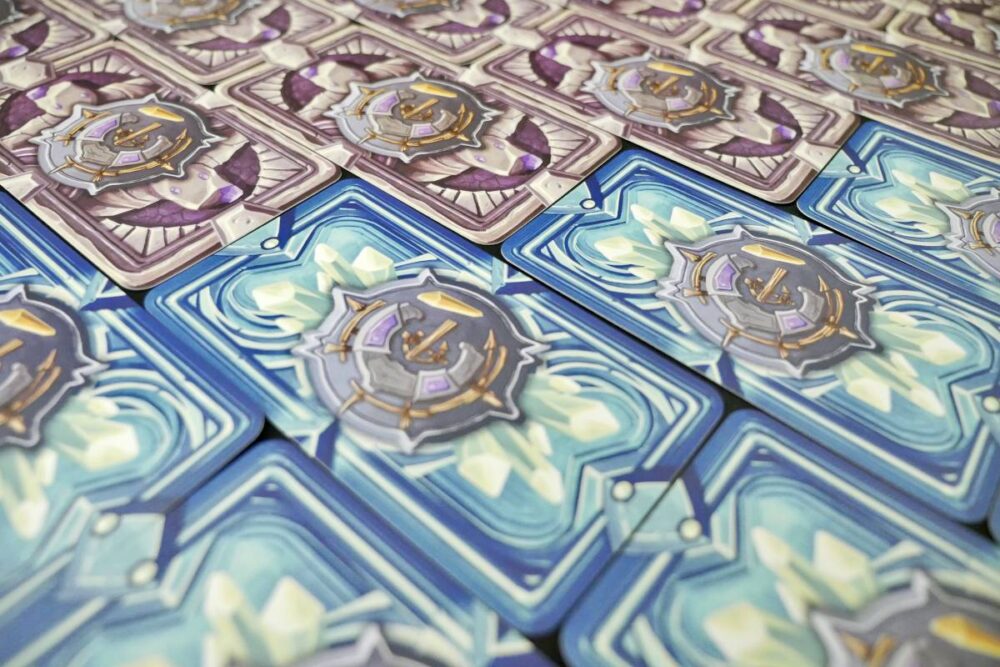
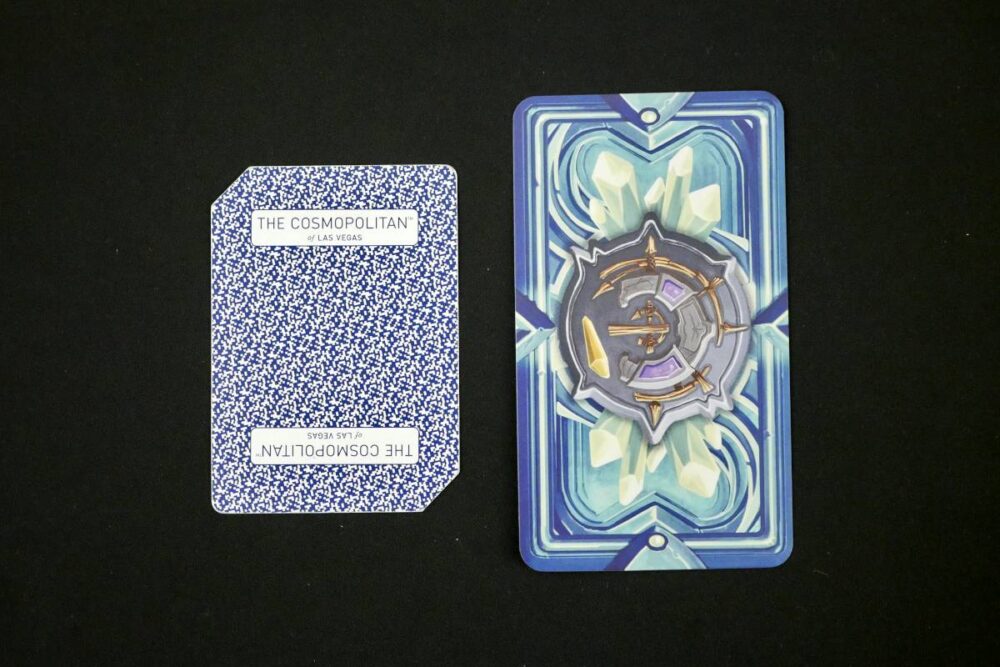
I love the larger tarot-sized cards. Now, I don't normally like tarot-sized cards in board games because they tend to take up too much space and they're harder to handle as far as shuffling and dealing. But here, it works. The size makes them easier to read and lends presence to each market. And since you aren't building a tableau of cards, the size doesn't sprawl out—you just play to a pile and recall back into your hand later. The tarot size gives Century: Golem Edition more body and substance.
The graphic design is clean and easy to read. The Golem cards are mostly artwork, with clear point values and crystal requirements along the bottom. The Merchant cards are also mostly artwork, with their crystal effects in the top-left corner. Not only is it super intuitive to figure out, but you'll never accidentally confuse one type of card for the other. And it's so easy to read that you can tell what a card does from across the table.
The crystals are pretty, tactile, and fun to handle. Like most of the rest of the production, these are perfectly sized: big enough to carry significance and be easy to pick up and handle, but not so big as to be distracting or wasteful. I like the irregular shape, which injects the game with much-needed tactility, and the colors are gorgeous. Century: Golem Edition would feel much flatter if these were cardboard tokens or wooden cubes; instead, these crystals glimmer with personality.
While the metal coins are stunning, they're overkill. On the one hand, metal coins are awesome. I love them. They're hefty, tactile, and substantial. It doesn't get more premium than this with tokens in board games. But the Copper/Silver Coins in Century: Golem Edition aren't important enough to get such premium treatment. There are only 10 of each and you rarely handle them—when you earn a coin, you just move it in front of you and it's never touched again. I honestly would've preferred cardboard here to shave a few bucks off the MSRP while providing a comparable experience.
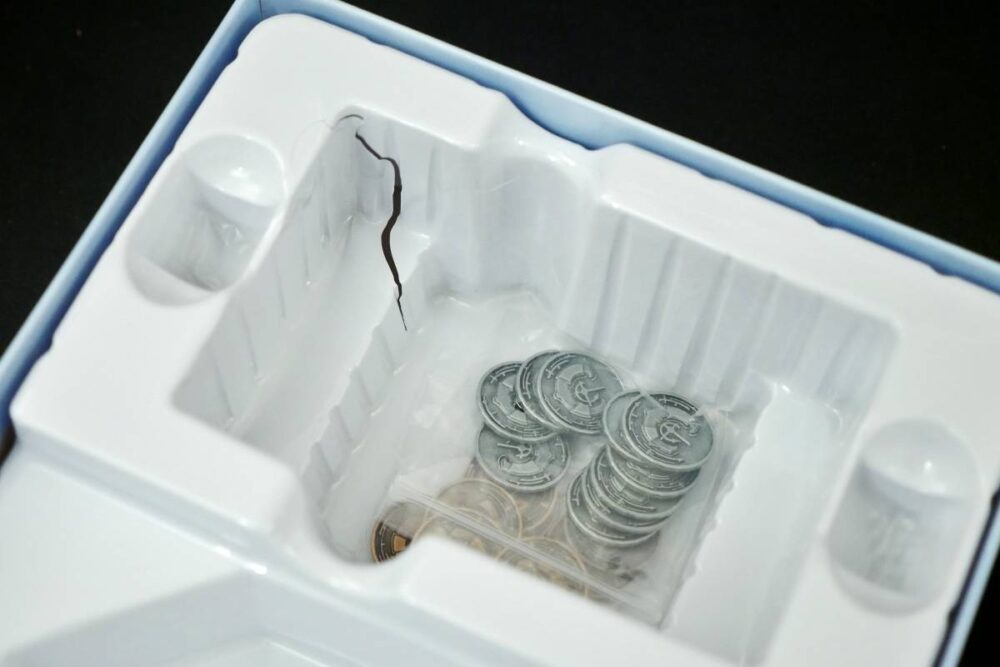
The game box comes with a good insert. There's a snug spot for the crystal trays, plus a well for all the cards. The crystal trays speed up setup and they come with a nice lid, plus the cards are held stable and they're easy to take out of the well. I can appreciate that. My one complaint is that the plastic for the insert is really fragile, so much so that mine cracked in two places during shipping. I also wish the box was smaller, but at least it isn't too big.
The plastic insert is so thin, it cracked during shipping despite no box damage.
The Bottom Line
Century: Golem Edition is a good game. It's an excellent introduction to the engine building genre, and the above-average production is sure to make you feel good while playing. But it's a bit too pure, too streamlined—it lacks the oomph that would keep me coming back. It's enjoyable enough while playing, but unremarkable and forgettable otherwise.