
My least favorite part about reviewing board games is giving a negative review to a game that I highly anticipated and wanted to love. Such is the case with A Place for All My Books.
As an introvert myself, I really resonate with the theme: stay at home, enjoy your hobbies, muster up enough "social battery" to head out into public when necessary, then head back home. I'm not a huge book reader, but that's fine—the heart of the theme still speaks to me.
But as a game, A Place for All My Books is a big letdown. Thinking about getting a copy? Here's everything you need to know about how it plays, why it falls short for me, and whether you might like it yourself.
This review is based on a review copy of A Place for All My Books provided by Smirk & Dagger Games, but my thoughts and opinions are my own.
Overview
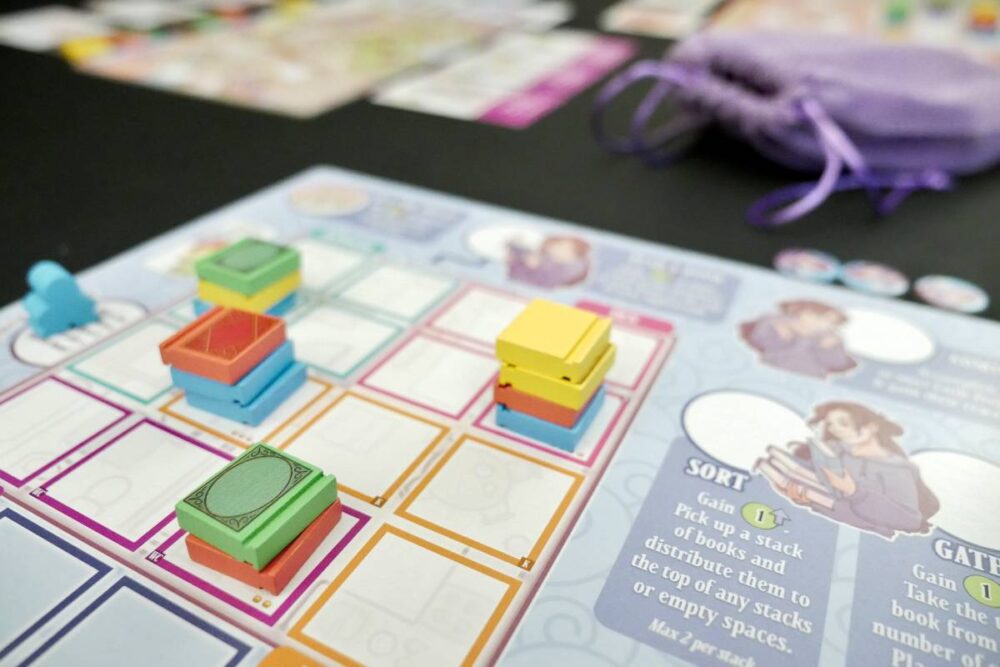
A Place for All My Books has you playing the role of a stereotypical introvert who's in love with books—not just reading them, but collecting and organizing them throughout your home. Of course, you'll have to leave home and visit town to acquire more books... which you can only do once you've built up enough "social battery." Ah, the plight of the introvert.
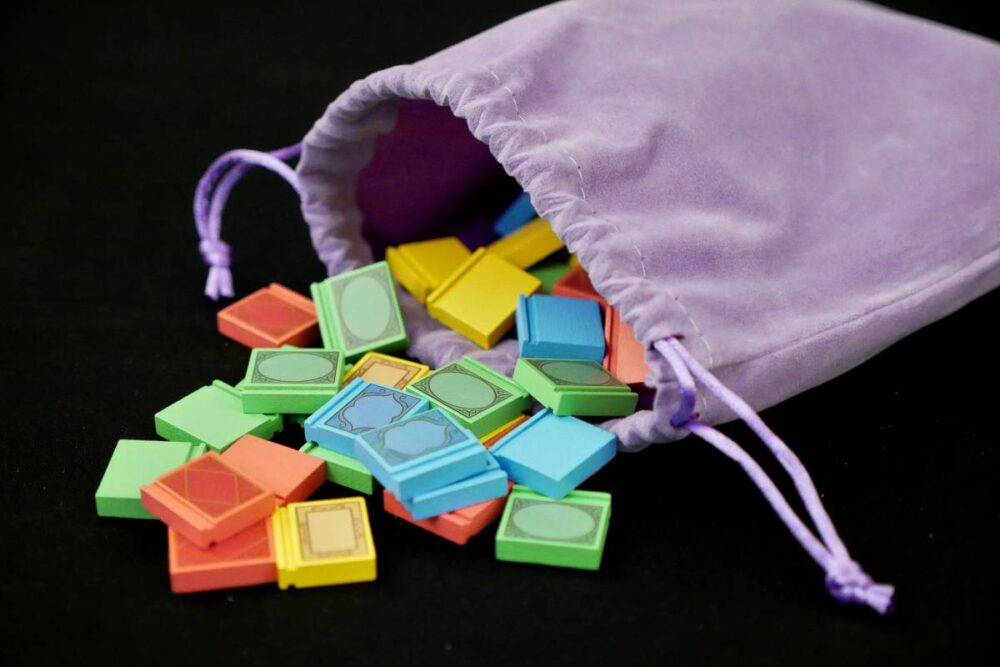
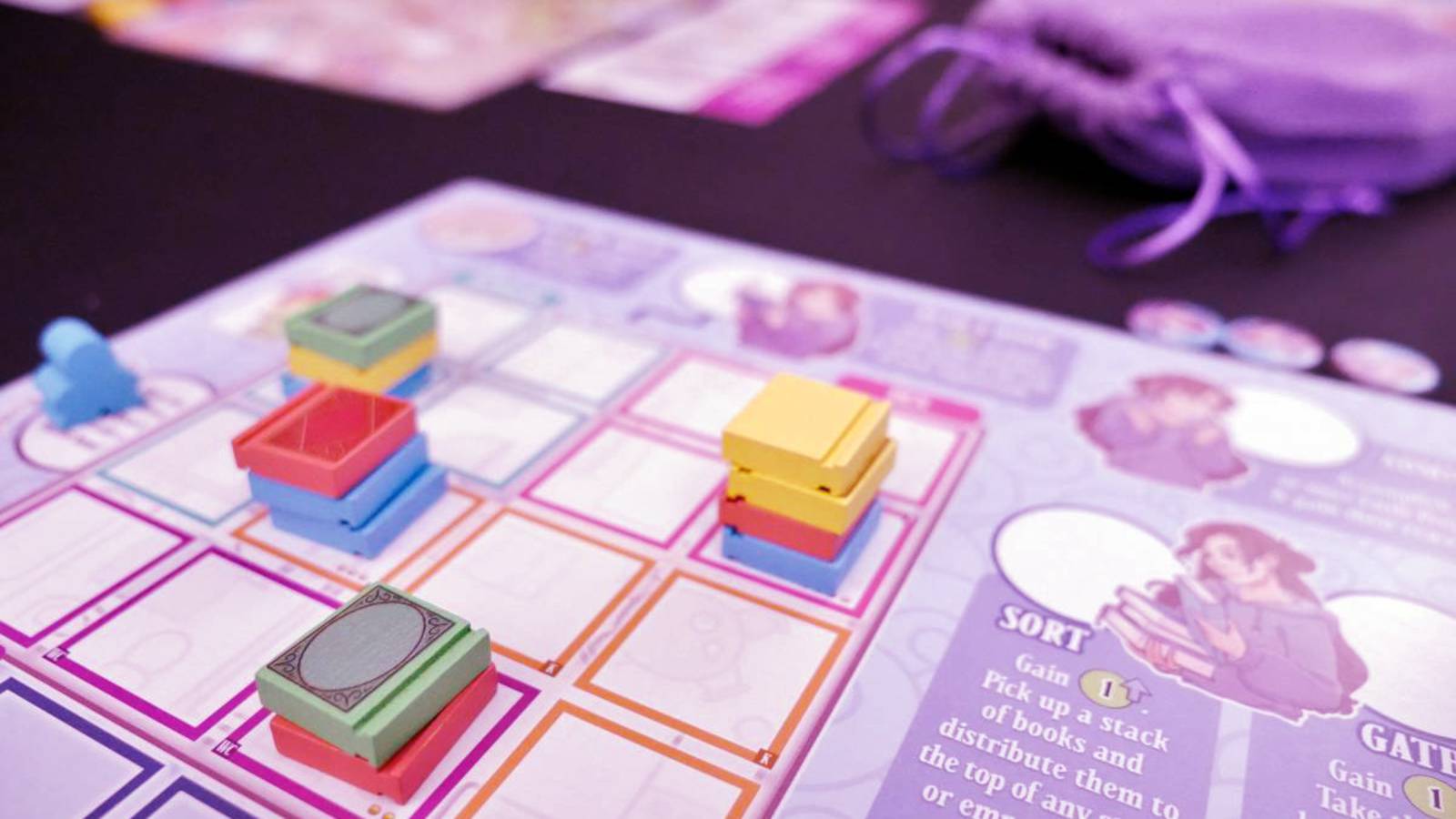
In A Place for All My Books, small plastic Books are the main pieces you'll be dealing with, which are kept in a bag and drawn at different points of the game. There are 32 in each of the four main colors: Green, Blue, Red, Yellow. There are also 2 Wild Books, which can be any color.
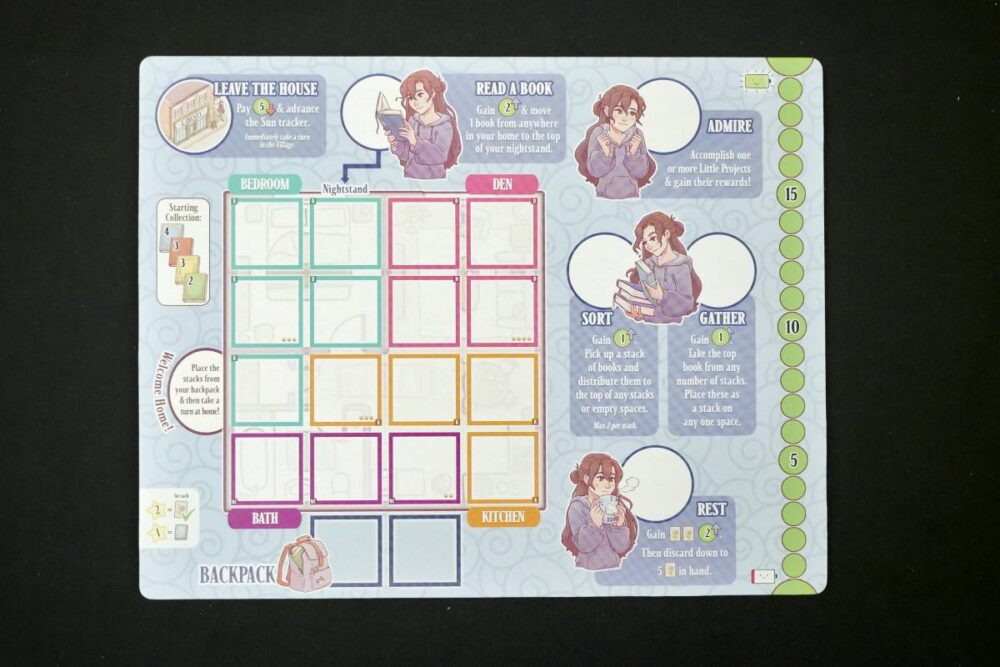
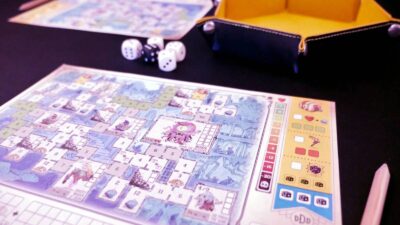
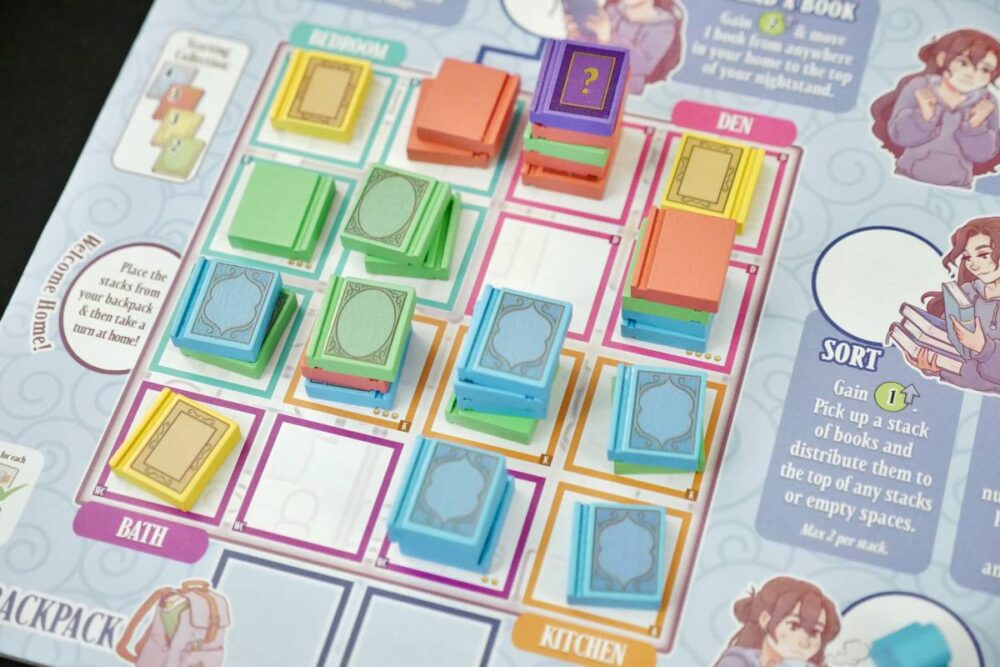
Much of the game takes place in your own personal Apartment Board, which is a 4x4 grid of spots for your Books. That grid is split into 4 sections: Bedroom, Den, Bath, and Kitchen.
Books are stacked and unstacked upon each other throughout your Apartment, and the core gameplay of A Place for All My Books involves moving your Books around between the grid spaces to create different stacks that fulfill various personal objectives.
A stack of Books can never exceed 6 Books!
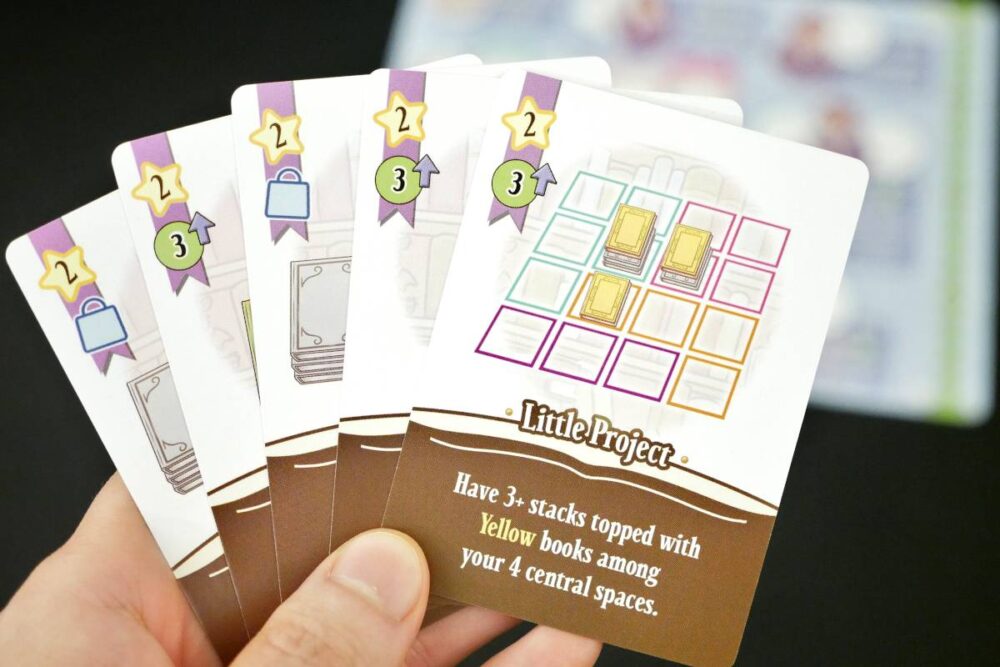
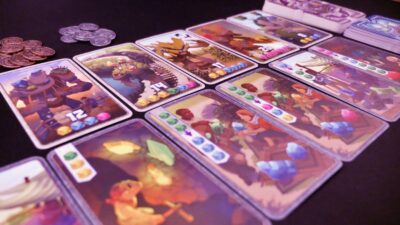
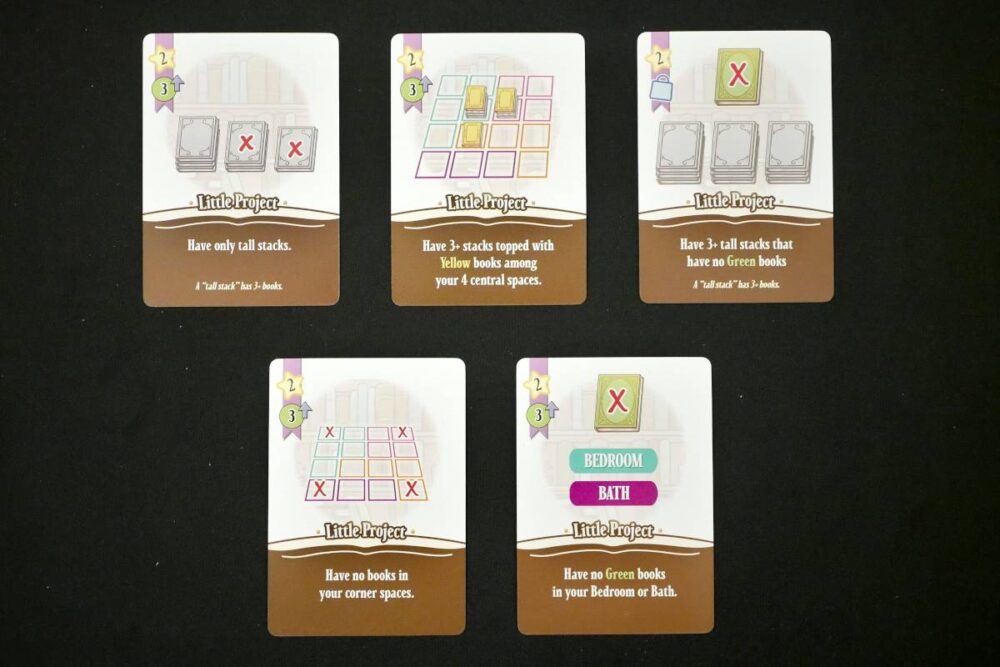
Those personal objectives come in the form of Little Project cards, which you hold privately in your hand (up to a limit of 5 at a time). Completing Little Projects is one way to earn points, and they also grant other bonuses depending on the specific card you complete.
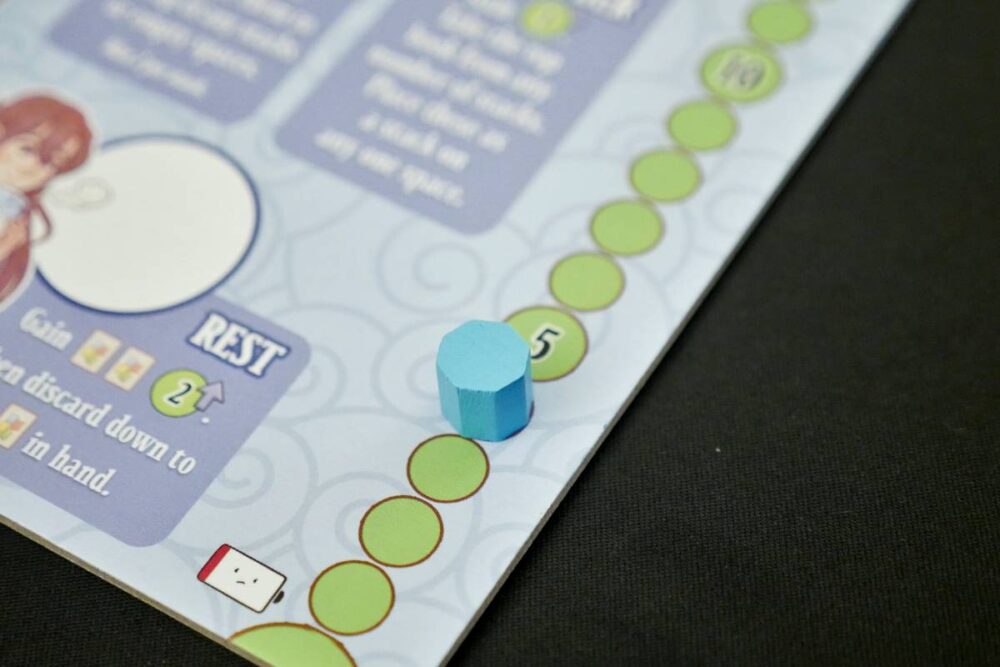
While organizing Books in your Apartment and completing Little Projects, you gradually gain Social Battery. You'll need Social Battery when you head into town for other things (mainly to acquire more Books).
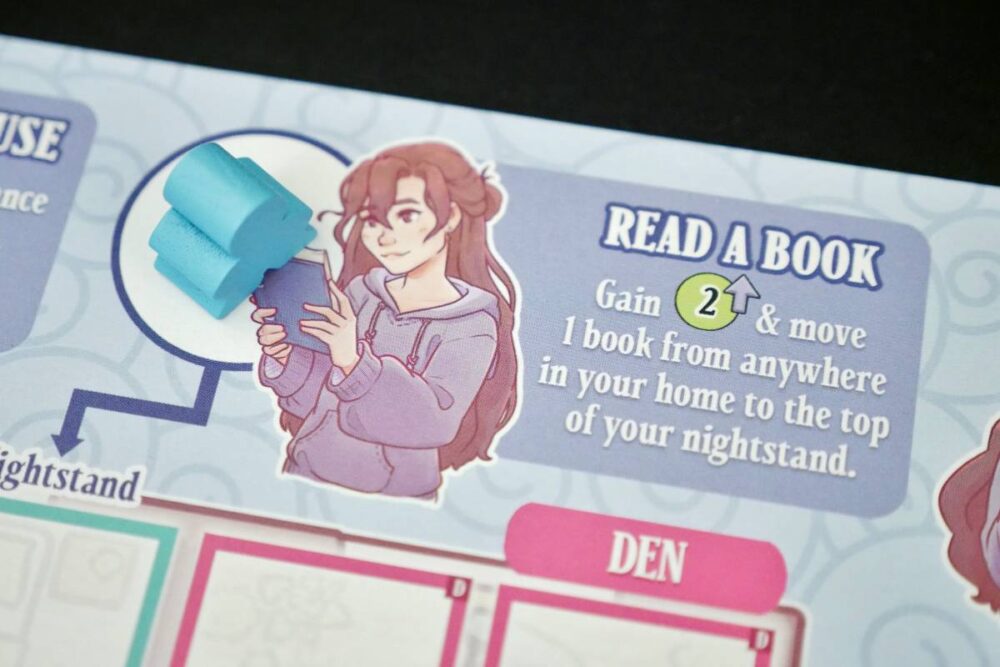
To take actions, you have a worker meeple. Your Apartment Board has worker spots for your worker, where each worker spot is a certain action you can take. Every turn, you must move your worker to one of the other worker spots in your Apartment, no repeats allowed.
Here's a quick overview of the worker actions:
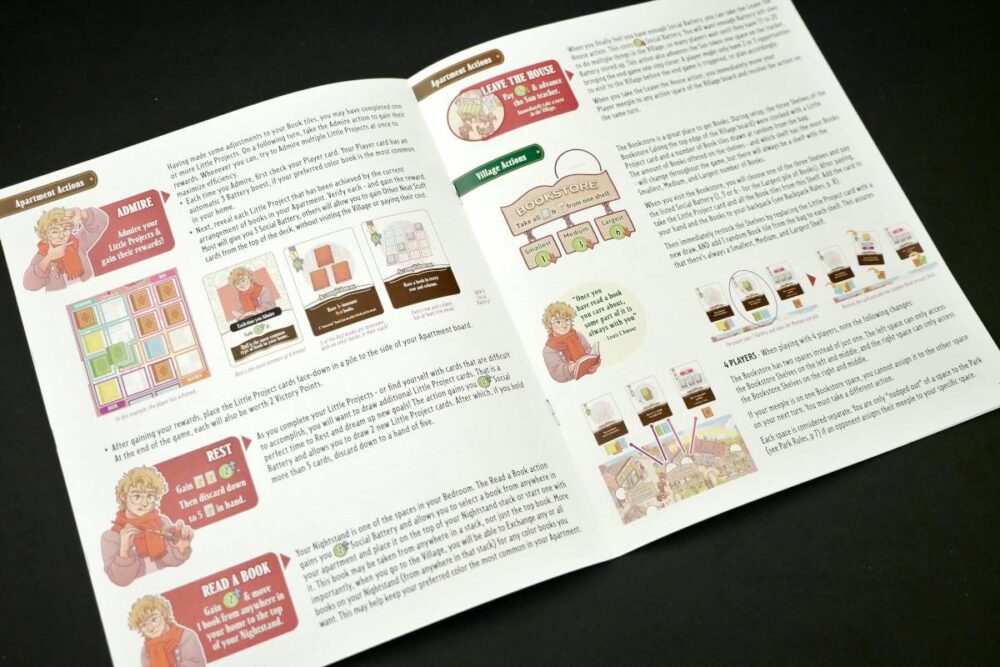
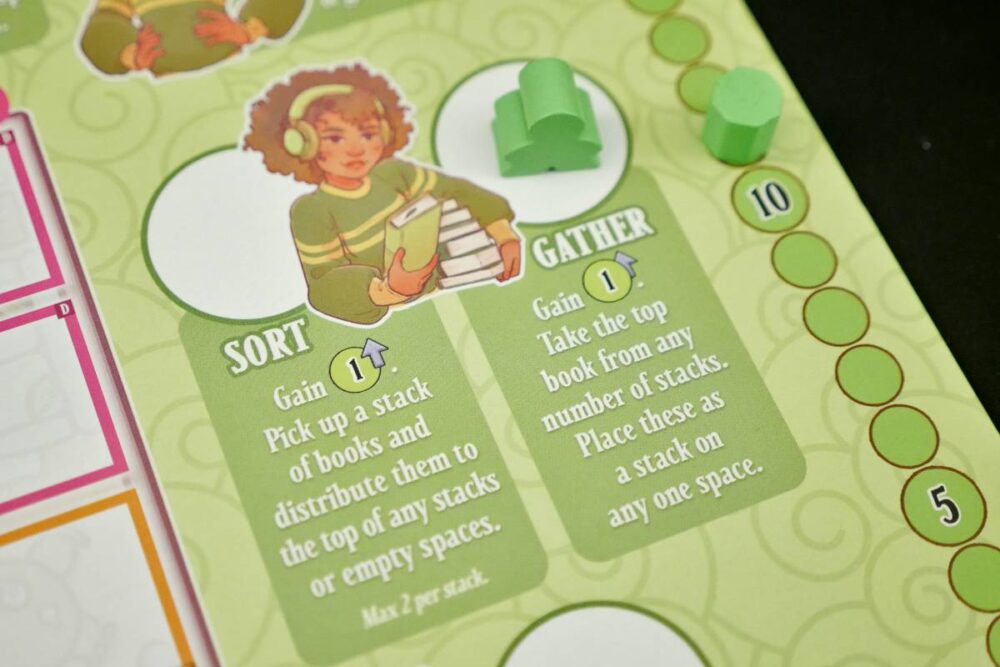
- Gather: Gain 1 Social Battery. Take the top Book from up to 6 different stacks, then place them all as a new stack on any Apartment space. You can place the newly gathered stack on an existing stack as long as the final height doesn't exceed 6 Books.
- Sort: Gain 1 Social Battery. Pick up one entire Book stack, then place each Book from that stack—one by one—to the tops of any Apartment spaces (can be occupied or empty). No more than 2 Books can be distributed to any given Apartment space.
- Admire: Complete as many Little Project cards in your hand as you can, given the current layout of Books in your Apartment. Gain the rewards on each completed Little Project card.
- Rest: Gain 2 Social Battery. Draw 2 more Little Project cards into your hand, then discard down to a maximum of 5.
- Read a Book: Gain 2 Social Battery. Take a Book from anywhere in your Apartment, then place it on top of the Nightstand space in your Apartment. If a stack is already there, place it on top of the stack.
- Leave the House: Pay 5 Social Battery, then leave the house and immediately take another turn in town. (More on this below.)
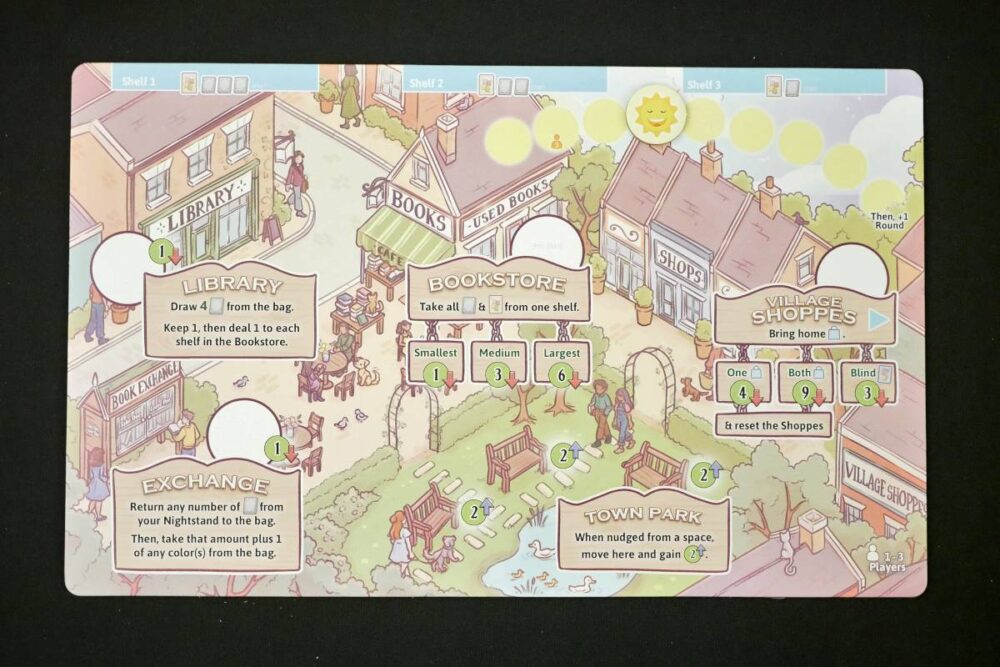
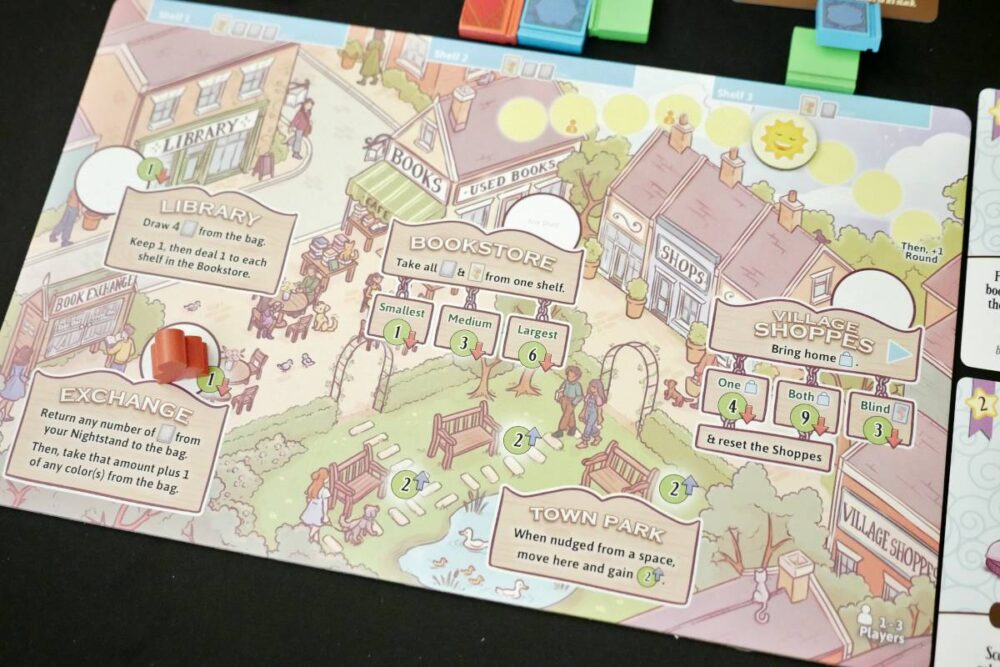
When you leave the house, your worker meeple moves from your personal Apartment Board to the shared Village Board. When you visit town, there's a Sun Track on the Village Board that moves forward by one. (This will be the end game trigger.) And the Village Board has its own set of worker spots and associated actions:
- Bookstore: Buy one of the three Little Project cards in the Bookstore display plus all the Books on that card, paying Social Battery depending on the relative number of Books: 1 for the smallest pile, 3 for the medium pile, and 6 for the largest pile. Restock another Little Project in the display, then add 1 random Book from the bag to each Little Project.
- Library: Pay 1 Social Battery to draw 4 random Books from the bag. Select 1 to keep (which gets added to your Backpack), then add 1 to each of the Little Projects in the Bookstore display.
- Village Shoppes: Pay Social Battery to buy the Neat Stuff cards on display: 4 to buy one, 9 to buy both, or 3 to buy the top card from the deck (unseen). Neat Stuff cards provide points and special abilities.
- Exchange: Pay 1 Social Battery to return any number of Books from the Nightstand space in your Apartment, then draw an equal-amount-plus-one Books from the bag to your Backpack. You get to choose the color of each Book drawn this way.
- Town Park: Whenever someone moves their worker to a Village location spot you already occupy, you get booted to the Town Park and gain 2 Social Battery. You can't go to the Town Park willingly.
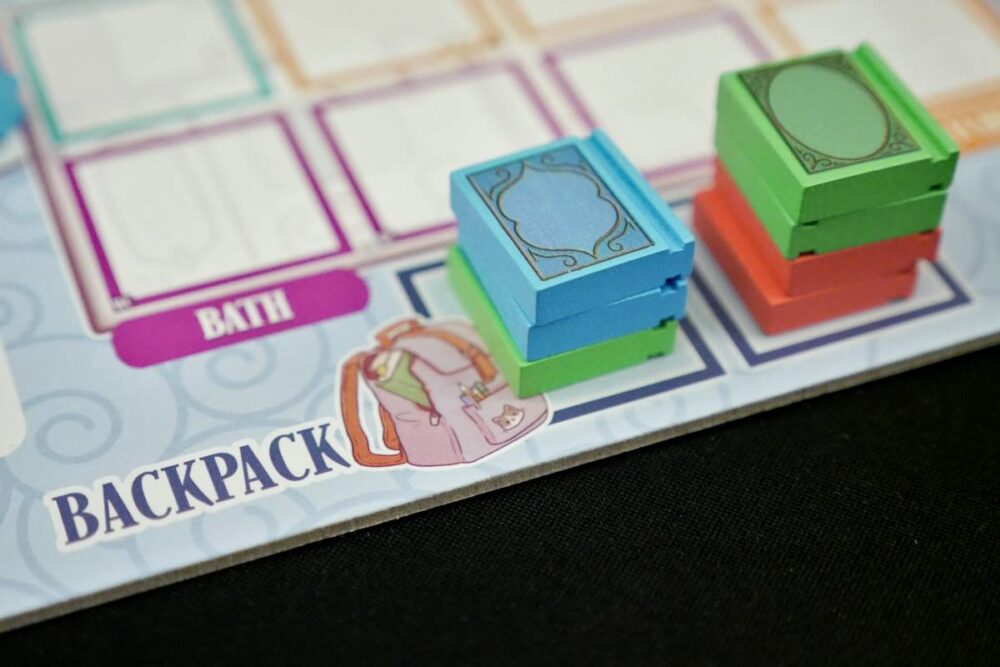
Whenever you acquire Books while in the Village, they don't go straight to your Apartment grid—instead, you add them to one of the two Backpack spaces on your Apartment Board. When adding a Book to your Backpack, it can go onto either space, but it can't be moved once it's been placed. Later Books must be placed on top of your existing Backpack stacks.
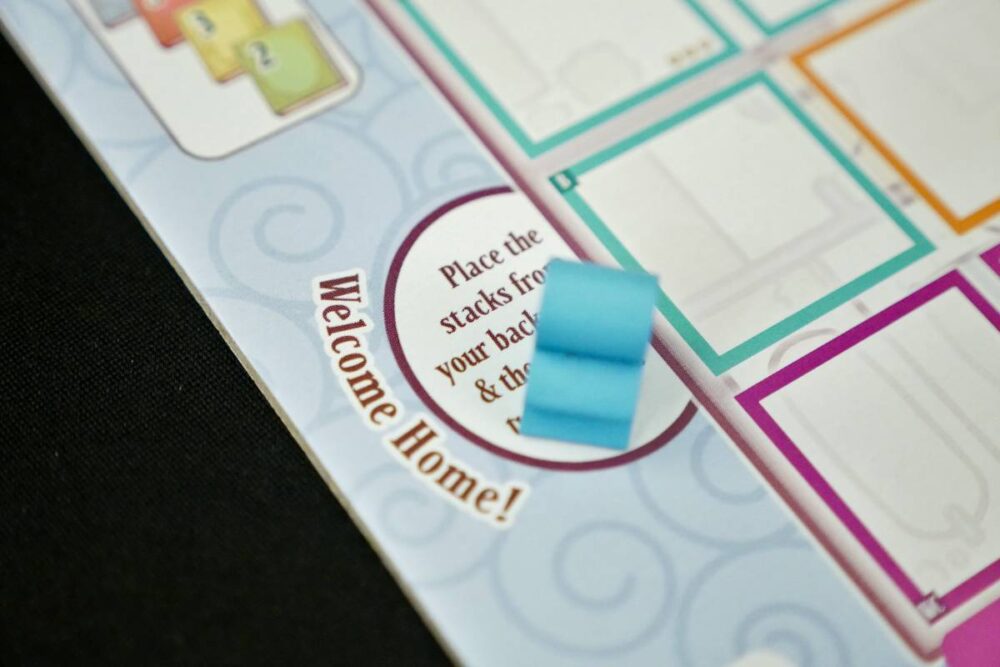
When you want to leave town and go back home, you can move your worker back to your Apartment Board on the spot labeled Welcome Home. Doing so lets you unload your Backpack into your Apartment, then you immediately get to take a "real" turn with one of the Apartment worker spots.
When unloading your Backpack, you must move each entire stack as-is to one of your Apartment spots. The spot can be empty or occupied, as long as the final stack doesn't exceed the height limit of 6 Books. You cannot divide a Backpack stack when unloading it into your Apartment.
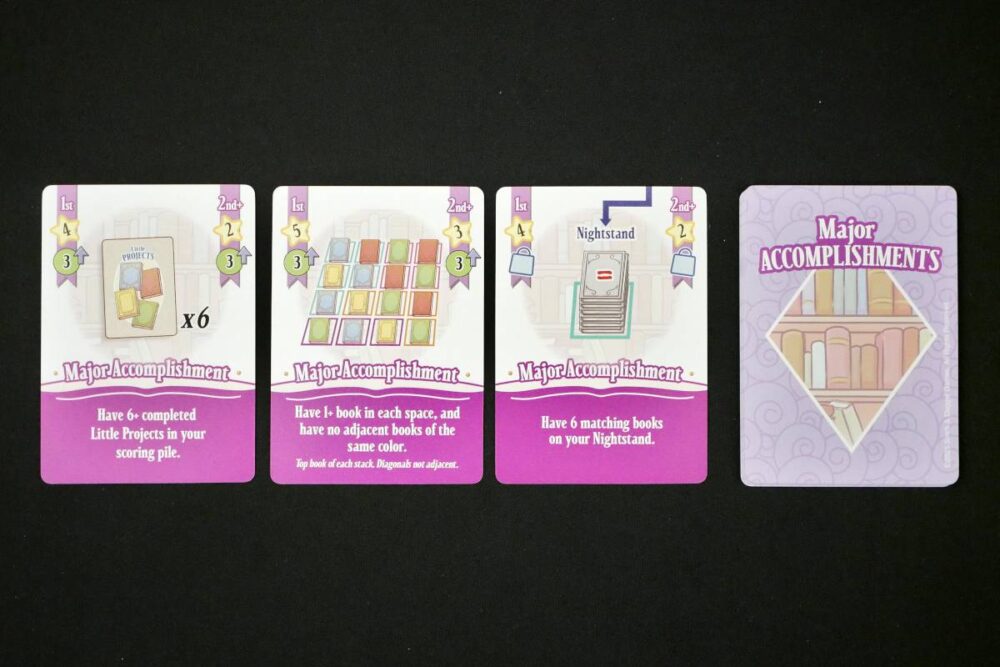
The last element to know about in A Place for All My Books are the Major Accomplishments, which are essentially public objectives for players to race each other against. These are more difficult than the Little Projects, but the rewards are also greater (i.e., more points).
Three are randomly chosen for each game, and the first player to complete one gets the bigger reward for that card. When a Major Accomplishment is completed, it's still available for others to complete, but everyone after the first finisher will get a lesser reward for it.
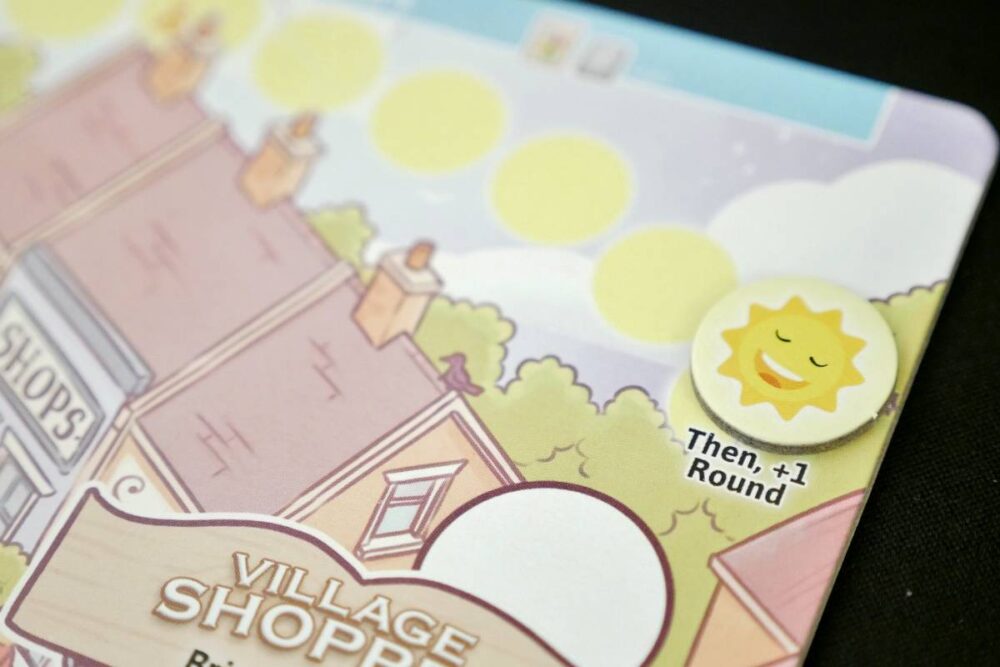
The end game is triggered when the Sun Track on the Village Board reaches the final spot, at which point the current round is played out plus one additional round. Then, add up your scores to see who wins:
- 1 point for every Book in your Apartment.
- 2 points for every completed Little Project.
- Bonus points for every Major Accomplishment.
- Bonus points for every Neat Stuff you collected.
- 1 point for every 4 Social Battery you have unspent.
Setup and Table Footprint
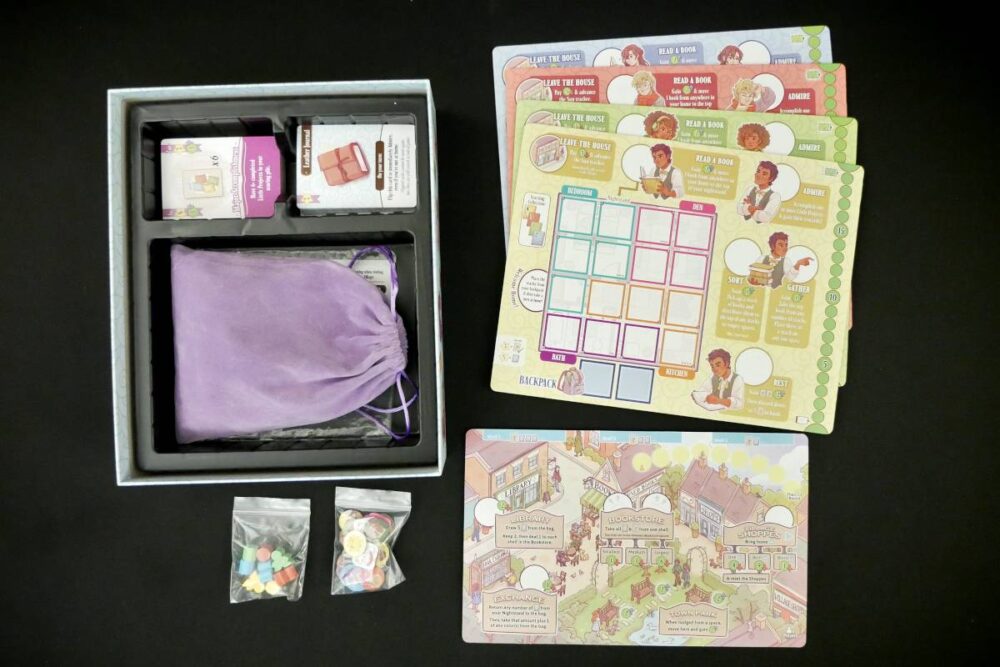
I find myself reluctant to play A Place for All My Books for several reasons, but one of them is because the setup feels laborious for what it is. Here's the gist of what the setup process is like:
- Take out the Village board and put the Sun token on the Sun Track.
- Throw all the Books into the bag and shuffle it up.
- Shuffle up the deck of Little Project cards.
- Shuffle up the deck of Neat Stuff cards.
- Shuffle up the Major Accomplishment cards and deal out 3 of them for the game. The rest go back to the box.
- After everyone chooses a color, give each player the player card of their color, plus their Apartment Board, Worker Meeple, Major Accomplishment tokens, and Social Battery token.
- From the bag, each player pulls the number and color of Books as indicated on their Apartment Board, then randomly stacks those Books in the spaces designated on their Apartment Board.
- Deal 5 Little Project cards to each player, who then choose 3 to keep and discards the rest.
- Deal 3 Little Project cards to the Bookstore display, then seed each card with 1 Book, 2 Books, and 3 Books, respectively.
- Deal 2 Neat Stuff cards to the Village Shoppes display.
- Everyone sets their Social Battery to an initial value depending on their position in turn order.
I'm exhausted just typing all that out! And I did it to give you an idea of what it takes to get this game from box to table. It's about 10 minutes, give or take, without rushing—and for me, that's a little too long given the weight and caliber of this game.
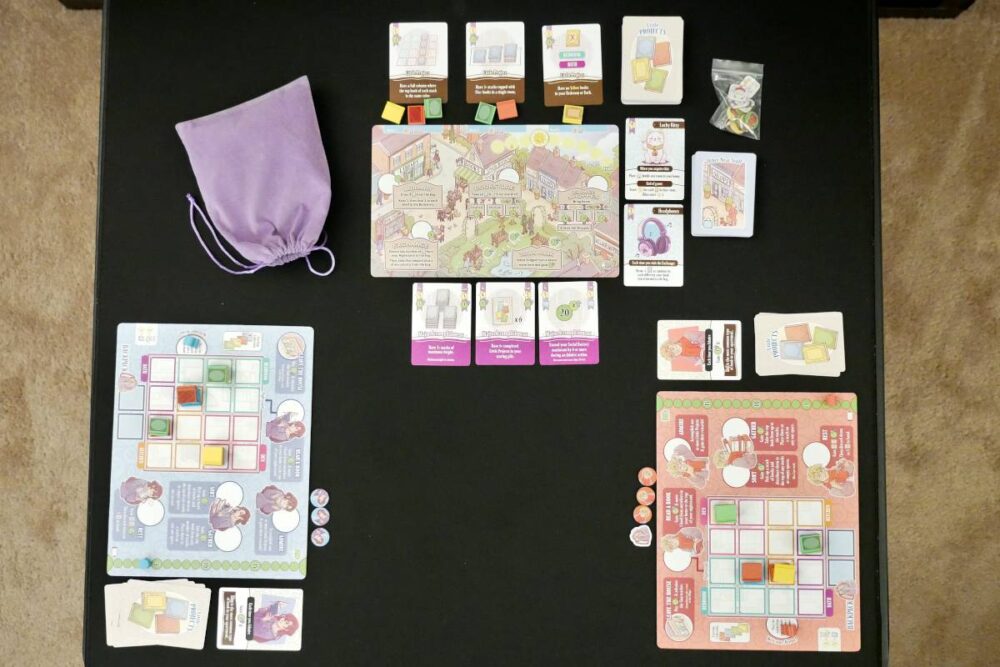
The table footprint of A Place for All My Books is also too big for my liking. While each player's personal Apartment Board is perfectly fine, the game gradually sprawls as you complete Little Projects and collect Neat Stuff cards—and you'll be completing and collecting a lot of them. Not to mention the central Village Board with its Bookstore and Shoppes displays.
Between that, the Apartment Boards, plus each player's growing tableau of cards, it all gets to be sort of unmanageable—even with just 2 players. My wife and I found ourselves running out of table space and feeling cramped on our standard 3-by-3-foot gaming surface, which is not what I was expecting. I wish it was a cleaner and tighter experience.
Learning Curve
A Place for All My Books isn't a tough game to learn, but there's plenty that can trip up a novice board gamer. Worker placement games are already on the unusual side, so I definitely wouldn't introduce this to someone as their first worker placement game. The interplay between personal Apartment Board and shared Village Board could be a stumbling block.
But it's more than just that. The spatial puzzle (of organizing Books in the Apartment grid) isn't intuitive, as you have to figure out how to use the various worker spots to get done what you want to get done. Then there's the Social Battery management. Then you have Neat Stuff cards with all kinds of abilities that are all over the place, with some even introducing their own tokens and extra mechanisms.
When you step back, you'll see that there's actually a lot more going on in A Place for All My Books than the "cozy" box art would suggest. You'll have to teach a good amount before you can start playing, and a gamer who hasn't encountered these concepts before will likely struggle.
A Place for All My Books is clearly a gamer's game, meant for people who are firmly entrenched in the hobby. I'd say it's adequately "cozy" for someone who's already comfortable playing complex strategy games, but I would not suggest playing this with novice or casual gamers.
Game Experience
Decision Space
A Place for All My Books is first and foremost an action efficiency optimization puzzle. There are layers to this:
- Get your Books organized in as few actions as you can.
- Organize your Books in a way that fulfills as many Little Projects as you can, so you can complete them all in one go. Meanwhile, try to achieve the Major Accomplishments before others do.
- Time your Admire action to net the most points every time.
- Go to the Village when your Social Battery is near max. Don't hang around in the Apartment, wasting your valuable energy.
- In the Village, spend your Social Battery smartly to net yourself the best haul of Books and Neat Stuff you can get.
As you can see, the spatial puzzle of arranging Books in your Apartment grid is only a small part of your overall strategy. The main thing is making sure you're choosing your actions in the right order and netting as much as you can with every action you take.
Unfortunately, there isn't much to think about. When you're in your Apartment, the "right" actions are pretty obvious. Your Little Project cards dictate where your Books go, and you just alternate between Sort and Gather to get them where they need to be, with the occasional Read a Book mixed in. Admire when you're ready, Rest when you need more Little Projects, and Leave when your Social Battery is full.
In other words, you don't have much room for creative strategy or deviation. And since your Book goals are determined by your Little Project cards, you don't have much control over your destiny—you just have to lean into whatever cards you get. (See "Luck Factor" below.)
All in all, A Place for All My Books lacks interesting choices and mostly plays itself. The decision space is too small and shallow for the amount of moving parts, and the juice isn't worth the squeeze. (The silver lining to that is, at least it isn't prone to analysis paralysis.)
Luck Factor
There's too much randomness in A Place for All My Books for me.
For starters, the Little Project cards. You start with a random hand, then randomly draw more every time you Rest. Sometimes you get an entire set that meshes well together, making it easy to complete most of them with a single Admire. Sometimes you get cards that don't work together or even clash with opposing needs, forcing you to waste turns drawing more and hoping for ones that synergize better. Luck can swing big for you.
Same goes for the Neat Stuff cards. Some are outright better than others, and since you're mainly gaining these cards through blind draws (see "Fun Factor" below), you have to luck into the good ones. And even though most Neat Stuff cards are uninteresting, you might get one that synergizes well at the right time to give you a big point boost.
The randomness of Book tiles is less of an issue. Whether you're drawing blind from the bag (via Library) or buying them seen (via Bookstore), you can usually make do with what you get. And if you use the Exchange, you even get to pick the exact color Books you want. The bag-pulling aspect seems to be the least random—funny but true!
Fun Factor
My biggest takeaway from my A Place for All My Books sessions is that the game is underbaked and disjointed. It needed more time in the oven to streamline its mechanisms, blend into a more cohesive whole, and refine the fun. As-is, the game fell flat for me.
The chief offense has to be the card designs, which are boring and uninspired. The Little Projects and Major Achievements lack interest, but I can excuse that. What I can't excuse are the special abilities on Neat Stuff cards, of which there are many... and yet they're all boring. I've never drawn a Neat Stuff card and been excited by what I got. Most of the time, I shrug and set it aside and promptly forget about it.
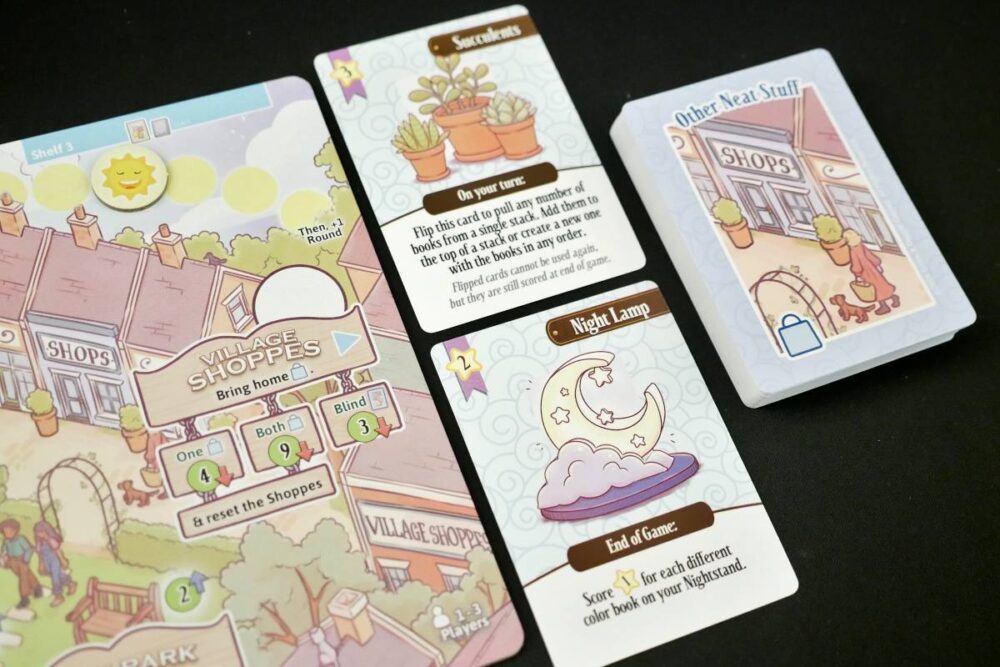
Nothing proves my point better than the Village Shoppes spot, where the display of Neat Stuff cards so often stagnates because nobody wants to buy them. They're only good for their points, so you might as well gain Neat Stuff via blind draws and completed Little Projects. The whole Village Shoppes display is so underwhelming.
The spatial puzzle also isn't very fun. The only real challenge with Little Projects is acquiring the Books you need to complete them. Once you have the Books you need, getting them into their proper spaces is easy... but repetitive. (See "Pacing" below.) Eventually, you're swimming in so many Books that Little Projects become solvable in your sleep.
And it doesn't help that the whole experience is insular and quiet. With zero player interaction, there's no reason to care about what anyone else is doing. (See "Player Interaction" below.) Yet turns are snappy so you have no space to banter or chat. You're just thinking about your own stuff, with few—if any—moments of tension. That'd be perfectly fine if the gameplay was compelling, but here it's a deathblow.
Pacing
Across my plays of A Place for All My Books, I noticed a weird tension in two directions: in one sense, this game feels too short and you don't actually accomplish a lot, but in another sense, it outstays its welcome.
Most actions are so small, there isn't much of an impact from turn to turn. Those small actions do add up to something bigger—especially when you Admire and score a bunch of Little Projects—but when you're in the thick of it, it's all just... repetitive. Constantly bouncing between the same two or three actions to move Books around gets old pretty fast. I consistently find myself wishing it was over by the halfway point.
On the plus side, small actions mean fast turns. That would be a good thing, if only the game itself had an interesting game arc. Sadly, it doesn't. You might acquire more Books and Neat Stuff along the way, but turn 1 and turn 15 and turn 30 all feel remarkably similar. It's flat from start to finish, capped off with an anticlimactic Sun Track ending.
And I'd be remiss if I didn't mention the wonky design that emphasizes Book organization in your Apartment as the core gameplay loop, yet rewards you the most points when you're in the Village. You can stay in your Apartment indefinitely, moving books around and scoring an endless source of Little Projects. (And why wouldn't you? That's what the game is about, after all.) If everyone does that, the game will drag forever... so the game entices you to go to the Village by putting all the points there.
It just rubs me the wrong way that 1) the game could potentially never end if no one ever goes to the Village and 2) the best way to score points is to do something that isn't the core gameplay.
Player Interaction
There's close to zero player interaction in A Place for All My Books. I don't say that as a negative, but it's important to note because you might come into this thinking it'll have significant interaction with the whole "shared Village Board" part of its design. It doesn't.
No surprise that you're completely on your own with your personal Apartment Board, as no one can even come in. But the shared Village Board sees surprisingly little interaction because you might not even be in the Village at the same time as anyone else. And even when you are, you may not want the same spots at the same time.
Plus, when interaction happens, it's trivial. Unlike almost every worker placement game out there, A Place for All My Books has no blocking. You can always go to an occupied spot—you simply bump off whoever's there and they gain 2 Social Battery for the trouble. The rulebook makes it seem like a big deal, as if you'll seriously have to consider whether it's worth giving someone the bonus to bump them off... but no. If you need the spot, you just do it. I've never thought twice about it.
You spend 80% of the game alone in your Apartment, then 20% in the Village where interactions are rare, and the interactions that do occur aren't even blips on your radar. If you like multiplayer solitaire, you'll fit right in with A Place for All My Books; if you want interaction, look elsewhere.
Player Counts
Don't play A Place for All My Books with 4 players. The biggest problem is the Sun Track, which only has 2 trips per player. By comparison, the 2-player/3-player Sun Track has 2 trips per player + 1 additional trip. That one extra trip may not seem like a big deal, but it is. Without it, the last player to take their second trip into the Village will trigger the end of game and be unable to do anything of value. It's a significant disadvantage.
As for the other player counts... If you want more interaction, the 3-player game is ideal to maximize the likelihood of being in the Village at the same time as another. If you want zero downtime and a more puzzly experience, play solo. (See "Solo Mode" for more.) In fact, for those reasons, I'd say A Place for All My Books is best played solo.
Fiddliness
One thing I don't like about A Place for All My Books is how messy and fiddly it can get. There's a lot of stuff strewn about, from your Little Projects and Neat Stuff, to the Village displays, to the Book tiles, to the discard piles. I wish it was better organized and less of a mess.
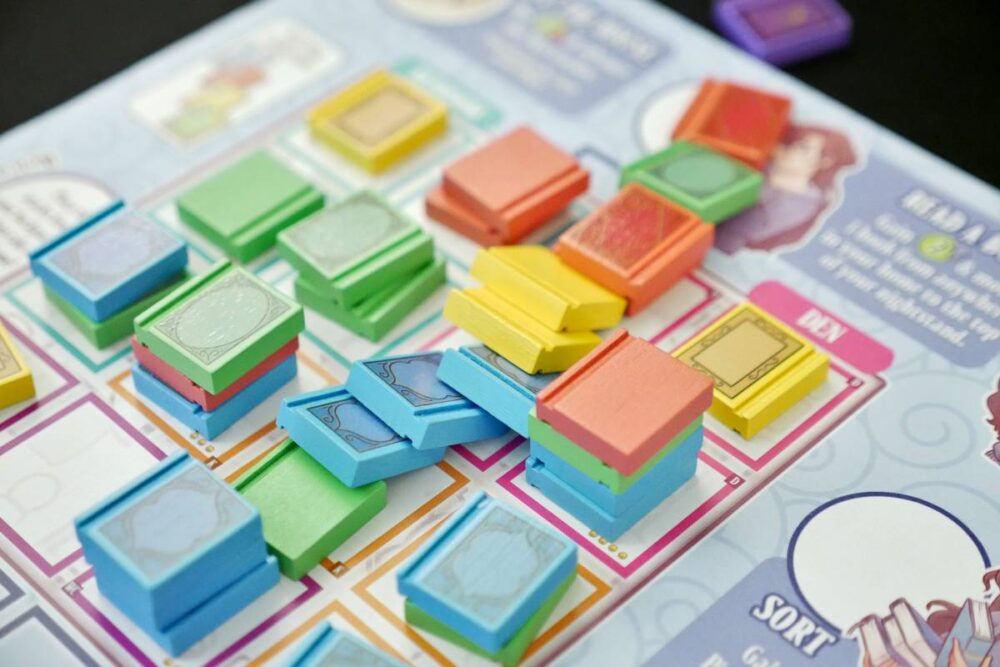
And look. I'm generally not a clumsy person, but about once or twice every game I've accidentally knocked over Book stacks. It doesn't take much to knock a stack over—the sleeve of your shirt as you're reaching towards the Village, or the drawstrings of your hoody as you lean over to examine a card, or an accidental bump of the table. And when a stack falls over, you better hope you remember where everything was!
Replayability
To me, a board game's replayability is more about how fun it is, less about variability from play to play. Unfortunately, A Place for All My Books is lacking on both fronts.
I don't want to repeat all the points I've already made, so see the above sections on "Decision Space," "Fun Factor," and "Pacing" for details on why I think A Place for All My Books delivers a flat experience. In short, the decisions are shallow, the puzzle is uninteresting, and the pacing is wonky. Not enough depth or excitement to keep me engaged through one play, let alone to keep me coming back and wanting more.
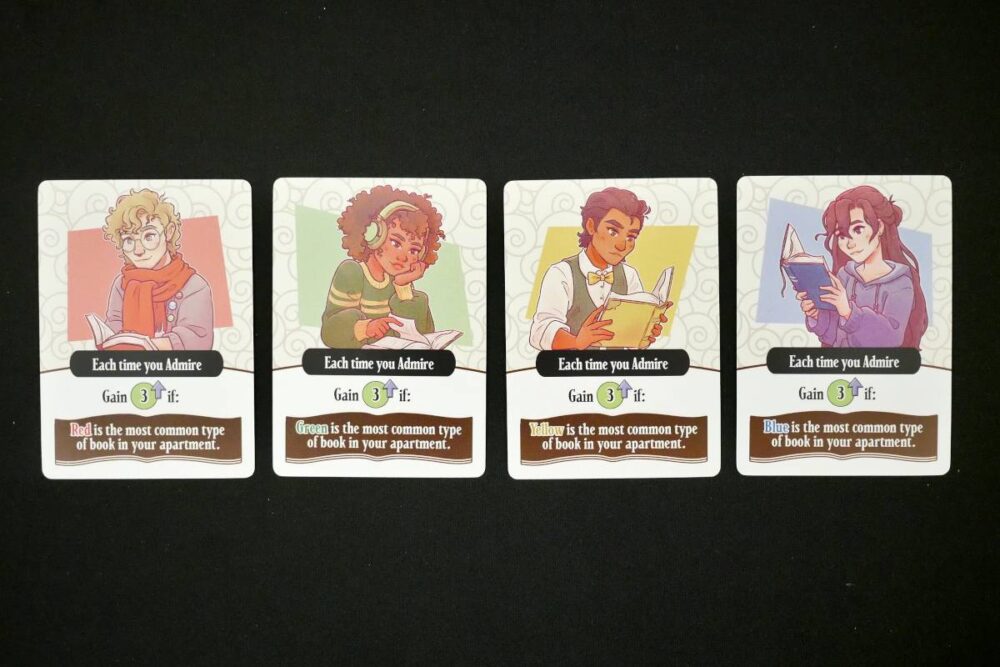
The gameplay experience isn't just samey from the first round to the last, but also from session to session. You "choose a character" at the start, but the difference between characters is negligible. You also go through most of the Little Projects deck every game, so the novelty of those cards wears off quickly. It's stale and repetitive. (The one saving grace is that the combination of Little Project cards you draw is different every time, but see "Luck Factor" for why that's a problem here.)
As I pen this, I have no desire to play A Place for All My Books again. It needed a lot more time in the oven to develop into something worthwhile, to streamline some of the bloat, to make the cards more exciting and the decisions more compelling. It's underwhelming at best.
Solo Mode
Above, I wrote that A Place for All My Books is best played solo. That's because the solo mode retains all the normal gameplay, has zero downtime, and adds an extra layer of challenge with the Penelope automa (which is quick and painless to run).
On your turn, everything is the same. The setup and turn structure are unchanged in solo mode, and your goal is the same: to collect and rearrange Books, complete Little Projects, and rack up points.
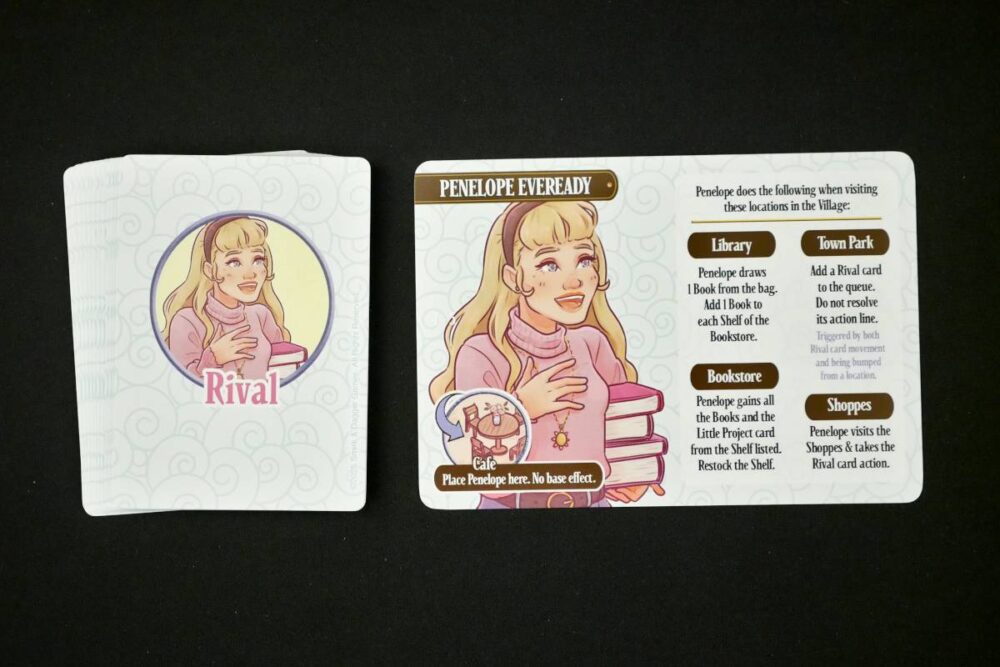
Your opponent is Penelope. Penelope is a special 14-card automa deck, with one card flipped over every time it's Penelope's turn. Every card gets added to the "Rival Queue," a timeline of all revealed Penelope cards. The size of the Rival Queue determines which action is taken on Penelope's revealed card (i.e., as more Penelope cards are revealed, the stronger her actions become). Most of the time, her actions involve moving to a spot in the Village and possibly a bonus action, too.
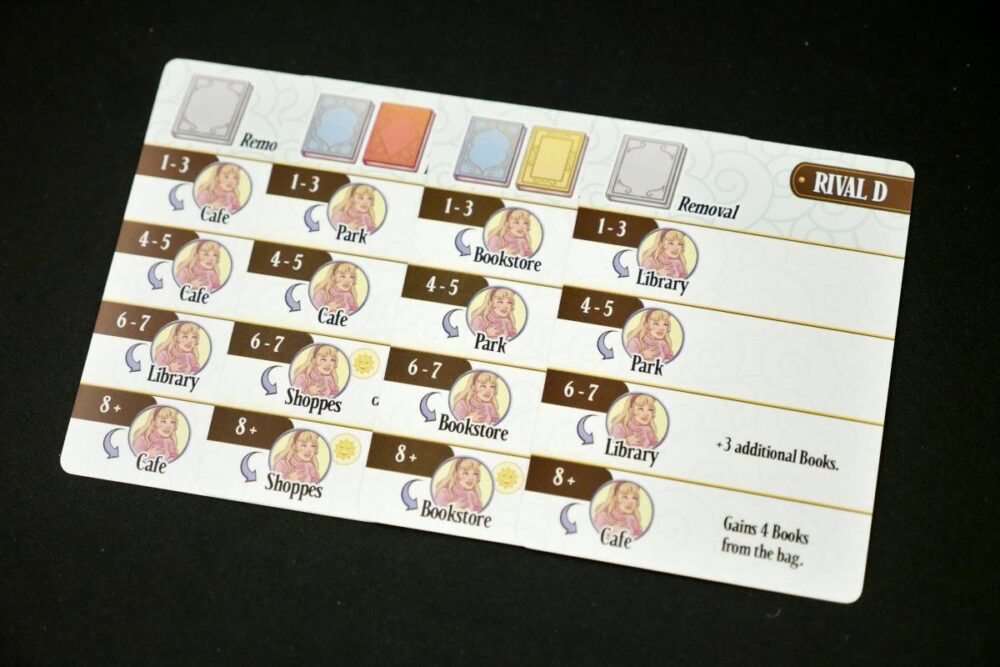
You can manipulate the Rival Queue. Whenever you complete Little Projects, you'll remove cards from the Rival Queue that match Book colors on those completed Little Projects, and those cards are recycled back into Penelope's deck. Why does this matter? If Penelope's deck ever runs out, you instantly lose. This is the extra layer of challenge in solo mode.
If you can score more points than Penelope by the time the Sun Track ends, you'll win. It's pretty difficult until you learn how to manage the Rival Queue, but once you get the hang of it, you can then adjust the difficulty between Levels 1 through 5. Solo mode takes about half an hour to play.
Production Quality
A Place for All My Books is yet another reminder that theme and art can't save a game if the underlying gameplay falls short. Which is a shame because the production on this game is pretty good for the most part.
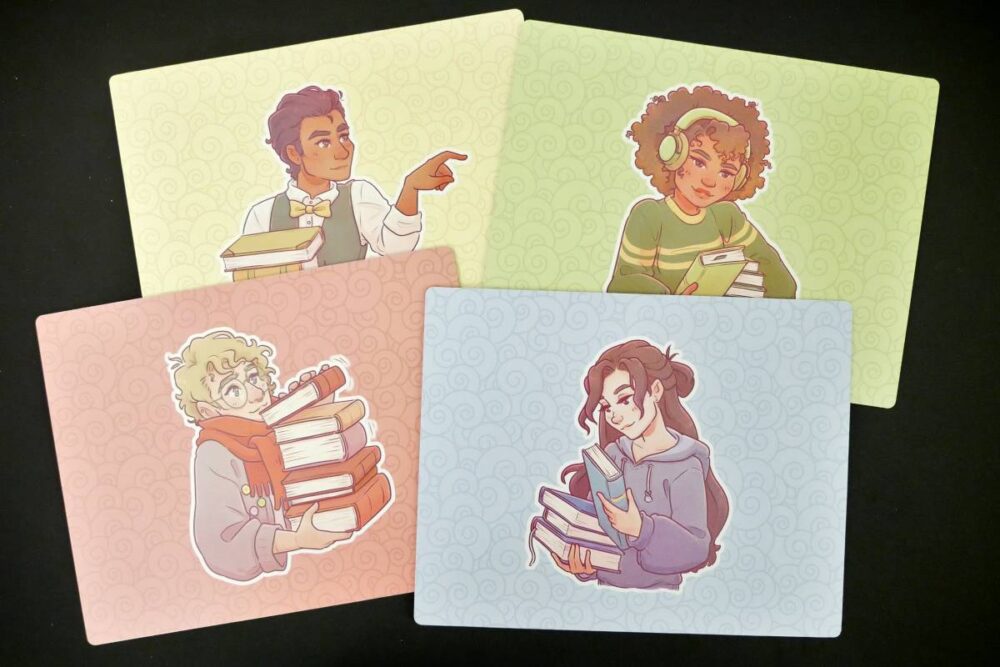
The art is pleasant, even if it isn't to my tastes. A Place for All My Books employs an art style that, from what I can tell, is increasingly popular in modern webcomics. It's flat, pastel, warm, cartoony, almost with a retro vibe but not quite. It's cozy, inviting, and accessible. It's done well, although I don't particularly care for it.

The Book tiles are chunky and tactile, though stacks can tumble. I tend to like wooden pieces and that's certainly true here. The Books aren't too special, but I appreciate that they're more detailed than simple rectangles. They're big enough to comfortably manipulate, which is important for making all those stacks. Unfortunately, they're easy to knock over once stacked up to 5 or 6... perhaps they could've been a little wider.
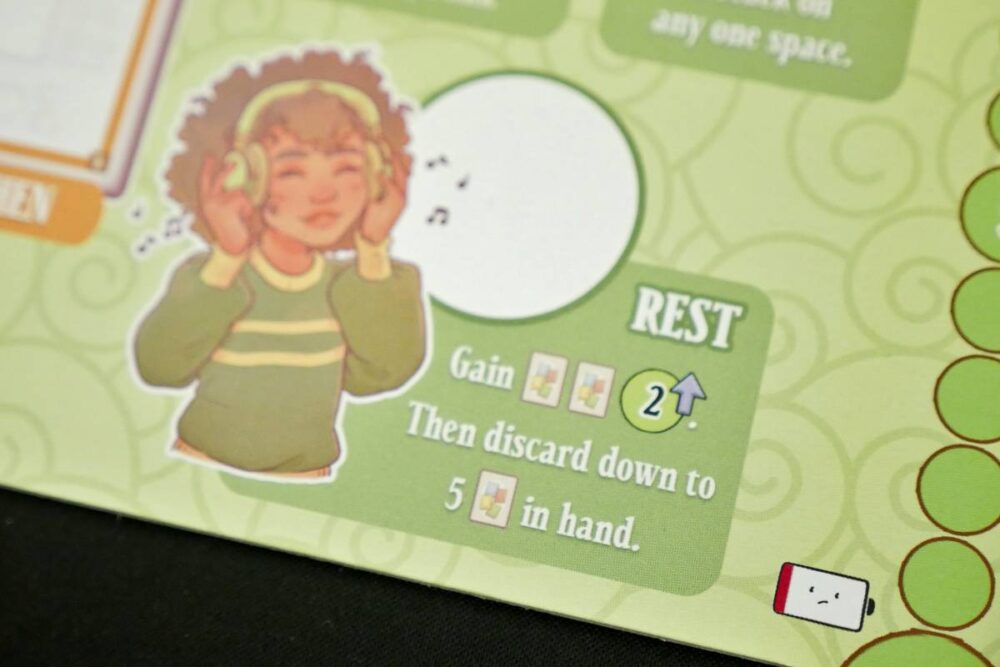
The Apartment and Village Boards are user-friendly. I'm learning that user-friendliness is one of the most important production notes for me, and A Place for All My Books nails this part. Every worker spot in the Apartment and Village has text explaining what that action does, with helpful icons where appropriate. It relieves mental load and prevents stalling.
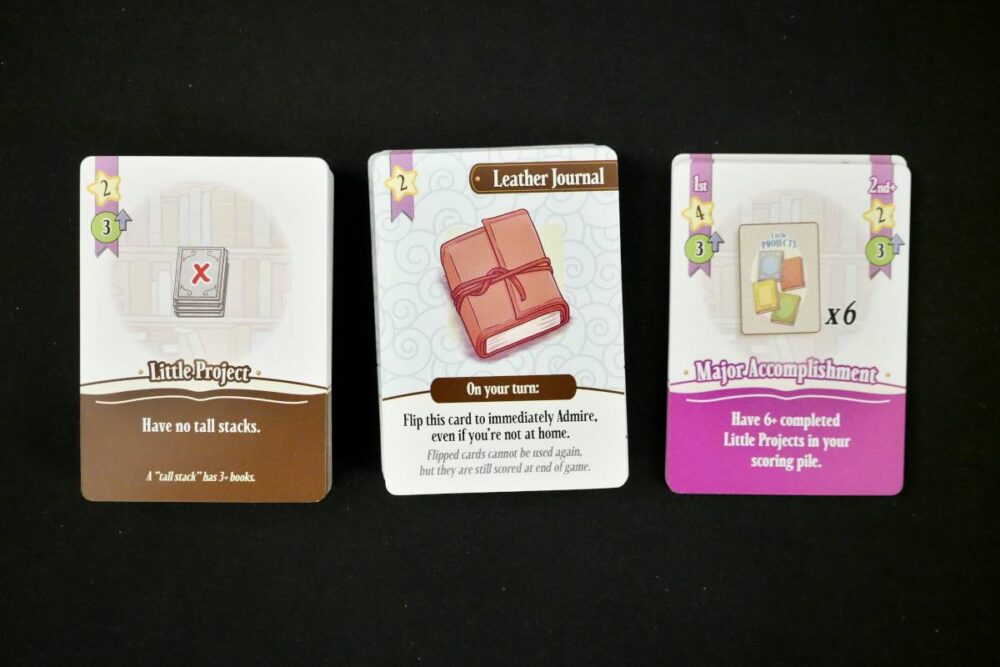
The cards are thin but the graphic design is fine. The card thinness isn't a big deal for Neat Stuff and Major Accomplishments, but it might be for the Little Projects (which you hold in hand). I could see them wearing out fast if you replay this a lot, so maybe think about sleeving them. As for the graphic design, it's like the artwork: I don't care for the style, but at least it's readable and accessible. It's clear and not cluttered.

The cloth bag feels high-quality. Cloth bags can be hit-or-miss in board games, and I'm happy to say this one is pretty dang nice. Not only do all the Books fit inside with plenty of room to spare, but the texture itself is soft and velvety. Suede-like, in a way. It almost feels like a waste because you don't actually handle the bag that often...
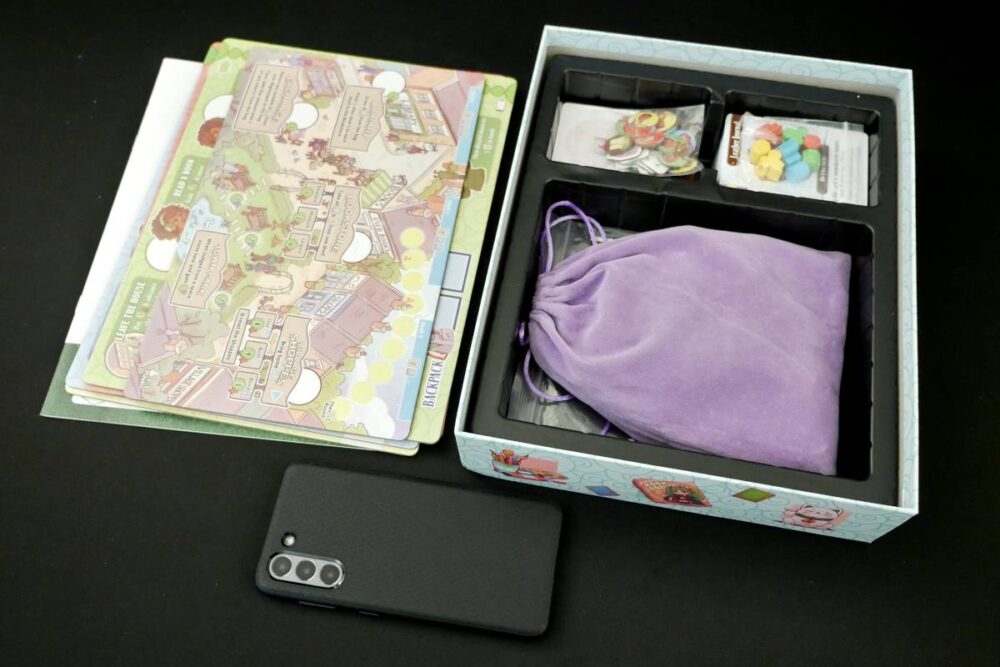
The game box and insert are satisfactory. I was surprised at the box size when I first got it, but it made sense upon opening it. The Apartment Boards are a good size (see above) and the bag of Book tiles needs room. I like the layout with the two separate wells for cards. It works well and facilitates a smooth setup (which feels otherwise laborious).
The Bottom Line
A Place for All My Books is, in a word, underbaked. It's a cool concept but tepidly executed, resulting in a limp and disjointed experience that's frankly boring. Slapping on a "cozy" label is not enough to excuse underwhelming gameplay. Unfortunately, I have no desire to play it again and I'd decline requests to play it.
Stop Buying Games
You'll Regret
Before your next game purchase, run it through this mental checklist that every seasoned gamer uses.
Free checklist, delivered instantly to your inbox.
No spam, ever. Unsubscribe in one click.